Kevjn Lim
Introduction
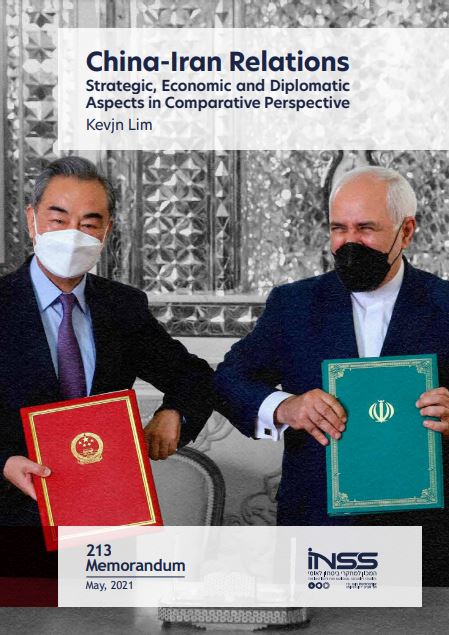
The People’s Republic of China and the Islamic Republic of Iran – and specifically the relationship between the two – pose a number of policy challenges for the State of Israel. China ranks among Israel’s leading trade partners and investors, but that relationship has created trilateral tensions involving Israel’s major power ally, the US, for whom China has become the principal strategic challenge. At the same time, Iran remains Israel’s leading nemesis and most critical national security threat, which means, at first blush at least, that what it gains from its interactions with China risks becoming Israel’s loss in the final ledger. These considerations and the questions they raise drive the research aims of the present memorandum.
Chapter 1: Strategic Considerations, Convergences, and Constraints
China and Iran’s conduct bears a number of similarities, evolving as both states have from separate revolutionary beginnings, the one in 1949, the other in 1979. There is, as a result, a certain convergence of interests. Yet, the divergences are hardly negligible, and it is these which impose constraints on the future trajectory of bilateral relations, with US policy constituting what is arguably the single most important external factor and source of interference. This chapter examines the broad strategic factors underlying bilateral relations. It begins with a survey of each partner’s core interests and areas of policy focus as they flow from, and in turn interact with, domestic conditions. The chapter then looks at the areas where bilateral interests converge and diverge. While the latter at times also necessarily assume the form of economic, diplomatic, and military interactions, these are ultimately a function of broader, strategic considerations.