by Thomas R. McCabe
July 12, 2016
http://smallwarsjournal.com/jrnl/art/apocalypse-soon-the-battle-for-dabiq
July 12, 2016
http://smallwarsjournal.com/jrnl/art/apocalypse-soon-the-battle-for-dabiq
The extremely confused land war against ISIS[1] in Syria and Iraq continues to grind on, with the current situation trending somewhat against ISIS in Iraq, less so in Syria.
The Russian intervention has bought the Assad regime at least an improved stalemate, with the Assad regime consolidating their position in their western Syrian bastion (although their hold on that may still be uncertain[2]) and regaining some ground, especially around Palmyra in the south.[3] (However, their attempt to expand toward ISIS’s Syrian ‘capital’ of Raqqa has evidently failed.[4]) While Assad has gone through the motions of negotiating there is no reason to believe he has abandoned his past announced intention to militarily crush the rebellions.[5] (This is, after all, the preferred method in the region, since the aim is not just to defeat current rebellions but to intimidate the survivors—the claim that you can’t kill your way out of an insurgency being Western thinking.) Continuing Russian-supported offensives by Assad-aligned forces, including nonSyrian Shia jihadi militias such as Lebanese Hezbollah,[6] have--at least for the moment--isolated Aleppo.[7] The Russians are supposedly committed to support the Assad regime’s intended reconquest of the city.[8]
While the Kurdish YPG and its screen of allies in the Syrian Democratic Forces,[9] who have continued to make ground advances against ISIS,[10] occasionally talk about advancing south to Raqqa,[11] they recognize doing so would probably be extremely difficult and costly, and it is more likely their major concern is consolidating a Kurdish-controlled region along the Turkish border with Syria. In Iraq, the partially rebuilt Iraqi Security Forces and their allies, having retaken Fallujah, are in what is probably at most the preliminary phases of preparing the ground for an offensive to retake Mosul.[12],[13] While the Iraqi Kurds have announced they are ready to take Mosul,[14] they are waiting for Iraqi Security Forces (ISF) support for what they expect to be a very bloody battle.[15],[16] Meanwhile, the Iraqi Government is struggling to avoid collapse due to political infighting.[17]
In all likelihood, the Battle for (or, more likely, the prolonged siege of[18]) Aleppo will be the major battle in the Syrian Civil War for the foreseeable future. However, the Battle of Aleppo is not likely to be a decisive battle in the war against ISIS. Most of the opposition forces there are either from Jabhat an Nusra (Al Qaeda’s Syrian branch) or other non-ISIS factions.[19] There is no reason to believe ISIS will commit major forces to the battle—they will undoubtedly prefer to let their enemies fight while preserving their own strength.
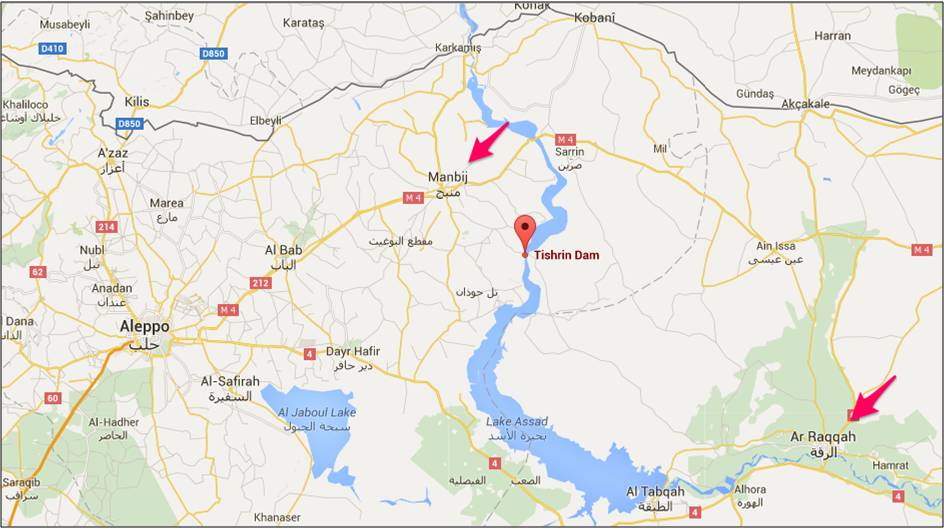
Aside from Aleppo, the most potentially strategically significant area for the foreseeable future is the enclave, sometimes called the “Manbij Pocket,”[20] along the Turkish border between the Kurdish enclave of Afrin to the west and the Kurdish-controlled region east of the Euphrates. As of mid-2016, most of the area is held by ISIS, although the SDF and the Kurds have a foothold across the October Dam in the southeast,[21]and have been trying to take the town of Manbij proper,[22] while anti-ISIS rebels control an area in the north and west. The strategic importance of the area to the various combatants is clear:
ISIS and undoubtedly the other jihadi factions want to retain it to maintain access to what has evidently so far been a comparatively open operating environment in Turkey.[23] ISIS is also firing rockets into Turkey from the pocket.[24]
The Kurds want it to establish a continuous belt of Kurdish-controlled territory along the Turkish-Syrian border and to consolidate a Kurdish region within Syria.[25]
The other rebel factions operating there, especially those supported by the Turks, want to maintain control to allow continued access to Turkey.
The Assad Regime will want to take control to, at the very least, seal the border with Turkey and reclaim the territory.
The Turks want to be able to support their favored anti-Assad factions, preserve it as a buffer to keep more refugees out of Turkey, block hostile factions from firing into Turkey,[26] and prevent the Kurds from consolidating control of the border area.[27]

Location of Manbij. Source [28]
But if these weren’t enough, another reason why a major—and potentially a decisive--battle with ISIS may be fought in the enclave is because it contains the village of Dabiq. The importance of Dabiq is not because of its tactical or strategic military significance—it has none—but because of the religious significance ISIS has chosen to give the place.

The Religious Significance of Dabiq
Like Christianity, Islam is a diverse faith, with various interpretations. The one chosen by ISIS has declared that Dabiq is to be the location of the decisive battle—“al-Malhamah al-Kubra”--between the forces of Islam and those ISIS defines as Crusaders, which will supposedly herald “the Hour”-- the end times of the world. As ISIS has said in Dabiq, their on-line propaganda publication named after the town; [Note—author explanations in brackets]
“As mentioned in the introduction to our first issue, the name of our magazine was taken from the area named Dābiq in the northern countryside of Halab [Aleppo], due to the significant role it will play during the events of al-Malhamah al-Kubrā (The Grand Battle) against the crusaders.
“Abū Hurayrah [a companion of the Prophet Muhammad[30]] reported that Allah’s Messenger [the Prophet Muhammad] (sallallāhu ‘alayhi wa sallam) said, “The Hour will not be established until the Romans land at al-A’māq or Dābiq (two places near each other in the northern countryside of Halab).[31] Then an army from Madīnah [Medina] of the best people on the earth at that time will leave for them. When they line up in ranks the Romans will say, ‘Leave us and those who were taken as prisoners from amongst us so we can fight them.’ The Muslims will say, ‘Nay, by Allah, we will not abandon our brothers to you.’ So they will fight them. Then one third of them will flee; Allah will never forgive them. One third of them will be killed; they will be the best martyrs with Allah. And one third will conquer them; they will never be afflicted with fitnah [intra-Muslim infighting]. Then they will conquer Constantinople.[32]
These battles are supposed to be followed by even more momentous events. The ISIS-favored prediction continues;
“While they are dividing the war booty, having hung their swords on olive trees, Shaytān [Satan, the enemy of God] will shout, ‘The [false] Messiah has followed after your families [who were left behind.]’ So they will leave [for their families], but Shaytān’s claim is false. When they arrive to Shām [Syria] he comes out. Then when they are preparing for battle and filing their ranks, the prayer is called. So ‘Īsā Ibn Maryam [Jesus, son of Mary[33]] (sallallāhu ‘alayhi wa sallam) will descend and lead them. When the enemy of Allah sees him, he will melt as salt melts in water. If he were to leave him he would melt until he perished, but he kills him with his own hand, and then shows them his blood upon his spear.””[34]
This religious claim is reinforced by a prediction from ISIS’s founding godfather, Abū Mus’ab az-Zarqāwī, whose quote about Dabiq is on the opening pages of every issue of the publication:
“The spark has been lit here in Iraq, and its heat will continue to intensify – by Allah’s permission– until it burns the crusader armies in Dābiq.”[35]
We should note that while there are various interpretations as to the signs of the Hour and whether it is imminent,[36]polling indicates that expectations that the world is approaching the End Times are evidently widespread among Muslims.[37] However, although at least one of the previous ISIS leaders thought the Hour was imminent and ran the organization accordingly,[38] it is at least open to question whether the current ISIS leadership actually believes these prophesies--they may well not.[39] In Dabiqthey rather carefully hedge on the issue. The Zarqawi quote doesn’t pin them down by saying that it is necessarily imminent—it requires Allah’s permission. One article in their publication Dabiq on “The Islamic State Founders on Signs of the Hour” actually had nothing on such signs.[40] However, by emphasizing Dabiq they have declared the place to be what might be considered a religiously-defined strategic center of gravity for their movement.
Therefore, Dabiq may ultimately be significant for one of the major reasons that Stalingrad became significant—the enemy leader decided to make it significant. That being the case, we should expect ISIS to fight hard to hold it, and anyone trying to capture it should expect a major battle. Because religious factors are central to the motivation of many ISIS fighters, [41] ISIS attempts to mobilize its fighters to fight there should have more success than in several past efforts.[42] It is also likely to encourage their willingness to sacrifice themselves (“martyrdom” in ISIS thinking) in the fighting.
ISIS is the most powerful of the rebel factions in Syria. Since a major Kurdish move into the area risks open Turkish intervention,[43] and the non-ISIS rebel factions are too weak and/or too fragmented to make a joint effort (and many of them may be further weakened in the coming battle for Aleppo[44]), the most likely antagonist will be the Assad Regime, or more correctly its allies,[45] in particular Lebanese Hezbollah and the other Shia jihadis recruited by Iran, supported by Iranian units and Russian air, artillery, and special operations forces.[46] (The Syrian Arab Army is evidently largely defunct.[47]) Meanwhile, ISIS-related facilities, concentrations, and troop movements in the area are an obvious potential target for Coalition air strikes and any artillery or rockets the U.S. deploys in the region.[48]
If ISIS loses Dabiq, they won’t be able to ignore the loss, as they did with the battle of Kobane,[49] or double-talk about it not being significant. The motto of ISIS is “Remaining and Expanding.” It is difficult for them to claim they have been expanding lately, and if they lose Dabiq they will be unable to claim they are remaining either. And since they claim to be on a divine mission, how can they claim Allah’s favor if the infidels win a battle that ISIS has declared to be decisive?
End Notes
[1] This article uses the designation ISIS because it is the most widely recognized designation.
[2] “Syria rebels retake key town in western coastal province: monitor, rebels,” Reuters, 1 Jul 2016,http://www.reuters.com/article/us-mideast-crisis-syria-latakia-idUSKCN0ZH4QA , accessed 2 Jul 2016.
[3] See Jamie Dettmer, “Islamic State Suffers More Reversals in Syria,” Voice of America, 4 Apr 2016,http://www.voanews.com/content/islamic-state-suffers-more-reversals-syria/3268963.html , accessed 5 Apr 2016. Also see Christopher Kozak, “Russian-Syrian-Iranian Coalition Seizes ISIS-Held Palmyra,” Institute for the Study of War, 27 March 2016,http://iswresearch.blogspot.com/2016/03/russian-syrian-iranian-coalition-seizes.html?utm_source=Russian-Syrian-Iranian+Coalition+Seizes+ISIS-Held+Palmyra&utm_campaign=Russian-Syrian-Iranian+Coalition+Seizes+ISIS-Held+Palmyra&utm_medium=email , accessed 27 March 2016.
[4] “Islamic State regains areas lost to Syrian government,” Associated Press, 21 Jun 2016,http://bigstory.ap.org/article/3e96d211b34a4c0294827963f9f91762/regains-control-areas-it-lost-syrian-government , accessed 23 Jun 2016.
[5] Sammy Ketz and Christian Chaise, “AFP EXCLUSIVE: Assad vows to retake Syria, amid new ceasefire push,” AFP, 12 Feb 2016, https://www.yahoo.com/news/afp-exclusive-assad-vows-retake-whole-country-warns-150319669.html , accessed 2 Apr 2016.
[6] For information on the Shia militias, see Phillip Smyth, The Shiite Jihad in Syria and its Regional Effects, Washington Institute for Near East Policy, 2015,https://www.washingtoninstitute.org/uploads/Documents/pubs/PolicyFocus138_Smyth-2.pdf .
[7] “Syria conflict: Army fire 'cuts key Aleppo road,'” BBC, 7 July 2016,http://www.bbc.com/news/world-middle-east-36735196 , accessed 8 Jul 2016.
[8] Tom Perry and Vladimir Soldatkin, “Syrian PM says Russia to back new Aleppo attack; opposition says truce near collapse,” Reuters, 11 Apr 2016, http://www.reuters.com/article/us-mideast-crisis-syria-idUSKCN0X70GE , accessed 12 Apr 2016.
[9] Aron Lund, “Origins of the Syrian Democratic Forces: A Primer,” Syria Deeply, 22 Jan 2105,http://www.syriadeeply.org/articles/2016/01/9346/origins-syrian-democratic-forces-primer/ , accessed 31 Jan 2016.
[10] Andrew Tilghman, “With U.S. advisers and firepower, Syrian rebels take key city from ISIS,”Military Times, 27 Feb 2016, http://www.militarytimes.com/story/military/war-on-is/2016/02/27/syrian-rebels-take-shaddadi-from-islamic-state/80994894/ , accessed 28 Feb 2016.
[11] “Are the Kurds Prepared to Liberate Raqqa from ISIS?,” ARA News, 18 Mar 2016,http://aranews.net/2016/03/kurds-prepared-liberate-raqqa-isis/ , accessed 25 Mar 2016.
[12] Hollie McKay, “Mosul siege stalled as Iraqi army once again flees when bullets fly, say sources,”FoxNews.com, 7 Apr 2016, http://www.foxnews.com/world/2016/04/07/mosul-siege-stalled-as-iraqi-army-once-again-flees-when-bullets-fly-say-sources.html , accessed 8 Apr 2016.
[13] Missy Ryan, “U.S. visit highlights obstacles to an Iraqi offensive on Mosul,” Washington Post, 21 Apr 2016, https://www.washingtonpost.com/news/checkpoint/wp/2016/04/21/u-s-visit-highlights-obstacles-to-an-iraqi-offensive-on-mosul/?wpmm=1&wpisrc=nl_check , accessed 22 Apr 2016.
[14]Thomas Gibbons-Neff, “Inside the Kurdish fighting forces: the U.S.’s proxy ground troops in the war against ISIS,” Washington Post, 2 Feb 2016,https://www.washingtonpost.com/news/checkpoint/wp/2016/02/02/inside-the-kurdish-fighting-forces-the-u-s-s-proxy-ground-troops-in-the-war-against-isis/ , accessed 3 Feb 2016.
[15] Sharon Behn, “Kurdish Commander: Mosul Battle Will Be 'Bloodbath',” Voice of America, 21 Mar 2016, http://www.voanews.com/content/islamic-state-battle-for-mosul-iraq/3247160.html, accessed 23 Mar 2016.
[16] Thomas Gibbons-Neff and Karoun Demirjian, “The Kurds are ready to retake Mosul. Now they just need the Iraqi army.,” Washington Post, 14 Jan 2016, https://www.washingtonpost.com/news/checkpoint/wp/2016/01/14/the-kurds-are-ready-to-retake-mosul-now-they-just-need-the-iraqi-army/ , accessed 16 Jan 2016.
[17] Patrick Martin with Emily Anagnostos, Rachel Bessette, and Hannah Werman, “Iraq Government Collapse Likely as a Rump Parliament Calls for Resignations,” Institute for the Study Of War, 15 Apr 2016, http://iswresearch.blogspot.com/2016/04/iraq-government-collapse-likely as-rump.html?utm_source=Iraqi+Government+on+Verge+of+Collapse+as+a+Rump+Parliament+Grasps+for+Power&utm_campaign=Iraq+Situation+Report%3A+March+29+-+April+4%2C+2016&utm_medium=ema , accessed 18 Apr 2016.
[18] Lionel Beehner and Major Mike Jackson, “What the siege of Sarajevo can teach us about Aleppo,” Washington Post, 9 May 2016, https://www.washingtonpost.com/news/monkey-cage/wp/2016/05/09/what-the-siege-of-sarajevo-can-teach-us-about-aleppo/ , accessed 10 May 2016.
[20] Rikar Hussein, “Turkish-Syrian Border Pocket is Heart of Fight Against IS,” Voice of America, April 20, 2016, http://www.voanews.com/content/turkey-syria-border-manbij-pocket-heart-islamic-state-fight/3294536.html , accessed 21 Apr 2016.
[21] Aron Lund, “Taking the October Dam: Syria’s Kurds Keep Hitting the Islamic State,” Carnegie Endowment Syria in Crisis Blog, 28 Dec 2015, http://carnegieendowment.org/syriaincrisis/?fa=62363 , accessed 30 Dec 2015.
[22] The effort has had mixed success. See Suleiman Al-Khalidi, “Islamic State repels U.S.-backed forces in north Syria city: monitor,” Reuters, 2 July 2016, http://www.reuters.com/article/us-mideast-crisis-syria-manbij-idUSKCN0ZI0Z4 , accessed 3 Jul 2016; and “U.S.-backed forces drive into Islamic State-held city, monitors say,” Reuters, 7 July 2016, http://www.reuters.com/article/us-mideast-crisis-syria-islamic-state-idUSKCN0ZN1ZZ?utm_source=Sailthru&utm_medium=email&utm_campaign=DFN%20EBB%207.8.16&utm_term=Editorial%20-%20Early%20Bird%20Brief , accessed 8 July 2016. And even if they take it, will they be able to hold it?
[23] Aaron Stein, “The Islamic State in Turkey: A Deep Dive into a Dark Place,” War on the Rocks, 6 Apr 2016, http://warontherocks.com/2016/04/the-islamic-state-in-turkey-a-deep-dive-into-a-dark-place/ , accessed 7 Apr 2016. Also see Meira Svirsky, “Secrets and Lies: Turkey's Covert Relationship With ISIS,” The Clarion Project, 29 Mar 2016,http://www.clarionproject.org/analysis/secrets-and-lies-turkeys-covert-relationship-isis , accessed 30 Mar 2016; and Uzay Bulut, “Turkey Releases ISIS Suspects,” The Clarion Project, 3 Apr 2016, http://www.clarionproject.org/analysis/turkey-releases-isis-suspects# , accessed 4 Apr 2016. It remains to be seen whether or how much the Istanbul Airport attack will change this.
[24] Hussein, “Turkish-Syrian Border Pocket is Heart of Fight Against IS.”
[25] Rodi Said, “Syrian Kurds set to announce federal system in northern Syria,” Reuters, 16 Mar 2016,http://news.yahoo.com/federal-system-announced-kurdish-controlled-northern-syria-085335022.html , accessed 18 Mar 2016.
[26] “Turkey could send ground troops into Syria in self-defense: PM,” Reuters, 4 May 2015,http://www.reuters.com/article/us-mideast-crisis-turkey-islamicstate-idUSKCN0XV0SX , accessed 5 May 2016.
[27] Supposedly one of the reasons the Russians pushed for a cease fire was to prevent possible overt Turkish intervention into the enclave. See Joseph V. Micallef, “Syria: Why the Ceasefire is Unravelling,”Huffington Post, 17 Apr 2016, http://www.huffingtonpost.com/joseph-v-micallef/syria-why-the-ceasefire-i_b_9710602.html , accessed 18 Apr 2016.
[28] “Map showing Manbij region of Syria near Turkish border,” undated,
https://newcoldwar.org/wp-content/uploads/2016/06/Map-showing-Manbij-region-of-Syria-near-Turkish-border.jpg , accessed 7 Jul 2016.
[29] https://www.google.com/search?q=map+dabiq+syria&biw=1073&bih=522&tbm=isch&imgil=j3STGxDECJMFOM%253A%253BGVULAcfQXPuIfM%253Bhttp%25253A%25252F%25252Fshoebat.com%25252F2014%25252F09%25252F30%25252Fisis-advancing-tomb-grandfather-founder-ottoman-empire%25252F&source=iu&pf=m&fir=j3STGxDECJMFOM%253A%252CGVULAcfQXPuIfM%252C_&usg=__EVi55mW6lZrFpFtCpBeqIiQs8oM%3D&ved=0ahUKEwjuyqmkkILMAhXGwj4KHdPtCv0QyjcIKQ&ei=FEIJV-7wEsaF-wHT26voDw#imgrc=j3STGxDECJMFOM%3A . Accessed 26 June 2016.
[30] And supposedly one of the most prolific narrators of hadith [stories of the Prophet Muhammad’s life] in Sunni hadith compilations. “Abu Hurayrah,” Islamic Encyclopedia, undated,http://islamicencyclopedia.org/public/index/topicDetail/id/58 , accessed 9 July 2016.
[31] A’maq is in Turkey, which ISIS could claim means it has already been occupied by “Crusaders.”
[32] “The Liberation of Dabiq,” Al Hayat Media Center, Dabiq Issue #3, 16 Sep 2014,http://worldanalysis.net/14/2014/09/dabiq-magazine-issue-3/ , P.15.
[33] In Islam, Jesus is considered a prophet, but not divine.
[34] “The Liberation of Dabiq,” Al Hayat Media Center, Dabiq Issue #3, 16 Sep 2014,http://worldanalysis.net/14/2014/09/dabiq-magazine-issue-3/ , P.15.
[35] Al Hayat Media Center, Dabiq Issue #1, 6 Jul 2014,http://worldanalysis.net/14/2014/07/english-publication-iraq-dabiq-issue-1/ , P.2.
[36] As good a place to start as any is Appendix 1 in William McCants, The ISIS Apocalypse, New York, St. Martins, 2015, pgs.163-171. McCants says it is based on his translations of “…several of Muhammad’s supposed prophecies of the End Times based on the original sources,…” McCants, P. 163.
[37] Overall, polling indicates that about half of Middle Eastern and North African Muslims expect these events to occur in their lifetime. See Chapter 3, Articles of Faith, Pew Research Center, The World’s Muslims: Unity and Diversity, 9 August 2012, http://www.pewforum.org/2012/08/09/the-worlds-muslims-unity-and-diversity-3-articles-of-faith/ , accessed 27 Apr 2016.
[38] McCants, The ISIS Apocalypse, P. 31-32.
[39] McCants, The ISIS Apocalypse, P. 154.
[40] Most of what it contained were predictions of one of ISIS’s favorite medieval clerics, Ibn Taymiyyah, about the then ongoing war with the Tatars. Al Hayat Media Center, “The Islamic State Founders on Signs of the Hour,” Dabiq, Issue 4, Oct. 2014,http://worldanalysis.net/14/2014/10/dabiq-issue-4-failed-crusade/ , Pgs 35-37, accessed 4 Apr 2016.
[41] While motivation undoubtedly varies from person to person, the following are potentially significant religious factors for ISIS fighters, especially the foreign fighters who make up a major portion of their force:
Belief that they are living in the End Times;
Desire to live in what they consider to be truly Muslim society and system;
Pride in being Muslim and a sense of being a member of an elite vanguard and a participant in something greater than themselves.
To defend Islam from attack by unbelievers, and/or to defend Sunni Islam from attack by Shia Islam;
Seeking a sense of personal fulfillment and redemption and status in being a combatant for Islam in a cosmic war of good against evil.
See Thomas R. McCabe, "A Strategy for the ISIS Foreign Fighter Threat.” Orbis, Vol. 60, no. 1 (Winter 2016): 140-153. Also at http://www.fpri.org/article/2016/01/a-strategy-for-the-isis-foreign-fighter-threat/ .
[42] Evidently, several past ISIS efforts to mobilize fighters have failed. See Aymann Al-Tamimi, “A Caliphate Under Strain: The Documentary Evidence,” CTC Sentinel, 22 Apr 2016,https://www.ctc.usma.edu/posts/a-caliphate-under-strain-the-documentary-evidence , P. 2, accessed 24 Apr 2016.
[43] Wladimir van Wilgenburg, “The Battle for the Euphrates: Turkey's Response to Kurdish Expansion,” Jamestown Foundation Terrorism Monitor, Volume 14, Issue 4, 19 Feb 2016,http://www.jamestown.org/single/?tx_ttnews%5Btt_news%5D=45111&tx_ttnews%5BbackPid%5D=7&cHash=7e804e21fbc4639538335df7c6ec9f3f#.VxPUMqR8Ntp, accessed 21 Feb 2016.
[44] Even before Aleppo the non-ISIS factions in the Manbij pocket were unable to make advances and hold ground against ISIS even when reportedly backed by Turkish artillery and possibly US air strikes and Turkish special forces. See Adam Hill, “Syrian Army Starts Battle for Aleppo, ISIS Cuts Turkey-Backed Rebels in Half,” Russia Insider, 15 Apr 2016, http://russia-insider.com/en/syrian-army-starts-battle-aleppo-isis-cuts-turkey-backed-rebels-half/ri13893 , accessed 16 Apr 2016.
[45] Aside from some elite units, most of the Syrian Arab Army is of questionable readiness. See Kheder Khaddour, “Strength in Weakness: The Syrian Army's Accidental Resilience,” Carnegie Middle East Center, 16 Mar 2016, http://carnegie-mec.org/2016/03/10/strength-in-weakness-syrian-army-s-accidental-resilience/iuz7 , accessed 4 Apr 2016.
[46] Tim Ripley and Jeremy Binnie, “Putin reveals units deployed to Syria,” IHS Jane's Defence Weekly,22 March 2016, http://www.janes.com/article/58952/putin-reveals-units-deployed-to-syria , accessed 24 Mar 2016.
[47] Tom Cooper, “What’s Left of the Syrian Arab Army?” War is Boring, 18 May 2016,https://warisboring.com/whats-left-of-the-syrian-arab-army-eec39485df43?mc_cid=3ecd3b9b6f&mc_eid=b82a39e4ec#.fk2r8a3g7 , accessed 19 May 2016.
[48] Humayra Pamuk, “Turkish minister says U.S. to deploy rocket launchers near Syrian border,”Reuters, 26 Apr 2016, http://www.reuters.com/article/us-mideast-crisis-syria-turkey-usa-idUSKCN0XN12F , accessed 28 Apr 2016.
[49] In Dabiq, without admitting they had lost the battle for Kobane, they sneered at the Kurds for advancing under cover of American air power and how that air power had leveled the town. Al Hayat Media Center, “American Kurdistan,” Dabiq Issue 10, July 2015,https://azelin.files.wordpress.com/2015/07/the-islamic-state-e2809cdc481biq-magazine-1022.pdf , pgs 30-31.
LtCol Thomas R. McCabe, USAFR (Ret), is a retired career analyst for the U.S. Department of Defense and a retired Lieutenant Colonel from the U.S. Air Force Reserve. He worked for over ten years as a Middle East military analyst for the Air Force and as a counterterrorism analyst for two years. His articles on the Middle East and terrorism have been published in Parameters, Orbis, Middle East Quarterly, and Security and Democracy. This article represents his views only and should not be considered the opinion of any agency of the U.S. Government.
No comments:
Post a Comment