Daniel Araya

We stand at the threshold of a technological revolution. As Elon Musk recently explained to an audience of military personnel, “the fighter jet era has passed”. Speaking with Lieutenant General John Thompson at the Air Warfare Symposium, the technology executive praised the US military but stressed the fact that autonomous drone warfare had arrived. The truth is that Musk did not go far enough. Not only are we witnessing the end of fighter jets. We are witnessing the end of the Industrial-era military itself.
Like the creaking decline of Detroit automakers, so the world’s industrial-era institutions are now poised to be displaced or transformed by a rising era of artificial intelligence (AI) and machine learning (ML). This is not a minor shift. Indeed, what we are now facing is a complete redesign of a fading industrial order. As Ray Dalio observes, we are entering a new global era.
This transition portends a dramatic shift away from rudimentary machines and toward precision electronics. More to the point, it signals a structural transformation in the nature of global security with implications for America’s military predominance.
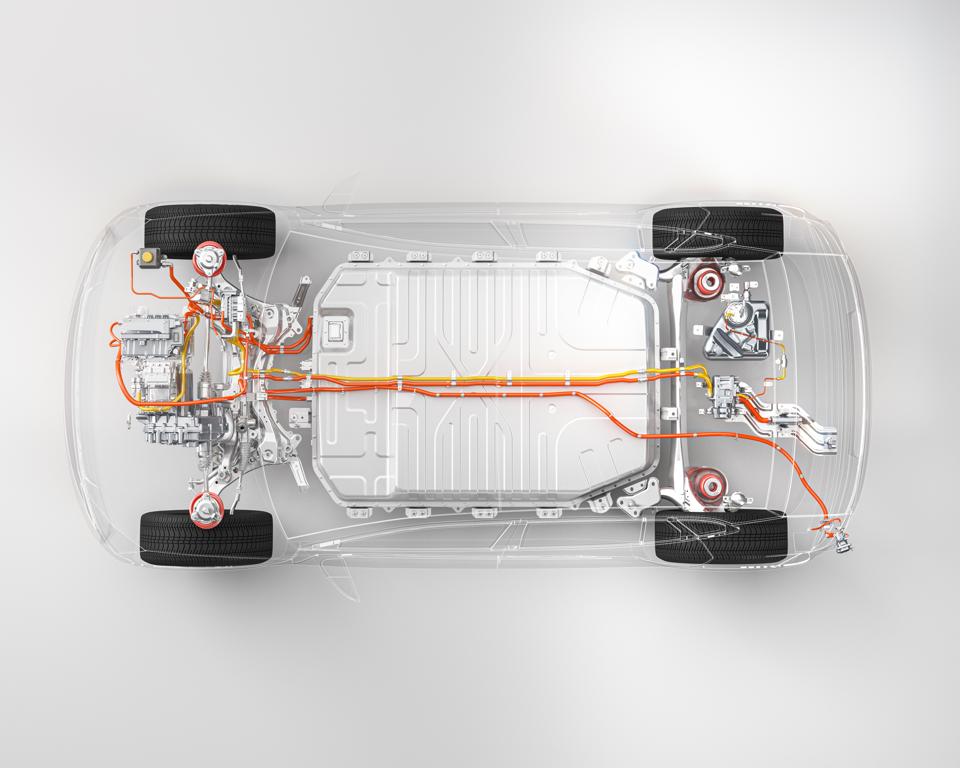
Modern electric car chassis x-ray vehicle battery in studio environment line art 3d render GETTY
Beyond Climate Change
Much as mass electrification accelerated the rise of the United States, so AI has begun transforming the contours of the global order. AI is a general purpose technology with a capacity to reshape the nature of global security. Underlying this shift is the rise of technologies that leverage energy decentralization and electronics in remaking combustion-based technologies.
Conventional forecasts on technology often make the common error of assuming that system changes of this magnitude simply replace old technologies on a 1-to-1 basis. In reality, disruptions on this scale tend to disproportionately replace old systems with dramatically new architectures, boundaries, and capabilities. Indeed, even as the industrial era winds down, technological innovation is speeding up.
In the case of energy— solar, wind and battery capacity are now driving an exponential decline in the cost of energy. Since 2010, solar photovoltaic (PV) capacity costs have fallen over 80% while onshore wind capacity costs have fallen more than 45%, and lithium-ion battery capacity costs have fallen almost 90%. As the cost curve for renewables ultimately plummets to near-zero, the shift to cleantech will become a major disrupter of conventional militaries. Add to this data-driven advances in AI and ML and what we are beginning to see is a complete technological restructuring.
Disruptions of this magnitude are driven by the convergence of technological and institutional changes that trigger causal feedback loops— pushing existing systems into accelerated decline. With a fraction of the parts needed for fossil fuel technologies, electricity-driven technologies are not only cheaper and easier to maintain but subject to the same accelerating returns as other computational technologies.
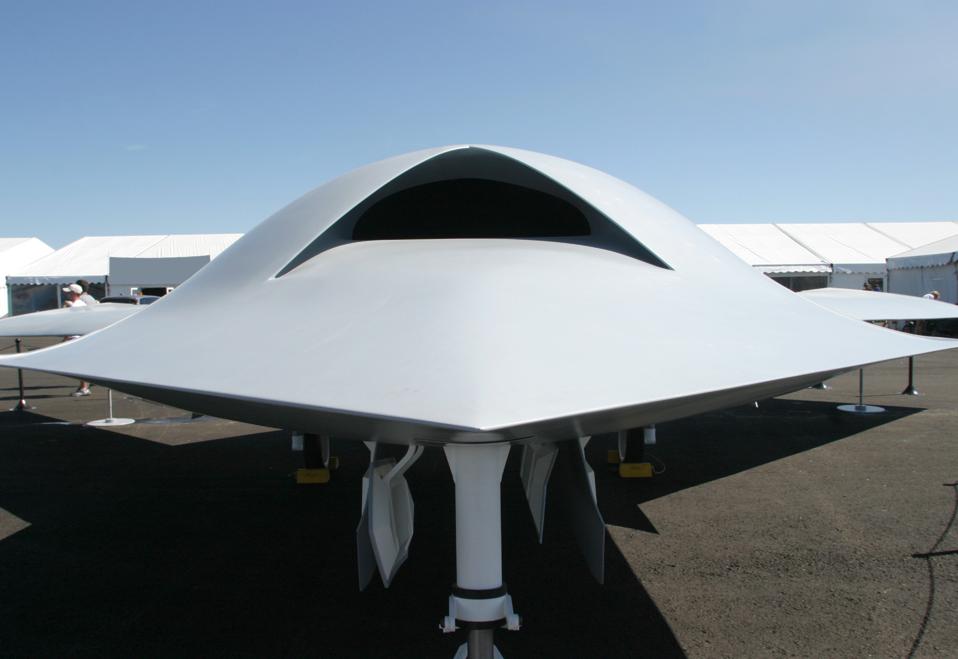
Boeing X-45A UCAV (Unmanned Combat Aerial Vehicle) on display in an air show, Dayton, Ohio, USA. GETTY
Power in the Post-Industrial Era
The impact of past technological revolutions can provide some perspective on the changing nature of contemporary institutions. Building on fossil fuels, Britain and the United States became globe spanning empires. Today, Industrial era technologies (print, television, automobiles) and the institutions that gave rise to them are now in decline.
To take one example, the oil industry is now undergoing a structural collapse. As recently as 2013, Exxon was the largest company in the world. In the third quarter of this year, the energy giant reported a loss of $680 million, bringing its total losses for 2020 to $2.37 billion. As countries leverage data, electronics, and software automation to compete for military and commercial advantage, they are beginning to transition beyond fossil fuels and into a massively competitive global market for innovation.
According to the International Energy Agency (IEA), renewables are now set to account for almost 90% of all new global power capacity through 2025. By 2030, renewables will provide the cheapest electricity option for most regions of the world while oil and gas are reduced to stranded assets. Indeed, BlackRock— the world's largest asset manager— views clean energy as a 10 trillion dollar market.
Given this shift, the US military now finds itself in a very precarious position. Currently the world’s largest consumer of fossil fuels, the US military is now on course to be disrupted by more strategically innovative competitors. As energy costs fall to near zero, the nature of global security will change dramatically. The good news is that the military has already begun making strides in transforming its dependence on fossil fuels. According to a Department of Defense report, the armed forces nearly doubled renewable power generation and nearly tripled renewable energy projects between 2011 and 2015.
What is clear is that AI and renewables are a force multiplier for transformative innovation in generating a much stealthier military footprint. Clean energy means reducing the vulnerability of easily attacked convoys dependent on refueling. It also means a massive windfall in financial resources for next generation military innovation. And most importantly, it means a highly mobile renewable energy infrastructure at near-zero cost.

Digital military GETTY
The Next Global Order
We are living through a period of transition between two epochs: an industrial era characterized by predictable factory labor and a new digital era characterized by widespread institutional unravelling. This unravelling builds on structural changes rooted in (1) technological transformation (AI), (2) geopolitical restructuring (the rise of China), and (3) environmental crisis (climate change).
China’s growing economic largesse and its strategic investments in clean energy, autonomous weapons, and precision-guided missiles signals a dramatic shift in the nature of military power. China is moving to adopt intelligent systems that will fully automate parts of its’ enormous economy while leading the world in renewables. These investments will eventually drive a broad transformation of China’s military with other countries following suit.
In this new century, the United States remains a formidable power, but its days of unipolar hegemony have come to an end. Disruptive technologies like AI and renewables are transforming the contours of power, driving the need for new institutions in managing a changing economic order.

Three Communication Satellite dishes at thundershtorm . GETTY
Beyond Centralization: Rethinking Security
What we know already is that a massive data revolution is accelerating a convergence of physical, digital and biological technologies around software and automation. Data-driven technologies are now the core infrastructure around which a global society operates. In fact, the IDC estimates that global data is now growing at an annual rate of 61%. Data is expected to reach 175 zettabytes by 2025 (a trillion gigabytes) and these technologies are now fragmenting state power.
Given the scale of proliferating technologies in driving non-state actors and asymmetrical challenges, it would be wrong to assume that we can simply renew the institutions inherited from a previous century. And given the scope of these changes, we can assume that America’s lead in military predominance will fade unless specific investments are made in transforming the institutions of the military itself.
In a century characterized by asymmetrical threats (cyber, biological, and ecological), US leadership has begun to wane. From climate change to cyber-conflict, and from political deadlock to a populist revolt, rage and resentment are on the rise across Western democracies and American leadership looks increasingly hollow.
The truth is that centralized institutions of all kinds are now extremely vulnerable to disruption. As cutting-edge technologies become cheaper, they spread to a wider range of actors, democratizing the capacity for non-state actors to create and leverage force at scale. The move to increasing decentralization will inevitably mean the end of large bureaucracies (corporate, government, academic, and military) and command hierarchies. But it will also mean the rise of asymmetrical security challenges.

GPS or Weather Satellite orbiting Earth. CG image. GETTY
Transforming the U.S. Military for the Network Age
With an armed force of more than two million people, 11 nuclear aircraft carriers, 70 submarines, and the world’s most advanced military technologies, the US remains the predominant military power. But with the rise of competing nations— China, Russia, India, Iran, and Turkey— the balance of power is shifting. Indeed, as Eurasia Group’s Ian Bremmer declares, the US-led global order is already finished.
The geopolitical landscape has begun shifting and many analysts now worry that the United States is in structural decline. The bad news is that the end of Pax Americana would likely open a global power vacuum. Indeed, nation-states, private firms, and non-state actors that can weaponize AI and renewables could soon have a degree of political, economic and military influence that we simply have never seen before. Without a US military designed for the 21st century, the potential for chaos could grow exponentially.
Part of the answer will involve the evolution of new institutions that can secure a data-driven era in the form of a second Bretton Woods system while devolving power to the local level. More than anything else, this will mean developing a comprehensive security and military network that can help guide the transition out of a collapsing industrial order . To be sure, designing new security institutions that feed on and manage this “creative destruction” will be daunting.
Much as oil and steel set the terms for the Industrial Age, so AI and renewables will now set the terms for the Digital Age. And as autonomous machines, renewable energy infrastructure, quantum communication, augmented brain-machine interfaces, and space-based weapons come to the fore, pressure will grow to rethink the nature of global security. Indeed, the challenge before us today is to leverage the affordances of this Fourth Industrial Revolution to redesign America’s military and security systems for a network age.
In the era of complex networks, localized self-sufficient communities (local nodes) will simply be better equipped to respond to accelerating technological change. Indeed, this is the driving premise underlying the design and evolution of the Internet itself. Managing a thorny cluster of challenges that crisscross non-state actors, diffuse criminal organizations, geopolitical competitors, and the proliferation of autonomous weapons means rethinking the nature of security for a new global order.
Building on clean energy technologies and software automation, the US military will need to return to first principles, harnessing AI and human intuition to aid and eventually lead in decision-making while deploying special operations forces when needed. But more than resources alone, this will mean transforming the institutions of the US military for a network age.
No comments:
Post a Comment