


 What kept the Goods and Services Tax (GST) from becoming a reality in India for a quarter of a century after the adoption of the structural adjustment programme in 1991? What made it possible in 2016? To what extent the Indian model of GST reflects a compromise between the need to keep fiscal federalism intact and to respond to a more global economic imperative? To what extent India’s transition to a concurrent dual GST has brought about a change in the principles, rules, frameworks, and institutions guiding intergovernmental fiscal interactions? This paper investigates these issues and shows that the shifts in the indirect tax regime in India since independence have taken place within the structural context of constitutional rules, the economic policy paradigm and political dynamics. Party congruence after 2014 helped to facilitate the introduction of the GST, but the shape thereof was strongly marked by path-dependent logics and the role of state governments as institutional veto players. In addition, the paper examines the ways in which India’s transition to a concurrent dual GST has brought about a fundamental change in the principles, rules, frameworks, and institutions guiding intergovernmental fiscal interactions.
29 January 2021
The Political Economy of India’s Transition to Goods and Services Tax
What kept the Goods and Services Tax (GST) from becoming a reality in India for a quarter of a century after the adoption of the structural adjustment programme in 1991? What made it possible in 2016? To what extent the Indian model of GST reflects a compromise between the need to keep fiscal federalism intact and to respond to a more global economic imperative? To what extent India’s transition to a concurrent dual GST has brought about a change in the principles, rules, frameworks, and institutions guiding intergovernmental fiscal interactions? This paper investigates these issues and shows that the shifts in the indirect tax regime in India since independence have taken place within the structural context of constitutional rules, the economic policy paradigm and political dynamics. Party congruence after 2014 helped to facilitate the introduction of the GST, but the shape thereof was strongly marked by path-dependent logics and the role of state governments as institutional veto players. In addition, the paper examines the ways in which India’s transition to a concurrent dual GST has brought about a fundamental change in the principles, rules, frameworks, and institutions guiding intergovernmental fiscal interactions.RCEP-Countries Create Asia-Pacific Free Trade Zone
The signing of the Regional Comprehensive Economic Partnership (RCEP) on 15 November 2020 establishes the world’s largest free trade area. The agreement was hailed as an important step forward for the international trade system: protectionism is no longer the only visible option for the third decade of the twenty-first century. But RCEP is a relatively weak instrument. It consolidates existing trade agreements in the region, but does not represent a breakthrough to a liberal economic space. It lacks the potential to make the Asia-Pacific region into a monolithic trading bloc, nor does it contribute to overcoming growing political tensions in the Indo-Pacific.
The process that led to RCEP began in 2012, and was initiated by the ASEAN states. The agreement includes that organisation’s ten members (Brunei, Indonesia, Cambodia, Laos, Malaysia, Myanmar, the Philippines, Singapore, Thailand and Vietnam) plus China, Japan, South Korea, Australia and New Zealand. One of the original motives for the ASEAN states was to create a counterweight to the Trans-Pacific Partnership (TPP). After US President Donald Trump withdrew from TPP in 2017, the smaller and rather less ambitious Comprehensive and Progressive Agreement for Trans-Pacific Partnership (CPTPP) was realised in its place. This did not represent a full substitute for RCEP because important ASEAN members remained outside, in particular Indonesia and Thailand.
RCEP does not in fact involve great change in trade relations between ASEAN and China, which have been governed by a free trade agreement since 2010. That agreement was an initiative of then Chinese Prime Minister Zhu Rongji rather than ASEAN.
MERICS China Forecast 2021
2020 was a turbulent year for everything China related. In 2021, countries around the world will face the double challenge of dealing with the Covid-19 health crisis and bracing for the economic fallout it will cause. While promising vaccine breakthroughs look set to usher in the end of the pandemic, the economics and politics of vaccine distribution will test the international community. At the same time, a series of critical developments will affect EU-China relations: the CCP’s 100th birthday, the publication of China’s 14th Five-Year Plan, a new US President and a new German Chancellor.
To shed some light on what observers think EU-China relations will look like in 2021, MERICS conducted a survey among 170 European China experts and roughly 1,000 members of the wider international public. A selection of the results was presented on January 13, 2021, at the MERICS China Forecast 2021 event and discussed by leading China specialists.
The MERICS China Forecast 2021 event
Following opening remarks by MERICS Executive Director, Mikko Huotari, the first panel on China’s domestic politics and economy featured George Magnus, Associate at the China Centre of the University of Oxford, Rana Mitter, Professor of the History and Politics of Modern China at the University of Oxford, Arthur R. Kroeber, Founding Partner & Head of Research at Gavekal Dragonomics Beijing and Nonresident Senior Fellow at Brookings, and Kristin Shi-Kupfer, Senior Associate at MERICS and Professor for Contemporary China at the University of Trier. It was moderated by Bernhard Bartsch, Senior Expert China and Asia Pacific at the Bertelsmann Foundation.
China, Xinjiang, and the Uyghurs in Global Jihadist Propaganda
By Lucas Webber
China’s Xinjiang policies have drawn the ire of transnational militant organizations and the topic of Uyghur repression has found rhetorical traction within global jihadist discourse. Al-Qaeda, the Islamic State (IS), and others have explicitly threatened China and prominent jihadist figures such as Ayman al-Zawahiri and Abu Bakr al-Baghdadi have criticized Beijing’s treatment of Xinjiang’s Muslim population. While conflict in the region has not traditionally been a priority concern for most non-Uyghur jihadists, Xinjiang issues have become more international and mainstream in recent years. Militants of disparate geographies and of numerous languages have been devoting noticeably greater attention to Xinjiang in their propaganda content. Growing global media coverage and popular awareness of Chinese policy toward the Uyghurs has put additional pressure on jihadist organizations to publicly address the subject.
China’s Muslim majority Xinjiang region has long been the site of political unrest and separatist activity. Andrew Small describes how “For decades, this resistance was largely secular and pan-Turkic in inspiration, but by the 1990s, the impact of the religious revival across the region and the proliferation of transnational Islamist groups had started to give it a more explicitly Islamic character.” Beijing’s response to the instability has been to crackdown on the region through its “Strike Hard” campaigns and other strict security measures. China has been very aggressive in its efforts to combat the “Three Evils” of terrorism, separatism, and religious extremism. The Chinese Communist Party (CCP) often attributes the region’s political violence to jihadist organizations, but there is contentious debate amongst researchers over the extent of transnational involvement. What can be said for certain, however, is that China’s clampdown has inflamed animosities and become a subject of increased propaganda focus for jihadist organizations around the world.
A New Estimate of China’s Military Expenditure
Dr Nan Tian and Fei Su
 China publishes a national defence budget each year. In 2019 it reached 1.2 trillion yuan (US$175 billion). However, this figure does not account for all of China’s military spending. To provide a more accurate representation of China’s spending, SIPRI’s estimate—based on an analysis made in 1999—includes other items in addition to the official defence budget.
Given China’s accelerating military modernization and reforms in recent years, the existing estimate of China’s military spending deserves a reassessment. This SIPRI report provides a comprehensive new analysis of the financial resources China dedicates to military purposes. Using publicly available sources in both English and Chinese, the report presents a new estimate of Chinese military expenditure.
The new estimate—1660 billion yuan ($240 billion) in 2019—is around 142 billion yuan ($21 billion) less than the old SIPRI estimate. Although the new approach to estimating Chinese military expenditure improves on the old method, limited public transparency in budgeting on specific categories is still a cause of concern. Future research should focus on publicly available Chinese-language sources as there is still scope to improve the precision of the new estimate.
Taking Flight: China, Japan, and South Korea Get Aircraft Carriers
Many naval theorists have heralded the end of the aircraft-carrier era.[1] They argue that the advent of pervasive sensors and precision-guided munitions would overcome improvements in ship-based defenses to render the aircraft carrier (and perhaps most large surface combatants) obsolete. Such a shift in naval warfare would obviously have its biggest impact in the world’s biggest body of water, the Pacific Ocean. Australia decommissioned its last aircraft carrier in 1984. After the Cold War, Russia dispensed with an aircraft carrier for its Pacific Fleet. Thailand left its lone aircraft carrier without fixed-wing aircraft. By the first decade of the 21st century, the only active aircraft carriers in the Pacific were American, and even those were under budgetary threat. Then-Secretary of Defense Donald Rumsfeld contended that the future lay in “prompt global strike”—using new weapon systems that can strike foes a world away within hours—and less in forward-deployed forces, like aircraft carrier battle groups.
Yet, over the last decade, China, Japan, and South Korea have all committed to adding aircraft carriers to their fleets. China was the first. It now has two carriers in service and a third under construction. Japan is converting two of its helicopter carriers into full-fledged aircraft carriers, and South Korea has rushed the development of its first. Certainly, the spurt in carrier construction has much to do with what the three countries see as their security priorities, including China’s desire to push out its seaward defenses and protect its “historic rights” over neighboring areas; Japan’s desire to ensure that those areas do not include the Senkaku Islands (Diaoyu in China); and South Korea’s desire to ensure that Japan’s efforts to ward off China do not imperil its hold on the Liancourt Rocks (Takeshima in Japan and Dokdo in South Korea). But the new construction also speaks to the enduring value that navies put in aircraft carriers. Regardless of their vulnerabilities, carriers remain useful for defending and taking distant outposts.
China’s Cold War (and Post-Cold War) Thinking
The EU–China Comprehensive Agreement on Investment
On December 30, 2020, the European Union and China concluded in principle the Comprehensive Agreement on Investment (CAI). Beijing’s sudden flexibility on the terms of the bilateral investment agreement is clearly part of an effort to pre-empt improving U.S.–EU relations. Essentially, the CAI gives European investors additional market access in China in exchange for access to markets that are already more open to China than China is to the EU. The deal will be a political win for China at a time when China’s diplomatic relationships around the world are worsening. Beijing has become increasingly belligerent toward countries that want greater transparency in areas like the use of forced labor and the origins of COVID-19. The U.S. and the EU must work together to address the China challenge. With the CAI, Europe is making a down payment on a separate peace that will do long-term damage to the transatlantic relationship.Download Report
Deteriorating China-Australia Relations
Dr Anne-Marie Schleich
Since April 2020, Australia and China have been embroiled in escalating trade and diplomatic disputes. The relationship between the two countries has constantly deteriorated and is currently at a critical point. Developments on both sides could be right out of a filmscript on “how to wreck bilateral trade and diplomatic relations”.
The seesawing conflict started in 2018, when Australia barred Huawei from providing 5G network services to Australia because of security concerns. In February 2020, the Australian Dumping Commission initiated and also continued anti-dumping duties on various Chinese steel and aluminium products. And in April 2020, Australia pushed for an international inquiry into the origins of Coronavirus and gathered substantial support among other WHO member countries. It was a move which the Chinese Deputy Ambassador to Canberra termed “shocking”. China retaliated in May and the following months with import suspensions and import delays of Australian beef, barley, cotton, thermal coal, timber, copper, beer and lobster on the basis of ‘health or consumer protection issues’ or of ‘quota restrictions’. It also imposed higher tariffs on many other Australian goods such as wines and issued Australia travel warnings for Chinese tourists and students.
In May, the Australian government decided to continue imposing anti-dumping duties on Chinese imports. In turn, Australia introduced stricter rules for foreign investments in sensitive assets in June. It also suspended in July its extradition treaty with Hongkong in response to China’s introduction of security legislation in Hongkong. In December, Australian Prime Minister Morrison directly responded to an image on the Chinese Foreign Affairs spokesman twitter account depicting a (likely) fake image of an Australian soldier holding a knife to an Afghan child. PM Morrison demanded an apology from China which never came.
Avoiding the Iranian Trap: Iraqi Shia Are not Loyal to Iran
by Munqith Dagher

It is no secret that in Iraqi Shia public opinion, Iran plays a negative role in Iraq. In recent years, Iran has lost its soft power as a model of Shia political Islam. According to the latest polls, over 85 percent of Iraqis, including 82 percent of Shia, say that Iran plays a negative role in Iraq. Meanwhile, only 18 percent of Iraqis overall and only 23 percent of Shia Iraqis believe that Iran is a reliable partner for Iraq.
Although there is apparently a rising current in Iran (within the state and not the revolutionary currents) that realizes that Iran’s loss of soft power in Iraq and the region is a result of its revolutionary policies over the past decade which exacerbated Iran’s troubles both internally and externally, the revolutionary current continues to push for more hardline policies based on Islamic resistance against Israel, the United States, and their allies in the region.
This current, which derives legitimacy for its survival and dominance over Iran’s political and economic capabilities from the idea of exporting Iran’s revolution, cannot accept the idea of Iran transforming into a state that is concerned with its internal affairs, focused only on addressing the interests of its citizens without interfering in the affairs of others. Iran, which continues to praise the Islamic revolution and embrace the concept of exporting the revolution more than 40 years after it occurred, established its entire political system around the philosophy of vilayat-e faqih, or guardianship of the Islamic jurist. This religious philosophy has been not only a cornerstone of Iran’s domestic politics, but also guided and inspired its foreign policy, especially in the vital Shia domain, both in the region and globally.
Global Covid-19 Responses Through a Critical Security Studies Perspective
Lachlan Abbott

This content was originally written for an undergraduate or Master's program. It is published as part of our mission to showcase peer-leading papers written by students during their studies. This work can be used for background reading and research, but should not be cited as an expert source or used in place of scholarly articles/books.
On the 19th of March 2020, Australian Prime Minister Scott Morrison announced the closure of Australia’s borders to all non-residents and non-citizens in response to the COVID-19 pandemic (Murphy & Karp 2020). The Prime Minister’s decision was in-line with the actions of other leaders, as states attempted to control the spread of infection through travel restrictions (Pillinger 2020). However, a core tenet of the World Health Organization’s (WHO) 2005 revision of the International Health Regulations was to find ways to combat the international spread of disease which “avoids unnecessary interference with international traffic and trade” (World Health Organization 2005, p.1). Subsequently, the WHO has continually advised against state-based travel restrictions during the COVID-19 pandemic (Ferhani & Rushton 2020, p.3). While the geopolitics of recommended measures is complex, the varying responses between the WHO and states illustrates a divide in COVID-19 responses.
This essay will argue that the current COVID-19 response is dominated by traditional security notions of state-centrality, which despite some possible short-term benefits, fundamentally fail to understand the broad implications of the pandemic. By viewing the current global response in the lens of Critical Security Studies (CSS), it is clear that only a shift toward human security will allow for a full COVID-19 recovery, wherein all people are free of wants. This essay will not attempt to provide specific policy solutions to all the various COVID-19 challenges. Instead, by demonstrating the prevalence and problems of a state-based approach in border restrictions, medical stockpiling, national security framing and domestic policy, it will be made clear that the only cure of the interconnected ramifications of COVID-19 is emancipating all individuals using a transnational framework.
Critical Security Studies and Human Security
After the Capitol Riot, Biden’s Summit for Democracy Is More Needed Than Ever
Stewart M. Patrick

In the aftermath of Jan. 6, there have been calls for Biden to abandon this idea, insisting that America must get its own house in order before trying to revive democracy globally. That is a false choice, however. Now more than ever, democracy’s champions need to hang together. Rather than jettison his summit, Biden should frame it as a sober gathering where democratic nations can reconfirm their commitment to rule by the consent of the governed, humbly acknowledge that their own democracies remain works in progress, and pledge individually and collectively to stand up for their shared principles at home and abroad. .
Featured Article: Great Power Competition Lessons from Tibet
by Steve Ferenzi
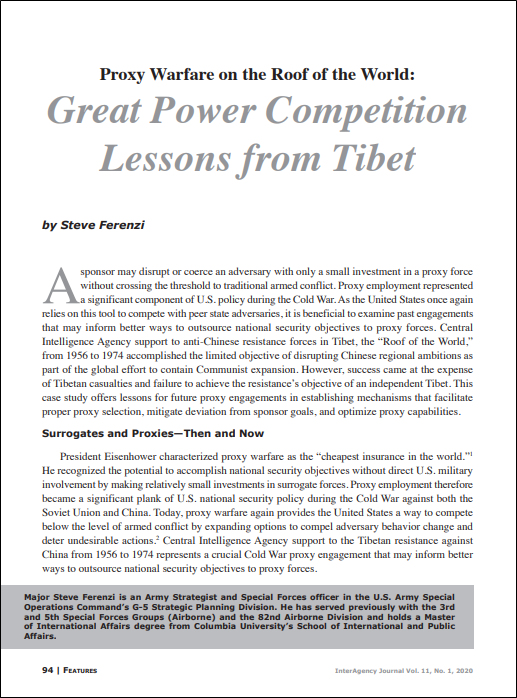
A sponsor may disrupt or coerce an adversary with only a small investment in a proxy force without crossing the threshold to traditional armed conflict. Proxy employment represented a significant component of U.S. policy during the Cold War. As the United States once again relies on this tool to compete with peer state adversaries, it is beneficial to examine past engagements that may inform better ways to outsource national security objectives to proxy forces. Central Intelligence Agency support to anti-Chinese resistance forces in Tibet, the “Roof of the World,” from 1956 to 1974 accomplished the limited objective of disrupting Chinese regional ambitions as part of the global effort to contain Communist expansion. However, success came at the expense of Tibetan casualties and failure to achieve the resistance’s objective of an independent Tibet. This case study offers lessons for future proxy engagements in establishing mechanisms that facilitate proper proxy selection, mitigate deviation from sponsor goals, and optimize proxy capabilities.
President Eisenhower characterized proxy warfare as the “cheapest insurance in the world.” He recognized the potential to accomplish national security objectives without direct U.S. military involvement by making relatively small investments in surrogate forces. Proxy employment therefore became a significant plank of U.S. national security policy during the Cold War against both the Soviet Union and China. Today, proxy warfare again provides the United States a way to compete below the level of armed conflict by expanding options to compel adversary behavior change and deter undesirable actions. Central Intelligence Agency support to the Tibetan resistance against China from 1956 to 1974 represents a crucial Cold War proxy engagement that may inform better ways to outsource national security objectives to proxy forces…
Preparing for Climate Change in the World’s Top Militaries
By Justin Leopold-Cohen
There has been considerable analysis on the competition between the United States, Russia, and China, and potential military conflict. These pieces tend to examine respective militaries’ firepower, troop numbers, hybrid capabilities, and other conventional measures, however, strategists ought to consider how these militaries are preparing for the consequences of climate change. The environment can shape matters at the tactical, operational, and strategic levels just as much as more traditional measures. Be it Napoleon choosing to retreat out of Russia rather than endure the harsh winter, World War II’s delayed D-Day Invasion and effects on allied airpower during the Battle of the Bulge, or visual challenges in Iraq and Afghanistan from sand and dust storms, which were even known to cause lung disease to servicemen after prolonged exposure.
Besides the impact on how military strategy is planned, there is also discussion among military strategy scholars on how climate change will create an increase in armed conflict globally. A 2019 Stanford-led study found that climate has already affected between three and 20 percent of armed conflict risks in the last century and this will increase as more incidents of extreme weather continue to occur. The Stanford study explains that as increasing levels of extreme weather persist, there will be more environmental disasters, negative impacts to national economies, as well as reduction in natural resources, all of which can be drivers of conflict. Given the existing and potential influence of climate on armed conflicts, as well as damage to military infrastructure and humanitarian driven deployments, how are the world’s top militaries preparing for climate change?
The Global Risks Report 2021
In partnership with Marsh McLennan, SK Group and Zurich Insurance Group

The 16th edition of the World Economic Forum’s Global Risks Report analyses the risks from societal fractures—manifested through persistent and emerging risks to human health, rising unemployment, widening digital divides, youth disillusionment, and geopolitical fragmentation. Businesses risk a disorderly shakeout which can exclude large cohorts of workers and companies from the markets of the future. Environmental degradation—still an existential threat to humanity—risks intersecting with societal fractures to bring about severe consequences. Yet, with the world more attuned to risk, lessons can be drawn to strengthen response and resilience. In 2020, the risk of a pandemic became reality. As governments, businesses, and societies grapple with COVID-19, societal cohesion is more important than ever.
Jamestown Foundation: China Brief, January 12, 2021, v. 21, no. 1
Winter Coal Shortages Reveal Chinese Energy Vulnerabilities
Xi Jinping Boosts the Party's Control and His Own Authority
Trouble Finding Partners: Barriers to China’s Overseas Basing
Buying Silence: The Price of Internet Censorship in China
Year-End CCP Politburo Meetings Stress Political Loyalty—and Hint at Potential Shake-Ups in the Party Bureaucracy
Global energy and climate outlook 2020
The Way Forward for the United States in Somalia
The United States Africa Command (AFRICOM) is on track to withdraw almost all U.S. forces from Somalia by January 15, 2021, providing a gratuitous public relations and operational windfall to al-Shabaab, Somalia’s potent al-Qaeda affiliate. The hasty exit compromises the reputation of the United States as a partner and opens the door to a greater role for the People’s Republic of China. President Donald Trump ordered the move precipitously, and the Department of Defense announced it on December 4, 2020. The action puts at risk the security of American citizens, the homeland, and strategic interests. The withdrawal comes at a time when Somalia is in political crisis and jeopardizes the stability of Somalia’s nascent civil government. The incoming Biden administration should reverse the decision and set its own policy and strategy for Somalia.
A decade ago, counterterrorism was the United States’ top national security concern, and Somalia’s newly created transitional government had no capacity to govern. Al-Shabaab controlled most of south and central Somalia, including almost all of Mogadishu. Since then, African Union forces (AMISOM) cleared al-Shabaab from Mogadishu and many other cities and towns. Somalia’s state-building project completed the creation of its constituent member states and conducted two peaceful transfers of power. Yet, recent years saw little progress in building civilian governance, and, in some areas, there was a regression. The United States should apply a whole-of-government approach to help the next Somali government develop more accountable institutions that can improve the lives of its people and weaken and displace al-Shabaab. The military alone is unlikely to resolve this conflict, but military pressure is a key ingredient in bringing about a negotiated solution.
The Threat is Real
From Trump to Biden
David Adesnik
On January 6, 2021, a mob of American rioters stormed the Capitol building in Washington, DC. The ensuing melee led to the killing of a Capitol Police officer and the death of four rioters. The episode was a national disgrace. It was an assault on Congress. It was an attempt to forcibly overturn the results of a democratic election. It was a gift to foreign enemies whose main goal is to see American power and leadership laid low, riven by internal division and chaos. And it would not have happened without the encouragement of the president of the United States, Donald Trump.
The abortive insurrection was launched just as this edited volume on Trump’s national security legacy was about to go to publication. Indeed, FDD’s scholars had the unenviable task of having completed our foreign policy assessments of the most controversial president in modern memory at the very moment the most shocking events of his presidency were unfolding.
Trump’s term in office will forever be defined by the terrible events of January 6. Nothing will change that. To a lesser extent, it will be defined by his mercurial decision-making style. Trump was a “post-policy” president who vexed allies and enemies alike. And as we can attest, he vexed think tankers, too.
United States Climate Politics Under Biden: Is the Clean Energy Revolution Under Way?
Édito Énergie
 For most of United States (US) history, environmental issues enjoyed bipartisan support. While Democratic President Johnson signed the Clean Air Act in 1963, Republican President Nixon established the Environmental Protection Agency (EPA) in 1970. America’s “environmental decade” culminated under President Carter, with Congress enacting ambitious environmental legislation.
 However, the election of President Reagan in 1980 led to a change in paradigm, with neoliberal economic theories becoming dominant within conservative circles. Under pressure from powerful lobbying groups, the Republican Party begun to support a deregulatory and pro-fossil fuel agenda. Partisanship on environmental issues accelerated throughout the 1990s and 2000s, leading to a legislative gridlock in Congress. Not only did President Bush Jr. refuse to ratify the Kyoto Protocol, but his administration worked with interest groups to cast doubt on climate science. While Obama became the first President to enact ambitious national climate policies, he did so mostly during his second term, and had to rely on executive orders since Democrats lost their majority after the 2010 mid-term elections. Unlike legislation, executive action lacks durability; hence, Obama’s climate legacy was vulnerable.
GOVERNANCE OF THE WATER-ENERGY-FOOD NEXUS FOR AN INTEGRATED IMPLEMENTATION OF THE 2030 AGENDA
Srinivasa Reddy
The interdependence among transactions for pursuing WEF securities by actors in the differing action situations generates a need for coordination in changing or sustaining institutions, policy goals and policy instruments that guide actions leading to sustainable outcomes. Coordination is achieved through arrangements based on cooperation, coercion and competition. Coordination in complex social-ecological systems is unlikely to be achieved by a single governance mode but rather by synergistic combinations of such modes. Particular coordination arrangements that emerge in a given context depend on the distribution of authority, information and resources within and across interlinked decision-making centres. Integrating the political ecology-based conceptualisations of power into the analytical framework further extends the governance analysis to include the influence of power relations on coordination. Methodological innovation in delineating action situations and identifying the unit of analysis as well as integrating different sources and types of data are required to operationalise the conceptual framework.
Army working on strategy to prepare networks, workforce for digital transformation
Andrew Eversden
/cloudfront-us-east-1.images.arcpublishing.com/mco/MIORNZ2BUFBJDIJSTGF235DS2Y.jpg)
WASHINGTON —The U.S. Army is developing an enterprise digital strategy as the service prepares its networks and workforce for multidomain operations, the service’s new chief information officer said Friday.
In his first public appearance Friday, Raj Iyer, the first civilian CIO of the Army, outlined his priorities for reforming the Army’s approach to IT after the service split its CIO/G-6 office into two positions to better align its IT positions as the service unifies its global enterprise and tactical networks. Iyer, who started his job in December, will work closely with Lt. Gen. John Morrison, the Army’s first deputy chief of staff for the G-6. Lt. Col. Mary Ricks, an Army spokesperson, said the service hasn’t confirmed a date to release the strategy.
The plan, Iyer said, will go beyond addressing IT infrastructure plans, outlining how the Army will prepare its workforce for the digital age by changing culture and fostering innovation. “It’s about how we leverage technologies, and how we’re going to ... leapfrog into the future with digital transformation,” he said. “But along with that, we’re going to need digital skills, talent management.”
While Iyer has a massive undertaking as the Army prepares for future war-fighting needs, one of his priorities is to control the service’s IT spending. The Army is continually over budget on IT, allotting about $14-15 billion, but spending $16-17 billion, said.
Minilateralism for Multilateralism in the Post-COVID Age
Amalina Anuar, Nazia Hussain
As progress in global governance fora decelerates, minilateralism is increasingly pushed to the fore as a complement, and more provocatively, as an alternative to multilateralism. In contrast to the multiple interests of an expanding and diverse membership, as well as the geopoliticisation of governance issues stemming from escalating US-China tensions, minilaterals offer an edge vis-à-vis informality, select membership, and a narrower issuebased focus. Despite this promise, however, minilateralism has a mixed track record given factors, both external and internal, to minilaterals themselves. Considering a recent slew of recommendations for greater minilateral participation on the part of ASEAN members, and more broadly, countries within the Indo-Pacific, this report examines opportunities for and challenges to enhancing the effectiveness of minilateralism in a post-COVID-19 era, with an eye towards strengthening multilateral governance.
2021- WHAT'S TO COME?

There are quite a few things we know about 2021: it will be 365 days long, include scheduled events such as elections and summits, and the tail end of the Covid-19 pandemic. But what is it that we do not know, should expect, or brace ourselves for?
On 22 January, the EUISS live-streamed its yearly foresight event entitled '2021- What's to come?' on YouTube to help us think through the challenges ahead, anticipate disruptions, and be better prepared for the coming year. More information here.
At the event, the EUISS launched its most recent Chaillot Paper 'What if...not? The cost of inaction', drawing attention to the cost of inaction in a variety of areas, ranging from Russia to Africa, from cyberspace to environmental matters.
Researching Extremist Content on Social Media Platforms: Data Protection and Research Ethics Challenges and Opportunities
 The digital space played a central role in the radicalisation processes of many perpetrators of past attacks: extremists including Anis Amri (Berlin, Germany), Brenton Tarrant (Christchurch, New Zealand) and Stephan Balliet (Halle, Germany) took advantage of social media platforms not only to gather and distribute information, and to network and stage, but also to exchange ideas with like‑minded people and sometimes even to share an attack live for thousands of viewers. It is through this communication by radical or extremist actors that we can learn much about the radicalisation processes that take place in the virtual world. The content and its presentation, as well as the way in which these actors communicate, are of central importance in that regard and can serve as a background against which to develop the most appropriate preventative and demobilising measures.
In the context of this research field, data retrieved from social media naturally has become increasingly important. This is exemplified by numerous scientific publications based on data from social media: for instance, Facebook, Twitter, YouTube and Instagram. An extremely large pool of data can now be accessed and used to develop and test hypotheses. These opportunities go hand in hand with limitations and pitfalls. This relates to potential ethical and data protection requirements, which certainly provide challenges for researchers but also many opportunities. While transparency and the guideline “maximising benefits and minimising harm” are essential throughout the entire research process, there are further principles and guidelines that need to be considered. In the first two sections, we summarise some key ethical considerations that a research process in this academic field should include and we provide insights into the main data protection principles to be observed. We then highlight the opportunities available to and balancing acts required of researchers in this regard. In the third section, we discuss the interplay between researchers, data sources and policies of platforms, and give some key recommendations.
Army Seeks Security For ‘Smart’ Base Networks
By KELSEY ATHERTON

FORT CARSON, Colo. — Two Polaris GEM automated shuttles, custom-configured by Perrone Robotics using their TONY (TO Navigate You) autonomy kit, will operate as Fort Carson post shuttles beginning in mid-September. (Courtesy photo)
ALBUQUERQUE: Data-driven “Smart Cities” networks could make Army bases more efficient, safe, and livable — but the Army needs to make sure they aren’t as vulnerable to cyber attack as civilian Internet of Things technologies have proven to be.
“Our installations are not a safe haven,” said Andrew Nelson, director of the Army Engineer Research and Development Center’s International Research Office in London, at an AFCEA NOVA conference today. “Particularly as we incorporate more technology and smart-cities infrastructure, we’re introducing vulnerabilities to the installation via cyber-physical threats we previously haven’t had to deal with.”
Acknowledging the risks from the start is crucial if the Army is to proceed with its new Installations Strategy, which was published in December 2020 and emphasizes the risk that stateside bases will be attacked. It’s much easier to build safeguards in from the beginning than to try to bolt them on after the fact.
Subscribe to:
Posts (Atom)