Aaron Pilkington
The war in Ukraine is helping one country achieve its foreign policy and national security objectives, but it's neither Russia nor Ukraine.
It's Iran.
Iran is among Russia's most vocal supporters in the war. This has little to do with Ukraine and everything to do with Iran's long-term strategy vis-à-vis the United States.
As Russia's war on Ukraine passes six months and continues eroding Russia's manpower, military stores, economy and diplomatic connections, leader Vladimir Putin has opted for an unlikely but necessary Iranian lifeline to salvage victory in Ukraine and also in Syria where, since 2015, Russian soldiers have been fighting to keep Bashar al-Assad's government in power.
Putin's move has, in turn, helped Iran make progress in promoting its national interests.
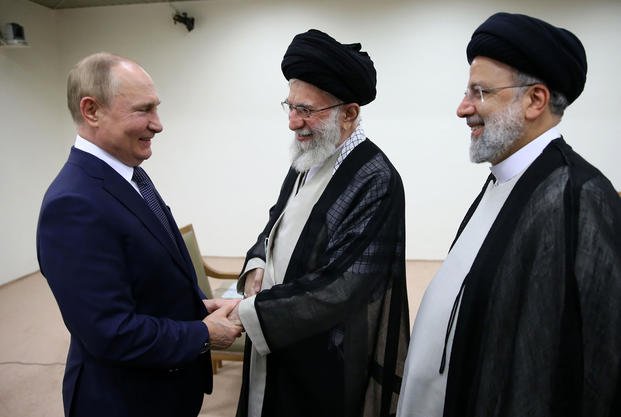 Supreme Leader Ayatollah Ali Khamenei, center, and Russian President Vladimir Putin, left, greet each other as Iranian President Ebrahim Raisi stands at right, during their meeting in Tehran, Iran, Tuesday, July 19, 2022. (Office of the Iranian Supreme Leader via AP)
Opposing the US everywhere
Since the Islamic Revolution of 1979, Iran's leaders have believed the United States is constantly scheming to topple Iran's government. They view leaders in Washington as the greatest threat and obstacle to promoting Iranian national interests – achieving economic self-sufficiency, international legitimacy, regional security, power and influence.
The fears of Iran's leaders are not irrational – the long history of U.S. meddling in Iranian affairs, continuous open hostility between the two countries and decades of U.S. military buildup in close proximity to Iran greatly concern leaders in Tehran.
The U.S. has military forces in many Middle Eastern countries, with or without invitation. To promote its national interests, Iran is working to force the U.S. military out of the region and reduce U.S. political influence there.
Iran has an even bigger aim: to overthrow what it sees as the U.S.-dominated global political order.
Iran counters U.S. influence by maintaining partnerships with an assortment of nonstate militias and governments united by their fierce anti-U.S. hostility. The country nurtures a network of militant partner and proxy groups, whose own political preferences and ambitions align with Iran's objectives, by providing weapons, training, funds – and, in some cases, direction. Among the recipients are Hezbollah, Hamas and Palestinian Islamic Jihad, friendly Iraqi militias and Ansar Allah in Yemen, better known as the Houthis or the Houthi rebels.
Through these militias and their political arms, Iran extends its influence and works to shape an Iran-friendly government in states like Lebanon, Syria, Iraq and Yemen. It threatens U.S. forces and antagonizes Western-allied governments in states such as Israel, Jordan, Saudi Arabia, Kuwait, Bahrain and the United Arab Emirates.
At the national level, Iran maintains no permanent mutual defense treaties. Its closest strategic partners include Syria, Venezuela, North Korea, China and Russia. They cooperate politically, economically and militarily to create an alternative to what their leaders perceive as the U.S.-led world political order.
That cooperation includes undermining U.S. national interests and helping ease or circumvent Western political pressure and economic sanctions.
Tehran to the rescue
Russia's current war in Ukraine has left Moscow with only a handful of sympathetic friends.
Few political leaders understand Putin's newfound political isolation and related animosity toward the United States more than Iranian leader Ayatollah Ali Khamenei. But Iran-Russia relations are complicated.
The two countries found common cause in helping Syrian strongman Assad defeat his country's opposition forces, but for different national interests.
Saving Assad helps Russia reassert itself as a major power in the Middle East. For Iran, a friendly Syria is a critical link in Iran's anti-U.S., anti-Israel coalition.
As Russia and Iran fought to sustain Assad, they also competed for lucrative postwar reconstruction and infrastructure contracts in that country, and to shape the post-civil war political environment to their advantage.
But neither country was bold enough to influence the way the other operated in Syria. Consequently, sometimes Iranian-backed and Russian forces cooperated, and at other times they squabbled. Mostly they left each other alone.
Ultimately, though, Russia's plight in Ukraine compelled its leader to solicit Iran's help in two ways.
First, the Islamic Revolutionary Guards Corps, a branch of the Iranian military, provided supplementary manpower to fill the void left when Russia reallocated troops from Syria to its Ukraine campaign.
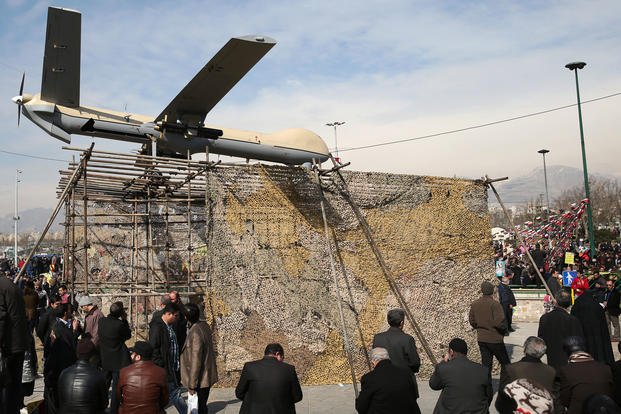
Second, Russia will use Iran's low-cost and battle-proven unmanned aerial vehicles, commonly known as drones, to counter Kyiv's Western-supported arsenal and buttress its own struggling forces and surprisingly inept warfighting capabilities.
In July, Iran hosted numerous Russian officers and conducted training on Iranian Shahed-129 and Shahed-191 drone operations. Anonymous intelligence sources and Ukrainian officials indicated that Russia already has obtained and employed Iranian drones in Ukraine. Though unconfirmed, this is consistent with a previous White House assessment that Iran would provide Russia with "up to several hundred" drones for use in Ukraine.
Ukraine war promotes Iran's interests
This warming alliance may not help Russia defeat Ukraine. It will promote Iran's national interests.
Russia's Syria drawdown brought additional Iranian soldiers there to further prove their fighting abilities and entrench themselves in Syria. That then allows Iran to control territory threatened by anti-Assad forces and maintain an open corridor or "land bridge" by which Iran extends support to its network of anti-America and anti-Israel partners and proxies.
Second, Russia's acquisition of Iranian arms will significantly boost Iran's weapons industry, whose primary clientele right now is its own militias. Iran's recent efforts to expand drone manufacturing and exports yielded limited success in small, mostly peripheral markets of Ethiopia, Sudan, Tajikistan and Venezuela.
Moscow is the second-largest global arms exporter, and its surprising transformation to Iranian arms importer signals the seriousness of Russia's problems. It also legitimizes and expands Tehran's weapons industry beyond arms production for the purpose of self-sufficiency. This one alliance moves Iran toward a more prominent role as a major arms exporter.
Lastly, Russia's war in Ukraine extends a new avenue by which Iran might directly counter U.S.-provided weapons and the opportunity to undermine U.S. and NATO influence in Eurasia. Iran's drones could afford Moscow an effective and desperately needed response to U.S. weapons wreaking havoc against Russian forces in Ukraine – the High Mobility Artillery Rocket System, the Javelin anti-tank guided missile, the Switchblade "kamikaze" or suicide drone and others.
Iranian weapons may force Ukraine's Western benefactors to allocate additional billions for counter-drone or air defense systems, or aid to replace assets that Iranian weapons potentially neutralize.
This has already happened on the Arabian Peninsula, where Iran-equipped Ansar Allah's drone warfare against Saudi Arabia and the UAE compels Gulf states to expend disproportionate sums on costly weapons systems and to develop other expensive solutions to counter Iran's low-cost drones.
Zero-sum game
Limited tactical victories scored by Iranian drones may prolong and further destabilize the war in Ukraine, but they will not tip the scales of conflict in Russia's favor.
Their greater contribution is to Iran's national interests: They allow Iran to directly check and undermine the U.S. and NATO outside of Iran's usual regional area of operations. They boost Iran's profile among countries that also wish to challenge the United States and NATO's political, military and economic power. And they strengthen solidarity among those countries.
As Iran's fighters, advisers and weapons proliferate to new areas and empower U.S. adversaries, Iran further promotes its national interests at the expense of U.S. national interests.
No comments:
Post a Comment