Alexander Hill
Vladimir Putin’s “special military operation” in Ukraine is approaching its first anniversary. The war being fought by Russian forces today is, however, very different from that being fought when Russia first invaded Ukraine.
In February 2022, the Russian attack on Kyiv — seemingly aimed at bringing about regime change in Ukraine — soon faltered. It quickly became apparent that the current Ukrainian regime would not simply collapse.
Putin appeared to have ignored or not been told about improvements in the Ukrainian armed forces that separatist and Russian forces fighting in the Donbas region since 2014 experienced first-hand. Nonetheless, during the first weeks of the war, Russian forces secured significant territory in eastern Ukraine.
Russia’s war of movement, however, soon degenerated into the sort of fighting that it’s engaged in today. Ukrainian forces also recaptured territory relatively quickly in the fall of 2022, but their war of movement has also come to an end for the time being.
Neither side has been able to gain a decisive advantage on the battlefield. Russia’s army in Ukraine has not collapsed — despite the predictions of many western observers — and shows no signs of doing so. Here’s why.
Redeploying forces
Russia’s attack north of Kyiv was undoubtedly a debacle and it was halted, resulting in a redeployment of Russian forces to the east. That move both greatly simplified Russian supply lines and meant more troops in the east. The Russian pullout from territory near Kherson, in southern Ukraine, had the same effect.
Russia invaded Ukraine with an army far too small to wage a major war there.
Although Putin for many months wouldn’t acknowledge that his so-called special military operation in Ukraine was in fact a full-fledged war, he has certainly now done so — both in words and actions.
His change of tack has been accompanied by a considerable strengthening of Russia’s army in Ukraine. The partial mobilization of reservists has given the Russian army far greater human resources than it started with.
The Russian reservists are concentrated in the east of Ukraine, and they are on the defensive across most of the front lines. This defensive posture means fewer lives lost and more resources than the offensive operations across a wider front nearly a year ago.
Russian offensive operations are now largely focused on trying to secure the remaining territory of Donetsk and Luhansk. Securing that territory was a core justification for the invasion.
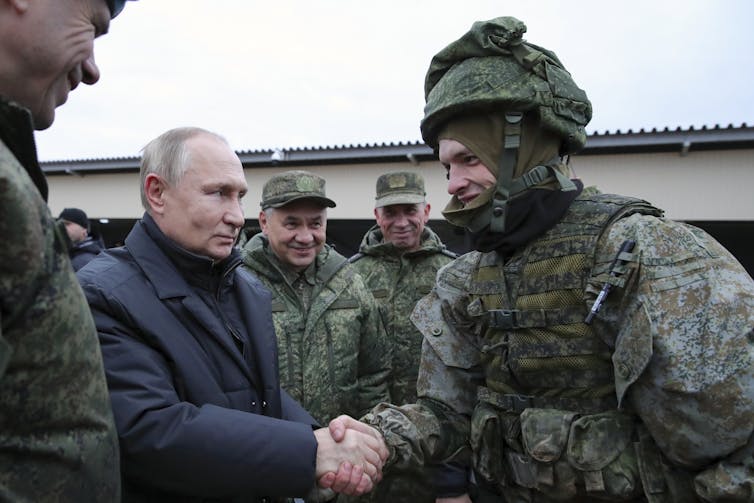 Russian President Vladimir Putin shakes hands with a soldier as he visits a military training centre of the Western Military District for mobilized reservists in the Ryazan region of Russia in October 2022. (Mikhail Klimentyev, Sputnik, via AP)
‘Grinding advance’
Russia’s current operations in the region of Bakhmut in Donbas are not making rapid progress, but constitute the sort of grinding advance that in many ways better suits the Russian army.
The types of problems with the “command and control” of Russian troops at the beginning of the war have been reduced for operations of more limited scope. Typically less experienced and lacking extensive training, Russian reservists are better suited to the more limited and methodical operations of today.
Russian forces also have considerable experience fighting the sort of artillery-heavy war now being fought.
Russian forces attempted to rush the Chechen capital of Grozny back in late 1994 in a manner not dissimilar to the attack on Kyiv in 2022. In the light of that failure, they adopted the sort of tried-and-tested, artillery-centred approach honed during the Second World War to reduce the city before capturing it. That approach was applied to Mariupol.
As an historian of the Russian and Soviet military, I am well aware of what might be regarded as a Russian cultural disposition towards rash initial offensive operations that make way to a more methodical and measured follow-up. In addition to the case of the seizure of Grozny during the Chechen wars, the Soviet Union’s great Patriotic War is littered with examples of this phenomenon.
This has often been accompanied by a psychological doubling-down and a deeper commitment to the task in hand. There are plenty of signs that this has been the situation for the Russian army since the fall.
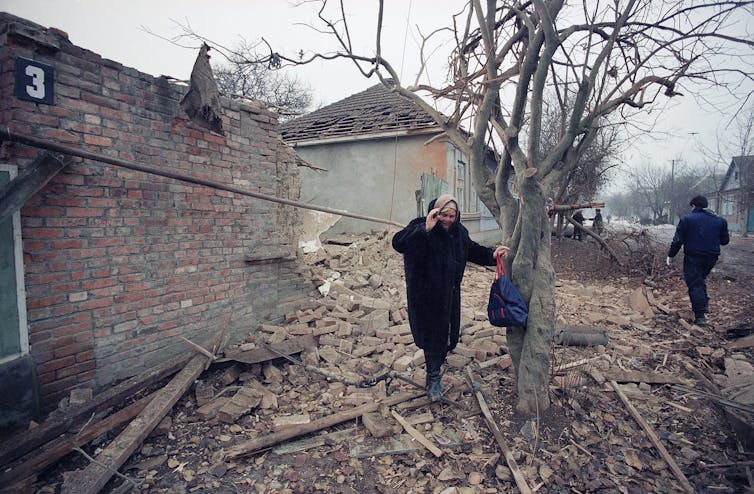 Chechen citizens look over the rubble of destroyed houses during a lull in the fighting in Grozny in January 1995. (AP Photo/Mindaugas Kulbis)
Distrust of the West and NATO
Despite Russian losses and setbacks, public opinion polls suggest Russia’s population still supports the war effort in Ukraine. That support is crucial for the army fighting in Ukraine.
Western support of Ukrainian efforts to recapture all territory lost since 2014 is the sort of no-compromise stance that feeds acceptance of the Russian government’s argument that the West has been out to get Russia for some time, and that NATO’s expansion to Russia’s borders is part of a process that justifies Russia drawing a line in the sand.
Many Russians consider Crimea a core part of Russia, and western support for Ukraine’s attempts to recapture it is a particular affront.
Both sides will suffer shortages in manpower and material as the war drags on. Russia has large reserves, along with a handful of overt allies like Iran and North Korea — whereas Ukraine is backed by the weight of the NATO alliance.
Long war is likely
Both sides therefore have the capacity to keep fighting for the foreseeable future. More western equipment, including some of the latest western tanks and other armoured vehicles, will undoubtedly strengthen the Ukrainian military in the short term. But more vehicle types complicate training, maintenance and supply issues.
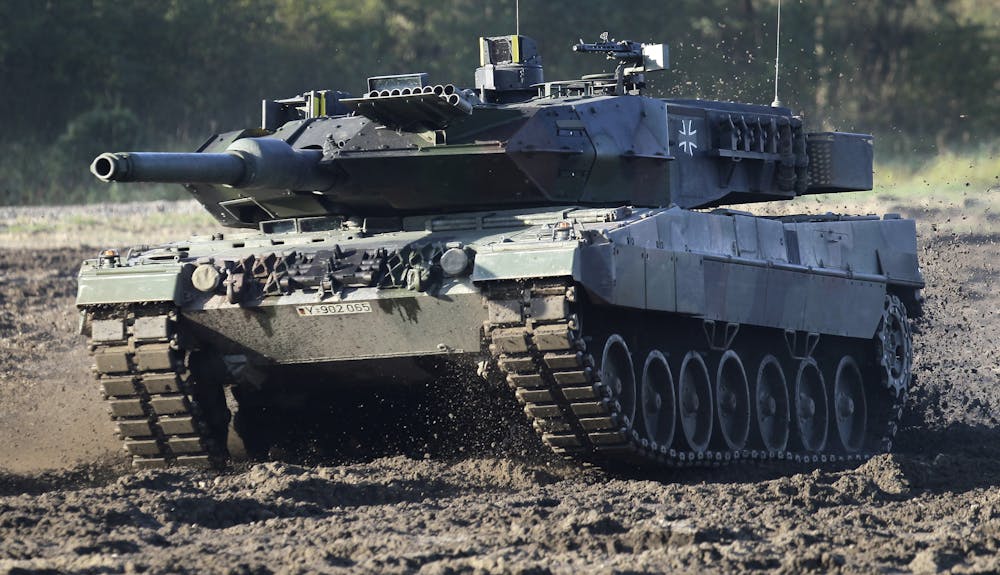
A Leopard 2 tank is pictured during a demonstration event in Germany. The Germans are still determining whether to send the tanks to Ukraine. (AP Photo/Michael Sohn)
Now that Germany has agreed it will supply Ukraine with tanks, Putin has a considerable propaganda victory. Parallels were already being drawn in the Russian media between the German invasion of the Soviet Union in June 1941 and the prospect of German tanks on the battlefield in Ukraine today.
If the war continues along its current trajectory, neither side is likely to gain a decisive advantage. One side or the other may gain temporary advantage as they escalate and counter-escalate, but any advantage for either Russia or Ukraine is unlikely to be sustained.
Sadly, in the absence of any negotiations — and certainly meaningful talks in which both sides will have to give as well as take — the bloodshed is likely to continue for some time yet.
No comments:
Post a Comment