28 June 2014

CHINA’S PROBLEM WITH RULES: MANAGING A RELUCTANT STAKEHOLDER

June 26, 2014 

Many admonish the United States for not finding a more far-sighted way to manage strategic competition with a reemerging China. However, the ongoing search for a bilateral strategic roadmap has proven quixotic largely because of China’s reluctance to embrace international norms and rules, especially in the realm of national security. From maritime disputes to economic cyber theft, China is keen to exert its newfound power rather than to be bound by multilateral rules. Meanwhile, the ongoing crackdown on domestic freedom in China only reinforces fears that Beijing will treat neighbors as subordinates and remain a reluctant global stakeholder for decades to come.

Major General Zhu Chenghu recently claimed that “the Americans are making very, very important strategic mistakes right now” in their dealing with China. “If you take China as an enemy,” he expanded, “China will absolutely become the enemy of the U.S.” But while General Zhu seeks to defend Chinese coercion through punchy talking points, he glosses over China’s role in determining the fate of regional peace. As Joseph Nye is fond of saying, “only China can contain China,” because neighbors will respond to the tenor of Chinese behavior.

Far from seeking to create a new Cold War in Asia or contain China, the United States wants to see the amazing development and dynamism of Asian economies continue. But this will require continued consensus on certain rules, which is challenging in no small part because China apparently does not want to buy into the post-World War II international system that it did not play a role in creating. Yet China claims that it wants to play a responsible role and that it wants to create rules. From the Shanghai Cooperation Organization and an Asian infrastructure bank, to proprietary dialogues with Southeast Asia and both Koreas, China wants to be “present at the creation.” In short, China wants to make rules that are mindful of Beijing’s point of view if not Sinocentric.

Surprise: US-China Military Ties Are Actually Improving

June 27, 2014

U.S.-China military relations have a long way to go, but they’ve improved substantially in the last four years. 
Today marks the start of RIMPAC 2014, the largest naval exercise in the world. For the first time, China is among the participants in this U.S.-organized exercise. As Ankit noted on our Flashpoints blog, China’s participation in RIMPAC is unlikely to fundamentally change the nature of U.S.-China mil-to-mil relations. However, in the midst of angry rhetoric on both sides (particularly at the Shangri-La Dialogue), it’s easy to forget that the military aspect of the U.S.-China relationship has actually been on the upswing in recent years.

Back in 2010, military relations were so fragile that China cut them off completely in retaliation for a U.S. arms sale to Taiwan. At that time, then-U.S. Secretary of Defense Robert Gates noted in frustration that the military-to-military relationship was the only area were progress was “held hostage” by other concerns. He then publicly repeated the desire of U.S. President Obama and then-Chinese President Hu Jintao for “sustained and reliable military-to-military contacts at all levels that reduce miscommunication, misunderstanding, and miscalculation.”

At the time of Gates’ remarks, freezes on mil-to-mil contacts were the exception rather than the norm. Such contacts had been severed numerous times in the past, usually for precisely the reason they were cut off in 2010: as an angry Chinese response to a U.S. arms sale to Taiwan. However, since the resumption of mil-to-mil contacts in January 2011, the military aspect of the relationship has been remarkably stable.

After Gates’ ice-breaking visit to China in 2011, a slew of official military-to-military contacts followed. General Chen Bingde, Chief of the PLA General Staff, came to the U.S. in 2011, and Minister of Defense Liang Guanglie followed in 2012. Liang’s visit was a huge step forward for U.S.-China mil-to-mil relations. Many had assumed China would cancel the trip in the wake of yet another U.S. arms sale to Taiwan, and the diplomatic tensions arising from the Chen Guangcheng incident. Liang himself said that his visit to the U.S. “is a kind of turnover in the China-U.S. military relationship.”

Since that “turnover,” U.S.-China military contacts have been more frequent than ever before. Both Admiral Samuel Locklear, commander of U.S. Pacific Command, and then-Secretary of Defense Leon Panetta made the journey to China in 2012. China’s Minister of Defense Chang Wanquan came to the U.S. in 2013, and new Secretary of Defense Chuck Hagel was in China earlier this year. General Martin Dempsey, chairman of the Joint Chiefs of Staff, and his Chinese counterpart Fang Fenghui also traded visits in 2013 and 2014.

Keeping military-to-military contacts stable and regular has been a stated goal for Obama and Hu as well as Xi Jinping. In part, this may be a sign that China in particular is more interested in such a dialogue. In the past, many experts felt that China did not value the security dialogues very highly, and so such meetings became diplomatic scapegoats, sacrificed to prove China’s displeasure with various U.S. actions. Now, however, China seems just as interested in having serious discussions about U.S. military policy (especially the “rebalance to Asia”) as the U.S. is to speak with China.

ISIS Tries to Grab Its Own Air Force


06.25.14 

In its march to Baghdad, ISIS seized the heavy weapons of a modern army. Now, the jihadists are attacking Iraq’s biggest air base – and could soon be able to attack from the sky. 

The Islamic State of Iraq and al-Sham is threatening to take control of Balad Airbase, Iraq’s largest airfield and one of America’s most important military outposts during its occupation of the country. 

Today, Balad still has plenty of vehicles and aircraft on the base that any terrorist group would covet, including Russian-made transport helicopters, surveillance planes, and a fleet of pickup trucks fitted with heavy machine guns.

Now, that airbase is coming under fire—and is in danger of falling into the hands of ISIS, according to U.S. intelligence officers, internal reports from Balad, and outside analysts. Reuters reported Wednesday that the base was now surroundedon three sides by insurgents and taking heavy mortar fire. 

“We assess the group continues to threaten the air base and Iraqi Security Force control of the air base as it moves south towards Baghdad,” a senior U.S. intelligence official told reporters Tuesday. 

Of course, even if ISIS were to gain control of Balad, there is no guarantee its fighters would know how to operate or maintain the aircraft that are stored there. But an ISIS takeover of Balad would be significant nonetheless. As NBC News reported Tuesday, Iraqi officers say without air support they are on an equal footing with ISIS fighters. 

Baghdad a ‘legitimate threat’ to fall, Pentagon says

BY JAMES ROSEN AND JONATHAN S. LANDAY 
June 24, 2014 
Source Link

A general view from a helicopter shows Baghdad, Iraq, Monday, June 23, 2014.

WASHINGTON — Ninety U.S. military advisers arrived in Baghdad on Tuesday to begin assessing Iraqi security forces’ ability to regain control of the embattled country, with the Pentagon acknowledging for the first time that the Iraqi capital could fall to Islamist militants.

The new arrivals joined 40 American troops sent to Baghdad on June 15 to form 130 of the up to 300 U.S. forces that President Barack Obama announced last week he was rushing to Iraq to help counter a two-week offensive by the militants.

Rear Adm. John Kirby, the Pentagon spokesman, said the 130 Americans would take two to three weeks to assess the current security situation and recommend how to dispatch the additional up to 170 military advisers to Iraq.

“It’s a measured, deliberate approach to help us and (Iraqi security forces) get better eyes on the situation and what they’re facing,” Kirby told reporters.

Kirby pushed back at one journalist’s description of such an approach as “rather leisurely,” given how quickly the Sunni insurgents, the Islamic State of Iraq and Syria, or ISIS, have seized a broad swath of cities and territory north of Baghdad.

“Everybody shares a sense of urgency here about what is going on inside Iraq,” Kirby said.

Pakistan: Ten Days after 'comprehensive' Operations in North Waziristan:

By Dr. S.Chandrasekharan.
Dated 27-Jun-2014
http://www.southasiaanalysis.org/node/1554

Though intensive operations against the TTP commenced on 23rd May 2014, the Inter Services Public Relations (ISPR) formally christened the operation as “Zarb-e-Azb” on 15th of June. This was a week after the audacious attack by the TTP on Karachi International Airport on the morning of 8th June. 

The statement from ISPR said that “using North Waziristan as a base, the terrorists had waged a war against the State of Pakistan and had been disrupting our normal life in all its dimensions, stunting growth and causing enormous loss of life and property.”

The Director General of ISPR added that the terrorists had also paralysed life and perpetually terrorised the entire peace loving and patriotic population. He said that the Afghan National Army and the Afghan Border Police have been requested to help and seal the porous border. The irony is that such calls were coming from the other side-Afghanistan to their counter parts in Pakistan till recently!

The Pakistan Army called it a “comprehensive operation” involving air force, artillery, tanks and thousands of ground troops. Unofficial estimates put the number of troops involved as much as 40,000.

Nawaz Sharif accompanied by the Army Chief visited the Hqrs of the Peshawar Corps for a briefing on the continuing operations. Sharif had promised full financial support to ensure success of the operation. 

In the absence of independent information, one has to go by the official handouts of the ISPR. There are many varied reports on the casualties inflicted on the militants and adding up the daily figures published do not give a true picture. One report indicates that over 300 militants have been killed so far and twenty-three hideouts destroyed. The figure is high and it is suspected that the numbers in a few cases includes civilians too. On the Army’s side eight have been killed and seven injured. 

It’s Not Our War


The United States should help others crush ISIS, and not much else. 
ISIS is well-armed, but not invincible. 

Despite prodding from the United States and others, Iraqi Prime Minister Nouri al-Maliki doesn’t want to share power, the Kurds don’t want to give up a shot at independence, and the Sunnis would rather stick with murderous jihadist protectors than trust a Shiite government that shuns their demands and persecutes their leaders.

Fred Kaplan is the author ofThe Insurgents and the Edward R. Murrow press fellow at the Council on Foreign Relations.

Should any of this surprise us? More to the point, why do some among us persist in thinking that, through three cups of tea and a few well-aimed airstrikes, we can persuade sectarian chieftains to cede their vital interests to some greater good as defined by foreign powers?

Earlier today, after meeting with Secretary of State John Kerry, Maliki denounced the demands for a new, more inclusive Iraqi government, saying that such a move would amount to a“coup”—which, indeed, it would. Maliki recently won the popular vote in a national election, and while his party hasn’t yet assembled a working majority in parliament, no other obvious leader sits poised on the sidelines. Maliki knows that the countries most keen to beat back the Sunni jihadists of the Islamic State in Iraq and Syria—especially Iran, the neighboring ally that counts most—have no choice but to support him for now. He might also look for inspiration from Bashar al-Assad, whose days as Syrian president were long ago deemed over and who nonetheless hangs on. Not only do delusions run deep, sometimes in the short run they’re justified.

SOMETHING IS ROTTEN IN THE STATE OF IRAQ

June 26, 2014 · in Commentary
The monthly death toll in May 2014 was Iraq’s highest since 2008. The year 2013 was the most murderous in five years. In late 2013, violence flared in western Iraq’s Sunni Anbar province, as fighters from the Islamic State of Iraq and the Levant (ISIL) and an assortment of local groups — Naqshbandis, Sunni tribes, ex-Ba’athists, and the like — angry at the repressive and marginalizing sectarian policies of Nuri al-Maliki’s government and the behaviour of its security forces in the region, rose in revolt. Around 300,000 people fled their homes, and towns such as Fallujah and Ramadi fell into the hands of the rebels. Elements of the government’s security forces also abandoned their posts and fled. Washington was not entirely indifferent, and it sped up the supply of Hellfire missiles and UAVs to Maliki’s sectarian armed forces.

But it has taken June’s dramatic fall of the heavily garrisoned Sunni Arab city of Mosul to ISIL fighters and their allies, the no less dramatic collapse of the largely U.S.-equipped, funded and trained Iraqi security forces, and the continuing advance of Sunni forces towards Baghdad and indeed into Anbar province, to have finally led Washington to the conclusion that something is rotten in the state of Iraq. Secretary of State John Kerry has ridden into town insisting that the Iraqis form a government of national unity in order to attract serious U.S. aid and repel the Sunni onslaught.

A government of genuine national unity that brings together the various sects and ethnicities to fight against a common threat is a thought that is as nice as it is unrealistic. If there is any chance that it could happen, Maliki must first go, although there is little sign that he is prepared to fall on his sword and every likelihood that his followers would resent him being forced to do so. In the wake of Mosul’s fall, Sunni Arab and Kurdish lawmakers mostly absented themselves from a parliamentary session that Maliki had hoped would grant him a state of emergency, seeing it, surely correctly, as a bid to finally establish himself as Iraq’s new dictator. Many of them, and some Shias too, had already indicated in the wake of the April election that they were no longer willing to acquiesce in his rule.

But it is arguable that even a coalition government sans Maliki is unlikely to have much genuine unity about it. Sunni politicians will be loathe at this juncture to align themselves — even if they can be leaned on to do so — with a predominantly Shia government relying on a primarily Shia security apparatus, Shia militias, and perhaps U.S. bombardment, to keep at bay the rich diversity of Sunni groups that fought their way to the gates of Baghdad. Their dilemma would be even worse if Tehran decides to adopt the role of Maliki’s cheerleader-in-chief, let alone were it to elect to contribute directly to the fight. This is a Sunni-Shia fight and Washington is at imminent risk of sliding down a slope that results in an American military contribution to the further humiliation of the Sunnis at the behest of the majority Shias and Iran. Many Sunnis already interpret Washington’s long-standing acquiescence in Maliki’s relentlessly divisive behavior in that way.

What Has Become of the Free Syrian Army and Other Pro-Western Syrian Rebel Groups? Has ISIS Destroyed Them All?

Syria: The Rebels Are Screwed
June 26, 2014
strategypage.com

The U.S., NATO and Saudi Arabia are discussing what to do about their support for the Syrian rebels. The main problem is the Islamic terrorists, who are hostile to the Syrian government as well as all the nations supporting the rebels. This is an embarrassing situation for Saudi Arabia where much of the current Islamic terrorism originated over the past few decades. The Saudis officially support Islamic 

conservatism because that is popular throughout Arabia and especially in the areas (Mecca and Medina) containing the most holy Islamic shrines. But the most extreme of the Islamic conservatives consider the Saudi royal family not Islamic enough and seeks to impose an Islamic religious dictatorship. This has been the goal of Islamic extremists for over a thousand years. It never happens, but keeps exploding into periods of Islamic terrorism before it is crushed again but never completely eliminated, at least in Arabia. The Saudis have controlled Islamic terrorism within their kingdom but at the cost of still tolerating Islamic radicals who behave (or else). That arrangement is rare and does not exist anywhere else. In Syria and Iraq the Saudis now support the extermination of Islamic terrorists. This means the Assad government is no longer the main target in Syria. This also means that the Saudis and Iranians have to pause their growing Sunni-Shia feud because both countries have more to fear from ISIL Sunni Islamic terrorism than from each other. Western nations know they are already on the ISIL radar and are cracking down on ISIL fund raising and recruiting in the West. Where does this leave the Syrian rebellion? The secular rebel groups and acceptably moderate Islamic rebels already have a coalition of sorts although that currently includes unacceptably radical groups like al Nusra. In short, things do not look good at all for the rebels. They are screwed.

The rebels are crippled mainly because the six month long internal civil war between ISIL (Islamic State in Iraq and the Levant) and all the other rebels (half of them rival Islamic terrorists and the rest secular and tribal groups) has weakened rebel resistance. The government has been taking advantage of this and attempting to aid their fellow Shia in Iraq with air attacks in western Iraq. The Assads see themselves as soon winning the civil war, now that they have the Saudis, the Israelis and the West on their side.

The Rise of ISIS

Der Spiegel
June 26, 2014

The jihadist group Islamic State of Iraq and Syria is relatively new on the scene, but its secretive leader Abu Bakr al-Baghdadi has quickly transformed it into one of the most feared terrorist groups around. It threatens to completely transform the Middle East.

Brigadier General Saad Maan trudges through the midday heat to the Iraqi army’s Baghdad “operation room” as his aides shove updates into his hand and whisper into his ear. His mobile phone rings constantly. The command center of the Iraqi military is located in the Adnan Palace, a pompous structure built by Saddam Hussein between the crossed-swords monument and the new US Embassy.

General Maan is the public face of the security apparatus. Until recently, his job consisted of explaining to his country what the army and police were doing in response to the repeated terror attacks in Baghdad. But for the last two weeks, Maan is no longer talking about “incidents.” Iraq’s army is now engaged in war, and Maan has begun speaking about “the front.”

Inside the operation center, he traces the frontline on a map. “The greatest danger is not in the north,” he says, “rather it is to the south and the west, among the farms and canals in Babil Province and between the fields and palm orchards of Anbar.”

Huge traffic jams have clogged the road to the Baghdad airport in recent days as people hurry to leave. Embassies have evacuated personnel while foreign companies have sent many of their workers out of the country. Meanwhile, private security companies in Baghdad more than doubled their fees within just a few days last week. Fuel and food prices have also spiked, partially due to the ongoing fighting around the Baiji oil refinery, the most important such facility in the northern part of the country. But ISIS advances have triggered chaos elsewhere in the country as well: On June 10, the jihadist militia took over Mosul and then marched into Saddam Hussein’s hometown of Tikrit the very next day. Now, ISIS fighters are just a few dozen kilometers from Baghdad.

Commandos Versus Roadside Bombs The Pentagon is worried its elite forces aren’t ready to spot Afghanistan IEDs


After more than a decade of fighting in Afghanistan, the Pentagon is worried that American commandos might not be able to spot and avoid roadside bombs. The Joint Improvised Explosive Device Defeat Organization—or JIEDDO—outlined these concerns in contract documents released on June 24.

JIEDDO is looking to pay private contractor Orbis Operations more than $600,000 to teach special operators how to spot and identify IEDs. Orbis will be on the hook for nine of these “situation awareness training” sessions between July and August.

The reasons for the training program were detailed in a so-called “Justification and Approval” document. The Pentagon needs a J&A any time it wants to give a contract to one company without a having to take any other offers.

This training will fill a “critical and life-threatening … gap,” according to JIEDDO. Until earlier this year, elite forces could largely rely on regular Army engineers and bomb squads to clear the homemade munitions.

The ground combat branch’s specialized equipment and highly trained bomb technicians have been in great demand over the last decade. But Washington is drawing down in Afghanistan and pulling out many of those vital troops. 

Conversely, commandos working to train local forces will probably be among the last to leave. The Pentagon says these Special Operations Forces lack the training and gear to best protect themselves against IEDs—“the number one killer on the battlefield.”

Elite troops “received minimal route clearance, detection and removal … specialized [counter-IED training], if any,” the Pentagon’s improvised munitions experts say. The situational awareness training was apparently “not considered critical for SOF units and [was] not part of theirpredeployment training” before they headed out to Central Asia.

If true, one could only wonder why the Pentagon did not fix this glaring omission years ago. However, these dire claims could be more for the benefit of Pentagon budgeteers than anyone else.

For one, JIEDDO admits that commandos have already cleared hundreds of IEDs across Afghanistan in recent weeks as the spring fighting season heats up. These forces are managing without the additional courses.


In addition, special operators might not have all the unique Army engineering tools, but they’re hardly unprepared. U.S. Special Operations Command has bought the blast-deflecting trucks seen in the picture above, radio jammers and other life-saving equipment for its forces in Afghanistan.

RIMPAC 2014 – THE INS AND OUTS


On June 26th, one of the world’s largest and most significant naval exercises began in and around Hawaii. Rim of the Pacific (RIMPAC) is a biannual event led by the United States Navy and usually involves maritime forces from more than n Pacific countries, including Canada. Although the exercises have been held consistently since 1971, this year’s edition promises to have an unprecedented impact on military and strategic affairs in the Asia-Pacific region. 

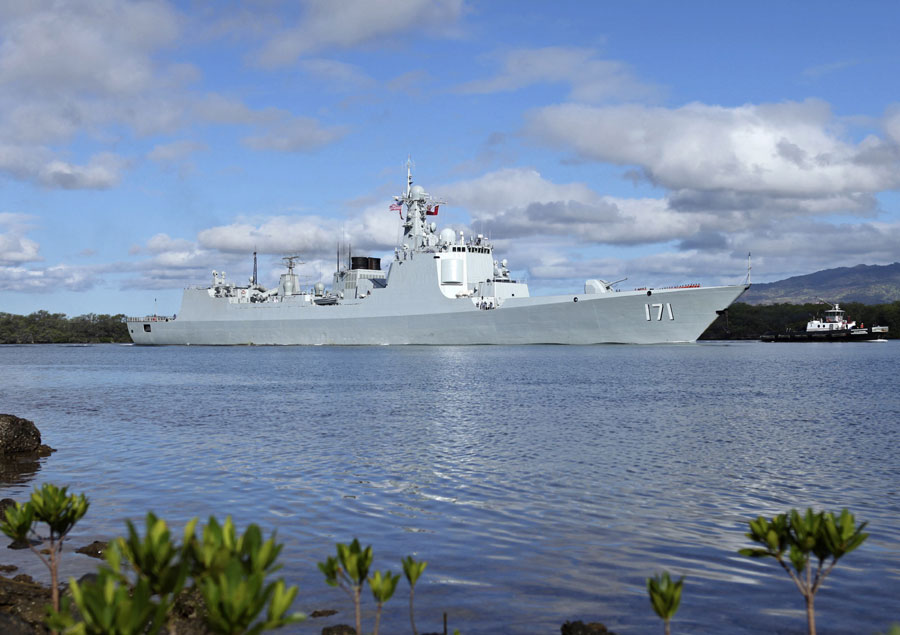
Chinese People’s Liberation Army Navy (PLAN) destroyer Haikou (171) at Joint Base Pearl Harbor-Hickam in Hawaii
Of particular note, 2014 marks the first time China participates in RIMPAC. Previous editions have involved regional neighbours, like Japan and South Korea, but curiously excluded the People’s Liberation Army Navy (PLAN). Early this year, as planning was underway for the upcoming edition of RIMPAC, the US extended an invitation to China for the first time. However, the fallout from the Shangri-La Dialogue in Singapore on May 31-June 1 left considerable doubt that China would accept the invitation. It therefore came as a surprise when China formally accepted the invitation one week after the heated debate in Singapore. In a move that could help reduce regional tensions, four PLAN vessels have participated in the exercise, serving alongside ships from other participating countries, like Japan, the Philippines, and Canada.

This is also the first RIMPAC exercise for the small Southeast Asian state of Brunei. The Royal Brunei Navy is a rather small force, especially in comparison to the impressive naval might of nearby Singapore, but it has contributed two off-shore patrol vessels. These smaller ships, the KDB Darussalam and KDBDarulaman, are also Brunei’s newest acquisitions and so RIMPAC is viewed as an opportunity to test out their capabilities in simulations of large-scale maritime combat operations.

With Brunei, participation in RIMPAC increases among Association of Southeast Asian Nations (ASEAN) members to six out of ten, indicating a willingness by the bloc to become more actively involved in Pacific security. The four member states not participating in 2014 either lack the capacity to participate, such as landlocked Laos, or they were not invited to participate, such as the despotic regime in Burma.

While China and Brunei are in this year, Russia is out. In 2012, Russian maritime forces joined RIMPAC for the first time. Three vessels took part, led by the destroyer RFS Panteleyev, which had previously served alongside NATO forces as part of Operation Ocean Shield. But with tensions rising over Russia’s actions in Ukraine, no invitation was extended to join RIMPAC in 2014.

U.S.-Cuba Relations May Be Thawing

JUNE 20, 2014

U.S. President Barack Obama (L) greets Cuban President Raul Castro during Nelson Mandela's memorial service in 2013. (Chip Somodevilla/Getty Images)

A breakthrough in U.S.-Cuba relations may be in the offing. On June 14, Uruguayan President Jose Mujica delivered a letter from U.S. President Barack Obama to Cuban President Raul Castro, according to Uruguayan media June 20, containing an offer to begin talks on a variety of issues, most prominently Washington's longstanding economic embargo. According to Uruguayan media, Obama had asked Mujica to help him improve relations with the island nation when Mujica was in Washington in mid-May. If the report is true, the transaction could be the first step toward reconciliation.

Cuba certainly has its reasons for entertaining such an offer. The country's main benefactor, Venezuela, may no longer be in a position to support the Cuban economy. In fact, Venezuela is in the throes of a protracted economic crisis, which is owed partly to declining oil production. Since Cuba depends heavily on Venezuelan oil exports, it may soon have to look elsewhere for its energy needs. Castro was supposedly interested in Obama's offer, provided that it did not necessarily impose conditions on Cuba, but given the situation in Venezuela, Castro would demand that the embargo be lifted in any negotiations.

Normalized ties would also benefit the United States, which is concerned with Russia's attempts to improve relations with Latin America. Though the Cold War is over, Washington still does not want any country, let alone Russia, to establish too strong a presence in a country as geographically close as Cuba. That Havana is so close to Caracas may also help the United States make some political overtures to the government of Venezuelan President Nicolas Maduro, though Venezuela's future stability and willingness to engage the United States largely depends on Maduro's political support and the country's economic conditions. However, Cuba's influence in the Venezuelan military and intelligence organizations could facilitate future communication between Washington and Caracas.

Still, domestic considerations will delay any potential reconciliation between Cuba and the United States. Under the 1996 Cuban Liberty and Democratic Solidarity Act, lifting the embargo and ending sanctions requires U.S. congressional approval, which hinges on a variety of issues, including human rights improvements and the election of a new government in Havana. Obama cannot simply approve an agreement to normalize relations with Cuba.

In any case, an agreement would have to be agreed upon by both sides -- no small feat, given the decades of animosity between the two. In the United States, improved public opinion toward ending the embargo would help future negotiations, but opposition lawmakers could impede the government's efforts. For its part, Cuba has been liberalizing its economy slowly for nearly four years, and the concerns some Cuban leaders have over opening up an erstwhile closed country could delay the pace of any talks.

Of course, both countries have ways of moving the negotiations forward if they wish. These include possible prisoner exchanges. In fact, Obama has already reportedly asked Cuba (via Uruguay) to release Alan Gross, a U.S. citizen held in Cuba since 2009 for subversive activity. Discussions over the release of prisoners would be a strong sign that a larger negotiation is imminent.

Reprinting or republication of this report on websites is authorized by prominently displaying the following sentence, including the hyperlink to Stratfor, at the beginning or end of the report.

"U.S.-Cuba Relations May Be Thawing is republished with permission of Stratfor."

At the 'End of History' Still Stands Democracy


By FRANCIS FUKUYAMA
June 2014 

A crowd tries to climb the Berlin Wall on Nov. 10, 1989, the morning after it was first breached Getty Images 

Twenty-five years ago, I wrote the essay "The End of History?" for a small journal called the National Interest. It was the spring of 1989, and for those of us who had been caught up in the big political and ideological debates of the Cold War, it was an incredible moment. The piece appeared a few months before the fall of the Berlin Wall, right about the time that pro-democracy protests were taking place in Beijing's Tiananmen Square and in the midst of a wave of democratic transitions in Eastern Europe, Latin America, Asia and sub-Saharan Africa. 

I argued that History (in the grand philosophical sense) was turning out very differently from what thinkers on the left had imagined. The process of economic and political modernization was leading not to communism, as the Marxists had asserted and the Soviet Union had avowed, but to some form of liberal democracy and a market economy. History, I wrote, appeared to culminate in liberty: elected governments, individual rights, an economic system in which capital and labor circulated with relatively modest state oversight. 

Looking back at that essay from the present moment, let's begin with an obvious point: The year 2014 feels very different from 1989. 

Russia is a menacing electoral authoritarian regime fueled by petrodollars, seeking to bully its neighbors and take back territories lost when the Soviet Union dissolved in 1991. China remains authoritarian but now has the second-largest economy in the world, as well as its own territorial ambitions in the South and East China Seas. As the foreign-policy analyst Walter Russell Mead recently wrote, old-fashioned geopolitics has returned big time, and global stability is being threatened at both ends of Eurasia. 

History's Warning: A U.S.-China War Is Terrifyingly Possible

June 26, 2014 

The United States and Britain almost came to blows in 1861 over the Trent Affair. Yet, conflict was averted. What it says about the state of play between Beijing and Washington today—and for the chances of war—is striking.

Many Americans believe that the United States and China have entered a long-term strategic competition. The way we use “competition” in many ways resembles a literary trope. At the US Naval War College, for example, we teach several historical case studies explicitly built around this narrative: Where a “rising power” challenges the “hegemon,” and its aggressive bid only increases tensions that at some point lead to military conflict. This is the story as much with Athens and Sparta in classical Greece as with Britain and Germany in the early 20th century.

The limitation of such historical analogies is in how, perhaps unwittingly, they create for us expectations that only go in one direction. It might be more helpful to contrast America and China today with a strategic competition that did not lead to war. This sort of comparison encourages us to test our dynamics against similar forces within an historical situation that—however strategically alarming at the time—did not end in war. Is our situation similarly stable (at a deep level), or should we really be worried?

Happily, there is a startlingly familiar—if mostly forgotten—historical counterpoint. Here the United States is the British Empire, and China is the United States:


In 1861. Britain and America almost went to war during the winter of 1861-1862. We call it the Trent Affair. Why did we almost go to war?

Because the US—in the midst of civil war—was in “existential mode” and on a strategic hair-trigger. Britain was supplying high-tech weapons to the Confederacy, and also the delivery vehicles to get them past the Union blockade. Worse yet Britain (along with France) might recognize the Confederacy at any moment. In the eyes of the Lincoln administration, Britain was a real strategic threat.

This is why the Britain-US analogy (as in the verse fragment above) is relevant: China is challenging the US; the US is actively containing China across a great ocean; disputes between China and US local allies threaten an incident, followed by crisis; both nations feel threatened by each other; and thus, both countries increasingly see each other as strategic threats. Plus, both nations fought each other in bloody war just a couple long generations back, in Korea, just like Britain and the US did in 1812.

But if Victorians seem too far-fetched and fantastical to tell us anything about today, the Trent crisis is still the best metaphor we have for thinking through our strategic naval situation with China. The most important question it asks us is this: When USS San Jacinto stopped and boarded a British flag vessel (Royal Mail Steamer Trent), forcibly (and illegally) removing Confederate envoys to the United Kingdom and France, why was there no war?

Remember, a lot of people on both sides of the Atlantic wanted war. Amanda Foreman’s book—A World On Fire—describes this amazingly intense Anglo-American crisis, much worse that anything that has happened yet between the US and China. But war did not happen.

Here are ten reasons why war between Britain and the US did not happen. In contrast, stacked like historical cordwood, are ten darker indicators why war—despite everything we say—might just happen between the United States and the Peoples Republic of China.

Number 1: Easy but overlooked—British elites simply had no narrative of war with the US in 1861. Do no discount this factor. In every war ever fought, “The Narrative” is the biggest (and the deepest) factor in the decision to go to war. Because there was no developed canon of a British-American War, there was no constituency in place for conflict, and no collective expectation waiting to be activated.

There was not even a popular press playing out war stories about fighting Americans. Not so today. The narrative is strong like a drumbeat, and everywhere you can read the likes of “America’s Coming War With China.” War has not only been imagined, it already has its dramatic framing. In a score of breathless—“what would war look like”—media narratives, it has already been imagined. For their part, the People’s Liberation Army (PLA)/ People’s Liberation Army Navy (PLAN) is lashed on by the dark symbols and legacies of the century of Chinese shame and degradation—to ring in a restoration of Chinese greatness.

Uncle Sam is shaking me down


MARGARET WENTE
Uncle Sam is shaking me down
Jun. 24 2014

The other day, my accountant called me with bad news. I have to write a cheque for $593.12 to the U.S. government.

I was floored. I’m Canadian. I have a Canadian passport. I haven’t lived in the United States since I was 14. I pay a pile of taxes here. Why should I pay money to a foreign power?

“It’s a new investment tax,” he said. “It’s supposed to help pay for Obamacare.”

Welcome to the nightmare of U.S. citizens abroad. There are hundreds of thousands of us in Canada, and millions more worldwide. Most of us are law-abiding people. But the U.S. government is treating us like tax cheats. It also says that any “U.S. person” (meaning anyone born in the United States, or even anyone with American parents) must keep filing U.S. tax returns, forever – or else.

This news has come as a nasty shock. Take the case of Carol Tapanila, a former American who lives in Calgary. Her developmentally disabled son, now an adult, is also deemed to be American, even though he was born in Canada. As she put it in an interview with the CBC, “he’s entrapped.” Trying to figure out how to comply with U.S. tax laws has already cost her tens of thousands of dollars, and she’s had to pay taxes on her son’s disability savings plan, which the U.S. government has called an “offshore trust.”

It gets worse, because now there will be no place to hide. On July 1, the loathsome FATCA (Foreign Account Tax Compliance Act) kicks in. It requires banks around the world to cough up the financial information of any client suspected of being a U.S. person. This means your RESPs, your mutual funds, your bank accounts. To its shame, Canada did not resist this extraterritorial abuse of power and privacy. The banks can’t resist, either – they’re on the hook for heavy fines if they don’t comply.

When I first heard about this stuff a couple of years ago, I thought it was a paranoid fantasy. But it was for real. When I wrote about my own dilemma about whether to comply, I was inundated with e-mails from terrified little old ladies who were afraid they’d be arrested at the border on their way to Florida. They won’t be. But the truth is bad enough. Even though the IRS has now promised not to treat them like criminals, simply complying with the law can cost thousands of dollars. On top of that, some people have been on the hook for taxes on assets that are tax-free in Canada. Plus, all the assets you hold jointly with your spouse have to be reported as if you owned them all.

The only way out is to formally renounce your U.S. citizenship – a serious and expensive business. “People really need to extricate themselves,” John Richardson, a Toronto lawyer who’s an expert on citizenship and taxation, told me in an interview.

My own view is that the people in charge down there don’t have a clue. As usual, America is a big blundering giant that goes out to get the bad guy and wreaks collateral damage on the innocent without even noticing. They have no idea how many of us there are, and they probably don’t care. Americans truly can’t imagine why anyone born there would choose to live somewhere else.

I used to be quite proud of the country where I was born. But now it’s stomping all over me. That hurts. Enough to cut the cord? I’m thinking about it.

Column A questionable game of 'shut up' on Iraq


Sen. John McCain (R-Ariz.) participates in a discussion on the unfolding violence in Iraq. (T.J. Kirkpatrick / Getty Images) 

Iraq war: Obama cared almost solely about the postwar part and very little about the Iraq part

Why can't supporters of the Iraq war criticize Obama's handling of the current Middle East crisis? 

It's a fact of human nature that it's easier to talk about who's to blame for a problem than it is to figure out what to do about the problem.

Case in point: There's a near-riot in liberal circles over the very idea that supporters of the Iraq war should even be allowed to criticize the president's handling of the current Middle East crisis, never mind offer advice on how to proceed.

I long ago conceded that the war was a mistake, but I also didn't think it had to stay one.- 

James Fallows says Dick Cheney and company "have earned the right not to be listened to." Slate magazine's Jamelle Bouie says that prominent public intellectuals and journalists who supported the Iraq war should "be barred from public comment." Charles Pierce at Esquire is less subtle: "Shut up, all of you. Go away."

Some go even further. Katrina vanden Heuvel asks in the Washington Post: "Can someone explain to me why the media still solicit advice about the crisis in Iraq from Sen. John McCain (R-Ariz.)? Or Sen. Lindsey Graham (R-S.C.)?" (One possible answer: They are newsmakers, holding prominent positions on pertinent Senate committees.)

I'm always curious what agency in a free society is in charge of enforcing prohibitions on such things.

Given the tendency for nearly everyone to get things wrong over time, this is a dangerous game. Vanden Heuvel has been wrong about so many things, it's difficult to know where to begin. She opposed pretty much the warp and woof of America's Cold War policies. She opposed Bill Clinton's war in the Balkans. She opposed the Persian Gulf War.
Fallows made a name for himself in the 1980s and '90s championing the notion that Japan Inc. would overtake the United States. Shall we stop listening to him on economic issues?

Warsawgate Rocks Poland


Landov 

06.24.14 
Warsawgate Rocks Poland 

Leaked recordings of top Polish officials dissing the Obama administration have worked to Putin’s benefit. Could he be behind them? 

In early June, Poland celebrated the 25th anniversary of the partially free elections that brought Solidarity to power, triggered the collapse of communism throughout Eastern and Central Europe, and ushered in a new age of democracy and growing prosperity. Chronic partisan bickering largely gave way to a rare moment of well-deserved self-congratulation. Also for a brief moment, when Barack Obama addressed the Polish people and European leaders assembled in Warsaw’s Castle Square, the U.S. president appeared to convince Poles that the bonds between their two countries were as strong as ever. 

But what a difference a couple of weeks make. 

As a result of the publication by the weekly magazine Wprost of surreptitiously recorded private conversations of several of Poland’s top officials, the current government is under siege, U.S.-Polish relations have taken a massive hit, and all of Poland is awash with conspiracy theories. Under Polish law, the only clearly illegal actions were performed by whoever recorded the conversations without the permission of the parties involved, but everyone caught up in Warsawgate is reeling. 

The biggest bombshell exploded at the feet of Foreign Minister Radek Sikorski, who has been a key player in Europe’s response to the Ukraine crisis and harbored ambitions of succeeding the European Union’s foreign policy chief Catharine Ashton. The recordings were made in restaurants a few months ago, before the Russian takeover of Crimea that triggered renewed cooperation with the United States. But that didn’t make the tone of Sikorski’s remarks any less incendiary. 

Cyberwar games: live world hacking map

25.06.2014 
The Net’s Dark Side: Watch People Try to Hack Each Other, Live 
A honeypot network tracks global hacking attempts in real time 

The rise of the internet has given rise to a new battlefield. Whether across the country or across the world, hackers work to penetrate the digital defenses of nations, corporations, organizations and individuals.

In a wonderful animated map, computer security company Norse shows who's hacking who in real time. These hacks aren't the ones going after the Pentagon, of course. Instead, says Quartz, Norse's map shows hacking attempts against a “honeypot” network set up by Norse. This isn't all the world's hacking, but it could be a representative view of what that hacking ecosystem looks like. A snapshot of the map is reproduced above, showing some of the baseline back-and-forth hacking attempts from this morning. 

According to Nextgov, hackers try to break into the Pentagon 10 million times every day. The National Nuclear Security Administration fends off the same. The New York Times says that America's universities are facing millions of hacking attempts each week, while way back in 2011 Facebook was facing 600,000 hacking attempts every day.

Though Norse's map shows shots fired both against and from the United States and a load of other countries, it also seems to show China's dominance in this space. If you watch long enough you'll see bursts of massive, coordinated attacks springing out of China, like this one from this morning:
A big burst of hacking attempts emanates from China. 

Online Maps Show Cyber Attacks in Realtime

Privacy and Security Fanatic (Ms. Smith)
June 25, 2014
Spellbound by maps tracking hack attacks and cyber threats in real-time
NORSE ‘DARK INTELLIGENCE’ HAS A ‘LIVE’ MAP OF GLOBAL CYBER ATTACKS AND KASPERSKY LAB HAS AN INTERACTIVE CYBER THREAT MAP, BOTH UPDATE IN REAL-TIME. CAREFUL NOT TO GET SUCKED IN AS THE AMAZINGLY HYPNOTIC MAPS ARE SERIOUS TIME EATERS.

If you’ve ever been entranced by maps showing data in real-time, such as alightning strike map, then it’s likely a global map with “live” cyber attacks might hold you spellbound too.

Although the attacks seem like they are being launched from China, that is not necessarily true as attackers are good at masking their real location. Just the same, in this little snapshot of “live” activity, Norse’s cyber attack map showsChina launching massive attacks on the USA. As far as attack origins go, the U.S. is plenty active too; in fact the top five attack countries are China, followed by the U.S., Bulgaria, Netherlands, and Other Country – wait, what?

According to Norse, a “dark intelligence” and security solution company, “Every second, Norse collects and analyzes live threat intelligence from darknets in hundreds of locations in over 40 countries.” As cool as the attack map is, what you see is only a “small subset of live flows against the Norse honeypot infrastructure, representing actual worldwide cyber attacks by bad actors. At a glance, one can see which countries are aggressors or targets at the moment, using which type of attacks (services-ports).”

27 June 2014

Challenges, Offline and Online

By Jaswant Kaur

25th June 2014 

Around a decade ago, no one would have imagined the extent to which the Internet would change our lives. Be it payment of utility bills, filing income tax returns, buying a dress or contacting a childhood friend, everything is possible with a few clicks on the mobile or the laptop and that, too, without sacrificing the comfort of one’s home or office.

Ever since Narendra Modi was sworn in as prime minister, one item that has been engaging his attention is e-governance through broadband connectivity in rural areas and use of regional languages for the purpose. The task is easier said than done, as is evident from a report on global information technology released in April.

The World Economic Forum and the Samuel Curtis Johnson Graduate School of Management at Cornell University had conducted a detailed study on the growth of information and communication technology (ICT) in 148 nations. The report mentions an index—Networked Readiness Index (NRI)—measured on a scale of 1 to 7 to calculate the extent of preparedness of a country to adopt and harness the benefits of ICT.

India ranked 37 among 82 countries in 2003. Though the number of countries increased, there has been a consistent decline in India’s ranking over the last decade. It slipped to the 83rd position in 2014 from the 68th position in 2013. The fall signalled India’s dismal performance in comparison to other countries. It is one of the least performing BRICS nations.

India’s vast size, huge population, lack of infrastructure and awareness regarding new technology pose a problem. If one goes by the information provided by the department of electronics and IT on its website, one is shocked to know the total number of e-transactions for standard services like utility service bills payments, transport facilities, education, etc. were only 121.63 crore during the last six months.

The number of e-transactions per 1000 people comes to 910 on an average. However, there are states like Assam, Bihar and Sikkim where this number falls to a paltry 27, 28 and 16 e-transactions respectively. On an average, only 0.75 per cent of transactions are done online for an average of 77 e-services provided throughout India. The Union Territory of Lakshadweep has the highest percentage (4.54 per cent) of online transactions with the lowest number (22) of e-services being provided since January, Andhra Pradesh offers the highest number (359) of e-services though the usage is only 0.27 per cent.