27 June 2014

Obama's Disastrous Iraq Policy: An Autopsy

JUN 23 2014
The president ignored the country and its increasingly dictatorial prime minister for years.
Mourners in Najaf carry the coffins of Iraqi Special Forces soldiers killed in clashes with Sunni militants in Ramadi, in January 2014. (Ahmad Mousa/Reuters)

Yes, the Iraq War was a disaster of historic proportions. Yes, seeing its architects return to prime time to smugly slam President Obama while taking no responsibility for their own, far greater, failures is infuriating.

But sooner or later, honest liberals will have to admit that Obama’s Iraq policy has been a disaster. Since the president took office, Iraqi Prime Minister Nouri al-Maliki has grown ever more tyrannical and ever more sectarian, driving his country’s Sunnis toward revolt. Since Obama took office, Iraq watchers—including those within his own administration—have warned that unless the United States pushed hard for inclusive government, the country would slide back into civil war. Yet the White House has been so eager to put Iraq in America’s rearview mirror that, publicly at least, it has given Maliki an almost-free pass. Until now, when it may be too late.

Obama inherited an Iraq where better security had created an opportunity for better government. The Bush administration’s troop “surge” did not solve the country’s underlying divisions. But by retaking Sunni areas from insurgents, it gave Iraq’s politicians the chance to forge a government inclusive enough to keep the country together.


The problem was that Maliki wasn’t interested in such a government. Rather than integrate the Sunni Awakening fighters who had helped subdue al-Qaeda into Iraq’s army, Maliki arrested them. In the run-up to his 2010 reelection bid, Maliki’s Electoral Commission disqualified more than 500, mostly Sunni, candidates on charges that they had ties to Saddam Hussein’s Baath Party.

The US Should Celebrate Its Decline

The Upside of Down argues that the U.S. is declining — and that’s a good thing, especially for Washington.
“Being number one has its advantages, to be sure, but increasingly, we need other countries to step up — and it shouldn’t frighten us when they do.”

The debate about the future of global order is dominated by U.S. scholars who believe the United States’ leadership is set to endure (such as Robert Kagan’s The World America Made, Bruce Jones’ Still Ours To Lead) and U.S. declinists (such as Ann Lee’s What the U.S. Can Learn from China and Stephen Leeb’s Red Alert). Kagan and Jones believe that China’s rise will not threaten U.S. global leadership. The declinists (often called pessimists by critics) believe that unipolarity is soon coming to an end or has already ended.

Kenny’s The Upside of Down does not easily fit into any of these categories. The author early on says that relative decline is inevitable — it is not a matter of choice, as proponents of a muscular foreign policy (such as Kagan) would argue. “It is important to recognize that policies to ‘regain US dominance’ are destined to fail,” he writes. The rise of the rest is not only well under way, he says, it is also desirable. Kenny argues that the United States should embrace, not resist, a world in which “the rest” catch up with the West. The author is aware that this may sound counterintuitive:

International relations theory is too often presented in purely relative terms. The realist position effectively proposes that every country is solely out to be top of the pile. That’s impossible for the vast majority, of course, and dumb even for the few for whom it is plausible. This isn’t a zero-sum competition, and foreign policy thinking that treats the world that way is immensely counterproductive.

IDF FAILURES CONTINUE IN NEGEV, WEST BANK AND GOLAN – OPED

Despite the fact that last week the Netanyahu government managed to find $250-million to add to the IDF’s disputed budget request without any public discussion or notice, the Israeli army continues to fail in its mission on multiple fronts. Ireported yesterday, that Hezbollah penetrated close enough to the Israeli “border” in the Golan to destroy a defense ministry vehicle that was bringing water to a frontline IDF military post. The son of the driver was killed.

A few days ago, a Gazan crossed the heavily-surveilled border with Israel and walked three miles into the Negev right up to a Kibbutz where he apparently intended to throw a hand grenade and kill someone. He never got the chance because he was apprehended–by a civilian. Considering that the IDF routinely kills children and elderly men searching for scrap metal or playing soccer on the Gaza side of the border and calls them terrorists seeking to infiltrate, one wonders how an armed Palestinian wanders across the border and reaches an Israeli community miles away without anyone knowing about it. Only in the Haaretz Hebrew article linked above does it note this as a serious security failure. English-language reports on the incident seem to conveniently omit this salient fact. Why would they expose the ineptitude of the IDF to readers eager to believe in the righteousness and rectitude of these defenders of Zion?

In 2012, another Palestinian crossed the border and walked five miles into the Israeli Negev without the IDF detecting it. This individual succeeded in attacking a community next door to the one attacked this week, and wounded a woman before being shot to death. Security failures only seem to multiply.

The woefully inaptly named ‘Operation Brother’s Keeper’ has now killed its fifth (or seventh, depending on how you count it) Palestinian victim. Israel knows the kidnap victims are dead but refuses to acknowledge it publicly. Mondoweiss exposed the gag order which everyone and his brother knew existed, and which Israel never acknowledged. It censors any mention of the suspects in the crime or the fact that the victims are dead.

Why American Air Power Won't Save Iraq from ISIS

"Ultimately, the only way to decisively weaken ISIS would be for moderate Sunni groups to turn against it."

President Obama’s Thursday speech outlining America’s response to the situation in Iraq alluded to the possibility of an expanded U.S. role there, which could involve some form of aerial support to Iraqi Security Forces (ISF) fighting on the ground against the Islamic State of Iraq and Syria (ISIS) and other Sunni Arab insurgents. The coordination of air power and Iraqi allies on the ground (perhaps with a limited presence of American Special Operations Forces) would mirror U.S. interventions in Afghanistan in 2001 and Libya in 2011. The principal objective of a limited aerial intervention in Iraq would be to provide battlefield support to ISF to change the dynamics on the ground, decisively halting ISIS’s offensive and reversing its recent territorial gains. While this approach was tactically and operationally successful in Afghanistan and Libya, its long-term strategic benefits in those cases are more uncertain. There is no reason to expect that a similar intervention in the unfolding crisis in Iraq will further long-term American strategic interests—even if it achieves limited tactical successes.

At first glance, Iraq would seem to be an ideal setting for reenacting the Afghan/Libyan model. As it did in Afghanistan and Libya, airpower could have a decisive impact on the outcome of what are essentially conventional battles between Sunni insurgents and ISF. However, a closer look at those cases does not provide much ground for optimism. First, the antigovernment forces would adapt their tactics in response to American airpower and thus make it less effective. Similar to the response of Qaddafi’s forces to NATO bombing, ISIS and its allies would eschew massing their forces in the open in conventional formations (thus posing as targets for American precision bombs); their forces would instead disperse, take cover and conceal, which would significantly reduce their vulnerability from airpower, without necessarily ending their offensive. This tactical adjustment would not necessarily allow the insurgents to hold on to their newly conquered territory indefinitely. As the Libya case clearly shows, a prolonged intervention with precision airpower in conjunction with local ground forces can weaken and help overcome local opponents through attrition. With sufficient time, airstrikes would enable ISF to defend the territory it currently holds and even reclaim territory lost to ISIS forces.

A key point, though, is that U.S. intervention from the air will not bring about these results quickly. Indeed, the NATO operation in Libya took far longer and involved significantly more firepower than the allies initially anticipated. A few pinprick attacks are unlikely to alter the trajectory on the ground; and a more sustained military campaign would require firm American political will—something that may not be in the cards.

Second (and more crucial), in response to a successful counteroffensive on the part of the Iraqi government, supported by U.S. airpower, ISIS would certainly switch to the kind of guerrilla tactics in which it proved so proficient in the past (just as the Taliban did after its early defeat in 2001). In this scenario, ISIS and other insurgent groups, benefiting from the support of significant segments of Iraq’s Sunni population, could sustain a high-intensity guerrilla campaign against the Iraqi government for a long period of time. This reinvigorated insurgency may make the year preceding the insurgent “surge” (with hundreds of terrorist and hit-and-run attacks and over 1,000 deaths a month) look like a period of relative stability. Thus, an aerial intervention would not provide a lasting solution; at best, it would merely push ISIS and the broader Sunni resistance back to the position they were in just some months ago.

NRO Wants to Use Video Game Technology to Improve How It Collects and Process Spy Satellite Imagery and Electronic Signals

Ray Locker 
June 23, 2014 
Spy satellite agency wants to tap video game technology 

The National Reconnaissance Office (NRO), the secretive agency that launches and runs the nation’s spy satellite system, is looking at technology developed by the video game industry to help it improve how it gathers and analyzes intelligence data, according to a research proposal released Monday. 

The NRO wants to tap into the video game industry’s “innovative algorithms” and “enhanced visualization techniques,” the proposal said. 

The NRO works with the National Security Agency and the National Geospatial-Intelligence Agency to provide data to be analyzed to track weapons of mass destruction and potential terrorists, develop military target information, help with natural disaster assistance and support international peacekeeping and relief efforts. 

The Director’s Innovation Initiative, the agency says, is aimed at paying for research in collection, data processing, management and dissemination-enabling technologies. The various projects are expected to last no longer than nine months and cost no more than $450,000, NRO documents show. 

The NRO needs to improve its collection technologies, the document says, because the agency has shifted from “a set of fairly well known and defined targets, to data collection against a diverse, highly dynamic set of targets with spatial,

spectral and temporal variations having ill-defined characteristics.” The agency needs to gather data against targets that move frequently and are harder to locate and track. 

REALPOLITIK AND THE MISUSE OF HISTORY

If we needed any further confirmation, the crisis in Ukraine and the breakdown of Syria and Iraq have underlined, once again, the limits of Western power. In truth, the notion that there are many problems in our world beyond our gift to solve has been in the ascendant for at least the last decade. It is firmly entrenched in the defense and foreign policy establishment due to a series of chastening experiences since 2001. Polling confirms that such a view is widely shared among the general population.

Like British foreign policy in the 19th century, American foreign policy for the last hundred years has been characterized by cycles of optimism and pessimism over the country’s role in the world. Robert Kagan recently described the latest pessimistic turn as “an intellectual problem, a question of identity and purpose.”

Debates about American foreign policy are often mischaracterized as a battle between realists and idealists. This is misleading. In truth, it has always been a matter of emphasis rather than absolutes: a debate between those who emphasized front-footed and proactive engagement with the world at any one time, and those who emphasized the need for restraint and circumspection. As an outsider in D.C.—and, to top it off, a British one—it strikes me that the trenches between various “schools of thought” are dug much deeper than they need to be. Nonetheless, one consequence of America’s unprecedented power in the international arena is that relatively minor shades of difference in Washington can have global historical effects.

Much of the debate about these recent crises has not been about the substance of the problems themselves—centuries old ethnic and religious rivalries, arbitrarily drawn borders and the unravelling of late colonial structures—but the role of the United States in somehow creating them. Depending on what side you are on, it is the fault of the other. In this case, “the other” is no longer the subjected peoples on the end of the imperial boot, but the last or current administration, or factions therein. Various explanations blame the invasion of Iraq in 2003, the failure to keep combat troops there beyond 2013, American meddling in the Middle East, or American inaction thereafter. The debate over Syria in 2012 and 2013, for example, was really a debate about Iraq in 2003, the debate some wished we had. It is not so much that we end up fighting the last war as we end up having the wrong argument.

THE WAR ON THE ROCKS SUMMER FICTION READING LIST

Looking to crack open a novel at the beach this summer? Look no further than this list. Our contributors offer their favorite fiction about war, foreign affairs, and intrigue.

Spytime: The Undoing of James Jesus Angleton, by William F. Buckley, Jr. (2001) — For those who like spy novels, but find Ian Fleming too fantastical and John Le Carrรฉ too cynical. It’s also based on the career of one of the CIA’s most impactful figures, and has much to tell about the ways that a single perceived threat can consume even the best in government service.

Horn of Africa, by Philip Caputo (2002) — Intensely personal depiction of covert operations in a challenging, complex, and messy part of the world with strong echoes of “Apocalypse Now.” I’ll never understand why it isn’t on the shelves of more bookstores, but it is absolutely worth a visit to Amazon.

John Bew

The Tale of Old Mortality, by Walter Scott (1816) — Written in 1816, the year after the Napoleonic Wars (Scott had been in Paris with the allied leadership at the time that Napoleon was vanquished, and was close to those in power). It is set in a period of political turmoil in Scotland in the late 17th century at the time of the Scottish Covenanter’s rebellion. It is the model of an historical novel about the complexities of political allegiance, factionalism, and the ability (or lack thereof) of man to change the course of history. Health warning: you need to work through the treacle-like Scottish dialogue in the first few chapters before it starts to flow. Scott was a conservative but hugely admired by Karl Marx.

Flashman, by George MacDonald Fraser (1969) — I’m currently, finally, chewing my way through War and Peace by Tolstoy. But if you want to enjoy your holiday, read the first “Flashman” set at the time of the first Anglo-Afghan War.

Bob Collins

The Private Space Industry 2050-2100 Report Released


Wikistrat is pleased to release the final report from its recently concluded crowdsourced simulation “The Private Space Industry 2050-2100.”

Nation-states have to date dominated the exploration – and exploitation – of space, even as private companies had involvement all along. As private companies (both old and new) expand the scope of their operations – and ambitions – across this century, some observers compare the expected growth of the private space industry to that seen by commercial air travel and logistics across the past century. In that trajectory, it took roughly a half-century of experimentation and “boot-strapping” to achieve the modern industry that we now take for granted.
Early this year, Wikistrat ran a fourteen-day simulation in which over 75 analysts from around the world collaboratively explored the nature of the private space industry (PSI) in the second half of the 20th Century. Will its activities be similar to those of today (primarily selling goods and services to governments and quasi-government organizations), or will multiple entrepreneurs be operating new businesses in space? Will operations beyond Earth’s orbit be like they are today (confined to expeditions financed by a decreasing scientific budget), or will profitable firms operate on the moon and beyond?

The simulation’s summary report, compiled by Dr. Bruce Wald, synthesizes over 35 trajectories for a variety of existing and future companies collaboratively explored by over 75 Wikistrat analysts.

A Theory of Cyberwarfare: Political and Military Objectives, Lines of Communication, and Targets

By Jason Rivera 
Jun 10, 2014 
The interwar period between 1918 and 1939 is well characterized by the term, “Revolution in Military Affairs.” This era of military history is remembered as critically important in terms of aviation advances and is often characterized by the remarkable progress in technology, weaponry, and general military strategy. During this era, modern militaries fielded squadrons of fighter and bomber aircraft as nations endeavored to achieve air superiority and overall military superiority through new and unexplored domains.[1] Throughout the Second World War, these modern militaries would deploy their air capabilities into a global conflict that proved to be more costly in terms of lives and destruction of property than any war in human history. By the end of World War II, airpower proved to be a critical component of the Allied Powers’ victory within both the European and the Pacific theaters of war.

Nearly 70 years later and after over a decade of wars in Iraq and Afghanistan, the United States and much of the Western world is headed toward another interwar period. Like the interwar period of the early 20th century, the world is likely to undergo yet another technological change that may have far-reaching implications on military strategy. Military forces throughout the world are exploring methods and means by which they may exert force within cyberspace and are allocating intellectual, financial, and human resources towards fielding a cyber force capable of conducting war in the 21st century. It is noteworthy that the FY 2014 U.S. defense budget’s top priority is the military’s transformation to a “smaller and leaner” force, yet all branches of the U.S. military receive drastic budget and force size increases for cyber operations.[2] Despite the heavy investment in cyber capabilities, it appears that the proverbial cart may have been placed before the horse; despite receiving massive amounts of financial and human resources, there appears to be no general consensus for a national strategy for military cyber operations, let alone an agreed upon understanding of the term ‘cyberwar.’

The rarity of public historical information on cyber conflict makes the development of military strategy in cyberspace a difficult objective to pursue. The details of cyber operations are often restricted and information regarding the development of network accesses, methods, and means are closely guarded industrial and state secrets. Furthermore, the nature of network administration gives ultimate authority to those who possess physical access to the network, giving administrators the exclusive capability to disconnect from the network and conduct remediation. It follows then that successful offensive cyber operations (OCO)[3] and computer network exploitation (CNE)[4] are more often than not carried out in a clandestine or covert manner as to not alert the network administrator. The resulting secrecy of operations within the cyber domain has hampered the development of military strategy within cyberspace as only limited numbers of personnel possess full access to the knowledge base necessary to formulate strategy.

Why Britain's Armed Forces are shrinking by the day and does it really matter?

By Joe Shute and Mark Oliver
25 Jun 2014
More people are now cutting hair and becoming jihadists than opting to fight for Queen and Country
Britain's Armed Forces are being dramatically reduced in size Photo: Getty

The combined strength of Britain’s hairdressers is now more than that of Her Majesty’s Armed Forces. There are currently 185,000 coiffeurs to 159,630 regular forces personnel, and more troops yet are due for the chop.

The Ministry of Defence is implementing £10.6 billion budget cuts which will lead to regular soldiers being slimmed down from 102,000 to 82,000 by 2020.

But that doesn’t matter, the Government says, because they are going to fill the Army gap with a minimum of 11,000 extra reservists by 2018. That means recruiting an extra 2,750 reservists a year by showing them snazzy recruitment videos like this.

The only problem, is since 2012, the trained strength of the Army reserve has flatlined. The MoD now says recruitment processes have improved. But even so, between April 2013 to April 2014, the number of trained reservists increased by just 170 people.

That means, by a rough estimate, more British people have travelled out to join Isis in Iraq and Syria than helped bulk up our own reservist force last year. That’s an estimated 400 to 500 jihadists, by the way.
Signing up new regular soldiers to plug the gaps is also well behind schedule. Over the past year the Army has recruited 6,366 regular soldiers against a target of 9,715. That’s a shortfall of 34 per cent.

The MoD is now even looking at relaxing rules on tattoos on people's faces, necks and hands to try to bolster numbers. Your country needs you.

No wonder the Army restructuring has now been included on a Government “Watch” list of projects Whitehall should be worried about. The National Audit Office, which scrutinises public spending for Parliament, isn’t very impressed either.

A report released this month claims a two-year delay in recruitment software is actually costing the MoD an estimated £1 million a month, when all this was meant to save money. The restructuring, the report warns, poses risks which could “significantly affect the Army’s ability to achieve its objectives and value for money”.

It also found that Capita, the private firm with whom the Army has signed a 10-year £1.2 billion contract in 2012, is currently 67 per cent below its annual target for recruiting reserves.

A shortage of boots on the ground may be one thing, but at least we still rule the waves, right?

Well, we’ve got plenty of admirals (38) and captains (260) the only problem is there are fewer and fewer warships to accommodate them.


Lord West, a former First Sea Lord, has described the total number of escort vessels a "national disgrace", and the fact we don't have any aircraft carriers as "madness".

But now, at least, we’re finally getting one.


The new 65,000 ton HMS Queen Elizabeth is being named by the Queen in July and will be fully operational by 2020 (so that will just be a decade we've spent without one, then). We’re building another, too. The HMS Prince of Wales will be ours for a cool £3 billion, except the Government is yet to decide whether to sail, sell or mothball her because it says it was committed to building the ship by the previous Labour administration.


Even if we do manage to keep them both, for the time being, at least, we’re not exactly flushed for planes to fly from them.


On top of this, in 2010, it was decided to sell off Britain’s entire fleet of 74 Harrier jump jets to the US for a knock down fee. The plan was to replace them with 138 £70 million F-35 Joint Strike Fighters for both the RAF and the Royal Navy by 2018. But the plane has been dogged by cost overruns, delays and accusations of poor performance. Last week the Pentagon ordered all models grounded after engine trouble triggered “an in-flight emergency”.


Mere “teething problems”, so claim military chiefs, who say the cuts will have no impact on the military force we once were. And, in any case, the world is a safer place these days; the call of duty comes increasingly less.


Yet people like these men... think it matters quite a lot.


Former British Army head Lord Dannatt, General Sir Richard Shirreff, and US defence chief Chuck Hagel


They say Russia's actions in Ukraine have shattered the myth of European security in the post-Cold War era, and civil conflict in Syria and Iraq have left the defence reforms conceived of in 2010 outdated.


At a meeting of Nato foreign ministers in Brussels this week, US defence officials urged every member to now spend a minimum of 2 per cent of GDP on defence to combat the “game-changer” in Ukraine.


At present, Britain remains one of only four countries in the 28-member alliance to do this (the other three are the US, Greece and Estonia).


But a new analysis commissioned by officials in the military and revealed earlier this month, has suggested this may fall to 1.9 per cent of GDP by 2017. The MoD insists defence spending will remain above two per cent this year and the next. But what about after that?


Only yesterday General Sir Peter Wall, the Chief of The General Staff, warned Britain may have to undertake military operations sooner than people think because of the rapidly changing security situation around the world. He also echoed fears that any further defence cuts after the 2015 election would endanger the Army’s new slimmed down structures.


Critics say these have been cuts made by bayonet, rather than careful scissor snip, and anything more puts national security at risk. When you no longer project power, the world stops listening.


But then again, maybe everybody will just leave us peacefully be. Nobody seems to give Costa Rica much bother. And they haven’t had an army since 1948.

26 June 2014

Confront Jihadism at Home

http://www.newindianexpress.com/columns/Confront-Jihadism-at-Home/2014/06/24/article2296094.ece

By Tufail Ahmad

Published: 24th June 2014

With Iraqi cities falling to V and the Taliban storming the Karachi airport, the jihadist threat to India is getting real. Throughout history, bands of barbarians have defied established rules of conduct and invaded empires. In the 5th century, Germanic barbarians ransacked Rome several times, causing the fall of the Roman Empire under Augustus Romulus. In the 8th century, jihadists launched unprovoked invasions of Europe and India, led by Tariq bin Ziyad and Muhammad bin Qasim. On 9/11, barbarians unleashed airborne invasions of American cities. On 26/11, arriving by boats they fought for days in Mumbai. They are launching knife attacks in Chinese towns.

The barbarians use technologies of the day—swords, guns, boats, planes, GPS or Google maps. Around June 10, when jihadists of the Islamic State of Iraq and Syria (ISIS) ransacked Iraqi cities, they bulldozed a border post set up by Britain and France under the 1916 Sykes-Picot Agreement. In the jihadists’ imagination, maps are vital. Lashkar-e-Taiba (LeT) founder Hafiz Muhammad Saeed speaks of Hyderabad, Junagarh and Kashmir in the same breath. Maps envisioned by the Taliban and Uyghur militants include territory from India to Xinjiang as part of Muslim lands, which Osama bin Laden stood to liberate. Jihadism is powered by maps.

Recently, columnists argued that Iran will gain from ISIS advances in Iraq, but history unfolds in unfamiliar ways. If the jihadists target Shi’ite holy cities of Najaf and Karbala, they could embroil Iran. Tehran is already involved in Syria and has nurtured terrorist groups like Hezbollah. With a professional army, Iran appears in good health, but decades of authoritarian-clerical rule have caused faultlines not all of which are known. What’s known is this: A suicide bomber attacked a meeting in Pishin in 2009; suicide bombings occurred in Zahedan in 2009 and 2010; suicide bombers exploded themselves outside a mosque in Chabahar in 2010. There are attacks in Sistan-Baluchistan by jihadists who recently seized Iranian soldiers, dragging them into Pakistan.

For several centuries through the World War II, wars were waged by states. Now, non-state actors, state-supported jihadists and self-acting individuals are instigating wars that cannot be fought with nuclear weapons. About 200 Pakistani jihadists are in Syria; some were seen recently with ISIS in Iraq in Pakistani attire. With the Saudi-Pakistan military alliance active in Syria, jihadism could fell Iran and then Pakistan. The jihadists in Afghanistan and Pakistan are as agile as they are in Iraq and Syria. One idea unites them: jihad. Pakistani jihadists have also entered Myanmar and the Maldives, and connected to Inter-Services Intelligence (ISI) cells in Malaysia and Sri Lanka.

Armed Force Transformation and the National Security Problems

Date : 21 Jun , 2014
With issues of getting India back on track economically and serious problems in keeping the navy afloat, India’s policy makers probably have little time to worry about the recent events that have overtaken the Ukraine, especially the Russian occupation of the Crimea. But they should be, because Russia’s unilateral and wholly illegal action sets a precedent that we may yet regret. Not only was Russia’s reasons for the unprovoked action, supposedly the protection of the ethnic Russian population that required little protection, completely unwarranted but what is more worrying, was the inability of the international community to initiate any substantive action to deter the Russian action.

It is incumbent on our military hierarchy to ensure that they are not guilty of acts of commission or omission that can result in sub optimal performances by the armed forces in meeting their constitutional duties.

The rising tide of aggressive nationalism in China may just see this precedent as an opportunity to correct what it sees as historical wrongs in the Asia- Pacific region, may be even closer, in Arunachal.

While, undoubtedly, there is some justification for not being excessively alarmed about such a scenario, in view of the fact that we are a nuclear power with the proven ability to target major population centers in China. However, the credibility of our nuclear deterrence is questionable if the recent media reports on the government having been “spooked” by the movement of some troops ostensibly towards Delhi in January last year is to be believed. The inability of the Defence Minister or the Prime Minister to communicate directly with the Army Chief on the subject reflects poorly not only on their leadership and personal qualities but more importantly on the functioning of the National Command Authority that controls our nuclear assets. This episode only emphasizes the need for keeping our powder dry as a sensible precaution keeping in view that nations, over the years, have been known to miscalculate, more so when they believe the opposition to be lacking effective leadership and direction.

Unraveling the direction of India’s China policy

 24 Jun , 2014
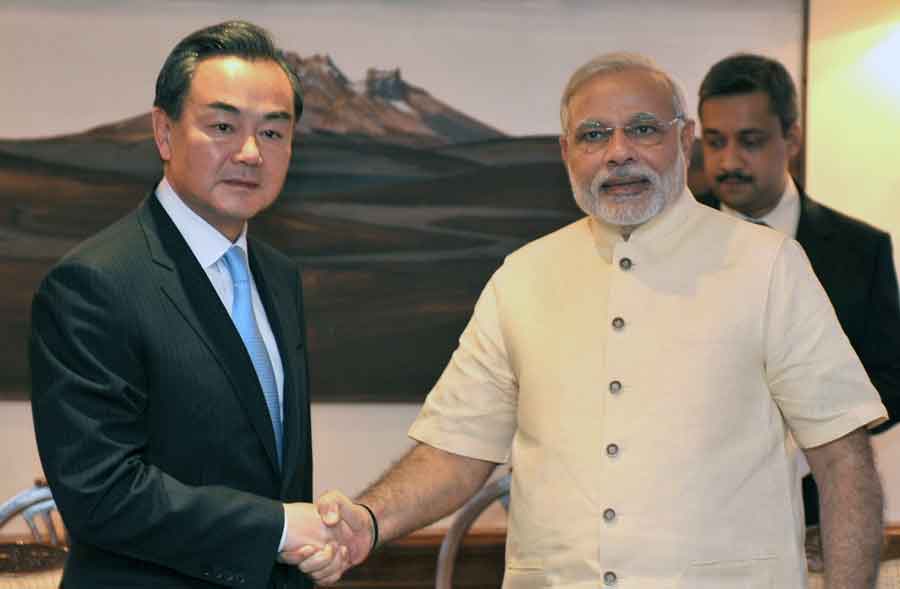
Prime Minister Narendra Modi (Right) and Wang Yi, Minister of Foreign Affairs of People’s Republic of China (Left)

Since then Prime Minister Modi has returned home after his maiden foreign visit to Bhutan. Modi’s as a relationship building exercise it may be called a moderately successful visit, considering the extremely short preparatory time the foreign offices of both countries had. However, its impact would be watched with interest by both India and China during the forthcoming border talks between Bhutan and India.

There were indications that India would be speeding up infrastructure development work along its border with China.

A Global Times article on Modi’s visit welcomed the visit. And Chinese foreign ministry spokesperson has announced that India’s Vice President Hamid Ansari would be attending the commemoration ceremony China’s holding at Beijing to celebrate the 60the Anniversary of the Panchsheel next week.

Modi’s Japanese visit will now be taking place in second half of July due to the Budget presentation in parliament on July 11.

Obviously, China seems to be taking the Indian move in Bhutan in its stride. In any case it is too early to read the Indian Prime Minister’s mind on foreign policy making. It would be reasonable to do so as its contours emerge in the coming months.

An analysis of China’s reading of the pulse of India’s foreign policy changes under Prime Minister Narendra Modi written on June 13, 2014 titled “China’s reading of India’s foreign policy trend” is reproduced below.

China’s reading of India’s foreign policy trend

The two-day visit of Chinese Foreign Minister Wang Yi as President Xi Jinping’s Special Envoy to New Delhi within three weeks of Prime Minister Narendra Modi assuming office underlines China’s keenness, if not anxiety, in building bridges with the Indian leader who has come to power with a massive personal mandate.

In spite of all the flowery rhetoric at play during Wang Yi’s visit, he probably had a limited agenda to feel the pulse of the new Indian leadership under Narendra Modi. This is not going to be an easy exercise because Modi has shown he leads from the front with an assertive style and ruthlessly pursues his objectives. His campaign style and later his utterances in office have shown his uncanny ability to spring surprises upon the opposition and the regional satraps.

Leadership: Greed Is Good For The Taliban


June 24, 2014: In Afghanistan the Taliban have ignored heavy losses and the inability to carry out a successful warm-weather offensive for over a decade. Worse, heavy losses have persuaded many pro-Taliban tribal leaders to try and negotiate peace with the government. Yet the senior leadership (safe since 2002 in Quetta, a city in southwest Pakistan just across the border from Helmand province) refuse to consider making peace. The official reason is the belief that after the foreign troops are gone (most by 2014, the Americans by 2016) the various other tribes (Tadjik, Uzbek and Hazara) will not be able to remain united and the Pushtuns, led by the Taliban, will take back control. Taliban leaders inside Afghanistan don’t see any serious lack of unity among the other tribes (who comprise 60 percent of the population and an even higher portion of the military personnel) and remain with the Taliban because it pays well. That is the case because the Taliban income grows with the amount of activity by the gangs that produce and export opium and heroin. The drug gangs have some armed men on the payroll but their most formidable weapon is cash. The gangs bribe anyone who might interfere with business and only call on the Taliban (or other armed groups on the payroll) to apply force to prevent some hard ass official from threatening what produces so much cash for so many people. 
In addition to their cut of the drug business, the Taliban have established themselves as regular gangsters as well with growing income from extortion and protection (payments from tribes and businesses to protect them from Taliban attack). The more pragmatic Taliban leaders don’t care what the old men in Pakistan are hallucinating about as long as the money keeps coming and there are no major threats to this ancient way of life. The foreign troops were definitely a threat, but there were not enough of them and there were plenty of government officials and security force (army and police) commanders willing to take a bribe. It was still dangerous, but with the foreign troops gone it is a lot less dangerous. 
Where does this leave all the Taliban religious baggage? It’s still there but diluted more and more by even more powerful urges to get rich, get high, get laid or simply get your way. The Taliban religious baggage is the exception while greed is still the rule.

The Different Taliban Worlds

Daniel S. Markey, Senior Fellow for India
Bernard Gwertzman, Consulting Editor
June 2014

World headlines have spotlighted two branches of the Taliban in recent weeks with the release of U.S. POW Sgt. Bowe Bergdahl and the assault on the Karachi airport in Pakistan. CFR Senior Fellow Daniel S. Markey, a leading expert on the Taliban, explains the different goals and tactics of the groups: the Afghan-based and focused outfit that negotiated Bergdahl's release, and the Pakistani Taliban, which claimed responsibility for the airport attack and is in regular combat with the Pakistani state, military, and civilians. Markey says that the Pakistani government, under the leadership of Prime Minister Nawaz Sharif, is trying to negotiate a peace accord with the latter group, but the military leadership is losing patience with the lagging negotiations. As for the United States, he says, there is also a "waning patience for curtailing drone strikes if the Pakistanis don't start taking the fight to the Pakistani Taliban in a more significant way." 
Jinnah International Airport in Karachi, after an attack by Taliban militants on June 8, 2014. 

Are there two separate Talibans or one coordinated Taliban? 

If we look at the Afghan Taliban, we are basically talking about the group that ran Afghanistan right up until just after 9/11. Their remnants and their leader, Mullah Omar, by most accounts are said to be based somewhere inside Pakistan, probably inside Balochistan. And then you have a significant offshoot that also swears allegiance to him: the Haqqani Network, based further to the north in North Waziristan, also inside Pakistan. The Afghan Taliban is notable for having hosted bin Laden and embracing a worldview that is backward, violent, and extreme. However, they are Afghanistan-oriented and focused. There really have been no instances of the Afghan Taliban turning their guns on the Pakistani state, attacking the people of Pakistan, or, more importantly in this case, the military. 

After Karzai

Mujib Mashal

Afghanistan’s outgoing president hobbled the warlords, protected personal freedom, and helped heal a shattered country. He also winked at corruption and ruled like a tribal chief. His successor will inherit a country that’s in better shape than you might think—and a government with little power to keep it that way. 

In the shadow of the Kandahar City mausoleum of Ahmad Shah Durrani, the warrior-king who founded the modern state of Afghanistan, sits a small shrine, the blue plaster of its dome peeling off. “Here rests the martyred champion Azimullah,” reads the headstone inside the shrine, black calligraphy on white marble whose once-brilliant color is fading to gray.
An 18-year-old shopkeeper with dark almond eyes, Azimullah Khaksar gave his life on September 5, 2002, so that Hamid Karzai, the recently appointed interim leader of Afghanistan, could live. He wrestled a gunman who had opened fire on Karzai as the president waved through a car window at a crowd outside the governor’s compound in Kandahar. In the free-for-all shooting that followed, as Karzai’s motorcade made a clumsy effort to flee, Azimullah caught bullets in his chin, stomach, and legs. Which of the bullets came from the assassin and which from Karzai’s bodyguards, no one knows.
The arrival of Hamid Karzai, on the heels of the U.S. invasion in 2001, promised Afghans a break from the recent bloody past. Karzai’s lack of involvement in the long, brutal civil war that followed the Soviet retreat in 1989 raised the possibility of a unified country after a decade of battling fiefs. His international backing promised reconnection to the world after years of isolation. While not all Afghans welcomed Karzai—several circles within the Northern Alliance, for instance, wanted power for themselves—many ordinary people looked upon him with hope.
I remember hearing Karzai’s name on the radio for the first time, when I was a teenager in Kabul, as fires caused by American bombs burned throughout the city. The name had a ring to it, a lightness that itself seemed to promise new possibilities. For more than a decade, we had been ruled by men whose names and titles were a mouthful; the last was the one-eyed self-proclaimed “Leader of the Faithful, Emir of the Islamic Emirate of Afghanistan Mullah Mohammed Omar Mujahed.” He had been more myth than man—most Afghans did not hear his voice or see his image until after he was toppled. The simplicity of Hamid Karzai’s name, without a credential affixed to it, seemed to suggest humility and an unpretentious nature.
The name struck a chord with Azimullah, too, and sparked his curiosity. “Karzai,” Azimullah had said at home on many occasions in the days after he first heard it. “I wonder what he is like.” As Karzai and the forces around him pressed closer to Kandahar City, Azimullah found a photo of him at the buzzing Charso bazaar. He brought the photo home and showed it to his family. “This, they say, is Karzai,” he explained, pointing at the bald, mustachioed man in a suit.
Charismatic and youthful, Karzai in 2002 was a man with “an enormous talent,” as Amrullah Saleh, his former intelligence chief, recently put it to me, who “showed no celebration, jubilation, or a sense of triumph” as he took power; he was a man who “moved with the mood of the country” and spoke to the people’s exhaustion and deprivation and exclusion—and to the country’s ability to heal.

Al-Qaeda’s Kashmir Call: An ISI Diversion Tactic


Al-Qaeda’s media arm, Al-Sahab released a video clip on 13 June 2014 urging the Kashmiri Muslims to emulate the militant actions of insurgents fighting in Iraq and Syria and launch an uprising against the Indian Authorities. The video features Maulana Asim Umar, a Pakistan based Al-Qaeda propagandist who is seen conveying the message for establishment of Islamic caliphate in Kashmir. Though the video message seems to be a clear ploy on the part of ISI in trying to deflect the unwanted attention from internal security situation within Pakistan and give impetus to waning insurgency in Kashmir, the purported message must be analysed with the prevailing security situation in the region which is in a fluid and transitional stage. The coalition forces are planning to withdraw from Afghanistan by the year end which provides an opportunity to the Afghan Taliban to increase its sphere of influence. Pakistan Army today is facing a greater threat, both from within the country from TTP and its umbrella organisations and in its strategic retreat backyard, Afghanistan, where its unquestioned patronage has at times been undermined in Afghanistan. The third component of the insurgent outfits are the terror organisations of the Punjabi Taliban, Lashker-e-Taiba (LeT), Lashker-e-Jhanghvi and Jaish-e-Mohammad (JeM) who enjoy the patronage of the Pakistan Army, the ISI and the political establishment and have been creating disturbances in Kashmir in the past.

The planned drawdown by the end of the year in Afghanistan will leave approximately 10,000 US soldiers, who are likely to be employed in training of Afghan National Army (ANA) and maybe carryout specialised surgical operations. With a reduced strength, they would not have mentionable capability to conduct large scale operations. This would leave the field open for Taliban and Northern alliance forces. Utilising the safe heavens of Khyber Pakhtunkhwa and Waziristan, the Afghan Taliban would utilise the drawdown to concentrate on expanding and consolidating its footprint within Afghanistan. Even with a reduced strength of the US forces, it is unlikely to achieve success of the scale of 1990s due to an improving ANA and lack of local population support. Given the constraints, it would not be in any position to support operations in Kashmir.

The second terror component is the Tehrik-i-Taliban Pakistan (TTP). Pakistan today faces unprecedented internal security turmoil due to TTP. The latest brazen attack on the Karachi Airport shows its determination as well as audacity to challenge the might of the Pakistani security forces including its army. The very fact that the TTP elements were able to enter the airport complex with relative ease indicates the support of sympathizers within the security forces assisting their cause of ruling Pakistan under the Sharia law. TTP has its aim enunciated in establishing an Islamic caliphate in Pakistan and would employ all its cadres and resources to effectively challenge the writ of the government. Thus, even TTP would not be interested in escalating insurgency in Kashmir at the cost of its anti army operations within Pakistan. Given the present inter security strife, the Pakistani army will be deeply embroiled in counter insurgency operations in the coming years against the TTP elements as well as Afghan Taliban should they continue to inhibit the lawless areas along the Afghan border. It’s one time strategic assets will definitely cause more harm to its professional prowess as well as credibility if the army fails to act in a coordinated and timely manner. The Pakistan Army’s present state counter insurgency operations are unlikely to weaken the TTP as aerial bombings or artillery fires rarely annihilate insurgent cadres in large numbers. The collateral damage will only strengthen the TTP and other outfits. The only viable option would be to conduct counter insurgency operations with adequate boots on the ground and a mindset shift to tackle the TTP. Though Pakistan Army has recently acknowledged that home grown terror organisations are a greater threat than India, it’s obsession with India centric operations may lead to a state of near anarchy if focused and coordinated operations are not undertaken against TTP. 

The only viable terror threat arises from elements of Punjabi Taliban under the tutelage of ISI which can dent the prevailing peaceful state within Kashmir. With trained cadres of JeH, LeT etc present in terrorist camps in POK and Pakistan Punjab and waiting for an opportunity to sneak into India, the coming months especially the winter period will present a challenge to the security forces along the line of control. The plausible intention of the ISI in coordinating efforts of the Punjabi Taliban and acting as a link with al-Qaeda seems to be to create an atmosphere of uncertainty to revive the dying insurgent movement in Kashmir. Its past actions at reviving the insurgent movement have been successfully stymied by resolute political will and coordinated operations by Indian Army. It’s only a matter of time before its present misadventure meets the same fate. Nevertheless, vigilant action at line of control will have to continue to thwart any attempts at pushing the insurgents across the fence. Also, the Pakistan Army should realise that given the new political establishment in New Delhi, any such impulsive action under the garb of non state actors will lead to a befitting reply and a greater dent to its image and credibility, which is already under scrutiny within Pakistan. 

The Author is a Senior Fellow at CLAWS. Views expressed are personal. 

Asia’s Massive ‘Climate-Smart’ Dividend


A new report sets out the benefits of ‘climate smart’ policies for Asian economies.
Asia has been handed a massive incentive to curb emissions, with a new report estimating potential trillion-dollar economic benefits as well as better public health and environments.

Released Monday, the “Adding up the Benefits” report by the World Bank and the ClimateWorks Foundation said “climate smart” policies supporting clean transport and improving energy efficiency in appliances, buildings and factories could boost global gross domestic product (GDP) growth by from $1.8 trillion to $2.6 trillion a year by 2030.

Based on the effects of potential policy changes in Brazil, China, the European Union, India, Mexico and the United States, the report said these measures could save more than 1 million lives a year, avoid up to 1.5 million tons of crop losses and generate some 200,000 jobs, while taking the equivalent of 2 billion cars off the road.

“If fully implemented, the set of regulatory, tax and other policy actions outlined in the report could account for 30 percent of the total emissions reduction needed in 2030 to limit global warming to 2 degrees Celsius,” the report estimated.

In China, the report said the use of 70 million low-emission “clean cookstoves” could avoid an estimated 1 million plus premature deaths a year, generate $11 billion in economic benefits and create 22,000 jobs. According to the International Energy Agency, 241 million Chinese will still rely on solid fuels (coal and biomass) for cooking and heating by 2030, generating significant household air pollution.

In India, the building of 1,000 kilometers of new bus rapid transit (BRT) lanes in 20 cities at a cost of up to $4 billion would save an estimated 27,000 lives from reduced accidents and air pollution, while generating 128,000 jobs. The effect on India’s GDP would be up to a $13.5 billion increase between 2013 and 2032, the report said.