Robert Beckhusen
War Is Boring
October 17, 2014
The Navy’s Battle Command Ship Patrols the Black Sea: USS ‘Mount Whitney’ minds Russia
October 16, 2014The U.S. Navy has sent its most advanced battle command ship into the Black Sea to reassure allies rattled by an aggressive Russia. And while she’s there, the ship also has a chance to snoop on Moscow’s military moves.
USS Mount Whitney, a Blue Ridge-class command-and-control ship based in Italy, entered the Black Sea on Oct. 11 and proceeded directly to Georgia for medical and command exercises.
The 620-foot-long Mount Whitney doesn’t usually get much attention. She’s unglamorous even by Navy standards. She barely has any weapons, aside from a few machine guns to ward off small boats and a rotating Phalanx gun as a last resort against anti-ship missiles.
She’s also old, having commissioned way back in 1971.
But Mount Whitney is a very interesting—and important—vessel. Aside from the aircraft carriers and amphibious assault ships that ferry warplanes and Marines are the world, there are actually few ships more important than Mount Whitney.
Wherever she goes, she watches and listens. She’s the flagship of the U.S. Sixth Fleet, which is responsible for patrolling the Mediterranean. She’s also got some of the best bandwidth for all kinds of different communications signals. If you want to browse Facebook while on deployment, Mount Whitney is your ship.
Mount Whitney entered the Black Sea the day after the French spy ship Dupu de Lôme left it—which has some interesting implications regarding the vessel’s mission.
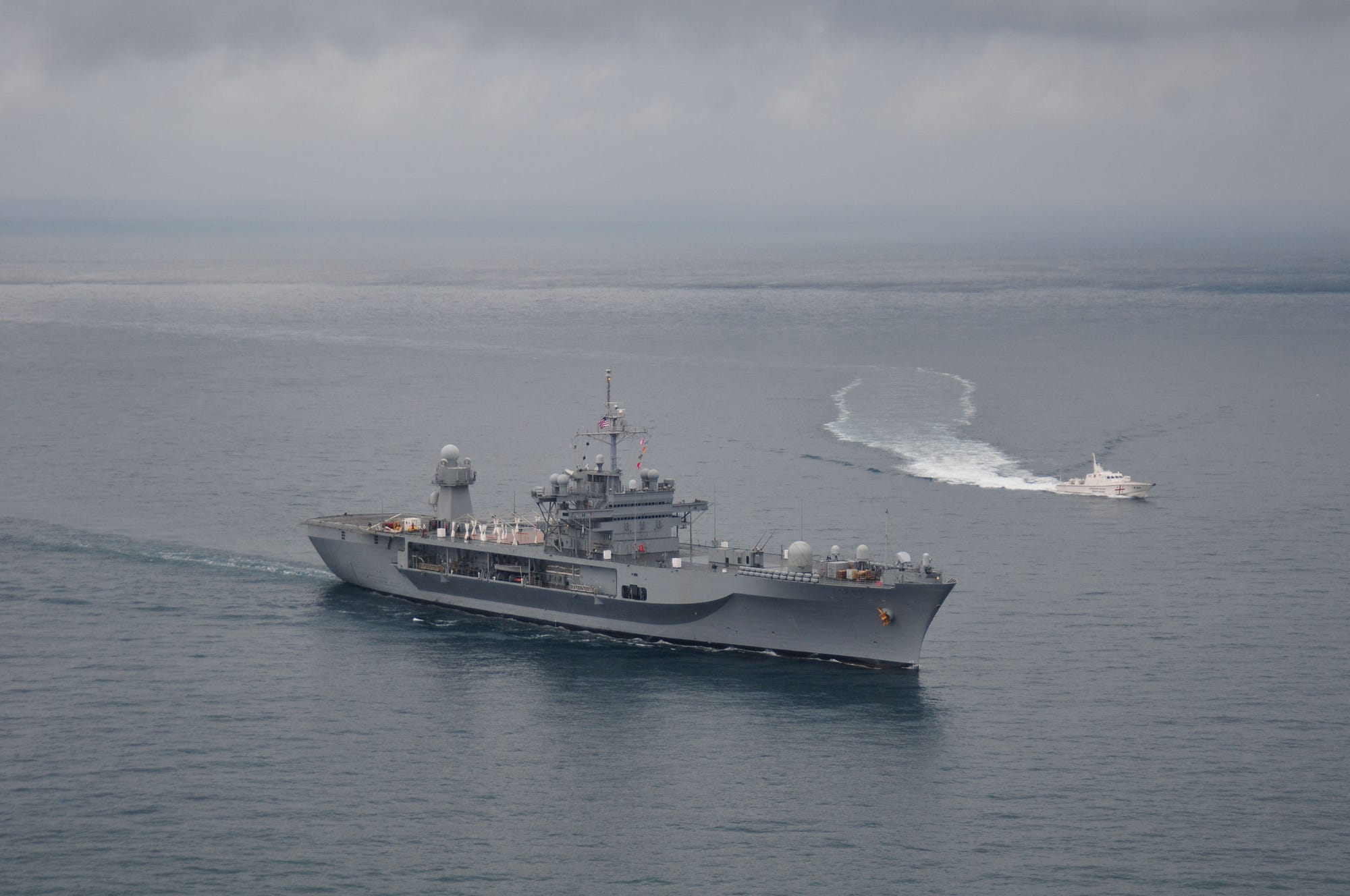 When Mount Whitney visited the Black Sea in February during the Sochi Olympics, she became the subject of rumors in the Russian press that she’s a spy ship, owing to the vessel’s numerous radomes and the sensitive electronics gear on board.
Mount Whitney in the Black Sea in November 2013. At top—Mount Whitney off the Italian coast on Oct. 8, 2014. Navy photos
The secretive nature of spy gear makes its presence hard to verify. But the task of a command-and-control ship is to know as possible. Mount Whitney packs an SLR-25 cryptological system, “a comprehensive and complete signals intelligence … capability,” according to the Navy.
This means Mount Whitney can detect electronic transmissions from ships and aircraft at long ranges and pinpoint their locations with radio direction finders. She could handily monitor noisy Russian military activity in the Black Sea and on land.
Aside from the command ship, the heavily-armed missile destroyer USS Cole is also in the region. As of right now, these are the only NATO vessels in the Black Sea from nations that don’t directly border it. Dupu de Lôme, the Canadian frigate HMCS Toronto, the Spanish frigate Almirante Juan De Bourbon and the French frigate Commandant Birot all recently departed.
But Dupu de Lôme might also be heading back to the Black Sea, according to the Russian state news agency RIA Novosti. This wouldn’t be unusual, as the vessel makes frequent voyages in and out to comply with the 21-day limit in the sea imposed by the Montreaux Convention.