6 July 2014

ISIS: The New Taliban


Reuters/Corbis Images
A fighter with an ISIS flag and weapon in Mosul, Iraq, June 23, 2014

In the days since the Islamic State in Iraq and Syria (ISIS) took control of much of northern Iraq, Western leaders and analysts have expressed alarm at what they have called a powerful new form of jihadism. Some have likened ISIS to a new al-Qaeda. Both assessments are wrong. 

In its rapid advance toward Baghdad, ISIS has already eliminated national boundaries between Iraq and Syria, captured significant arms and weapons caches, caused a spike in global oil prices, reinvigorated ethnic and sectarian conflict across the Arab world, and given Islamic extremism a dramatic new source of appeal among many young Muslims. On June 30, the first day of Ramadan, ISIS also declared that it was reestablishing the “Caliphate,” long an aspiration of other jihadist groups. 

Yet despite these accomplishments, ISIS may not be as unusual as it has been described. Nor does it seem primarily interested in global jihad. In many ways, what the group is doing to Syria and Iraq resembles what the Taliban did in Afghanistan and Pakistan in the early 1990s. 

Like the Taliban, ISIS’s war so far has been about conquering territory rather than launching an al-Qaeda-style global jihad or issuing fatwas to bomb New York or London. Although it has attracted some three thousand foreigners to fight for it, ISIS’s real war is with fellow Muslims, and in particular Shias, against whom it has called for a genocidal campaign. Just as the Taliban changed the contours of Islam in south and central Asia so ISIS intends to do the same in the Middle East. ISIS is also seeking territorial control of the central Middle East region. 

There are several instructive parallels between the two groups. The hardcore forces of ISIS probably number fewer than 10,000 trained fighters; the Taliban never numbered more than 25,000 men—even at the height of the US surge when there were over 150,000 Western troops in Afghanistan and twice that many Afghan soldiers. 

Like the Taliban, ISIS successes are built around military competence that includes excellent command and control, sound intelligence, well prepared logistics support, training, high mobility, and rapid speed of maneuver. Just as ISIS, after years of preparation and recruiting in Iraq and Syria, has overrun Mosul and other important Iraqi cities in a matter of weeks, Taliban conquered all of southern and eastern Afghanistan in a blitzkrieg offensive in a few months in 1994. The main strategy of both groups is the frontal assault combined with outflanking movements, as well as night attacks. And both organizations are also prepared to play a long game. In 1996, after the Taliban had laid siege to Kabul from the south for two years without success, they used a flanking movement from the east to finally surprise the government and conquer the city. 

An even more effective innovation of both groups is to wage battle across several countries and borders, creating multiple logistic centers and sources for recruits, while confounding national responses to them. Thus the Pakistani and Afghan Taliban treat their two countries as virtually one when it comes to fighting their opponents, while ISIS is now using tactics it perfected in Syria to capture cities in Iraq. And just as the Afghan Taliban established sanctuaries in Pakistan, where it could regroup and reequip, ISIS is now able to use territories in both Syria and Iraq to make their survival much easier and their defeat more difficult. 

Chris Steele-Perkins/Magnum Photos
Taliban fighters, Afghanistan, 1996

Both groups are preoccupied with capturing territory rather than promoting global jihad, but their militarism and their extreme Islamism renders them ill-equipped to govern the areas they control. Like the Taliban, ISIS’s political outlook is distinct from both traditional Islamic fundamentalist parties, such as the Muslim Brotherhood, and global terrorism organizations like al-Qaeda. The primitive and extreme version of Islam it imposes—already on view in ISIS-controlled Syria cities like Raqqa—terrifies local populations and demoralizes armies and governments. But as the Taliban showed before it, this way of ruling cannot constitute a viable political program in the long term. 

ISIS/ISIL: Jihadists Go for the Lulz Mix Equal Parts al-Qaeda and LulzSec then Blend


I don't seek out media appearances but last week was a busy one for me. I was interviewed by CBS News, BBC World Service, Jonathan Green of Australian Broadcasting Corporation's Sunday Extra, and by Piya Chattopadhyay of the CBC's The Current. I also had invitations from NPR and CTV that I, unfortunately, had to turn down due to time constraints. It was a busy week but thankfully all of the journalists, hosts and producers who reached out to me had a sincere interest in complex stories. They are my kind of people so talking to them was actually quite fun.


A thirty minute guest slot on a radio show seems like an eternally long time when the invitation is extended. But believe me when I tell you that it passes in an instant. A five minute appearance is even worse. It's like being shot out of a cannon. I still have no idea what I said during my brief 1 a.m. BBC World Service appearance but I do know that an absolutely terrifying number of people do. So that leaves a few more thoughts on this subject that I didn't quite get to...

It wasn't too long ago that the hacker group LulzSec rampaged through the internet. They appeared to be an unstoppable force. They were seemingly above the law. In fact, they openly mocked it day in, day out. Throughout it all their message was magnified by non-stop attention from global media fueled by a massive social media footprint. For months the feds looked absolutely lost and outmatched. In reality, they were quite the opposite. They quietly and methodically identified the key players, picked the core group apart, then shut them down and locked them up. Along the way they leveraged the intelligence gathered and the informants created to go on a rampage of their own. The feds won and they won big. So when looking at groups like this it's important to remember that Superpowers don't tweet their way to lulz. They use intelligence, police work, courts and the occasional missile. And Hellfires are the ultimate last lulz.

If Iraq must be divided, here’s the right way to do it


By Michael O'Hanlon and Edward P. Joseph
JULY 4, 2014

As Iraq spirals toward chaos and its Kurdish region talks independence, the issue of partition, orfederalism, has resurfaced. This is a concept that then-Senator Joe Biden strongly advocated in 2006. Though it would be difficult to accomplish, federalism could still be a helpful element as Iraqis struggle through their current tragic mess.

The appeal of federalism could grow if Iraqi leaders in Baghdad cannot agree soon on a government of national unity, ideally one without Prime Minister Nouri al-Maliki, who has proven so divisive. Whether a “soft partition” — meaning the creation of a Sunni autonomous zone to complement the existing Kurdish one — or “hard partition” –meaning the formal redrawing of regional lines — it would seem a natural idea. Not only because of the recent violence, which has caused hundreds of thousands of Iraqis to flee their homes, but also the arbitrariness with which state borders were drawn by the European powers after World War One.

We did a study of the possible soft partition of Iraq in 2007, and found that the new Sunni autonomous zone would need the following: 
  • A proportionate share of Iraq’s total oil revenue (perhaps 15 percent to 20 percent) because the Sunni regions generally lack oil resources; 
  • An arrangement with Baghdad allowing Sunnistan police to patrol the region’s cities on a routine basis, but with Sunnis, Shi’ites and Kurds continuing to support a national army for the country’s overall defense; 
  • A means for Sunnis to safely sell their property so those seeking to leave places like Baghdad (now roughly 10 percent to 15 percent Sunni) could settle in the new autonomous region with enough means to buy homes; 
  • An economic transition fund to help create job opportunities for resettled Sunnis; 
  • Clearly defined, enforced and monitored minority rights for all Iraqis choosing to stay in regions where they are not in the ethnic/sectarian majority, an inevitability since many Iraqis are in mixed marriages, and 
  • Physical protection by a combination of national and local security forces for people relocating. 
These ideas should be part of the public conversation today as Iraqis debate their political futures.

The Iraqi constitution even allows for these possibilities. The idea of a Sunni autonomous region, largely protected from any further predations by future Shi’ite leaders in Baghdad, may even persuade moderate Sunni leaders at the national, provincial and tribal levels to support a new government of national unity. In other words, it could help resolve the current crisis.

That said, partition cannot be seen as an alternative to cooperation by Iraqi political leaders across sectarian lines. In fact, to be stabilizing and consistent with U.S. national security goals, restructuring Iraq via one of these means must be done collaboratively, not by fiat by one group or because of developments on the battlefield.

IMF warns of negative spiral in France as recession looms again

France has sunk into an economic malaise and could take years to climb back out

Markit’s PMI services gauge for France fell for the third month to 48.2 in June, pointing to an outright fall in GDP following zero growth in the first quarter Photo: Xeridat / Barcroft Media

03 Jul 2014

France is on the cusp of a fresh recession as services contract sharply and the country braces for yet another round of austerity cuts, with record jobless levels likely to bedevil Francois Hollande’s presidency for years to come.

Markit’s PMI services gauge for France fell for the third month to 48.2 in June, pointing to an outright fall in GDP following zero growth in the first quarter.

The International Monetary Fund cut its growth forecast this year from 1pc to 0.7pc, warning that there would be no “appreciable decline” in French unemployment until 2016. “Volatile and uneven leading indicators point to the risk of a stalled recovery,” it said.

The IMF said public debt should peak at 95pc of GDP next year but a “growth shock” would push it to 103pc by 2016. The Fund warned of a “negative spiral of low growth and falling inflation” that is pushing up real borrowing costs and further choking investment, already dismally weak. Core inflation was 0.3pc in May.

The economic relapse is a political disaster for Mr Hollande, already the least popular leader in modern times with a poll rating of 23pc, and reeling from a crushing defeat by the far-Right Front National in European elections.

Related Articles


The country is being left behind by Spain and others as they reap the first rewards from supply-side reforms, although the France’s Socialists grumble that they are merely under-cutting France with deflationary wage cuts in a 1930s-style race to the bottom that ultimately benefits nobody.

Mr Hollande is paying the price for a failed strategy in his first two years in office when he clung to the old model and relied on tax rises rather than spending cuts to cover austerity packages. The state sector has risen to 57pc of GDP, suffocating the private economy.

Yet the country is also caught in a vicious circle as it tries to meet EMU deficit rules, forced to push through successive austerity packages without offsetting monetary stimulus or a weaker currency. The IMF said France’s exchange rate is over-valued by 5-10pc.

The effect of austerity has been to erode the tax base, leaving the budget deficit stuck at over 4pc of GDP. France has gained remarkably little from fiscal tightening equal to 5pc of GDP over the last three years. Undeterred, it is now pushing through extra cuts of €50bn by 2017 under the new premier Manuel Valls, dubbed the “economic Clemenceau” for his willingness to endure casualties stoically. The biggest hit will come next year, raising the risk that economy will once again to fail to achieve escape velocity.

There is unlikely to be a quick rescue from the European Central Bank. Mario Draghi, the ECB’s president, offered no further clues yesterday on whether the bank would launch quantitative easing to revive credit and to build a safety buffer against deflation.

Mr Draghi said the ECB’s next rounds of cheap loans for banks (TLTROs) could inject €1 trillion into the system, and signalled that borrowers would not be treated too harshly if they used the money to play the “carry trade” by investing in government bonds rather lending to the real economy.

However, it is unclear what the ECB policy is. Bundesbank chief Jens Weidmann said the rush into peripheral bonds was “not without danger”, and may reverse abruptly. He warned that loose money is once again encouraging bad practices.

The bar for QE clearly remains extremely high. The ECB is likely to wait until later this year to see whether the measures agreed last month start to unlock credit for small business in Southern Europe. For now private sector loans are contracting at a 2pc rate.

President Hollande has made his peace with the employers’ federation Medef this year, launching a burst of Gallic Thatcherism. He is pushing through tax relief for business and a shake-up of labour markets along with wage freezes, despite ever-louder protests from his Socialist Party base.

The IMF praised the package of measures but said dismissal rules are still among the most restrictive in the OECD club of rich states, and there has been “no progress” on product market reform for five years. At best it will take years to pull France out of its deep malaise.

America’s New Allies: Russia, Iran and Syria?


"Notwithstanding a variety of differences in priorities and preferences, Russia, Iran and Syria all oppose the Sunni extremists seeking to bring Maliki down and support a unified Iraq."

July 3, 2014

Iraqi Prime Minister Nouri al-Maliki must be pretty unhappy with the United States. Facing an existential threat to his country and a political threat to his leadership, Maliki has to contend at the same time with a disenchanted patron in Washington responding much more weakly than he prefers to the former challenge and not at all to the latter (if not offering tacit encouragement to some of Maliki’s political rivals). So, predictably, he is turning elsewhere for support and to limit his dependence on American help. Enter Russia, Iran, and Syria.

Moscow likely enjoys the opportunity to provide Su-25 ground attack fighters—even if they are used and aging aircraft—at a time when U.S. officials are perversely stating that the ongoing instability may further delay Iraq’s receipt of U.S. F-16 fighters (and when Maliki has openly expressed frustration with slow U.S. deliveries, saying that Iraq was “deluded”). In addition to shipping the planes, Russia has also sent technicians, who must presumably start by assembling the jets, readying them to fly, and offering a refresher course to Iraqi pilots who probably have not flown Su-25s for some time.

For its part, Iran appears to be both providing military supplies and sharing intelligence from drones operating in Iraq, according to U.S. officials. Looking ahead, a top Iraqi parliamentarian and Maliki ally has warned that Baghdad may “need Iranian strikes” on ISIS in Iraq if the U.S. does not conduct air attacks itself. Syria is of course aggressively fighting the militants on its own territory and has recently launched its own airstrikes against them across the border into Iraq. Maliki expressed appreciation for the Syrian attacks, saying “they carry out their strikes and we carry out ours and the final winners are our two countries.”

Notwithstanding a variety of differences in priorities and preferences, Russia, Iran and Syria all oppose the Sunni extremists seeking to bring Maliki down and support a unified Iraq. Likewise, while all are constrained by limited capabilities, they face few domestic obstacles in aiding Maliki’s government—political, legal or otherwise—and are much closer to Iraq than the United States, which makes the crisis more important for them. Distance has also helped Iran and Syria to act fairly quickly. It is still unclear whether the three governments are acting with any coordination, however. If so, it is probably general and strategic rather than specific and tactical—at least so far.

WASHINGTON AND THE WORLD


The Ally America Needs
Japan’s moves away from pacficism are nothing to worry about—in fact, they’re great for the United States.

By DENNIS BLAIR 
July 03, 2014

Japan’s historic move to reinterpret the country’s postwar “peace constitution” this week and adopt a more active role in Asia-Pacific security comes none too soon for the United States. Right now, more than ever, Washington needs robust allies.

In East Asia, the broader Middle East, the Sahel and Eastern Europe, extremists, sub-national groups and even hostile countries seek to take over territory and change borders and governments through coercion, intimidation and terrorism.

Although these events might seem disparate and limited in scope, their number and frequency amount to a global challenge to the international order the United States has led since World War II.

The United States depends on some basic building blocks of power to maintain this global order: our economic and military might, diplomatic skill and strong and cooperative allies. But at a time when we need all the friends we can muster, most are becoming less reliable as they deal with internal political and economic issues and reduced defense budgets. Even within NATO, member countries make individual decisions on each separate crisis—often struggling to act in concert, as the tepid response to Russia’s incursion into Ukraine showed. In the future, the United States will have to work hard to convince some traditional allies and partners to mount effective international responses when our common interests are threatened.

Japan, however, is bucking this trend of tepid responses. For the last 60 years, the country’s Constitution has prevented Japan from fully participating in international peacekeeping operations and constrained the alliance with Washington. But this week, the government of Prime Minister Shinzo Abe decided for the first time to allow the Japanese Armed Forces to do more than defend their homeland from a direct attack. Japan will now be able to join the United States—its alliance partner—in the event of aggression by adversaries. Japan’s self-defense forces could, for instance, be authorized to shoot down missiles heading for the United States and defend American warships on the high seas.

The threat of greatest immediate concern is North Korea. In the event of large-scale North Korean aggression, Japan can now not only provide bases and logistic support for U.S. forces, but its ships and planes can also join with the U.S. military to conduct combined defensive patrols in the Sea of Japan and the airspace over it. Although there is little likelihood that the disputes in the South China Sea and East China Sea will lead to conflict, this Japanese decision, along with American assurances that our treaty with Japan applies to the Senkakus—an island chain claimed by both China and Japan—make that likelihood even lower.

Central Asia’s Energy Rush

The region’s major powers are in a tussle to control its rich energy sources. 
By Michał Romanowski
July 03, 2014

Central Asia is rapidly emerging as the key playing field in the contest to access energy resources and the leverage they offer. The new Great Game is played out once again in the region, only this time it is not over political or territorial influence, but over the vast raw material deposits that are in the possession of the former Soviet Union republics, especially those situated by the Caspian Sea. The Caspian’s share of oil and gas global exports is set to rise to 9 and 11 percent, respectively, in the coming 20 years. Much is at stake.

Russia, although not a direct producer, was and still is – given the developed pipeline network – supervising much of an energy transit from Central Asia. The Central Asia-Center gas pipeline system, the first line of which was completed in 1960, makes for a good case study. It allows both Uzbek and Turkmen gas to be delivered to Russia, which then resells it at a profit to energy-hungry Europe or uses it for domestic purposes. Moscow exercises its influence over the region and as a consequence gains both politically and economically.

In the wake of the collapse of the Soviet Union, Central Asian states sought to loosen Russia’s firm grip. An independent complex pipeline system was a priority for transporting the resources outward. Given that the Caspian Sea is landlocked, gas and oil need to cross several borders before reaching an end customer. This requires a very substantial investment, yet energy diversification in Central Asia is moving steadily ahead.

State of Play

Kazakhstan is the leading oil producer in the region, with output of roughly 1.6 million barrels per day (bbl/day), of which approximately 90 percent is exported. The Baku-Tbilisi-Ceyhan network that came online in 2006 is not the only Kazakh attempt to break Russia’s monopoly. Astana is already one of the most significant oil suppliers to China. The first pipeline connecting the Caspian shore with China’s Xinjiang province, is one of the longest links in the world at nearly 2300 km. China in fact controls around 20 percent of Kazakhstan’s oil production and is its key trade partner. Bilateral trade should reach $40 billion next year.

Turkmenistan is the main gas exporter and possesses the largest gas deposits in Central Asia and one of the richest in the world. It has similar goals. The first Turkmen undertaking to break Russia’s transit dominance was a pipeline to Iran built in 1997. The recent major venture – the Central Asia-China gas pipeline – allows Ashgabat to transfer its hydrocarbons directly to China. Interestingly from a regional perspective, it also offers to connect spurs from Kazakhstan and Uzbekistan.

Beijing already buys the majority of Turkmen gas exports. Yet the volumes sold to China are to be tripled by the end of this decade, while the Russian figures, after a pipeline blast in 2009, have fallen dramatically and show no sign of returning to previous levels.

Considerable investment is also being made in Turkmenistan to build a domestic east-west gas pipeline, which should be concluded by 2016. In addition, a Turkmenistan-Afghanistan-Pakistan-India link is expected to be finalized in the near future. Finally, there is the never ending story of the trans-Caspian connection. It remains highly uncertain, but Turkmen authorities expressed their readiness to supply gas should it go ahead.

INDO-US CYBER DIALOGUE SHOULD INCLUDE HARDWARE SECURITY – ANALYSIS


By Jennifer McArdle

Much like the Indo-U.S. strategic partnership, Indo-U.S. cyber engagement appears to have plateaued and could benefit from a tailored reset. Since the 2001 establishment of the Indo-U.S. Cyber Security Forum, India and the United States have sought to partner on various cyber issues of collective importance: cyber security, cybercrime, cyber forensics and cyber security norms, among others. Apart from a 2013 goal of supply-chain security, Indo-U.S. cyber cooperation is largely software-based. This ignores a mutual, more incipient cyberhardware threat, which permeates broader defence issues. A failure to address the issue of hardware security could have a highly deleterious impact on India’s defence apparatus. The time is ripe for India and the United States to expand the Indo-U.S. cyber-dialogue to include hardware security.

The weapon platforms that are critical to state security and deterrence—nuclear weapons, cruise and ballistic missiles, fighter jets and any number of other systems—are dependent on semiconductor integrated circuits, or chips, which make up the hardware of the system. The semiconductor supply chain has become increasingly globalized, and asJohn Villasenor at the Brookings Institution has noted, tampered or malicious chips, which operate as hidden ‘back doors’ for espionage or sabotage, have likely heavily contaminated the global supply chain. Malicious hardware can be inserted into a chip after the design phase but before it is manufactured and placed in a product, thus making it challenging to detect. Should a malicious chip be placed in a critical weapon system, that platform could cease to operate.

At present, while India does design its own semiconductor chips, it lacks the capacity to manufacture its semiconductors domestically. As the East West Center notes, most of India’s integrated circuit design work is done for various multinational corporations, who transfer the design for manufacturing elsewhere, often to locations such as Shenzhen, China. So long as India’s chips are manufactured externally, India risks placing compromised circuits in their indigenous weapons systems, thus exposing them to potential sabotage or espionage. India needs a secure supply of ‘trusted’ semiconductors for its domestically produced systems.

Last October, the former Union Minister for Communications and Information Technology, Kapil Sibal announced at the Observer Research Foundation (ORF) and Federation of Indian Chambers of Commerce and Industry (FICCI), India Conference on Cyber Security and Cyber Governance, that imported computer hardware posed a serious security threat to India. The Indian government had decided to invest in manufacturing semiconductor chips. Four months later, on February 14, former Prime Minister Manmohan Singh, sanctioned the construction of two semiconductor wafer plants, or ‘fabs’, in cooperation with two different business consortiums. Construction is expected to begin in September.

While India has announced the creation of two ‘fabs’, it is unclear what leverage the Indian Ministry of Defense (MoD) will have manufacturing ‘trusted’ chips for its critical defense systems. If the U.S. model sheds any light on potential defense microelectronic trajectories in these two semiconductor plants, it might prove to be very little.

An anti-US Stuxnet? Startling attack against industrial complex revealed.


A cyber-espionage campaign targeting industrial control system networks bears all the hallmarks of sabotage – and has an apparent Russia connection, one group says.

A three-year Eastern European cyber-espionage campaign against US and European energy companies granted attackers access to industrial control system networks that could be used to sabotage and disrupt energy supplies across the US, Japan, and Europe, security researchers say.

The attack group has earned the name "Energetic Bear" for its apparent Russian connection and focus on energy companies, according to an analysis by Crowdstrike, a cyber-security company in Irvine, Calif. The attack began in 2011, and the specialized malware has impacted 1,000 companies in 84 countries, the company says.

Whoever is behind the attacks, they have the hallmarks of being state-sponsored – including echoes of Stuxnet, the world’s first known cyber-weapon, which was deployed by the US and Israel to sabotage Iran’s nuclear fuel production facilities at Natanz four years ago, several cyber-security researchers told the Monitor.


Beyond its breadth, stealth and sophistication, what is most unusual is the industrial control system network software targeted by the “Bear,” they say. The intent was not simply to compromise these networks, but to control them.

Details about the spy campaign began to dribble out last week. That’s when F-Secure, a Finnish cyber-security company, startled the industrial controls system security community with its conclusion that the attacker had used OPC – a type of translator software widely used in industrial networks – to intercept critical details of its victims' systems.

First, the attackers crept onto the websites of three key industrial control system (ICS) software vendors in Europe. From there, they inserted a nasty piece of malware that has been dubbed Havex (for an inscrutable word in the malicious software code) deep into otherwise legitimate software downloads on the websites.

NSA Revelations All in One Chart


By Julia Angwin and Jeff Larson, ProPublica, illustrations by Alberto Cairo, special to ProPublica

Published June 30, 2014 

This is a plot of the NSA programs revealed in the past year according to whether they are bulk or targeted, and whether the targets of surveillance are foreign or domestic. Most of the programs fall squarely into the agency’s stated mission of foreign surveillance, but some – particularly those that are both domestic and broad-sweeping – are more controversial.

Just as with the New York Magazine approval matrix that served as our inspiration, the placement of each program is based on judgments and is approximate.

For more details, read our FAQ or listen to our podcast. Also, take our quiz to test your NSA knowledge.

A Rose by Any Other Name Still has Thorns: A Global Network of Navies


A ROSE BY ANY OTHER NAME STILL HAS THORNS: A GLOBAL NETWORK OF NAVIES
July 3, 2014 · in Commentary

In Shakespeare’s “Romeo and Juliet,” the latter states that “a rose by any other name would smell as sweet.” What she fails to acknowledge, or perhaps she intentionally deceives her young and naïve paramour, is that while roses would have an olfactory appeal, they still have thorns. It is worth keeping this in mind when reading a recent article in Proceedings that advocates for a “global network of navies” – the most recent incarnation of the “1,000 ship navy” concept articulated in 2005 by then-Chief of Naval Operations Michael Mullen. The “1,000 ship navy” is a fleet-in-being of nations willing to respond to shared challenges, since no navy could “go it alone.” In the new Proceedingspiece, current Chief of Naval Operations Jonathan Greenert and Rear Admiral James Foggo argue that the United States Navy must be “compelled to strengthen the bonds of international maritime cooperation” because no country has sufficient forces to address the myriad of challenges on the high seas or the littorals. Partnerships, therefore, are necessary and would meet those growing global threats. The name may have changed from a 1,000 Ship Navy to a Global Network of Navies, but the arguments supporting the idea remain overly optimistic and neglect to account for other realities. The concept still has thorns.

Isolation, either in international relations or naval operations, remains an inadvisable and irresponsible path for the United States as the world’s largest military power and – for the time being – the largest economic power. Engagement is necessary in an increasingly connected global community. But that interconnectivity presents both opportunities and challenges. While the Navy and the country may hope more for the opportunities, they must however resign themselves to the inherent realities of regional and global challenges to partnerships.

Chinese Military Opens New Cyber Espionage and Intelligence Analysis Center

July 4, 2014
Inside China: Mixed feelings over multinational naval exercise
Miles Yu
Washington Times

On June 26, China’s state media including the Communist Party’s mouthpiece, the People’s Daily, announced that the People’s Liberation Army’s General Armament Department has opened a new cyber espionage and intelligence analysis center called Research Center for the Cyberspace Strategic Intelligence.

Billed as a PLA’s “high level intelligence platform” to collect and analyze intelligence from cyberspace, the center will focus on centralizing cyber intelligence, coordinate cyber intelligence gathering, developing and studying cyber espionage sources and methods.

Last month, the Justice Department indicted five PLA hackers for penetrating American cyber networks to steal trade secrets for the benefit Chinese companies.

On June 25, the new U.S. ambassador to China, former Sen. Max Baucus, blastedChina for its continuing and intensifying cyber espionage and theft against the United States.

“We wouldn’t sit idly by while a crime is committed in the real world, so why should we do it when it happens in cyberspace?” Mr. Baucus said.

The tragedy of the Arabs


The Middle East 
A civilisation that used to lead the world is in ruins—and only the locals can rebuild it Jul 5th 2014 | From the print edition

A THOUSAND years ago, the great cities of Baghdad, Damascus and Cairo took turns to race ahead of the Western world. Islam and innovation were twins. The various Arab caliphates were dynamic superpowers—beacons of learning, tolerance and trade. Yet today the Arabs are in a wretched state. Even as Asia, Latin America and Africa advance, the Middle East is held back by despotism and convulsed by war.

Hopes soared three years ago, when a wave of unrest across the region led to the overthrow of four dictators—in Tunisia, Egypt, Libya and Yemen—and to a clamour for change elsewhere, notably in Syria. But the Arab spring’s fruit has rotted into renewed autocracy and war. Both engender misery and fanaticism that today threaten the wider world.

Why Arab countries have so miserably failed to create democracy, happiness or (aside from the windfall of oil) wealth for their 350m people is one of the great questions of our time. What makes Arab society susceptible to vile regimes and fanatics bent on destroying them (and their perceived allies in the West)? No one suggests that the Arabs as a people lack talent or suffer from some pathological antipathy to democracy. But for the Arabs to wake from their nightmare, and for the world to feel safe, a great deal needs to change.

The blame game

One problem is that the Arab countries’ troubles run so wide. Indeed, Syria and Iraq can nowadays barely be called countries at all. This week a brutal band of jihadists declared their boundaries void, heralding instead a new Islamic caliphate to embrace Iraq and Greater Syria (including Israel-Palestine, Lebanon, Jordan and bits of Turkey) and—in due course—the whole world. Its leaders seek to kill non-Muslims not just in the Middle East but also in the streets of New York, London and Paris. Egypt is back under military rule. Libya, following the violent demise of Muammar Qaddafi, is at the mercy of unruly militias. Yemen is beset by insurrection, infighting and al-Qaeda. Palestine is still far from true statehood and peace: the murders of three young Israelis and ensuing reprisals threaten to set off yet another cycle of violence (see article). Even countries such as Saudi Arabia and Algeria, whose regimes are cushioned by wealth from oil and gas and propped up by an iron-fisted apparatus of state security, are more fragile than they look. Only Tunisia, which opened the Arabs’ bid for freedom three years ago, has the makings of a real democracy.

Peering into America’s Military Blind Spots: High-Impact Long Shots

PEERING INTO AMERICA’S MILITARY BLIND SPOTS: HIGH-IMPACT LONG SHOTS
July 3, 2014 · in Analysis

The national security establishment is currently facing criticism for a perceived failure to anticipate Russia’s actions in Ukraine, the capture of a swathe of Iraqi territory by the Islamic State in Iraq and the Levant, and the political upheaval of the Arab Spring. The American public expects its leaders to be prepared for such contingencies while also addressing familiar challenges, like terrorism or China’s increasing assertiveness.

The breadth and rising tempo of potential crises, coupled with fiscal constraints, means that national security leaders can’t hope to be fully prepared for all contingencies. But continually focusing on the problem of the day creates blind spots when it comes to low likelihood but extremely disruptive factors. It is one thing to be caught off guard by the anticipatable actions of a nation or even a non-state actor; it is far more serious to be surprised by a new method of warfare.

If there was ever a time to be on guard against disruptions that can upend America’s strategic position, it is now. Taking stock of long-shot, high-impact surprises does not mean waiting until the consensus wisdom, or the events at hand, catch up. The national security community should not shy away from constantly challenging the assumptions that it relies on to build everything from budgets covering hundreds of billions of dollars to operation plans for the armed forces.

The Center for a New American Security’s Creative Disruption Task Forcesurveyed defense experts on the most disruptive elements for the future of America’s defense industry and strategic position. The surveys on the the Future Defense Environment, Technology Trends and Security Implications, and Implications of Emerging Technologies for the Future of Warfare, covered a sweep of time and technology through 2030, and in some cases beyond.

One of the most valuable insights was how respondents revealed potential blind spots for the United States in the factors or outcomes believed to be the least likely to be disruptive. The surveys also showed how the national security community’s own preferences can influence its ability to anticipate the future.

(W)ARCHIVES: THE PENTAGON PAPERS AND PREMATURE PUBLICATION

(W)Archives: The Pentagon Papers and Premature Publication
July 4, 2014 · in (W)ARCHIVES

Edward Snowden is fond of comparing himself to Daniel Ellsberg, the man who leaked the Pentagon Papers in 1971. Ellsberg’s deed is often viewed as a great act of patriotism. Ellsberg himself said in his memoirs that “leaking could be a patriotic and constructive act.” The papers Ellsberg leaked eventually found their way to the New York Times, which published major excerpts, and to Alaska Senator Mike Gravel, who read substantial portions of them into theCongressional Record.

Given that today is the 4th of July and patriotic fervor is at its annual peak, I thought it might be worth looking at the Pentagon Papers themselves.

The Pentagon Papers,or, as they were more properly known, the “Report of the Office of the Secretary of Defense Vietnam Task Force,” or “United States – Vietnam Relations, 1945-1967,” are now declassified. The original documents are available at the National Archives to anyone who wants to see them. A large portion of the opus is also available online, such as these first few hundred pages which examine U.S. policy toward Vietnam from 1940 to 1950; describe the “character and power of the Viet Minh”; and ask whether Ho Chi Minh should be understood as an “Asian Tito,” opposed to Soviet-style communism.

It was Secretary of Defense Robert McNamara who caused the Pentagon Papers to come into existence. The idea came out of a 1967 meeting with Harvard Professor Richard Neustadt. McNamara recalled in his 1996 memoirs that “for the first time…I voiced my feeling that, because the war was not going as hoped, future scholars would surely wish to study why. I thought we should seek to facilitate such study in order to prevent similar errors in the future.” Later that year, McNamara acted on this idea, ordering his Assistant Secretary for International Security Affairs, John McNaughton “to start collecting documents for future scholars to use.” He further directed that the collection should include relevant documents not only from the Pentagon but from the White House, State Department, and CIA, as well. McNaughton put Leslie Gelb, later a New York Times reporter and President of the Council on Foreign Relations, in charge of the project.

Weekend Reading: 4th of July Edition

WEEKEND READING: 4TH OF JULY EDITION
July 4, 2014 · in Weekend Reading

Happy Independence Day, America! While you’re enjoying 4th of July festivities this weekend, be sure to check out these great foreign policy and national security reads from the past week.

Independence Day round-up: In honor of the 238th anniversary of the signing of the Declaration of Independence and America’s first declaration of war, we’ve got a few 4th of July-themed stories to entertain you throughout the weekend. War on the Rocks contributor Adam Tiffen, writing for Task & Purpose, traces the 11 times in history when Congress officially declared war on another country. And the Washington Post tests readers’ knowledge of events surrounding American independence with some surprising facts about what did and didn’t happen on July 4, 1776.

The Last Man’s Club of WWI: This heartwarming story from USA Today describes how a group of surviving soldiers from World War I returned home after the war and made a vow: “They’d reunite yearly and save a trophy of their adventure — a bottle of French wine — until one man was left alive. Then he would uncork the white Burgundy and toast his departed comrades.” More than 100 years later, these veterans have all passed on, but the bottle of wine remains in Meadville, Pennsylvania, as a token reminder of the Great War that is slowly fading from history.

More on WWI: This year, there has been an increase in books published on the subject of the First World War, however, the Kings of War blog offers two pieces of advice to readers and students of WWI: “Do not make corny, irrelevant attempts to tie together the situations of 1914 and 2014,” and, “Upon reading a book, ask yourself if it can pass the acid test: can it explain why it all happened?”

That time America didn’t win the World Cup: Still reeling from the men’s national soccer team’s loss to Belgium (or perhaps still watching because you actually like soccer/football)? Don’t miss this list of seven U.S. presidents awkwardly interacting with soccer balls for a good laugh.

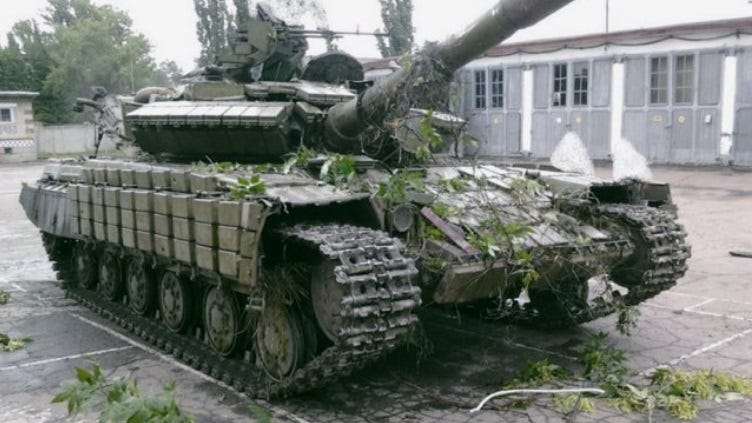
Cold War Super-Tanks Enter Battle in Ukraine

Cold War Super-Tanks Enter Battle in Ukraine 
T-64s waited five decades for major combat 


The Soviet T-64 tank is a Cold War oddity. Designed by the Kharkov Tank Factory in Ukraine, the 40-ton armored vehicle represented a huge technological leap ahead of existing T-55 and T-62 tanks when it entered service in the mid-1960s.

But the advanced T-64 would see merely sporadic combat in Russia’s border wars. Only today, 50 years after it first appeared, is the vehicle playing a leading role in a serious conflict—in Ukraine, where both the government in Kiev and Russian-backed eastern separatists have deployed T-64s in vicious urban fighting.

The T-64 introduced a number of advancements, including a new diesel engine. It also replaces the human loader with an automatic device for ramming shells into the breech, reducing the overall crew to just three people and saving weight. The T-64 was the first Soviet tanks with the now-standard 125-millimeter smooth-bore cannon, which in upgraded T-64Bs can fire a guided missile through its tube.

The Soviets never exported the T-64, preferring to sell cheaper, simpler T-55s, T-62s and T-72s. Throughout the later decades of the Cold War, thousands of T-64s equipped Soviet armies, primed to wage apocalyptic tank war with American M-1s, German Leopards and British Challengers.

The T-64 was more than adequate to the task. “This particular tank was provided with certain capabilities that were more advanced than NATO tanks that would not appear for an additional 15 or 16 years,” U.S. Army Maj. James Warford concluded in a 1992 thesis.

When the Soviet Union broke up, Ukraine inherited hundreds of T-64s …and the factory that built the tanks. Recently enhanced with new armor and a so-called “active defense” system than shoots projectiles in order to intercept incoming rockets, the rebuilt T-64BM Bulat is Ukraine’s most advanced tank.

When eastern separatists—armed, supplied and reinforced by Russian agents—rose up this spring, demanding to split away from Kiev and join Moscow, Ukraine sent T-64s into combat.

And thanks to Russia, so did at least one rebel group. On June 14, NATOpublished satellite imagery supposedly showing unmarked T-64s crossing from Russia into Ukraine. Six days later, Twitter user @mstyslav9 posted a photo they claimed depicted a T-64 belonging to the Donetsk People’s Republic separatist army.

It’s possible Moscow sent T-64s because it could then convincingly argue that the rebels had gotten the tanks from Kiev’s armories, rather than from Russia.

Making Sense of Military Doctrine: Joint and Service Views on Maneuver


MAKING SENSE OF MILITARY DOCTRINE: JOINT AND SERVICE VIEWS ON MANEUVER
July 3, 2014 · in Hasty Ambush

Maneuver is a critical concept to properly plan and execute warfare on all levels. Yet service and joint doctrine provide confusing and sometimes conflicting guidance about what the term means for the force today. So let’s take a look and try to distill this concept down to its essence.

In Army doctrine, movement and maneuver is one of eight elements of combat power that enable forces to achieve a position of advantage in relation to the enemy (ADRP 3-0). For the Air Force, maneuvering airpower adds flanks in other dimensions that make the vertical and virtual battle as important as the horizontal battle. It conceives of airspace as analogous to an additional flank in the third dimension, which can be exploited to achieve a relative advantage (AFDD 3-0). And USMC doctrine discusses maneuver warfare as an expansion of the notion of maneuver. For Marines, maneuver warfare includes taking action in any dimension whether temporal, psychological or technological, to gain an advantage (MCDP 1-0).

These service definitions don’t do much to alleviate confusion, so what about joint doctrine? Within joint doctrine, maneuver first appears as a principle of joint operations focused on placing the enemy in a position of disadvantage through the flexible application of combat power.Moreover, movement and maneuver are defined together as a single joint function within joint doctrine. Joint Publication 3-0 Joint Operations illustrates this point, defining movement and maneuver together as

…the disposition of joint forces to conduct operations by securing positional advantages before or during combat operations and by exploiting tactical success to achieve operational and strategic objectives. This function includes moving or deploying forces into an operational area and maneuvering them to operational depths for offensive and defensive purposes. It also includes assuring the mobility of friendly forces.