28 July 2014

Free Speech Gets Tricky When ISIS Shows Up Social networks struggle with open access as terrorists’ accounts proliferate


The Islamic State of Iraq and Syria militant group has been wrestling with major social media companies in an attempt to keep its hateful message online. Sites such as Twitter shut down ISIS wherever they can—so increasingly, the militants’ propaganda is also turning up downstream on smaller, alternative social platforms.

As ISIS fans spread the group’s nauseating snuff pics and hate-fueled rantings to a wider range of sites, they’re taking advantage of social media’s open philosophy—and leaving trouble in their wakes.

When ISIS routed the Iraqi army back in mid-June, it attracted the scrutiny of Twitter’s censors. The armed group has a disciplined and well-organized presence on the microblogging site, with accounts representing its media organs and provincial leadership.

Twitter began taking down a few of ISIS’ official accounts, including those of its media arms Al I’tisam and Al Hayat.

Twitter generally is mum on the motivations behind the suspensions. But its terms of service forbid users from making specific violent threats, which provides enough cause for the company to cancel terrorists’ accounts.

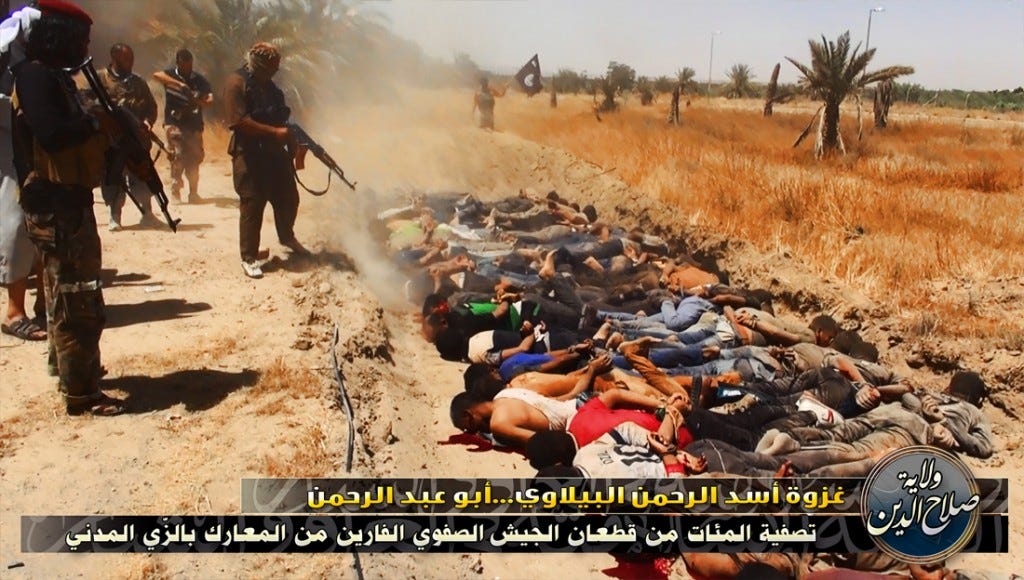
ISIS posted to Twitter a series of photos it said depicted its execution of more than a thousand Iraqi soldiers it had captured.
But not everyone is happy with the ability of large social media companies to exercise central control over the actions of their users. As social media like Facebook and Twitter have grown in popularity, alternative sites including Friendica and RedMatrix have offered social platforms with greater user privacy and freedom of expression.

“There is no central authority,” explains Mike Macgirivin, the principal developer and global coordinator of Friendica and RedMatrix.

Users can connect to the Friendica network in two ways. They can run the free, open-source software on their own server or they can create an account on one the free public servers. “They are provided by volunteers and are paid for out of pocket—for the benefit of providing free access,” Macgirvin says.

RedMatrix, which uses Friendica’s software, operates in a similar manner—although with greater privacy protections and built-in profile backup features.

That kind of infrastructure has made the networks welcoming places for dissident speech. But when ISIS propaganda unexpectedly appeared on the sites, it left many members concerned about legal jeopardy and the safety of fellow users.

In early July, ISIS devotees opened seven accounts on a Friendica.eu server, mirroring content from the group’s propaganda organs. With the accounts up and running, ISIS fans began advertising them on Twitter and in an affiliated Web forums as alternative hosts for the group’s content.

How the U.S. Allowed ISIS to Form a Terrorist Army

The Fiscal Times
July 25, 2014 

The United States has sent additional military advisers to Iraq and increased the number of drone flights to 50 per day, up from one flight a month. Yet so far this has done little to stop the rise of the jihadist terror group, the Islamic State, abbreviated as ISIS or ISIL, which has transformed itself from a loosely aligned band of militants to a full-blown army of terrorists, Brett McGurk, the deputy assistant defense secretary for Iraq and Iran, told the House Foreign Affairs Committee on Wednesday.

“ISIL is worse than al Qaeda,” said McGurk. “ISIL is no longer simply a terrorist organization. It is now a full-blown army seeking to establish a self-governing state through the Tigris and Euphrates valley in what is now Syria and Iraq.”

McGurk’s testimony shows just how quickly ISIS has grown and established itself as a legitimate military force. Back in February, McGurk warned that the threat from al Qaeda was increasing in Iraq. In the last six months, ISIS has broken with al Qaeda and introduced elements of sharia law across western Iraq and eastern Syria. It is now on the verge of taking Baghdad.

Convert Or Face Death: Iraqi Christians Flee Mosul

Inform

Christians in Mosul began fleeing Iraq?s second-largest city Friday ahead of a Saturday afternoon deadline issued by Sunni insurgents for them to convert to Islam. If they choose not...

“We did see this coming,” said Chairman Ed Royce (R-CA). “And that makes it even more troubling that the administration didn’t do what was necessary to prevent [ISIL] from taking over such a large swath of Iraq.”

Royce and other Republicans on the committee slammed the Obama administration for failing to conduct drone strikes against ISIS. McGurk, however, said that it was not clear if a drone strategy would effectively stop the group.

ISIS EXTREMISTS DESTROY SHRINE OF JONAH – VIDEO


The shrine of Jonah – revered by Christians and Muslims alike – has been turned “to dust” near Iraq’s Mosul. Footage of the event was posted online, and witnesses said it took ISIS militants just an hour to stuff the mosque with explosives.

“ISIS militants have destroyed the Prophet Younis (Jonah) shrine east of Mosul city after they seized control of the mosque completely,” an anonymous security source told the Iraq-based al-Sumaria News.

The extremist group ISIS changed its name from the Islamic State of Iraq and Syria (ISIS/ISIL) to just the Islamic State (IS), after formally declaring a new caliphate in Syria and Iraq at the end of June.

Muslims know the tomb as the shrine of Younis, whereas Christians refer to it as the tomb of Jonas.

Jonah is renowned for having been swallowed by a fish or a whale in the Bible’s Old Testament, with a similar story being present in the Koran. The site upon which the mosque had been built dated back to the eighth century BC.

“[The] Islamic State completely destroyed the shrine of Nabi Yunus after telling local families to stay away and closing the roads to a distance of 500 meters from the shrine,” an anonymous official from the Sunni Endowment, which manages Sunni religious affairs in Iraq, told AFP.

Israel, Hamas, WhatsApp and Hacked Phones in the Gaza Psy-War


07.26.14

The digital battlefield is full of surprises as efforts to terrify turn ludicrous, Israelis discover Palestinian friends, and gag orders crumble. 

TEL AVIV, Israel — Call it psychological warfare gone wrong. Really, really wrong. 

When Hamas posted a threatening message on its newly minted Hebrew-language Twitter account, @QassamHebrew, the intent was to scare the living daylights out of Israelis. Instead, one of the most feared terrorist groups in the world got its ass kicked by a woman using less than 140 characters. 

Rather than shaking in her sandals, Elizabeth Tsurkov, a 27-year-old relief worker from Tel Aviv, decided to pen a quick response, in which she very politely corrected the tweet’s grammatical errors, giving Hamas a free lesson in Hebrew 101. 

“It just bugs me when I see mistakes like that,” said Tsurkov, as though she’d just revised a first grader’s exam. “Also, I thought I’d have some fun with them.” 

You’d expect Hamas would be angry or pissed, or simply ignore her response. But this is the Middle East, after all, where nothing is that simple or predictable. So instead, Hamas thanked her, not once but twice. And, in an oddly gracious tone, even explained why it made the mistake. 

“I’m not one of those who believe all Palestinians hate me,” said Tsurkov. “But I did think everyone in Hamas did. Here was a guy who wrote me back and said thank you. I couldn’t help but feel that even he had a human side to him.” 

In an increasingly inhumane confrontation, with Hamas doing its best to slaughter Israelis, to little avail, and the Israeli counterattack costing hundreds of Palestinian lives, most of them civilian, these flashes of humanity are one of the strange twists in the psy-ops that both sides consider an important part of the battlefield. The problem for Hamas is that its digital campaign is as ineffective as its rocketry. 

When word got out about the unlikely exchange between Tsurkov and Hamas, many more Israelis began following Hamas on Twitter. The account (which has since been suspended) went from a little more than 2,000 followers to about 6,500 almost overnight. 

The technological warfare between Israel and Gaza took yet another weird turn when, a couple of weeks ago, Hamas (again in an effort to provoke fear), hacked into more than half a million Israeli smart phones, sending several hostile text messages. 

Last week, the terrorist organization took to Facebook to warn Israelis it was about to hit Tel Aviv at 9 P.M. sharp, again with spectacularly poor results. The rockets did fall, albeit a few minutes late. But rather than scare people out of their wits, they served as a moment of much-needed comic relief for many. 

Shalom Asayag, a well-known Israeli comedian responded: “Nine is not really good for me, I’m rather busy. Is there any way you can reschedule?” His comment got 50,000 likes and was seen by more than 1.5 million Israelis. 

As technology and social media permeate every aspect of our lives, they’ve also become potential game-changers on the battlefield. While Facebook and Twitter have been around for years, they’ve never been quite as prevalent, or handy, as they are today. 

But as Operation Protective Edge enters continues into its third week, the psychological operations of Hamas are getting more ghoulish. 

In This Gaza War, the Truth Is Buried

JUL 25, 2014

ISRAELI SOLDIERS SPRAY GAS AT A TUNNEL USED BY HAMAS MILITANTS TO INFILTRATE ISRAELI LINES. 

Here is one of the more astonishing facts of an already fairly astonishing war: The tunnels that Hamas has dug under Gaza’s border with Israel -- tunnels designed not for commerce, but for kidnapping -- reportedly contain tranquilizers and handcuffs, seemingly meant to be used by Hamas terrorists to gain physical control over Israelis they've seized.

I sometimes find it tiring to listen to Israeli spokesmen ask the same question over and over again: What would you want your leaders to do if your country’s enemies were firing rockets at your home?

The answer these spokesmen seek doesn't come entirely easily these days. This is in part because much of the world suffers from a kind of Hamas-specific amnesia, in which the group's past deeds (hundreds of murdered Israelis) and extreme goals are forgotten as soon as they are learned. But it’s also in part because the success of the Iron Dome anti-rocket system complicates the whole subject a bit.

The Iron Dome batteries could have provided Israeli policy makers with at least one answer that was short of immediate aerial retaliation, or eventual ground invasion. Israel might have been smarter, at the outset of the war, to absorb some of these initial attacks (assuming, of course, that it had continued good luck in interception). This would have ultimately made its cause slightly easier to explain to the world.

A delayed, or minimalist, response to the rocket attacks would have also denied Hamas an obvious battlefield victory: Hamas’s morally perverted but tactically clever goal is to maximize Palestinian civilian casualties. Its rockets are bait. And Israel has become expert at taking the bait.

But there is no Iron Dome for tunnels. The tunnels give me real pause. It’s hard enough to imagine a situation in which your neighbors are quite intentionally trying to blow up your house and kill your children with rockets. But Hamas’s well-developed kidnapping strategy represents a whole other category of depravity. The handcuffs and tranquilizers are mere baroque, Pulp Fictionish details. The core depravity of Hamas is its longstanding policy of treating every Jew as a target for elimination.

So I would ask this question: What would you want your government to do if your enemy was digging tunnels under your village, in order to pop out at night to kill or kidnap you? Could you imagine taking the risk that members of your family might be seized, dragged underground, handcuffed and tranquilized, and then held in the dark, perhaps for years, perhaps never to come home? Hamas terrorists have recently emerged from these tunnels inside Israel multiple times. This is not a theoretical threat.

Hamas Tunnel Threat at Center of War with Israel


JERUSALEM (AP) -- A network of tunnels Palestinian militants have dug from Gaza to Israel - dubbed "lower Gaza" by the Israeli military - is taking center stage in the latest war between Hamas and Israel.

Gaza's Hamas rulers view them as a military game changer in its conflict with Israel. The Israeli military says the tunnels pose a serious threat and that destroying the sophisticated underground network is a key objective of its invasion of Gaza.

Israel has known about the tunnels for several years, but has been hard-pressed to find an effective way to block them. Now it is counting on its ground war to at least reduce the threat.

"Israel knew there was a problem with the tunnels, but it didn't internalize their significance," said Shlomo Brom, a retired Israeli general. "At any given moment, Hamas could send dozens of militants through separate tunnels to attack communities in Israel."

Gaza has two sets of tunnels - those reaching Egypt and those reaching Israel.

The underground passages to Egypt are meant to bypass a border blockade on Gaza that was tightened by Israel and Egypt after Hamas seized the territory in 2007. The tunnels provide an economic lifeline and are used to deliver building supplies, fuel, consumer goods and even cattle and cars.

In some of those tunnels, Gaza militants received weapons and cash from their patrons abroad, particularly Iran. Egypt has destroyed virtually all of the tunnels over the past year, driving Hamas - which was taxing the smuggled imports - into a severe financial crisis.

Separately, Hamas significantly expanded its network of tunnels from Gaza to Israel after a major Israeli ground offensive that ended in January 2009.

Several senior Hamas officials have told The Associated Press that the expansion of those tunnels was part of a broader shift in military tactics after 2009, with input from the Hezbollah guerrilla group in Lebanon, which has fought Israel repeatedly.

"There are thousands of resistance fighters working underground and thousands others working above the ground, to prepare for the upcoming battle," Ismail Haniyeh, a top Hamas leader in Gaza, said earlier this year. "No one can imagine what the resistance is ready to do to confront the occupiers."

In addition to the tunnels, Hamas also boosted its arsenal of anti-tank rockets, which had proven effective in Hezbollah's battle with Israeli ground troops in Lebanon in 2006, said the officials, who spoke on condition of anonymity because they were not permitted to discuss military strategy with reporters.

Hamas also moved many of its rocket launching sites and storage sites underground, making it more difficult for Israel to target them. Since the current round of Israel-Hamas fighting began on July 8, Gaza militants have fired more than 2,000 rockets at Israel and repeatedly tried to sneak into Israel through tunnels.

Old Story, New Twists in Gaza War

July 26, 2014

CAIRO (AP) -- The third Gaza war is playing out much like the first one more than five years ago: The harrowing civilian toll in Gaza is now at the center of the discourse, eclipsing the rocket attacks by Hamas militants that were the stated reason for the Israeli assault.

Then as now, a question persists: Beyond the carnage, are Israel's airstrikes against civilian locations achieving anything at all?

It ended messily for Israel in 2009. A U.N. commission investigated, Israel refused to cooperate, and the resulting report - since then partly disavowed by its own author, former South African judge Richard Goldstone - said Israel deliberately targeted civilians and might have committed war crimes, along with Hamas.

About 1,400 Palestinians, including many hundreds of civilians, were killed in the operation dubbed "Cast Lead," along with 13 Israelis. After 18 days this year, the civilian death toll of operation "Protective Edge" is at similar levels - and the proportion is higher. Israel's argument is similar as well: Hamas is to blame not only for attacking a much-stronger power with rockets, but also for operating from within heavily populated residential areas, as well as mosques, hospitals and schools.

Navi Pillay, the U.N. high commissioner for human rights, said Wednesday that some of the recent Israeli attacks, including those on homes and on a care center for the disabled, raise "a strong possibility that international law has been violated in a manner that could amount to war crimes."

She also condemned indiscriminate Hamas attacks - including 3,000 rockets fired since July 8 that have killed several civilians in Israel - and said storing military equipment in civilian areas or launching attacks from there is unacceptable. But "the actions of one party do not absolve the other party of the need to respect its obligations under international law," she added.

International law can be a fuzzy and subjective thing, its application dependent on circumstances. The wider context also affects the degree of political pressure on Israel to stop. So it is important to note that there are also key differences between now and 2009. Here's a comparative look:

THE ROCKETS HAVE MORE RANGE

It is hard for outsiders to grasp the meaning, to Israelis, of Tel Aviv. The seaside metropolis of about 2 million is prosperous and fun, and an easy, generally liberal atmosphere prevails. It is a place of high tech, of electric nightlife, of diverse and highly Westernized culture, of surfing and gay pride parades. It is essential to an often unspoken but profound feeling that many Israelis cling to, which oddly aligns with what Arab critics would say: That they somehow do not belong in the Middle East.

In 2009, Hamas was firing relatively small projectiles with minimal range, mostly aimed at border communities surrounding the blockaded Gaza Strip. These are gritty places: hardscrabble towns that are relatively poor; or kibbutz farming communities whose people are often idealistic and pioneering. The people under fire there were certainly displeased, but by and large had no illusions about where they live.

The Gaza war has done terrible things to Israeli society


LISA GOLDMAN
Jul. 24 2014

Lisa Goldman is director of the Israel-Palestine Initiative at New America, a Washington-based think tank.

Earlier this month, one of Israel’s most famous writers announced in his weekly newspaper column that he was packing up his family and moving to the United States – permanently. Sayed Kashua, an Arab-Palestinian citizen of Israel who resides in Jerusalem, is the author of critically acclaimed novels and a popular television series, all written in Hebrew with wit and insight into the complex, conflicted society of Arabs and Jews living uneasily side-by-side. But after more than two decades of believing that ultimately Arabs and Jews would find a way to co-exist as equals, he wrote, something inside him “had broken.” He no longer believed in a better future.

Mr. Kashua’s decision to emigrate came in response to a series of events that were marked by violence and incitement against the Arab population, from the government to the street. One member of the Knesset, Israel’s parliament, called for a war against the Palestinian people on her Facebook page. Another called an Arab legislator a “terrorist” during a parliamentary committee session, while still another, the leader of an ostensibly centrist party, submitted a proposal to ban an established Arab nationalist party with sitting members of the Knesset. The editor of a right-wing newspaper suggested that now was the time to transfer the Arab population out of the occupied West Bank. In Jerusalem, mobs of hyper nationalist youth rampaged through the cafe-lined downtown streets chanting “death to Arabs,” assaulting random passersby because they looked or sounded Palestinian. Most horrifically of all, a 17 year-old Palestinian boy from East Jerusalem was abducted from the street by six young Jewish men, three of them minors. The police found Mohammed Abu Khdeir’s corpse in the nearby Jerusalem Forest shortly after CCTV cameras recorded some young men forcing him into a car. He had been doused with gasoline and burned alive. Three of the six boys confessed to the crime and re-enacted it for the police.

This orgy of internecine violence was sparked by the mid-June abduction of three Jewish teenage boys – Naftali Fraenkel, Gilad Shaer and and Eyal Yifrah – who were hitchhiking in the West Bank. The army carried out a massive three-week manhunt for the boys, that included pre-dawn raids and dozens of arrests; it ended with the discovery of three corpses buried in a field near Hebron. And while the men who committed the crime were almost certainly Palestinian, Hamas has vociferously denied involvement even as the Israeli government continues to accuse them of masterminding the abduction and murder as an act of terrorism.

After the nationally televised funerals for the boys, with moving eulogies delivered by their mothers, the country seemed to explode. Ultra nationalists openly organized anti-Arab demonstrations via Facebook groups. In response to the murder of Abu Khdeir, the Palestinian residents of East Jerusalem demonstrated violently against even more violent paramilitary police, three of whom were filmed beating a handccuffed and unconscious Palestinian-American boy named Tariq Abu Khdeir. And then the rage spread to the Galilee, where Palestinian-Arabs (sometimes called “Arab Israelis”) came out onto the streets to demonstrate; they were met by paramilitary police who used violent crowd control methods usually reserved for the occupied territories – rubber bullets, tear gas and brutal beatings. According to Adalah, a local NGO that monitors minority civil rights in Israel, the police arrested more than 400 Arab citizens for protesting.

When Strategies Collide

THE GAZA WAR
Published on July 25, 2014

Many wars are fought over accidents and misunderstandings. This is not one of those times. With key interests at stake, the conflict in Gaza is likely to continue. 

As the politicians, pundits, and foreign policy panjandrums of the world Western world wring their hands over the chaos and carnage in Gaza, it’s worth noting that there are solid reasons why peace is proving so elusive. Both sides have reason to think they can pull off a significant victory in the current round of fighting, and neither side thinks it can live with the consequences of a defeat. Until something happens to change the thinking on one or both sides, a cease fire will be hard to achieve. 

HOPES FOR A WIN

Israel continues to fight because it believes that with more time, it can destroy enough tunnels and inflict enough damage on Hamas to significantly degrade the organization’s military strength and weaken it politically. Furthermore, both Saudi Arabia and Egypt are, perhaps for the first time, quietly rooting for Israel to crush the Muslim Brotherhood-affiliated Hamas. Given this, Israeli officials presumably think they have a golden opportunity for the extended and crushing war that they really need to inflict serious damage. Any war with the Palestinians involves political costs and setbacks for Israel, but at this particular moment, war in Gaza is less politically expensive than at other times. Given that Hamas is a significant and growing danger, Israeli leaders are likely to think, why not use the opportunity for all it is worth?

Hamas on the other hand is elated by its success in temporarily but significantly hampering operations at Ben Gurion Airport (arguably the most significant single Palestininan tactical accomplishment since the 1948 War). In addition its fighters have had unexpected success killing Israeli soldiers on the ground, and the Arab street is electrified by the conflict. The resulting publicity offers Hamas an opportunity to emerge from the isolation it faced after the overthrow of the Morsi government in Egypt. Since more Israeli progress on the ground will inevitably and tragically mean more civilian deaths, Hamas can also hope for big propaganda victories to offset any military setbacks that prolonged hostilities will bring. Hamas and its Turkish and Qatari allies can also hope that the longer the war lasts, the worse Egypt and Saudi Arabia will look. The Gaza war isn’t just a war between Israel and Hamas; it is a stage in the struggle between the Muslim Brotherhood and its Arab opponents. The longer Hamas can bear up under Israel’s military pressure, the more success it has in the intra-Arab struggle. 

The hope of victory is one reason the two sides keep fighting; both Israel and Hamas also believe that defeat would impose unacceptable costs. 

ISRAELI FEARS

For Israel, there are three big reasons why losing is unacceptable. First, as a small country surrounded by enemies and facing hostile public opinion in the world at large, Israel’s security depends in large part on its reputation for military supremacy. That reputation, Israelis feel, deters many more attacks and keeps opposition passive and political rather than encouraging it to be active and military. This is an advantage that Israel will not lightly give up; hostilities are unlikely to end until and unless the Israelis feel they have made their point. 

That motive is always present, but it became much more important after a rocket from Gaza caused a significant interruption in service from Ben Gurion Airport. People don’t travel much across Israel’s land frontiers; the airport is Israel’s vital link with the rest of the world. Hamas and anti-Israel forces everywhere were wildly elated by this success, and Israel’s enemies now think they can imagine a new strategy to drive the Jewish state to its knees by cutting it off from the outside world. Israeli defense officials likely feel that they must now do two things: eliminate the capacity of Hamas to repeat this attack, and make the consequences so wounding and expensive to Hamas as to reduce the attractiveness of repeat efforts. This new factor is a military game-changer, and it greatly raised the stakes of the conflict. (The biggest political mistake of the war so far? The American officials who banned U.S. flights from using the airport made a cease fire much harder to obtain.) 

I. At around noon on March 20 last year, Air Force One landed at Tel Aviv’s Ben Gurion Airport for Barack Obama’s first presidential visit to Israel.

The three-day trip had been billed as an Israeli reset—the newly reelected president’s bid for a clean slate with the Jewish state after four years of icy relations. Obama would lay a wreath at the tomb of Theodor Herzl, the father of Zionism. He would visit the Yad Vashem Holocaust Museum. He would address an auditorium packed with Israeli students. And, of course, he would meet with Israeli Prime Minister Benjamin Netanyahu.

Before heading to Netanyahu’s office, however, the presidential motorcade took Obama to see his favorite Israeli: the country’s dovish 89-year-old president, Shimon Peres. As Obama stepped out of his car in front of Peres’s Jerusalem residence, he was greeted with a red carpet, along which a line of children stood waving Israeli and American flags and singing, “Heveinu Shalom Aleichem” (“We Have Brought Peace Upon You”). Inside, at a podium, Obama and Peres praised each other before a swarm of TV cameras. Later, in the presidential garden, they took turns shoveling dirt for a tree planted in Obama’s honor. And in the middle of it all, the two ditched the crowd for a meeting in Peres’s office. Four people joined: two Peres aides, National Security Advisor Tom Donilon, and new Secretary of State John Kerry.

“I want to focus on the peace process,” Obama told Peres as they sat down. “No one in the world understands it better than you.”1 Both presidents were firm believers in the two-state solution. And in pursuit of that vision, both had invested hope in Netanyahu, only to find themselves jaded. In 2011, Peres had conducted top-secret peace negotiations with Palestinian President Mahmoud Abbas on the prime minister’s behalf, but called them off when Netanyahu’s backing wavered. Obama’s tensions with Netanyahu, meanwhile, had become fodder for Israeli comedians. After years of failing to get the parties back to the negotiating table, Obama had reportedly given up on a peace deal. But he brought a different message to Peres that day: “Everywhere I go in the world, people talk about it,” he said. “The international community waited for the U.S. elections to be over, and then the elections in Israel—and now it’s expecting us to lead an effort towards peace. I want to go for it.”

Fortunately for Obama, “going for it” would require little time and political capital. In Kerry, he had someone eager to expend his own. Kerry recognized the foibles of Abbas and Netanyahu, but also their merits. In the former, Kerry saw a leader well ahead of his public on the subject of peace with Israel—and who, at age 77, might not be around much longer. And in the latter, he saw an uncontested prime minister, who, if only persuaded to make the tough compromises most of his countrymen were prepared to accept, could shepherd a deal through the landmines of Israeli politics. Above all, in the weeks since assuming office, Kerry had become convinced that the parties didn’t have much longer to craft a two-state solution. As he would say at a House hearing the following month: “I think we have some period of time—in one to one-and-a-half to two years—or it’s over.”

Back at Peres’s office, the Israeli president saluted Obama and Kerry for taking on the decades-old conflict. He had known almost every president and secretary of state since John F. Kennedy. And he had seen most of them parachute into the world of Middle East peacemaking, only to walk away frustrated and empty-handed. But he shared Kerry’s sense of urgency—and, strangely, his optimism. He told Obama that Abbas remained “the best peace partner Israel could hope for” and that Israel's recent elections—which had forced the right-wing Netanyahu into a more centrist coalition—presented an opportunity that shouldn’t be missed.

“I’m glad you think so,” Obama said. “John is going to be here a lot over the next few months.”

II. On the night of July 18 last year, after months of talks with John Kerry, Mahmoud Abbas convened a meeting of the Palestinian leadership at his presidential compound in Ramallah (the “muqata”). As the dozens of officials took their seats around a long u-shaped table, beneath a panorama of the Jerusalem skyline, the Palestinian president shuffled his notes and looked out at his comrades, more nervously than usual. He was about to make the toughest sell of his political life.

Over his five decades in the Palestinian Fatah movement, Abbas (or Abu Mazen, as he’s popularly known) had grown accustomed to staking out positions on Israel that put him in the minority. He pushed secret talks with Israelis in the 1970s, advocated recognizing Israel and forswearing violence in the 1980s, and questioned the wisdom of the second intifada in the 2000s. Elected president of the Palestinian Authority in 2005 following Yasir Arafat’s death, Abbas had campaigned on creating a Palestinian state through negotiations. But over and over, outside factors got in the way. A 2006 Hamas election victory and 2007 Gaza coup left Abbas in control of just the West Bank, and 2008 talks with Israel were short-circuited by Israeli Prime Minister Ehud Olmert’s corruption indictment and Netanyahu’s subsequent election. As of 2013, Abbas’s proudest achievement was the U.N.’s recognition of Palestine as a “non-member observer state”—a status with no practical significance. As one senior Palestinian official put it, “It’s bullshit, and we know it’s bullshit.”

Docs Seized By Israel Suggest Hamas Was Preparing A “Tet Offensive” Style Attack From Underground Tunnels

Author: Deborah Danan
July 26, 2014

Hamas Prepared Attack That Would Bring Israel to Its Knees, Israeli Defense Officials Say

Israel’s Prime Minster Benjamin Netanyahu revealed on Thursday that Hamas was intending to attack Israel from dozens of tunnels in a coordinated simultaneous attack. At the beginning of Thursday’s special cabinet meeting the prime minister said, “These tunnels enable the enemy to open a multi-pronged offensive and carry out a massive terror attack inside Israel.”

According to security officials cited by Israeli news website NRG, the political echelon now needs to give the military more time to eliminate the tunnels since “we are now not even halfway through.” The attack Hamas was planning, the officials say, “would have made Israel drop to its knees.” They added that even the tunnels destroyed until now takes away from Hamas a strategic asset the terror group has been working on for years.

The IDF’s Southern Command assessment is also that more time is needed, and in fact it was on the Southern Command’s recommendation that the government on Wednesday decided to reject a proposal for a humanitarian ceasefire. Intelligence officials assessed that such a truce would allow Hamas time to reorganize and what Israel needed to do now is push the terror group with its back against the wall so the leaders there will ask themselves whether it was wise to continue the large-scale fighting they initiated.

The IDF is continuing to engage Hamas targets and infrastructure on a daily basis: in one incident on Thursday, two terrorists who climbed out of a tunnel immediately surrendered to soldiers from the Paratrooper Brigade. There were other incidents where dozens of men surrendered to the IDF. On Friday morning, the IDF spokesperson revealed that five days ago, soldiers from the Nahal Brigade were confronted by a woman wearing a suicide vest.

According to the report, after engaging a terrorist squad, a figure rushed out toward the soldiers. It was a woman with a bomb strapped to her chest. The soldiers identified the threat and “neutralized” her before she was able to carry out her intended suicide attack, the IDF spokesperson said.

The Southern Command led the call not to make do with artillery and air force fire, but rather to widen the Gaza theater. According to NRG, sources in the IDF say Hamas had prepared for the battle but it has now escalated beyond the group’s control. They assessed that the group’s resilience is seemingly starting to crack at the seams.

Hamas has prepared a veritable plan for ground warfare, after a few failed terror attacks and the realization that rockets are no match for Israel’s Iron Dome defense system. Preparations for a ‘boots-on-the-ground’ war started when Hamas realized it had nothing to lose, but the organization was not prepared for the IDF to start the ground incursion so soon and hoped to have convenient exit strategies.

IDF officials warned that the drop in the daily number of rockets fired at Israel do not indicate Hamas is running out. While it is true that Hamas’s reservoir of projectiles has been significantly depleted, taking into account the number of rockets fired and the number of rockets and launchers destroyed by the IDF, the smaller barrages are seen in the military as a calculation by Hamas that the war can take a whole month and therefore it would need to retain its rocket-launching capabilities to the very last day. According to estimates, Hamas had 9000 rockets at the beginning of Operation Protective Edge. It has fired around 2000 and some 3000 were destroyed by Israel. It therefore still has some 4000 rockets in storage.

Israeli Paratrooper Forces uncover a tunnel network used by Hamas in Gaza during Operation Cast Lead. Photo: Wikimedia Commons.

Israel Surprised By Number, Sophistication Of Gaza Tunnels

By Paul Alster
July 26, 2014

The Israeli Defense Forces were surprised by the number of tunnels under the Gaza border. (Courtesy: IDF)

Some 60 shafts connect to at least 28 tunnels. (Courtesy: IDF)
tunnel3pic.jpg

Shafts leading down to tunnels began in mosques, schools, houses and even fields. (Courtesy: IDF)
tunnel5 copy.jpg

Israel plans to demolish all of the underground passageways with explosives. (Courtesy: IDF)

While rockets and mortar fly through the sky in Gaza and southern Israel, the focus of the Jewish state’s military is underground, on the warren of tunnels they say allow Hamas operatives to move freely in and out of the Palestinian territory committing acts of terror.

Pictures released by the Israel Defense Forces show tunnels, some primitive and others sophisticated enough to include walls and ladders, running under the border from the Hamas-controlled district before they were intentionally destroyed. More than 60 access shafts leading to 28 tunnels have been uncovered since Israel’s ground operation — dubbed Operation Protective Edge — began on July 8.

“An IDF force uncovered a terror access shaft in Gaza in which were weapons, maps and IDF uniforms, all intended for the execution of terror attacks against Israel,” said an IDF statement. “In addition, an IDF force attacked several militants emerging from a tunnel opening in the southern Gaza Strip. Since the beginning of the ground operation more than 60 access shafts leading to some 28 tunnels have been uncovered.”

“This can be dealt with diplomatically or militarily – now it’s being done militarily with a lot of success.”

- Israeli Defense Minister Moshe Ya’alon

Defense Minister Moshe Ya’alon said shutting down the tunnels is critical to security in Israel.

“We’ve been busy with the tunnels for a long time — in the last year we have discovered four in our territory,” Ya’alon said. “This can be dealt with diplomatically or militarily — now it’s being done militarily with a lot of success.”

The E.U. is the world’s great no-show

July 24, 2014

A woman looks at clothes piled up in a room of a building occupied by pro-Russian separatists in Donetsk. (Bulent Kilic/AFP/Getty Images)

The Ukraine crisis has shone a spotlight on one of the glaring gaps in the world: the lack of a strategic and purposeful Europe. The United States can and should lead on the response to this conflict, but nothing can really happen without Europe. The European Union is by far Russia’s largest trading partner — it buys much of Russia’s energy, is the major investor in Russian companies and is the largest destination for Russian capital. Some of President Obama’s critics want him to scold Vladimir Putin. But ultimately, it is European actions that the Russian president will worry about. 

Consider how Europe has dealt with Ukraine. For years, it could not really decide whether it wanted to encourage Ukrainian membership in the union, so it sent mixed signals to Kiev, which had the initial effect of disappointing pro-European Ukrainians, angering Russians and confusing everyone else. 

Fareed Zakaria writes a foreign affairs column for The Post. He is also the host of CNN’s Fareed Zakaria GPS and editor at large of Time magazine.

In 2008, after Moscow sent troops into Georgia, Europe promised an “Eastern partnership” to the countries along Europe’s eastern fringe. But, as Neil MacFarlane and Anand Menon point out in the current issue of the journal Survival, “The Eastern partnership was a classic example of the EU’s proclivity for responding to events by adding long-term and rhetorically impressive, but resource-poor, bolt-ons to existing policy.” 

European leaders were beginning to woo Ukraine without recognizing how this would be perceived in Russia. Moscow had its own plans for a customs union, to be followed by a Eurasian Union, which was meant to be a counter to the European Union. Ukraine was vital to Russia’s plans and was dependent on Russia for cheap natural gas. Plus, of course, Ukrainians were divided over whether to move west or east. 

Negotiations between the European Union and Ukraine for an association agreement meandered along, with the lawyers and translators taking a year to work out the text. In describing this tardiness as a mistake, Polish Foreign Minister Radoslaw Sikorski said, “The same thing applies to the [European] Union as to the Vatican. God’s mills grind slowly but surely.” The deal that was offered to Ukraine was full of demands for reform and restructuring of its corrupt economy, but it had little in the way of aid to soften the blows and sweeten the pot. When then-President Viktor Yanukovych rejected Europe’s offer and sided with Moscow, he set in motion a high-speed, high-stakes game that Europe was utterly unprepared for and could not respond to. 

If Europe was trying to move Ukraine into its camp, it should have been more generous to Kiev and negotiated seriously with Moscow to assuage its concerns. Instead, Europe seemed to act almost unaware of the strategic consequences of its actions. Then when Russia began a campaign to destabilize Ukraine — which persists to this day — Europe remained a step behind, internally conflicted and unwilling to assert itself clearly and quickly. Those same qualities have been on display following the downing of Malaysia Airlines Flight 17. 

Will the Russian Army March into Ukraine?

07.24.2014

It scarcely seems possible, but the situation in Ukraine keeps getting worse.

First Vladimir Putin let loose his “little green men”–a collection of Russian intelligence agents and military personnel along with a sprinkling of locals–to stir up a separatist rebellion in Crimea. Then after a bogus referendum held under Russian guns, he brazenly annexed Crimea, as flagrant a violation of international law as it is possible to imagine. Next he instigated another faux rebellion in eastern Ukraine led by Russian citizens, many of them current or former Russian military and intelligence personnel.

The pro-Russian rebels managed to carve out a quasi-independent region in eastern Ukraine where there is a substantial Russian-speaking population even if previous public opinion polls had indicated little support for breaking away from Ukraine. When the elected government in Kiev began to fight back against the rebels with some success, Putin provided them with heavier weapons including the sophisticated Buk or SA-11 air-defense system which brought down Malaysian Airlines flight 17, killing some 300 people on board.

Instead of apologizing for this war crime committed by his stooges, Putin has spun elaborate fantasies about how the Malaysian aircraft was really brought down by a Ukrainian anti-aircraft battery or fighter aircraft, even though U.S. intelligence and every other reputable observer has provided ample evidence that the foul deed was committed by a missile fired from the territory controlled by Russian separatists. Then the Russian rebels had the gall to deny international investigators access to the crash site and to actually loot the belongings of the innocent victims.

Far from chastened in the aftermath of the Malaysian Airlines tragedy, Putin is actually escalating his aggression. On Wednesday two Ukrainian fighter aircraft were shot down over their own airspace, with Kiev alleging that the shots came from the Russian side of the border. The State Department reports that in recent days artillery in Russia has been pounding Ukrainian positions and that Russia is now supplying the rebels with heavier weapons including tanks and rocket launchers. Speculation is rife that Putin may order the Russian army into Ukraine or that, at the very least, his proxies will stage a major offensive.

It is simply incredible that this is happening in the Europe of 2014–the land of the euro and the Eurovision song contest, of espresso and Bordeaux, of long vacations and short work weeks. Wasn’t Europe supposedly entering an era beyond power politics and certainly beyond war?

Recent events sound like something out of the 1930s, the dark years when brazen predators picked off countries at will: Czechoslovakia, Austria, Abyssinia (Ethiopia), China all fell while the League of Nations and the “international community” stood by, helpless and hapless, paralyzed, not knowing what to do. Putin is no Hitler or Tojo or Mussolini, but there are echoes of these outrageous events in his reckless disregard for the norms of international conduct.

China’s War on the Internet

July 26, 2014

With more Chinese going online, the CCP has strengthened its effort to create an Internet with Chinese Characteristics. 

On the one hand, China has the most internet users of any nation on earth by far, most of whom aren’t accessing the web from a fusty old PC, but rather from their smart phones and tablets. Online retail has also taken China by storm, with some estimating that e-commerce could account for 22 percent of China’s annual economic growth by 2025. Some Chinese Internet stocks are surging, and China’s penchant for creating useful and imaginative apps is growing.

On the other hand, you have Dong Rubin.

Dong Rubin began his foray into becoming an online enemy of the state when he vocally criticized the case of 24-year-old Li Qiaoming—who met an untimely end in 2009 in what authorities laughingly said was a particularlyraucous game of hide-and-seek with other inmates. For years afterward, Dong has expressed vocal opposition to local corruption, environmental pollution, and injustice. Still, it wasn’t until the 2013 crackdown on “rumors” that police lured him out of his home by telling him his car had been hit, arresting him on the spot, an arrest Dong Rubin predicted online after his offices were raided. This week, he was sentenced to six and a half years in prison.

The storm that social media faced almost a year ago still rages today and will continue; it’s also having some very serious consequences for the Chinese Internet as a whole. For example, during the first half of 2014—after the rumor crackdown ravaged content and arrested dozens—the number of people logging onto social mediawebsites plummeted 7.4 percent. Internet usage in China has been on a steep incline for many years now, but, with the crackdown on outspoken social media personalities, the growth in Internet users slowed to a 2.3 percent increase as of June, the lowest in 8 years.

The world was struck last year when a crackdown on “rumors” started to bring China’s social media rise to a halt. Many expected it to be like the gun crackdowns in Guangdong that ended with photos of replicas being run over by a steam roller or porn crackdowns that feature heavily in newspapers bragging of shuttering tens of thousands of websites and blogs. However, sadly, after almost a year and with so many still awaiting sentencing for their social media crimes, it is no longer a crackdown; it’s policy.

Many thought the worst was over by February, and users started to flock to more private means of communication online, such as the WeChat app. In fact, over 37 percent of those who quit Weibo joined WeChat. But, in mid March, that app fell victim to the long, paranoid arm of the Chinese law as well, with journalists, organizations, and publications getting their public accounts shut down. The censorship even spilled over into Thailand, Hong Kong, Vietnam, Malaysia, and Singapore.

SORRY STORY

GWYNNE DYER
28 Jul 2014

The question to bear in mind, when reading this whole sorry tale, is this. If Americans are, on average, no stupider than Germans, then why are their intelligence services so stupid? After the most recent revelations about American spying in Germany, there was considerable speculation among members of the Bundestag (parliament) that Germany might “get even” by inviting US whistleblower, Edward Snowden, to leave his Moscow exile and come to Berlin. But Chancellor Angela Merkel, at her traditional pre-summer vacation press conference, rained all over that idea.

“We learned things [from Snowden] that we didn’t know before, and that’s always interesting,” she said — but “granting asylum isn’t an act of gratitude.” Given that one of the things she learned from Snowden was that the National Security Agency of the United States of America was bugging her mobile phone, this showed admirable restraint on her part, but even Merkel’s restraint only goes so far.

Very recently, her patience with persistent American spying even after Snowden’s revelations snapped quite dramatically, when she ordered the US Central Intelligence Agency’s “chief of station” at the American embassy in Berlin to leave the country. The US has never formally apologized for tapping Merkel’s phone. It refused to give her access to the NSA file on her before she visited Washington. And it went on paying a spy who worked for the Bundesnachrichtendienst (BND-Federal Intelligence Service) right down to this month.

Getting fat

“One can only cry at the sight of so much stupidity,” said Finance Minister Wolfgang Schaeuble, insisting that the information given to the US by the spies was of no real value. That’s probably true — yet the American controllers paid their spy in the BND almost $40,000 in cash for 218 secret German documents. Some of those secret documents were even about the discussions of the German parliamentary committee that was investigating the earlier American spying efforts, including the bugging of Chancellor Merkel’s phone. The American spy agencies simply don’t know how to stop spying, even when they have been caught red-handed. They only got away with such brazen behaviour for so long because the Germans naively trusted them. The spy from the BND, for example, simply sent the US embassy an email asking whether they were interested in “cooperation”. The German authorities didn’t pick up on it because they didn’t monitor even the uncoded communications of a “friendly” embassy.

What is clear from all this is that the American intelligence agencies are completely out of control. They are so powerful that even after the revelations of massive abuse in the past year very few politicians in Washington dare to support radical cuts in their budgets or the scope of their operations. They collect preposterous amounts of irrelevant information, alienating friends and allies and abusing the civil rights of their own citizens in the process.

The Best Air-to-Air Missile in the World Is in Sweden Gripen fighters the first to get the new Meteor missile

The air force of neutral Sweden may not be one of the big-hitters in terms of global power projection. Indeed, it has barely even undertaken combat operations.

When Swedish jets went into action over Libya in 2011, during Operation Unified Protector, the government only allowed them to fly reconnaissance missions. The previous time Swedish fighters deployed in combat was almost 50 years earlier, during the Congo crisis.

However, Sweden always has taken its air defense very seriously—and has a proven track record of developing innovative, often indigenous solutions to meet its air-power needs. Now, the Swedish air force is about to field what is arguably the most capable air-to-air missile in the world.

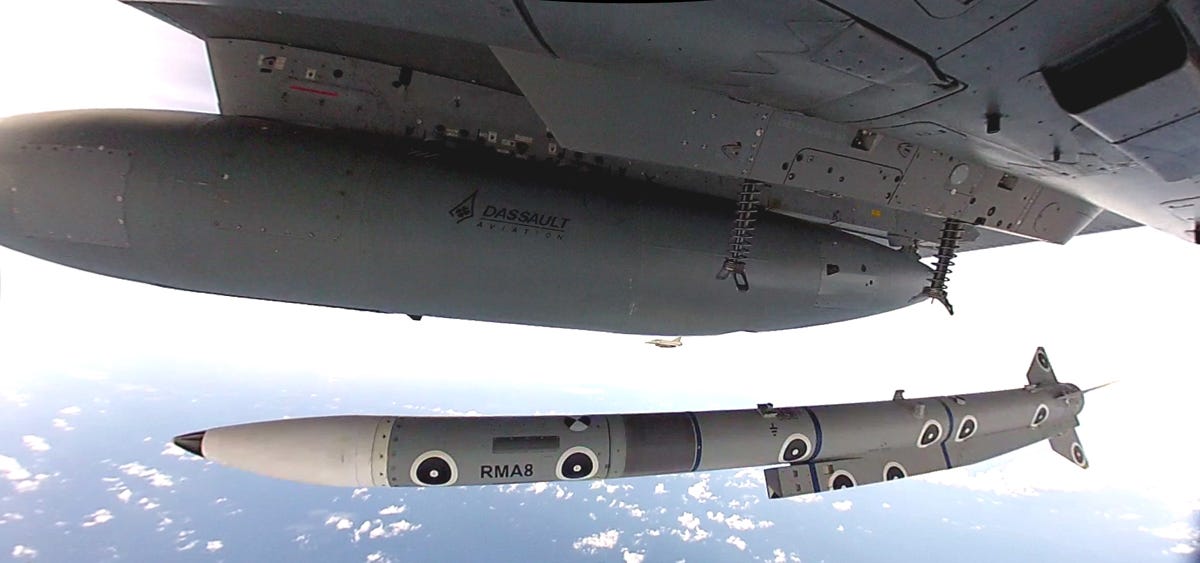
The Meteor is not a Swedish product per se, but it will see its initial operational service as part of the armament of the Swedish air force’s fleet of Saab JAS 39C/D Gripen fighters.

Sweden is part of a multinational European team that has developed the Meteor Beyond-Visual-Range Air-to-Air Missile. France, Germany, Italy, Spain and the U.K. also are involved. Pan-European missile house MBDA is the prime contractor.

A French air force Rafale, operating from the Cazaux Flight Test Center in southwestern France, launches a test Meteor in 2012. MBDA photo

The Swedish connection

It was back in September 2010 that Sweden elected to integrate the Meteor ramjet-powered missile with the Gripen, allocating the appropriate funds—as yet undisclosed—and finalizing contractual paperwork.

As well as Sweden becoming the first nation with an operational Meteor capability, it was important that the same option be made available to Gripen export customers. Foreign countries that have so far signed up for the Swedish multi-role fighter include Brazil, the Czech Republic, Hungary, South Africa and Thailand.

In its initial application on the Swedish air force Gripen, the Meteor comes as part of the Materiel System 20 update. MS20 is due to enter service in 2015, at which point the Swedish air force and the Gripen will be the first air arm and the first platform with fully operational Meteors.

Sweden, and local fighter-maker Saab, have ensured that they play a central role in the Meteor’s fortunes. In doing so, they have established a significant lead in the air-dominance race. While both China and Russia have also been working on ramjet-powered active-radar-guided missiles, the Meteor looks like it will beat all of its rivals into service.

The ramjet powerplant means that the Meteor is an air-breathing air-to-air munition—the first to enter service. Thanks to its efficient ramjet motor, the Meteor is a true very-long-range missile, a class that, since the retirement of the Phoenix-and-F-14 combination, is entirely absent from the U.S. military.