1 September 2014

Does Latest Rebel Offensive Indicate Putin Wants Land Link Between Russia and the Crimea?

Andrew E. Kramer and Andrew Roth
New York Times
August 29, 2014

Ukraine Rebels Advance on Key Port, in Hint at Putin’s Strategy

NOVOAZOVSK, Ukraine — Backed by Russian troops and weaponry, hundreds of Ukrainian rebel militiamen mobilized on Friday in this southeastern town, vacated by the Ukrainian military two days ago, and began to push toward the strategic seaport of Mariupol 27 miles away. The leader of the rebels called the advance a broad new effort to wrest control of a wide swath of coastal territory from the central government.

The militiamen flew the flag of “Novorossiya,” or New Russia, a reference to Russia’s historical claims over the southeastern area of Ukraine that encompasses the rebellious Donetsk and Luhansk regions under siege by the Ukrainian Army.

Their thrust toward Mariupol, the biggest city in the southeast, was the most prominent evidence that the insurgency in eastern Ukraine bordering Russia has been given a new infusion of vitality by President Vladimir V. Putin of Russia. It came as Mr. Putin directly addressed the insurgents for the first time on Friday in a message posted on his website in which he called them the fighters of Novorossiya.

The developments offered new insights into the strategy of Mr. Putin, who has supported the rebels in defiance of the United States and its Western allies as part of a broader effort to keep Ukraine within Russia’s sphere of influence. The rebel advance along the southeastern coast suggested that Mr. Putin may be establishing the basis for a more independent eastern Ukraine, or for an overland route from Russia to Crimea, the southern Ukrainian peninsula that Russia annexed five months ago.

Ukraine and the West have accused Russia of increasingly brazen military aggression, sending troops, tanks and other weapons across the border to support the rebels. The Kremlin has denied the accusations and asserted that any Russian soldiers fighting in Ukraine are volunteers on vacation.

A takeover of Mariupol, an industrial city of 450,000, would go a long way toward helping the separatists gain control over land that would connect Russia to Crimea.

“We plan to take Mariupol,” said a commander of the rebels in Novoazovsk, who identified himself by his nickname, Svet. “Now we are fighting for the southeast of Ukraine for Novorossiya.”

A Radical Way for Ukraine to Fight and Defeat Russia

BY ANDREW L. PEEK,The Fiscal Times
August 29, 2014

The image of Russian tanks advancing through southeastern Ukraine should be deeply embarrassing to Americans. 

Not because Ukraine is of such vital national interest; not because the fate of liberty at home hinges on Luhansk or Donetsk; but because it is very clear that Putin (as well as Bashar Assad, Egyptian President Sissi, the Iranian Supreme Leader, Chinese Premier Li, the Saudi royal family, Bibi Netanyahu, Shinzo Abe, Angela Merkel, virtually every other major world leader, and probably a plurality of his family members) simply does not really care what the President of the United States thinks.

In his Thursday press conference on two of the currently unfolding crises, President Obama refused to call the Russian invasion an invasion. “Invasion” presumably implies action; instead, it was a “continuation of what’s been taking place for months now,” which is actually more embarrassing than delineating this as a singular one-off. He and other world leaders will be discussing this issue at the NATO summit next week, but Obama was upbeat about the situation over all: “I think that the sanctions we’ve already applied have been effective.” Despite, well, the evidence.

To be fair, the fact that economic sanctions have not altered Russian behavior is not really Obama’s fault. They were never going to be enough. Effective sanctions would require whole-hearted European support, and since Europe’s economy is heavily dependent on Russian energy, major players like Germany will not impose the kind of sanctions regime that ultimately brought Iran to the bargaining table, relatively speaking.

Because of Europe’s dependency, an effective Russia policy simply has to supplement the limited costs of economic sanctions with some other kind of costs. Usually, this is where military aid would come in. But the Obama Administration has steadfastly refused to send Ukraine weapons, arguing that arming the Ukrainians might lead to Russian escalation and in any case will not change Russia’s overwhelming military superiority.

It’s a little nonsensical, because Russia’s perfectly willing to escalate anyway; and if helping our friends resist stronger foes doesn’t change anything fundamental, then…why do we help anybody? Why do we even have friends? Why not just accept Russian and Chinese domination over Eurasia and go home?

In one sense, though, the Administration’s right. Nobody believes Taiwan, for example, can defeat China in a war. Nor can Georgia defeat Russia. But arming Taiwan raises the cost of Chinese military action without committing American troops. It’s a deterrent. And NATO’s deterrent to Russian aggression along its borders has simply fallen apart.

Why the West should let Russia have eastern Ukraine

August 29, 2014
Ukraine ought to be split in two, anyway

Ukraine is two nations in one state. (AP Photo/Antoine E.R. Delaunay)

Putin's Russia seems to have finally launched its bona fide invasion of Ukraine. And many righteously indignant American lawmakers will surely be eager to try to stop Russia (not at any cost), or at least punish it for doing something reprehensible. Ukraine is a sovereign country, and invading sovereign countries is bad (you know, unless you are the United States).

But this thinking misses a crucial dimension of the problem.

America has a blind spot when it comes to nationhood. America's implicit theory of humans seems to be that as long as they get "life, liberty, and the pursuit of happiness" out of their government (and low taxes and the ability to vote the bums out), they're happy. But people want another thing out of their government: nationhood.

What this means is tricky, because each nation defines what it is for itself, often implicitly. For some nations, nationhood is tied closely to ethnicity. For some, it is tied to land. For some, it's language or culture or history. For most countries, it is a mysterious mix of all of these. America is almost unique in believing, at least officially, that its nationhood is fundamentally defined by agreement to a set of legal rules.

But nations have psyches, wants, desires, fears, destinies even — and integrity. This is why Charles de Gaulle never referred to the Soviet Union and only to Russia. To him, the Politburo was not really driven by Communist ideology but rather by simple national interest. Stalin did only what Peter the Great would have done in the same circumstances.

America's blind spot on the importance of nationhood is largely responsible for the maddeningly obvious events of the Iraq War. The problem that lay at the heart of the conception of the Iraq War was failing to understand that Iraq is not, and never has been, a nation. In the mind of the architects of the war, if they could figure out a way to get Iraq's government to work or merely to be an improvement over Saddam Hussein's regime, Iraqis would be happy — they would get life, liberty, and the pursuit of happiness, after all — and the venture would be a success. But Iraq was never a nation but an agglomeration of nations and peoples — Sunnis, Shias, and Kurds. The only way to hold it together was — as Saddam Hussein, no theoretician, understood quite well — the way it was actually held together: through violence and terror. Now most people understand that if "Iraq" can be held together, it will be as a legal fiction: as a very loose confederation of autonomous Kurdish, Sunni, and Shia enclaves. If only it hadn't taken a decade and unfathomable blood and treasure for American policymakers to understand one of the basic rules of the grammar of history.

RUSSIA – EUROPEAN UNION SANCTION CONFLICT IMPACT – ANALYSIS


A one-year food import ban decree signed on August 6, 2014, by Vladimir Putin, the President of the Russian Federation, caused massive backlash among the European farmers, as well as foreign politicians and analysts.

The decree bans the import of certain foods, such as beef, pork, poultry and chicken, fruit, vegetables, fish, cheeses, milk and milk-based products, from the USA, Australia, Canada, Norway and the EU member-states. The detailed list of products covered by the food ban was announced by Dmitry Medvedev, the Prime Minister of the Russian Federation, on August 7.

Several days after the signature date, the officials removed certain products from the list, such as lactose-free milk, salmon and trout fry, seeding potatoes, onions, hybrid sweet corn and peas, as well as nutritional supplements.

The Russian counter-sanctions caused a severe impact on exporters and food producers from Greece, Lithuania, Poland, Germany, Finland, Norway, Spain and other countries.

The European authorities have announced a financial program to aid the farmers hurt by the food ban, such as producers of peaches, nectarines, other fruit and vegetables, and milk products; but several foreign analysts, as well as the food producers themselves, say that these measures will not be sufficient to help the companies.

However, Juha Väätänen, professor at Lappeenranta University of Technology in Finland, suggested that the effect from the Russian sanctions was the strongest only during the first days after their introduction, while in the long term most European producers will be able to move to other markets.

“Europe is the biggest exporter of food in the world, and sanctions by Russia are valued at 3% for the Europe for export. In Europe, the scale of sanctions is very small, but some countries are suffering a lot,” the analyst said in an interview to “PenzaNews” agency.

According to him, Moscow’s actions will not push the EU towards lifting the sanctions, since the latter were imposed because of the Ukrainian conflict.

“From the European perspective, the sanctions are linked to the situation in Ukraine. And now, when Russia declared sanctions at the European Union, the EU is not doing anything, because the situation in Ukraine hasn’t changed. So the EU is not responding to the economic sanctions from Russia, because Europe doesn’t see an economic problem: they see a political problem based in Ukraine,” Juha Väätänen explained.

Stefan Meister, Senior Policy Fellow at the German Council on Foreign Relations, also argued that the economical effect of the Russian food ban on Europe was minimal.

“As we all know, Russia is not really a crucial market: it depends on the area. Maybe for Baltic states, for Poland, this really is a key market, but for many other member-states it’s just one of the markets,” the expert said.

However, he admitted that in certain cases, such as for the German milk and chicken producers, the food ban became a major concern for the next few years.

Stefan Meister also suggested that the affected agricultural businesses will be able to move to other world markets in the future, which, according to him, is facilitated by a trend to become more economically independent from Russia, which is gaining popularity among the European businessmen.

At the same time, the expert noted that Moscow’s actions proved that the Kremlin was not as defenseless against the sanctions as the West thought.

MI-5’s Faulty 2009 Assessment on Muslim Radicalization in Britain

August 29, 2014
Counter-Terrorism: Family Values

Back in 2009 MI5 (Britain’s domestic intelligence agency) announced that Islamic radicalism was no longer growing in the United Kingdom but that many of those who were already radicalized were still dangerous. Now that assessment has been revised to reflect the fact that while Islamic terrorism became less acceptable to most Moslems by 2009, it was still popular with younger Moslem men. That popularity evolved into “jihad chic” and got a new boost in 2011 when the Arab Spring uprisings (which were not instigated by Islamic terrorist groups) had apparent success. This surprised Islamic terrorist groups who then joined the Arab Spring rebels when these uprisings appeared to be succeeding. Naturally the Islamic radicals grabbled more credit than they were due and sought to take advantage of the chaos to turn countries formerly run by Arab dictators into religious dictatorships run by Islamic radicals. This has not succeeded anywhere, yet, but it has created quite a mess in the Middle East and in the West.

Now MI5 is using its databases of Islamic terrorist sympathizers and wannabes to locate newly radicalized British Moslems or those who have been seen fighting for Islamic terrorists in the Middle East. When MI5 ran the numbers they realized that it was quite likely that more British Moslems were overseas fighting for Islamic terrorist groups than were serving in the British armed forces.

The 2009 MI5 assessment was based on the belief that Islamic radicalism was following a similar pattern that MI5 encountered with the IRA (Irish Republican Army). Despite Northern Ireland (which the IRA wants to unite with the Republic of Ireland to the south) being largely free of IRA terrorist violence for the previous decade MI5 still spent 15 percent of its budget seeking out the diehard Irish terrorists, and preventing them from carrying out more attacks. MI5 still devotes a lot of resources to the remaining IRA terrorists. But now Islamic terrorists are seen in a different light and as more of a long-term threat.

In 2009 it was not appreciated that the basic difference between the IRA and the Islamic terrorists was that the IRA was only concerned with unifying Ireland while the Islamic terrorists want to conquer the world. In 2009 the Islamic terrorists were thought to have merely gone from a growing menace to a persistent one. The rising death toll of dead Moslems at the hands of Islamic terrorists (from 2004-2006) had precipitated a decline in support, among Moslems, for Islamic radicalism. That led to more tips and cooperation with the police everywhere. This put more Islamic radicals on the run. Some of them were so desperate to avoid MI5 that they fled to Northern Ireland, where only one percent of the population is Moslem (versus four percent for Britain overall).

In 2009 some 70 percent of the terrorist plots discovered in Britain had some connection to Pakistan based terrorists. This made it easier for MI5, or so they thought. About four percent of the British population is from South Asia, or is of South Asian ancestry. Half of those are from India, 36 percent from Pakistan, and most of the rest from Bangladesh. About half the South Asian population is Moslem. While Britain is the European nation most agreeable to assimilation, it is also, like other countries in the region, hostile to migrants. They are tolerated, not welcomed, as they are in the United States. As with the United States, natives, and legal migrants are also hostile to illegal migrants and a growing number of Islamic terrorists sought to get their families into Britain, one war or another, to keep them safe while dad was off slaughtering someone else’s wives and children for the cause.

Great Power Politics and the Ukrainian Crisis: NATO, EU and Russia after 2014

Henrik Larsen, Research Fellow, International Security Program

This report assesses the relationship between Europe and Russia as the sum of great power reactions to the Ukrainian crisis and Russia's annexation of Crimea. Despite agreement on a no business-as-usual principle, important national nuances have arisen stemming from different historical bonds to eastern Europe and Russia (Germany, Poland, United States) or different interests in the region (France, United Kingdom).

The report calls for a recalibration of the Europe-Russia relations along three dimensions based on the great power pattern: imposing moderate sanctions and thus letting markets punish Russia, given its vulnerability to international investors; placing the EU at the forefront of implementing the Association Agreement already in place to assist Ukraine in painful but needed reforms; and getting NATO to reinforce its eastern posture to incentivize de-escalation.

The Ukrainian crisis must be recognized and managed as a predominantly politicaleconomic rivalry involving relatively strong Russian interests in this common neighborhood with the EU.


For more information about this publication please contact the ISP Program Coordinator at 617-496-1981.

Full text of this publication is available at:

What Territory in Syria and Iraq Does ISIS Control?

Kathy Gilsinan
August 28, 2014
The Many Ways to Map the Islamic ‘State’

ISIS territory in Iraq and Syria tends to be described as “swaths.” The estimated size of these swaths, which ISIS leader Abu Bakr al-Baghdadi declared a caliphate in June, varies widely in reports, from 12,000 square miles—”an area the size of Belgium,” per The Wall Street Journal—to 35,000 square miles, or “an area the size of Jordan,” as George Packer wrote this week in The New Yorker. Whatever else the caliphate is, by these estimates of territorial size at least, it’s starting to look more and more like a state. Packer continued:

The self-proclaimed caliphate stretches from the newly conquered towns along the Syrian-Turkish border, through its de-facto capital of Raqqa, in northern Syria, across the obliterated Iraqi border into Mosul, Tikrit, and Falluja, down to the farming towns south of Baghdad—roughly a third of the territory of both [Iraq and Syria].

In The Economist in June, that looked like this:

The Economist's map shows where ISIS is present in, controlling, or contesting territory—a broad depiction of what the 'caliphate' might be. Under that definition, this image would not have changed much since June despite recent gains by ISIS; where it has acquired more territory (as in Syria's Raqqa province, where this week it seized the last of the government-controlled military bases), ISIS was in many cases already shown as “present” in the map above. The difference now is that ISIS has won more battles, and as a result has more infrastructure and resources to fund and defend what it now calls the Islamic State.

Kurdish Push for Independence Derailed by ISIS?


Since July 3, when the President of the Kurdistan Regional Government (KRG) Massoud Barzani instructed the KRG parliament to begin preparing a referendum on independence as soon as possible and followed up by saying on July 7 that he would no longer “hide that the goal of Kurdistan is independence”, new developments have fundamentally transformed the situation. On August 7 the U.S. returned to military action in Iraq to combat the imminent threat posed to the KRG by militants from the Islamic State of Iraq and Syria (ISIS). On August 12, under pressure from the U.S. and Iran, Nouri Maliki lost the support of his State of Law parliamentary bloc and thus his bid for a third premiership, clearing the way for fellow Shia Haidar Abadi and a possible political compromise between the Sunnis, Shias, and Kurds that make up Iraq.

With the U.S. now directly engaged in protecting the Kurds and the city of Erbil while stressing the importance of the unity of Iraq, efforts by the Kurdish leadership to move towards independence appear to have been sidelined. Confirming the implicit retreat from their previous position, Hoshyar Zebari, the Iraqi Foreign Minister who along with others had withdrawn from the Maliki government in July, confirmed in an interview with the Washington Post on August 13 that “priorities have changed” and that the goal of Kurdish independence, while not “abandoned,” had been “put aside.”

Accelerated Efforts

The recent Kurdish push towards the age-old dream of independence had built up steam parallel to the KRG’s worsening relationship with the central government in Baghdad and in particular with Prime Minister Maliki, whose coalition had once again emerged as the largest bloc in the April 30 parliamentary elections. At the heart of the dispute has been the energy resources within the Kurdistan region, which the KRG have developed independent of the central government. The KRG argues that it has the right to sign independent contracts with oil companies and to keep revenues it accrues from their work in the KRG – along with future revenues from independent exports – because the central government has failed to provide the KRG with its full revenue share. The central government for its part has justified the withholding of portions of the KRG’s 17 percent share of revenue from energy sales from all of Iraq – including all payments since February 2014 – largely on the grounds that the KRG’s independent energy dealings are in violation of Article 108 and 109 of the Iraqi Constitution, which states that oil and gas are owned by all the people of Iraq and the authority to develop energy resources and distribute revenues lies solely in the central government in Baghdad.

The “Responsibility to Protect” (R2P) in Iraq Shouldn’t Just Be About Military Intervention

August 29, 2014

The resumption of limited military campaigns in Iraq has raised concerns that well-intentioned efforts to avert catastrophic military defeats and a humanitarian crisis in the country may lead to mission creep, or at best, will not likely yield desired outcomes envisioned by the Obama Administration.

According to the United Nations report to the Secretary General, the underlying principle behind R2P or the Responsibility to Protect is that “When a State…‘manifestly fail[s]’ to protect its population from the four specified crimes and violations,” other states would “take collective action in a ‘timely and decisive manner’ through the Security Council and in accordance with the Charter of the United Nations.” Nonetheless, one problem with R2P which may hamper effective responses could be that the definition and the scope of responses in a “timely and decisive manner” may vary among participating states due to different expectations and domestic constraints within participating states. Furthermore, given that the “confusion about the relationship between R2P and non-consensual military intervention” can lead to dangerous mission creep that often violates the requisite impartiality, the indigenous population may perceive such missions “as a ‘Trojan horse’ that legitimizes great power interference in the affairs of the weak.”

If history offers any guide, the Clinton Administration’s tragic experience in Somalia in 1993 demonstrates that what began as a well-intentioned humanitarian endeavor to feed the hungry quickly degenerated into a manhunt bereft of legitimacy. In hindsight, according to former Ambassador John Hirsch, one major reason for the mission creep in Somalia wherein a contingent of the Delta Force commandos and Rangers were called upon to hunt down the recalcitrant Somali warlord Muhammad Farrah Aideed had been that the policymakers and military officials alike “wildly over-estimated the effectiveness of first world military capacities in a third world context…[even though] they completely underestimated the extent of popular support for Aideed.” But even more important, the United States was forced to withdraw from Somalia because it had violated neutrality requisite in R2P missions.

The United States could find itself mired in yet another inextricable quagmire should it primarily rely on its military to execute R2P. As former Marine and State Department official, Matthew Hoh, recently argued in his recent interview with Salon, “If our troops go into Iraq they will be picking winners and losers in a society they do not understand and in a war that is amazingly complex.” Retired Army Colonel and Boston University historian Andrew Bacevich takes Hoh’s assertion further when he avers in his Los Angeles Times op-ed that to “imagine at this late date that the United States possesses the capacity to reverse this sad situation is surely a delusion.”

As if to bear out Hoh and Bacevich’s arguments, the United States is already ratcheting up its military involvement in Iraq in the aftermath of the gruesome beheading of the freelance journalist James Foley last week. As the New York Times reports, President Obama has authorized aerial surveillance over Syrian air space as a step towards “strik[ing]…ISIS near the largely erased border between those two nations.” In addition, the US Delta Force operators, in tandem with their British SAS counterparts, have formed hunter killer teams known as Task Force Black to “cut the head off the snake” that is ISIS.

For the United States, there are better alternatives to military intervention which may help to sustain a successful R2P mission. Such solutions may require a combination of deft diplomacy in an effort to form an international consensus against ISIS in tandem with a national consensus at home to ensure American public support for the limited US military involvement in Iraq. As the New America Foundation fellow Brian Fishman argues in his latest commentary, without a coherent strategy and absent “a real national consensus,” there may not be a “viable mechanism to defeat ISIS.” Despite strident calls for a renewed full-scale war against the Islamic extremist group by retired Marine General John R. Allen and former Ambassador James F. Jeffrey, without domestic and international support, there may be no feasible military solutions against the radical jihadist group.

Bashar Al Assad Is Laying a Deadly Ambush for Obama in Syria


President Barack Obama's decision to authorize aerial surveillance of Islamic State in Iraq and Syria (ISIS) positions in Syria suggests that airstrikes employing manned and unmanned aircraft may not be far behind. All of this is right and proper. Yet danger lurks. The head of Syria's preeminent crime family—President Bashar Al Assad—waits, crocodile-like, for the American angler to tumble out of the boat. For Assad, opportunity knocks. If he handles matters correctly he can, with an assist from American inaction, return to polite society while others do the anti-ISIS heavy lifting for him.

From the beginning of Syria's 2011 popular uprising against a corrupt, incompetent, cynical, and brutal regime, Assad has pursued with singleminded discipline a very simple strategy: Sell oneself as the fire brigade to help hose the flames of one’s own arson. Determined to create an alternate opposition that would overwhelm peaceful protest, Assad emptied his jails of violent, Islamist prisoners and employed tactics of violent sectarianism to lure back to Syria the Al Qaeda in Iraq (AQI) terrorists his regime once escorted to Iraq from Damascus. As AQI in Syria morphed into ISIS and the Nusra Front, and as foreign fighters swelled their ranks, Assad's message—amplified by Iran and Russia—has been unchanging: "I am the bulwark against terrorism. Sooner or later the West will have to crawl back into my good graces."

Assad, his minions, and his apologists believe the hour of deliverance is nigh. Walid Al Mouallem, foreign minister of the pseudo-government providing clerical services to the ruling clan, has warned Washington against violating Syria's sovereignty while offering coordination and collaboration against ISIS. The Obama administration has responded appropriately to the offer: with contemptuous rejection. Still, danger lurks in the murky waters of Levantine political intrigue. 

For Bashar Al Assad the ideal scenario is one in which ISIS helps him kill off his armed nationalist opposition in western Syria, American aviation assets pound ISIS positions in the east, and he sits comfortably in Damascus, feeling once again needed by the West as a useful partner against those arguably more evil than him. And a lucrative dividend awaits: The fact or perception of collaboration between Washington and Damascus driving wedges between the U.S. and every one of its regional partners, thereby serving the interests of the party Assad has so faithfully served: Iran.

Based on his experience with Washington since mid-2011, Assad has every reason to believe his strategy will bear fruit. Now, as his own forces focus on bombing, shelling, and starving civilians, ISIS fighters in western Syria work obligingly to eliminate his armed opposition. Now, as the U.S. contemplates an aerial campaign against ISIS targets in the east, Assad envisions a continuation of living large at the expense of others: Iran, Russia, ISIS, and now America. He expects harsh rhetoric from Washington. He will tell allies and adversaries alike to pay no attention to the words of those who have told him to step aside, warned him of red lines, threatened him with military strikes, and promised aid to opponents that never quite materialized in the forms or quantities required.

Indeed, if all the administration has to offer is more rhetoric, it is walking into a deadly geopolitical ambush. Even as Washington—ideally joined by partners—goes its own way operationally against ISIS with no reference whatsoever to the Assad regime, Assad will be believed both inside Syria and around the region when he claims that the fix is in. He will allege coordination and collaboration when none exists. He will hint at prominent visitors from Europe and the U.S., irrespective of their actual authorities. If all there is from Washington is talk, he will be believed.

When Americans leave for jihad

By Peter Bergen and David Sterman
August 28, 2014

Kurdish Peshmerga forces stand guard at their position in the Omar Khaled village west of Mosul near Tal Afar on Sunday, August 24. They have been battling the militant group ISIS, which has taken over large swaths of northern and western Iraq as it seeks to create an Islamic caliphate that stretches from Syria to Iraq.

Peter Bergen, David Sternman: First American known killed while fighting for ISIS 
Writers: Other Americans drawn to ISIS, al-Nusra in Syria; 100 have fought or tried to 
No American involved with ISIS or Nusra charged with plotting attack inside U.S., they say 
Writers: Tracking the foreign fighters is a key priority for counterterrorism efforts 

Editor's note: Peter Bergen is CNN's national security analyst, a vice president at the New America Foundation and the author of "Manhunt: The Ten-Year Search for bin Laden -- From 9/11 to Abbottabad." David Sterman is a research associate at the New America Foundation. This article is adapted from a commentary that appeared earlier this month.

(CNN) -- Douglas McAuthur McCain grew up in the Minneapolis area. Aged 33, he died more than 6,000 miles to the east of his birthplace, fighting in Syria for ISIS, the group that calls itself the "Islamic State."

ISIS is a group that even al Qaeda has rejected, in part, for its reprehensible tactics, which run to public crucifixions.

McCain's transformation to a militant jihadist left his family "devastated," his uncle, Ken McCain, told CNN.

McCain is the first American known to have been killed while fighting for ISIS. But he is not the only American drawn to the group or to al Qaeda's affiliate in Syria, the al-Nusra Front.

Behind the Scenes of Cyber Warfare

25/8/2014

The Operations Department of the IDF C4I Directorate is responsible for operating all of the IDF's C4I resources at any time and under any weather conditions

Col. Miki Buskila 

The IDF C4I Directorate is undergoing a revolution with regard to the employment of C4I resources in operational environments: instead of employing communication channels in a vector manner, according to need, the Directorate is switching to the regional communication methodology. This architecture is similar to the one used by the cellular service providers. 

"The same principles that apply to the civilian telecom market, where the user turns on his cellular phone and connects to the cell that provides the best service, apply to the battlefield: the communications officer requests a bandwidth and it is assigned to him by the regional C4I element," explains Col. Miki Buskila, Head of the Operations Department at the IDF C4I Directorate. "As far as he is concerned, the question of where the bandwidth comes from is irrelevant. You need communication and you will get it. The user of the cellular communication service providers does not know which cell serves him and how the network architecture is constructed. As long as everything works OK – he does not want to know." 

Unlike other directorates of the IDF, which operate their own C4I resources, in the case of the IDF Ground Arm the C4I Directorate is responsible for operating the Arm's C4I resources in the field. Buskila commands the C4I operations center at the Quirya compound in Tel-Aviv. This center is responsible for responding to the regional commands' demands for bandwidth during operational and routine security activities. "Every regional command has C4I resources, and we also have GHQ resources like satellite communication or airborne relays. If the regional command wants to employ C4I resources, they will request these resources from us and we would coordinate the allocation to them. It is not really different from a situation where the regional command requests fighter aircraft support from GHQ," explains Buskila. 

In the past, the communications officer was independent in operating telephone systems or computers in the field. In recent years, the IDF have switched to a centralized concept. The trigger for this decision was the need for bandwidth that would be wider than the narrowband radio channels normally employed at the front line. With systems like the Tzayad (Digital Ground Army) and other systems that are evolving into the default selection in the operations of ground forces, bandwidth is either a facilitator or an inhibitor, and only a regional architecture can provide high rates in a combined configuration of wireless ground communication. 

"You will need us in order to operate some of the systems deployed on the border," says Buskila. "The operational doctrine says that the warfighter should receive whatever he needs from the regional C4I element in the area where he operates, with a sufficient bandwidth. It does not matter for the user where the communication resources are coming from and how things work in the background. The change stems from the need for bandwidth and also from the desire to provide communication that is better suited to the needs of combat operations. The IDF currently possess many other sites and capabilities, and the regional C4I element can provide a service that is superior to the single channel they used to allocate in the past." 

If you think about it, the regional concept of the C4I Directorate corresponds with the IDF's fire employment concept as presented during the last fire conference. In both cases, an end user (a communications officer/infantry battalion commander, respectively) demands services from the IDF regional command element in that that area, as required – whether those services consist of bandwidth or fire support. "Today you can open a communication channel opposite several sources. It provides flexibility to the communications officer. This is not about 'red tape' that may interfere with the employment of the capabilities, but rather about providing the regional command with additional capabilities. We operate an operations center at the Quirya compound in Tel-Aviv 24/7, through which we manage the IDF regional C4I elements – from Eilat to Manara," says Buskila. "This model had worked as far back as 2006, during the second Lebanon war. Since then, it has been put to the test in all of the IDF's operations and routine activities." 

"Plasma Screen in the Field" 

Cyber Attacks From Russia Expected to Rise Dramatically If New Economic Sanctions Are Levied on Kremlin

Sanctions on Russia will increase risk of cyber attacks against Western companies and critical infrastructure
IHS Jane’s Intelligence Review
August 27, 2014
The United Kingdom’s Government Communication Headquarters (GCHQ) to the west of Cheltenham. Western companies may be at increased risk of cyber attacks following sanctions on Russia, but GCHQ and other Western government bodies have taken steps to tackle cyber crime. 
Key Points Increased Western sanctions against Russia suggest that retaliatory cyber attacks are more likely. 

State or state-sponsored cyber groups are likely to target critical Western assets with disruptive or criminal attacks. 

Firms that manage critical resources or financially sensitive data are likely to be at the highest risk of attack, together with large companies that are considered to be “symbolically Western”. 
EVENT

EU and US sanctions have been steadily expanded against Russia since they were first initiated in March following Moscow’s annexation of the Ukrainian region of Crimea. The most recent round, announced on 30 July, targeted specific sectors of the Russian economy, including state-owned banks and a ban on the export of certain technologies to be used in oil extraction.

EU and US sanctions have been steadily expanded against Russia since they were first initiated in March following Moscow’s annexation of the Ukrainian region of Crimea. The most recent round, announced on 30 July, targeted specific sectors of the Russian economy, including state-owned banks and a ban on the export of certain technologies to be used in oil extraction.

As any economic sanctions imposed by Russia will have far more limited ramifications than the Western sanctions are already having on Russia, IHS assesses that there is an increased risk of Russia seeking to retaliate by other means, including cyber attacks against Western states, both against critical infrastructure and businesses.

In August 2014, at least four US banks were hacked, including JP Morgan, with the hackers stealing data relating to checking (current) account and savings account information in what was described in the New York Times as a “sophisticated cyber attack”, which is being investigated by the FBI and NSA. According to Bloomberg, the attacks were the work of Russian hackers, as the level of sophistication was too high for normal criminals, suggesting state sponsorship. As well as state and financial assets, critical national infrastructure (CNI) and large companies considered to be “symbolically Western” are likely to be within the target set for any potential state-sponsored cyber attacks.
HISTORICAL CYBER CRIME

Russia has been accused by several cyber security firms of having undertaken cyber attacks, as a nation-state and a “host” for non-state actors. In July 2014, a representative for the W0rm Russian hacking collective claimed responsibility via Twitter for stealing a database of passwords and usernames from the CNET website servers for more than 1 million users. In August, an estimated 1.2 billion confidential usernames and passwords gathered from 420,000 websites were stolen by the Russian CyberVor group, according to Hold Security. There is no evidence of state sponsorship, but we assess that so-called patriotic hackers are valuable as they allow plausible deniability of state involvement.

Speeding up DRDO output

30 Aug , 2014

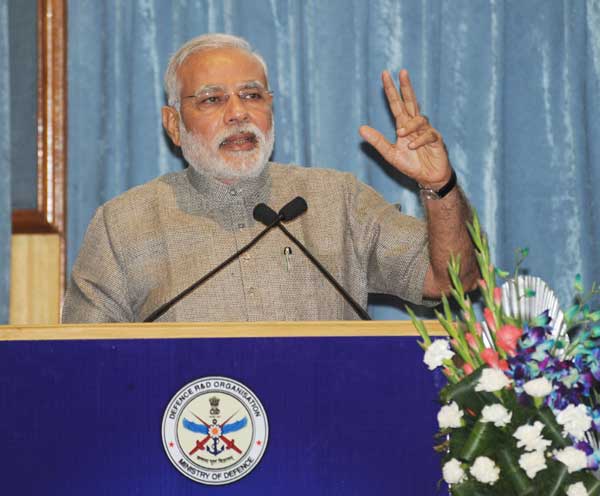
Prime Minister Narendra Modi addressing at the DRDO Awards presentation ceremony in New Delhi

The Prime Minister Narendra Modi has called upon Defence Research and Development Organization (DRDO) to speed up projects and advance delivery schedules. He has opined that India can be world leader in defence technology and show the world way forward.

Those in the MoD, who exercise control over DRDO, are blissfully ignorant of what defence equipment is all about. In weapons, they can’t tell gun from a howitzer and in engines, cam shaft from crank shaft.

These are very high expectations and there is nothing in DRDO’s past performance to generate such great hopes. Infact the record of this organization is extremely dismal and disappointing. There is no accountability and it has never been put through a science audit, inspite of repeated demands for the same

On the urging of Parliamentary Committee on Defence, a revamp of DRDO was carried out. Nothing much happened, except for some cosmetic changes, which are of little consequence. We continue to import even low technology equipment where over 70 percent of weapons and equipment is imported. Think of the out go of foreign exchange and jobs lost.

While the Prime Minister is unaware of the DRDO capabilities and potential, but surely, Arun Jetley, the part time defence minister, who has been in parliament for a long time and is expected to have paid attention to debates on defence matters, ought to know better and therefore should have briefed the Prime Minister to lower his expectations from this organisation. In the past these very false hopes of delivery by DRDO has kept in limbo, the deployment of private industry in this field.

The DRDO budget has been 5 to 7 per cent of the defence budget with allocations for major projects such as LCA, Arjun tank etc being over and above this budgeted figure. Much of this amount has gone into civil works. If any proof of this lavish expenditure is required, one need go no further than have a look at the DRDO office complex at the rear of South Block and then ofcourse see Sena Bhavan as well.

Those in the MoD, who exercise control over DRDO, are blissfully ignorant of what defence equipment is all about. In weapons, they can’t tell gun from a howitzer and in engines, cam shaft from crank shaft. Projects can hang fire for decades while those responsible for these continue to move up the promotion ladder and so do those of the MoD who control them.

There is little understanding and mutual confidence between the DRDO and the defence services. The Prime Minister is aware of the disconnect and that is why he impressed upon the DRDO to involve user in the development of military weapons and equipment. The DRDO never spells out its technological status in relation to the equipment to be developed. With the result, GSQRs are prepared without proper interaction with the DRDO, but keeping in mind what is already in the market.

The WhatsApp Soldier

By Ganapathy Vanchinathan 
August 28, 2014 

The army has been in the news over the last fortnight, and again for all the wrong reasons. These include an incident regarding the functioning of the Army Wives Welfare Association, and a few instances where the behaviour of senior officers was brought into question. This article is not to debate whether these reports are true or false or analyse the extent of truth or falsehood in them. It is fair to assume the Indian Army is well in control of the events and all necessary actions are being taken to ensure logical culmination of these cases. Of that there can be no doubt. But does that mean all is hunky dory. No, not really.

Consider these two news reports. One in a local Israeli newspaper on 21 July 2014 which said – “Soldiers' Families Learn Sons were Killed through WhatsApp”. The family members of one of the 13 soldiers of the Golani Brigade killed during Israeli Defence Forces (IDF) Operation Defensive Edge in the Gaza Strip on 20 July 2014, learned about his death from a WhatsApp message, before any official notification of his death was issued by the IDF. Another WhatsApp message mentioned the name of a Golani Brigade officer as dead, while in fact he was hospitalised in serious condition. The second one – “Army Cracks the Whip after Internal Message Lands on WhatsApp”. This report refers to sharing of an official message by a military formation in Kashmir Valley purportedly to speedily disseminate a message to coordinate ceremonial last rites of Late Major Mukund Varadarajan, AC and Late Sepoy Vikram Singh, SC who had died in an operation in Kashmir on 25 April 2014. Whether intended or otherwise the message also reached a senior officer in the Army HQ which sent alarm bells ringing and directives were reportedly issued to army units instructing them to refrain from sharing classified communications on social media.

While there will always be a strong desire to receive and share real-time information, it is undeniable that adhoc and arbitrary circulation of these messages containing such news, especially if uncorroborated and exaggerated, may lead to irrevocable damage to those who are related to the subject of such messages. Lives may be ruined and reputations can be mud, all in a matter of seconds. It is another matter that on 23 July 2014, the Israeli Military Police arrested three soldiers and a civilian on suspicion of spreading military information and false information using WhatsApp. Such misunderstandings due to messages or rumours spreads either unwittingly, or very well as part of a mischief will lead to loss of faith and trust within the organisation, with those at stake not being given a chance to defend themselves. Such messages may also unwittingly (or intentionally) compromise security. In fact, what one does not know is happening with the information being shared in such a platform is a far bigger risk than what one knows is surely happening.

A CONSTELLATION OF VITAL PHENOMENA: A LITERARY WINDOW INTO RUSSIA’S CHECHNYA WARS

August 28, 2014
Anyone who thinks “western values” are an arrogant fiction created to perpetuate the dominance of market democracies or whitewash their crimes should read A Constellation of Vital Phenomena, a heartbreakingly poignant novel about the wars in Chechnya. Based on the reporting of amazingly brave — and murdered — Russian journalist Anna Politkovskaya, and the memoir of Chechen doctor Khassan Baiev, it chillingly recounts Russia’s arbitrary and brutal reign of terror during several attempts to subdue rebellion in one of its constituent republics.

In the novel, as in reality, Russian paramilitaries work under the command of intelligence operatives, mercenary corps are integral to the government forces, and conscripted soldiers are victims, too, of the dishonorable behavior. The government paints all Chechens as terrorists, justifying indiscriminate violence. The only outside nations willing to help Chechens are “Arab states (who) would not fund a war of nationalism, only a war of religion,” which shades the conflict toward jihad and makes it of even less interest internationally.

The Brutality of Russia in Chechnya

The Russian counter-insurgency campaign has never been effective in Chechnya, in large part because the brutality and fear they sowed among Chechens. There has been no redress of legitimate grievance or separation of people into reconcilable and irreconcilable factions, as had been essential to every successful counter-insurgency campaign from Britain in Malaya to the U.S.-led coalitions in Iraq and Afghanistan.

Moreover, by 2004, Few Russians cared. Chechen jihadists had attacked a school in Beslan, killing 330 people and attacked the Moscow theater where 120 hostages died (though most from gas used by Russian police); the Putin government further blamed them for bombing an apartment building in Moscow. Media in Russia were narrowing as the government became increasingly authoritarian. Whether corresponding to that change or because Russians themselves were changing in their attitudes (information on Russian abuses was not difficult to come by) — 80% of Russians supported their government’s campaign. In fact, reading A Constellation of Vital Phenomena during Russia’s ongoing dirty war in Ukraine, the similarities in Russian attitudes and behavior between the two conflicts is depressingly striking. A 2012 Human Rights Watch appealassessed that:

The known risk to activists in Chechnya, reinforced by blatant public threats by Kadyrov, who is alleged to be personally behind a number of cases of torture and killings, heightens the obligation of the Russian authorities to act urgently.

It goes without saying that Russian authorities have done no such thing. It makes preposterous Russian Foreign Minister Sergei Lavrov’s hypocriticalrecent denunciation that “the Ukrainian authorities think they can use any means in order to defend their territorial integrity and sovereignty.”

Limited War Is Back


NATO's current strategic framework might fail to deter further gains by Russia's green men.

EUROPE NEEDS to rearm and defend itself to cope with a new military threat. The American security umbrella—in both its conventional and nuclear forms—is no longer adequate, particularly on NATO’s vulnerable eastern flanks. Indeed, the extended deterrent provided by the United States to its most exposed allies may not be well suited to inhibiting attacks similar to Russia’s recent incursion into Ukraine, which displayed all the hallmarks of the newly popular limited conventional wars—brief and decisive, violent and yet very restrained. The purpose of such conflicts is to achieve a quick fait accompli in a geographically circumscribed area through limited force—in this case, paramilitary means followed by Russian regular forces. It is difficult to deter such a threat through the promise of retaliation, which by its very nature must occur after the facts on the ground have already been changed. A threat of retaliation is simply less credible when the enemy has achieved his objective through a low-intensity action. What are needed instead are strong local military capabilities—a preclusive defense—that increase the costs of that limited attack. Europe must start to defend its border rather than indulge in the belief that the traditional formula for deterrence, based on retaliation and the extended deterrent provided by the United States, will suffice. It won’t.

WHEREAS LIMITED warfare went out of fashion in the West after Vietnam, Russia regards it as a central part of its military doctrine. It has practiced it in Georgia, Crimea and eastern Ukraine, and presumably rehearses it elsewhere. It is therefore imperative to study anew the challenges presented by such a form of sanguinary behavior. “Limited wars” have several distinctive features. First, they are characterized by self-imposed restraint in the political objective sought and the level of force used. The aggressor could escalate the confrontation, but chooses not to. The purpose of limiting the use of force is to avoid some reaction that would undermine the political objective sought in the conventional assault. In the case of today’s Russia, the purpose is to extend influence and control westward without eliciting a strong response from NATO and the United States. Moscow recognizes the clear military superiority of its main rivals and consequently desires to avoid a pitched confrontation that it would lose. Hence, its use of force is calibrated to be sufficient to conquer pieces of Ukraine but not so large and violent that it would prompt a unified political, economic and military reaction from the West.

Russia is as clear regarding what it wants to avoid as it is concerning what it wants to achieve. Moscow’s objectives are limited: a small and quick territorial grab rather than a massive invasion (at least for now). There is no drive to the capital (Kiev, in this instance) or attempt at full conquest but instead a speedy push inside the neighboring state followed by a sudden, self-imposed stop. It is a “jab and pause” style of war fighting meant to achieve a swift and limited fait accompli. A rapid conquest of Crimea or parts of eastern Ukraine is followed by a pause and apparent openness to seek a mutually acceptable negotiated settlement. But the limited objective has already been achieved, and the quick suspension of violence is a sign of the satisfaction of the original goal.

A limited war is also characterized by limited means. The aggressor state carefully tailors its methods to the goal it wants to achieve—and the reaction it wants to avoid. Minimal violence is employed. The potential for escalation is made clear but held in reserve. In the case of the Crimean invasion, the Russian operation started anonymously with unmarked troops (dubbed “little green men” by Ukrainians), an indication that Moscow was uncertain about how local Ukrainian forces would react. In the event of determined opposition, Russia maintained the option of either escalating with larger forces or, should Western powers come to Ukraine’s aid militarily, halting the operations of the unmarked troops.

31 August 2014

Ukrainian National Security and Defense Council Report on Today’s Fighting in the Eastern Ukraine

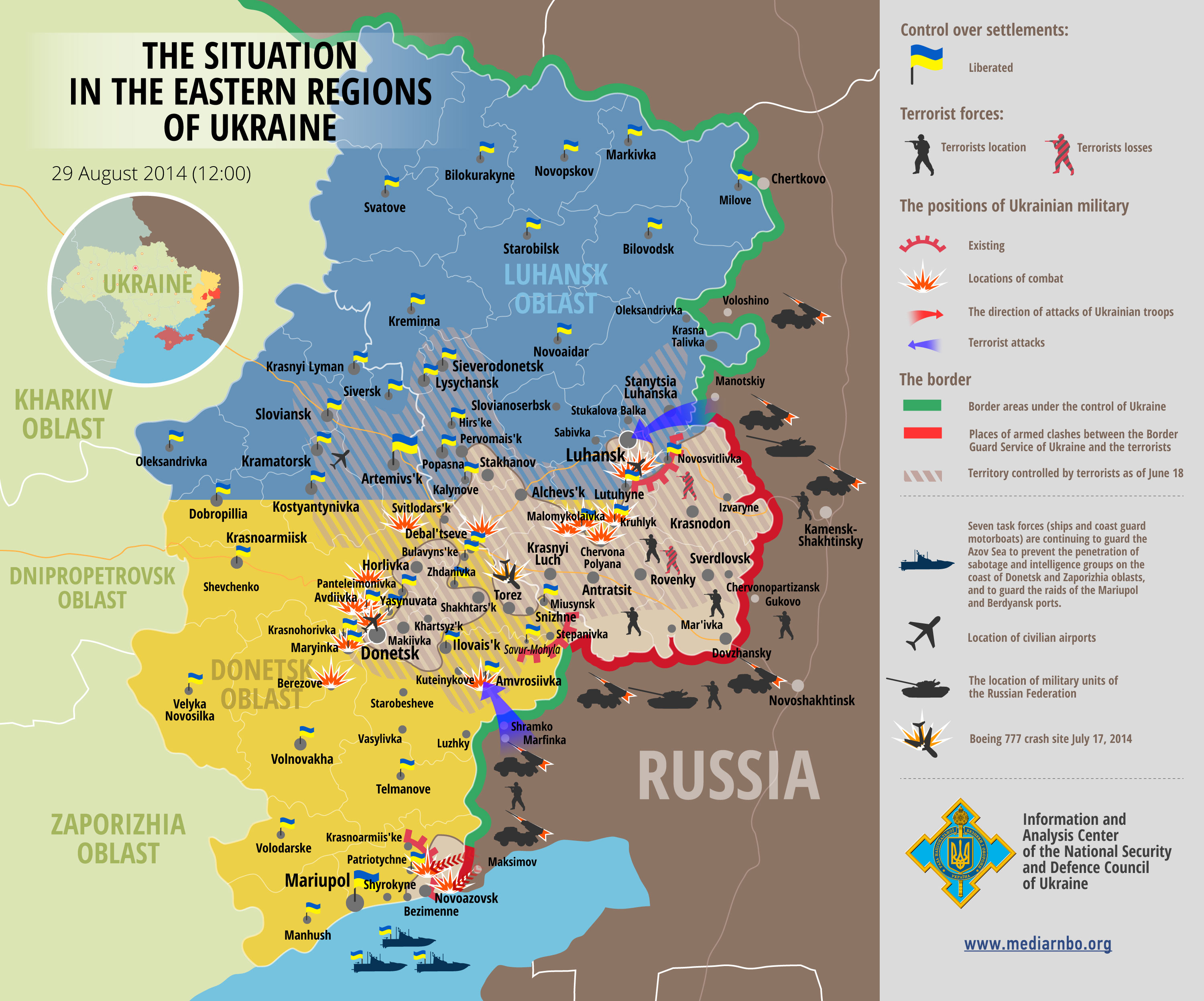
The situation in the Eastern regions of Ukraine
Ukrainian National Security and Defense Council
August 29,2014

NOTE: A larger PDF version of this map can be accessed by clicking here.


Consolidated data of the Information and Analytical Centre of the NSDC of Ukraine 17:00 - 29 august 2014

Military operations in the conflict zone

The situation in the ATO area remains difficult. It continues countrer-offensive of the RF Armed Forces and separatists gangs in south-eastern of Donetsk region. Armored Russians and their mercenaries located around Novoazovsk.

Today the armed forces of Ukraine several times entered in the fire contact with guerillas near the settlements Zolote and Gorske in Luhansk region.

In other parts of the ATO areas it has been ongoing positional battles on the outskirts of Luhansk, under Novosvitlivkf and Hryaschuvate, Donetsk and Ilovajski, Marinka, Starobeshevo and Olenevka Volnovakha (Donetsk region). In settlements Perevalsk, Zorynsk, Maloivanivka, Mala Faschivka, Verhuliyivka, Rozsypne it is fixed income of reinforcements for terrorists. The militants continue to fire Debaltseve with mortars installed in cars.

On 26 and 27 August positions of ATO forces in the area Novoazovsa were fired from multiple launch rocket systems “Grad”. It is noticed that in time of explosion of shells it deposited out unknown lacrimatory substance. According to preliminary analysis, it may be caused by outdated combustion of solid rocket fuel used in 220 mm unguided rocket projectiles.

By existing labeling it is revealed that these shells - 9 M 27 - are in service in RF Armed Forces. This confirmed additionally by the data of Classifier of the Chief Rocket Artillery Directorate of the Ministry of Defense.

In Mariupol direction jointed ATO forces improve engineering and fortification equipment of roadblocks and strongholds and carry out preventive measures in the city. Inhabitatts with settlers from captured terrorists cities help to build fortifications to prevent the Russian military assault on the outlying areas of the city. Mariupol locals are rushing to the Army Recruiting Offices expressing a desire to defend their city from the invading of Russian army.

The situation in the conflict zone localities

Terrorists’ giving of humanitarian aid to the local population in Lugansk is mostly demonstrative by nature: food is handed out before the cameras of Russian journalists. After their departure, the process of giving assistance immediately ceases.

Today in Luhansk region resumed gas supply in 4 towns: vilages Samsonivka, Pridorozhne (Krasnodonsky district), Irmino (Perevalsky district), Stanitsya-Luhanska (12 thousand subscribers). Total without gas supply remain partially - 24, full - 56 settlements in Luhansk region.

Rescuers of DSNS of Ukraine continue to restore infrastructure in the liberated from terrorists cities of Luhansk region. Now there is a combined rescue squad of Interregional Center Quick response (Sumy region). In August rescuers pulled out four piles of buildings, took out 1147 tons of destroyed building structures, cleared from trash a half mile of streets and roads of debris and 4,750 square meters of land from the wreckage, restored 460 square meters of roofs of buildings and fences. In addition to the reconstruction of destroyed buildings, lifeguards constantly deliver humanitarian aid to Luhansk region: food, necessities and clothing. In general, the region has delivered 341 tons of humanitarian aid and 52 cubic meters of drinking and 24 cubic meters of technology water.

***** Winning the Campaign Against the Islamic State: Key Strategic and Tactical Challenges

AUG 29, 2014 

The United States does not have good or quick options in dealing with the Islamic State, in part because it faces serious challenges in Iraq and Syria that cannot be separated from any efforts to weaken and destroy the Islamic State. This, however, is not a reason to stand and wait for better options that do not exist. The situation will not get better because the United States continues to dither.

The United States is already acting in important ways, and if this action is taken more decisively, in an integrated form, and over enough time to be effective it may well be capable of both imploding the Islamic State and serving U.S. interests in both Iraq and Syria.

This strategy is laid out in detail in a briefing entitledWinning the Islamic State Campaign: Key Strategic and Tactical Challenges that is available on the CSIS web site athttp://csis.org/files/publication/140829_Iraq_Campaign_brief.pdf.

Shaping and Implementing an Effective United Strategy for Defeating the Islamic State

The United States must act in ways that recognize the grand strategic conditions it faces. The United States needs to act in ways that conserve its resources and recognize that it faces a wide range of competing strategic challenges both in the region and the world – as well as its domestic political realities: 
Secular, “Christian” United States with poor track record in Iraq and ties to Israel; lack of allied confidence in U.S. in Arab world and Turkey; No allied unity. 
Islamic State is only one of many regional and “Islamist” challenges: Morocco to Philippines: Libya, Tunisia, Egypt, Lebanon, Syria, Iran, Yemen, Pakistan, Central Asia, Myanmar, Thailand. 
Islamic State is only one of many Jihadist movements and threats even within Syria and Iraq; 70+ in Syria alone. 
Defeating Islamic State will still leave Jihadist movements, continuing threat. 
Caught between two increasingly sectarian civil wars with failed regimes in Syria (Alawites, Hezbollah, Iran-IRGC) and Iraq (Shi’ite militias, IRGC, Kurds). 
No chance of meaningful victory even in Iraq without Iraqi political unity. No clear good alternative in Syria. 
Many competing strategic priorities: Afghanistan, Ukraine, Asia, U.S. domestic issues and budget. 
Uncertain Congressional and public support; none for major ground presence. 

Given these conditions, the Administration, the Congress, and the American people need to accept the fact that a successful strategy must deal with three basic realities.

Defeating the Islamic State Must Be Far More Than a Military or Tactical Struggle

The first reality is that any effort to defeat the Islamic state must be far more than a military or a tactical struggle. It is a political and ideological struggle as well, and the United States must mobilize itself and its allies to use every possible tool to weaken the Islamic State and do so in the context of two ongoing civil wars in Iraq and Syria.