7 December 2014

Urgent Need for Steps to Make Nathu La Route to Kailash Mansarovar Safe for Pilgrims


India and China had signed a bilateral agreement on September 18 this year providing for for conducting the Kailash Mansarovar Yatra through Nathu La in Sikkim Himalayas in addition to the existing Lipulekh Pass in Uttarakhand.

Addressing the media after the signing of the MoU in this regard, Prime Minister Narendra Modi said the new route offers many benefits. “It makes Kailash Mansarovar accessible by a motorable road, which is especially beneficial for older pilgrims. It offers a safer alternative in the rainy season, makes the pilgrimage shorter in duration and will enable a much higher number of pilgrims to go there,” he said.

However, the bad news is that whereas China may be able to do its bit to take necessary steps to ensure the safety of the route before it opens, unprepared India may still be fighting with the systemic inertia to remove vulnerabilities for ensuring a hiccup free, smooth passage to the pilgrims, tourists and traders on its side of the border.

Of course, this bad news is somewhat obscured by another good news that by now we not only know the weak links in our chain of operation and what ails our disaster management systems, but additionally, we have also been repeatedly taught the do’s and don’ts of life by none other than the disasters themselves. Every now and then, we have passed through the tides of pain and suffering which are now so intense as to drive us to action. Nathu La, through which pilgrims will be able to reach Mansarovar next year, literally means a Pass with ears that listen. We too need listening ears without which the cries of those affected will continue to haunt us! It is therefore time to act.

Ordinarily hard core pilgrims are neither deterred by dangers that they might face when it comes to pilgrimage, nor do they fear the horror stories of disaster-inflicted death, destruction and sufferings, told to them by the previous generation. This is because they value faith, devotion, penance and salvation more than they fear death. It is the duty of the government, however, to protect the pilgrims from dangers of all shades and colors. According to a report in the News from China, September 2014 Issue, a total of nearly 70,000 Indian citizens have travelled to Tibet for pilgrimage in the past decade. The number of pilgrims has shot up from a mere 400 in 2003 to 14,084 in 2013, a whopping 35 fold increase!

Nathu La is already attracting tourists because of its fascinating altitude of 4310m, Tsomgo Lake, Baba Mandir and the fun of a handshake with the Chinese at the border fence. Once the route is opened for pilgrimage, the elderly and the sick will also not like to be left behind regardless of high altitude problems and dangers of which they may or may not be aware at this time. They will need acclimatisation, medicare and all kinds of support even in the normal times. In the event of border skirmishes and natural calamities, they will need much more than the so called preparedness. Even then a great majority of pilgrims may not get deterred by anticipated dangers, no matter how serious, because afterall, Nathu La had already been on the old Silk Road for trade between India and China, and it, even now continues to be one of the three open trading borders.1 Moreover, if Jawaharlal Nehru and Indira Gandhi could reach Bhutan via Nathu La more than half a century ago, then why not the pilgrims now? The Nathu La route may have remained closed for over four decades after the Sino-Indian war of 1962 but India’s armed forces have always been there and trade through Nathu La has already resumed as far back as 6 July 2006. Further, widening of the Gangtok- Nathu La highway is presently in progress and, en route, the tourists are already benefitting from modern amenities such as the high altitude internet cafe and ATM machines. Where is the danger to the pilgrims and why so much fuss, then?

Forget the South China Sea: Taiwan Could Be Asia's Next Big Security Nightmare

December 5, 2014

"Expect to see Beijing sabre-rattling and cross-strait tensions rising in the run-up to Taipei’s 2016 presidential elections, and don’t be surprised if that is followed by a new cross-strait crisis."

Forget the South China Sea. The results of Taiwan’s local elections last week, still reverberating in Beijing, are more likely than not to propel Taiwan’s ascension to the status of No.1 security problem in Asia over the coming two to three years.

That is one consequence of the shellacking Taiwan’s ruling KMT party took in last week’s local elections. The ruling KMT lost thirteen of twenty-two cities and counties, including the Mayoralties in Taipei (by an opposition-backed doctor) and Taichung. All told, the opposition Democratic Progressive Party took 47.5 percent of the vote to 40.7 percent garnered by the ruling KMT.

This sets the stage for the 2016 presidential elections. President Ma Ying-jeou, whose popularity was in single digits before the elections, is finishing his second term and cannot run again. So humbled was Ma that he resigned as chair of the KMT. The opposition Democratic Progressive Party (DPP), whose constitution calls for Taiwanese independence, has fuzzy positions on many key issues, but is nonetheless now well positioned for 2016.

It’s the Economy, Stupid

How ISIS Governs The Territory Its Controls in Iraq and Syria

Simon Speakman Cordall
December 5, 2014

How ISIS Governs Its Caliphate
Militant Islamist fighters waving flags, travel in vehicles as they take part in a military parade along the streets of Syria’s northern Raqqa province, June 30, 2014. Stringer/Reuters

This year has seen the map of the Middle East redrawn. The West has acquired a new public enemy number one: remorseless, faceless and vicious. The Islamic State, or ISIS, has expanded from a relatively obscure terrorist group at the start of the year, to one that wields near absolute control over anywhere between 12,000 square miles (according to the Wall Street Journal) and 35,000 square miles (according to The New Yorker) of formerly Syrian and Iraqi territory. Within the region, around 56 million people must navigate between the armies of the rival militias, warlords and national armies that are barely distinguishable from one another.

But while Western forces attempt to counter the ISIS surge with its sustained bombing strategy, little attention is paid to an unpalatable reality within the borders of the so-called new Islamic State, or caliphate. In the midst of the chaos, ISIS is deliberately and methodically establishing clear areas of definable civil governance, breathing new life into the memory of a series of caliphates that united a succession of Muslim empires until 1924.

Scott Atran, an anthropologist and senior research fellow at Oxford University, recently submitted a report to the U.S. Department of Defense and Congress on the difficulty of fighting the ideology of such a state.

“The caliphate as an idea has never gone away,” Atran says, “And now that it is here again after a hiatus of nearly 100 years, as a concrete matter of fact, it will focus the hearts and minds of hundreds of millions of people. The critical question is not, ‘How can we thwart or destroy the caliphate?’ because attempts to do that will likely backfire. Rather the question is, ‘How can we live with and transform the idea and reality of a caliphate – and one that will be nuclear-capable probably sooner rather than later – into something that does not threaten other peoples’ ways of life?’ That is a question for everyone, but it is not even on our political radar.”

Blood Money How ISIS Makes Bank

November 30, 2014 

Damage at an oil refinery that was targeted by what activists said were U.S. strikes near the Syrian town of Tel Abyad, October 2, 2014. (Courtesy Reuters)

A key element of U.S. President Barack Obama’s strategy against the Islamic State of Iraq and al-Sham (ISIS) has been striking at the oil fields seized by the group to undermine its finances. But ISIS is a diversified criminal business, and oil is only one of its several revenue streams. U.S. officials ignore that fact at their own peril. 

It is true that oil is ISIS’ key source of funding right now. The terrorist group has become the world’s richest precisely because it has seized some of the world’s most profitable oil fields in Iraq and Syria. Even with those fields operating below capacity due to a lack of technology and personnel, ISIS is estimated to be producing about 44,000 barrels a day in Syria and 4,000 barrels a day in Iraq. ISIS sells crude at a discount (around $20–$35 per barrel) to either truckers or middlemen. The crude gets to refiners at around $60 per barrel, which is still under market price. Smugglers pay about $5,000 in bribes at checkpoints to move the crude oil out of ISIS controlled territory. Even selling the oil at a discount via pre-invasion smuggling routes out of Iraq, ISIS can still expect over a million dollars in revenue each day.

And ISIS’ enemies are getting richer from the trade, too: Kurdish part-time smugglers who facilitate ISIS’ oil sales can earn up to $300,000 each month. A Kurdish newspaper recently published a list of people involved with ISIS, especially its oil operations. The list includes individuals with the last names of several Kurdish ruling families; a Toyota branch in Erbil, which sells ISIS trucks; a Politburo member and military leader; and oil refineries, among others. Some of those on the list were associated with oil smuggling under Saddam Hussein. Kurdish facilitators also provide goods to ISIS, including trucks, gas cylinders (for cooking and heating), gasoline, and other necessary commodities.

Oil is not ISIS’ only source of revenue. For example, when the group needed seed capital to recruit personnel and acquire military equipment to conquer the Sunni-dominated areas of Iraq, some of it came from donors in the Gulf States, who had funded the antecedents of ISIS. More recently, ISIS funding has come from the usual terrorist businesses—smuggling, kidnapping, extortion, and robberies. In one reported case, a Swedish company paid $70,000 to rescue an employee who had been taken by ISIS. And before the American journalist James Foley was beheaded, ISIS fighters demanded an exorbitant sum for his freedom, which they did not receive.

The Close Ties Between Russian Intelligence and the Belarus KGB

December 5, 2014

Belarusan espionage: Ties with Russia remain close

However, Belarusan intelligence and special services may have their own agenda separate from Russia’s, with which Lukashenka can attempt to pursue a more independent foreign policy.

On 10 November the General Prosecutor’s Office of Lithuania reported that a Vilnius court would try a Lithuanian citizen on espionage charges. The Lithuanian authorities claim that he cooperated with Belarusan security services.

As other cases from recent years prove, Belarusan intelligence is quite interested in its immediate neighbours – Poland and Lithuania. Belarusans usually seek military intelligence and generally probe opportunities to advance Belarusan economic interest in these countries.

Belarus’s EU neighbours regard Belarusan intelligence as being, more or less, on par with its Russian counterpart. However, despite close ties since Soviet times and cooperation agreements, Belarusans may have a separate agenda, as Lukashenka’s attempts to pursue a more independent foreign policy.

Inside Belarus, recent public spying cases have involved only local citizens. As either Andrej HajdukoÅ­’s or priest UladzislaÅ­ Lazar’s cases show, the authorities can use espionage charges to intimidate the opposition or independent institutions.

A spy with Belarusan roots

A former worker of Oro Navigacija, a Lithuanian air traffic control agency, is suspected of committing espionage against Lithuania for Belarus’s security services. He may receive up to 15 years in prison as a result. A Vilnius circuit court will hold his trial in January. At the moment the suspect’s name remains unknown.

The investigators claims that the suspect secretly photographed documents in his office, including various objects tied to Lithuania’s military and civilian infrastructure, and then proceeded to hand them to the General Staff of the Belarusan armed forces. “He gathered and passed on to Belarus information on the Lithuanian armed forces, its state enterprises, objects of strategic importance for national security in Lithuania”, stated a press release from the General Prosecutor’s Office.

The Chief of Lithuania’s Security Department Gediminas Grina noted that Russia could also use this information, because Belarus and Russia have a military alliance and share intelligence data.

Having Belarusan roots, the suspect visited Belarus a couple of times a year to see his relatives and friends. His two sons have business partners in Russia, and regularly go there on to tend to their affairs. These facts could easily become rounds for Lithuania’s own security services to become interested in him.

However, espionage scandals more often than not arise Belarus’s other neighbour – Poland. In recent years several incidents have occurred with Belarus citizens being charged with spying.

Belarus intelligence: Poland in its sights

Russian Navy Task Force Enters the Mediterranean

December 5, 2014

Russia Northern Fleet convoy enters Mediterranean Sea for naval mission
MOSCOW, December 4. /TASS/. Russia’s Northern Fleet convoy of warships and auxiliary vessels led by large submarine chaser Severomorsk has entered the Mediterranean Sea through the Straits of Gibraltar, spokesman of the Northern Fleet Captain First Rank Vadim Serga told TASS on Thursday.

“Before sailing through the straits crews had joint drills and practised sailing through narrow waters amid intensive navigation,” he said, noting that “The naval convoy is preparing to fulfil tasks as part of Russian naval task force acting regularly in the Mediterranean Sea.”

Northern Fleet’s warships had drills to ensure security of civilian navigation from piracy and a terrorist threat in the Bay of Biscay, Serga said. Combat crews of amphibious assault ship Alexander Otrakovsky have drilled the use of air defense systems and radioelectronic warfare to rebuff an air attack of an imaginary enemy.

Naval sailors set out for a far voyage from Severomorsk, a base of Russian Northern Fleet in the north of the country, on November 20, already sailing more than 2.8 thousand nautical miles.

Is Enthusiasm in the Russian Military for the War in the Ukraine Waning?

Paul Richard Huard
December 5, 2014

Vladimir Putin’s Losing Streak: Russians are losing enthusiasm for the Ukraine war

At first glance, Russian president Vladimir Putin seems to have defied all the odds.

Russia is poised to mount a winter offensive against a defiant Ukraine that still struggles to supply its army, treat its wounded and repel a world military power. In November, international monitors sighted more convoys of Russian vehicles carrying soldiers, as well as unmarked T-72 and T-64 tanks, crossing from Russia into eastern Ukraine near Donetsk.

An October poll indicated the Russian president has an 88-percent approval rating. Politically, he seems unassailable.

That could be changing. As Ukraine grows more defiant and Russia’s economy suffers, more and more Russians are losing interest in Putin’s war.

At the moment, there is no apparent political rival with the ability to challenge Putin’s policies or his rule. To further consolidate his power, Putin has jailed dissenting journalists and opposition politicians.
The United States and the NATO alliance don’t want a direct confrontation with Russia over Ukraine, instead relying on sanctions and rhetoric that mostly have done little to trouble Putin or his supporters among Russia’s elite.

But now increasing economic doldrums—owing to collapsing oil prices and a devalued ruble—plus fervent Ukrainian nationalism and a Ukrainian army that prevails despite its immense problems, indicate Putin’s future might not be as rosy as his recent years.

There have even been a few scattered near-mutinies among Russian troops resisting deployment to eastern Ukraine.

“Although Putin is in a strong position now, he’s replaceable,” Graeme Auton, professor of political science at the University of Redlands and an expert on Russian energy policy, told War Is Boring. “I think he is in an increasingly tenuous position, and he is facing what is for him an unfortunate confluence of events.”

Consider the recent drop in oil prices. As Putin continues the invasion of Ukraine, OPEC dealt an economic body-blow to a nation where oil revenues comprise nearly 50 percent of the Russian budget annually—a loss of at least $100 billion according to some estimates.

OPERATION AURORAGOLD HOW THE NSA HACKS CELLPHONE NETWORKS WORLDWIDE


In March 2011, two weeks before the Western intervention in Libya, a secret message was delivered to the National Security Agency. An intelligence unit within the U.S. military’s Africa Command needed help to hack into Libya’s cellphone networks and monitor text messages.

For the NSA, the task was easy. The agency had already obtained technical information about the cellphone carriers’ internal systems by spying on documents sent among company employees, and these details would provide the perfect blueprint to help the military break into the networks.

The NSA’s assistance in the Libya operation, however, was not an isolated case. It was part of a much larger surveillance program—global in its scope and ramifications—targeted not just at hostile countries.

According to documents contained in the archive of material provided toThe Intercept by whistleblower Edward Snowden, the NSA has spied on hundreds of companies and organizations internationally, including in countries closely allied to the United States, in an effort to find security weaknesses in cellphone technology that it can exploit for surveillance.

The documents also reveal how the NSA plans to secretly introduce new flaws into communication systems so that they can be tapped into—a controversial tactic that security experts say could be exposing the general population to criminal hackers.

Codenamed AURORAGOLD, the covert operation has monitored the content of messages sent and received by more than 1,200 email accounts associated with major cellphone network operators, intercepting confidential company planning papers that help the NSA hack into phone networks.

One high-profile surveillance target is the GSM Association, an influential U.K.-headquartered trade group that works closely with large U.S.-based firms including Microsoft, Facebook, AT&T, and Cisco, and is currently being funded by the U.S. government to develop privacy-enhancing technologies.

Karsten Nohl, a leading cellphone security expert and cryptographer who was consulted by The Intercept about details contained in the AURORAGOLD documents, said that the broad scope of information swept up in the operation appears aimed at ensuring virtually every cellphone network in the world is NSA accessible.

THE OPERATION APPEARS AIMED AT ENSURING VIRTUALLY EVERY CELLPHONE NETWORK IN THE WORLD IS NSA ACCESSIBLE.

“Collecting an inventory [like this] on world networks has big ramifications,” Nohl said, because it allows the NSA to track and circumvent upgrades in encryption technology used by cellphone companies to shield calls and texts from eavesdropping. Evidence that the agency has deliberately plotted to weaken the security of communication infrastructure, he added, was particularly alarming.

“Even if you love the NSA and you say you have nothing to hide, you should be against a policy that introduces security vulnerabilities,” Nohl said, “because once NSA introduces a weakness, a vulnerability, it’s not only the NSA that can exploit it.”

NSA spokeswoman Vanee’ Vines told The Intercept in a statement that the agency “works to identify and report on the communications of valid foreign targets” to anticipate threats to the United States and its allies.

Vines said: “NSA collects only those communications that it is authorized by law to collect in response to valid foreign intelligence and counterintelligence requirements—regardless of the technical means used by foreign targets, or the means by which those targets attempt to hide their communications.”
Network coverage

Two More Fallacies of Future War Adding to the ARCIC Narrativ


This post was provided by contributor Chad Pillai, an US Army strategist. The views expressed belong to the author alone and do not represent the US Army or the Department of Defense. 

Earlier this month, I had the pleasure of listening to LTG H.R. McMaster brief the Joint Forces Staff College (JFSC) the Army’s Operating Concept (AOC) and his four fallacies of future warfare. For those not familiar with his four fallacies, they are: 

The Vampire Fallacy: Essentially this fallacy revolves around the idea that technology will save the day. Perfect situational intelligence and super weapons will make war clean and easy. 
Zero-Dark-Thirty Fallacy: This fallacy is somewhat tied to the first because intelligence that allows for the conduct of “strategic raids” where highly trained special forces can locate and neutralize threats quickly and with minimum risks. 

Mutual of Omaha’s Wild Kingdom Fallacy: This fallacy states that the U.S. can fight its land wars via proxy while providing air, sea, space, and cyber domain power. Bin Laden’s escape from Tora Bora and the Iraqi Army’s inability to fight ISIL bear witness to this fallacy. 
RVSP Fallacy: This fallacy essential says that the U.S. can choose which conflicts it wishes to engage in and which ones if can avoid. In some cases this may be true, but in others, the U.S. may find itself dragged itself into a conflict. McMaster reiterated the line from Leon Trotsky who said, ‘you may not be interested in war but war is interested in you.’ 

LTG McMaster’s fallacies are largely accurate; however, I believe there are others that need mentioning. There are two specific fallacies I offer for consideration in light of our current security and economic environment. The two fallacies are The Arsenal of Democracy and Exquisite fallacies.

THE ARESENAL OF DEMOCRACY FALLCY. This fallacy emanates from the idea that the development of strategy should not be resource-constrained. As some say, strategies are resource informed. If tactical leaders cannot plan in an unconstrained environment, I am not sure strategists are able to get away with it. If we are serious about the ENDS-WAYS-MEANS construct, how the hell do we make the claim that our strategy is resource informed? Strategist produce deeply flawed geo-strategic plans when there are no considerations for how the MEANS are produced and paid for. For many in the U.S., this fallacy has its roots in the historic American Way of War of throwing material and personnel mass at our enemies from the Civil War to WWII. 

In WWII, FDR pronounced that the U.S. would be the ARSENAL OF DEMOCRACY and Major General Albert Wedemeyer in the U.S. Army War Plans Division led this effort with the VICTORY PLAN. While the VICTORY PLAN may have identified what the nation needed to produce in order to win WWII, as a military document it lacked many of the financial and economic details needed to determine whether the nation could produce the stated requirements stated or make adjustments as global conditions changed such as the need to materially support our Allies. 

We Must Step Back From the Nuclear Precipice

By Karipbek Kuyukov
December 05, 2014

Nuclear weapons have already exacted a terrible toll. Now, more than ever, this must be remembered. 

The Cold War – and the constant fear of nuclear war – were among the darkest periods in humanity’s history. We had all hoped that those days were behind us.

But in recent months, we have seen a disturbing revival of tensions between Russia and the West. Old wounds have been re-opened. There is talk of a return to Cold War brinkmanship and even development of new nuclear weapons. The slow but steady progress made towards ending the nuclear threat is in danger of being reversed. We need to step back from this precipice.

This is why it is critical not to forget the terrible human and environmental costs of nuclear weapons – costs which Kazakhstan still suffers every day. I was born 100 kilometers from the epicenter of the Semipalatinsk nuclear test site where the Soviet Union exploded more than 600 nuclear devices between 1949 and 1991. My parents and thousands of others would watch those bright and vast mushroom clouds as they filled the sky. The tests have had terrible physical consequences for the people who lived near them.

I came into this world without arms. People often ask me if I can be sure that radiation was the cause. If you had lived in my home town or region, this would not be a question.

In the place where I grew up, I saw mothers and midwives shocked at the sight of their babies. My own mother didn’t see me for three days. When she did, she was in shock for a long time. She couldn’t even speak. But I wasn’t the only one. I saw families too embarrassed to show their children to the outside world, hiding them deep inside their homes and bringing them out only briefly for fresh air and sun.

I witnessed families and whole communities decimated by radiation-related cancers. As the United Nations confirms, more than 1.5 million people in Kazakhstan have suffered the effects of Soviet nuclear weapons testing.

Why Russia still matters

05 Dec , 2014
http://www.indiandefencereview.com/news/why-russia-still-matters/

Russian President Vladimir Putin is visiting India in the second week of December for what will be the 15th annual summit between the two countries. He is scheduled to address, during his stay at Delhi, a joint session of Parliament, a rare honour reserved for select foreign dignitaries. His visit assumes significance at a time when Russia is no longer fashionable in the Indian discourse on international relations and strategic affairs. Ever since the advent of the Modi government, one has heard a lot about the USA, China and Japan. Modi has talked about converting the “Look East Policy” to “Act East Policy”. But the new Indian Prime Minister has not said anything substantially on Russia, India’s only “all weather friend” over the years.

…in the field of economics, while China, Japan , Australia and the United States are talking of investing scores of billions of dollars in Indian economy, India and Russia have not even able to reach the target of US $ 15 bn bilateral trade.

It may be noted that the annual India-Russia summits are held alternatively in India and Russia, thanks to the declaration of “the India Russia Strategic Partnership”, signed in October 2000. It was the brainchild of none other than Putin, who sincerely tried to restore the traditional warmth and vibrancy to the bilateral relationship that was lost during Yeltsin’s Presidency. Even from India’s viewpoint, there have been some serious issues with Russia. All this, in turn, is probably due to the relative decline of Russian power – falling demographic indicators, excessive dependence on petroleum and military products to revive the economy, and unreasonable often uncompromising Western expansion in the Russian periphery – at a time when a rising India is diversifying its global needs.

That explains why in the field of economics, while China, Japan , Australia and the United States are talking of investing scores of billions of dollars in Indian economy, India and Russia have not even able to reach the target of US $ 15 bn bilateral trade. Official statistics suggest that India-Russia bilateral trade in 2013 stood at US$ 10.01 bn, out of which India’s exports to Russia stood at US$ 3.1 bn (an increase of 1.7% over 2012) and India’s imports amounted to US$ 7 bn (showing decrease of 14% over 2012). Indian investments in Russia are estimated to be US$ 7 bn, bulk of which is in the energy sector, while Russian investments in India are estimated to be of the order of meagre US$ 3 bn, primarily in the telecommunications sector. The main problem in the economic sphere, it seems, is that two countries have not yet come to terms with the new situation where private players and organisations are dominating the economic contours and where they have to deal with each other directly without governmental interventions.

OPEC is wrong to think it can outlast U.S. on oil prices

By TIMMUL LANEY
Dec 2, 2014 

Technology is cheaper and West doesn’t use oil to fund a welfare state

OPEC Secretary-General Abdullah al-Badri
Give Saudi Arabia credit: Whoever sets oil-production policy for the desert kingdom has guts. Unfortunately, the sheiks have made what’s likely to become a sucker’s bet.

You know this part already, but the 12-nation Organization of the Petroleum Exporting Countries last week declined to cut production, sending Brent crude oil futures tumbling to their cheapest point since 2009. The Saudis appear to be spoiling for a fight, trying to find out exactly how cheap oil must be to force surging U.S. shale-oil production to seize up like an unlubricated engine.

Energy stocks are falling; were are the buyers?(4:26)

Energy stocks are on sale following a five-month plunge in crude oil, but so far few investors are tempted to bargain-hunt. Matt Wirz joins MoneyBeat. Photo: Getty.

“Naimi declares price war on U.S. shale oil,” a Reuters headline shouted, referring to Saudi Arabia Oil Minister Ali al-Naimi.

But there are at least three big problems with this strategy. One, North American crude isn’t as expensive to produce as it used to be. Two, there’s more than you think in the pipeline to make it even cheaper. And third, OPEC nations, including Saudi Arabia, have squandered their edge in cheap oil supplies on welfare states rulers can’t easily cut back.

In 2012, when U.S. shale burst into public consciousness, common wisdom was that it would cost at least $70 to $75 a barrel to produce. As recently as last week, saying U.S. producers could tolerate $60 oil seemed aggressive.

But data from the state of North Dakota says the average cost per barrel in America’s top oil-producing state is only $42 — to make a 10% return for rig owners. In McKenzie County, which boasts 72 of the state’s 188 oil rigs, the average production cost is just $30, the state says. Another 27 rigs are around $29.

That’s part of why oil companies aren’t cutting capital spending much — and they say they can keep production rising without spending more, by getting more out of wells they have already drilled.

A key example is mega-independent Devon Energy DVN, -2.30% , which produces about 200,000 of the 9 million-plus barrels the U.S. drills each day.

Devon wouldn’t give an interview, but said last month that it expects production to rise 20%-25% next year with little growth in capital spending. It has room to work because its pretax cash profit margins have widened by 37% in the first nine months of this year, to almost $30 per barrel of oil equivalent. More than half its 2015 production is protected by hedges if prices stay below $91 a barrel, the company says.

This trend toward efficiency will only get more pronounced, Lux Research analyst Daniel Choi suggests. Technology startups in energy exploration have raised $7 billion in the past decade, generating now-tiny companies that will use advances in seismic data collection and steam-assisted gravity drainage to lower costs even further. Companies such as Liquid Robotics and Laricina Energy are likely to get acquired before going public, but work like theirs will spread, Choi predicts.

Sheikhs v shale

The economics of oil have changed. Some businesses will go bust, but the market will be healthierDec 6th 2014 

THE official charter of OPEC states that the group’s goal is “the stabilisation of prices in international oil markets”. It has not been doing a very good job. In June the price of a barrel of oil, then almost $115, began to slide; it now stands close to $70.

This near-40% plunge is thanks partly to the sluggish world economy, which is consuming less oil than markets had anticipated, and partly to OPEC itself, which has produced more than markets expected. But the main culprits are the oilmen of North Dakota and Texas. Over the past four years, as the price hovered around $110 a barrel, they have set about extracting oil from shale formations previously considered unviable. Their manic drilling—they have completed perhaps 20,000 new wells since 2010, more than ten times Saudi Arabia’s tally—has boosted America’s oil production by a third, to nearly 9m barrels a day (b/d). That is just 1m b/d short of Saudi Arabia’s output. The contest between the shalemen and the sheikhs has tipped the world from a shortage of oil to a surplus.
In this section

Cheaper oil should act like a shot of adrenalin to global growth. A $40 price cut shifts some $1.3 trillion from producers to consumers. The typical American motorist, who spent $3,000 in 2013 at the pumps, might be $800 a year better off—equivalent to a 2% pay rise. Big importing countries such as the euro area, India, Japan and Turkey are enjoying especially big windfalls. Since this money is likely to be spent rather than stashed in a sovereign-wealth fund, global GDP should rise. The falling oil price will reduce already-low inflation still further, and so may encourage central bankers towards looser monetary policy. The Federal Reserve will put off raising interest rates for longer; the European Central Bank will act more boldly to ward off deflation by buying sovereign bonds.

There will, of course, be losers (see article). Oil-producing countries whose budgets depend on high prices are in particular trouble. The rouble tumbled this week as Russia’s prospects darkened further. Nigeria has been forced to raise interest rates and devalue the naira. Venezuela looks ever closer to defaulting on its debt. The spectre of defaults and the speed and scale of the price plunge have unnerved financial markets. But the overall economic effect of cheaper oil is clearly positive.

Just how positive will depend on how long the price stays low. That is the subject of a continuing tussle between OPEC and the shale-drillers. Several members of the cartel want it to cut its output, in the hope of pushing the price back up again. But Saudi Arabia, in particular, seems mindful of the experience of the 1970s, when a big leap in the price prompted huge investments in new fields, leading to a decade-long glut. Instead, the Saudis seem to be pushing a different tactic: let the price fall and put high-cost producers out of business. That should soon crimp supply, causing prices to rise.

Former US Navy Systems Administrator Given 2 Years in Prison for Hacking Navy Database

Aaron Boyd
December 5, 2014

System Admin Sentenced For Hacking Navy Database

A former nuclear systems administrator with the Navy was sentenced to two years in prison for his role in the 2012 hacking of the Navy’s Smart Web Move database and publicly releasing personal records of some 222,000 service members.

Team Digi7al member Nicholas Paul Knight, 27, of Chantilly, Va., was sentenced Friday after pleading ‘guilty’ in May.

The Naval Criminal Investigative Service (NCIS) began looking into Team Digi7al in 2012 after a breach was detected in the Smart Web Move database, which stores personnel records, including Social Security numbers, dates of birth and other personally identifiable information. Links to the information were posted publicly through the Team Digi7al Twitter account.

In 2013, while serving on the USS Harry S. Truman, Knight was caught up in a NCIS sting operation while attempting to hack into a restricted network.

Knight’s co-defendant Daniel Krueger, 20, of Dix, Ill., received a two-year prison sentence on Oct. 22.

Knight, Krueger and Team Digi7al have also been linked to cyberattacks on the National Geospatial-Intelligence Agency and more than 50 other public and private networks.

“Computer hacking presents a significant risk to national security,” said Danny Williams, U.S. attorney for the Northern District of Oklahoma. “As a service member in the United States Navy, the defendant knowingly breached his oath of enlistment and became an insider threat. We will continue to work with our law enforcement partners to find cyber-criminals and prosecute them to the full extent of the law.”

First Operational MQ-8C FIRE SCOUT Maritime Surveillance Drones Delivered to USN

Marina Malenic
December 5, 2014

Northrop Grumman delivers first operational MQ-8C Fire Scout to USN


The MQ-8C’s autonomous landing features allow it to land on a sloped surface like that of a ship’s deck at sea. Source: Northrop Grumman
Key Points 
Northrop Grumman has delivered the first operational MQ-8C Fire Scout to the USN 
The MQ-8C has double the endurance and three times the payload capacity of the already deployed MQ-8B 

Northrop Grumman has delivered the first of a possible 70 MQ-8C Fire Scout unmanned helicopters to the US Navy (USN), the company announced on 3 December.

Based on the Bell 407 helicopter, the aircraft is a larger and more capable version of the Schweizer Aircraft 330-based MQ-8B Fire Scout. The MQ-8C has double the endurance and three times the payload capacity of the B-model, Northrop Grumman said in a statement. The C-model has a range of about 150 n miles and a payload capacity over 317 kg. It is outfitted to conduct ship-based intelligence, surveillance, and reconnaissance (ISR) missions.

The company is under contract to build 19 MQ-8Cs, including two test aircraft. The navy’s total planned inventory for MQ-8 Fire Scout is 70 air vehicles (which includes 61 production funded and 9 research, development, test, and evaluation funded vehicles). In addition to the 30 MQ-8Bs and 19 MQ-8Cs that have been procured to date, the programme will buy an additional 21 MQ-8C air vehicles. The MQ-8Cs first deployment is currently scheduled for 2016.

The USN conducted land-based MQ-8C flight tests in August to prepare for sea-trials. The first ship-board flight tests aboard USS Jason Dunham (DDG 109) are scheduled to begin in the coming weeks. The trials will provide the navy with data to assess the system for operational use. “The test programme will run through the summer as we expect these aircraft to be ready for operations by year’s end,” George Vardoulakis, vice-president for medium-range tactical systems at Northrop Grumman, said following the land-based testing earlier this year.

NSA accused of intercepting emails sent by mobile phone firm employees

4 December 2014

New claims against National Security Agency’s surveillance operations based on information obtained by Edward Snowden 

The allegations by the Intercept website are based on documents contained in material provided by Edward Snowden, above. Photograph: Pontus Lundahl/AFP/Getty Images

The National Security Agency has reportedly intercepted emails sent by employees of mobile operators in an attempt to find security weaknesses in their networks that it could exploit for surveillance purposes.

The US government body has spied on hundreds of companies and organisations, including those in allies such as Britain and Australia, as well as in nations America regards as hostile. It plans to insert flaws into communications systems so that they can be accessed by their operatives.

The allegations, reported by the Intercept, are based on documents provided to the website and contained in material provided to them by Edward Snowden, the whistleblower and former NSA subcontractor who is now living in Russia.

A covert operation called AURORAGOLD that started in 2010, if not earlier, has monitored the content of messages to and from 1,200 email accounts associated with mobile operators to intercept relevant documents, the article states.

By May 2012, the NSA had collected technical data on about 700 of the almost 1,000 mobile networks worldwide.

According to the article, the information collected has been shared with other US intelligence agencies as well as those in Britain, Canada, Australia and New Zealand.

Very few companies that have been targeted have been identified in the documents, but a map found in one indicated that the NSA had some degree of “network coverage” in countries on every continent, including Germany and France.

Another of the operation’s targets has been the GSM Association, the London-based trade body that sets standards for mobile networks around the world.

Snowden documents reveal NSA bid to hack the world's cellphone networks


WHAT'S THIS? 
A pedestrian uses a smartphone as he walks along Market Street on June 5, 2013 in San Francisco, California.

The NSA has worked for years to hack into cellphone networks worldwide, trying to bypass and undermine their security, according to Edward Snowden documents revealed by The Intercepton Thursday. 

The documents reveal a top secret operation codenamed AURORAGOLD. The operation's aim: collect information about cellphone carriers' internal systems to find vulnerabilities that can be exploited by the NSA to hack into cell networks. 

Thanks to AURORAGOLD, the agency had obtained technical information on about 70 percent of cellphone networks worldwide, as of May 2012, according to The Intercept

Last year, another set of Snowden documents had already revealed that the NSA was taking advantage of outdated — but still widely used — encryption technology (the A5/1 protocol, if you want to get technical) to spy on conversations and texts. 

This new trove of information reveals that the NSA is also trying to get around newer and stronger cellphone encryption technologies, such as A5/3

To do that, the NSA is spying on the internal emails of cellphone companies employees — and spying on the GSM Association, a giant London-based trade conglomerate that represents hundreds of carriers such as Verizon, AT&T and Vodafone, as well as technology firms such as Microsoft, Facebook, Nokia and Samsung. 

The Intercept also published a top-secret map that seems to suggest that 

Snowden documents: UK spy agency hacked Reliance cables, accessed data

Saikat Datta
Dec 05, 2014

British intelligence hacked into two major undersea cables owned by Reliance Communications compromising millions of users, including those from the Indian government, reveal the latest scan of documents leaked by Edward Snowden, the US National Security Agency (NSA) contractor-turned-whistleblower. This security breach took place sometime between 2009 and 2011.

A private company, bought by telecom major Vodafone in 2012, helped the British intelligence agency General Communications Headquarters (GCHQ) in hacking the Reliance cables and 27 others that converged in the UK, reveal the documents.

These revelations were made in the last week of November by UK’s Channel 4 and German newspaper Süddeutsche Zeitung that jointly investigated the Snowden cache.

The Reliance cables carry internet and data traffic between Asia and Europe, and Europe to the American continent. Indian users compromised by this breach include those who don't necessarily use a Reliance connection as the cables carry data from a multitude of internet service providers in multiple countries.

The website of Reliance Globacom, part of Anil Ambani’s Reliance Telecom group, describes itself as being one of the world’s “largest private undersea cable system spanning 67,000 km route.”

Renamed Global Cloud Xchange (GCX) in March, it owns two key undersea cables — FLAG, which connects Europe to Asia, and FLAG Atlantic 1 (FA1), which connects the American continent with Europe. Both cables meet at a junction in southwest UK and are connected by the local area network operated by Vodafone subsidiary Cable & Wireless.

The FLAG Europe-Asia undersea cable has landing stations in Egypt, the Arabian peninsula, India, Malaysia, Thailand, Hong Kong, mainland China, Taiwan and Japan. It was a key target, the documents show, since it carries data from countries that the US and UK are most interested in, like Middle East countries, India and also China.

Worrying About Cyber War Is Making Us Less Safe

Ten days ago, on Nov. 24, online security firms revealed the existence of a powerful computer virus called Regin. A tool of espionage (pdf), the bug displayed all the hallmarks of nation-state backing, researchers said. Suspicion immediately fell on the US and Israel.

Leo Mirani is a reporter for Quartz in London. He has previously worked at The Economist, Time Out Mumbai and Tehelka. Full Bio

The following day came news of a massive intrusion into the systems of Sony Pictures Entertainment. Several pre-release films were leaked, along with detailed personal records and communications of employees. An estimated 100 terabytes of data were stolen, and some 40 gigabytes have so far been leaked. Investigators pointed the finger at North Korea (paywall).

Unsurprisingly, there has since been much hand-wringing about cyberwarfare, with one prominent right-wing American website declaring that “The first cyber war is under way.”

It is precisely this sort of hype that Thomas Rid, a professor of security studies at King’s College London, and Robert M. Lee, an active-duty US Air Force cyber-warfare operations officer, warn against in their paper “OMG Cyber!” (pdf), published in the most recent issue of RUSI Journal, a well-regarded peer-reviewed academic journal of defense and security topics.
Cyber-riches

Rid and Lee argue that hype makes for bad policy. As defense budgets have shrunk, cyber is one area where funding has grown. That leads to perverse incentives, encouraging worry in order to gain and preserve funding. Since cyber is where the money is, all threats are re-labelled cyber-something. That means “it is ever harder to say when something clearly is not cyber-related,” the authors write.

“What we are seeing is espionage and practices and techniques that are easy to understand both technically and politically,” says Lee. “By hyping them into something they are not we fail to respond appropriately. Our policies, our technologies, our education, [and] our military’s readiness are being focused on a classification and understanding of the problem that does not align with the reality.”

FBI warning links wiper malware to Sony Pictures hack


The Federal Bureau of Investigation has issued a warning to U.S. businesses regarding the potential for cyberattacks using data-wiping malware. 

The five-page "flash" FBI warning, detailed in a Reuters report, is said to describe the same malware used in a recent attack against Sony Pictures Entertainment, which resulted in the leak of several unreleased motion pictures, as well as financial information, emails and casting details for movies still in production.

One of the leaked films, The Interview, is slated for a Dec. 25 release and features a plot to assassinate Kim Jong Un, the supreme leader of the Democratic People's Republic of Korea, leading to speculation that hackers from North Korea may have been responsible for the incident.

The FBI warning noted that the malware is capable of overriding all data on computers' hard drives, including the master boot record (MBR), which contains information on how a drive is portioned and the boot code needed to run an operating system. The agency asked the U.S. businesses that received the report to contact federal agents if they spot similar malware. It also provided advice on how to respond to such an attack if necessary.

"The overwriting of the data files will make it extremely difficult and costly, if not impossible, to recover the data using standard forensic methods," the report said.

Wiper malware has yet to be used to target businesses based in the U.S., though firms in the Middle East and Asia have been subjected to the destructive attacks. Attackers famously used the Shamoon malware to target Saudi Arabia-based oil firm Saudi Aramco in 2012, which crippled tens of thousands of systems at the company by destroying MBRs after stealing valuable data. Businesses and media outlets in South Korea suffered similar attacks in 2013, which Symantec attributed to the Whois hacker group.

Militant Militias in Libya Now Armed With Sophisticated Surface-to-Air Missiles

Jeremy Binnie
December 5, 2014

Photos prompt speculation about Libyan militia’s air defences
This low-resolution image showing two S-125 (SA-3 ‘Goa’) transporter-loader vehicles being moved by a semi-trailer truck was posted on Khalifah Haftar’s Facebook page on 2 December. Source: Khalifah Haftar

Photographs showing surface-to-air missiles (SAMs) being transported in Libya suggest the powerful militia from the coastal city of Misratah is attempting to improve its air defences in response to an expansion in Libyan Air Force operations to the west of the country.

A photograph of two transporter/loader vehicles for the S-125 (SA-3 ‘Goa’) SAM system with missiles was published on 2 December on the Facebook page representing Khalifah Haftar, the former general leading a coalition of militias and military units, including the remnants of the air force, against the rival Libya Dawn alliance, which includes the Misratah militia.

The Facebook page said the missiles were being transported from the city of Sabha to Misratah, 600 km to the north.

Satellite imagery shows there was a S-125 battery just north of Sabah, but some of its support vehicles appear to have been destroyed during the NATO-led intervention in 2011. The battery’s three launchers and SNR-125 ‘Low Blow’ target-engagement radar appear to have survived the war, but had been removed by July 2013.

While photographs on the former general’s Facebook page showed the S-125 transporter/loaders and possibly some additional missiles in containers, they did not show the ‘Low Blow’ or other associated components needed to launch the missiles.

Photographs from other sources have also shown the same S-125 transporter-loader vehicles carrying missiles.

Welcome to the Post-Precision World In terms of strategy, there’s still no replacement for landpower in this age of high technology

Landpower is Indispensable

The development and advancements in precision-guided munitions have increased the military’s ability to successfully strike target with a level of accuracy previous generations of weapons couldn’t match. While the exponential increase in accuracy and lethality of today’s weapons have increased the efficiency of our killing power, the ability to be discriminate in its use has not kept pace. This fact makes landpower unique and indispensable in discussions on the use of force.

In the application of force, landpower has the most precise rheostat and as populations move closer together and live in the complex terrain of urban areas, landpower will only grow in importance. Its role in the application of military power is irreplaceable. Modern weapon systems clearly have the ability to kill and destroy on an unprecedented scale, but their use needs discernment to be effective tools of policy.
Clausewitz Had It Right

Precision-guidance technology has evolved substantially since the advent of airpower and the dawn of the missile age, which has arguably changed the character of war, but the nature of war remains the same.

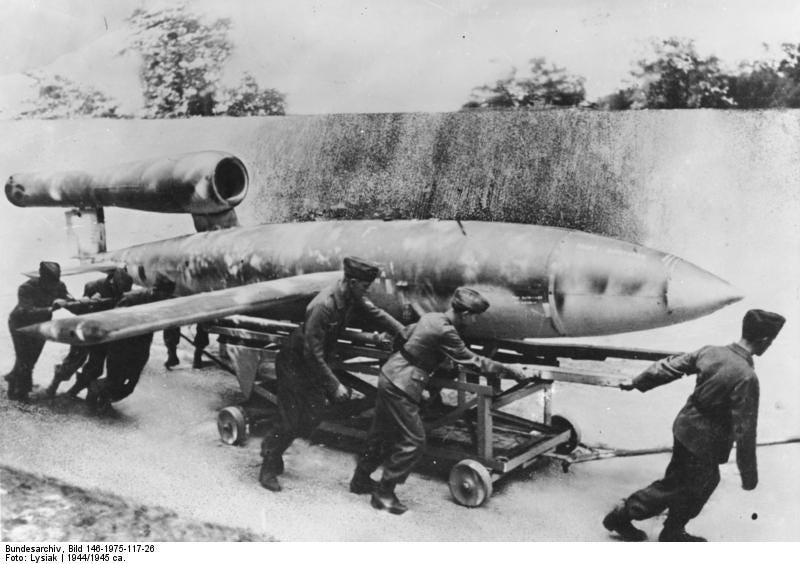
The German V-1 flying bomb and the larger V-2 rocket of World War II heralded the arrival of the precision era. Against these crudely steerable yet deadly projectiles there was little British air defenses could do, especially against the larger, faster, and relatively more accurate V-2 rockets that did considerable damage to British cities. Allied air forces had to deliver over 100,000 pounds of bombs to suspected V-2 launch sites to destroy these airborne threats. Ultimately, however, army forces had to seize the launch sites to eliminate the V-2 threat. Precision technology has continued to advance but hasn’t become the panacea many of its advocates hope.

division-commander-based-design


This post was provided by Col(Retired) Bob Simpson, the former lead at the Army Capabilities Integration Center for many initiatives, including Army 2020, Strategic Landpower, and Force 2025 and Beyond. The views expressed belong to the author alone and do not represent ARCIC, the US Army, or the Department of Defense. 

From roughly the 1900’s through the turn of this century, the US Army used the Army Division as the basis for force design, experimentation, organization and training. In the early 2000’s two things happened that caused the focus of those efforts to shift to “brigade based design”.[i] First, the RMA infatuation with flattening organizational hierarchies allegedly enabled by information empowered brigades,[ii] and second, the changing of US strategy in Iraq that dictated a steady generation of Army brigade combat teams to meet operational requirements. Today the Army is still focused on the brigade in general, and specifically the maneuver brigade combat team as the center of both Army force generation and force design. Even now, the Army is reorganizing its brigades and other brigade and below functional units to correct weaknesses revealed by the war. Risks and trades are often being shifted to higher echelons without full appreciation of the consequences to those echelons, or understanding of the associated opportunity costs. The last ten years of warfighting refute the information age promise of flatter organizations and near autonomous brigades,[iii] and highlight the changing role of echelons above brigade headquarters in achieving strategic and campaign outcomes. It is time to rebalance Army future force design by returning to the Division as the focal echelon for force design and experimentation.

Should we focus predominantly on solving the brigade commander’s problem?

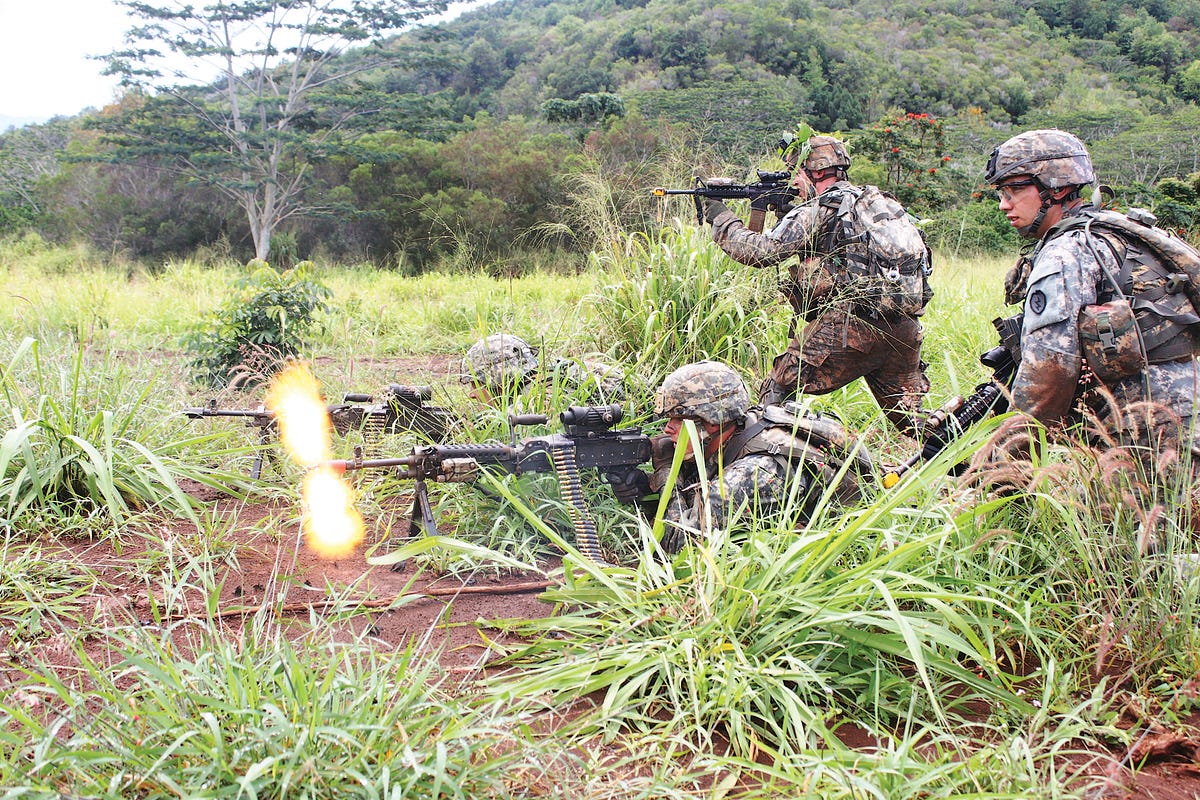
Spc. Derrick Penninger (center, foreground), infantryman, Troop C, 3rd Sqdn., 4th Cav. Regt., 3rd BCT, 25th ID,, fires a burst from his M240B machine gun as his squad engages an enemy bunker during Operation Raider Pillage, April 24 | Photo by 1st Lt. Garrett Nash, 3rd Brigade Combat Team Public Affairs, 25th Infantry Division.