8 December 2014

Violence and Repression in Chechnya

12.04.2014

The Romans became infamous for their “make a desert and call lit peace” approach to counterinsurgency. But even the Romans knew they had to offer subject populations “bread and circuses” to win them over to Roman rule rather than just brute-force oppression. That is a lesson that Vladimir Putin still doesn’t seem to have learned, judging from the latest terrorist attack in Chechnya, which came even as he was giving his predictably delusional and self-congratulatory state-of-the nation speech in Moscow. (The highlight or lowlight was his claim that Crimea has the same significance for Russian nationalists “as the Temple on the Mount in Jerusalem for those people who worship Islam or Judaism,” thus making it clear that for him Russian nationalism is a religion.)

At least 19 people were killed in the Grozny attack. What’s really interesting is that this is not an isolated occurrence. As the New York Times notes, citing the Caucasian Knot website, “290 people had been killed and 144 wounded in fighting scattered through the Caucasus this year through the end of November.”

There is, in short, a real war going on in Chechnya and its environs–a war driven in part by jihadist ideology, to be sure, but also by Russian repression, which is what turned so many Chechen nationalists in their desperation to embrace radical Islam in the first place. Like many other local conflicts, this one has bled into the larger struggle of the jihadists against all manner of enemies. The Caucasus Emirate, as the local jihadist group is known, has sworn allegiance to ISIS and many Muslims from the Russian Caucasus have gone to Syria to join ISIS operations there.

This means that some intelligence sharing and law enforcement cooperation with Putin’s reprehensible regime is probably a necessity, but we must not lose sight of the extent to which his own brutal rule has aggravated the problem of terrorism. Insurgencies must be fought with force but in most instances they can only be ended by reaching some kind of reconciliation with the local people, as the British and the IRA did in the Good Friday Accords and as the FARC and the Colombian government are now striving to do. It is impossible, alas, to imagine that Putin, who revels in his macho cult, could ever take such far-sighted steps for peace.

ISIS Fighters Reportedly Capture Part of Air Base in Eastern Syria

December 6, 2014

BEIRUT — Islamic State group fighters stormed parts of a sprawling army air base Saturday in eastern Syria after days of clashes that killed dozens on both sides, activists said, while state media reported that the offensive was repelled.

The base, outside the city of Deir el-Zour, has been used by the government in the past months to launch air raids on areas held by the Islamic State group bordering Iraq.

The Islamic State group is trying to capture the air base and a nearby barracks known as Brigade 137 to eliminate the main pocket of resistance in the area and provide a major morale and propaganda boost after a string of setbacks in recent weeks.

The Britain-based Syrian Observatory for Human Rights said the latest attack began Saturday with a suicide car bomb at the main entrance of the Deir el-Zour air base. Later Saturday, the push stopped after fighters came under heavy shelling from army positions, it added.

The group said that some Islamic State fighters had breathing problems in the area after government forces used chlorine gas against them.

Syrian state TV quoted an unnamed military official as saying that troops repelled attempts by “terrorists” on several areas near the city of Deir el-Zour and killed “tens of them and destroyed their vehicles and weapons.”

The Islamic State group began a major offensive on the air base, one of the last government-held areas in the province of Deir el-Zour, on Thursday.

The Observatory said that since Thursday, 119 fighters on both sides have been killed, including 51 troops and pro-government militiamen. It said some 68 Islamic State group fighters have been killed, of which 33 were Syrians and two were French citizens.

The Secret Casualties of Iraq’s Abandoned Chemical Weapons

By C.J. Chivers
Oct. 14, 2014

During the Iraq war, at least 17 American service members and seven Iraqi police officers were exposed to aging chemical weapons abandoned years earlier.

These weapons were not part of an active arsenal. They were remnants from Iraq's arms program in the 1980s during the Iran-Iraq war.

Many troops who were exposed received inadequate care. None of the veterans were enrolled in long-term health monitoring.

Munitions are unaccounted for in areas of Iraq now under control of ISIS.


Japan and Abenomics Moment of reckoning

Dec 6th 2014

THERE is little doubt that Shinzo Abe, Japan’s prime minister, sees himself as a leader with an historic mission. In an interview with The Economist, he recalled the revolutionaries from his home prefecture of Yamaguchi who in the 1860s overthrew the old order and transformed Japan into an industrial powerhouse. Now, as then, he argued, Japan has to overhaul itself to catch up with the outside world. Also as then, his domestic opponents are united. “Far-reaching change was necessary for Japan, and my seniors in history staked their lives to achieve it, even though reform did not necessarily win backing from the majority,” he says.

Mr Abe’s supporters have been surprised by how little political capital he has spent on his own economic plan. After his landslide victory in December 2012, he fired up the country with talk of three economic “arrows”: radical monetary easing, extra public spending and bold reforms in the way Japan’s calcified economy works. He has governed in a hyperactive style, jetting off to dozens of countries in a diplomatic offensive. Yet he has shown far less vigour in pushing through the tough, market-oriented reforms that he has repeatedly promised.

Now Mr Abe claims that he needs yet another mandate from voters to implement Abenomics, as his reform programme is commonly known—even though his government already possesses a thumping majority. The snap general election he has called for the lower house of the Diet, or parliament, on December 14th, follows a run of bad news that has put his government on the defensive.

The economy is still struggling after a rise in the consumption (value-added) tax in April from 5% to 8% that crimped household spending. Falling GDP in the latest two quarters means that Japan is technically in recession, although revised figures to be announced on December 8th could show that the economy shrank from July to September by less than originally suggested, possibly close to zero. In October year-on-year core inflation (excluding the impact of the tax rise) fell to 0.9%. It may decline further, thanks partly to falling oil prices. This suggests that Mr Abe’s monetary arrow is falling well short of his target to reach 2% in 2015-16—even after an extra round of easing announced in late October. And an unwelcome reminder of Japan’s gargantuan pile of debt, now at over 240% of GDP, came on December 1st when Moody’s downgraded Japan’s credit rating in response to Mr Abe’s move last month to delay a second rise in the consumption tax, from 8% to 10%, which had been due next year.

Debunking retreat argument against Obama’s foreign policy

By Michael A. Cohen 
DECEMBER 04, 2014


President Obama shook hands with Zhang Dejiang, Chairman of the Standing Committee of the National People’s Congress, during a meeting in Beijing. 

Earlier this week, I went on NPR’s “On Point’’ to discuss the Obama administration’s foreign policy performance. One of my fellow panelists was Bret Stephens, an editorial writer at the Wall Street Journal and author of the new book, “America In Retreat: The New Isolationism and the Coming Global Disorder.” It’s the kind of book that it catnip for conservative opponents of President Obama.

As Stephens said on the radio, while George W. Bush perhaps might have pushed too far in the direction of over-engagement, Obama has swung the pendulum back in the other direction toward isolationism and retrenchment.

Indeed, while I have not yet read Stephens book, in an excerpt I discovered that not only does he believe that “America is in retreat,” but that the retreat is the “motivating impulse” of the Obama presidency.

How can anyone make an argument like that? After all, the evidence that America is not in retreat and has not forsaken a role of global engagement during the Obama presidency is so obvious it is barely worthy of discussion.

Top General: Americans Are Increasingly Lacking The Smarts And Fitness Needed To Join The US Army

DEC 6, 2014

Young Americans are increasingly unfit for Army service due to obesity, academic failings, and various other shortcomings.

Maj. Gen. Allen Batschelet, the US Army Recruiting Command commanding general, told a US Army Bloggers roundtable Thursday that the Army is facing significant challenges in recruiting. Part of this is due to an improving economy offering more young people career options outside of the military.
More significantly, an increasing number of Americans are simply ineligible for Army service. As of now, Batschelet said, only three in ten Americans between the ages of 17 and 24 meet the Army's standards for service. By 2020, according to the general, "that eligibility number could be down to two in ten."

"Obesity forms a big part of it, the disqualification. That's the growing trend," Batschelet said. However, moral disqualifications over an increasing range of criminalized behaviors have barred many young men and women from enlisting.

Similarly, an "erosion in academic qualification of the young people we are engaging with" has left the Army grasping for eligible recruits. The problem is "reflected in declining high school graduation rates," Batschelet, alongside the failure of an increasing number of Americans to achieve high school equivalency certificates.

For Batschelet, the slipping educational standards of Americans is the most worrying trend for the future of the US Army. Although obesity is the leading disqualifier for people looking to enlist, tht challenge is one that "we as a society, and even as the Army, can deal with."

In contrast, deficiencies in education will take "significantly more time to address ... that's the more worrisome one for me," Batschelet said.

Reflected in the problem of education, recruits have routinely scored worse on the Armed Services Vocational Aptitude Battery (ASVAB) test, Batschelet said.

According to the Military Times, the Department of Defense has strict quotas on what percentage of enlisted can score on the ASVAB. At most only 4% of enlistees can score in the 10th to 30th percentile of the test, and no more than 40% 0f enlistees can score lower than the 50th percentile.

Europe: When the Unthinkable Becomes Possible

 December 3, 2014

Europe's economic crisis is slowly but steadily eroding the political systems of many countries on the Continent. New actors are emerging and threatening the supremacy of the traditional players. Alliances and events that seemed impossible only a few years ago are now being openly discussed across Europe. On Dec. 3, for example, Sweden announced it would hold early elections, partially because of political moves from the far right. In Spain, the ruling center-right party is openly discussing the possibility of entering an alliance with its traditional center-left rivals to prevent a protest party from taking over. Key members of the European Union, including Sweden, Spain, the United Kingdom and possibly Greece, will hold elections in 2015. In most cases, these countries will see outcomes nobody would have thought possible in 2008.

Sweden

Swedish Prime Minister Stefan Lofven announced the snap elections after his center-left government lost a budget vote less than three months after coming to power. Lofven's announcement was precipitated by a decision by the far-right Sweden Democrats party to support the opposition during a budget vote. Sweden's early elections, the first for the country in almost 60 years, will be held March 22, with the anti-immigration Sweden Democrats likely playing a central role. In Sweden's parliamentary elections in September, no coalition managed to form a majority government, but the elections were marked by the strong performance of the far-right party, which received 12.9 percent of the vote, up from 5.7 percent in 2010, when it entered parliament for the first time.

What is a Geopolitical Diary?George Friedman Explains.

While Sweden is one of the fastest growing economies in Europe, unemployment remains above pre-crisis levels. More important, Sweden has the largest number of asylum applications per capita in the European Union. Last year, violent riots shook Stockholm's immigrant-heavy suburbs, revealing Sweden's struggle to integrate its immigrants into mainstream society. Opinion polls show that Swedes still largely support the idea of living in a country that is open to asylum-seekers, but they are also worried about the economic and cultural impact of increased immigration. If the Sweden Democrats hold their place as the country's third-largest party, they will probably become key in the formation of a new government. This would put a far-right party in a position of power in one of Europe's main economies.

Satellite Imagery Shows North Korean Nuclear Reactor at Yongbyon Still in Shutdown Mode

David Albright and Serena Kelleher-Vergantini
December 6, 2014

Digital Globe commercial satellite imagery dated December 1, 2014 continues to show signatures consistent with the shutdown of North Korea’s Yongbyon 5 megawatt-electric (MWe) reactor for maintenance or renovations and possibly some level of fuel replacements. However, caution is warranted: North Korea may also be desperate for plutonium for nuclear weapons and willing to unload the reactor earlier than expected, while also conducting maintenance work on the reactor.

Some signatures are visible at the reprocessing plant located southeast of the Yongbyon reactors, suggesting some level of operation. However, North Korea may also be trying to signal plutonium separation activities without actually conducting any. At the enrichment site, located in the southern part of the Yongbyon nuclear site, roof renovations on a building adjacent to the uranium centrifuge building have halted.

Analysis of imagery dated June 30, August 27, and September 29, 2014, combined with procurement data obtained by ISIS, suggests that North Korea has emphasized the production of weapon-grade plutonium in the 5 MWe reactor as well as enriched uranium for its nuclear weapons program. Analysis of more recent imagery dated December 1, 2014 suggests that North Korea continues to work on maintaining the aged 5 MWe reactor and intends to restart it. The start-up date of the experimental light water reactor (LWR) continues to remain uncertain.

Backgrounder on Secret North Korean Cyber Espionage Unit

December 6, 2014 

How impoverished North Korea built elite ‘secret war’ hacker unit 
Despite its poverty and isolation, North Korea has poured resources into a sophisticated cyber-warfare cell called Bureau 121, defectors from the secretive state said as Pyongyang came under the microscope for a crippling hack into computers at Sony Pictures Entertainment. 

A North Korean diplomat has denied Pyongyang was behind the attack that was launched last month but a U.S. national security source said it was a suspect.

Defectors from the North have said Bureau 121, staffed by some of the most talented computer experts in the insular state, is part of the General Bureau of Reconnaissance, an elite spy agency run by the military. They have said it is involved in state-sponsored hacking, used by the Pyongyang government to spy on or sabotage its enemies.

Pyongyang has active cyber-warfare capabilities, military and software security experts have said. Much of it is targeted at the South, technically still in a state of war with North Korea. But Pyongyang has made no secret of its hatred of the United States, which was on the South’s side in the 1950-53 Korean War.

Military hackers are among the most talented, and rewarded, people in North Korea, handpicked and trained from as young as 17, said Jang Se-yul, who studied with them at North Korea’s military college for computer science, or the University of Automation, before defecting to the South six years ago.

Speaking to Reuters in Seoul, he said the Bureau 121 unit comprises about 1,800 cyber-warriors, and is considered the elite of the military.

“For them, the strongest weapon is cyber. In North Korea, it’s called the Secret War,” Jang said.

One of his friends works in an overseas team of the unit, and is ostensibly an employee of a North Korean trading firm, Jang said. Back home, the friend and his family have been given a large state-allocated apartment in an upscale part of Pyongyang, Jang said.

“No one knows … his company runs business as usual. That’s why what he does is scarier,” Jang said. “My friend, who belongs to a rural area, could bring all of his family to Pyongyang. Incentives for North Korea’s cyber experts are very strong … they are rich people in Pyongyang.”

Fleet Cyber Command/10th Fleet: US Navy’s SIGINT and Cyber Warriors

Richard R. Burgess
December 6, 2014

ARLINGTON, Va. — The Navy’s cyber warriors not only react to intrusions on the service’s networks, but also have teams that pro-actively hunt for intruders hiding in cyberspace.

Speaking to an audience Dec. 2 at the Center for Strategic and International Studies, a Washington think tank, VADM Jan Tighe, commander of Fleet Cyber Command and the U.S. Tenth Fleet, said that in addition to its “layered defense in depth,” Fleet Cyber Command has “people [who] go hunt … [who] look for bad actors in new and different ways.

“We have sensors and countermeasures to … detect movement inside our network. We do surveillance inside our networks,” Tighe said.

“The threat in cyberspace is evolving almost on a daily basis,” she said. Because of the “low cost of entry” of cyber attack it is “hard to determine intent of malicious actors” and the command has to treat any intrusion as dangerous.

The threats include national governments, criminals, “hacktivists” and hackers seeking to disrupt, she said.

Fleet Cyber Command is the Navy’s component of U.S. Cyber Command and a component of U.S. Strategic Command. With about 1,850 cyber warriors, it conducts operations for combatant commanders and the National Security Agency.


Cyber warfare “is definitely a team sport,” Tighe said, speaking of the coordination and lesson-sharing with the cyber forces of the other armed forces and with the Defense Information Systems Agency.

Fleet Cyber Command is part of the Information Dominance Corps of the Navy and part of a larger effort that began five years ago to take a holistic approach to electronic warfare, intelligence, cyber warfare, meteorology and oceanography.

Tighe said the command’s first responsibility is to ensure that the Navy’s networks can “operate as a warfighting platform … available and secure.”

The command also provides signals intelligence to supported commands, delivers effects in support of warfighting objectives, and provides situational awareness.

Tighe said that delays in the modernization of the Navy’s networks make them harder to defend. She also expressed concern that loss of information from the defense industry’s networks can reduce the warfighting advantage of the United States.

CYBERWAR REPRESENTS EXISTENTIAL THREAT TO US

4 Dec 2014 

Nineteenth century military genius Carl von Clausewitzcoined the phrase: “War is a mere continuation of politics by other means." In his day, the number of wars was limited by the time and expense to organize large armies and then march across borders to inflict pain. 

War was much more expensive in the twentieth century, but the number of conflicts expanded because planes and missiles cut the time it took to inflict pain. Proliferating technologies make it now possible for any nation to acquire cyber tools at minimal cost to instantly inflict pain on any other nation. Clausewitz would expect the number of cyberwars to grow exponentially in the twenty-first century. 

The advent of cyberwar represents a new “high bar risk” as the U.S. faces-off against a deadly trifecta of cutting-edge digital technologies, advanced military weapons, and the ability to disrupt critical infrastructure. With this type of war built around digital technology, America’s enemies will focus on turning our own technology against us.

The first year of the twenty-first century will be remembered for 19 illegal aliens who trained at a Florida school to use U.S. commercial airliners as improvised explosive devices. The 9/11 terrorists slaughtered more Americans than died at Pearl Harbor. With the U.S. government politically forced to declare war on much of the Middle East, the financial cost from the attacks and subsequent military response is over $3.3 trillion.

Former National Coordinator for Security, Infrastructure Protection, and Counter-terrorism for the United States, Richard A. Clarke, defined "cyberwarfare” as “actions by a nation-state to penetrate another nation's computers or networks for the purposes of causing damage or disruption.” When confronted with the statistic that less than 0.0025% of revenue at the average U.S. corporation was being spent on information technology security, Clarke warned: “If you spend more on coffee than on IT security, then you will be hacked. What's more, you deserve to be hacked.”

Can Ashton Carter rein in a Pentagon out of control?

 December 4


In this Feb. 12, 2013 file photo, Ashton Carter testifies on Capitol Hill in Washington. Carter has emerged as President Barack Obama's top candidate to become the next defense secretary, according to administration officials, putting him in line to take over a sprawling department that has had an uneasy relationship with the White House. (J. Scott Applewhite/AP)

Chuck Hagel may not have been able to work with the ever more powerfulNational Security Council staff, but this discussion of personalities misses the point. The key to success for a defense secretary today is the ability to manage not White House aides but rather the Pentagon, which is the world’s most complicated and most dysfunctional bureaucracy. Ashton Carter, the president’s presumed choice as the next secretary, is a brilliant man and perhaps has made some friends at 1600 Pennsylvania Ave. But by far the best quality he has going for him is that he seems to understand the need to rein in a Pentagon now so out of control that it is difficult to fully comprehend or explain. 

Republicans worry a great deal about dysfunction in government. They launch investigations to find out why a few hundred million dollars were wasted and insist that departments do more with less. Except for the largest government bureaucracy in the world, the Defense Department, which spends about $600 billion a year — more than the entire GDP of Poland — and employs 1.4 million men and women in uniform, 700,000 civilians and 700,000 full-time contractors. The Pentagon’s accounts are so vast and byzantine that it is probably impossible to do a thorough audit of them. 

Lethal Robots and the Conduct of Warfare

By Marcus Fielding
December 06, 2014

Perhaps not quite the Terminator, but lethal robots are set to have a growing role on the battlefield. 

The use of lethal robots in conflict is inevitable. When it happens, it’ll create a significant shift in the ways of warfare. A discussion has already begun (see here and here) on how such capabilities might be developed and applied.

Robots in general are becoming smaller, smarter, cheaper and more ubiquitous. Lethal robots are becoming more deadly and discriminating. The degree of autonomy will be a key driver of a robot’s role in conflict and is likely to evolve in three generations; the semi-autonomous, the restricted-autonomous, and ultimately the fully-autonomous generation.

We’re already a decade into the semi-autonomous generation—using robots to kill people but with humans still in the decision loop. Technology and cost factors mean the semi-autonomous generation has—so far—been dominated by states. Moreover, the targeting of senior-level decision makers has come to be regarded as a legitimate and effective tactic. ‘Targeted killings’ by states with drones, aircraft, missiles or occasionally Special Forces raids have become common. As lethal robots proliferate they’ll increasingly be used for such missions because of their low cost and risk.

Space Exploration and U.S. Competitiveness

Steven J. Markovich
December 5, 2014

The launch of Sputnik and subsequent Russian firsts in space convinced many U.S. policymakers that the country was falling dangerously behind its Cold War rival. Consecutive U.S. administrations invested in education and scientific research to meet the Soviet challenge. These investments propelled the United States to victory in the so-called "space race" and planted the seeds for future innovation and economic competitiveness, experts say. Yet since the 1990s, NASA's share of federal spending has waned. The U.S. private sector has ramped up investment in space, but accidents in October 2014 cast some doubt on the pace of commercial space flight.


The Soviet Union took the world by surprise in October 1957 with the launch of Sputnik, the first artificial satellite. In a matter of months, President Dwight D. Eisenhower and Congress initiated measures to build U.S. scientific and engineering prowess, including the creation of NASA, a civilian space exploration agency.

Presidents have largely determined NASA's long-term missions. In May 1961—a few weeks after the Soviet Union put the first human in space (Yuri Gagarin)—President John F. Kennedy committed the United States to a lunar landing. He stressed the urgency and the value of this mission in a landmark speech at Rice University in September of that year. "We choose to go the moon in this decade and do the other things, not because they are easy but because they are hard; because that goal will serve to organize and measure the best of our energies and skills; because that challenge is one that we're willing to accept, one we are unwilling to postpone, and one we intend to win."

After six successful lunar missions, NASA's manned program pulled back to Earth, while robotic missions such as Voyager and Viking continued to explore the Solar System. NASA focused on sending astronauts into low earth orbit (LEO) with the 1973 launch of Skylab, the first U.S. space station, and the Space Shuttle. The Space Shuttle served NASA for thirty years (1981–2011) and helped build the International Space Station (ISS), an orbiting laboratory that has been continuously occupied by humans since 2000.

Why the world missed the oil price crash

December 5 


A man changes the price for a gallon of gasoline at a gas station in Medford, Massachusetts December 4, 2014. Brent crude oil fell below $69 a barrel on Thursday after Saudi Arabia announced deep cuts in selling prices for Asian and U.S. buyers, a week after refusing to support OPEC output cuts. REUTERS/Brian Snyder (UNITED STATES - Tags: BUSINESS ENERGY SOCIETY) (Brian Snyder/Reuters)

Michael Levi, a senior fellow and the director of the Center for Geoeconomic Studies at the Council on Foreign Relations, is the author of “The Power Surge: Energy, Opportunity, and the Battle for America’s Future.”

On Feb. 1, 2011, oil prices rose above $100 a barrel. For the next three years, they largely stayed there, with few of the dramatic ups and downs that oil markets are famous for. So when prices began falling slowly in June of this year, most industry experts shrugged. Hundred-dollar oil was here to stay, right? 

That attitude has made the vicious plunge in oil prices over the past few months all the more shocking. U.S. oil production has been rising for several years; more recently, Libyan oil output has surged, too. Those increases collided with a weak global economy this summer to create a glut of oil. Late last month, members of the Organization of the Petroleum Exporting Countries (OPEC) announced that they would not cut their own production to compensate and stabilize prices. Oil promptly fell below $70 a barrel, down 40 percent from its June peak. 

“Oil Enters New Era,” announced Bloomberg News. OPEC is “throwing in the towel,” declared the head of oil research for a major bank, transforming energy markets “for many years to come.” A new age of low-price oil, with OPEC on the sidelines, is upon us, experts declared — and everyone has to adapt. 

But before everyone pivots from one dogmatic view of oil markets to a radically different and equally certain vision, we ought to ask: Why were so many people wrong about oil prices? Bad assumptions about how the U.S. oil industry works, and about the power of OPEC and Saudi Arabia, drove our misconceptions about where prices were heading — and continue to confuse us about where they’ll go next. 

Fleet Cyber Command/10th Fleet: US Navy’s SIGINT and Cyber Warriors

Richard R. Burgess
December 2, 2014

ARLINGTON, Va. — The Navy’s cyber warriors not only react to intrusions on the service’s networks, but also have teams that pro-actively hunt for intruders hiding in cyberspace.

Speaking to an audience Dec. 2 at the Center for Strategic and International Studies, a Washington think tank, VADM Jan Tighe, commander of Fleet Cyber Command and the U.S. Tenth Fleet, said that in addition to its “layered defense in depth,” Fleet Cyber Command has “people [who] go hunt … [who] look for bad actors in new and different ways.

“We have sensors and countermeasures to … detect movement inside our network. We do surveillance inside our networks,” Tighe said.

“The threat in cyberspace is evolving almost on a daily basis,” she said. Because of the “low cost of entry” of cyber attack it is “hard to determine intent of malicious actors” and the command has to treat any intrusion as dangerous.

The threats include national governments, criminals, “hacktivists” and hackers seeking to disrupt, she said.

Fleet Cyber Command is the Navy’s component of U.S. Cyber Command and a component of U.S. Strategic Command. With about 1,850 cyber warriors, it conducts operations for combatant commanders and the National Security Agency.

Cyber warfare “is definitely a team sport,” Tighe said, speaking of the coordination and lesson-sharing with the cyber forces of the other armed forces and with the Defense Information Systems Agency.

Fleet Cyber Command is part of the Information Dominance Corps of the Navy and part of a larger effort that began five years ago to take a holistic approach to electronic warfare, intelligence, cyber warfare, meteorology and oceanography.

Tighe said the command’s first responsibility is to ensure that the Navy’s networks can “operate as a warfighting platform … available and secure.”

Unit 8200: Israel’s NSA and Birthplace of the israeli High-Tech Industry

Jeff Moskowitz
December 5, 2014

Over the summer, in the middle of a two-month-long Israeli-Palestinian war, representatives of some of the biggest names in tech crammed into the stairwell of a Tel Aviv skyscraper to wait out Hamas rocket fire. Wearing Sequoia Capital name tags and TechCrunch T-shirts, they squeezed against one another, passing the time by talking about the Paris startup scene and the success rate of Iron Dome, Israel’s missile defense system.

They came to Tel Aviv for the demo day of a uniquely Israeli brand of startup incubator: one conducted by graduates of Israel Defense Forces Unit 8200 – the Israeli NSA. It was a fitting reminder of the close ties between Israel’s Silicon Wadi (the nickname for Israel’s startup ecosystem) and the country’s military establishment.

The 8200 is the largest unit in the Israeli army. It’s responsible for signals intelligence, eavesdropping and wiretapping, as well as advanced technical jobs and translating work. It is also widely acknowledged as producing a disproportionately high percentage of Israel’s tech executives and startup founders, including the brains behind Check Point Software Technologies, NICE Systems, and Mirabilis (creator of the proto-instant messaging system ICQ) – three of the biggest Israeli tech companies.

In general, the military intelligence and technological units of the Israeli army (including 8200) provide the training ground for much of the country’s tech successes. The founders of Waze, a popular GPS navigation app acquired by Google last year for more than a billion dollars , served in military intelligence. MobileSpaces, which was bought last month by the US firm Pulse Secure for $100 million, was founded by graduates of Unit 8200.

Adam Singolda spent seven years doing advanced encryption for the IDF before he founded Taboola in 2007, a recommendation engine that has an estimated value of $1.5 billion. Founders of the Web development platform Wix.com also served in 8200. That company went public last year in the biggest Wall Street debut ever for an Israeli company.

Because an intelligence background is not always publicly available information, it’s impossible to compile statistics, but experts agree the effect of the intelligence and technological units on the country’s hi-tech sector is massive.

What you need to know about Ashton Carter, Obama's new Defense Secretary nominee

December 5, 2014

Ashton Carter, a former Defense Department official and Harvard professor, will be nominated to be the next Secretary of Defense at a Friday morning press conference with President Obama. 
Carter has a long list of academic and security establishment credentials, as well as a history of bipartisan praise. 
His main expertise is in nuclear strategy and he has overseen the Pentagon's weapons procurement and budget. 
He has a history of hawkish leanings on certain issues, advocating for a preemptive strike against North Korea in 2006 and calling for a bigger residual force to be left in Iraq when President Obama was withdrawing troops. 
Who is Ashton Carter?

On Friday morning, President Obama will announce that he will nominate Ashton B. Carter to replace Chuck Hagel as Secretary of Defense, according to a White House statement.

A theoretical physicist and former Harvard professor with an expertise in nuclear policy and weapons spending, Carter served in the Pentagon under Presidents Clinton and Obama and rose to be Deputy Secretary of Defense in October 2011. As deputy, he managed the Pentagon day-to-day and helped deal with the effects of sequestration.

Well-connected among the national security establishment, Carter "has advised nearly every major strategy group, research council, and governmental panel on issues of international security," according to the New Republic.

When his boss and then-Secretary of Defense Leon Panetta stepped down at the beginning of Obama's second term, Carter was considered as a possible replacement (and also as a potential Energy Secretary). Obama chose former Republican Senator Chuck Hagel instead, and Carter remained deputy until December 2013, when he returned to academia.

Carter has a long list of elite academic credentials. After earning a bachelor's degree in medieval history and physics from Yale, he earned his PhD in theoretical physics from Oxford in 1979. He then worked briefly in Congress's Office of Technology Assessment and the Pentagon and as a research fellow at MIT's Center for International Studies, before joining the faculty at Harvard University and becoming the director of its Center for Science and International Affairs. In 1993, he joined the Clinton Administration as Assistant Secretary of Defense for International Security Policy and later served as a senior advisor to the administration's North Korea Policy Review.
What Carter's nomination means for the US
December 06, 2014


Let’s not rush to mock Hagel for citing the War of 1812 as a precedent for contemporary strategy. He has a point. 

It’s astonishing how one errant word or metaphor can disarm readers’ or hearers’ critical faculties. Exhibit A: Secretary of Defense Chuck Hagel’s citing the War of 1812 as a precedent for the U.S. Army to integrate coastal defense into its post-Afghanistan, post-Iraq slate of missions.

The War of 1812 reference made Hagel the butt of countless jokes. Military wags roundly lampooned the secretary for deriving guidance for today from such an antiquarian reference. After all, today’s ultramodern U.S. military has little to learn from its early history. Right?

Well, no. It’s not right at all. The substance of Hagel’s remarks was mostly lost amid the wisecracks. In reality, what he proposes makes eminent good sense for groundpounders searching for their identity in maritime Asia.

What do listeners hear when someone draws the War of 1812 analogy? Two things, it seems. One, that the person drawing the analogy sees a United States defending its immediate environs against an outside, far stronger maritime power. It’s not a globe-straddling superpower. It’s a local power trying feebly to protect its shores. No serious thinker would pattern contemporary methods on such a lackluster precedent.

And indeed, Britannia, faraway but overpowering, ruled the waves — including the waves lapping against the eastern seaboard of North America — during that half-forgotten conflict. Its Royal Navy imposed a stifling blockade on the new republic, squelching seaborne trade almost wholly by 1814. Having won a spate of inspiring single-ship victories in the opening months of the war, the U.S. Navy found itself largely confined to port. Worse, the Royal Navy landed amphibian forces along the Chesapeake Bay. Redcoats burned the presidential mansion, later the White House, late in 1814. Some precedent.

Blinders, Blunders, and Wars

Dec 2, 2014 

The history of wars caused by misjudgments, from Napoleon's invasion of Russia to America's invasion of Iraq, reveals that leaders relied on cognitive models, or simplified representations of their worlds, that were seriously at odds with objective reality. Blinders, Blunders, and Wars analyzes eight historical examples of strategic blunders regarding war and peace and four examples of decisions that turned out well, and then applies those lessons to the current Sino-American case. Leaders' egos, intuitions, unwarranted self-confidence, and aversion to information that contradicted their views prevented them from correcting their models. Yet advisors and bureaucracies can be inadequate safeguards and can, out of fawning or fear, reinforce leaders' flawed thinking.

War between China and the United States is more likely to occur by blunder than from rational premeditation. Yet flawed Chinese and American cognitive models of one another are creating strategic distrust, which could increase the danger of misjudgment by either or both, the likelihood of crises, and the possibility of war. Although these American and Chinese leaders have unprecedented access to information, there is no guarantee they will use it well when faced with choices concerning war and peace. They can learn from Blinders, Blunders, and Wars.

As a general remedy, the authors recommend the establishment of a government body providing independent analysis and advice on war-and-peace decisions by critiquing information use, assumptions, assessments, reasoning, options, and plans. For the Sino-U.S. case, they offer a set of measures to bring the models each has of the other into line with objective reality.

Key Findings

Strategic Blunders Can Happen When Leaders Rely on Defective Cognitive Models of Reality and Have No One to Correct Them. 
Strategic blunders can result from faulty intuition, egotism, arrogance, hubris, grand but flawed strategic ideas, underestimating the enemy and the difficulties and duration of conflict, overconfidence in war plans, ignoring what could go wrong, stifling debate, shunning independent advice, and penalizing dissent. 
These conditions are especially dangerous when combined with excessive risk taking based on an overestimation of one's ability to control events. 
The Key to Bridging the Gap Between a Defective Model and Objective Reality Is Information, Amply Supplied and Well Used. 
Decisionmakers may be more receptive to information that supports rather than threatens their beliefs, preconceptions, and models. 
Institutions close to decisionmakers can be drawn into the same subjective perception of reality. 
Government institutions are not dependable safeguards against strategic mistakes. 
Improvements are needed in how leaders and institutions use information so that better cognitive models will enable them to make better choices. 

Division Commander-Based Design Why the Army should return to the Division as the focal point for future force design efforts


This post was provided by Col(Retired) Bob Simpson, the former lead at the Army Capabilities Integration Center for many initiatives, including Army 2020, Strategic Landpower, and Force 2025 and Beyond. The views expressed belong to the author alone and do not represent ARCIC, the US Army, or the Department of Defense. 

From roughly the 1900’s through the turn of this century, the US Army used the Army Division as the basis for force design, experimentation, organization and training. In the early 2000’s two things happened that caused the focus of those efforts to shift to “brigade based design”.[i] First, the RMA infatuation with flattening organizational hierarchies allegedly enabled by information empowered brigades,[ii] and second, the changing of US strategy in Iraq that dictated a steady generation of Army brigade combat teams to meet operational requirements. Today the Army is still focused on the brigade in general, and specifically the maneuver brigade combat team as the center of both Army force generation and force design. Even now, the Army is reorganizing its brigades and other brigade and below functional units to correct weaknesses revealed by the war. Risks and trades are often being shifted to higher echelons without full appreciation of the consequences to those echelons, or understanding of the associated opportunity costs. The last ten years of warfighting refute the information age promise of flatter organizations and near autonomous brigades,[iii] and highlight the changing role of echelons above brigade headquarters in achieving strategic and campaign outcomes. It is time to rebalance Army future force design by returning to the Division as the focal echelon for force design and experimentation.

Should we focus predominantly on solving the brigade commander’s problem?
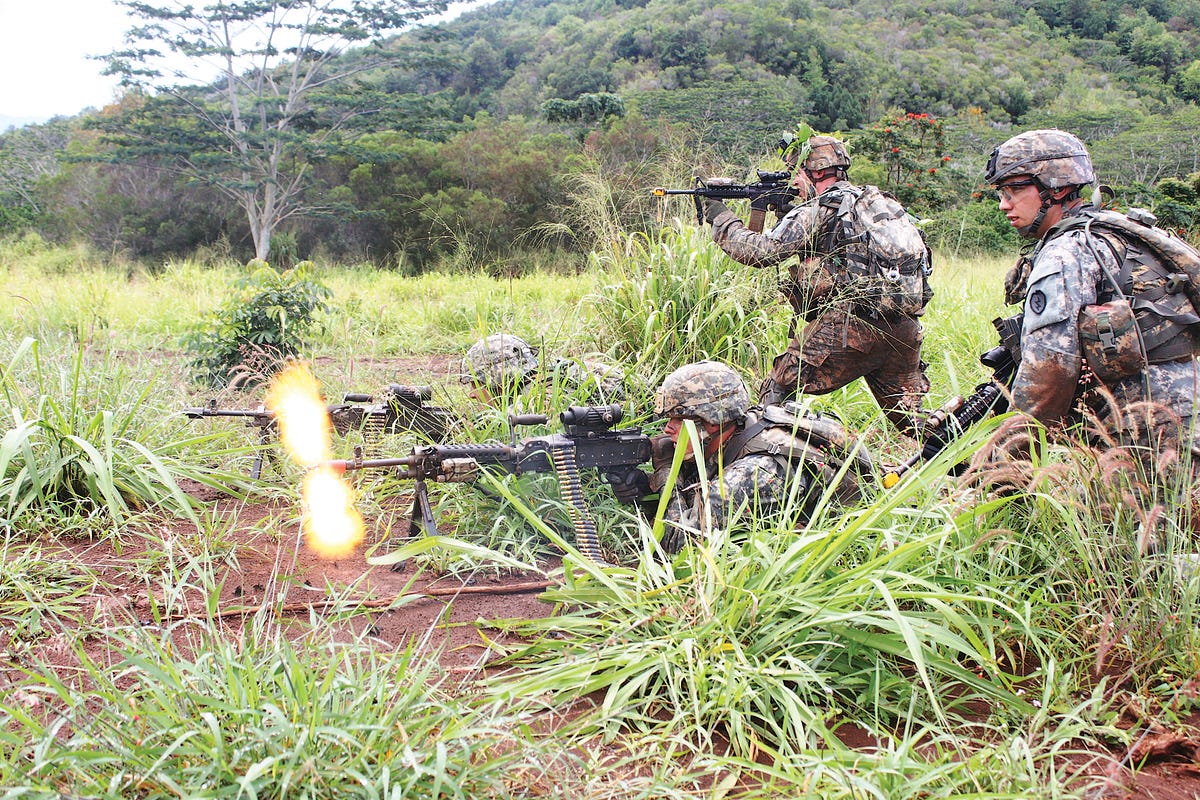
Spc. Derrick Penninger (center, foreground), infantryman, Troop C, 3rd Sqdn., 4th Cav. Regt., 3rd BCT, 25th ID,, fires a burst from his M240B machine gun as his squad engages an enemy bunker during Operation Raider Pillage, April 24 | Photo by 1st Lt. Garrett Nash, 3rd Brigade Combat Team Public Affairs, 25th Infantry Division.

“Brigade-based design” was and is really “brigade commander-based design”. A design that focuses on the Brigade commander‘s task and purpose.[iv] Should we focus predominantly on solving the brigade commander’s problem? The Strategic Landpower White Paper[v] and the Army Operating Concept[vi] suggest we need to design our formations from the perspective of higher echelon commanders’ task and purpose. This paper is therefore a call to make the division commander’s problem the focal point of Army future force design efforts, and the baseline from which risks, trades and opportunity costs are measured. It may well be that such an approach will validate the current lethality heavy design of the maneuver BCT, for example. On the other hand, it is equally possible that approach will reveal that we have placed too much responsibility for sustainment and maneuver support on the Division Commander and limited that echelon’s tactical agility in doing so. Like a weight lifter that focuses too much on one part of the body, the current BCT will do very well in one exercise and not well in others, especially when viewed through the prism of the Division Commander’s mission. This is especially important as it appears that killing our way out of a problem is less and less satisfactory as a matter of policy and comprises fewer and fewer of our missions as a matter of practice.[vii]

The Russian Bear Roars in the Sky: Beware the Deadly Su-35 Fighter

December 6, 2014 


The Sukhoi Su-35S Flanker-E is the most potent fighter currently in operation with the Russian Air Force. Should American pilots be shaking in their cockpits? 

The Sukhoi Su-35S Flanker-E is the most potent fighter currently in operation with the Russian Air Force. The powerful twin-engine fighter, which is an advanced derivative of the original Soviet-era Su-27, is high flying, fast and carries an enormous payload. That, combined with its advanced suite of avionics, makes the Su-35 an extremely dangerous foe to any U.S. fighter, with the exception of the stealthy Lockheed Martin F-22 Raptor. That is one of the reasons the Chinese People’s Liberation Army Air Force is keen to acquire the new jet.

“It’s a great airplane and very dangerous, especially if they make a lot of them,” said one senior U.S. military official with extensive experience on fifth-generation fighters. “I think even an AESA [active electronically scanned array-radar equipped F-15C] Eagle and [Boeing F/A-18E/F] Super Hornet would both have their hands full.”

One U.S. Navy Super Hornet pilot—a graduate of that service’s elite TOPGUN school—offered a sobering assessment. “When taken as a singular platform, I like the Su-35’s chances against most of our platforms, with perhaps the exception of the F-22 and F-15C,” the naval aviator said. “I suspect the F/A-18E/F can hold it’s own and F-35 has presumed stealth and sensor management on its side.”

But one Air Force official with experience on the Lockheed Martin F-35 Joint Strike Fighter said that the Su-35 could pose a serious challenge for the stealthy new American jet. The F-35 was built primarily as a strike fighter and does not have the sheer speed or altitude capability of the Su-35 or F-22. “The Su's ability to go high and fast is a big concern, including for F-35,” the Air Force official said.

The Most Important Alliance You've Never Heard Of


FEB 17 2014


A membership diagram of Latin American and Caribbean intergovernmental organizations. (Wikimedia Commons)

In Venezuela, students have been killed while protesting against the government of Nicolás Maduro, who is jailing opposition leaders and just closed a television station that dared broadcast the demonstrations. Argentina is irresponsibly racing toward a dangerous economic cliff. The Brazilian economy is in recessionand 2014 will mark its fourth consecutive year of subpar growth, as the country reels from its largest capital flight in more than 10 years.

Is a decade of progress in Latin America coming to an end? For some countries, surely. But not necessarily for the entire region. Four nations are developing an initiative that could add new dynamism to Latin America, redraw the economic map of the region, and boost its connections with the rest of the world—especially Asia. It could also offer neighboring countries a pragmatic alternative to the more political groupings dominated by Brazil, Cuba, and Venezuela.

If the Alliance were a country, it would be the world's eighth-largest economy and seventh-largest exporter.Amid all the bad news in the region, the presidents of Chile, Colombia, Mexico, and Peru met with little fanfare in Cartagena last week to seal an economic pact launched in 2012. They call their project the Pacific Alliance, and it will soon include Costa Rica and possibly several other countries. The four founding members are the most successful economies in Latin America; they boast the region's highest economic-growth rates and lowest inflation rates. Together, they represent 36 percent of the region's economy, 50 percent of its international trade, and 41 percent of all incoming foreign investment. If the Alliance were a country, it would be the world's eighth-largest economy and seventh-largest exporter. Its members lead the lists of the most competitive economies in Latin America and those where it’s easiest to do business. Given that trade among the four countries is currently a mere 4 percent of their total trade, the potential to expand trade and investment flows is huge.