16 December 2014

The Pacific Rim’s Future Wars Belong to Marines

To counter China, Asian militaries build up amphibious forces

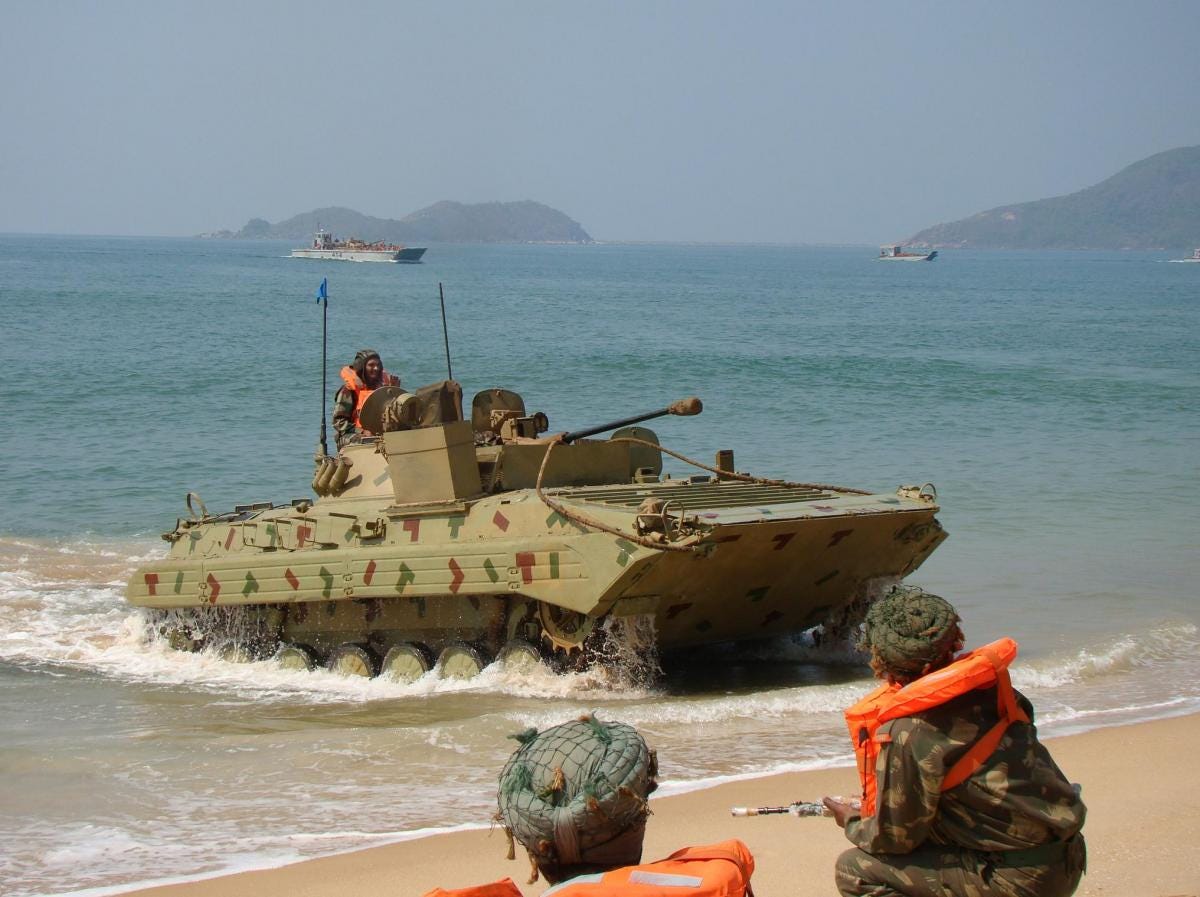
Across the Pacific Rim, regional powers are creating new marine infantry units.

Fast, highly-trained and designed for military missions originating from the sea, marines are invaluable for the kinds of conflicts Asian and Pacific nations might fight in the future.

Since 2009, India, Australia and Japan have all announced the creation of seagoing infantry forces.

These units are tiny in comparison to the U.S. Marine Corps. But Asia’s regional powers are not just creating mini-marine forces of their own, they’re buying the landing ships and transport aircraft to carry troops to danger zones and—if necessary—into battle.

It’s an expensive insurance policy for a region where Pacific Ocean shipping lanes serve as economic lifelines. Losing control of these sea lanes will havedire consequences for billions of people.
But as these three countries are discovering—there’s a lot to learn when it comes to amphibious warfare.

Naval infantry have existed for thousands of years, and specialized marine units date to the 16th century Spanish Empire. But it’s Asia that spurred the creation of modern marines.

In the years before World War II, Imperial Japanese troops struggled to digest China. The country’s tough coastline—crisscrossed with river systems and water that was much too shallow for harbors—prompted Japan to invent flat-bottomed landing craft, capable of delivering ground forces directly to shore.

After the war, Japan disbanded its entire military, and passed the torch of amphibious operations to the U.S. Marines. As the world’s preeminent amphibious force, the USMC acts as a go-to expeditionary army designed to operate far beyond America’s borders.

The budding Asian marines will likely work in the same fashion, but with a more regional—and less global—focus. Many Asian nations rely on shipping lanes to sustain their economies. These lanes reach through the Straits of Malacca, the Indian Ocean and the Persian Gulf.
These lanes need security. The marines’ likely scenarios include fighting pirates, conducting peacekeeping operations and responding to natural disasters.

The Bay of Bengal: The Maritime Silk Route and China’s Naval Ambitions

By David Brewster
December 14, 2014


With its Maritime Silk Route initiative, China is rapidly developing a presence in the Bay of Bengal. 

Since late 2013, Beijing has been promoting its “Maritime Silk Route” (MSR) initiative as a proposed oceanic complement to its various overland “Silk Route” projects. Details remain sketchy, but the proposal appears to envisage a system of linked ports, infrastructure projects and special economic zones in Southeast Asia and the northern Indian Ocean. While much of the public discussion to date has focused on ports and infrastructure, probably of greater significance is the development of new production and distribution chains across the region, with China at its center. The concept might be seen as akin to Japan’s “flying geese” strategy of the 1970s when Japanese companies outsourced component production to successive tiers of lower-cost states in Southeast Asia.

If implemented, the initiative would bind countries in the Bay of Bengal and the northern Indian Ocean much closer to the Chinese economy. Several states in the region, including the Maldives, Sri Lanka and Bangladesh have indicated an in-principle agreement to participate in the MSR and are keen to encourage Chinese investment in port and transport infrastructure and manufacturing facilities. India has been much more circumspect about the proposal, and the visit of President Xi Jinping to Delhi in September 2014 failed to elicit an endorsement of the project from Prime Minister Narendra Modi.

Although China has long claimed that its interests in the Indian Ocean region are purely economic, it’s increasingly clear that the MSR could have a major impact on the strategic balance in the Bay. For some years there’ve been concerns in Delhi and Washington about the security cooperation between China and various Bay states and the strategic significance of Chinese control over port infrastructure in the region. We’re now seeing considerable maneuvering among China, India, the United States and even Russia in building defence relationships in the region.

Al-Shabaab Redeploying Forces Along Somali-Kenyan Border

December 15, 2014

More and more al Shabaab groups are leaving central Somalia and heading for the Kenyan border, where they have access to the large number of Somali refugees (in well supplied Kenyan camps) and ethnic Somalis long resident in northern Kenya. These Somali Kenyans are easier to convince or coerce into cooperating with the Islamic terrorists than the Kenyans belonging to one of the many black African tribes native to East Africa south of Somalia. Al Shabaab is still angry at Kenya for sending troops into southern Kenya and, with the aid of local clan militias, set up a new government in the area that had long been under al Shabaab control. Traditionally Somalis invade Kenya not the other way around and the fact that the Kenyans got away with their “invasion” of southern Somali still annoys al Shabaab (and a lot of other Somalis.) 

So al Shabaab is moving south for revenge as well as to get away from peacekeepers, anti-al Shabaab militias and the trained soldiers the government now has available. The al Shabaab forces along the border are not yet strong enough to go to war with the Kenyan Army and the local Somali militias, but terrorism is another matter. So groups of al Shabaab gunmen have been crossing the border and murdering non-Moslem civilians they come across. This has angered Kenyans who are demanding that their government do something. In response Kenyan warplanes have bombed suspected al Shabaab camps and Kenyan troops are aggressively seeking out al Shabaab men on both sides of the border. Despite that there is panic among non-Moslem Kenyans living near the Somali border and thousands are leaving.

Kenya currently has 3,000 troops on the Somali side of the border and even more on the Kenyan side (in addition to police). The government is apparently going to send more troops and police to the Somali border and Kenyans up there who are ethnic Somalis are being asked to help. Some do, but many do not and a few actually support al Shabaab. At the moment the Kenyan security forces are held in low esteem by most Kenyans and political and military leaders are under a lot of pressure to actually do something.

The UN and other foreign aid groups gave become increasingly strident about foreign donors not providing enough money to deal with growing food shortages in Somalia. So far only about a third of the money (over 800 million) needed to handle the coming food crisis has been pledged. There are 20 percent more Somalis in need of aid this year than last. Foreign donors are reluctant to spend a lot of money on Somali aid because over the last two decades so much aid has been stolen by Islamic terrorists, warlords, bandits and whatever passes for government. The drought in 2011 killed a quarter of a million, largely because al Shabaab banned the “un-Islamic” food aid from those needing it. But the donor nations note that the aid groups play down the theft and subsequent investigations revealed this and the fact that the aid groups simply paid off the thieves, often with a portion of the aid. Donor nations want better security before they provide all that is demanded.

ISIS Has Captured Iraqi Town of Al Wafa in Al-Anbar Province

Bill Roggio and Caleb Weiss
December 15, 2014

Islamic State overruns town in Anbar, executes Awakening fighters

The Islamic State took control of a town in Anbar province in western Iraq yesterday and executed 21 members of the Sunni Awakening tribal movement in another town late last week.

Islamic State fighters launched an assault on al Wafa, which is west of the provincial capital of Ramadi, on Dec. 12 and defeated Iraqi security forces and local tribal fighters. Nineteen policemen were killed in the fighting. Reutersreports:
Police forces backed by few members of government-paid Sunni tribal fighters tried to prevent the militants from crossing the sand barrier surrounding the town, but were overwhelmed when sleeper cells from inside opened fire on them, the mayor and a police officer said.

Police forces and the pro-government Sunni fighters were forced to retreat to a nearby police-brigade headquarters bordering their town.

"We are trapped inside the police 18th brigade. Islamic State managed to surround us today. If no government forces were sent to help us then we will be exterminated," the mayor, who was with the police forces that withdrew from al-Wafa, said by telephone.

Additionally, near the town of Baghdadi, which is just outside of Al Asad Airbase, the Islamic State captured 21 Awakening fighters on Dec. 10 and executed them two days later. “All the bodies had bullet wounds to the head and chest and were dumped inside an orchard near the Islamic-State controlled town of Kubaisa,”Reuters reported.

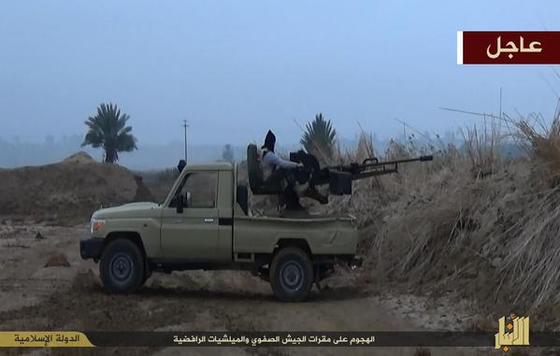
The Islamic State’s Anbar division released photographs of the fighting in Baghdadi on Dec. 11. The photos show its fighters firing on Iraqi personnel, then displaying the bodies of dead security personnel. Additionally, the Islamic State showed photos of captured vehicles and weapons, including US-made Humvees, mortars, rockets, heavy machine guns, and assault rifles. Some of the photographs are reproduced below; the images of the dead Iraqi security personnel are too graphic to display.

ISIS: THE INSIDE STORY: INTERVIEW WITH SENIOR ISIS COMMANDER

December 12, 2014 

ISIS: The Inside Story

One of the Islamic State’s senior commanders reveals exclusive details of the terror group’s origins inside an Iraqi prison – right under the noses of their American jailers. Report by Martin Chulov

Detainees in Camp Bucca, in southern Irag. Photograph: David Furst/AFP/Getty Imageshttp://www.theguardian. com/world/2014/dec/11/-sp- isis-the-inside-story

In the summer of 2004, a young jihadist in shackles and chains was walked by his captors slowly into the Camp Bucca prison in southern Iraq. He was nervous as two American soldiers led him through three brightly-lit buildings and then a maze of wire corridors, into an open yard, where men with middle-distance stares, wearing brightly-colored prison uniforms, stood back warily, watching him.

“I knew some of them straight away,” he told me last month. “I had feared Bucca all the way down on the plane. But when I got there, it was much better than I thought. In every way.”

The jihadist, who uses the nom de guerre Abu Ahmed, entered Camp Bucca as a young man a decade ago, and is now a senior official within Islamic State (Isis) – having risen through its ranks with many of the men who served time alongside him in prison. Like him, the other detainees had been snatched by US soldiers from Iraq’s towns and cities and flown to a place that had already become infamous: a foreboding desert fortress that would shape the legacy of the US presence in Iraq.

The other prisoners did not take long to warm to him, Abu Ahmed recalled. They had also been terrified of Bucca, but quickly realized that far from their worst fears, the US-run prison provided an extraordinary opportunity. “We could never have all got together like this in Baghdad, or anywhere else,” he told me. “It would have been impossibly dangerous. Here, we were not only safe, but we were only a few hundred meters away from the entire al-Qaida leadership.”

It was at Camp Bucca that Abu Ahmed first met Abu Bakr al-Baghdadi, the emir of Isis who is now frequently described as the world’s most dangerous terrorist leader. From the beginning, Abu Ahmed said, others in the camp seemed to defer to him. “Even then, he was Abu Bakr. But none of us knew he would ever end up as leader.”

Abu Ahmed was an essential member of the earliest incarnation of the group. He had been galvanized into militancy as a young man by an American occupation that he and many like him believed was trying to impose a power shift in Iraq, favoring the country’s larger Shia population at the expense of the dominant Sunnis. His early role in what would become Isis led naturally to the senior position he now occupies within a revitalized insurgency that has spilled across the border into Syria. Most of his colleagues regard the crumbling order in the region as a fulfillment of their ambitions in Iraq – which had remained unfinished business, until the war in Syria gave them a new arena.

He agreed to speak publicly after more than two years of discussions, over the course of which he revealed his own past as one of Iraq’s most formidable and connected militants – and shared his deepening worry about Isis and its vision for the region. With Iraq and Syria ablaze, and the Middle East apparently condemned to another generation of upheaval and bloodshed at the hands of his fellow ideologues, Abu Ahmed is having second thoughts. The brutality of Isis is increasingly at odds with his own views, which have mellowed with age as he has come to believe that the teachings of the Koran can be interpreted and not read literally.

His misgivings about what the Islamic State has become led him to speak to the Guardian in a series of expansive conversations, which offer unique insight into its enigmatic leader and the nascent days of the terror group – stretching from 2004, when he met Abu Bakr al-Baghdadi in Camp Bucca, to 2011, when the Iraqi insurgency crossed the border into Syria.

Fight ISIS? You're Kidding, Why?

December 13, 2014

With a political eye on an electorate understandably reluctant to get involved in another foreign war, the Obama administration waited until after the mid-term elections to announce the deployment of an additional fifteen-hundred "non-combat" combat troops to Iraq in an attempt to halt the advance of ISIS.

And ho-hum, the announcement made nary a ripple in the public consciousness. It's as if, a thousand here, a thousand there, another thousand hither and yon, as long as none of those troops are coming home on litters or in caskets—with video topping the evening newscasts—no one really cares, and whatever America is doing over there in Iraq really isn't war. Is it? 

The president sure isn't calling it a war, not America's part. Rather, it's just a bit of tactical advising and surgical bombing, a minimalist approach to war-making, for any of which the president has little stomach. It's not difficult to read President Obama's mind and heart, that he's wishing ISIS could be relegated back to their once-JV status, at least for another two years, at which time he can pass off the problem to the next president.

Today, no one is calling ISIS the JV squad, and the president's additional fifteen-hundred advisers may keep ISIS from storming through the gates of Baghdad in the coming months, but no one is making the argument that this tiptoeing, combat-free strategy will push ISIS from the territory they have captured nor eliminate their threat to the rest of the Middle East.

And again, it's ho-hum, as if Americans don't even want to think about an oppressive and expanding Islamic State. The occasional beheading that pops up in the media startles us, but only for a moment, as we immediately tune it out. If we were to consider seriously the jihadists' barbaric actions in the name of the Caliphate, then we would have to accept that the Caliphate is by definition uncompromising, and as such we would have to steel ourselves to vanquish those fighting for it. Steel ourselves for war, complete war, not a couple of thousand non-combat bootless troops here and there willy-nilly.

Former British Government Officials May Be Called to Testify Before New Parliamentary Investigation Into UK Involvement in CIA Torture

Rowena Mason
December 15, 2014

UK torture inquiry could summon Blair and Straw
Tony Blair and his former foreign secretary Jack Straw could be summoned before a parliamentary inquiry in an attempt to determine the extent of any British involvement in torture of terror suspects.

The two senior figures from the last Labour government may be asked to give evidence to the intelligence and security committee (ISC) in the wake of the publication of a US Senate report confirming that the CIA used brutal and ineffective methods after 9/11.

However, pressure is growing on the government to announce a separate, judge-led inquiry, amid concerns that the ISC is too closely associated with the Westminster establishment.

Sir Malcolm Rifkind, the ISC chairman and a Conservative former foreign secretary, said on Sunday he would investigate “without fear or favour” regardless of whether it might embarrass the security services, ministers or Whitehall.

He said his committee would not shy away from saying that the evidence pointed towards the possibility of prosecutions if it thought that was appropriate.

Asked on the BBC’s Andrew Marr Show whether senior figures from the last government such as Blair and Straw could be asked to give evidence, Rifkind replied: “Certainly we would request any former minister or serving minister who has a contribution to make to our inquiries, to give evidence. If they refuse to do so that itself would imply they had something to hide. So we’ll have to wait and see what happens.”

He said no decisions had yet been taken about who would be called as witnesses. It was reported over the weekend that Straw was questioned by police as a witness in 2012 over allegations that British MI6 agents were involved in the renditions of Libyans back to the regime of Muammar Gaddafi, where they were subsequently mistreated. The police inquiries are expected to conclude within the next few months, enabling the ISC to start investigating the allegations as its top priority.

Global Nuclear Disarmament: The Humanitarian Consequences Route

Manpreet Sethi
ICSSR Senior Fellow affiliated with the Centre for Air Power Studies (CAPS) 

The tenacity of nuclear weapons to continue to exist is evident. At the end of the Cold War, many wrote obituaries claiming that these weapons would soon be the “detritus of the Cold War.” Nothing however, could have been further from the truth. Half a century later, the weapons are still around in large enough numbers to pose dangerous risks to humanity. 

It is in this context that it is interesting to examine a two-year old development that has taken a new approach to the challenge of ridding the world of nuclear weapons. This is the initiative that was primarily spearheaded by Norway, Mexico, Austria, Ireland, Switzerland and New Zealand. It hit headlines in March 2013 when the first conference on humanitarian consequences of nuclear weapons was held in Oslo. It focused on the impact of nuclear weapons on human life. Based on testimonies of the hibakushas (survivors of Hiroshima and Nagasaki), and presentations from factual studies on effects of nuclear explosions, 128 countries reached the conclusion that effects of the use of nuclear weapons were not constrained by borders and that no single nation or international body had the resources or the capability to deal with the consequences. Interestingly, India and Pakistan were the only nuclear-armed states that chose to participate in the conference. The five NPT nuclear weapon states, and Israel and North Korea, ignored the congregation.

Eleven months later, in March 2014, an even larger number of nations, 146 this time (though still not the NWS) came together in Mexico to further highlight the humanitarian challenges of nuclear weapon explosions. More and detailed studies were presented on the long term socio-economic impact of use of nuclear weapons. It was established that reconstruction of infrastructure and regeneration of the socio-economic parameters on which we today measure quality of life would take decades to rebuild if the world were to witness a nuclear exchange. However, the only possessors in the Conference were from India and Pakistan. Seven other nuclear-armed states, two of which own more than 90 per cent of the global nuclear stockpile, evinced no interest in the subject!

Ten months from then, on 8-9 December this year, a third Conference on the subject is being hosted by the government of Austria in Vienna. It proposes to specifically focus on the impact of nuclear explosions on human health, climate, food security and infrastructure. Also included are sessions on inadvertent nuclear use as a result of human and technical factors such as error, negligence, miscalculations, miscommunications, cyber interference, technical faults etc. 

FORMER CMDR. URGES NATO TO SEND ARMS TO UKRAINE

December 14, 2014 

Meals ready to eat isn’t cutting it; but, this isn’t going to happen under this POTUS. RCP

James Stavridis said during a visit to London: “I think we should provide significant military assistance to the Ukrainian military. I don’t think we should limit ourselves to, non-lethal aid. I think we should provide ammunition, fuel, logistics. I think cyber-assistance would be very significant and helpful, as well as advice and potentially advisers.

“I don’t think there needs to be huge numbers of NATO troops on the ground. The Ukrainian military can resist what’s happening, but they need some assistance in order to do that.”

Former Commander Urges NATO To Send Arms To Ukraine

James Stavridis, ex-Nato supreme allied commander in Europe, says non-lethal aid insufficient in fight against separatists

A former commander of NATO in Europe has called for the alliance to send arms and military advisers to Ukraine to help it fight Moscow-backed separatists.

James Stavridis said during a visit to London: “I think we should provide significant military assistance to the Ukrainian military. I don’t think we should limit ourselves to, non-lethal aid. I think we should provide ammunition, fuel, logistics. I think cyber-assistance would be very significant and helpful, as well as advice and potentially advisers.

“I don’t think there needs to be huge numbers of NATO troops on the ground. The Ukrainian military can resist what’s happening, but they need some assistance in order to do that.”

Ukraine announced on Friday that it would conscript 40,000 more soldiers next year and double its military budget, in an attempt to counter the separatist threat in the east.

The US and European states have offered only non-lethal assistance, despite Kiev’s appeals for weapons to help it reassert control over areas in eastern Ukraine currently under the sway of pro-Russia separatists. However, on Thursday the US Senate passed a bill authorizing Barack Obama to provide military training and arms including anti-tank and anti-armor weapons.

Bob Corker, the senior Republican member of the Senate foreign relations committee, said: “The hesitant US response to Russia’s continued invasion of Ukraine threatens to escalate this conflict even further. Unanimous support for our bill demonstrates a firm commitment to Ukrainian sovereignty and to making sure [Vladimir] Putin pays for his assault on freedom and security in Europe.”

This month NATO established trust funds to help finance assistance to Ukraine in reforming its armed forces, but that too was limited to non-lethal help.

In August Putin told a group of young supporters that Russia was one of the world’s leading nuclear powers, adding: “Russia’s partners … should understand it’s best not to mess with us.”Stavridis, a retired US Navy admiral who was NATO supreme allied commander in Europe from 2009 to 2013, and is now dean of the Fletcher School of Law and Diplomacy at Tufts University in the US, also expressed concern about Putin’s recent rhetoric emphasizing Russia’s nuclear arsenal.

GORBACHEV BLAMES U.S. FOR PROVOKING ‘NEW COLD WAR’

December 13, 2014 

Former Soviet leader Mikhail Gorbachev in Berlin, Nov. 8, 2014. Former Soviet leader Mikhail Gorbachev in Berlin, Nov. 8, 2014.Sean Gallup—Getty Images

“It’s America calling the shots in everything!” the former Soviet leader tells TIME

In the offices of Mikhail Gorbachev, still sharp at 83 and plainspoken as ever, the walls are lined with photos from his travels as the leader of the Soviet Union and, in the years after its demise, as a living icon of the Cold War. One picture shows him with his late wife Raisa standing arm-in-arm with Mickey Mouse and Minnie Mouse. In another frame he wears a cowboy hat and jeans as he stands beside Ronald Reagan, the U.S. President who famously branded Gorbachev’s country an “evil empire” in 1983. These portraits, like many others in his Moscow office, betray Gorbachev’s affection for his former American adversaries.

But in the course of this year those feelings seem to have been subsumed in a rising sense of animosity, as Russia and the West enter what Gorbachev calls a new Cold War. “Are we in the middle of a new Cold War? Indeed we are,” he tells TIME in an interview last month at the Moscow branch of the Gorbachev Foundation, the international advocacy group he founded in 1991, when he was forced to resign from his post as President due to the dissolution of the Soviet Union.

The elder statesman, who was named TIME’s Person of the Year in 1987 and ‘Man of the Decade’ two years later, is not the first to declare the start of a new Cold War this year. Russia’s annexation of Crimea in March has caused officials and pundits around the world to warn that the West’s efforts to isolate Russia have opened a dangerous gulf between them. But the roots of the present standoff run deeper than this spring, says Gorbachev, and the blame for it lies with the Americans.

In the years that followed the Soviet collapse, the West “tried to turn us into some kind of backwater, a province,” he says. “Our nation could not let that pass. It’s not just about pride. It’s about a situation where people speak to you however they want, impose limitations, and so on. It’s America calling the shots in everything!”

For a country whose leaders remember the years when Russia was a superpower, the American dominance of global affairs has always been a taunting reality and a constant source of frustration. Instead of treating Russia as an equal partner, the West tried to “push us out of politics,” says Gorbachev, most recently during the revolution that brought a pro-Western government to power in Ukraine early this year. Vladimir Putin’s reaction to that uprising sought to claw back some of the influence Russia had lost, and for that the Russian President has earned Gorbachev’s admiration.

America Built Massive Floating Bombs to Blast a Vietnamese Bridge

The Air Force’s top secret mines didn’t work very well

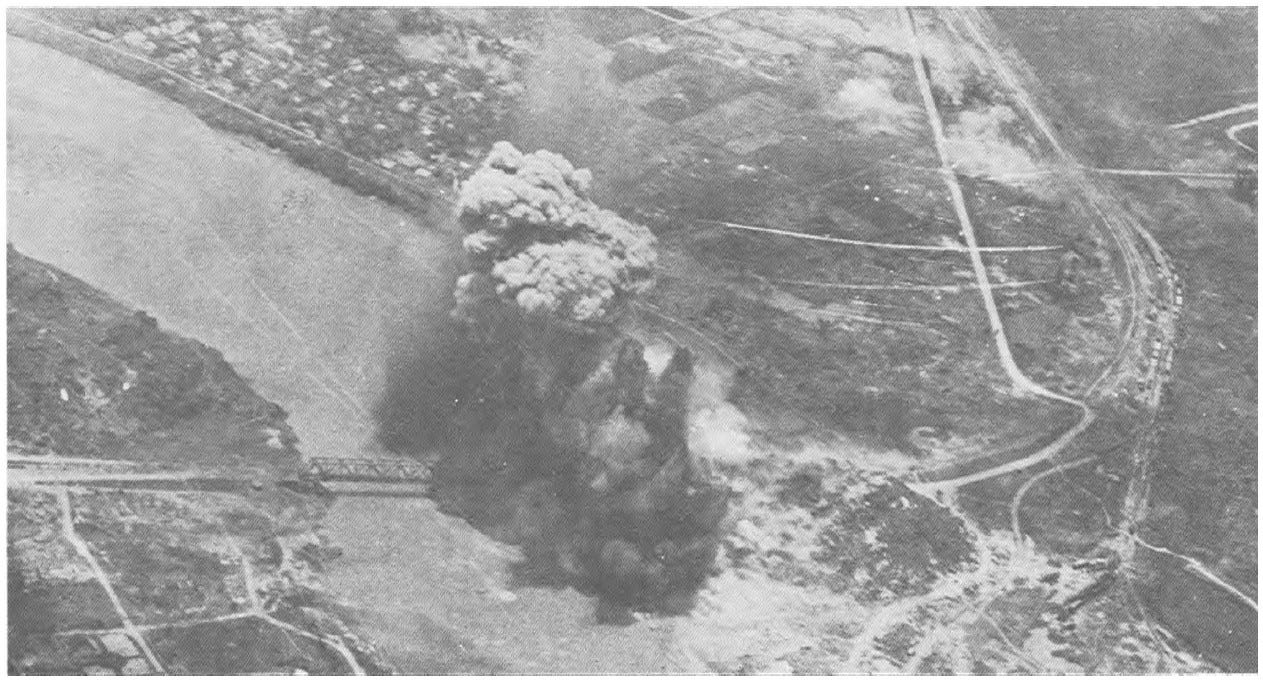
In 1965, the U.S. Air Force set out to destroy the Thanh Hoa bridge in North Vietnam. The crossing over the Song Ma River was a major artery for troops and supplies heading south.

But the span—nicknamed Hàm Rồng, meaning “dragon’s jaw” in Vietnamese—was heavily defended and seemingly impervious to American ordnance.

And despite sucking up Hanoi’s time and resources, the bridge quickly became a symbol of defiance and determination in the face of a much larger and more powerful enemy.

So by September, the Air Force’s Armament Laboratory had started work on a unique floating bomb it hoped would finally blast the structure for good. The top secret project—Operation Carolina Moon—involved some of the most advanced technology available at the time.

The flying branch was frustrated with the ineffectiveness of previous attacks. During one early strike, F-105 Thunderchief fighter-bombers and other aircraft hit the structure more than 300 times without inflicting any lasting damage.

“The hard fact was that 750-pound bombs just were not big enough to
deliver the coup de grace to such a formidable structure,” an official Air Force history explains.

So even when American munitions—including early guided missiles and bombs—did damage the span, North Vietnamese repair crews quickly put it back into business.

At left—the Thanh Hoa bridge survives an early attack. At right—the Dragon’s Jaw is finally destroyed in 1972. At top—a U.S. Air Force C-130 in Vietnam. Air Force photos
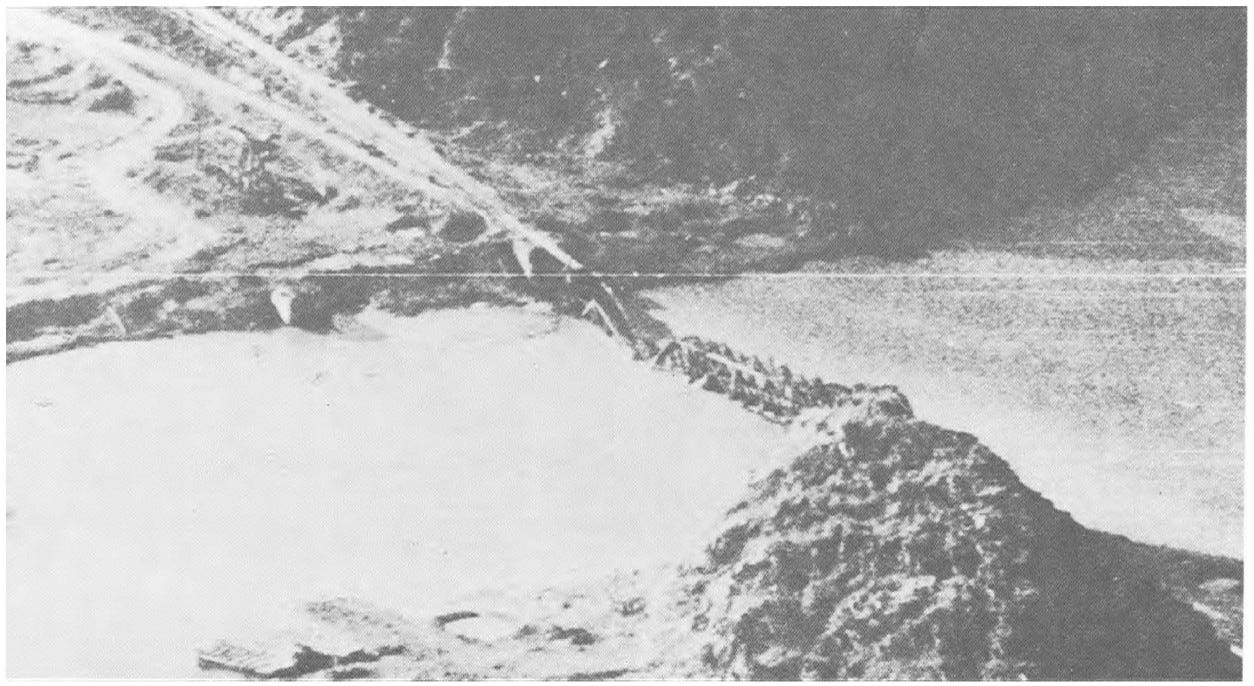
The Air Force needed a weapon that was large enough to actually bring down the Dragon’s Jaw—and keep it out of service permanently. The weapon also had to be accurate enough to hit the bridge as pilots dodged murderous anti-aircraft fire.

Diego Garcia’s Role in the CIA’s Extraordinary Rendition Program

Jamie Doward
December 13, 2014

The deal that allows the US to maintain a military base at Diego Garcia will come up for renewal next year. 

It was July 2005 and Jack Straw was in combative mood. During a parliamentary debate, the then foreign secretary insisted that there was no need for a judicial inquiry into the UK’s role in extraordinary rendition – “unless we all start to believe in conspiracy theories and that the officials are lying, that I am lying, that behind this there is some kind of secret state which is in league with some dark forces in the United States”.

But the publication last week of a long-awaited US Senate intelligence report has raised fresh questions about what the UK knew about the CIA’s torture programme – and in particular the role played by an obscure overseas British territory.

Al-Jazeera reported earlier in the year that the committee had seen evidence that Diego Garcia, an atoll in the Indian Ocean, had been used for extraordinary rendition “with the full cooperation” of the UK. But when the heavily redacted report was published, it made no mention of Diego Garcia, raising questions about whether references to it had been removed at the request of the UK.

The questions were not without foundation. Earlier this year the Observerrevealed that senior British diplomats had met Senate committee members more than 20 times since they started their investigation, prompting claims that they had lobbied for certain exclusions. Last week Downing Street insisted that any requests for material to be redacted were made solely on the grounds of national security.

Climate Change and the Meaning of Leadership

December 12, 2014 

Much gets said in foreign policy debates in Washington about world leadership, and how the United States should, is, or isn't exerting it. Most often one hears reference to the subject in criticisms of the current administration, to the effect that it is not exercising leadership that it should. The topic especially comes up in connection with the soup of messy issues in the Middle East, amid calls for more use of U.S. military force and allusions to “allies” being unhappy about the United States not doing more to advance causes of particular interest to them.

Consider the key elements of leadership. It has to involve some shared interest or objective, just as leadership exhibited by a key player on a football team is exerted on behalf of the team's shared interest in winning games. It also does not involve the leader doing everything, or even most things, himself. Instead it consists of the leader, by gaining respect through some combination of persuasion and setting a favorable example, getting others to do their necessary part as well.

Now consider the attitudes toward the United States exhibited at the current negotiations on climate change at Lima Peru, as reported by Coral Davenport in the New York Times. An important part of the context, one that has made a huge difference from how the United States was regarded in earlier multilateral negotiations on the climate problem, is that the United States has recently reached a path-breaking agreement with mega-polluter China on reducing emissions of greenhouse gases, and the Obama administration has not just talked the talk but also walked the walk with new regulations to curb emissions from coal-fired power plants. A result has been “cheers, applause, thanks and praise” for U.S. negotiators. “The U.S. is now credible on climate change,” says the French ambassador who is his country's lead diplomat on the subject. Says a leading United Nations official with responsibilities on the subject, “Countries got weary of negotiations with the U.S.; it got tough in negotiations, but it didn’t deliver. Now the U.S. has policies in place to deliver on its word.” Delegates praised the personal involvement in the current talks of Secretary of State John Kerry.

SECRETIVE DOD DRONE DODGES DEFENSES AT HYPERSONIC SPEED: A NEW WEAPON IN AMERICA’S SUPERFAST ARMS RACE WITH CHINA

December 14, 2014 

Secretive DoD Drone Dodges Defenses At Hypersonic Speed: A New Weapon In America’s Superfast Arms Race With China

Jeffrey Lin and Peter Singer, writing recently in Popular Science, begin, “on August 25, an explosion tore through the southern Alaskan sky. The blast shook the remote island that houses the Kodiak Launch Complex, where the U.S. DoD was testing an unmanned, hypersonic glide vehicle (HGV). The flight of the highly secretive craft,” the two men write, “lasted a mere four seconds before an “anomaly” in the launch rocket forced controllers to deploy the emergency self-destruct mechanism.”

…”Upon discovering the location of a terrorist leader in Syria, an HGV fired from an Army base in Europe — could hit a target in less than a half an hour.”

Mr. Lin and Mr. Singer note that “the launch, the latest in a series that began in 2011, was saddled with added pressure: China has reportedly carried out at least two hypersonic tests this year (though both also ended in flames).” Actually, China just announced at the end of last week a third hypersonic test. The U.S. and China are “racing to engineer a vehicle capable of traveling faster than 10 times the speed of sound — which presents major obstacles. Such craft requires materials that can withstand temperatures over 3,500 degrees Fahrenheit; and, a steering system sensitive enough to maneuver through the thin air of the upper atmosphere,” they write.

“The details behind the U.S. and China’s HGV programs remain confidential; but, that real-world test/s — however spectacular the crashes — are taking place…indicates that the vehicles have crossed into the realm of the possible. Experts anticipate that HGVs could be fully operational by 2019; and, reach speeds of Mach 25, or about 16,000 miles per hour.”

“If weaponized” Popular Science notes, “HGVs could fly as far as intercontinental ballistic missiles (more than 3,500 miles) but strike with greater accuracy. Since the gliders don’t fly in a predictable parabolic arc like ballistic missiles do, they would be exceedingly difficult to shoot down with traditional missile defenses. And, their speed would make possible a whole new pace of war. For example. upon discovering the location of a terrorist leader in Syria, and HGV fired from a U.S. Army base in Western Europe could hit a target in less than a half an hour.”

How It Flies

1) Launches via rocket boosters that detach in the upper atmosphere;

2) Descends to an altitude of about 50 miles and then pulls up to level off it course;

3) Glides along an unpredictable path, veering left and right to avoid defenses;

4) Dives downward to hit its intended mark;

5) Destroys its target with explosives, or the vehicles kinetic energy alone.

Hypersonic Technology: Challenges And Opportunities

IEA WARNS OF SOCIAL UNREST AS OIL PLUMMETS — TOO MUCH OF A GOOD THING – CAN BE A BAD THING; RUSSIA, VENEZUELA, GOLD, LIKELY BIG LOSERS; CHINA, JAPAN, PHILIPPINES, AIRLINES, TRANSPORTS, MANUFACTURING WINNERS

December 12, 2014

IEA Warns Of Social Unrest As Oil Plummets — Too Much Of A Good Thing – Can Be A Bad Thing; Russia, Venezuela, Gold, Likely Big Losers; China, Japan, Philippines, Airlines, Transports, Manufacturing Winners

“Weak demand and oversupply in world oil markets raise the risk of global instability; and, the potential for financial default,” the International Energy Agency (IEA) warned today (December 12, 2014) — as it cuts its global oil demand in 2015. This report comes at oil prices hit a multi-year low — with Light Sweet Brent Crude trading at $63.09 and West Texas Crude at $59.17. “Continued price declines — for some countries and companies, make an already difficult situation worse,” the IEA said in its new report. The IEA forecasts that “Global oil inventories are projected to build by around 300M barrels in the first half of 2015…in the absence of any disruption.”

“The resulting downward price pressure would raise the risk of social and/or, financial difficulties,” as corporations and nations find it difficult to manage and pay back debt.

Winners And Losers: Declining Oil Price’s Effect Around The Globe

John Schoen, writing on the December 11, 2014 website hosted by CNBC.com, “writes that for most of the world [particularly Japan IMO] the tailwind of lower oil prices is helping to lift the pace of,” global economic growth. But, what is good for the goose — isn’t always good for the gander as the saying goes. “In Russia and Venezuela, falling prices have cut revenue from oil sales, hammering local currencies, stocking local inflation, and crimping economic growth”

“So, what happens if oil prices drop to as low as $40? Mr. Schoen asks. “To find out,” he says, “economists at Oxford Economics fired up their computer models to run projections on growth rates of 45 economies around the world. They started with a “baseline” forecast of $84 in 2015 — a number that until a few months ago — seemed like a reasonable forecast,” Mr. Schoen wrote. Oxford “looked at several ways that oil affects growth. Factors included how much oil a country produces and consumes, how big a role oil plays in overall energy demand, the impact on currency exchange rates, fuels taxes, and other factors.”

“After knocking down the price of oil in $10 increments, — the country seeing the biggest boost was the Philippines, which could expect its economy to grow at a 7.6 percent clip over the next two years, if oil were to fall to $40 per barrel. China and India were next in line as cheap oil beneficiaries, with growth rates of 7,1 percent and 6.7 percent respectively,” Mr. Schoen added.

“The biggest loser,” Oxford said was — Russia — “which would see growth shrink by an average of 2.5 percent annually over the next two years — even without factoring in a possible currency crash, and ongoing sanctions imposed against Russia by the U.S. and Europe.”

Classified NRO Satellite Launched on Friday Has Reportedly Been Placed in Molniya Orbit

William Graham 
December 14, 2014 

United Launch Alliance has conducted its final launch of 2014, making use of a new upper stage engine on its Atlas V rocket to deliver a National Reconnaissance Office payload into orbit. Friday’s launch of NROL-35 dodged the weather and occurred at 19:19 local time (03:19 UTC on Saturday) from Space Launch Complex 3E at Vandenberg Air Force Base. 

Atlas V Launch: 

Although mission details are classified, the rocket was believed to be targeting a Molniya orbit – a highly elliptical trajectory with a period of 12 hours. The orbit is named after the Soviet Union’s Molniya communications satellites which were the first spacecraft to make use of the orbit. 

The Atlas V flew in her 541 configuration, however her Centaur upper stage sported an RL10C engine for the first time. 

As is normal for National Reconnaissance Office spacecraft, NROL-35’s mission has not been disclosed. The likely use of a Molniya orbit, however, suggests that it will either be used for communications or signals intelligence (SIGINT). 

Currently the NRO has two types of spacecraft operating in these orbits; a series of communications satellites known as Quasar or the Satellite Data System (SDS) and a fleet of SIGINT birds known as Trumpet. 

The Army is getting serious about cyberwarfare


December 12, 2014

The sign outside the headquarters of the US Army's new Cyber School at Fort Gordon, Georgia. The school is part of the Army's creation of a new cyberwarfare branch.

When Laura Jackson went to her local Army recruiter, she wasn't actually sure what she wanted to do in uniform. She was interested in intelligence, figuring it would be challenging, with some good career prospects to boot. One of the options was a job labeled "35Q." 

"I had another semester of school left, and 35Q was the only one that had a leave date after I finished college," Jackson explains. "So I chose that one. I had no idea what I was getting into. No idea." 

That's how she accidentally went to war — in cyberspace. The job titled 35Q is what's called a "network warfare specialist," and Jackson now spends her days monitoring the Army's computer systems, defending them — and their secrets — from hackers and cyber attacks from across the globe. 

The threat is constant, and it's now on the Army's priority list like never before. The Army established a branch for cyberwarfare just weeks ago, giving these soldiers the same status as traditional fields like infantry or artillery. And at Fort Gordon, Georgia, the new home of that branch, things are ramping up. 

"The last time the Army did this was with Special Forces, 27 or 28 years ago," says Col. Jennifer Buckner, the first commander of the Army's new Cyber School, which will soon take over training the Army's future cyber warriors. "So this is kind of a big deal for the Army, and we're really the only branch of the service that is approaching it this way." 

Cyber wargame hunts for hidden talent in Churchill's bunker


The Cabinet War Rooms sheltered Winston Churchill and his cabinet during the World War II Blitz. Last weekend, it found itself used in a battle against a 21st century invasion.

The bunker was the venue for this year's Cyber Security Challenge in which teams of amateur security analysts were pitted against a foe aiming to bring down the UK's financial system with a deluge of digital threats. The teams had to analyse the attacks, develop ways to mitigate them, and report to a fictional board of directors about what to do next.

The teams were confronted with a concerted attack featuring a combination of a denial of service, phishing and ransomware, which together rendered online banking platforms inaccessible and forced the cancellation of a high-profile stock market floatation.

After spreading beyond the City and hitting the transport, power and utilities sectors, the scenario culminated in a potentially life-threatening attack on a nuclear power plant — which thankfully the competitors managed to avert.

The aim of the 36-hour competition is to find hidden talent in people who might not necessarily consider a job in information security — a few years back the competition was won by a postman. The event is sponsored by tech companies, but also by the UK's National Crime Agency and the government surveillance agency GCHQ, and is set up using the organisation's experience of real world cyber-attacks.

'Toby' from GCHQ — participants from the agency don't give their real name due to the sensitive nature of their work — said events like this are useful for finding great candidates that might not shine at an interview.

Judy Baker, chair of Cyber Security Challenge UK, said the aim of the completion is to bridge the cyber-security skill gap which has emerged, but said more needs to be done to make IT security a priority for businesses. "Why isn't it a module in business studies?" she asked.

IMP PAPERS

China’s Grand Strategy is not Absent, Just Contradictory http://www.eastwestcenter.org/download/7633/34864/apb292.pdf


Jamestown Foundation

· China Brief, December 5, 2014, v. 14, no. 23 http://www.jamestown.org/uploads/media/China_Brief_Vol_14_Issue_23_2.pdf

o China’s Espionage Against Taiwan (Part II): Chinese Intelligence Collectors

o China’s Soft-Power Deficit Widens as Xi Tightens Screws Over Ideology

o Xi’s Military Reform Plan: Accelerating Construction of a Strong PLA

o Assessing China’s Afghan Peace Play

· Terrorism Monitor, December 5, 2014, v. 12, no. 23 http://www.jamestown.org/uploads/media/TerrorismMonitorVol12Issue23_03.pdf

o Lashkar-e-Zil: Al-Qaeda’s ‘Shock and Awe’ Force

o Islamist Radicalization: A New Challenge for Kenya

o From Obscurity to Dominance: The Continuing Rise of Yemen’s al-Houthi Movement


Blinders, Blunders, and Wars: What America and China Can Learn http://www.rand.org/pubs/research_reports/RR768.html

The Role of Maritime and Air Power in DoD's Third Offset Strategy http://www.rand.org/pubs/testimonies/CT420.html

UK’S MILITARY DEAL WITH BAHRAIN – ANALYSIS

By Ahmad Kazemzadeh

The 10th Manama Dialogue, also known as the IISS Regional Security Summit 2014, was held in the Bahraini capital city of Manama on December 5-7, 2014, attended by high-ranking security and military officials from certain Western and Arab countries of the region.

On the sidelines of the event, a new military deal was signed between the UK and the government of Bahrain, which will allow Britain to establish its first military base in the Persian Gulf kingdom. Although the signing ceremony was held in presence of the British Defense Secretary Michael Fallon, the agreement was actually signed by the British Foreign Secretary Philip Hammond, and Bahraini Minister of Foreign Affairs Sheikh Khalid bin Ahmed Al Khalifa. This proves that the agreement not only pursues military goals, but also political objectives as well.

Now, the question is what are those goals, which are pursued by the parties that have signed the agreement? Given the fact that the current Bahraini government is actually considered a stooge of Saudi Arabia, can the scope of that agreement be considered to be limited to Bahrain and Britain?
Goals Britain pursues by signing military deal with Bahrain

The goals pursued by the British government though signing of the military deal with Bahrain can be divided into those that have been declared and those goals that have not been declared yet.

The declared goals are the goals that have been explicitly announced by Britain’s military and political officials. The British Defense Ministry issued a statement following the signing ceremony to announce the obvious goals of the deal. The statement noted that according to the agreement, the british Navy will be able to build its first base in Mina Salman port of Bahrain where British warships will be deployed in order to enable London to dispatch more and bigger ships in future to this strategic region in a bid to guarantee the stability and security of the Persian Gulf. Michael Fallon, Britain’s defense secretary also explained about the goals of the new agreement, noting that it would pave the way for the long-term presence of the British Navy in the Persian Gulf region.

The British Foreign Secretary Philip Hammond, however, tried to hide military goals of his country behind a diplomatic façade by implying that the agreement has been, in fact, a favor done by his government to the government of Bahrain and other Arab countries in the Persian Gulf for which they should be indebted to the UK.

Therefore, without saying anything clear about his government’s need to the agreement, he said, “Your security is our security; your prosperity is our prosperity; your stability is our stability. So a strategic priority for the [Persian] gulf and for the wider region is to build partnerships; partnerships for security, partnerships for prosperity, partnerships for stability. I was delighted last night to sign a memorandum of understanding with His Excellency Sheikh Khalid bin Ahmed Al Khalifa in the presence of his royal highness the crown prince. That arrangement will put the longstanding presence of the Royal Navy in Bahrain on a permanent footing.”

NEW U.S. MARITIME STRATEGY COMING “VERY SOON”


Notes from the U.S. Naval Institute’s Defense Forum Washington 2014

Last week I attended the U.S. Naval Institute’s Defense Forum Washington 2014 – “What Does the Nation Need from its Sea Services?,” which was well attended by fellow CIMSECians. Speakers included legislators, senior researchers, and representatives from the U.S. Navy, U.S. Marine Corps, and U.S. Coast Guard. The full videos of the speakers and an in-depth recap are available here, but I wanted to touch briefly on a few items that stood out.
Acting Deputy Chief of Naval Operations for Plans, Policy, and Operations, RADM Kevin Donegan, did a good job articulating the questions the sea services have wrestled with in building the forthcoming maritime strategy document known as CS-21R, the revision to the 2007 A Cooperative Strategy for 21st Century Seapower (CS-21). While he didn’t reveal most of the answers to those questions he did acknowledge the conflicting views of what the document should be, or look like. and the difficulty in getting it on the streets, but said it would be published “very soon.” RADM Donegan did note that the underlying assumptions of 2007 in some cases no longer hold true, with a nod to the threats facing Europe. One item he did reveal was that Humanitarian Assistance/Disaster Response (HA/DR) would remain a prioritized mission, something that has been questioned since its inclusion in CS-21, although whether this has a practical impact on budgeting priorities is itself debatable.

There was also some discussion about the manner in which CS-21R will be rolled out to the country, with one audience member asking if there would be educational outreach efforts and town hall meetings – useful components in explaining both the content and its relevance to the American public. But those lines of effort must be just the beginning. If CS-21R is to have the impact that it should, and presuming of course that one agrees with the strategy therein, the release of this document necessitates a full public affairs and internal education campaign plan. This is an important opportunity for the sea services to make their case to the people, Congress, “decision makers,” and their own folks that supporting the nation’s (as Ron O’Rourke put it in a later presentation) maritime strategy must be a priority. In telling the story of why resourcing the Navy, the Coast Guard, and the Marine Corps (as well as other maritime components) should take precedence over other funding priorities, the strategy document owns the part that gives a coherent explanation of what the services want to do with the means requested and why these are the best ways to achieve the ends defined by higher strategic guidance. Luckily there are plenty of recent anecdotes to illustrate the arguments, as VADM Donegan pointed out the practical importance of seapower in the recent Libyan and anti-ISIS campaigns.

A few other items I found interesting:

TOP U.S. LAWMAKER CALLS FOR REVIEW OF U.S./CHINA MILITARY ENGAGEMENT

December 14, 2014

Forbes Calls For Review Of U.S.-China Military Engagement

Beijing continues aggressive maneuvers despite increased cooperation

A top lawmaker is urging the Pentagon to review its military engagement policy with China amid concerns that cooperation has provided more benefits to Beijing and failed to convince the Chinese military to cease aggressive actions in the Asia-Pacific.

Rep. Randy Forbes (R., Va.), leader of the House Armed Services Committee’s Seapower and Projection Forces Subcommittee, sent a letter on Wednesday to Secretary of Defense Chuck Hagel and Deputy Secretary of Defense Robert Work. Forbes requested a “review of the [Defense] Department’s current mil-mil engagement policy with China, ideally as part of a larger [Pentagon] review of U.S security objectives in the region.”

“I believe that the Department currently lacks the thorough guidance and oversight mechanisms necessary to maintain a consistent mil-mil policy that best serves U.S. national security objectives over the ‘long-haul’ of the emerging U.S.-China peacetime competition,” he wrote.

Forbes said he could point to “multiple examples” where various defense officials, including Hagel’s office and the Pacific Command commander, “were pursuing multiple, divergent mil-mil engagement objectives.”

Several concerns have been raised about U.S.-China military cooperation. In May, Chinese Gen. Fang Fenghui visited the aircraft carrier USS Ronald Reagan in San Diego—a potential violation of provisions in the National Defense Authorization Act for fiscal year 2000. The law forbids military exchanges with China in areas such as “force projection operations,” but the Pentagon said at the time that it did not view the visit as a breach of the act.

A retired Chinese admiral later told a state news agency that Gen. Fang acquired valuable information about the Reagan’s capabilities.

“While our engagements demonstrate our military capabilities to China, enhancing our deterrent to a degree, I am concerned that they also have the potential to decrease China’s uncertainty about possible responses to their actions, which may only cause China to conclude that it can take more risks,” Forbes wrote in his letter.

Additionally, China conducted flight tests last month of its new J-31 stealth fighter jet, an aircraft that allegedly contains technology stolen from the U.S. F-35 Joint Strike Fighter. The Chinese military is suspected of obtaining the F-35 secrets through cyber attacks on a Lockheed Martin subcontractor. While the tests occurred, President Barack Obama was pressing Chinese leaders at an Asian economic summit to reduce incidences of cyber theft.

Obama also reached military agreements at the summit with Chinese President Xi Jinping that aimed to avoid future conflicts in Asia.

15 December 2014

*** Revisit the endgameplan

By Bruce Riedel
December 15, 2014

The longest war in American history is approaching its moment of truth. Next year, the American- and Nato-built Afghan army will face Pakistani-backed Taliban insurgents with only modest and decreasing foreign assistance. President Barack Obama has promised even that small troop presence will end by 2017. He needs to revisit this decision.

From January 2015, Nato will have 13,000 troops in Afghanistan, of which 10,800 will be Americans. Germany will be the second-largest troop contributor with 850, and Italy third with 500. The US force total is scheduled to drop to 5,500 by the end of 2015 and to near zero by the end of 2016. Obama has already slowed the withdrawal once, keeping an extra 1,000 troops next year than originally planned, and expanding their mission beyond training and advising the Afghans to include some combat roles, especially air support.

The president’s decision this past spring to publicly lay out his timeline for ending American troop involvement on the ground is widely regarded as a mistake in Washington. It gave the enemy unnecessary insight into our war plans and confidence that it could out-wait American resolve. Many fear it will lead to a repeat of the Iraq disaster, where the Iraqi army collapsed last summer without US support and lost Mosul to the Islamic State, forcing a very reluctant Obama to send troops back to Baghdad. But the White House has not changed the endgame plan so far.

Washington and Kabul have both sought to persuade Islamabad to reduce its support to the Afghan Taliban this fall. Pakistan’s army chief, General Raheel Sharif, was in Washington last month, and Afghan President Ashraf Ghani met with Pakistan Prime Minister Nawaz Sharif to improve ties. Shortly after the army chief’s visit, the Pakistan army announced it had killed a Saudi Arabian al-Qaeda operative in counter-terrorism operations near the Afghan-Pakistan border. This is a familiar pattern in US relations with Pakistan — an Arab terrorist is caught or killed just before or after a high-level bilateral meeting.