31 July 2015

Strengthening U.S. Alliances in Northeast Asia

JULY 16, 2015

The United States cannot forget that its future prosperity is inextricably linked to Asia's peaceful adjustment to its growing wealth and power.

Chairman Salmon, Ranking Member Sherman, Members of the Subcommittee, thank you for this opportunity to offer my views about how to strengthen U.S. alliance relationships with Japan and the Republic of Korea (ROK).

U.S. government officials refer frequently to these alliances as “cornerstones” or “lynchpins” for America’s foreign and security policies in the Asia-Pacific, and these metaphors would become tiresome if they were not so apt for describing the value the alliances deliver to U.S. national interests. Indeed, as this Subcommittee well understands, these two countries are among our most important partners in trade and rule making, collaborate closely with us within leading multilateral institutions, host significant forward deployed U.S. forces and train with us at an elite level, and are frequently the first to support U.S.-led efforts to ameliorate international crises (to which they bring valuable technology, finance, and human capital assets).

Japan’s Strategy for Central Asia

Last week, Japanese government officials announced that Prime Minister Shinzo Abe would visit five Central Asian countries in October. Abe’s trip aims to strengthen economic links with the energy-rich region. This announcement is the latest step in a trend that is seeing Japan pay more attention to Central Asia. Indicators of deepening ties between Japan and Central Asia have ranged from the declaration of the need for economic cooperation with Uzbekistan to increased investment in Turkmenistan’s natural gas industry and Caspian Sea port construction project.

Japan’s expanded diplomatic overtures can be explained in two main ways. First, they could be seen as a means of balancing against China. If true, this would effectively be a form of unwitting indirect assistance to Russia, whose own traditional hegemony in Eurasia is being seriously challenged by China’s growing trade ties and economic presence in the region.

Alternatively, Japan might simply prefer to see a little more diversity of interest in Central Asia, with itself, India, and the United States competing for influence with the dominant Russia-China rivalry.

Asia’s Renewed Deal Frenzy

The Nikkei’s purchase of Britain’s Financial Timesmay be a sign of bigger things to come, with Asia set to remain at the center of global merger and acquisition (M&A) deals through 2018, analysts say.

On July 23, the Japanese business daily outbid Germany’s Axel Springer media group to buy the venerable British newspaper from Pearson group for $1.3 billion, a record acquisition for a Japanese media organization. According to Bloomberg News, the Nikkei won the deal by paying a multiple of 35 times adjusted operating profit, making it “hard to argue with the price.”

Japanese companies have already shelled out a record $28 billion worth of overseas acquisitions in 2015, including Japan Post’s $5 billion purchase of Australia’s Toll Holdings and Itochu’s similarly sized deal for a stake in China’s Citic.

But this could be the tip of the iceberg according to research by law firm Baker & McKenzie and Oxford Economics, who have predicted global M&A will rise from $2.7 trillion this year to exceed $3.4 trillion by 2017, with much of it involving Asia.

Mudslides Make a Mess in Central Asia

Higher than average temperatures have led to increased glacial melt and dangerous mudslides across the region.

In recent weeks both Kazakhstan and Tajikistan have been subjected to damaging floods and mudslides–thought not because of rain. Instead, unusually high temperatures have led to increased glacial melt in Central Asia’s mountains.

In Kazakhstan, a glacial lake upstream from Almaty on the Kargalinka River burst, sending “water, mud, boulders, and other debris rushing down the river toward Almaty.” Farther down river, a dam held most of the water back but a mudslide reached Almaty’s outlying towns, reportedly injuring 76 people, damaging over 120 homes and forcing nearly 1,000 people to evacuate. According to NASA’s Earth Observatory, which provides satellite images and analysis of climate and environment events around the world, “the Kargalinka is not the only river in the area that faces the threat of glacial lake outburst floods. In 2012, an analysis of satellite imagery of the northern Tian Shan pointed out 47 potentially dangerous lakes in the region.”

NASA’s satellite images show the growth of a melt pond south of Almaty and the widening of the river as mud and water rushed northward (the images have been inverted so that south is at the top and north the bottom). Toward the bottom of the images the dam holding back most of the water becomes more prominent as water backs up behind it. RFE/RL reports that the dam is now holding back 30,000 cubic meters of water and some fear it may break.

America’s Security Role in the South China Sea

JULY 23, 2015

For the United States, the South China Sea is an important area of the Asia-Pacific region for three reasons: 1) it is part of a major transit route for maritime commercial traffic to and from East Asia and for the United States Navy; 2) disputes over the ownership of its many small islands, reefs, atolls, and rocks among China and several nearby Southeast Asian states (including one United States ally, the Philippines) are generating tensions that could result in conflict and instability; and 3) Beijing could eventually use its growing influence in the area to create a sphere of influence detrimental to United States interests.

These factors justify United States attention to events occurring in the South China Sea, and a set of policies designed to ensure access and transit, prevent or minimize tensions, and support the peaceful and legally based management of local disputes. Unfortunately, United States statements and actions at present are not effectively achieving such objectives, and growing tensions over the issue are threatening to severely destabilize the critical United States-China relationship in unnecessary ways.

Reacting to continued Chinese land reclamation efforts on several reefs in the Spratly Islands, senior United States officials and military officers vow to “fight tonight” if needed to defend United States interests across the Indo-Pacific, while referring to Chinese claims across the South China Sea as “preposterous” and Chinese land activities there as designed to “militarize” the region and to build a “great wall of sand.” In response, Chinese officials and spokespersons warn the United States against provocative actions, insist that China will not back down, and reiterate their determination to “safeguard our own sovereignty and territorial integrity.”

Can China-Turkey Relations Move On?

July 30, 2015
http://thediplomat.com/2015/07/can-china-turkey-relations-move-on/

Turkey’s president, Recep Tayyip Erdogan, arrived in China today and held meetings with Chinese officials, including Premier Li Keqiang and President Xi Jinping. It’s his first visit to China since assuming the presidency in August 2014, although he traveled to Beijing in 2012 while serving as prime minister.

As I noted previously, the trip faced an unwelcome complication thanks to issues related to ethnic Uyghurs in China. Anti-China protests broke out in Turkey earlier this month over reports that Uyghur celebrations of Ramadan were being restricted by the Chinese authorities. For its part, Beijing is angry that Turkish diplomats in Southeast Asia have reportedly been providing travel documents to Chinese Uyghurs, allowing them to more easily travel to Turkey. China is wary of Uyghurs seeking to carve out an independent state from China, and increasingly concerned about Uyghurs becoming radicalized and joining international terrorist groups.

A First: China Turns Back Commercial Flight For Violating East China Sea ADIZ Rules

July 30, 2015
In late-2013, Asia-Pacific security watchers wrangled with what China’s then newly declared unilateral air defense identification zone (ADIZ) over the East China Sea would mean in practice for civil aviation in the region. Two powerful status quo states – the United States and Japan – immediately refused to recognize the ADIZ and reacted accordingly: The United States flew unarmed bombers through the airspace and Japan instructed its civilian aviators not to comply with the new Chinese requirements. Of course, the ADIZ was never going to immediately hurt the material interests of Japanese and American aviation – for these states, the Chinese ADIZ was more a signal of Beijing’s growing intent to revise the status quo in its near seas than anything. The states that would suffer, as is almost always the case in international affairs, would be the smaller and weaker ones.

How China Is Expanding Its Coast Guard

The People’s Liberation Army Navy (PLAN) has transferred an unknown number of old frigates to the China Coast Guard, IHS Jane’s Defense Weekly reports.

According to the article, work is currently underway to transform two Type 053H2G Jiangwei I-class frigates into coast guard cutters at a Chinese naval yard:

Photographs show two ‘Jiangwei I’ frigates alongside at a naval shipyard in Pudong, Shanghai, one of which has had most of its armament removed and the hull painted white. Limited work has been undertaken on the second so far.

The pictures indicate that the ship has largely been disarmed with the YJ-83 anti-ship missile launchers, the HQ-61 surface-to-air missile (SAM) launcher, the twin 100 mm gun turret, and two twin 37 mm gun mountings removed. “The two forward twin 37 mm mountings are currently still in place,” however, according to IHS Jane’s Defense Weekly.

China's Navy Tests 'Maritime Combat Ability' in the South China Sea

July 30, 2015

The Chinese People’s Liberation Army Navy (PLAN) conducted naval drills that included live firing drills in order to boost its “maritime combat ability” in the South China Sea on Tuesday, Xinhua reports.

According to PLAN spokesperson Liang Yang the naval drills are part of an annually held exercise and in line with international law. Consequently, he urged observers not to indulge in “excessive interpretations” of the military maneuvers:

Holding sea drills is a common practice for navies with various countries. The annual drill by the Chinese navy aims to test the troops’ real combat abilities, boost their maneuvrability, search and rescue power and the abilities to fulfill diversified military missions.

Citing PLAN sources, Xinhua stated that the exercise involved over 100 ships, dozens of aircraft and several battalions of the Second Artillery Corps – the unit responsible for most of China’s conventional and nuclear ballistic missiles and land-attack cruise missiles.

Additionally, navy sources told Xinhua of an unknown number of information warfare troops participating in the drills. “[A]ll sorts of information technology tactics” were used to identify air and sea targets in real time,Reuters reports, citing information from China Military Online.

A View From the Other Side of the Hill

Gary Anderson

How is the Islamic State looking at the situation in Iraq and Syria? It is impossible to be sure, but they are fairly transparent in their public statements; this is a group that generally does what it says it is going to do: The following is an approximation of how I believe they view their situation based on some research for a book I am writing on the subject. Sadly, no jihadists were harmed in the writing of this piece.

GENERAL SITUATION. The Caliph’s first strategic goal has been achieved. We have accomplished political and military control of most of the Sunni majority regions of Iraq and a large portion of northern Syria.

The second objective of eclipsing the weak leadership of al Qaeda Central as the leading force in worldwide Jihad is also proceeding well. Jihadists in Nigeria, Yemen, Libya and Afghanistan have sworn fidelity to the Caliph. Those in Libya and Nigeria are holding political and military control of significant territory.

The third strategic objective of diminishing American influence by dragging her into a winless conflict is succeeding well. Recent reports indicate that the American military leadership is frustrated with their President’s refusal to let them use all aspects of military power is creating a “go all in, or go home mentality”. This indicates demoralization, and their president publically admitted recently that they still lack a coherent strategy. The diminished American influence through war weariness envisioned by Sheikh Osama was diluted by his weak successors, but we are proving to be worthy inheritors of his vision.

Turkey Joining Islamic State Offensive - So Why is it Targeting the Kurds?

July 29th, 2015 

Between 03.40 and 03.53 on July 24, three Turkish F-16 jets bombed three Islamic State targets in Syria. This was the first time the Turkish military has taken direct action against the terrorist group.

As the airstrikes began, Turkish police arrested a large number of suspected IS sympathisers across the state. The Turkish government has also opened the strategically important Incirlik airbase to Western allies engaged in the bombing campaign against IS. US officials have called this a “game-changer”. Turkey, a key Middle Eastern state and NATO ally, has formally joined the coalition against IS.

But the decision to get involved, after months of international pressure, has not been made entirely out of a sense of obligation. There is political manoeuvring, and a domestic agenda. Alongside the IS offensive, Turkey has also reportedly launched a crackdown on positions of the Kurdistan Workers' Party (PKK) who are now claiming the attacks bring about the end of a two-year ceasefire between the government and the Kurds.
Show of force

Russian Government Hackers Used Twitter and Photos to Penetrate U.S. Computer Systems

July 29, 2015

Russians hackers used Twitter, photos to reach U.S. computers: report

Russian government-backed hackers who penetrated high-profile U.S. government and defense industry computers this year used a method combining Twitter with data hidden in seemingly benign photographs, according to experts studying the campaign.

In a public report Wednesday, researchers at security company FireEye Inc (FEYE.O) said the group used the unusual tandem as a means of communicating with previously infected computers. FireEye has briefed law enforcement on what it found.

The technique, uncovered during a FireEye investigation at an unnamed victim organization, shows how government-backed hackers can shift tactics on the fly after they are discovered.

“It’s striking how many layers of obfuscation that the group adopts,” said FireEye Strategic Analysis Manager Jennifer Weedon. “These groups are innovating and becoming more creative.”

The machines were given an algorithm for checking a different Twitter account every day. If a human agent registered that account and tweeted a certain message, instructions for a series of actions by the computer would be activated.

Russia—A Different Kind of Threat

JULY 20, 2015

Russia is a superpower in decline, and the challenge it poses to the United States is very different from that posed by the Soviet Union.

On July 13, 2015, the barracks of a unit of elite Russian airborne troops in Omsk, Siberia, collapsed, killing 23 servicemen. A day later, a long-range Tu-95 Bear bomber crashed in eastern Russia, the fifth Russian Air Force plane crash in a month. The entire Tu-95 fleet was grounded as a result. A few days earlier, though, two Bears were in the air, on a long-range patrol near the coast of Alaska, where they were intercepted by U.S. fighters.

In Washington, U.S. President Barack Obama’s nominee to be the chairman of the Joint Chiefs of Staff, General Joe Dunford, called Russia “the greatest threat” to the United States at his July 9 confirmation hearing. In an interview the day before, Air Force Secretary Deborah Lee James made the same claim. The White House andState Department promptly distanced themselves from Dunford’s comments, but they failed to smother the impression that Dunford may be on to something.

Russian aggression against Ukraine has revived the long-forgotten craft of marketing the Russian threat. Russia certainly is a problem, and the U.S. relationship with it is at its worst since before the Cold War ended. But a sober look at Russia reveals a superpower in decline. Its economy is stumbling; its military capabilities are no match for those of the United States and its allies; and its actions are in large measure driven by exaggerated threat perceptions and insecurity at home and abroad.

A Decade of the Nuclear Deal

JULY 18, 2015

The deal revolutionized U.S.-India ties, which progressed so dramatically that it is often easy to forget the recrimination that dominated bilateral encounters since 1974.

Ten years ago this day, on 18 July 2005, the US and India moved boldly to cement their bilateral relationship. President George W. Bush and prime minister Manmohan Singh issued a historic joint statement renewing civil nuclear cooperation, eliminating the singular discord that had bedevilled mutual ties for over 30 years.

Although it often appears as if the 18 July 2005 initiative inaugurated this fresh start, in reality, it only capped a deeply transformative phase of bilateral cooperation that had begun earlier under prime minister Atal Bihari Vajpayee—and which reached its apotheosis during Bush’s first term.

During this period, it was India that had seized the initiative to boldly support the US. By endorsing Bush’s plans for deep nuclear reductions and missile defence, offering Indian military facilities for the US campaign in Afghanistan, refusing to lead the international chorus of opposition to the US war in Iraq, and coming close to contributing even an Indian Army division for post-conflict stabilization in Iraq, Vajpayee demonstrated that New Delhi could behave as Washington’s “natural ally” because it served, first and foremost, India’s own deepest national interests.

The Secret to America’s Foreign-Policy Success (and Failure)

JULY 27, 2015

Is there a reason why U.S. policies worked with Cuba and Iran, but didn’t in Iraq or with Russia? Yes. And, as it turns out, it’s not that complicated.

If you have been watching hopes for a benevolent “new world order” crash and burn over the past two decades, you might have concluded that the United States isn’t very good at foreign policy.

Just consider where the United States was when the Cold War ended, and consider where it is today. In 1993, the Soviet Union was gone, and the United States faced no serious geopolitical rivals. (Can you say “unipolar moment”?) Saddam Hussein still ruled Iraq, but his military power was in tatters and his programs for weapons of mass destruction (WMD) were being dismantled. The Oslo Accords made Middle East peace seem tantalizingly close; al Qaeda was not yet a major force; and Iran possessed exactly zero nuclear centrifuges. A “third wave” of democratic expansion was underway, and sophisticated observers from Thomas Friedman to Francis Fukuyama thought humankind had no choice but to embrace market-based democracy, individual freedom, the rule of law, and other familiar liberal values.

Has the U.S. Just Sold Out the Kurds?

JULY 28, 2015

The most effective ground force against the Islamic State could become collateral damage under a U.S. deal with Turkey.

Turkey sent fighter jets into northern Iraq last week to attack an adversary it sees as a grave threat to its national security. But the target was not the Islamic State.

Instead, the Turkish warplanes pounded a Kurdish militia in Iraq that has fought Ankara for years in a bid for self-rule.

Turkey also bombed Islamic State militants in Syria last week. Yet the strikesagainst the guerrilla Kurdistan Workers’ Party (PKK) in Iraq’s Qandil Mountains underscored Washington’s dilemma as it seeks to bring Turkey into the fight against the Islamic State despite Ankara’s long-running conflict with Kurdish separatists.

The United States has been pushing Turkey for nearly a year to throw its full weight behind the war against the Islamic State and for months was denied permission to stage airstrikes out of Incirlik Air Base, near the border with Syria. But now, as a consequence of winning Turkey’s permission to use the base for airstrikes, Washington may be allowing Ankara to batter the only forces on the ground that have proved effective against the Islamic State.

THE BRUTAL REALITIES OF NAVAL STRATEGY

Why does the U.S. Navy struggle with strategy? Or does it? In January of 2014, former diplomat John Tkacik lamented to the Washington Free Beacon that “it’s America’s misfortune that it no longer has any real maritime strategists.” A few months later, Rep. Randy Forbes sent a letterto the chief of naval operations expressing his concern on the matter, saying “in short, I am concerned at the deficit in strategic thinking.” There were quick responses from navalists in online journals and blogs, some of whom contended that there are plenty of naval strategists around. Last week a group of security studies scholars from the Naval Postgraduate School released a report on the Navy’s strategy development process which clearly declares: “Today’s Navy suffers from a strategy deficit.” Peter Haynes’ new book, Toward a New Maritime Strategy, jumps directly into the middle of this debate with authority. The book offers a behind the scenes history of when, how, and why the Navy developed its strategic documents following the end of the Cold War. The result is a masterpiece of institutional history that exposes the Navy’s strategy community, process, and leadership to the light of day. It is a light that is not always flattering.

The book begins with a general introduction and discussion of the Cold War and the Navy’s role in, and thinking about, a global conflict with the Soviets. Haynes, a Navy captain with a PhD in security studies, quickly guides the reader through the strategic documents and thinking produced through the 1960s, 70s, and 80s. Cold War naval thought culminated with “The Maritime Strategy” of the Reagan era. Yet as the threat of the Soviet navy began to evaporate from the world’s oceans, the U.S. Navy began to struggle with a description of its raison d’etre.

Britain Digs In AgainstISIS, Russia

JULY 28, 2015

Sensing a “darker threat environment,” America’s ally launches its first strategic review in half a decade. 

Great Britain, like its American ally, is reviewing the makeup of its military as it digs in for a long fight against the Islamic State and prepares to counter a resurgent Russia.
Marcus Weisgerber is the global business reporter for Defense One, where he writes about the intersection of business and national security. He has been covering defense and national security issues for nearly a decade, previously as Pentagon correspondent for Defense News and chief editor of ...Full Bio

The strategic defense and security review – the first since 2010 – is “refreshing our national risk assessment,” U.K. Procurement Minister Philip Dunne said Tuesday. The review will inform the U.K.’s national security strategy, the composition of the British military, and the equipment it purchases.

“We do recognize a darker threat environment,” Dunne said at a luncheon in Washington sponsored by the consulting firm of former U.S. defense secretary William Cohen. “Where we find aggression and our values under threat, we will speak out and we will stand up.”

Britain has already announced earlier this month that it would boost defense spending over the next five years, in part to counter Russia.

The New Strategic Importance of Tibet?


It is very rare for China to mention the ‘strategic importance of Tibet’, but it is what an article posted on the portal China Tibet Online recently did.

One of the reasons is the forthcoming 6th Tibet Work Forum which will decide the direction Tibet takes during the next decade. The ‘opening’ of Tibet towards Central and South Asia will be probably one the main decisions taken during the Forum.

It explains: “Tibet’s strategic status is of great importance. It is an important national security barrier; an important ecological security barrier; an important reserve base for strategic resources; an important base for agricultural products; an important area for the protection of China’s unique ethnic culture and a popular tourist destination.”

It then develops each of these strategic areas.

Why to mention this now?

America’s First Female Four-Star on Diversity in the Military

JULY 28, 2015

What has the U.S. military finally realized about workforce diversity and mission success? Retired Gen. Ann Dunwoody spells it out. 

When the Evil Queen looks into the magic mirror and asks the fateful question, “Who’s the fairest of them all?” she really just wants confirmation of what she already believes. When the magic mirror tells her something she doesn’t want to hear, well, all hell breaks loose. In our daily lives I call this misguided need for affirmation and tuning out other perspectives the Mirror, Mirror Syndrome.

General Ann Dunwoody recently retired as a four-star Army General after more than thirty-seven years of service to our country. Today General Dunwoody is president of First 2 Four, LLC, a leadership mentoring and strategic advisory services company, and serves on the board of directors for L-3 ... Full Bio

Interest in diversity, especially in the military, is a relatively new focus area. It is too easy and convenient for folks to view it as the continuation of affirmative action and quotas for minorities and the disadvantaged. Policies established to promote equal opportunity and equal employment were often viewed as forced inclusiveness rather than recognizing that prejudices and biases existed and we needed policy in order to move forward.

Google’s high-altitude internet balloons will soon connect all of Sri Lanka

July 29, 2015

In 2011, Google began developing Project Loon, an experimental program to provide free internet access to people in remote rural areas, using high-altitude balloons floating in the stratosphere. After test runs in New Zealand, Brazil, and the US, Project Loon is finally ready to…balloon. In 2016, Google will deploy balloons all over Sri Lanka, filling in its coverage gaps and effectively blanketing the entire island nation with broadband internet.

Harsha de Silva, Sri Lanka’s deputy minister of economic development,celebrated the news on Facebook. “Hopefully in a few months every person and every device on the island will be covered by 3G,” he said. Project Loon director Mike Cassidy traveled to Sri Lanka yesterday (July 28) to finalize the agreement with prime minister Ranil Wickremesinghe.

According to Phys.org, all 13 helium-filled balloons should be ready by March. They’ll be placed in the stratosphere—roughly 12 miles (19 kilometers) up in the sky, scraping the edge of space. That’s about twice as high as the altitude at which most commercial planes fly. Earthlings can then connect to the floating balloon network directly from their phones. Each balloon covers up to 25 miles (40 km) in diameter on the ground.

Unfortunately, the balloons can’t stay up there forever—Google plans to replace them every 100 days or so. In order to keep their operational costs down, local internet service providers will have access to them.

US Navy Builds Largest-Ever Amphibious Assault Ship for F-35 Fighters

July 30, 2015
Over at military.com, Kris Osborne reports that the assembly of the second America-class amphibious assault ship, USS Tripoli, is going according to plan, with a third of initial construction already complete.

The ship “is approximately 30% complete. Fabrication has started on 211 units, 97% of all units, and 84 grand blocks are erected — 47% of the total,” according to a U.S. Navy spokesperson who provided Osborne with a written statement.

Scheduled for launch in in July 2017 and with a tentative induction date set for December 18, the ship is specifically designed to accommodate Marine Corps F-35B Joint Strike Fighters, along a host of other aircraft such as MV-22 Osprey tiltrotor aircraft, CH-53 Super Stallions, and UH-1Y Huey helicopters.

Malaysia Silences the Press Amid Corruption Scandal

Malaysia’s Home Ministry has suspended two newspapers for three months after the latter published a series of reports exposing corruption in a government-managed investment company that implicated Prime Minister Najib Razak. Meanwhile, a news website was blocked in the country last week after a government agency found it guilty of publishing unverified information in relation to the similar corruption issue.

The licensing permit of The Edge Financial Daily and The Edge Weekly was suspended because their 1MDB reports were deemed by the Home Ministry to be “prejudicial or likely to be prejudicial to public order, security or likely to alarm public opinion or is likely to be prejudicial to public and national interest”.

The 1MDB issue refers to the controversial financial transactions of the company that allegedly benefited some politicians, including the prime minister. Early this month, the Wall Street Journal published a report linking Najib to a bank money transfer totaling $700 million. The government is currently investigating 1MDB as Najib denies the allegations. Some opposition leaders including former Prime Minister Mahathir Mohamad have called for the resignation of Najib over the 1MDB scandal.

Turkmenistan's Ongoing Media Crackdown


On July 28, reports from Alternative News Turkmenistan (ATN) confirmed the arrest of a freelance correspondent for RFE/RL’s Turkmen service,Azatlyk, in what is shaping up to be a sustained crackdown on the service’s activities.

Saparmamed Nepeskuliev has been collaborating with both Azatlyk and ATN, providing them with video footage of developments taking place inside the secretive, totalitarian state. Nepeskuliev is said to have been arrested on July 7 in the Caspian resort of Turkmenbashi on his return home to Balkanabat.

The journalist’s family reported him missing to the Balkanabat police department on July 8 after he failed to return home. On July 28, his family eventually found him alive and jailed in the village of Akdash. He was allegedly detained for carrying pills “containing narcotic substances,” and he is expected to be tried and sent to prison soon.

CYBERWAR: ISRAEL’S CYBER-DEFENSE HAS SILICON VALLEY SPINOFFS

28 Jul 2015

Internet security is becoming a major geopolitical issue. This year, Israel’s government established a national authority to help oversee protection of computer systems with sensitive civilian and military information. According to SiliconValley.com, Israel could be the first nation in the world to define mandatory cyberdefense steps for financial institutions.

“If I ranked the existential threats, cyber would come right behind nuclear weapons,” Carmi Gillon, former head of the Shin Bet domestic security service and chairman of Cytegic, told SiliconValley.com.

Israel reportedly began building its defenses over a decade ago in 2002 with the creation of the National Information Security Authority. This year, the additional measure of protecting civilian banks will break new ground in terms of cyber protection.

There were reportedly 2 million attempted hacks on Israel per day during last year’s war against Hamas in Gaza (Operation Protective Edge) last year.

Israel’s cybersecurity skills and technology have led to fruitful private sector investments. SiliconValley notes that in May, Israel’s biggest publicly-traded defense company, Elbit Systems, bought a cybersecurity division from Nice Systems for $158 million. Just two months before, Chinese e-commerce company Alibaba Group reportedly invested in Jerusalem Venture Partners in order to protect and secure its own operations.

Noam Chomsky: The United States is totally isolated

JUL 29, 2015

The iconic philosopher on America's broken education system and the lasting influence of the Monroe Doctrine

We’re pleased to publish another interview with Professor Noam Chomsky. In this recent conversation with Dan Falcone, a Washington DC–based high school history teacher, Chomsky builds on our last interview, discussing everything from Scott Walker to the Monroe Doctrine, from Citizens United to for-profit colleges. We hope you’ll share it widely.

I wanted to stay on the topic of education and ask you about language, terminology, and definitions in the social sciences. So for example, I’ve noticed in my curriculum that there’s a tendency to have terms with a real definition and then a code definition. Terms like foreign aid, independence movements, partition, and democracy.

Two terms that I know are of particular interest to you are anarchism and libertarianism. Could you discuss the varying definitions of those two terms, anarchism and libertarianism? Maybe the American definition versus the European, and why that’s important for education to sort out?

Why Service Members Should Receive Financial Literacy Trainin

July 28, 2015

We teach service members how to shoot guns and roll Humvees, but not how to balance their budgets.
The U.S. military offers incomparable benefits to those who choose to serve — paid health insurance and housing, job security, and tuition assistance to name a few — however, when it comes to financial planning, service members are left largely in the dark.

On May 15 the House of Representatives passed a bill mandating financial literacy training to all service members, a much-needed step toward preparing them for fiscal success. The proposal is part of the National Defense Authorization Act for Fiscal Year 2016.

The initiative would provide $400 million over five years, starting in 2016, for improved financial literacy training for troops and closely mirrors recommendations from the Military Compensation and Retirement Modernization Commission. The changes aimed at increasing the strength and frequency of financial education are especially important because service members will have to make some substantial financial decisions if the commission’s recommendations related to significantly overhauling the military’s retirement and health care systems go forward.

The Laser Revolution: This Time It May Be Real

July 28, 2015 

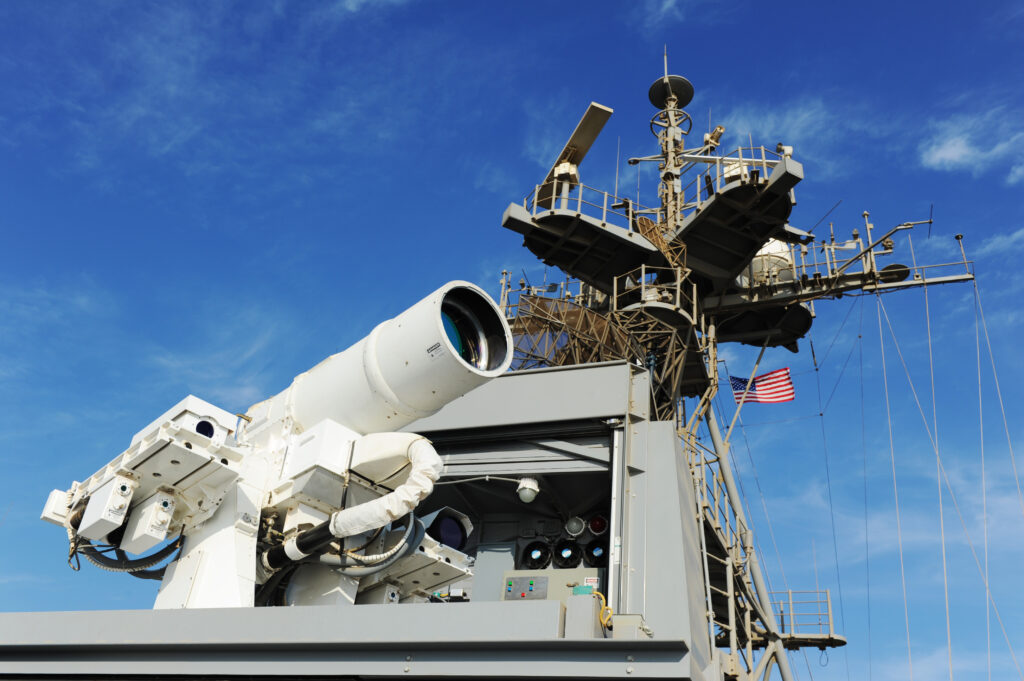
The Navy’s Laser Weapons System (LaWS) aboard the USS Ponce in the Persian Gulf

TYSON’S CORNER: New laser technology looks promising as a way to shoot down Chinese-style massed missiles. But laser projects have overpromised and underdelivered for decades, from Reagan’s Star Wars in the eighties to the Airborne Laser, canceled in 2011. Now proponents must convince the skeptics — particularly in Congress — that this time is different.

“Right now on Capitol Hill,” said Rep. Jim Langevin, co-chair of the Congressional Directed Energy Caucus, “I’d characterize the support of directed energy programs as mixed, but I would say it’s getting stronger as the technologies mature.”

“It’s not the easiest thing in the world to explain,” Langevin added. “Heaven forbid some physics is involved.” But that’s not the biggest problem advocates have, he said: “Decades of directed energy being oversold and under-realized — that’s probably our biggest enemy.”

“Since 1960 we have spent more than $6 billion on directed energy, yet until very recently we’ve had too little to show for it.” Rep. Doug Lamborn, Langevin’s co-chair, told today’sdirected energy summit. But now, “we are at an exciting transition point where we can actually meet COCOM [combatant commander] requirements in the near- and mid-term.”

When War and Weather Conspire

JULY 24, 2015

In an increasingly vicious cycle, conflict pushes people from their homes — then floods or landslides force them out of the U.N. tents where they took shelter.


A swamp is a bad place to live in tents. Mud turns to rivulets or dirty streams when rains come, breeding mosquitoes and the diseases they carry. Thin mattresses soak through, leaving people to sleep in water teeming with waste.

For as many as 70,000 people in Bentiu, in South Sudan’s northern Unity State, this has become the norm. Since 2013, the country’s protracted civil war has forced residents to flee their homes as armed groups attack townswith extreme brutality. But without an entrenched, well-planned emergency infrastructure that can handle the displaced, internal refugees have been forced to head to the nearest United Nations camps. These sites have sprung up in some inhospitable places in a makeshift effort to give some protectionto an increasingly vulnerable population. In Bentiu’s case, a camp was built under emergency conditions in a wetland. And when the rains come, life in the swamp becomes exactly what you might imagine: miserable.

The Army Needs Anthropologists

JULY 28, 2015

With the quiet death of the military's controversial Human Terrain System, America's soldiers have lost a guiding light that is needed now more than ever.

In 2007, the American Anthropological Association called the Army’s effort to embed social scientists with combat units “an unacceptable application of anthropological expertise,” citing a moral conflict between studying groups of Iraqis or Afghans and advising troops who might end up killing them. Rep. Duncan Hunter (R-Calif.) griped that the program, known as the Human Terrain System, had “no legitimate application in a war zone or out of one” and complained, ”The overall cost and failures of HTS indicate that [it] be considered for termination.” One self-described group of anti-colonial anthropologists even superimposed a founders’ head onto a Queen Elizabeth-style torso in a parody of the horror flick Saw, a somewhat distasteful demonstration of just how evil and imperialist they found its aims and methods.

In late June, after years of such criticism, USA Today learned the Army had quietly scrapped HTS in September 2014. An Army spokesman told the news outlet, “The HTS program ended on September 30, 2014, as there was no longer a requirement for HTS teams in theater,” but did not address either the (seemingly innocuous) nearly nine-month delay in announcing the termination or the apparent about-face from the Army’s relatively recent defense of the program. The Army did not respond to Foreign Policy’s subsequent request for clarification on these counts or on whether the Department of Defense plans to replicate the capability.