1 August 2015

The Dinanagar Terror Attack: What it Portends


At the time of writing this analysis of the terror attack in Dinanagar town of Punjab, the operation to flush out and finish the terrorists holed up in a police station is still going on. As a result, there is only sketchy information available on the basis of which some sense has to be made of what is happening, why it is happening and what it portends for the future. Until now it is not clear who these terrorists are and where they have come from. Did they infiltrate from the Jammu border side, in which case how did they travel all the way to Dinanagar? Did they infiltrate from the Punjab border side? Are they Pakistani Punjabi jihadis or are they Kashmiri militants or are they Khalistani terrorists? Did these terrorists even infiltrate from across the border or are they part of some terror group cell which has been activated inside India and therefore did not need to cross the border to strike in India? The honest answer is that we don’t know as yet.

Was their aim to target the Amarnath Yatra, as is the speculation in some quarters, and that they lost their way and entered Punjab? This theory sounds a little far-fetched because unless the Pakistanis are now so desperate that they are sending in people without any preparation or training, it is unlikely that people would have crossed the border without having received a detailed briefing on where they have to go and how to reach there. What is more plausible is that the terrorists deliberately launched an attack in Punjab instead of Jammu and Kashmir. This is perhaps the most critical aspect of this attack because this means that the theatre of terrorism is now being sought to be expanded beyond just Jammu and Kashmir. In fact, even in Jammu and Kashmir there have been more attacks by Pakistani-based terrorists in Jammu than in Kashmir where the attacks have generally believed to have been carried out by local terrorists instead of Pakistani terrorists. Therefore, regardless of whether or not there is a Khalistani angle to the attack, there appears to be a sinister design in expanding the area of terrorist attacks.

Lackawanna, New York Man Arrested and Charged With Trying to Provide Material Support to ISIS

July 29, 2015

New York Man Arrested and Charged with Attempting to Provide Support to ISIL 

WASHINGTON—Arafat M. Nagi, 42, of Lackawanna, New York, was arrested and charged by criminal complaint with attempting to provide material support and resources, namely personnel, to a foreign terrorist organization, the Islamic State of Iraq and the Levant (ISIL). The charge carries a maximum penalty of 15 years in prison and a $250,000 fine.

Assistant Attorney General for National Security John P. Carlin, U.S. Attorney William J. Hochul Jr. of the Western District of New York and Special Agent in Charge Brian P. Boetig of the FBI’s Buffalo, New York, Division made the announcement today.

“Our continuing fight against international terrorism today returns to Western New York,” said U.S. Attorney Hochul. “As alleged, Arafat Nagi pledged allegiance to the Islamic State and the leader of this terrorist organization. After buying military combat gear, he traveled twice to Turkey in an effort to help the group. Thanks to the combined efforts of law enforcement and community members, this defendant is no longer capable of achieving his goal of joining the most despicable group of our time.”

“The FBI has a responsibility to ensure that our law enforcement and intelligence agencies are positioned to identify existing or emerging threats,” said Special Agent in Charge Boetig. “Joint Terrorism Task Forces (JTTFs) serve as the national platforms for deterring, detecting and disrupting terrorist machinations. The JTTF in Buffalo relies on community engagement to gain perspectives on radicalization and to deter recruitment and the spread of radicalization messages. We continue to call upon people to contact law enforcement if they know of someone who has been influenced by ISIL rhetoric on social media—powerful propaganda that calls for followers to commit quick and unpredictable violent acts.”

Turks Using Cover of War Against ISIS to Attack Kurds and Domestic Political Opponents

Benjamin Harvey
July 29, 2015

Under Cover of War on Jihadists, Turkey Settles Score With Kurds

Just weeks after his grip on power looked to be slipping, Turkish President Recep Tayyip Erdogan is widening the net in an offensive against militants to root out political opponents and shore up his power base.

Erdogan called on Tuesday for parliament to lift the immunity from prosecution of lawmakers from the Kurdish party linked to the militant group PKK. That would pave the way for prosecutors to investigate alleged terrorist offenses.

“The Turkish state has the power to make so-called politicians and so-called intellectuals pay for the blood of its martyrs”

Turkey is striking PKK insurgents at home and in northern Iraq while bombing Islamic State in Syria, sending financial markets plunging. Erdogan, 61, is positioning himself to benefit from the crisis. The escalation comes seven weeks after the pro-Kurdish HDP won unprecedented support in Turkish elections, stripping the party founded by Erdogan of its parliamentary majority for the first time in 13 years.

“For all those who believed that a coalition opened the chance to sideline Erdogan, there was clear disappointment,” said Peter Schottmueller, who helps manage $17 billion as the head of emerging-market fixed income at Deka Investment GmbH in Frankfurt. “All actions that strengthen Erdogan’s position are detrimental for Turkey’s risk profile.”

No, COIN is Not a Proven Failure

July 28, 2015

Introduction

The once-praised concept known as population-centric counterinsurgency, typically abbreviated simply as "COIN", has fallen on hard times. On December 1st, 2014, The American Conservative published an op-ed by U.S. Army Lieutenant Colonel Daniel L. Davis entitled "COIN Is a Proven Failure".[1] A month earlier, retired Lieutenant General Daniel P. Bolger published Why We Lost, in which he claims that "by the time [Field Manual 3-24] came out, the techniques had already been tried and found wanting."[2] With the Taliban still intransigent nearly fourteen years after the 2001 invasion, and owing to ongoing conflict in Iraq, COIN's reputation for calming the chaos has taken a substantial hit.

Popular perception states that in late 2006, with stability in both Afghanistan and Iraq in sharp decline, a combined Army and Marine Corps team led by then-Lieutenant General David Petraeus drafted a new COIN field manual, FM 3-24/MCWP 3-33.5 Counterinsurgency. In early 2007, President George W. Bush announced a controversial surge of additional combat troops to Iraq. Petraeus, subsequently promoted to General, took command of Multinational Forces in Iraq (MNF-I), which employed the new COIN doctrine codified in FM 3-24 to exploit opportunities offered by the mid-2006 Anbar Awakening movement, and from a ceasefire by the Jaish al Mahdi militia. The International Security Assistance Force (ISAF) adopted a similar approach in Afghanistan, bolstered by a comparable 2010 troop surge ordered by President Barack Obama in late 2009. The COIN initiative in Iraq produced a temporary settlement that eventually deteriorated after American troops withdrew in late 2011; meanwhile, Afghanistan's COIN initiative largely failed to produce even a comparable temporary settlement.

Iran and North Korea: Partners in Proliferation?

By: Ryan Henseler
July 29, 2015 

On July 14, 2015 the United States, Great Britain, France, Russia, Germany and the People’s Republic of China (PRC), collectively known as the P5+1, finalized negotiations for a comprehensive nuclear deal with the Islamic Republic of Iran. According to the agreement, Iran will be required to disable many centrifuges critical to the uranium enrichment process necessary for weaponization, redesign the Arak nuclear reactor such that it is incapable of generating bomb-grade plutonium, and drastically decrease its stockpile of non-weapons grade uranium. In return, crippling UN trade sanctions will be lifted, which would immediately boost Iran’s economy, including the return of over $100 billion per year in oil exports currently lost due to sanctions. The deal purports to make it nearly impossible for Iran to construct a nuclear weapon within its borders and, “is not built on trust – but on verification.” In addition, UN embargoes on arms and ballistic missile sales to Iran will be extended for another five and eight years respectively.

Despite these recent signs of goodwill, Iran has long maintained cooperative ties with another rogue state, the Democratic People’s Republic of Korea (DPRK), better known as North Korea. In 2002, both states were labeled as part of the infamous “axis of evil” by then-President George W. Bush. Both nations share a deep mistrust of the West, and this connection serves as the bedrock of the alliance between the two otherwise ideologically divergent countries. In 2012, Iran’s Supreme Leader Ali Khamenei declared, “The Islamic Republic of Iran and North Korea have common enemies, because the arrogant powers do not accept independent states,” essentially restating the ancient Arabic proverb, “the enemy of my enemy is my friend.”

Iran's Secret 200-Year Strategy


Iran has been seeking the right to master Western technology for over two centuries.

Hidden behind the hundreds of stories in recent months about the negotiations with Iran lies a basic process obscured by the talk of diplomacy and deals: the transfer of technology.

Two hundred years ago this summer, Iran was engaged in a parallel set of talks with the Western powers about its right to acquire the latest scientific and military expertise. It was not nuclear technology that was at stake in the summer of 1815. Rather, it was the new military-industrial techniques that in the previous half century had seen European armies rapidly and orderly fire their way across former Muslim kingdoms from India to Egypt. The Middle Eastern powers who witnessed this saw the transfer of Western technologies as their only hope of security. Having been ravaged by Russia from 1804 to 1813, Iran had particular reason to be fearful. But as the lone Shiite state in the region, her long term enemies were her Muslim neighbors. The Ottoman, Mughal and Hotaki rulers of what is now Syria/Iraq, Pakistan and Afghanistan had all waged war against Iran’s “heretic” Shiites.

Why Guinea Matters to America


Blessed with abundant natural resources, Guineans should live in the most prosperous country in West Africa. But my country remains stuck in extreme poverty because of a half century of authoritarian governments, often inspired by the teachings of Karl Marx.

During this long period when Guineans struggled, fortunately there was good news and some hope. My country has been a bulwark of stability in West Africa’s so-called “arc of crisis.” So far, Guineans have been spared the tragic and destructive civil wars found in neighboring Liberia, Sierra Leone, Cote d’Ivoire, and Guinea-Bissau. Yet this could change. While wars around us have abated, economic stagnation, heightened tribalism, and the unbridled spread of terrorism throughout Africa could undermine Guinea’s cherished stability.

There is a way forward for my country to build on its stable past and avoid civil conflict and terrorism spreading to us. My vision is for a free, democratic, prosperous Guinea based on ethnic inclusiveness, the rule of law, free-market economics, and the effective management of the country’s vast mineral, agricultural, water, and human resources. I foresee a proud Guinea fully integrated into the West African economy and making a positive contribution to the world community.

Russian Government Hackers Used Twitter and Photos to Penetrate U.S. Computer Systems

July 29, 2015

Russians hackers used Twitter, photos to reach U.S. computers: report

Russian government-backed hackers who penetrated high-profile U.S. government and defense industry computers this year used a method combining Twitter with data hidden in seemingly benign photographs, according to experts studying the campaign.

In a public report Wednesday, researchers at security company FireEye Inc (FEYE.O) said the group used the unusual tandem as a means of communicating with previously infected computers. FireEye has briefed law enforcement on what it found.

The technique, uncovered during a FireEye investigation at an unnamed victim organization, shows how government-backed hackers can shift tactics on the fly after they are discovered.

“It’s striking how many layers of obfuscation that the group adopts,” said FireEye Strategic Analysis Manager Jennifer Weedon. “These groups are innovating and becoming more creative.”

The machines were given an algorithm for checking a different Twitter account every day. If a human agent registered that account and tweeted a certain message, instructions for a series of actions by the computer would be activated.

Russia Declares the National Endowment for Democracy as ‘Undesirable’

July 29, 2015

Russia Labels U.S.’s National Endowment for Democracy ‘Undesirable’ Under Law

Russian prosecutors on Tuesday formally labeled the Washington-based National Endowment for Democracy, a nongovernmental foundation funded by Congress, as an “undesirable” organization — banning it from operating in the country.

In a statement on its website, the General Prosecutor’s Office accused the foundation of working to disrupt national elections, influencing Russian authorities and discrediting the Russian army. The foundation is the first victim of a new law to expel foreign NGOs believed to be working against Russian interests.

Russians who continue working for such groups face up to six years in prison. 

The National Endowment for Democracy could not be immediately reached for comment. The bipartisan nonprofit was founded in 1983, and works in more than 90 countries. The group spent more than $5 million in Russia in 2013-14, prosecutors said.

Russia’s parliament drafted a list this month of a dozen “undesirables,” most of them U.S. nongovernmental organizations such as Freedom House and George Soros’s Open Society Foundations. Another group, the Chicago-based MacArthur Foundation, has voluntarily folded its Russian operations.

New Cyber Spyware Tool, called Hammertoss, Is Identified

Michael Mimoso
July 29, 2015

The espionage gang behind the MiniDuke backdoor uncovered by Kaspersky Lab and CrySys Lab in 2013 has surfaced again with a new backdoor and attack platform that is used sparingly against only high-value targets.

The new data theft tool, called Hammertoss, is a study not only in espionage capabilities, but also stealth and targeting. It’s been found so far only on one organization’s network, and has been linked to a Russian group dubbed APT29 by researchers at FireEye.

Once APT29 has access to a target network and deems it worthy, it deploys Hammertoss, which communicates through URLs seeded in social media accounts—Twitter in particular—and makes use of steganography in images stored on GitHub or compromised websites to retrieve encrypted instructions.

This is similar behavior to the original MiniDuke campaigns, which also moved through similar channels and tactics, but with much less obfuscation.

“MiniDuke and other tools that have been outed recently are part of the same toolkit,” said Jen Weedon, manager of threat intelligence at FireEye. “It’s unique, and considerably more complicated and layered in its approach. They will use Hammertoss when other tools don’t work.

The Super-Secret Relationship Between NSA and GCHQ and Commercial Cipher Machine Maker Hagelin

Gordon Corera
July 29, 2015

How NSA and GCHQ spied on the Cold War world

American and British intelligence used a secret relationship with the founder of a Swiss encryption company to help them spy during the Cold War, newly released documents analysed by the BBC reveal.

The story of the German Enigma machine is well-known - a device built to provide secure communications but which British code-breakers managed to crack at Bletchley Park. 

But there is another story - not fully told until now - about what came after.

The demand for machines like Enigma grew after the end of the World War Two. And one private company led the way in meeting that demand.

That company, founded by a man called Boris Hagelin, was called Crypto AG.

Hagelin had helped supply the US Army during the War before moving his business from Sweden to Switzerland.

Crypto AG sold its machines around the world, offering security.

But what customers did not know was that Hagelin himself had come to a secret agreement with the founding father of American code-breaking, William F Friedman.

Silicon Valley and Policing the Internet for the U.S. and UK Governments

Gordon Corera
July 29, 2015

Spies helped build Silicon Valley. Now the tables are turning 

If you want to understand how modern British and American intelligence services operate, you could do worse than visit the new exhibition that opens at Bletchley Park this week. It tells the story of code-breaking in the first world war, which paved the way not just for the better-known success story of world war two, but also GCHQ and the NSA’s modern day bulk interception. 

A century ago, just as today, intelligence services and network providers used to enjoy a symbiotic relationship. Britain, for example, exploited its dominance of the telegraph system to spy after its companies had built an imperial web of cables that wrapped itself around the world. Britain’s first offensive act of the conflict was to cut Germany’s own undersea cables and install “secret censors” in British company offices around the world that looked out for enemy communications. A staggering 80m cable messages were subject to “censorship” during the war.

In recent decades the US has enjoyed a similar ability to spy on the world thanks to its role in building the internet – what the NSA called “home field advantage”. This worked via two channels. The first was fibre-optic cables passing through either American or British territory, allowing intelligence agencies to install the modern equivalent of secret censors: computerised black boxes that could filter data to look for emails based on “selectors”. The second channel was Silicon Valley – which had thrived thanks to massive Pentagon and NSA subsidies. People around the world sent their communications and stored their data with American companies, whose business model often involved collecting, analysing and monetising that data. This attracted spies like bears to honey. And so Prism was born – requiring the companies themselves to run selectors across their own data. 45,000 selectors were running in 2012. Put together with cable-tapping, this meant that nearly 90,000 people around the world were being spied on.

Ref material on unconventional warfare, insurgency, irregular warfare, and small wars.

Assessing Revolution and Insurgent Strategy Project


Do you have it, have you read it?

Casebook on Insurgency and Revolutionary Warfare: 23 Summary Accounts


Casebook on Insurgency and Revolutionary Warfare, Volume II 1962 - 2009.


Human Factors Considerations of Underground in Insurgencies, 2d Edition, 2013,http://www.soc.mil/ARIS/HumanFactorsS.pdf

Undergrounds in Insurgent, Revolutionary and Resistance Warfare, 2d Edition, 2013,http://www.soc.mil/ARIS/UndergroundsS.pdf

We’re Developing the Wrong Leaders


Former Chairman of the Joint Chiefs of Staff Admiral Michael Mullen speaks to the assembled students of the Army’s Command and General Staff Officer Course

The following guest post was provided by Major Jon Mohundro, a Logistics officer currently teaching at West Point. His previous experience includes junior officer positions within Armor battalions and the TRADOC Commander’s Planning Group. The views expressed in his post do not necessarily reflect those of the Department of Defense, the Department of the Army, or the Army University. 

Army Chief of Staff General Raymond Odierno has repeatedly said that leader development is the Army’s top priority for developing the future force(1). As the defense budget continues to be constrained by sequestration, developing the right leaders who can operate and win in a complex world will become increasingly more important. Unfortunately, the Army’s officer education system is designed to develop the wrong leaders.

BACKGROUND

IARPA Wants to Know If You Can Predict Cyber Attacks

Kevin McCaney
July 29, 2015

IARPA wants an early warning system for cyber attacks

The hacks this year of the Office of Personnel Management databases, which went on for months before being discovered, underscored the importance of being able to detect network intrusions early on. But what if you could detect them before they happen?

The Intelligence Advanced Research Projects Agency wants to find out, by using a combination of internal security controls with external indicators to generate automated warnings of potential attacks, according to a Broad Agency Announcement. The Cyberattack Automated Unconventional Sensor Environment (CAUSE) essentially is looking to combine the kinds of monitoring (social media, search terms) used to track political trends or disease outbreaks with other “unconventional” sensors and advanced network monitoring.

IARPA points out that serious cyber attacks don’t just happen “but evolve in a phased approach” that includes early stages of reconnaissance and planning, not unlike burglars “casing” a bank before carrying out a job. CAUSE will seek to identify activity in those early stages as much as possible.

Satellite Imagery Shows Algeria’s First Hardened S-300 SAM Site Almost Completed

Chris Biggers
July 29, 2015

While rumors of Algeria receiving a S-400 battery from Russia continue topermeate the blogosphere, construction of the S-300 site over at Mers El Kébir is well underway.

Situated in Oran Province near the coast, Mers El Kébir is an important deployment location. It’s home to the Air Force’s frontline MIG-29 multi-role fighters, the Navy’s Kilo diesel electric submarines and OMCN/CNE shipbuilding, among others.

Once completed, it’ll be the country’s third S-300 site supporting the only known S-300 unit located on the northwest coast. The two other sites thought to host the system sit near Algiers, the nation’s capital and most densely populated city. [1]

According to satellite imagery, the site has been under construction for over two years and follows a configuration similar to those located at Ouled Fayet andReghaia. Like before, imagery shows that Algeria has taken its time hardening the site by erecting earth bermed protective shelters.

Recent space snapshots from May (right image; left image from May 2014) confirm that the protective shelters have been covered and that concrete access ramps were completed. A nearby support area was still under construction at the time of capture.

Unlike other S-300 sites around the globe — which typically follow basic Russian configurations of ‘C’ and ‘E’ shaped revetments — these hardened sites reiterate the system’s use for strategic defense.

Anonymous Says It Will Continue Leaking Canadian Intel Service Secrets

Justin Ling
July 29, 2015

Anonymous Vows to Keep Leaking Canadian Spy Secrets Over Police Shooting 

A chapter of the hacktivist group Anonymous released a document they say exposes the Canadian government’s signals intelligence infrastructure, and they’re planning to continue leaking the memos until police arrest the officers responsible for the death of a protester in British Columbia.

The document details previously secret details of Canada’s spying operations abroad and suggests its spy agency is active in many more foreign stations than it has publicly acknowledged, “many of which are located in developing countries and/or unstable environments.”

VICE News was unable to independently verify the document, purportedly from the treasury board, but spoke to three government employees who, while raising questions about specific aspects of the document, acknowledged that it may very well be real.

A video statement released in conjunction with the secret document also claims the leakers have evidence that Ottawa spied on the American government and that Washington retaliated with a promise to kill the Keystone pipeline proposal — a dramatic revelation, if true.

New Cyber Spyware Tool, called Hammertoss, Is Identified

Michael Mimoso
July 29, 2015

New Hammertoss Espionage Tool Tied to MiniDuke Gang

The espionage gang behind the MiniDuke backdoor uncovered by Kaspersky Lab and CrySys Lab in 2013 has surfaced again with a new backdoor and attack platform that is used sparingly against only high-value targets.

The new data theft tool, called Hammertoss, is a study not only in espionage capabilities, but also stealth and targeting. It’s been found so far only on one organization’s network, and has been linked to a Russian group dubbed APT29 by researchers at FireEye.

Once APT29 has access to a target network and deems it worthy, it deploys Hammertoss, which communicates through URLs seeded in social media accounts—Twitter in particular—and makes use of steganography in images stored on GitHub or compromised websites to retrieve encrypted instructions.

This is similar behavior to the original MiniDuke campaigns, which also moved through similar channels and tactics, but with much less obfuscation.

“MiniDuke and other tools that have been outed recently are part of the same toolkit,” said Jen Weedon, manager of threat intelligence at FireEye. “It’s unique, and considerably more complicated and layered in its approach. They will use Hammertoss when other tools don’t work.

Hamas' cyber battalions take on Israel

July 29, 2015

The Palestinians and Israelis are now battling in the virtual world, June 24, 2013.

While Palestinians and Israelis do plenty of fighting on traditional battlefields — the most recent such engagement being the Gaza War of summer 2014 — a new front has emerged that is just as vicious, albeit devoid of bloodshed and bullets. The so-called cyber war is fought on the Internet this time.
Summary⎙ Print The cyber war between the Israelis and the Palestinians is intensifying, with each side racing to penetrate the enemy’s sensitive sites.

The latest round of confrontations between Palestinians and Israelis occurred on the Internet April 9, when Israeli hackers leaked the Palestinian Population Registry containing data on 4 million Palestinians and published personal information about 700 Palestinian Authority employees, among them ministers and journalists.

The Israeli attack came in retaliation for actions by Palestinian hackers April 7, when they penetrated Israeli websites — among them those belonging to the office of the Israeli prime minister, the Ministries of Defense and Education, the Shin Bet, the stock exchange and the Tel Aviv police.

The hacking of Palestinian and Israeli websites can be just as dangerous as conducting military operations on the ground. Attacks on these sensitive websites — such as those belonging to military bases, airports and banks — can potentially result in devastating losses. These attacks could expose bank accounts or military and security installations and are considered a threat to national security.

Cybersecurity: We Need a Chinese Snowden

By Alexander Bowe
July 31, 2015

Without Chinese revelations about Chinese hacking and espionage, a cyber-détente is unlikely. 

Two issues have dominated the discussion of American-Chinese relations in recent months: the escalating war of words in the South China Sea and cybersecurity. Recently, clandestine hacking conflicts between the United States and China have increased in prominence. A bombshell report by internet security firm Mandiant in February 2013 claimed that a secretive Chinese military unit based out of Shanghai was responsible for a series of hacks on United States-based corporations. Another report a couple of months later showed that China was by far the largest source of international hacking attacks, with 41 percent of the world total (of course, the United States was number two on that list, but more on that in a bit); furthermore, the number of attacks originating in China was found to have drastically increased since the first quarter of that year.

(W)ARCHIVES: WHEN “SAFE ZONES” FAIL

July 31, 2015

The New York Times has reported that the United States, Turkey, and the Syrian opposition are planning to create a “safe zone,” free of the Islamic State of Iraq and the Levant (ISIL), for Syrians in an approximately 60-mile-wide strip of land along the Turkish-Syrian border. Certainly the long-suffering people of Syria deserve a place in which to be safe from ISIL and a safe zone might someday provide a convenient launching pad for a broader offensive against the group. However, a safe area comes with real commitments and serious dangers.

Nothing illustrates this better than the case of a modest Muslim town in Bosnia: Srebrenica, probably the most famous “safe zone” in modern military history. Documents posted by the invaluable National Security Archive set up the story. In April 1993, as the war in Bosnia was heating up, the United Nations Protection Force (UNPROFOR) in the former Yugoslavia was pressured into overseeing “An Agreement for the Demilitarization of Srebrenica,” between the Bosnian Serb and Bosnian Muslim armies and declaring the town a safe zone.

WEEKEND READING: JULY 31 – AUGUST 2 EDITION

July 31, 2015

Although Congress is about to go on vacation, we know you’ll all still be toiling away like us. Here’s what caught our eye this week.

Point, counterpoint: War crimes or wise decisions? A textbook demonstration of the complexity of war.

Point: In a story featuring incoming Marine Corps Commandant Lt. Gen. Robert Neller, Lt. Col. James Weirick raises questions about photos released by TMZ in 2014 that appeared to show Marines burning bodies in Fallujah.

“It is essential that the results of this investigation be released by Marine Corps Forces Central Command with minimal redactions. The press release by Pentagon [sic] stating that the Marines in the photographs were dishonorable and unprofessional must be evaluated against the investigation by the Marine Corps. If these Marines burned the bodies out of necessity and not to desecrate the bodies, then they deserve to have the record corrected.”

“A Marine who was there at the time told public affairs officials that commanders ordered the bodies to be burned because U.S. troops were living in close proximity to them and the corpses were ‘literally exploding’ from becoming bloated in the sun.”

The State of African Security


". . . [W]ith the wars in Iraq and Afghanistan being far less demanding than they were before, the United States now has the opportunity to contribute more meaningfully to Africa's security."
With President Barack Obama's recent trip to East Africa, attention has understandably focused on Kenya and Ethiopia, as well as nearby Sudan. And with the ongoing challenges posed by ISIL and related extremist movements, Nigeria, Mali, Libya and Tunisia have all stayed in the news.

But it is worth taking stock of broader security trends in Africa at this juncture. Doing so reminds us of the enormous challenges that remain on this continent with more than fifty countries and a billion people. Yet it also should give us hope, for much progress has been made, and with some additional effort, the United States may be able to help spearhead greater positive momentum. In addressing the developing trends on this huge continent, it is easiest to break things down by region, leaving aside for the moment the part of the continent where Mr. Obama has just been:

West Africa

GAO Report Reveals New Data About Strength, Funding and Deployments of U.S. Special Operations Command

Special Operations Forces: Opportunities Exist to Improve Transparency of Funding and Assess Potential to Lessen Some Deployments 

Published: Jul 16, 2015. Publicly Released: Jul 16, 2015.

What GAO Found

GAO analysis of the resources devoted to U.S. Special Operations Command (SOCOM) found that the number of authorized special operations military positions increased from about 42,800 in fiscal year (FY) 2001 to about 62,800 in FY 2014, which includes combat and support personnel. Even with this growth, special operations military positions constituted less than 3 percent of the military services’ FY14 total authorized force levels.

Special operations–specific funding has increased markedly, but the Department of Defense (DOD) has not determined the total funding used to support special operations forces (SOF). Funding provided to SOCOM for special operations–specific needs has more than tripled from about $3.1 billion in FY 2001 to about $9.8 billion in FY 2014 constant dollars, including supplemental funding for contingency operations. However, these totals do not include funding provided by the services, which SOCOM estimates is more than $8 billion annually. GAO found that DOD has little visibility over total funding to support SOF, primarily because it has not established a requirement or methodology to capture and report this information. Until DOD has more complete information on total funding to support SOF, decision makers will be unable to effectively identify and assess resource needs or weigh priorities and assess budget trade-offs.

New officer career tracks being mapped


By Andrew Tilghman
July 27, 2015 

Top Pentagon officials are mapping out a way to scale back or end the "up-or-out" rules and joint billet requirements that have defined career paths for generations, a defense official said.

The goal is to scale back the rigidity of today's personnel system and create more leeway for officers to pursue individualized career tracks or even take time off in the civilian sector before returning to active duty and resuming a military career.

That will likely include asking Congress to authorize changes to two key Cold War-era laws: the Defense Officer Personnel Management Act of 1980, known as DOPMA, and the Goldwater-Nichols Act of 1986, a defense official said.


The need to change those laws are among the key conclusions emerging from an internal Pentagon review of the personnel system launched earlier this year by acting Undersecretary of Defense for Personnel and Readiness Brad Carson. He's vowed to seek "revolutionary change" and create a military personnel system that emphasizes talent rather than seniority.

Carson plans to unveil a slate of about 50 recommendations in August, the defense official said.

Top US General Urges Countries to Bolster UN Peacekeeping

July 28, 2015

The United Nations needs rapid response forces, equipment and training to bolster peacekeeping, the United States' top general said on Tuesday ahead of President Barack Obama's planned summit of world leaders in September to win new commitments.

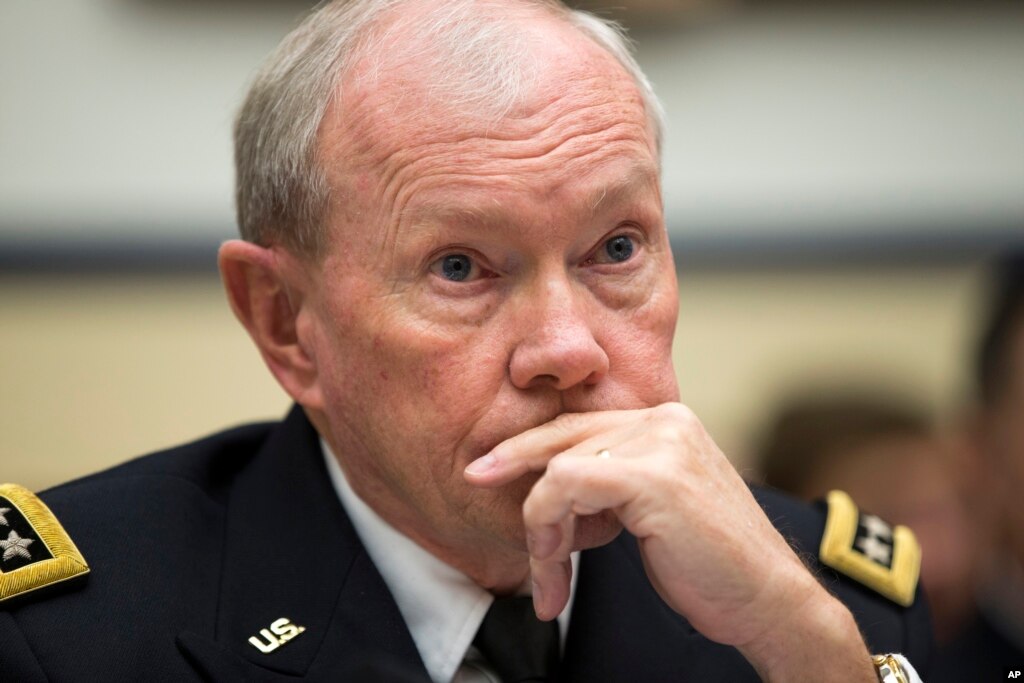
Army General Martin Dempsey, chairman of the Joint Chiefs of Staff, and U.S. Ambassador to the United Nations Samantha Power met with dozens U.N. ambassadors and military advisors in New York at the 69th Regiment Armory.

"The U.N. requires commitments from member nations to provide rapid response forces for emerging crises," he said.

"The rapid deployment of units within 30, 60, or 90 days - for a finite period - can help resolve developing crises, prevent expanded conflict, and in the process save more innocent lives."

Dempsey said more highly skilled police and military were needed, and more equipment. U.N. officials have said they need equipment ranging from intelligence and communications to armored vehicles, attack helicopters and transport aircraft.

Obama is due to convene a summit of world leaders on the sidelines of the U.N. General Assembly in September to secure new commitments to peacekeeping. In March, Power urged European countries to contribute more troops.

A--ARMY WARFIGHTING ASSESSMENT (AWA) 17.1 SOURCES SOUGHT ANNOUNCEMENT

1. DESCRIPTION 

1.1 The AWA is an Army hosted event conducted once a year. The AWA is replacing the yearly Network Integration Evaluation (NIE) .1 events, such that there will be one yearly AWA and one NIE event, as opposed to the past twice yearly NIE events. The AWA is approximately two to four weeks long and employs a Brigade Combat Team (BCT) at Fort Bliss, TX. The goal is to assess new and emerging capabilities and concepts aligned to Army Warfighting Challenges and Focused End States supportive of achieving Mission Command Network (MCN) 2020, and Force 2025 and Beyond (F2025B). The AWA events will include tactical exercises using current force equipment and emerging networked systems. Please see Attachment 4 for a White Paper and description of the Army's strategy to achieve MCN 2020 and F2025B through Focused End State (FES) objectives and tasks. Please see Attachment 5 for an Information Paper on the Army Warfighter Challenges (AWFC) methodology framework being used to shape Army modernization efforts. 

1.2 The US Army ASA(ALT) System of Systems Engineering and Integration Directorate (hereinafter referred to as SOSE&I) is seeking interested sources with mature solutions to enhance existing network and non-network systems capabilities to participate in an Army Warfighting Assessment (AWA) event scheduled to occur in October 2016 (referred to as AWA 17) at Ft. Bliss, TX and the adjacent White Sands Missile Range, NM (WSMR). The purpose of this notice is to identify emerging capabilities to be evaluated against a set of entrance criteria for an opportunity to participate in the AWA. This Sources Sought seeks solutions with a narrow focus on specific capabilities in the current and evolving equipment solution set. Functional requirements for these capabilities are listed in Paragraph 2. These Opportunity Solutions are: 

31 July 2015

Crass politicization of terrorism in India

By RSN Singh
30 Jul , 2015

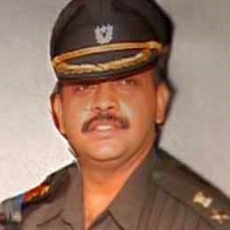
Ever since India began to be subjected to unremitting terrorism from Pakistan, mostly in direct collusion with the authorities in that country, there have been unmistakable signs on part of certain vested interests in India to hang on to some straw of ‘Hindu’ or ‘saffron terror’. The jihadi terror emanating from Pakistan, disconcerted these political vested interests not for reasons for the security concerns of the people and the country as such, but vote bank considerations. They nurtured the outrageous notion that the externally orchestrated ‘jihadi terror’ was polarizing the country on communal lines, which could severely impact on their brand of ‘secular politics’. Therefore, they embarked on a programme to ‘balance terror’ even if it meant fabricating a phenomenon called ‘Hindu Terror’.

It is purely imaginary, just like as it was in the immediate aftermath of partition in Pakistan. It may be instructive to know that the Cabinet Secretary of Pakistan, Mohd Ali, when asked by a top Indian bureaucrat, BK Nehru, regarding the persistent use of abusive language against India and Hindus by the Pakistani newspaper Dawn (Muslim League’s mouthpiece), replied that though he knew that it was wrong, but such fabrications about an enemy was necessary for building Pakistan. When Nehru retorted by asking what would happen if India was also to conjure up the bogey of “Hinduism in danger”, Ali quickly announced that Hinduism was incapable of fanaticism.

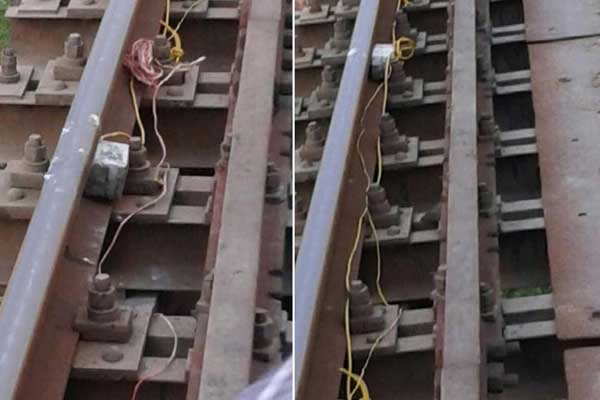
Dinanagar Terror Attack Attempt to revive militancy in Punjab?

By SP Sharma
29 Jul , 2015

The terror attack in Dinanagar town of Gurdaspur in Punjab and the growing incidents of terrorism in J&K coupled with frequent appearance of flags of the notorious ISIS terrorist outfit are a signal loud and clear for the chief ministers Parkash Singh Badal and Mufti Sayeed, to shed the politics of appeasement of radicals in their respective states in a bid to thwart the ugly designs of Pakistan to revive full-scale terrorism in the two states.

The new tactics of a woman terrorists accompanying the ultras at Dinanagar is a matter of concern as the phenomenon was witnessed in J&K during the period when terrorism was at its peak…

Reports of Pakistan making attempts to revive militancy in the two states with the help of terrorists of Punjab and J&K who were residing in Pakistan have been pouring in from time to time.

Why there is an attack in Dinanagar?


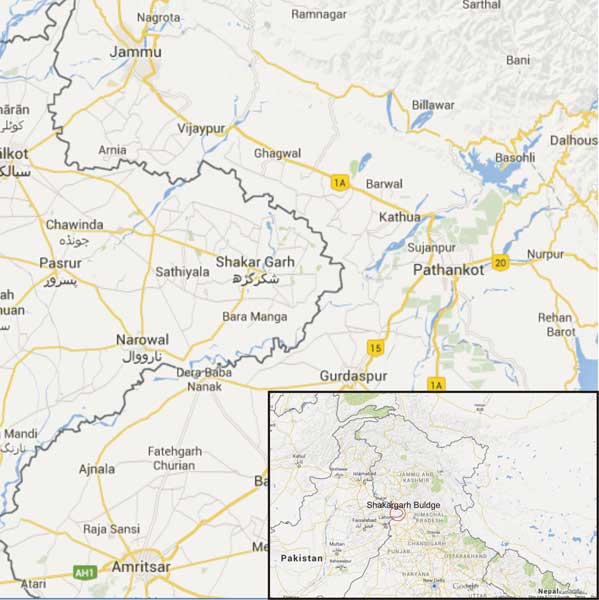
The foregoing eighteen months have witnessed three major jihadi attacks along the Pathankot-Jammu highway. This highway, NH1 (A), which serves as the lifeline of J&K runs parallel to the International Boundary (IB) with Pakistan. Most prominent places along this axis i.e. Kathua, Hiranagar, Sambha, RS Pura, have been subjected to terrorist attacks from Pakistan. With endemic attacks, the NH1 (A) is fast acquiring the infamy of ‘terror highway’.

…this Pakistani enclave (‘Shakargarh Buldge’) jutting into India can serve as a launch pad for infiltration and terrorist attacks both on some LoC portions beyond Akhnoor and IB portion southwards.

The latest attack in Dinanagar near Gurdaspur is being interpreted as revival of Khalistani terrorism in collusion with Pakistan sponsored jihadi terrorist organization like the LeT and the ISI. While this may be true to an extent, this angle should not be over-exaggerated. The geographical truism is that from Jammu to Amritsar the area should be treated as one strategic entity. This is engendered by the ‘Shakargarh Buldge’. This entire bulge which witnessed some intense battles during the 1965 & 1971 Indo-Pak wars is being used by Pakistan’s military-intelligence complex as a pivot for cross border operations by jihadis. This bulge dominates the entire NH1 (A) in both the Punjab and the J&K segments. Further, the bulge facilities selection of targets astride the highway by the jihadi terrors, as it is dotted with security forces, security establishments including cantonments.