8 November 2016

Pakistan's polity doesn't have capacity to sustain normal ties with India

Shivshankar Menon
Nov 04, 2016

On whether he sees any prospect for resolution of the Kashmir issue, Menon, who has been India's High Commissioner to Pakistan, replied in the negative.
NEW YORK: Pakistan's polity does not have the capacity to sustain a normal relationship with India, former foreign secretary and national security advisor Shivshankar Menon has said as he characterized relations between the two nuclear-armed neighbors as "managed hostility". 

"I would characterize (India-Pakistan relations) today as managed hostility, which I hope it stays managed," Menon said in response to a question on relations between the two nations at a panel discussion organised by the 'South Asia centre at New York University' here yesterday. 

On whether he sees any prospect for resolution of the Kashmir issue, Menon, who has been India's High Commissioner to Pakistan, replied in the negative. 

He said many of the issues relating to Kashmir have been around for a long time and "we know the solutions" to many of them but they seem to be "politically difficult" to serve. 

"Today I don't think Pakistan's polity has the capacity to sustain a normal relationship with India. I think there is a very strong institutional interest there," he said. 

Menon, who has authored the book 'Choices: Inside the Making of Indian Foreign Policy', however added that his "fear" is that if "it becomes a party political issue in India, which it has not always been, then you have the same dynamic operating." 

He emphasized that expectations in India on any improved relations with Pakistan are "very very low" particularly after the 26/11 Mumbai attacks. 
Getting a Grip on Issues Regarding Forward Areas

By Claude Arpi
07 Nov , 2016

Whether senior or junior, bureaucrats serving in the ministries of Defence, Home Affairs and Finance, should spend a weekend every month in the border areas. It should be seen as a ‘refresher course’

Something made my Diwali special this year: Prime Minister Narendra Modi spent the day with officers and jawans of the Indian Army, the Indo-Tibetan Border Police Force (ITBPF) and the Dogra Scouts who man the Tibet-India border in Kinnaur and Lahaul-Spiti districts of Himachal Pradesh.

The borders have always been neglected by Indian politicians, mostly busy preparing for the next election in their constituencies. It is truly a positive development to see the Prime Minister visiting the borders.

Though it was announced that Modi would be with the ITBPF at the Mana border post in Uttarakhand’s Chamoli district, he finally went to Kinnaur. Probably for security concerns, a diversionary announcement was made.

After landing at Chango, an Army and ITBP camp in Lahaul-Spiti, the Prime Minister travelled to Sumdo in Kinnaur district, where he distributed sweets to the jawans: “Our forces endure grave hardships for our security. If we remember them while being in a festive mood, our remembrance will give them strength and renewed energy”, he declared.

Tibet's Party Boss visits Indian Border

By Claude Arpi
06 Nov , 2016

According to The China Daily, Wu Yingjie, the Party Secretary of the Tibet Autonomous Region, visited Yümé (or Yumai) ‘the most sparsely populated town in China’ on October 12. 

The village (termed as a ‘township’ by China) is located north of the McMahon Line (and the Upper Subansiri district of Arunachal).

It is a border village with India.

The China Daily reported that Wu met frontier troops in the remote area: “[Wu] conducted a field survey on how to promote development and stabilization of the border region, people’s livelihood, grass-root-level Party building and poverty alleviation.”

The Chinese publication adds: “Setting out from Lhasa, capital of Tibet Autonomous Region, you must drive 400km to reach Lhunze [Lhuntse] county, Shannan city [in Lhoka] and another 200km muddy mountain road to reach the township.” The ‘township’ covers an area of 1,976 square kilometers and has one village comprising nine families …and 32 people.

Wu Yingjie told the local residents: “You defend the border areas of our country and protect our country from being nibbled or divided. I salute you.”

A flag raising ceremony was held in Yümé on the occasion of the Party boss.
The China Daily notes: “Frontier soldiers and local residents patrol in the township.

Every resident of the township has a strong awareness of border defense and make it part of their life,” adding “Though far away and less populated, Yumai township is not under-developed. It once had only one family. Then cadres and doctors were dispatched there by the government and the road, power station and health center were built to make it more suitable for living. By 2015, the residents’ per capita disposable income reached 26,000 yuan ($3,838).”

Who is to verify this?

School Burning: Turning the Clock Back in Kashmir

By Brig Anil Gupta
06 Nov , 2016

In the last 48 hours, more than three schools have been burnt in South Kashmir taking the tally to 25 so far since July 9 — a day after Hizbul Mujahideen commander Burhan Wani was gunned down by security forces. 

Why are schools being targeted and why are only government school buildings being burnt? Is it to destroy government property or is it part of a bigger sinister game plan?

The separatists and the fundamentalists in the Kashmir Valley are determined to turn back the clock and take the Valley once again to the medieval era where the Maulvis and Qazis ruled the roost and their writ ran unchallenged. They want the common Kashmiris to remain ignorant, poorly educated and under-developed so that they continue to hold sway over the masses as well as keep them deprived of the benefits of modern education that is mandatory to enjoy the benefits of development and economic growth.

“Great minds are always feared by lesser minds,” goes an old saying. It would answer the question as to why schools are being targeted. Schools are temples of learning. They impart knowledge. Through proper curriculum, schools imbibe the quality of reasoning in young minds, cultivate the spirit of nationalism and inculcate the habit of acquiring knowledge through the process of learning.

Knowledge is power. Knowledge allows one to decide what would be best for one to do. This is what the self-appointed leaders of radicalisation fear — and hence want to deprive young Kashmiris of knowledge. Their target is the future generations of Kashmiris so that they can have unbridled hold over them.

How to reduce South Asia's nuclear dangers

Jayita Sarkar

In the near term, prospects for South Asian nuclear disarmament appear dim. Assuming that nuclear weapons won't soon be eliminated from the subcontinent, what measures are available to India, Pakistan, outside nations, and international organizations that might reduce the risk of a South Asian nuclear exchange?

India and Pakistan continuously increase their stockpiles of fissile material. Pakistan possesses battlefield nuclear weapons that it threatens to deploy against India. New Delhi is close to completingdeployment of a nuclear triad. Non-state actors in South Asia pose a perpetual threat of gaining access to nuclear weapons or materials. Artillery fire along the India-Pakistan border is frequent.

For all these reasons, the nuclear situation in South Asia demands attention. But with Islamabad and New Delhi unlikely to slow their nuclear weapons development amid the long-standing antagonism and mistrust between the two sides, can anything be done to reduce nuclear risk in the region? Yes—initiatives of three kinds stand out for their potential to enhance South Asian nuclear stability. First, New Delhi and Islamabad could undertake bilateral cooperation in nuclear security. Second, the two sides could—with international help—seek to improve the region's nuclear cybersecurity. And India and Pakistan could commit, in one fashion or another, to the Comprehensive Nuclear Test Ban Treaty.

Improving nuclear security. An ongoing concern in South Asia is that terrorist groups might gain access to nuclear materials, either to use these materials in attacks or to use them as bargaining chips against either New Delhi or Islamabad.

US involvement is critical for South Asian arms control

15 SEPTEMBER 2016

South Asia's nuclearization has transformed the Indo-Pakistani conflict from a regional matter into a global issue. An exchange of 100 nuclear weapons between the two nations could kill 20 million people within a week and could also reduce global temperatures by 1.3 degrees Celsius, putting up to 2 billion additional people at risk of famine.

Realist scholars have long argued that to prevent the use of nuclear weapons in an Indo-Pakistani war, the two countries must achieve stable nuclear deterrence. Achieving this goal has come to seem increasingly difficult, if not impossible, and recent changes in India and Pakistan's nuclear doctrines and conventional strategies have made nuclear relations even more unstable. For example, the Indian Army's Cold Start doctrine involves quick conventional attacks—launched in retaliation for a terrorist attack by a Pakistan-based jihadi organization and intended not to provoke Pakistan into a first use of nuclear weapons. But Pakistan says it would respond to a Cold Start offensive with low-yield nuclear weapons.

The conventional wisdom is that India maintains a "recessed deterrence posture"—during peacetime, nuclear warheads are not mated with delivery systems and warheads themselves are not fully assembled. According to Debalina Ghoshal of the Delhi Policy Group, recessed deterrence contributes to strategic stability in Indo-Pakistani relations. But according to political scientist Vipin Narang of MIT, the belief that India keeps its nuclear weapons in a disassembled state "is largely now a myth. … [I]t seems likely that all of India's nuclear missile systems will eventually be deployed in a near-ready 'canisterized' state, which is a far cry from the prevailing perception that India maintains its nuclear force in a relatively recessed state." Pakistan's nuclear weapons, meanwhile, are apparently ready for use at any time, and authority to use nuclear weapons during military crises with India has reportedly been pre-delegated to Pakistani field commanders since 2000. It's too late now for true recessed deterrence in South Asia, and stable nuclear deterrence is probably impossible on the subcontinent.

The alt

South Asia: Beyond crisis management

12 OCTOBER 2016

Rather than "too much Uncle Sam"—that's how a subheading in Rabia Akhtar's first essay expressed the author's view—the problem in South Asia is "too little Uncle Sam."

Akhtar is concerned about India and Pakistan's inability to "grow up" and end their dependence on US management of nuclear crises. I share her concern, but unless Washington forces New Delhi and Islamabad to stop their nuclear arms race and take arms control seriously, the two South Asian nations will continue playing with nuclear fire. Pure bilateralism, without any US pressure, is a dead-end street—witness the two countries' inability to prevent the current crisis over the Uri attack.

What India and Pakistan require is more US involvement (along with a multilateral effort to reduce nuclear dangers, both globally and in South Asia). Washington's ultimate goal in the region must be denuclearization. Nuclear arms control would be a first step in that direction.

Akhtar claims that US influence over the South Asian rivals "is less pronounced… than my roundtable colleagues seem to believe." But Pakistan still depends on US economic and military aid. And the United States could use its leverage over India—made possible by the US-India nuclear deal—to encourage India to disavow its army's Cold Start Doctrine. Meanwhile, Washington could exert strong pressure on the Pakistani military to enforce the illegal status of allanti-Indian jihadi terrorist groups based on Pakistani territory. India might then reduce its military pressure on Pakistan, allowing the Pakistanis to feel more secure. Islamabad then might agree—under US pressure—not to deploy tactical nuclear weapons. The Indians might then make a similar pledge. This would amount to a "graduated and reciprocated initiative in tension reduction" of the sort identified by British economist and peace activist Kenneth Boulding. The result would be significant reduction in the risk of a South Asian nuclear exchange.

Xi Jinping gets a new title

Nov 5th 2016 

He wants to show who’s boss in the struggle that will now unfold

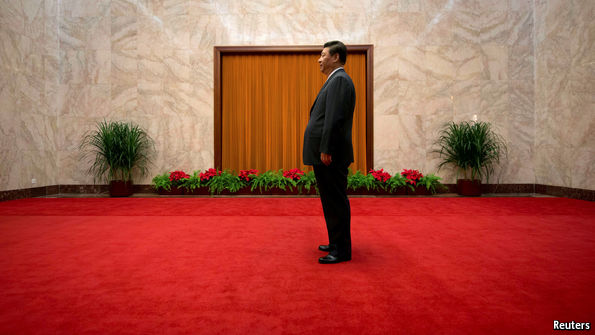
COMMUNIST leaders relish weird and wonderful titles. Kim Jong Il, the late father of North Korea’s current “Great Leader”, was, on special occasions, “Dear Leader who is a perfect incarnation of the appearance that a leader should have” (it doesn’t sound much better in Korean). China’s rulers like a more prosaic, mysterious epithet: hexin, meaning “the core”. Xi Jinping—China’s president, commander-in-chief, Communist Party boss and so forth—is now also officially “the core”, having been called that in a report issued by the party’s Central Committee after a recent annual meeting.

The term was made up in 1989 by Deng Xiaoping, apparently to give his anointed successor, Jiang Zemin, greater credibility after the bloody suppression of the Tiananmen Square protests. Just as Mao had been the core of the first generation of party leaders and Deng himself of the second, so Mr Jiang was of the third. (Hu Jintao, Mr Xi’s predecessor, was supposedly offered the title of fourth-generation core but modestly turned it down.)
In this section

Being core confers no extra powers. Mr Xi has little need of those; he is chairman of everything anyway. Status, though, is what really matters in China (Deng ruled the country for a while with no other title than honorary chairman of the China Bridge Association). And Mr Xi seems to be finding that all his formal power does not convey enough. Early this year, in what looked like a testing of the waters, a succession of provincial party leaders kowtowed verbally to Xi-the-core. But the term soon disappeared from public discourse. Its revival makes it look as if Mr Xi has won a struggle to claim it.

*** Why China And The U.S. Need Each Other In Space

01 November 2016

Space may be miles above us, but how it is being used - and by whom - is becoming increasingly important here on Earth. As of now, the United States leads the world inspace exploration and exploitation, but China is determined to narrow the gap. Beijing has set its sights on becoming a major power in space, and in the next two decades it could surpass veterans in the field such as Russia, perhaps even someday rivaling the United States itself.

It may come as little surprise, then, that Washington and Beijing rarely consider each other partners in space. Though not for lack of trying on China's part, U.S. leaders are suspicious of Beijing's intentions, particularly since the Chinese space program remains shrouded in secrecy. China's propensity for stealing technology is only added cause for concern in Washington, as is the Chinese army's interest in using civil and commercial advances in space for military gain.

In fact, in some ways the United States' current competition with China is not unlike its Cold War-era space race with the Soviet Union. Today's contest, however, is unfolding in a profoundly different atmosphere. Space is no longer a theater reserved for the world's militaries, and as the skies become more crowded, the costs of an accidental confrontation are rising. At a time when many civil space programsare struggling to stretch their shrinking budgets to cover growing expenses, most countries can no longer afford to pursue their lofty ambitions in space on their own. The United States and China are no exception, and despite their mutual distrust, they may have no choice but to work together to achieve some of their common goals in space.
A History of U.S. Unease

For decades, the United States has watched China's burgeoning space program with growing apprehension. Washington's fears initially did not stop it from allowing U.S. companies to use Chinese launch systems to put satellites into orbit. After a string of failures in the mid-1990s, however, the United States began to distance itself from its Chinese competitor.

With another rocket success, China solidifies place in space industry

NOVEMBER 4, 2016

The new Long March 5 rocket launched successfully on Thursday. The rocket could be used to support a Chinese space station and send an uncrewed mission to Mars.

A nation’s dream of journeying to Mars took flight in Wenchang, China, on Thursday. For now, though, the latest contender in the space race is sticking a little closer to home.

The new Long March 5 rocket launched successfully from the Wenchang Space Launch Center. The rocket measures 187 feet, making it the largest produced by China. It can carry 25 tons of payload into low-Earth orbit. The rocket carried a satellite that will be used to test a variety of technologies, from observing space debris to electric propulsion.

The rocket is an integral part of the growing Chinese space program. It lays the groundwork for future missions, such as China’s plan to have a fully-crewed space station by 2022 and send an uncrewed mission to Mars some time between 2024 and the end of the decade.

"Its successful launch has propelled China to the forefront of the world in terms of rocket carrying capacity, and marks a milestone in China's transition from a major player in space to a major power in space," the ruling Communist Party’s Central Committee and the Central Military Commission wrote in a letter, according to Chinese news agency Xinhua.

Excluded from participating in the International Space Station project, China has been assiduously growing its own space program. The country hopes to become an “aerospace power,” President Xi Jinping said, according to NBC News.

The vulnerability of the Chinese Corridor


Game theory suggests India’s dismay over the China-Pakistan Economic Corridor might be unfounded

After the Uri attacks, Pakistan’s special Kashmir envoy Mushahid Hussain Syed declared that the US was a waning power, suggesting that Pakistan was seeking out other allies. The reference was to China, a country that has been courting Pakistan for several years through a number of means including assistance in its nuclear programme.

Of late, there has been much talk of the China-Pakistan Economic Corridor (CPEC) that stretches from the autonomous region of Xinjiang to the Gwadar port. This corridor—which includes road, rail and port infrastructure—is expected to allow China to avoid the vulnerable Indian Ocean route currently used to transport oil from the Gulf. It will also enable Pakistan to create an alternative to the US for patronage while bringing economic development in desperately poor regions including Pakistan Occupied Kashmir (PoK).

India has noted the development of the project with some dismay. Prime Minister Narendra Modi is believed to have brought up the issue of the economic corridor passing through PoK in his bilateral meeting with Chinese President Xi Jinping on the sidelines of the G20 summit in September. Game theory, a subject that came of age at the height of the cold war between the US and the Soviet Union, suggests our dismay might be unfounded.

Top 10 American Misconceptions about China (Version 3)

Written by Frank Li

Misconception 1: China is a communist country

China is no longer a communist country per se! China was a communist country from 1949 to 1976. China embraced capitalism after Mao died in 1976. Today, China is more capitalistic than America in many ways.

China has a one-party political system. The ruling party is called the CPC (Communist Party of China). This unfortunate name has given the American political-media complex a good excuse to keep referring to China as "communist China" to impugn the country and arouse distrust in America. However, it's not true and it's done only to mislead Americans.

Misconception 2: China is a threat to America

China is not an enemy to America. Economically, China is a competitor to America. The use of the word "threat" is distraction and clearly un-American!

Militarily, China has never been a threat to America! For example, in 2015, China's 2015 military spending was $145 billion vs. America's $600 billion. China did increase its military spending in 2015 by 10%, which was characterized by America's mainstream media as a "ballooning" military budget. Where else on earth could this kind of talk have been possible other than in America? Thanks to "brainwashing" (Brainwashing in Communism and in Democracy)!

In 2015, America spent more on her military than the next 10 top spenders combined! Worse yet, America is the only country that has been spending like that for decades! Why so much? Because the MIC (Military Industrial Complex) has powerful lobbyists in Washington and has convinced our politicians (with enormous gifts) that the rest of the world is just waiting to subjugate us! Due to our perpetual military interventions, America has been, since the Cold War ended in 1991, a major source of instability around the world, especially in the Mideast.

How The Next U.S. President Can Contain China In Cyberspace

OCT 31, 2016 

This piece will appear in the Winter 2016 issue of the Journal of International Affairs. 

The next president should keep the pressure on China, but that requires following the Obama administration playbook. 

When transition planning gets underway in earnest this fall, one of the hardest memos to write will be the outbrief from the current National Security Council (NSC) team on what to do about China’s ongoing campaign of cyber espionage targeting the intellectual property of U.S. companies. While long a focus of both the president’s cyber and China teams, there is little chance that in the coming months the issue is going to be brought to any type of resolution. Instead, the next president will inherit a partially implemented plan that has produced positive results in the short term, but its long-term sustainability remains uncertain. He or she would be wise to follow the playbook left by the Obama administration, with a redoubled focus on the investigation and prosecution of cybercrime.

Critics of the administration on this topic generally fall into two camps. One, summed up nicely by the title of a book by Peter Kiernan, is the Becoming China’s Bitch camp.[1] In this view, the United States is so dependent on China that the Chinese can do what they want and there is little Americans can do to stop them. They hold U.S. debt, Americans can’t manufacture anything without them, Chinese students are leaps and bounds smarter than American students, and there are millions more of them studying science and math. The Chinese are strategic, looking around the corner of history and shaping it in their interests. They are playing three-dimensional chess and President Obama has been playing checkers. They put the blame on what they would characterize as Obama’s willingness to “lead from behind.” They then quote Sun Tzu, reference Unrestricted Warfare, and drop the mic.[2]

In the nuclear order, what role for China?


If China's economic and military power continues growing as in the recent past, Beijing can be expected to play a more active part in addressing geopolitical challenges, including the challenge of nuclear disarmament and nonproliferation. Is the role that China plays today in the nuclear arena appropriate to its national circumstances—and how should Beijing address disarmament and nonproliferation as its power and confidence increase?

China’s growing economic and military capabilities may have increased expectations in the United States. But the Chinese Communist Party takes a more modest view of its ability to address geopolitical challenges, including the challenge of nuclear disarmament.

Limits to growth. The Chinese government is responsible for the welfare of nearly a fifth of humanity. According to the World Bank, China ranks 71st among all nations in gross domestic product per capita. Chinese leaders see the enormous size of their population as a significant constraint on the nation's economic capabilities. They wish their counterparts in the United States were more understanding.

Demographic constraints on China’s long-term economic prospects led the Chinese Communist Party to fix military expenditures at approximately 2 percent of GDP: a percentage it has maintained since 1988. Comparatively high rates of annual economic growthhave allowed corresponding annual increases in military spending, but as the Chinese economy matures and its growth rate slows, military expenditures are likely to follow suit.

An obligation, not a luxury. China's leaders are aware that their participation in international nuclear arms control negotiations is not predicated on attaining a certain level of economic or military development. They understand that it is required under the terms of the Nuclear Non-Proliferation Treaty (NPT). The most important obligation China incurred by acceding to the NPT in 1992—an obligation it shares with the other four nations (the United States, Russia, the United Kingdom, and France) temporarily allowed to retain nuclear weapons—is to "pursue negotiations in good faith" on "a treaty on general and complete disarmament."

Blood, Dirt and Bombs: Battle for Mosul is Fierce Urban War

November 4, 2016

As Iraqi troops battled to gain ground a few streets away, soldiers in the Mosul district of Intisar wrapped a wounded and bloodied colleague in a blanket, lifted him off his Humvee, and sped him away from the frontlines for treatment.

Heavy shooting and mortar fire shook the neighborhood, which the soldiers were trying to recapture from Islamic State militants who have held Mosul for more than two years.

Fighting their way into the city this week, soldiers have gained a foothold in the eastern districts. A trip to the battlefront by Reuters journalists, one of the first visits into Mosul itself, showed the scale of the battle they face.

The thud of explosions boomed across the city streets and black smoke rose from an area about five blocks away. Many buildings were covered in a layer of black soot and one yellow house had a hole blown into it…

The battle to drive Islamic State out of Mosul is the biggest ground operation in Iraq since the U.S.-led invasion in 2003, and is likely to decide the fate of the self-proclaimed Islamic State caliphate that has defied the world since 2014…


Energy 2050: Insights from the ground up

By Scott Nyquist


How will the world satisfy its need for energy? McKinsey research offers a perspective. 

When it comes to energy, there is one matter everyone agrees on. For the near future, at least, the world will need more of it—and how it is produced and used will be a critical factor in the future of the global economy, geopolitics, and the environment. With that in mind, McKinsey took a hard look at the data, modeling energy demand from the bottom up, by country, sector, and fuel mix, with an analysis of current conditions, historical data, and country-level assessments. On this basis, McKinsey’s Global Energy Insights team has put together a description of the global energy landscape to 2050. 

It is important to remember that this is a business-as-usual scenario. That is, it does not anticipate big disruptions in either the production or use of energy. And, of course, predicting the future of anything is perilous. With those caveats in mind, here are four of the most interesting insights from this research. 

Global energy demand will continue to grow. But growth will be slower—an average of about 0.7 percent a year through 2050 (versus an average of more than 2 percent from 2000 to 2015). The decline in the rate of growth is due to digitization, slower population and economic growth, greater efficiency, a decline in European and North American demand, and the global economic shift toward services, which use less energy than the production of goods. For example, in India, the percentage of GDP derived from services is expected to rise from 54 to 64 percent by 2035. And efficiency is a forthright good-news story. By 2035, McKinsey research expects that it will take almost 40 percent less fuel to propel a fossil-fueled car a mile than it does now. By 2050, global “energy intensity”—that is, how much energy is used to produce each unit of GDP—will be half what it was in 2013. That may sound optimistic, but it is based on recent history. From 1990 to 2015, global energy intensity improved by almost a third, and it is reasonable to expect the rate of progress to accelerate. 

Israeli intelligence agencies see downside in Mosul


Shi'ite militias launch offensive to seal off western Mosul. Photo from Twitter/Reuters 

Israel’s intelligence agencies are closely monitoring the advance on the ISIS bastion in the Iraqi city of Mosul, and they are not optimistic about the outcome either for Iraq or themselves. 

A report issued Sunday by the Meir Amit Intelligence and Terrorism Information Center (ITIC), a security think tank, predicts a long siege and sectarian bloodbath in Mosul and an increased likelihood of ISIS attacks on Israel and its vulnerable neighbor Jordan. 

“This fear on Israel’s part is based on an assessment that conditions exist in Jordan that can turn significant portions of the population into Islamic State supporters,” said Shlomo Brom, formerly the director of the Israeli army’s strategic planning division. “The uniqueness of the Islamic State phenomenon lies in the fact that it expanded beyond the borders of one Arab state, both in its ideology and its operations.” 

Citing ISIS activity in Kirkuk, al-Rumba and Sinjar, the ITIC report says that “terrorist attacks and guerrilla warfare can be expected to continue in other arenas to divert attention and resources from the campaign for Mosul and to raise the morale of ISIS’s supporters in Iraq and Syria and beyond.” 

Israel’s connection to the Mosul area traces back to the British Mandate period before the proclamation of the state, when a pipeline ran from the oil fields in Kirkuk through Jordan to the port of Haifa. The assumption is that ITIC reports are based on human, signal and open source intelligence. 

Israel has long maintained a policy of providing covert military assistance to Kurdish groups, and in the past decade extended increased humanitarian aid to the both Kurds and Yazidi Christians in northern Iraq. 

RUSSIA’S TACTICS AND STRATEGY IN THE SOUTH CHINA SEA


Russia’s involvement in the South China Sea has historically been marginal. Since withdrawal from Cam Ranh Bay in Vietnam in the early 2000s, Russian military presence has been scarce, though the navy still makes port calls regularly. Russian leaders have not expressed much interest in the ongoing sovereignty disputes, mostly because Russian interest in regional affairs has been relatively weak and limited to maintaining bilateral relations with Northeast Asian states and Vietnam.

Generally, Moscow has taken an explicitly neutral stance on the maritime disputes, usually issued by the foreign minister or the Ministry of Foreign Affairs (MFA) spokesperson. They have repeatedly stated that Russia does not take any sides on sovereignty issues, supports a diplomatic solution, non-use of force, adherence to international law including the United Nations Convention on the Law of the Sea (UNCLOS) and the 2002 Declaration on Conduct, and calls for an early conclusion of negotiations over a binding code of conduct.

Russia has been low-key in the South China Sea because it simply doesn’t have much at stake. Little of Russia’s energy resources travel through the waters of the South China Sea. Russia does not yet have the reach or need to participate in regional squabbles, and does not have any major economic interests to protect there. Awareness in Russia about the South China Sea is very low, and rarely a matter of presidential politics.

The interest in the disputes that does exist comes from Russia’s close ties to both China and Vietnam. Russia is a long-time arms supplier to both countries and has been central to Vietnam’s naval modernization, especially with the Vietnamese navy’s six Kilo-class submarines capable of carrying Klub missiles. That is in addition to the corvettes, frigates, fighter jets, and missile defense systems that provide Vietnam the capability for retaliation and possibly deterrence against China.

The War by Other Means in Eastern Ukraine

October 27, 2016

Summary

The front lines seem to be following separatist leaders in eastern Ukraine. When an improvised explosive device detonated at his Donetsk apartment Oct. 16, Arsen "Motorola" Pavlov became the latest in a string of rebel commanders targeted outside the main zone of conflict. In the week since the assassination, speculation has swirled over which side of the fight orchestrated Pavlov's murder. Regardless of whether Ukraine, Russia or the separatists themselves perpetrated the hit, it could signal a turning point in the conflict.
Analysis

As the leader of the Sparta battalion, Pavlov was one of the primary separatist commanders in the conflict in eastern Ukraine. He played an instrumental role in several important battles over the past two years, including those at Slavyansk, Debaltseve and the Donetsk airport. Pavlov had close ties to the political leadership of Donbas; Aleksander Zakharchenko, president of the Donetsk People's Repubic, called him a hero and a friend. In addition, he claimed that the commander's murder was tantamount to a "declaration of war" from Kiev and vowed retribution against Ukrainian security forces.

A Rash of Attacks

Despite Zakharchenko's accusations, however, it remains unclear who is responsible. Ukraine has denied any involvement in the attack, which would have been difficult for Ukrainian forces to carry out given the tight security around Pavlov's home. Some have suggested that the assassination was the result of rivalries within the separatist movement, while others have claimed that Russia planned and executed the attack. The latter two scenarios seem especially plausible in light of the recent spate of attacks on separatist leaders beyond the line of contact. Zakharchenko himself was the target of an assassination attempt in late August, and in September, another prominent Donetsk rebel was gunned down in Moscow. In Luhansk, at least four separatist warlords have been killed since December 2015 in attacks away from the line of contact.

The complicated geopolitics of renewable energy

04 Oct 2016

Abstract

A recent UN climate agreement has the potential to shift global energy consumption from a mix dominated by fossil fuels to one driven by low-carbon technologies. It is clear that if this happens, fossil-fuel-producing countries will have to adjust their economies to reflect lower export earnings from oil, coal, and natural gas. The rise of renewable energy may also create new centers of geopolitical power. As renewable resources become widely distributed, supply-side geopolitics are expected to be less influential than in the fossil-fuel era. Instead of focusing on just two major resources, oil and natural gas, low-carbon energy geopolitics may depend on many additional factors, such as access to technology, power lines, rare earth materials, patents, storage, and dispatch, not to mention unpredictable government policies. Despite uncertainty, there is no question that the balance of power in energy geopolitics is shifting from fossil-fuel owners to countries that are developing low-carbon solutions. 

Meeting the goals set at the 2015 climate conference in Paris calls for dramatic changes in the global energy mix. One-hundred and ninety-five countries agreed on the objective of limiting the global average surface temperature to “well below” 2°C above preindustrial levels (United Nations 2015United Nations. 2015. “Adoption of the Paris Agreement.” Accessed September 22, 2016.http://unfccc.int/resource/docs/2015/cop21/eng/l09r01.pdf). To achieve this target, a shift to zero- and low-carbon energy-producing technologies will be required in the near future (IPCC 2014IPCC (Intergovernmental Panel for Climate Change). 2014. “Climate Change 2014 Synthesis Report, Summary for Policymakers.” Accessed September 22, 2016.http://www.ipcc.ch/pdf/assessment-report/ar5/syr/AR5_SYR_FINAL_SPM.pdf), with wide deployment of negative-carbon technologies – those that remove carbon dioxide from the atmosphere – in the second part of the century.

The U.S. Government And Zero-Day Vulnerabilities: From Pre-Heartbleed To Shadow Brokers

The U.S. Government And Zero-Day Vulnerabilities: From Pre-Heartbleed To Shadow Brokers

A PDF version of the article can be downloaded here.

In August 2016, a group calling itself Shadow Brokers released a cache of top secret cyber spying capabilities almost certainly belonging to the U.S. National Security Agency (NSA). Out of the fifteen exploits in the cache, several appear to be previously unknown vulnerabilities (a so-called zero day or 0day vulnerability).[1] Worryingly, these vulnerabilities were in security products produced by Cisco, Juniper, and Fortinet, each widely used to protect U.S. companies and critical infrastructure, as well as other systems worldwide. As of this writing, the Shadow Brokers are still revealing new vulnerabilities and there may be more zero days discovered.

The existence of these capabilities begs many questions critical to the future of cyberspace: 
Should the NSA have told vendors like Cisco about these vulnerabilities? 
What is the process for determining whether to retain or disclose them to vendors? 
Do these revelations mean this process is broken? 
How many does the U.S. government retain every year? 
How big is the U.S. arsenal of such capabilities? 
What should be done next? 

This report, based on research over the past six months from Jason Healey, senior research scholar at Columbia University’s School of International and Public Affairs (SIPA) and a class of graduate students, provides the best current answers for these questions.

Experts and Defense Officials Clash Over Offensive Cybersecurity

November 01, 2016 

A group of cybersecurity experts and scholars are calling on government officials to let private companies go on the offense in cyberspace, green-light active cybersecurity practices, and in some cases, launch retaliatory “hack back” attacks that intelligence and defense officials oppose.

That’s the subject of a new report by the George Washington University Center for Cyber and Homeland Security, where a task force including former secretary of Homeland Security Michael Chertoff, former Director of National Intelligence Dennis Blair, representatives from IBM, Microsoft, Northrop Grumman and others said it’s time to move beyond merely passive cybersecurity practices.

The report follows in the wake of increasingly frequent, aggressive and damaging cyberattacks like those uncovered against Yahoo this year, compromising the privacy and security of 500 million users, and Sony in 2014, which cost the company $35 million.

“Simply put, threats are expanding in persistence and consequence and we cannot solely rely on defensive measures and ‘firewall’ our way out of this problem,” the report reads.

While passive, perimeter-focused tools like firewalls, patch updates to fix holes, antivirus software, white or blacklisting safe and compromised sources of traffic, and limiting administrative authorities are all essential to cyber hygiene, they’re no longer enough to defend against advanced cyber-aggressors, according to the report.

ADP 3-0: A Theory of War Disconnected from Operational Art

November 4, 2016 

ADP 3-0: A Theory of War Disconnected from Operational Art

A great source of frustration when reading current US Army doctrine, specifically Army Doctrine Publication (ADP) 3-0 Unified Land Operations, is the lack of a definitive characterization of the theory of war and warfare. ADP 3-0 is the capstone publication of US Army doctrine that provides the common operational concept for the use of Army forces.[i] ADP 3-0 attempts to provide the future framework for the range of military operations the US Army expects to conduct, but without the explicit reference to the nature of war and the character of warfare. This omission in conjunction with a new doctrinal concept for the execution of operational art creates confusion and ambiguity on the role of operational art and its relationship to unified land operations. In spite of this exclusion, a further review of ADP 3-0 reveals that the US Army did have an implicit theory of war and warfare that underlines ADP 3-0. Unfortunately, based on the US Army’s theory of war and warfare, they have incorrectly described operational art and the relationship between unified land operations, operational art, and strategic aims.

The underlying theory of war as implied in ADP 3-0 is the continuation of Clausewitz’s theory of war and that war is “but a true political instrument, a continuation of political intercourse, carried on with other means.”[ii] Using the Clausewitzian theory of war as a lens to analyze ADP 3-0, the assessment of ADP 3-0 is that unified land operations have replaced war as the continuation of policy with other means. As described in ADP 3-0 war is only one component of unified land operations. The US Army is not limited to just prevailing in war, but performs a wide range of operations under the umbrella of unified land operations. All aligned under and integrated with joint or multinational elements for the use of policy aims.[iii]

Fifty Shades of Friction Combat Climate, B-52 Crews, and the Vietnam War

By Mark Clodfelter 
September 08, 2016


Introduction

“Four elements make up the climate of war: danger, exertion, uncertainty, and chance,” wrote Prussian military philosopher Carl von Clausewitz in his seminalOn War.1 He observed that collectively, those four elements comprised the notion of friction, which he defined as “the only concept that more or less corresponds to the factors that distinguish real war from war on paper.”2 Friction has disrupted the implementation of war plans since the dawn of civilization, and despite efforts to minimize its effects, it will continue to do so.

From the Airman’s perspective, friction looms especially large because of the importance of the technology needed not only to fight in the third dimension above the surface of the Earth, but also to live there, or at least to secure a presence in that environment. The possible breakdown of equipment or structural failure of an airframe could heighten stress and danger regardless of whether an enemy attempts to shoot down an aircraft. Additionally, unanticipated weather conditions could have a tremendous impact on aerial operations and their prospects for achieving success, or even occurring at all. Clausewitz remarked, “Countless minor incidents—the kind you can never really foresee—continue to lower the general level of performance, so that one always falls far short of the intended goal.”3

Friction’s impact on achieving the intended goal with airpower has served as a theme in Air Force doctrinal manuals, in particular after the December 1984 publication of Barry Watts’s The Foundation of U.S. Air Doctrine: The Problem of Friction in War.4 In that important work, Watts examined how instructors at the Air Corps Tactical School during the interwar years developed what they believed to be a war-winning concept of high-altitude, daylight, precision bombing, only to find that friction disrupted their formulaic plans to implement that notion during World War II. He noted, “While the conduct of war clearly involves engineering, it cannot be reduced

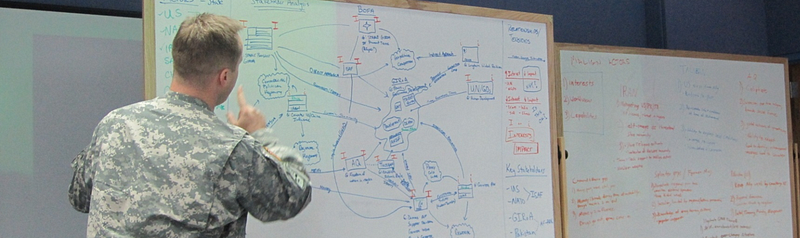
A Personal Reflection on Introducing Design to the U.S. Army


Teaching Systemic Design at the School of Advanced Military Studies in 2010, Kansas, Ft. Leavenworth.


In this blog, I explain how I accidentally became involved in a major transformation in U.S. military thinking, and reflect on some lessons from my experience.

This is a preprint of an article that will appear in the Journal of Military and Strategic Studies.
The Australian Army: Complexity Theory and Adaptive Campaigning

Every two years, the Chief of Army Exercise convenes the Australian Army’s Generals for professional deliberation. In 2006, there were three Exercise themes: mission command, a systems approach to problem solving, and the land-air partnership. The organizers of the Exercise, led by Colonel Damian Cantwell and Lieutenant Colonel David Wainwright, were also the authors of Adaptive Campaigning. Adaptive Campaigning was the Australian Army’s new capstone doctrine, which drew on insights from complex adaptive systems theory to address the challenges of complex warfighting.

As a defence scientist working deep in a defence research lab in Edinburgh, South Australia, receiving one of only three invitations to civilians to attend the Exercise was a rare opportunity to observe and interact with the top brass. At the time, I was leading a basic research project on complex adaptive systems for defence, while also completing my PhD thesis on a multidisciplinary approach to complex systems design. My Research Leader Anne-Marie Grisogono and I had contributed to the conceptual development of Adaptive Campaigning, and we were asked to help run a workshop on Systems Thinking.

7 November 2016

Gazing at a longer horizon

November 7, 2016

A national security doctrine, with political consensus, can prevent the unnecessary politicisation of national security issues. But is the government invested in drawing it up?

New Delhi’s decision to get back at Pakistan by raking up Balochistan in various global fora goes to demonstrate how tactical considerations continue to trump strategic thinking in India. New Delhi, under Prime Minister Narendra Modi’s stewardship, has displayed an exceptional, often admirable, amount of enthusiasm for foreign and security policy, and yet the country’s strategic thinking continues to be guided by bureaucratic ad hocism, tactical considerations, and political expediency.

Mr. Modi’s ‘energetic’ foreign policy has not gone significantly beyond catchy rhetoric and fanfare. Take, for instance, some of the early objectives of this government: neighbourhood first, selling India’s growth story globally, and getting Sino-Indian relations on track. Half-way through its term, most of these objectives lay in tatters. The Bharatiya Janata Party (BJP) leadership continues to argue that having completed over 50 foreign trips in this period, Mr. Modi has energised India’s foreign policy. But how does “energising” become a foreign policy achievement if policy and strategy are to be judged on the basis of outcomes, consistency and follow-up? Beyond these obvious issues, there is, however, a fundamental lacuna inherent in the country’s strategic behaviour and choices today: it functions without a grand strategic blueprint.

Boxed up in South Asia 

**** Explaining Mosul in Five Maps

OCTOBER 31, 2016
The Islamic State captured Iraq’s second largest city, Mosul, from the Iraqi government after a seven-day battle in June 2014. The US-backed Iraqi assault to recapture Mosul began with great fanfare on Oct. 18.
This piece will lay out the key things you need to know about the battle for Mosul in five maps.
But one thing cannot be expressed in maps. Already, the battle to take Mosul back has lasted longer than the battle IS fought to conquer it. IS is outmanned and outgunned in this fight, but it has dug in. It occupies a highly defensible position, and it is not going to retreat. This battle is not going to be a rout. It is going to be a bloody example of urban warfare.
The Battle for Mosul Begins

This map reveals three points about the coalition to retake Mosul. First, it shows how far Iraqi Security Forces and Kurdish peshmerga fighters have advanced. In the first few days, these fighters advanced quickly, until meeting stiffer Islamic State resistance roughly 10 to 25 miles outside the city. The coalition forces are still advancing, but their progress, especially approaching from the south, has been slowed significantly.
Second, it shows how far these forces have yet to go to reach the city—the battle will not begin in earnest until they do.
Third, it gives a sense of the anti-IS coalition’s strategy. Although there have been reports of Shiite militias heading west to cut off potential IS retreating points, those are unconfirmed at present, and the militias certainly don’t include the bulk of Iraq’s best fighters. The coalition is hoping that IS fighters will retreat from their positions and melt back into the desert, fleeing to their strongholds in Syria or becoming easy targets for airstrikes. IS is not likely to retreat—if it was going to, it would have done so already.

The second map in this series is a close-up satellite map of Mosul. Two key observations should be taken from this map.
First, you get a sense of just how messy this battle is going to be. Mosul is surrounded by the desert on most sides, and the fighting in the deserts and villages is going to pale in comparison to the fighting in the city once Iraqi troops enter. Mosul’s population is between 700,000 and 1.5 million. Every house and structure on this satellite map is a potential booby-trap, sniper’s den, or obstacle to an enemy’s advance.
Second, you can see how the battle is going to progress if it goes well for the coalition. Mosul is divided by the Tigris River. As Iraqi forces make progress coming from the south and east, IS will eventually retreat across the five bridges that link the two sides of the city. Those bridges will be major chokepoints, and IS could even opt to destroy them to slow the regime’s advance. Iraqi forces will be forced then to alter their approach to a siege and send troops around the other side or else take casualties in getting across those bridges.