9 November 2016

Report: China's Military Capabilities Are Growing at a Shocking Speed

November 7, 2016 

China’s military is developing ships, submarines, aircraft, intelligence systems and foreign bases in a bid to become a global military power, according to a forthcoming congressional China commission report.

The late draft of the annual report by the US-China Economic and Security Review Commission contains a chapter on Beijing’s power projection development and warns that once fully developed, the weapons and forces could contribute to a regional conflict in places like the South China and East China seas.

“China is building military capabilities to deal with hostile air, surface, and subsurface operational environments in the ‘far seas,’” the report states, noting that the operations expand the focus beyond the two island chains off China’s eastern and southern coasts.

The new military capabilities will “expand or improve the ability of the People’s Liberation Army to conduct a range of externally focused operations, to include combat insertion, island landing operations, humanitarian assistance/disaster relief operations, noncombatant evacuation operations, and peacekeeping missions,” states the report.

The report also warns that expanded military power projection capabilities could “also strengthen China’s traditional war-fighting capabilities against weaker neighbors.”

“Given its enhanced strategic lift capability, strengthened employment of special operations forces, increasing capabilities of surface vessels and aircraft, and more frequent and sophisticated experience operating abroad, China may also be more inclined to use force to protect its core interests,” the report says.

Deep Web: The ‘Dark’ Side Of Islamic State – Analysis

By Shahzeb Ali Rathore*
NOVEMBER 8, 2016

The so-called Islamic State (IS) is the most innovative terrorist group the world has seen. In the backdrop of its loss on the ground, IS is expanding its cyber capabilities to conduct more cyber-attacks and hacking. This and its migration into the ‘darknet’ will make IS more dangerous than before.

Terrorist and non-state actors have used different modes and mediums to spread their message and communicate with their comrades. The dawn of the Internet has also provided such groups with unparalleled opportunities to establish communications and operational links that were not possible before. Starting from websites, terrorist groups moved to more interactive mediums like chatrooms and forums. It was social media platforms, such as Facebook and Twitter that truly revolutionised how militants, terrorists and non-state actors communicated with each other, recruited sympathisers and supporters and disseminated their propaganda.

The self-proclaimed Islamic State (IS) perfected the use of social media, which became the preferred source for the so-called ‘jihadists’ or ‘soldiers of the Caliphate’. In response, tech companies have been compelled to take down Facebook and Twitter accounts affiliated with IS. The unintended cost of this policy is that supporters, sympathisers and members of jihadist groups have moved into the deep web and the darknet.
What is Deep Web and Darknet?

ISIS Can be Contained


Containment would place the burden of statehood on ISIS—forcing it to either moderate itself or risk implosion from within.

Two years in, the Obama administration’s strategy to “degrade and ultimately destroy” the Islamic State in Iraq and Syria (ISIS) has been criticized for its overall failure to articulate an ideal end state, especially for Syria. Despite a kill-ratio of “15,000-to-1,” tactical gains have not translated into strategic success. Critics contend that current efforts to defeat ISIS are unsustainable and ill-conceived given the half-measures employed. Yet, the more salient but neglected issue is what happens after the group’s demise. Even if ISIS is defeated, the cost of stabilizing former ISIS-controlled areas promises to outweigh the current commitment to destroy the group both in blood and treasure.

Indeed, in a region rife with sectarian conflict and poor governance, the rise of ISIS is a manifestation of state-failure in Syria and Iraq. This reality presents policymakers with a stark dilemma. Dislodging ISIS from Syria would only reopen a power vacuum that could possibly be filled by worse alternatives, but vacillating on ISIS would result in the caliphate's institutions becoming more entrenched and a rogue state more likely. With the growing certainty of Mosul’s liberation, the world optimistically anticipates Raqqa to be next.

But can Raqqa be the second Mosul? Given the complexity of the Syrian conflict, it is all the more necessary to reevaluate this strategy of annihilation which has dominated the policy discourse. Instead, a strategy of containment would seek to contest the fundamental nature of ISIS’ worldview by throwing down the gauntlet of de facto (but not de jure) statehood. Paralleling George Kennan’s 1947 formulation, containing ISIS in the Middle East today would recognize the multi-generational nature of this conflict and patiently maintain the territorial status quo against the group. Contra the preferred goal of driving ISIS out of Raqqa, containment challenges the group’s ideology by permitting it to run its full course and be found wanting in its areas of control. Two pathways are possible under this strategy. Licking its battle wounds, ISIS would either seek to re-consolidate its territorial control and moderate itself, or it would, in its revolutionary fervor, continue the struggle, thereby putting it at risk of implosion.

NATO Needs Realistic Goals Toward Russia

November 08, 2016

The next U.S. administration needs to recognize that the lack of consensus in Europe vis-à-vis Russia remains a key obstacle to crafting a workable strategy.

These days, Europe is a place where uncertainty seems to be the norm. Regional differences over how to deal with Russia are fast becoming enduring rifts, with fissures emerging across Europe’s political map. While this fragmentation could be blamed in part on the renationalization of politics across the continent, the most potent external factor is the resurgence of Russia and Europe’s inability to reach a consensus on how to respond to Moscow’s ambitions.

Russia’s pressure along NATO’s Eastern flank has generated different threat perceptions across Europe, and it continues to test the limits of allied solidarity. NATO’s response has so far addressed only partly the military dimension of this challenge, and absent a larger strategy, the current regime of rotational exercises and deployments may prove to be a temporary fix.

Europe’s internal divisions over how to respond to Russia’s challenge have stoked national resentments and reawakened historical narratives thought by many to be a thing of the past. This is bad news for NATO, for if this trend accelerates, there is a risk that the larger commitment to collective defense will be called into question.

So far, the debate over how to deal with Russia has not moved beyond the immediate need to augment deterrence and strengthen NATO defenses, and even this has been constrained by competing priorities and limited resources. NATO has not fully articulated the political dimension of its Russia strategy, for condemnations and expressions of outrage do not make it any more likely for Russia to return Crimea, which it annexed in March 2014, to Ukraine or terminate its operations in Syria.

Education In India: Skill Development Is The Key – Analysis

By Sudip Bhattacharyya* 
NOVEMBER 7, 2016

According to Hindu philosophy, everyone is born with the duty and obligation of ‘Pitririn’, ‘Rishirin’ and ‘Devarin’. The first means obligation to the family and ancestry, the second means obligation to the heritage and tradition and the last, formulated in modern terms, will boil down to obligation to the environment. The overall obligation is to repay more than what one has got so that the family, the heritage and the environment get more rich. And to be able to repay adequately, individuals need to be imparted required education and skill.

To the Western educated, the undertaking of education is necessary in a society to make a person productive so as to be useful to society and thereby earn his or her livelihood.

True education is one that is experienced, tasted and digested so that it becomes one with the blood, and not an external establishment. The central purpose of all education is that the nation as a whole should become self-sufficient in clear thinking and appropriate skills.

Most definitions of education essentially speak of building of character comprising sincerity, honesty and integrity and then acquiring skill in order to earn livelihood. It is really the parental education that can teach and help character-building whereas the institutional education does skill building. Responsibility towards the state and the nature are to be learnt in both the platforms.

‘Realists’ On Russia – Analysis

NOVEMBER 7, 2016

In the US, the establishment Foreign Policy.com (FP) isn’t as realist geared as its establishment counterpart The National Interest, which is affiliated with the Center For The National Interest (CFTNI).

The Thomas Graham-Matthew Rojansky October 13 FP article “America’s Russia Policy Has Failed“, is a prime example of US foreign policy establishment articulated realism. Ideally, realists don’t engage in hypocritically negative and inaccurate characterizations, that can be easily thrown back at the other party to an issue.

In their FP article, Rojansky and Graham highlight Russia as “undemocratic” and characterize “Russia’s aggression against Ukraine…”, while sidestepping the cavalier Western foreign policy establishment attitude towards the overthrow of the democratically elected Ukrainian President, Viktor Yanukovych, followed by a series of anti-Russian acts, that are opposed by a sizeable number on the territory of the former Ukrainian SSR. (On a comparative point, imagine FP accepting an article, that wrote of US aggression against Yugoslavia.)

The US government’s support for regimes less democratic than Russia puts into question the emphasis of portraying Russia as being undemocratic. For the better, (in terms of overall human rights) post-Soviet Russia isn’t the Soviet Union or Saudi Arabia. The democratic USA sees a mass media that regularly gives negatively inaccurate impressions of Russia. Those opposing that reality are subject to being caricatured and kept out of high profile situations.

Water scarcity Liquidity crisis


As water becomes ever more scant the world needs to conserve it, use it more efficiently and establish clear rights over who owns the stuff Nov 5th 2016 

“NOTHING is more useful than water,” observed Adam Smith, but “scarcely anything can be had in exchange for it.” The father of free-market economics noted this paradox in 18th-century Scotland, as rain-sodden and damp then as it is today. Where water is in ample supply his words still hold true. But around the world billions of people already struggle during dry seasons. Drought and deluge are a costly threat in many countries. If water is not managed better, today’s crisis will become a catastrophe. By the middle of the century more than half of the planet will live in areas of “water stress”, where supplies cannot sustainably meet demand. Lush pastures will turn to barren desert and millions will be forced to flee in search of fresh water.

Where water is available, when and in what condition matters hugely. About 97% of the water on earth is salty; the rest is replenished through seasonal rainfall or is stored in underground wells known as aquifers. Humans, who once settled where water was plentiful, are now inclined to shift around to places that are less well endowed, pulled by other economic forces. 

Climate change is making some parts of the planet much drier and others far wetter. As people get richer, they use more water. They also “consume” more of it, which means using it in such a way that it is not quickly returned to the source from which it was extracted. (For example, if it is lost through evaporation or turned into a tomato.) The big drivers of this are the world’s increased desire for grain, meat, manufactured goods and electricity. Crops, cows, power stations and factories all need lots of water.

Army assesses emerging tech to meet critical gaps

By: Mark Pomerleau
October 25, 2016

Part of the Army's planning to adapt to an increasingly contested and congested battle space involving a wide array of actors involves testing and evaluating how emerging technologies integrate with units. This was the thinking behind the Army Warfighting Assessment (AWA) 17.1, which began earlier this month.

Maj. Gen. Terry McKenrick, commander of the Army's Brigade Modernization Command, told C4ISRNET that AWA exercises seek to meet three key objectives or focuses — training for joint and multinational partners, improving interoperability with them, and continuing the assessment of concepts and capabilities for future forced development for the Army.

The exercise came out of the Network Integration Evaluations (NIE), which are focused on fielding and developing the mission command network out to the divisions and brigades across the Army over a number of years. McKenrick said the NIEs were somewhat of a restrictive environment as they don’t include joint or multinational partners given that their capabilities might be different and thus skew test results.

Understanding that the Army's joint deployments will always be relevant, McKenrick said they had to devise a training exercise with allies, in this case one focused more on innovation as opposed to integration, test and evaluation, as is the case with NIE. AWA, by contrast, will be examining innovative technologies and how they interoperate with units and partners in scenarios.

Army general: Don't just focus on 'the network'

By: Mark Pomerleau, 
November 2, 2016

The Army has been undertaking a significant effort focused on modernizing its information network, which provides a variety of services in the way of communication and online services, among others. The assistant program executive officer for operations, readiness and fielding at PEO C3T cautioned against taking a binary view of “the network.” 

“Let’s not talk just about 'the network,' " Gen. Karl Gingrich said, as the Army doesn’t view it as “the network.” 

Speaking during a panel discussion at the annual MilCom conference in Baltimore, Maryland, on Tuesday, Gingrich said the vision for PEO C3T is dominance through seamless mission command. By solely focusing on the network, it becomes a binary discussion — it’s either the network or not the network; the network’s on or the network’s up — he said, calling this a simplistic view. 

His shop ensures commanders at all echelons on the operational or tactical level all the way down to the squad leader have the ability to seamlessly execute mission command, he said, whether in involves air-ground, satellite-based terrestrial, voice or data. 

Gingrich said this is a joint effort and joint challenge, explaining that his team works tirelessly with the joint community to partner on numerous programs. 

Army's IT must be more maneuverable across domains


November 2, 2016 

Army's IT must be more maneuverable across domains

The Army's taking notice of the changing operational landscapes emerging. Part of this recognition involves the new push toward a multi-domain battle concept, one that recognizes the force must move beyond its traditional air-land battle to fight in air, land, littoral space and cyberspace.

This notion and recognition is where Army’s top leadership believes warfare is headed, William Lasher, deputy chief of staff, G6, Army Forces Command, said during a panel at the annual MILCOM conference in Baltimore Nov. 2. Lasher was referencing the rollout of the new battle concept at the annual AUSA conference in October. Multi-domain battle is substantially more complicated than air-land battle, he said.

The Army previously took steps toward such a construct as it recognized the need to build cyber capacity, Maj. Gen. John Morrison, commanding general of the Cyber Center of Excellence and commanding general at Fort Gordon, said at the same panel. The cyber forces provide organic cyber capabilities to enhance unified land operations.

Lasher explained that in the future adversaries will intentionally and frequently try to take down Army networks as an asymmetric means to undermine combat power. “We’re watching our adversaries do this in other areas,” he said.

The Dark Web isn’t all dark

NOVEMBER 2, 2016

Researchers who combed through the Dark Web, a portion of the internet masked by anonymizing software, found that a majority of the content there is legal. 

While the so-called Dark Web is often characterized as the digital domain for drug bazaars and illegal black markets, a new study indicates the majority of content available on this hidden portion of the internet is legal.

An analysis from from cybersecurity firm Terbium Labs that monitors Dark Web sites for stolen intellectual property or customer's personal data found that much of the Dark Web consists of ordinary sites, including graphic design services, personal blog posts, and Scandinavian political parties.

While criminals do take advantage of the Dark Web's cloak of anonymity, the study underscores its value for people and organizations that want to communicate without the risk of monitoring by government agencies on the open web.

The most commonly used tool for accessing Dark Web sites is the Tor anonymous web browser, which masks users' specific internet protocol addresses to hide their identity. Many of the hidden sites that Terbium analyzed aren't any less legal than destinations on the open web, which is much larger than the Tor network. 

According to the Tor Project, the nonprofit that manages the network, there are roughly 60,000 active Tor hidden services (or websites and chat services available only through the anonymous browser) as of Nov. 1. Terbium Labs analyzed 400 randomly chosen sites in its survey.

Cybersecurity news and analysis delivered straight to your inbox.

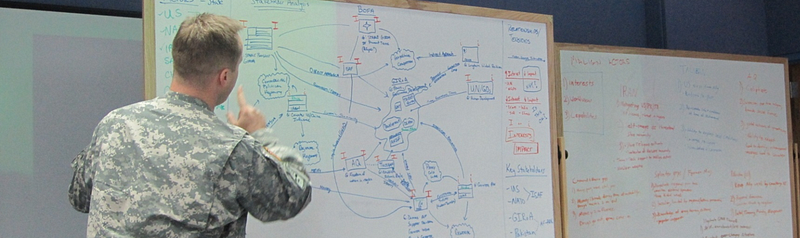
A Personal Reflection on Introducing Design to the U.S. Army


Teaching Systemic Design at the School of Advanced Military Studies in 2010, Kansas, Ft. Leavenworth.

In this blog, I explain how I accidentally became involved in a major transformation in U.S. military thinking, and reflect on some lessons from my experience.

This is a preprint of an article that will appear in the Journal of Military and Strategic Studies.
The Australian Army: Complexity Theory and Adaptive Campaigning

Every two years, the Chief of Army Exercise convenes the Australian Army’s Generals for professional deliberation. In 2006, there were three Exercise themes: mission command, a systems approach to problem solving, and the land-air partnership. The organizers of the Exercise, led by Colonel Damian Cantwell and Lieutenant Colonel David Wainwright, were also the authors of Adaptive Campaigning. Adaptive Campaigning was the Australian Army’s new capstone doctrine, which drew on insights from complex adaptive systems theory to address the challenges of complex warfighting.

As a defence scientist working deep in a defence research lab in Edinburgh, South Australia, receiving one of only three invitations to civilians to attend the Exercise was a rare opportunity to observe and interact with the top brass. At the time, I was leading a basic research project on complex adaptive systems for defence, while also completing my PhD thesis on a multidisciplinary approach to complex systems design. My Research Leader Anne-Marie Grisogono and I had contributed to the conceptual development of Adaptive Campaigning, and we were asked to help run a workshop on Systems Thinking.

FINDING ROOM FOR FAILURE IN THE PENTAGON

NOVEMBER 2, 2016

Mike Grimm’s first startup had just failed. He’d just blown his entire annual budget in a single day. His sole investor wasn’t happy.

Mike was a mid-level manager in the army, a major. He was responsible for planning and resourcing training events for army forces stationed in Hawaii. His “investor” was his boss, the commander of all army forces in the state. Mike’s “startup” was really an idea.

It was 1977. A spate of terrorist attacks and hostage crises had rocked the world over the past several years. Like most innovators, Mike’s idea was borne of a problem — one that he had the imagination to solve. He was a helicopter pilot, yet Mike could see that helicopters weren’t relevant to this new type of conflict. Terrorist attacks and hostage crises unfolded over mere hours, often on far-flung corners of the globe. Helicopters were slow and carried little fuel, making it impossible for them to reach a remote crisis before it was too late.

Mike wanted to make helicopters relevant again, by training crews to load their helicopters on airplanes for transport to distant locales, where they would rapidly unload, reorient themselves, and fly ground troops to conduct precise rescue missions.

With the fearless aplomb of of an entrepreneur, Mike planned a complex, unprecedented training event to demonstrate his concept — a dramatic, simulated hostage rescue on another of Hawaii’s islands. He pitched his idea to disparate groups, convincing an Air Force squadron to provide transport airplanes and a local infantry unit to act as the rescuers. With short notice, the helicopter crews and rescue force would be alerted to the breaking “crisis.” With minimal time to plan, the helicopters, crews, and rescue force would load onto transport aircraft and fly to an airfield on the embattled island. There, they would quickly unload, reorganize with the ground troops on the helicopters, and fly to the hostages’ remote location for the thrilling rescue.

How Effective is Your Leadership Narrative?

By: Drew Steadman
NOVEMBER 13, 2015

This guest post is from Drew Steadman, who created the top online resource for military professionals to develop their leadership skills. Read more from Drew at The Military Leader or follow him on Twitter @mil_Leader

What methods are best for inspiring the team after failure?

How long are you willing to wait for information after an initial report?

How long should a leader wait before jumping in to resolve internal team conflict?

What kind of failure would cause you to relieve a subordinate?

When is micromanagement appropriate?

And one more question:

How did you meet your spouse?

The last question should be much easier to answer. Why is that? It’s not like the other questions aren’t important. They’re just a bit nebulous, contextual, and abstract…and you probably don’t think about them very often.

The story of meeting your spouse, however, is clear, memorable, and specific. You lived the experience with anticipation and emotion permanency, recounting the story many times since. You know how to tell that story, complete with suspense and inflection to make it enjoyable. It’s a familiar narrative.

How Army's Archaic Evaluation System is Hurting the Service

November 2, 2016

There is an old saying that generals prepare for the last war they fought.

For the past decade and a half, the U.S. has been fighting a war in the Middle East against a lesser adversary, an enemy that in no way parallels the United States’ military might.

As cyber becomes more prominent and Russia flexes its muscles in Europe, Defense Secretary Ash Carter and senior military leaders realize the enemy is changing, which is why they are signaling for a shift in the talent makeup in the military.

The Army’s guidance given to promotion boards in 2016 reflected Carter’s call for a different kind of soldier; one that is creative and has advanced civilian degrees and broad experiences.

In that case, it would seem that Capt. Jim Perkins, executive director of the Defense Entrepreneurs Forum, an innovation engine of emerging defense leaders, would be a shoe-in for promotion. Perkins, also earned his M.B.A. from Georgetown University while in the Army.

Not only is he a high achiever, but he’s willing to pass up a much higher salary in the private sector in order to serve the public good.

As part of Federal News Radio’s special report The Army is Shortchanging its Future Force, Perkins said his experience is one example of how the Army is forcing out talented, promising and innovative officers from its ranks.

There are systemic and cultural issues keeping Perkins and his peers from being promoted.

Developing a Learning Institution: Entrenched Culture, Building the Foundation, and Asking the Right Questions

November 2, 2016

Developing a Learning Institution: Entrenched Culture, Building the Foundation, and Asking the Right Questions

Introduction

Contemporary management literature espouses the need for an organization to be agile, adaptable, and flexible. Many organizations are trying to figure out how to best adapt to become the coveted learning institution that can learn from its mistakes and continually improve in the face of changes in the operating environment. I think the answer lies in applying the principles that make a military successful in defeating a counterinsurgency to the business environment. Successful counterinsurgency campaigns require that a military becomes a learning institution, which means the same methods used by militaries to successfully combat a counterinsurgency can be replicated (with some modifications specific to the business environment) in any organization. Before addressing the principles of counterinsurgency, it is first necessary to understand the challenges associated with shifting an organization into a learning institution. The biggest hurdle in the development of a learning organization is an entrenched culture. Once one understands what leads to an entrenched culture one can then work on the application of counterinsurgency principles to improve his/her organization and turn it into a learning institution.

Entrenched culture is well known to many leaders and is something that exists in every organization. Entrenched culture acts as a roadblock in the face of an attempt at organizational change. Jack Welch, former CEO of General Electric captures the idea of an entrenched culture as follows:

In big companies calls for change are often greeted with a nice head fake. People nod at your presentations and pleasantly agree that, given all the data, it sure looks like change is necessary. Then they go back to doing everything they always did. If the company has been through enough change programs, employees consider you like gas pains. You’ll go away if they just wait long enough.[i]

8 November 2016

*** Here’s How the Pentagon Wants to Use Social Media On the Battlefield

BY PATRICK TUCKERREAD BIO
OCTOBER 28, 2016

Artificial intelligence will weave open-source and satellite data into useful intelligence in real time, the Pentagon’s No. 2 says.

It still takes the U.S. military too long to turn social media and other open-source information into something that operators in the field can use. Artificial intelligence is going to change that, and give U.S. troops a distinct battlefield edge, says U.S. Deputy Defense Secretary Bob Work.

Take the 2014 downing of Malaysian flight MH17 over Ukraine. (A conventional investigation by a European Union Joint Investigation Team took more than a year to affix blame to pro-Russian separatists operating a Russian-made BUK surface-to-air missile.) To test the current state of machine learning applied to open source intelligence, the Pentagon hired a data integration and geospatial intelligence company called Orbital Insight, a big-data analytics company with a focus on satellite imagery and geospatial data. Most of their business is commercial — for example, they, analyze pictures of parking lots from space topredict holiday sales trends.

The company quickly scanned all available open-source media and assembled a picture of evidence, and did it instantly. He used slides to tell the story to an audience at the Center for Strategic and International Studies: “On the lower left is a Twitter shot ofMH17 taking off…The next one comes from ParisMatch.com. It is the picture of the Russian SA-11 launcher with a serial number on it, date and time stamped near the village where the shootdown occurred; then on Bellingcat.com, the exact sameSA-11, at the exact same location. Then there’s a Twitter shot of a contrail of a missile rising at the time of the shootdown. Then a rebel leader takes credit for the shoot down on VK.com. That was immediately taken down, by the way. Finally on YouTube, there’s a picture of the exact same SA-11 with a missile rail that is now mysteriously empty going back into Russia. Learning machines did this without any human interaction.”

*** Trade vs Terror: Time for China to Choose

By Sanjay Kumar Kar
07 Nov , 2016

India-China relations have been severely impacted by China’s open support for Pakistan on many fronts. One of the important areas where China seems to be least worried is cross-border terrorism affecting countries like India and Afghanistan. India has been a victim of cross-border terrorism for many years — the most recent being the September 18, 2016 Uri attack sponsored by its neighbouring country Pakistan. 

China’s stand on terrorism is baffling and it pains India more than any other country. New Delhi has been pressing the United Nations (UN) to declare Jaish-e-Mohammed chief Masood Azhar — operating from Pakistan — as an international terrorist who poses serious threat to humanity and disrupts peace and tranquility in the subcontinent. Unfortunately, Beijing has consistently blocked the Indian move. On technical ground, China has succeeded twice in delaying the UN’s decision on Masood Azhar.

China’s deliberate tactics of blocking India’s progress in international fora is quite evident. In June 2016 at Seoul, Beijing successfully blocked New Delhi’s bid for membership of the Nuclear Suppliers Group (NSG).

Pakistan may be China’s natural ally but India is one of the biggest trade partners of China. While China-Pakistan total trade stood at $12 billion in 2014-15, China-India trade was valued at $72 billion in the same year. During the period under consideration, China’s export value to Pakistan reached just $10 billion compared to export value of $60.4 billion to India. In short, for all practical purposes, India is 6 times valuable for the Chinese economy than Pakistan.

*** The future is now: How to win the resource revolution

By Scott Nyquist, Matt Rogers, and Jonathan Woetzel

Although resource strains have lessened, new technology will disrupt the commodities market in myriad ways.

A few years ago, resource strains were everywhere: prices of oil, gas, coal, copper, iron ore, and other commodities had risen sharply on the back of high and rising demand from China. For only the second time in a century, in 2008, spending on mineral resources rose above 6 percent of global GDP, more than triple the long-term average. When we looked forward in 2011, we saw a need for more efficient resource use and dramatic increases in supply, with little room for slippage on either side of the equation, as three billion more people were poised to enter the consumer economy.

While our estimates of energy-efficiency opportunities were more or less on target, the overall picture looks quite different today. Technological breakthroughs such as hydraulic fracturing for natural gas have eased resource strains, and slowing growth in China and elsewhere has dampened demand. Since mid-2014, oil and other commodity prices have fallen dramatically, and global spending on many commodities dropped by 50 percent in 2015 alone.

Even though the hurricane-like “supercycle” of double-digit annual price increases that prevailed from the early 2000s until recently has hit land and abated, companies in all sectors need to brace for a new gale of disruption. This time, the forces at work are often less visible and may seem smaller-scale than vertiginous cyclical adjustments or discovery breakthroughs. Taken together, though, they are far-reaching in their impact. Technologies, many having little on the surface to do with resources, are combining in new ways to transform the supply-and-demand equation for commodities. Autonomous vehicles, new-generation batteries, drones and sensors that can carry out predictive maintenance, Internet of Things (IoT) connectivity, increased automation, and the growing use of data analytics throughout the corporate world all have significant implications for the future of commodities. At the same time, developed economies, in particular, are becoming ever more oriented toward services that have less need for resources; and in general, the global economy is using resources less intensively.

*** Russia Falls Into Old Habits

25 October 2016

Nearly 10 years ago, Stratfor published a series on Russia's historical boom-and-bust cycle. At that time, Russia was clearly at the height of a boom, rebuilding itself into a stable and robust power. Today, the country is quickly descending into the next, less pleasant stage. The strategy that revitalized the country is becoming less effective, forcing Russia and its leaders to act more aggressively at home and abroad.

Though still assertive, Russia is no longer acting from a position of strength. The country may maintain some semblance of strength for years to come, but its fragility will eventually become apparent, forcing it into the next phase of the cycle.

Geography's Role in Russian History

For nearly eight centuries, Russia has been trapped in a loose cycle: It rises from chaos, returns as a regional and sometimes even global power, grows aggressive as the system cracks, and then collapses before rising again. The cycle is less about political choice than it is about geographic constraints. Geographically speaking, Russia is operating from an inherently weak position. It is the largest country in the world, covering roughly 13 time zones (split now into four mega-zones). Yet 75 percent of the country is virtually uninhabitable frozen tundra that becomes marshland in the summer, making domestic trade extremely difficult. Maritime trade is also difficult for Russia, given that its only warm-water port, on the Black Sea, is blocked by rivals, including Turkey. Therefore, the country has struggled to develop economically.

*** How Army’s archaic evaluation system is hurting the service

November 1, 2016 

There is an old saying that generals prepare for the last war they fought.

For the past decade and a half, the U.S. has been fighting a war in the Middle East against a lesser adversary, an enemy that in no way parallels the United States’ military might.

As cyber becomes more prominent and Russia flexes its muscles in Europe, Defense Secretary Ash Carter and senior military leaders realize the enemy is changing, which is why they are signaling for a shift in the talent makeup in the military.

The Army’s guidance given to promotion boards in 2016 reflected Carter’s call for a different kind of soldier; one that is creative and has advanced civilian degrees and broad experiences.

In that case, it would seem that Capt. Jim Perkins, executive director of the Defense Entrepreneurs Forum, an innovation engine of emerging defense leaders, would be a shoe-in for promotion. Perkins, also earned his M.B.A. from Georgetown University while in the Army.

Special Report Overview

Not only is he a high achiever, but he’s willing to pass up a much higher salary in the private sector in order to serve the public good.

As part of Federal News Radio’s special report The Army is Shortchanging its Future Force, Perkins said his experience is one example of how the Army is forcing out talented, promising and innovative officers from its ranks.

*** Barack Obama, Neutral Nets, self driving cars and future of the world


Joi Ito, Scott Dadich, and President Barack Obama photographed in the Roosevelt Room of the White House on August 24, 2016. 

IT’S HARD TO think of a single technology that will shape our world more in the next 50 years than artificial intelligence. As machine learning enables our computers to teach themselves, a wealth of breakthroughs emerge, ranging from medical diagnostics to cars that drive themselves. A whole lot of worry emerges as well. Who controls this technology? Will it take over our jobs? Is it dangerous? President Obama was eager to address these concerns. The person he wanted to talk to most about them? Entrepreneur and MIT Media Lab director Joi Ito. So I sat down with them in the White House to sort through the hope, the hype, and the fear around AI. That and maybe just one quick question about Star Trek. —SCOTT DADICH

SCOTT DADICH: Thank you both for being here. How’s your day been so far, Mr. President?

BARACK OBAMA: Busy. Productive. You know, a couple of international crises here and there.

DADICH: I want to center our conversation on artificial intelligence, which has gone from science fiction to a reality that’s changing our lives. When was the moment you knew that the age of real AI was upon us?

November 2016. Subscribe to WIRED.

OBAMA: My general observation is that it has been seeping into our lives in all sorts of ways, and we just don’t notice; and part of the reason is because the way we think about AI is colored by popular culture. There’s a distinction, which is probably familiar to a lot of your readers, between generalized AI and specialized AI. In science fiction, what you hear about is generalized AI, right? Computers start getting smarter than we are and eventually conclude that we’re not all that useful, and then either they’re drugging us to keep us fat and happy or we’re in the Matrix. My impression, based on talking to my top science advisers, is that we’re still a reasonably long way away from that. It’s worth thinking about because it stretches our imaginations and gets us thinking about the issues of choice and free will that actually do have some significant applications for specialized AI, which is about using algorithms and computers to figure out increasingly complex tasks. We’ve been seeing specialized AI in every aspect of our lives, from medicine and transportation to how electricity is distributed, and it promises to create a vastly more productive and efficient economy. If properly harnessed, it can generate enormous prosperity and opportunity. But it also has some downsides that we’re gonna have to figure out in terms of not eliminating jobs. It could increase inequality. It could suppress wages.

*** Responding to China's Strategic Use of Combined Effects


October 26, 2016

China is wielding superior strategies that envelop opponents with expedient instruments of national power. Drawing from a rich tradition of comprehensive and indirect stratagems, Chinese leaders use a variety of methods notably absent in US strategy.

The core of Chinese strategy consists of combining preventative and causative effects, such as defend and coerce, deter and compel, dissuade and persuade, secure and induce. By combining these different effects, China forces others into disadvantageous outcomes. This paper reveals Chinese strategy as complex forms of confrontation and cooperation, and recommends a countervailing US strategy of combined effects.

Chinese strategy is based on simple distinctions that produce complex warfare. The operating logic is this: psychological and physical tools target an actor’s will and capability to create complex effects difficult to counter. In psychological confrontation, China intimidates will and neutralizes capability to Deter – Compel. In psychological cooperation, China assures will and enhances capability to Dissuade - Persuade. In physical confrontation, China punishes will and denies capability to Defend - Coerce. In physical cooperation, China demonstrates will and exercises capability to Secure – Induce. These differences create inexhaustible permutations.

Using this language, we examine variants of combined effects that the People’s Republic of China (PRC) has constructed to secure its territorial integrity. The cases involve 16 border disputes since the PRC’s founding in 1949. Overall, China’s pattern is to lead with inducement and follow up with other effects to isolate, divide and force accommodation by its intended targets.

In order to compete with China’s multiple effects, the U.S. needs offsets that integrate advanced technologies into synergistic strategies. Superior weapons technology is not enough. To prevail against China’s comprehensive strategy, American military power needs to contribute to the sustainment of combined effects. This is no simple feat for any government, but it has been a chronic challenge for pluralistic democracies to pull off. US national security strategy needs to organize its fragmented national capabilities into flexible lines of effect. 

** Sticks and Stones

By Jacob L. Shapiro
Nov. 4, 2016

The U.S. has faced some tough words from foreign leaders of late, but does it matter?

It wouldn’t be a normal day in the Philippines if President Rodrigo Duterte weren’t finding new and inventive ways to insult the United States. Two days after the U.S. State Department said it would halt the sale of 26,000 assault rifles to Philippine police forces on account of opposition in the Senate, Duterte said in a televised speech: “Look at these monkeys, the 26,000 firearms we wanted to buy, they don’t want to sell. Son of a bitch, we have many home-made guns here. These American fools.”

Philippine President Rodrigo Duterte is surrounded by the media as he answers questions following his inspection of Japan's coast guard drills in Yokohama on Oct. 27, 2016. 

Every time Duterte says something like this, the headlines the following day are easy to predict. The U.S. is losing an ally in the important Asia-Pacific region. U.S. power is eroding before the world’s eyes. China looks like the dominant power of the region. And then the news cycle runs its course, and Duterte is quiet for a few days, and the U.S. and the Philippines continue to cooperate like two allies who have had a Mutual Defense Treaty for the last 65 years, until Duterte says something again and the cycle repeats itself.

Duterte is the prototypical anti-U.S. politician right now, but the U.S. has plenty of relationships with countries whose leaders have insulted the United States. Consider the U.S. relationship with one of its most important allies in the world: Turkey. After the failed military coup in Turkey, President Recep Tayyip ErdoÄŸan purged many sectors of society. The U.S. criticized Turkey for this, and ErdoÄŸan fired back by pointing a finger at the United States, claiming Washington was behind the coup.

** One Wonders: It Happens Only in India !!

By Lt Gen Gautam Banerjee
05 Nov , 2016
http://www.indiandefencereview.com/news/one-wonders-it-happens-only-in-india/

It is said that morale makes a soldier, sailor and airman victorious against extreme and unforgiving odds. Therefore it comes as a surprise that while the Indian state finds Pakistan as an enemy state and China as an adversarial one, and remains tormented by an unending succession of internal revolts, the Ministry of Defence of the Government of India leave no limits breached in serving the cause of these inimical forces to de-motivate the Indian soldiery – the term ‘soldiery’ here bring synonymous to the warriors in the three Services. In so doing, the defence bureaucracy takes advantage of cluelessness, and perhaps carelessness, of their political bosses – the Defence, Finance and the Prime Ministers – to stir up mischief that must be unthinkable against the pristine majesty of the state.

Simple facts, dismaying no end, are illustrative. But the import of these may be truly appreciated only when tested against the principles of just governance. These principles recognise the salience of the final effects on the ground, and on the people, rather than motivated interpretations of rules and partisan trickery with rules, regulations and procedures. The defence bureaucracy’s abuse of such principles, just to keep the military institution in a perpetual state of professional and social starvation, is actually out of tune with the modern trends that have been adopted in all other Ministries. The urge to perpetuate that state of affairs is so compelling that even the interventions of the nation’s apex Court are brazenly diverted and deflected without compunction. But the main concern here is that the partisan trickeries being played in all of the Departments of the Ministry of Defence and its Finance Division relate to military morale and its culture of ‘nation-before-self’ that is fundamental to India’s power to protect her sovereignty and integrity as a nation-state, and that takes generations to build but just few acts of dishonesty to destroy.

Reams have been written in the media about the machinations and intrigues, and exposure of the defence bureaucracy’s subversion of the well being of the Indian soldiery. Therefore, just certain indicators should suffice to point out as to how the soldiery is being purposefully pushed into a sense of cynicism against the state it fights for, cynicism that could poison its so far invincible nationalist fervour. Consider the following representative examples, that ‘it happens only in India’:-

What Borrowing Trends Say About the German Economy

By Antonia Colibasanu

German businesses are relying less on external funding.

This week began with the release of numerous positive monthly statistics for the German economy. The Munich-based Ifo Institute’s latest German business climate index noted that business managers’ optimism has risen, considering that the index value for October is not only higher than last month but at its highest level in more than two years. At the same time, the Purchasing Managers’ Index, compiled by IHS Markit and used by the European Central Bank to assess the health of the region’s economy, indicated an accelerated increase in German business activity in October compared to September.

German Chancellor Angela Merkel speaks at the Christian Democratic Union Economics Conference of the Economic Council on June 09, 2015 in Berlin, Germany. The Economic Council (Wirtschaftsrat der CDU e.V.) is a German business association representing the interests of more than 11,000 small- and medium-sized firms, as well as larger multinational companies. Axel Schmidt/Getty Images

In addition, the Cologne Institute for Economic Research forecast that German exports to the U.K. will fall by just 6 percent next year due to the devaluation of the pound in relation to the euro following Brexit and that this decline will only marginally affect Germany’s economic performance in 2017. Lastly, the German development bank KfW released its latest report on the German middle class and small- and medium-sized enterprises (SMEs) on Oct. 25. It noted not only that the middle class is in “excellent shape” but that SMEs are continuing their strong performance, with stable sales growth of 3.3 percent and an equity ratio of 30 percent. All these developments seem to indicate that Germany has again become the driving force of the European economy.

Pakistan's polity doesn't have capacity to sustain normal ties with India

Shivshankar Menon
Nov 04, 2016

On whether he sees any prospect for resolution of the Kashmir issue, Menon, who has been India's High Commissioner to Pakistan, replied in the negative.

NEW YORK: Pakistan's polity does not have the capacity to sustain a normal relationship with India, former foreign secretary and national security advisor Shivshankar Menon has said as he characterized relations between the two nuclear-armed neighbors as "managed hostility". 

"I would characterize (India-Pakistan relations) today as managed hostility, which I hope it stays managed," Menon said in response to a question on relations between the two nations at a panel discussion organised by the 'South Asia centre at New York University' here yesterday. 

On whether he sees any prospect for resolution of the Kashmir issue, Menon, who has been India's High Commissioner to Pakistan, replied in the negative. 

He said many of the issues relating to Kashmir have been around for a long time and "we know the solutions" to many of them but they seem to be "politically difficult" to serve. 

"Today I don't think Pakistan's polity has the capacity to sustain a normal relationship with India. I think there is a very strong institutional interest there," he said. 

Menon, who has authored the book 'Choices: Inside the Making of Indian Foreign Policy', however added that his "fear" is that if "it becomes a party political issue in India, which it has not always been, then you have the same dynamic operating." 

He emphasized that expectations in India on any improved relations with Pakistan are "very very low" particularly after the 26/11 Mumbai attacks. 

Getting a Grip on Issues Regarding Forward Areas

By Claude Arpi
07 Nov , 2016

Whether senior or junior, bureaucrats serving in the ministries of Defence, Home Affairs and Finance, should spend a weekend every month in the border areas. It should be seen as a ‘refresher course’

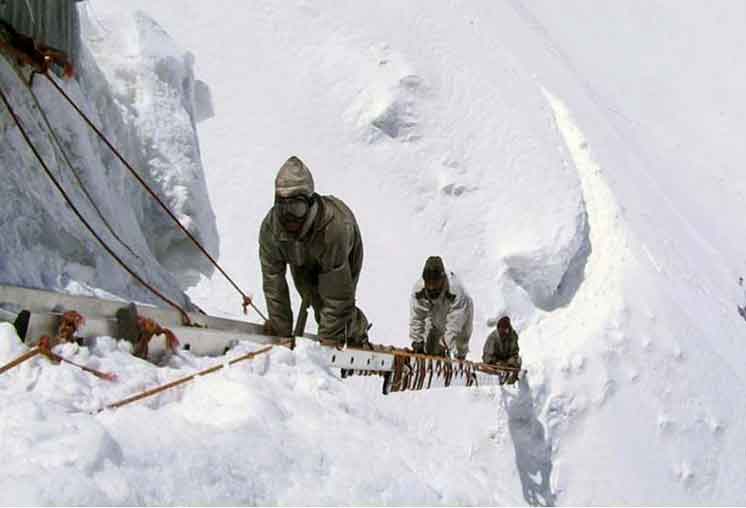
Something made my Diwali special this year: Prime Minister Narendra Modi spent the day with officers and jawans of the Indian Army, the Indo-Tibetan Border Police Force (ITBPF) and the Dogra Scouts who man the Tibet-India border in Kinnaur and Lahaul-Spiti districts of Himachal Pradesh.

The borders have always been neglected by Indian politicians, mostly busy preparing for the next election in their constituencies. It is truly a positive development to see the Prime Minister visiting the borders.

Though it was announced that Modi would be with the ITBPF at the Mana border post in Uttarakhand’s Chamoli district, he finally went to Kinnaur. Probably for security concerns, a diversionary announcement was made.

After landing at Chango, an Army and ITBP camp in Lahaul-Spiti, the Prime Minister travelled to Sumdo in Kinnaur district, where he distributed sweets to the jawans: “Our forces endure grave hardships for our security. If we remember them while being in a festive mood, our remembrance will give them strength and renewed energy”, he declared.