16 February 2023

Don’t Neglect ‘Small-Data’ AI

VINCENT CARCHIDI

Much hand-wringing has attended the notion that China has a “natural advantage” in the race to develop artificial intelligence because, as an autocratic state that casts a wide digital net, it is better placed to gather the vast swaths of data needed to train machine-learning models.

But big-data AIs are not the only AIs—and indeed, they may prove too data- and energy-intensive to undergird safe, reliable, and trustworthy AI-enabled defense technologies. Several new “small data” approaches promise better, quicker results—if the Pentagon ensures that they are not starved for funding in the race.

This was becoming apparent as far back as 2017. “The appropriate operational data can be difficult to obtain or lacking,” wrote Elsa Kania at the Center for a New American Security. "Even obtaining a comprehensive dataset to account for one’s own military is challenging.”

Regulate military use of emerging tech before ‘Armageddon,’ new report urges

JASPREET GILL

WASHINGTON — The US and other nations risk global catastrophe is they do not adopt a new overarching framework to regulate disruptive technologies like artificial intelligence, autonomy, robotics, cyberweapons and hypersonic missiles, a new report from the Arms Control Association warns.

The report, released Tuesday [PDF], says that without adopting such measures, “cutting-edge technologies will be converted into military systems at an ever-increasing tempo, and the dangers to world security will grow apace.

“A more thorough understanding of the distinctive threats to strategic stability posed by these technologies and the imposition of restraints on their military use would go a long way toward reducing the risks of Armageddon,” according to the report.

The report lays out the challenges with emerging technologies and calls out the Defense Department on its shortfalls surrounding its recent AI guidelines. It specifically points to how DoD failed to incorporate department-wide implementation of AI regulation procedures in its AI “ethical principles” and “merely reiterated the principles principles incorporated into the original guidelines and attached a blueprint for further action by DoD agencies” in its Responsible AI Strategy.

Is Google’s 20-year dominance of search in peril?


Near the bay in Mountain View, California, sits one of the biggest profit pools in business history. The site is the home of Google, whose search engine has for two decades been humanity’s preferred front door to the internet—and advertisers’ preferred front door to humanity. Every second of every day, Google processes perhaps 100,000 web searches—and, thanks to its clever algorithm, serves up uncannily relevant answers. That power has turned Google into a verb. It also opens up billions of daily opportunities to sell ads alongside the answers to searchers’ queries. The results’ accuracy keeps users coming back, and rivals at bay: all other search engines combined account for barely a tenth of daily searchers.

SpaceX didn’t intend that Starlink be ‘weaponized’ by Ukraine: Shotwell

THERESA HITCHENS

WASHINGTON — The Ukraine military’s use of SpaceX’s Starlink internet communications service as a weapon system in its war with Russia was something the company neither foresaw or agreed to, SpaceX President Gwynne Shotwell said today.

“We were really pleased to be able to provide Ukraine connectivity, and help them in their … fight for freedom. It was never intended to be weaponized, however,” she told the 25th Annual FAA Commercial Space Transportation Conference here today.

“The Ukrainians have leveraged it in ways that were unintentional and not part of any agreement. So you know, we have to work on that [with] Starlink. You offer a commercial product by connectivity to people which is helpful in conflict, but you also want to be careful of how they use it,” she added. “On the other hand, they’re trying to fight for their country, so I understand it. The thing is, it’s not what was intended.”

“It’s Not Possible for Me to Feel or Be Creepy”: An Interview with ChatGPT


Between Christmas and New Year’s, my family took a six-hour drive to Vermont. I drove; my wife and two children sat in the back seat. Our children are five and two—too old to be hypnotized by a rattle or a fidget spinner, too young to entertain themselves—so a six-hour drive amounted to an hour of napping, an hour of free association and sing-alongs, and four hours of desperation. We offered the kids an episode of their favorite storytelling podcast, but they weren’t in the mood for something prerecorded. They wanted us to invent a new story, on the spot, tailored to their interests. And their interests turned out to be pretty narrow. “Tell one about the Ninja Turtles fighting Smasher Venom, a villain I just made up who is the size of a skyscraper,” the five-year-old said. “With lots of details about how the Turtles use their weapons and work together to defeat the bad guy, and how he gets hurt but doesn’t die.” My wife tried improvising a version of this story; then I tried one. The children had notes. Our hearts weren’t in it. It was obvious that our supply of patience for this exercise would never match their demand. Three and a half hours to go.

My wife took out her phone and opened ChatGPT, a chatbot that “interacts in a conversational way.” She typed in the prompt, basically word for word, and, within seconds, ChatGPT spat out a story. We didn’t need to tell it the names of the Teenage Mutant Ninja Turtles, or which weapons they used, or how they felt about anchovies on their pizza. More impressive, we didn’t need to tell it what a story was, or what kind of conflict a child might find narratively satisfying.

Sharper: Critical Technology

Anna Pederson and Sam Howell

Critical technologies promise to upend traditional understandings of national security, economic prosperity, and everyday life. Artificial intelligence, semiconductors, quantum information technologies, biotechnologies, and related technology areas are applicable to a range of industries, from defense and logistics to agriculture and medicine. These technologies, which afford nation-states new tools and vulnerabilities, have become a crux of U.S.-China competition, and a prominent part of cooperation and contention with allies and partners. CNAS experts are sharpening the conversation around the policy challenges associated with critical technologies and how the United States. can maintain its technological superiority in the digital age. Continue reading this edition of Sharper to explore their ideas and recommendations.

Features

DoD Autonomous Weapons Policy

In January, the U.S. Defense Department (DoD) released an updated version of its policy on autonomous weapons, DoD Directive 3000.09, Autonomy in Weapon Systems. This was the first major policy update since 2012. In this CNAS Noteworthy, Vice President and Director of Studies Paul Scharre breaks down the new Directive and what it means for the U.S. military’s approach to lethal autonomous weapon systems. Dr. Scharre led the DoD working group that drafted the original DoD directive 3000.09 in 2012.

Opinion – Chat GPT and IR: Preliminary Reflections from within ‘Dark Academia’

Felix Mantz

Since appearing seemingly out of nowhere, ChatGPT has quickly risen to fame among teachers, lecturers, and professors across Western academia. While students to date seem mostly unaware of the technology and there are serious doubts over its effectiveness, ChatGPT now dominates numerous conversations among colleagues, department meetings, and ‘special discussion sessions’ across university spaces. This rapid emergence of ChatGPT has provoked a range of reactions among academics, spanning from excitement, curiosity, and techno-fetishism, to concern, anxiety, and existential worry about the future of academia and its disciplines. Among the more sceptical reactions from within the social sciences, including Political Science and International Relations, one key issue seems to be the question of student assessment: ‘If we cannot know whether essays are produced by students or computers, how can we meaningfully assess learning?’ Or more specifically, ‘How can we catch those who want to use ChatGPT to trick “the system”?’

My initial reaction was to reflect on how these questions might affect the introductory International Relations courses I teach this semester. While much of the overall grade students receive (45%) is through in-class presentations, activities, and participation – i.e. forms of assessment for which ChatGPT seems to be less of an issue – the other 55% of the grade is determined through essays. In other words, some students might be able to use ChatGPT to produce, submit, and receive a grade for these essays. Aside from being unsure how to prevent students from using ChatGPT or how to ‘catch’ those who do, I am not sure I am very interested in doing so in the first place.

Building guardrails for ChatGPT

Michael J. Ahn and Yu-Che Chen

The recent release of GPT-3, the state-of-the-art language model developed by OpenAI, has sparked a renewed interest in chatbot technology. One of the most notable developments in this area is ChatGPT, a chatbot that utilizes GPT-3 to perform a wide range of language tasks, such as text generation, language translation, text summarization, and conversation simulation. In its current form, ChatGPT has the potential to revolutionize the way we interact with technology, offering a wide range of applications from computer coding, customer service, and virtual assistants to language translation and content creation.

One of the key advantages of ChatGPT over traditional search engines is its ability to provide contextualized and processed information. ChatGPT can understand the context of a search query and provide results that are relevant and specific to the user’s needs by using natural language processing techniques. It can also interpret the intent behind a user’s query, even if it is phrased in a casual or conversational way, which makes it easier for users to ask questions and get the information they need.

Traditional search engines have been around for a long time and have a vast amount of pre-existing and real-time data indexed, and their sophisticated algorithms typically provide a ranked and vast list of search results that their users should process themselves. ChatGPT processes a vast amount of information and provides its users with information that is tailored to the users’ needs, intentions, and contexts. The understanding of the context of questions represents a valuable advance that is relatively accurate and, in the short time people have been using it, appears to open a new chapter in information search for the future.

Deterrence and Military Strategy in the Indo-Pacific: Time to Revitalize Strategic and Operational Concepts

Lt. Gen. Wallace ‘Chip’ Gregson (USMC, ret.)

After an eventful December and January, the defense and security policies of the United States and Japan are being upgraded, and look to be solidly set for the pacing threats of the era. In December, Japan formally published its new National Security Strategy. It was accompanied by a new National Defense Strategy and an ambitious Mid-Term Defense Buildup Program (now called the Defense Buildup Program, or DBP). These documents explain in detail plans for a major defense budget increase—the start of a process to bring Japan up to the NATO standard, which calls for a commitment of two percent of gross domestic product to defense. This program will represent a doubling of Japan’s resource commitment to defense in the next five years. Consequently, the security and defense policies—and budgets—are now in a much better place for the United States, Japan, and Taiwan—but there is still more work to be done.

The Enhancement of the US-Japan Defense Posture in the Pacific Region

January became known as “Japanuary” in Washington, reflecting the extraordinary number of Japanese visitors for policy and strategy discussions. It was capped by the latest “2+2” meeting of the defense and foreign policy secretaries and ministers of each country, ratifying the work done by their subordinates over the past year. A summit meeting between Prime Minister Fumio Kishida and President Joseph Biden provided the capstone to an extraordinary month (and year) for the Japan-US alliance.

Alone and unafraid: How to prepare to fight and win the next war

Lt. Col. Ernest “Nest” Cage

A near-peer conflict between the U.S. and China will be a nightmare lived in real life. Just how scary the nightmare of war might be is dependent on what is done now. As policymakers and war planners prepare for the potential of near-peer conflict — the biggest fight of modern times — two imperatives must be considered: the rapid investment and fielding of highly employable technology, and greater autonomy and expectations from novel warfighters on the battlefield.

In a recent conversation at the Australian Strategic Policy Institute, Commandant of the Marine Corps Gen. David Berger said that we will have to use everything in the cupboard to prevent conflict with China. At present, open-source war games predict that American fire power and expertise would prevail in a conflict with China. However, the current “victory gap,” is not static, and our military advantage over a near-peer adversary is not guaranteed in perpetuity.

While progress has been made to step up the pace of acquiring new weapon systems through existing acquisition authorities, it can be argued that much more speed is needed to ensure the force is ready for the next fight. This will mean more robust legislative reforms that entrust the Department of Defense with the authority to speed up the acquisition of emerging technology from future years to real-time relevance. It may even mean a radical idea: Buy now and report as soon as possible.

Buying bombs: Why the US often gets it wrong

Jacquelyn Schneider

Ukraine may be one of history’s great examples of military technological innovation.

It successfully integrated decades-old systems like the Javelin and the Stinger with modern digital targeting techniques; used commercial satellites to command and control decentralized forces; reverse-engineered cheap drones to deliver grenades, and converted ship-based Harpoon cruise missiles into truck-launched systems. It recently procured the Ground-Launched Small Diameter Bomb, a precision-guided 250-pound bomb employed by rocket beyond 90 miles.

The Ukrainians’ success highlights weaknesses in the U.S. arsenal. Production lines for weapons like the Javelin and the Stinger were all but shut down. The GLSDB received a hard pass from the U.S. military services. To launch the Harpoon from land, the Department of Defense had to draft a whole new emergency requirement.

As analysts Stacie Pettyjohn and Hannah Dennis concluded, the U.S. has been underinvesting in many munitions, including “anti-ship and area-effects weapons,” and is “not buying enough of these weapons” or “stockpiling enough precision-guided munitions (PGMs) for a protracted war.”

Good Riddance to the War on Terror

Paul R. Pillar

The occasion did not get much attention, but December 31 marked the end of what came to be called the “war on terrorism” (or alternatively, the “war on terror,” the “global war on terrorism,” or the GWOT). To be more precise, that is the date that overseers of military decorations in the Department of Defense declared to be the final day of eligibility to receive the National Defense Service Medal, which is awarded to all service members on active duty during a time of war. The medal had previously been awarded during the wars in Korea and Vietnam and the first Persian Gulf war. Then there was a period of eligibility lasting more than two decades for the “war on terrorism,” from September 11, 2001, until last New Year’s Eve.

This administrative detail about medals is the closest thing we are likely to get to an official announcement about the end of this latest “war.” American political leaders would understandably be reluctant to declare an end to this endeavor, only to have their opponents replay their words after the next terrorist attack that takes American lives. But now is as good a time as any to reflect on the mistakes that were central to this “war.”

The War Between Ukraine And Russia: What Statistics Can Tell Us

Dennis Soltys

Now that Western countries have agreed to supply Ukraine with offensive weapons, it seems a good time to review the statistics and dynamics of the Russo-Ukraine war thus far. A review might indicate what could be expected in the coming spring as the two sides prepare for a possibly decisive showdown, and it might also suggest appropriate Western policy measures.

The first question concerns statistics, their reliability, and what they might mean. Oryx, a Dutch organization using open sources, counts as evidence only those losses of equipment that are confirmed by photographic or video evidence. Thus as of Feb. 9, Oryx recorded that Russian losses of heavy equipment of all types were nearly 9,100 versus 2,934 for the Ukrainians.

While recognizing that these figures greatly understate actual losses, it is notable that the losses of the Armed Forces of Ukraine (AFU) were about one-third of Russian losses across most categories. This occurred even though AFU weaponry was comparatively poor — especially its artillery, which had a shorter range than its Russian counterparts and vastly less ammunition. The large majority of Russian tanks were destroyed by artillery, not by the famous Javelins, NLAWS, and Gustavs. Ukrainian-made anti-tank rockets and artillery lasted for four months, which meant that the eviction of the Russian army from the northern regions of Ukraine in the initial stages of the war was achieved mostly with domestic resources.
Plausible Devastation

Why the Military Keeps Spotting so Many Unidentified Flying Objects—and Then Shooting Them Down

SANYA MANSOOR

In the first two weeks of February, the U.S. Air Force has shot down four flying objects that have intruded on the skies over North America. The deployment of force is unprecedented for the U.S. during peacetime—leveraging some of the U.S. military’s most advanced fighter planes, surveillance tools, and expensive air-to-air missiles.

The first object shot down was an alleged Chinese surveillance balloon that the Biden Administration says was part of a years-long scheme to spy on nations across the Earth. But so far, officials have been much less clear about what the other objects are. One shot down over Alaska Feb. 10 was described as a “car-sized object” that did not appear to have a propulsion source. One downed over Canada the next day was described as “cylindrical,” potentially a balloon, but smaller than the Chinese balloon.

That balloon, which was publicly spotted over Montana Feb. 1 and carried sensors capable of spying on conversations on the ground, revealed an entirely new class of threat to U.S. air space. Experts say two things are happening as a result: First, the North American Aerospace Defense Command (NORAD) and other agencies tasked with watching for airborne incursions have recalibrated their detection methods to pick up smaller, slower-moving objects that they weren’t previously paying attention to. Second, the military decided that shooting these objects out of the sky and collecting the wreckage is one sure way to quickly learn where they’re coming from and what threat they pose.

Chinese balloons have been ‘transiting’ Middle East, top general says

AARON MEHTA

WASHINGTON — Chinese balloons have overflown the Gulf region, a top US general told reporters Monday, a revelation that comes after a 72 hour period which saw the US shoot down three flying objects in American airspace — and acknowledgements from the Pentagon that it has changed how it surveils US territory.

“We have seen surveillance balloons in the AOR,” said Lt. Gen. Alexus Grynkewich, commander of Air Forces Central, referring to US Central Command’s area of operations. “They did not go anywhere near any of our sensitive sites, but we have seen them in the past, transiting through the region … they haven’t been a threat to us, but we’ve certainly observed them in the region.”

Grynkewich, who was speaking at the Center for a New American Security, said that the balloons CENTCOM had tracked were Chinese. While he used the term “surveillance” to describe them, he noted that “they have not hung out over American bases or been any threat to our forces whatsoever,” and as a result it’s hard to know what the purpose of the floating devices was.

15 February 2023

ICET — another stillborn Initiative, and GE 414 — a noose?

Bharat Karnad

The US government and the Washington policy establishment has been aware for some time now of the brewing Indian dissatisfaction with America promising but not delivering advanced military and other technology. The Biden Administration has been wondering how best to try and mitigate the situation without altogether dismantling the present South Asia policy structure. It is an issue, many in Washington believe, was beginning to colour Prime Minister Narendra Modi’s evolving attitude to strategic cooperation with the United States in the Indo-Pacific.

This American take on the state of bilateral relations became clear in a seminar arranged not too long ago by a former senior Trump regime official at a Washington thinktank to facilitate my interaction with policy experts and the like. The topic was the state of Indo-US strategic linkages. Discussing the reasons for the halting progress in Indo-US strategic cooperation between the two countries, which has puzzled and dismayed many Americans, I elaborated why, in my view, this was so — essential lack of trust. Well into the discussion, my host asked me, point-blank to name the technologies the Indian military would like to get its hands on. I responded with indirection.

Ram Madhav writes: How Pakistan can fix itself

Ram Madhav

“We will eat grass, even go hungry,” Zulfikar Ali Bhutto, as foreign minister in Ayub Khan’s government in Pakistan, famously declared in 1964, insisting that his country would go nuclear. Six decades after that infamous statement, his own Pakistan People’s Party (PPP) leaders lament that while they have the bomb, they have only grass to eat.


Pakistan is torn today between a sinking economy and surging terror. The snakes in their backyard, as Hillary Clinton warned during her Islamabad visit in 2011, came back to bite those who reared them. Yet, its leadership insists on fulfilling Bhutto’s prophecy — “Pakistan will fight for a thousand years” against India.

In its existence of over seven decades, Pakistan couldn’t build a stable polity. It remains the only country under the longest spell of military control in South Asia, whereas even smaller countries like Bhutan graduated successfully to democracy. Bangladesh, which parted ways with Pakistan in 1971, built an enduring democracy, sending its army back to the barracks through strong popular will in the 1990s.

China held Taiwan war council in October, general’s memo reveals

Bill Gertz

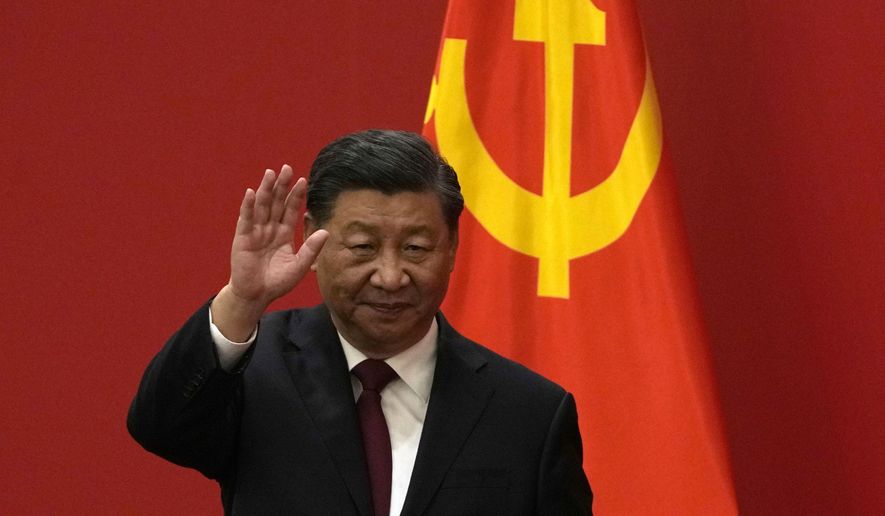
The four-star Air Force general who predicted a likely war with China within two years also revealed in his memo that Chinese President Xi Jinping has convened a “war council” of senior military leaders on Taiwan.

Gen. Michael Minihan, commander of the Air Force Air Mobility Command, said in the Wednesday memorandum leaked last week to wing commanders that Mr. Xi had secured his position as supreme leader and “set his war council in October 2022.” The outspoken general disclosed the meeting while offering his perspective on a military clash with China over Taiwan.

The general said he hopes he is wrong, but “my gut tells me we will fight in 2025.”

Air Mobility Command and Pentagon representatives declined to comment on the details of the memo.

The 2025 war prediction has generated headlines, but the revelation of the Chinese war council in October may matter more. U.S. officials said the gathering included top members of the Central Military Commission, the Chinese Communist Party’s most powerful institution, which is also headed by Mr. Xi and two People’s Liberation Army generals.

China Pathfinder: H2 2022 update


In the second half of 2022, China veered from one extreme to the other, with carefully choreographed control followed by sudden turmoil. In October, President Xi Jinping was elevated to an unprecedented third term, underscoring his iron grip on China’s Communist Party and the country. Two months later, the chaotic abandonment of zero-COVID measures, in place for nearly three years, triggered a nationwide health crisis. Throughout, the Chinese government has continued to claim that the path it has chosen for China’s economy and its people is the only right one.

Nevertheless, China’s economic weakness is pushing leadership to strike a more business-friendly tone. In recent months, Chinese officials have been reassuring a private sector hammered by regulatory crackdowns and rolling out the welcome mat for foreign investors who have been turned off by years of draconian COVID lockdowns. The defining question of 2023 will be whether the shift in policy and rhetoric is merely a short-term tactic by the Chinese government to shore up growth. So far, evidence of a more meaningful commitment to structural reform is hard to find.

The bottom-line assessment for H2 2022 shows that Chinese authorities were active in five of the six economic clusters that make up the China Pathfinder analytical framework: financial system development, competition policy, trade, direct investment, and portfolio investment. There were fewer developments in the innovation cluster, though we are watching to see if Beijing can muster a response to profound semiconductor controls imposed by the United States on China in October 2022. In assessing whether China’s economic system moved toward or away from market economy norms in H2, our analysis shows a mixed picture.

Building on China’s Mistake to Advance U.S. Interests after the Balloon

John Schaus

A Chinese balloon has captivated the United States for much of the past week. The balloon traversed North America, crossing into the Aleutian Islands in Alaska on January 28, to Canada on January 30, then across the continental United States from January 31 to February 4, until it was finally shot down six miles off the South Carolina coast into the Atlantic Ocean. Now that the balloon and its payload are being recovered from the Atlantic Ocean, U.S. leaders should focus on building consensus—among themselves and with the American public—on how to respond over time.

Q1: What happened?

A1: It depends on who you ask. According to China, it lost control of a research balloon used mostly for meteorology research over the Pacific, and it just happened to follow a five-day path over sensitive U.S. military installations in Idaho, Montana, Missouri, and toward the Carolinas. According to Brigadier General Patrick S. Ryder, Pentagon spokesperson, the balloon was outfitted to conduct surveillance over the United States.

Trial Balloon: Balancing Multiple Goals in U.S.-China Relations

Scott Kennedy

The notion that a balloon slowly floating across the continental United States at 60,000 feet would dominate the headlines and become an international incident of the highest order almost seems laughable on first glance. U.S.-China relations face much larger challenges, including the possibility of war in the Taiwan Strait, an ongoing war in Europe that is claiming countless lives and could continue to spread, and the dangers from not working together to address climate change and prevent future pandemics. But despite a kneejerk reaction to dismiss the balloon incident as nothing but an opportunity for venting hot air, in reality, this case is a test of the United States’ ability to implement a thoughtful foreign policy vis-à-vis its greatest strategic challenge.

Figuring out how to properly respond to the presence of the balloon over U.S. territory requires the weighing of two equally important principles. The first is avoiding moral hazard and not letting China escape penalty and opprobrium for misbehavior that threatens the United States’ national security. Claims that this was a privately-owned weather balloon that veered off course do not hold water. And the downplaying of this as a cute but curious piece of mylar overlooks the fact that the vessel’s high-tech equipment and navigation ability gave it distinctive intelligence-gathering value, and that it is part of a larger fleet of surveillance balloons crisscrossing the globe within the air space of other countries. Once the United States identified the balloon as part of a larger intelligence program, minimizing this becomes impossible, as that would teach Beijing that it could engage in such behavior without any costs. Calling Beijing out, working with other countries whose sovereignty has been or could be violated, and delaying Secretary Blinken’s visit to Beijing, serves this larger purpose.

The Cult of Secrecy: America’s Classification Crisis

Patrick Radden Keefe

In August 2016, the United States suffered one of the most cataclysmic leaks of classified information in history. An anonymous entity calling itself “the Shadow Brokers” exposed an arsenal of cyberweapons that had been developed—in great secrecy—by the National Security Agency. The intelligence community sprang into damage-control mode. Because the NSA’s hackers rely on a degree of plausible deniability, the disclosure of such clandestine tools and their connection to the U.S. government meant that the agency would be forced to devise new ones. But there was also a more pressing danger: with the source code for these powerful weapons now published on the Internet, any unscrupulous actor could deploy them. It was the digital equivalent of “loose nukes.”

Practically overnight, cybercriminals repurposed the NSA’s proprietary exploits to launch audacious ransomware attacks, ultimately shutting down millions of computers around the world and paralyzing thousands of private businesses, from an auto plant in France to a chocolate factory in Australia. Foreign governments took advantage of the tools, as well. North Korea used the NSA’s malicious code to attack the British health-care system, forcing hospitals to turn away patients. Iran used it to target airlines in the Middle East. Russia used it against Ukraine.

Even as these cyber-assaults proliferated, officials in Washington had no idea who was responsible for the breach. They did not know whether it was a foreign intelligence service that had compromised the NSA’s vaunted digital defenses or some disillusioned agency coder gone rogue. As if to compound the government’s humiliation and alarm, the Shadow Brokers taunted the agency in a series of online posts, mocking the investigation in playfully broken English: “Is NSA chasing shadowses?”

U.S. Defends Takedowns of Highflying Objects

Gordon Lubold

WASHINGTON—Biden administration officials defended on Monday their decisions to shoot down unidentified flying objects over North America this weekend and disputed new claims by Beijing that the U.S. violated Chinese airspace with high-altitude balloons.

Chinese officials—who were angered by the U.S. takedown of its suspected spy balloon off the Atlantic coast earlier this month—said that the U.S. had flown high-altitude balloons over its airspace more than 10 times since the start of 2022, fueling an escalating diplomatic standoff between the countries that has derailed efforts to reset relations.


The White House disputed China’s claims, while also defending stepped-up aerial surveillance that led to jet fighters scrambling to shoot down three unidentified flying objects following the destruction of the suspected Chinese spy balloon.

The latest takedowns occurred over Alaska on Friday, Canada’s Yukon territory on Saturday and Lake Huron on Sunday. Officials say they still haven’t determined exactly what they were destroying, but defended the decision to shoot them down.

10,000 cartel drones detected crossing U.S. border last year

Stephen Dinan

One single sector of the southern border saw more than 10,000 illegal drone incursions from Mexico last year, a senior Border Patrol agent told Congress on Tuesday.

Chief Patrol Agent Gloria Chavez, who oversees the Rio Grande Valley sector in southern Texas, said the cartels use the drones to keep tabs on where the Border Patrol is, so they can figure ways to sneak people and other contraband such as drugs through the gaps.

She and John Modlin, chief patrol agent in the Tucson sector of Arizona, said the cartels are driving the chaos on the border, controlling the crossings and forcing the Border Patrol to react to the smugglers’ tactics.

“In Tucson sector, everything south of the border is controlled by the cartels,” Chief Modlin told the House Oversight and Accountability Committee.

Strategies for building US semiconductor fabs: Finding skilled labor


Cranes, bulldozers, and scaffolding now dot the US landscape as a wave of residential and commercial building sweeps the country. In addition to private investment, the federal government’s $550 billion infrastructure legislation, designed to funnel money into road upgrades, rail improvements, and other public assets, is expected to raise construction spending to about $1 trillion over the next five to ten years.

Companies in advanced industries, which includes sectors such as semiconductors, defense, aerospace, batteries, advanced electronics, and automotive, could account for a good proportion of the construction spending. Through 2028, the value of their recent and proposed construction projects is expected to reach about $400 billion in the United States. The bulk of this spending, about $223 billion to over $260 billion, will go toward building or expanding semiconductor fabs across the country.1 The remainder will be devoted to giga-factories for batteries, data centers, renewable-energy plants, and other critical infrastructure.

Some semiconductor companies have already begun constructing new US-based fabs, but many have encountered obstacles related to the COVID-19 pandemic, which temporarily halted or slowed construction and disrupted supply chains. Shortages persist for many critical materials, including polyvinylidene fluoride (PVDF) piping and concrete. (For more information, see sidebar “Fab materials and equipment.”) Difficulties getting construction licenses and permits have also caused delays. But the shortage of skilled labor, including pipe fitters, welders, electricians, and carpenters, poses the greatest challenge to fab construction. Competition for these employees is intense across sectors, and people with specialized skills, such as tool calibration, are particularly scarce.

Avoiding a Long War: U.S. Policy and the Trajectory of the Russia-Ukraine Conflict

Samuel Charap, Miranda Priebe

Discussion of the Russia-Ukraine war in Washington is increasingly dominated by the question of how it might end. To inform this discussion, this Perspective identifies ways in which the war could evolve and how alternative trajectories would affect U.S. interests. The authors argue that, in addition to minimizing the risks of major escalation, U.S. interests would be best served by avoiding a protracted conflict. The costs and risks of a long war in Ukraine are significant and outweigh the possible benefits of such a trajectory for the United States. Although Washington cannot by itself determine the war's duration, it can take steps that make an eventual negotiated end to the conflict more likely. Drawing on the literature on war termination, the authors identify key impediments to Russia-Ukraine talks, such as mutual optimism about the future of the war and mutual pessimism about the implications of peace. The Perspective highlights four policy instruments the United States could use to mitigate these impediments: clarifying plans for future support to Ukraine, making commitments to Ukraine's security, issuing assurances regarding the country's neutrality, and setting conditions for sanctions relief for Russia.

DoD’s clarified AI policy flashes ‘green light’ for robotic weapons: Experts

SYDNEY J. FREEDBERG JR.

WASHINGTON — To defense officials working on robotic weapons, at first glance the recent rewrite of the Pentagon policy on “Autonomy in Weapons Systems” might look intimidating, like a Terminator. What was 15 pages in its original form expands to 24, adding paragraphs of ethical principles that new weapons programs must abide by, a full-page flowchart of go/no-go decisions that officials must work through, and a new bureaucratic entity to oversee it all, the Autonomous Weapon Systems Working Group.

But advocates and experts told Breaking Defense the revised policy is really more like R2-D2, helpful and full of nifty tricks. By adding clarifications, the handy flowchart, and the working group as a central clearinghouse — while not actually imposing any major new limitations on the development of autonomous weapons — the 2023 revision of DoD Directive 3000.09 turns the amorphous review process first laid out in 2012 into a clear procedure you can actually do.

“On one hand, it sounds like this is adding more layers of control and regulation, and that might sound daunting,” said Michael Klare, a senior visiting fellow at the Arms Control Association. “On the other hand, I think it’s meant to give a green light to commanders and project managers, [because] they can proceed with a clear understanding of what they’re going to have to go through and what criteria they’re going to have to satisfy.”

Will Logistics Be Russia's Undoing in Ukraine?

Bradley Martin

Wars rarely end quickly. The longer a war goes on, the more it requires: more money, more manpower, more firepower and, perhaps most importantly, more logistics. This last item—logistics—describes the often-complex systems that tie the war's front lines back to the economies of the nations doing battle, as well as the manpower required to link the two.

But the interdependence between what is happening at the front and what is happening economically back home can create counterintuitive situations and strange bedfellows. For example, a nation often cannot hope to continue a war without trading directly with the enemy.

Such is the case with Russia, which has long been selling its oil to nations that are directly supporting Ukraine. In March 2022, half of Russia's crude oil exports and 75 percent of its natural gas exports went to countries in the European Union. When the nations of the European Union prosper, they consume oil and gas. When those same nations prosper, they produce more of the kinds of military equipment needed by the Ukrainians in their war against Russia. And so, Russia's reliance on its energy exports causes it to sustain the very economies that are now supplying Ukraine with tanks and missiles to use against Russians.

The Realist Case for Ukraine

Jeffrey Mankoff
Source Link

The scope of the Biden administration’s response to the invasion of Ukraine has already exceeded what many observers—not to mention Russia’s leadership—expected. From intelligence sharing with Kyiv ahead of the invasion to the imposition of unprecedented sanctions on the Russian economy to the provision of increasingly capable weaponry to Ukraine’s armed forces, the United States has been critical to the failure of Russia’s “special military operation” to achieve its objectives. Despite US support and Ukrainian valor, the war is now approaching a second year, and several observers in the United States and in Europe have become increasingly alarmed at the consequence of a longer war.

Amid these concerns, some of the most trenchant criticisms of the Biden administration’s Ukraine policy have come from self-described realists. The realist paradigm, widely taught in international relations courses, describes the international system as anarchic, with states ruthlessly pursuing their own interests. It is critical of states and leaders who allow wooly ideological commitments to get in the way of this pursuit of realpolitik. Realism and realists are by nature cautious, wary of grand crusades and cognizant of the fact that problems in international relations are rarely “solved,” but must be managed over time. While these considerations have led many realists to call for greater restraint in aiding Ukraine, a strong realist claim can be made that the United States should continue its forthright support of Ukraine’s effort to drive the Russian occupiers out of its territory.

How Russia can end the war

EDWARD LUTTWAK

Looking ahead, there are only two possible major military moves for Russia. Following the mobilisation of 300,000 reservists last autumn, of whom more than half are now combat-ready, Putin’s army is now larger than when it invaded last February. Then, the aim was not to start a war but to end it, with a quick victory forecast by Russian and US Intelligence, both equally intoxicated by the false promise of “post-kinetic” warfare; this would combine electronic propaganda with cyber-attacks on everything from military headquarters to civilian infrastructures. Generals who had never fought against patriotic Europeans but only against Middle Eastern sectarians, if they had fought at all, who considered tanks old-fashioned and had limitless respect for “information warfare”, heavily influenced the totally wrong estimates that misled both Biden and Putin.

After initial failure, Putin had two perfectly reasonable options. He could have ordered a retreat — a politically feasible choice since low-level warfare had been underway for years and the entire operation could have been passed off as an exercise in intimidation. Alternatively, he could have declared war, mobilised the Russian Armed forces and invaded Ukraine in earnest.

Instead of choosing between retreat or an all-out offensive, Putin and his unimpressive advisors simply tried one thing after another, from the launch of as many missiles as possible against Kyiv and other cities (even anti-aircraft missiles, with their small warheads) to an attempt to conquer Odesa via the industrial town of Mykolaiv, whose shipyard workers acted out a favourite theme of Soviet propaganda: workers streaming out of factories to fight the enemy with whatever weapons they had.