5 July 2014

Strategic Materials: A Resource Challenge for India

Ajey Lele and Parveen Bhardwaj

ISBN 978-81-8274-786-9

Price: Rs. 795 [Download E-Book]
About the Book

The scramble for natural resources is not a new phenomenon. Every state, either developed or developing, is always found busy ‘managing’ resources for its sustenance and growth. Minerals (also called materials) is one the crucial natural resource which plays a significant part in the development of both civilian and military industrial complexes of nation-states. There are a few minerals which are categorized as ‘strategic’ because of their importance for the industries and owing to natural and man-made difficulties in their procurement. This work debates the issues of strategic materials and their importance for nation-states. There has been an attempt here to contextualize the importance of strategic materials from a national security perspective. This study presents a macro view with regard to India’s strategic minerals architecture and undertakes analysis to understand current and futuristic challenges and opportunities in this sector, and offers a few recommendations based on the assessment undertaken. Issues related to Rare Earth and new materials are also discussed.
Contents

Acknowledgments
List of Figures and Tables
The Thought
Introduction
Strategic Materials: An Overview
Mineral Chemistry
Important Materials
Elucidating Strategic Minerals
Global Distribution of Strategic Mineral Resources
Africa
Australia
Brazil
China
India
United States
Risk Assessment of India
India’s Strategic Materials ‘Resource Management’ Assessment
Broad Evaluation
In closing
India’s Import Dependency
DRC
Australia
Brazil
China
Russia
United States
Challenges for the Indian Mining Sector
Environmental Impacts of Mining
Impacts of Open Pit Mining
Threat fromNaxalism
Illegal Mining
Rare Earth Materials
What are REEs?
Explicit REE Significance
Global REE Deposits and Mining Processes
REEs and China
Challenging the Chinese Monopoly
India and REEs
REEs on the Critical List
Wrapping up
Emerging Materials
Graphene
Germanane
Stanene
Metamaterials
3D Printing Technology
Molybdenum disulphide
New Solar Cells
Shape Memory Alloys
Self-Healing Artificial Material
Boron, Aluminium and Magnesium (BAM) ‘Ceramic’ Alloy
Ceramic Matrix Composites (CMC)
Qingsongite
Conclusion and Recommendations

Counter-Terrorism: What Do You Want To Be When You Grow Up

July 2, 2014
 
ISIL (al Qaeda in Iraq and the Levant) has triggered a major feud with the Kurdish community by kidnapping 148 teenage Kurdish boys and trying to persuade some of them to become suicide bombers. This all began on May 30 when Syrian ISIL Islamic terrorists kidnapped 600 Kurdish children travelling (on what was supposed to be a safe route) to take school exams. The ISIL was persuaded (by threats of all manner of nasty retribution) to release the kids and eventually ISIL let most of the kids go (first the girls, then the younger boys). But 148 of the teenage boys were kept for some intense religious instruction and indoctrination. Most Kurds are Sunni Moslems but generally do not get involved in Islamic radicalism. Kurds (an Indo-European people) see suicide bombers and Islamic terrorism as an “Arab disease” and want nothing to do with it. The ISIL disagrees and believes with a little encouragement it can recruit some of the Kurdish kids. If anything happens to any of those teenagers the ISIL could find themselves on the wrong end of a nasty feud.

Such a desperate recruiting ploy by ISIL is another indication of how Islamic terrorists are having a harder time recruiting suicide bombers, largely because fewer parents are letting their sons attend religious schools (madrassa). Most Sunni Moslem parents are keen on getting an education for their kids. There are often limited choices. For example, in southern Afghanistan parents have limited choices because the Taliban (who operate mostly in the south) discourage the use of non-religious schools. In villages where the Taliban are strong enough to convincingly threaten parents, or have destroyed the local school, or scared away (or murdered) the teachers, the only option is a religious school. It not only provides some free education, but often feeds and houses their students as well. For many parents, this is an economic benefit. But most parents don’t like how some of these schools turn their kids into religious fanatics and suicide bombers. These parents often encounter threats from local religious conservatives because of their hostility to “Islamic education.” But the parents can often use the excuse that they need their sons to help with the family business (farming or tending herds). In any event, religious schools with a reputation for brainwashing their students are noting much reduced demand for their service.

This pattern is similar wherever Islamic terrorists are operating. Then there is also the problem of recruiting kids to be fighters. Recruiting teenagers as soldiers is increasingly discouraged by the international community. But training kids to be suicide bombers is more often tolerated in communities with a lot of religious conservatives. There are a growing number of madrassa in Afghanistan (over 800.) But the Afghan government (national and local) are less tolerant of madrassas that train terrorists. Still, some get away with it. This is a widespread problem in Pakistan and the Palestinian territories.

While the UN, and the international community, has vigorously sought bans on the recruiting of children (usually boys in their early teens) by rebel groups, and some armies, there has much less outcry over the use of Islamic schools for training and recruiting children as suicide bombers. This is largely the result of the Islamic nations vigorously opposing any such action in the UN. In general, Islamic nations do not want any criticism of their internal affairs, especially if it involves terrorism, or other unsavory practices (pedophilia, violent misogyny, slavery, religious bigotry, and corruption in general). This is one thing the Islamic nations can unite on, and the UN has learned to back off.

This Ultra Simple App Let’s Anyone — Encrypt Anything

July 3, 2014 ·
http://www.fortunascorner.wordpress.com

Andy Greenberg has an article in today’s (July 3, 2014) Wired.com, with the title above. He begins by noting, “encryption is hard. When NSA leaker Edward Snowden wanted to communicate with journalist Glenn Greenwald, via encrypted email, Greenwald couldn’t figure out the venerable crypto program PGP — even after Snowden made a 12 minute tutorial video.”

“Nadim Kobeissi wants to bulldoze that steep learning curve,” adds Mr. Greenberg. “At the Hope Hacker Conference in New York later this month,” he writes, “he’ll release a beta version of an all-purpose file encryption program called — MiniLock – a free, and open-source browser plugin designed to let even Luddites encrypt and decrypt files with practically uncrackable cryptographic protection in seconds.”

“The tagline is that this is file encryption — that does more with less,” said Kobeissi, a 23yr. old coder, activist, and security consultant. “It’s super simple, approachable, and it’s almost impossible to be confused using it,” he added.

Mr. Greenberg writes that Kobeissi’s creation is in “an experimental phase; and, shouldn’t yet be used for high security files; and, may in fact be the easiest encryption software of its kind. In an early version of the Google Chrome plugin — tested by Wired — Mr. Greenberg says “we were able to drag and drop a file into the program in seconds, scrambling the data such that no one but the intended recipient — in theory — not even law enforcement, nor intelligence agencies — could unscramble and read it.” “MiniLock,” he writes, “can be used to encrypt anything from video email attachments, to photos — stored on a UBS drive; or, to encrypt files for secure storage on DropBox, or Google Drive.”

“Like older PGP,” Mr. Greenberg adds, “MiniLock also offers so-called “public key” encryption systems. In public key encryption systems, users have two cryptographic keys, a public key, and a private one. They share the same public key with anyone who wants to securely send them files; anything encrypted with that public key can only be decrypted with their private key, which the user guards closely.”

“Kobeissi’s version of public key encryption hides nearly all of that complexity,” Mr. Greenberg notes. “There’s no need to even register or log in — every time MiniLock launches, the user uses only a passphrase, though MiniLock requires a strong one — with as many as 30 characters; or, a lot of symbols and numbers. From that passphrase, the program devises a public key, which it calls a MiniLock ID, and a private key which the user never sees; and, is erased when the program closes. Both are the same every time the user enters the passphrase. That trick of generating the same keys again in every session — means anyone can use the program on any computer/device, without worrying about safely storing, or moving a sensitive private key.”

7 ISPs Take Britain’s SIGINT Agency, GCHQ, to Court Over Internet Spying

Owen Bowcott
July 3, 2014
ISPs take GCHQ to court in UK over mass surveillance

ISPs are taking GCHQ to court for alleged breach of privacy. Photograph: AFP/Getty Images

Internet service providers from around the world are lodging formal complaints against the UK government’s monitoring service, GCHQ, alleging it uses malicious software to break into their networks.

The claims from seven organisations based in six countries – Germany, the Netherlands, South Korea, the UK, the US and Zimbabwe – will add to international pressure on the government after Edward Snowden's revelations about mass surveillance of the internet by UK and US intelligence agencies.

The claims are being filed with the investigatory powers tribunal (IPT), the court in London that assesses complaints about the agencies’ activities and misuse of surveillance by government organisations. Most of its hearings are held at least partly in secret.

The IPT is already considering a number of related submissions. Later this month it will investigate complaints by human rights groups about the way social media sites have been targeted by GCHQ.

The government has defended the security services, pointing out that online searches are often routed overseas and those deemed “external communications” can be monitored without the need for an individual warrant. Critics say that such a legal interpretation sidesteps the need for traditional safeguards.

The latest claim is against both GCHQ, located near Cheltenham, and the Foreign Office. It is based on articles published this year in the German magazine Der Spiegel, which alleged that GCHQ had carried out an attack codenamed Operation Socialist on the Belgian telecoms group Belgacom, targeting individual employees with malware (malicious software).

One technique was a “man in the middle” attack, which, according to the documents filed at the IPT, bypasses encryption software and “operates by interposing the attacker [GCHQ] between two computers that believe that they are securely communicating with each other.

"In fact, each is communicating with GCHQ, who collect the communications, as well as relaying them in the hope that the interference will be undetected."

The complaint alleges that the attacks were a breach of the Computer Misuse Act 1990 and an interference with the privacy rights of the employees under the European convention on human rights.

The organisations targeted, the submission states, were all “responsible and professional internet service providers”.

IBM, Cisco and Other U.S. High-Tech Companies Losing Chinese Government Contracts Because of NSA Spying Allegations

Nicole Lewis
July 2, 2014
Cyber Espionage Spells Trouble for High-Tech Supply Chain Planning

The US and China are entering a new era of mistrust over the issue of cyber espionage. The impact now threatens supply chain planning at US companies seeking to sell hardware, software, and maintenance and support services into China.

The latest chapter in this ongoing saga comes from a recent Bloomberg News report that the Chinese government is considering replacing the IBM servers that run China’s banking industry with Chinese-made technology. Chinese authorities say such a move would help them protect their financial data. If this report (which relied on four unnamed sources) is true, high-tech supply chain managers must recognize and prepare for slower sales into China.

Additionally, a new level of competition is about to take place as Chinese technology becomes more sophisticated and capable of managing business processes in sensitive markets that have a huge amount of daily transactions.

Last month, the Justice Department announced that five Chinese military officers had been indicted for allegedly hacking into the computers of major American companies (including US Steel Corp. and Alcoa Inc.) and stealing trade secrets.

For its part, the Chinese government cites Edward Snowden’s revelations about electronic surveillance conducted by the National Security Agency Prism project to access, collect, and process foreign intelligence passing through American-made servers. Officials have said the US spies on Chinese companies.

IBM isn’t alone

The mistrust between China and the US is now affecting technology companies’ business relationships.

Cisco Systems recently said that its business in China declined 8% in the quarter that ended April 26. Additionally, the Chinese government recently decided not to use Microsoft Corporation’s Windows 8 operating system for its computers.

One area of technology where companies stands to lose billions of dollars is cloud computing, which runs on high-end mainframe and server technology. According to Forrester Research analyst James Staten, the US cloud computing industry could lose up to $180 billion if foreign customers stop using cloud computing services because of recent revelations regarding the NSA’s electronic surveillance programs.

US tech companies need China

Escalation, Not Deterrence On NATO Article 5 and Cyber Attack

on Jul 2

NATO, we hear, is updating its cyber defence policy. A very serious cyber attack, some people in the Atlantic Alliance seem to suggest, should be treated like an invasion. “For the first time we state explicitly that the cyber realm is covered by Article 5 of the Washington Treaty, the collective defence clause,” Jamie Shea told ZDNet. He’s NATO’s deputy assistant secretary general for emerging security challenges.

The goal? “It’s certainly meant as a deterrent,” Shea said, “It’s not meant to be escalatory.” Defence ministers apparently already agreed on a formula. NATO is set to endorse the changes in Wales in September.

But will it work? — Probably not, I’m afraid.

We haven’t seen the document yet. But the new policy is likely to produce exactly the opposite of the intended effect: it may contribute more to escalation than to deterrence. For at least four reasons.

First, deterrence needs to backed up by a clear and credible threat of punishment. So far, NATO is doing the reverse: “We don’t say in exactly which circumstances or what the threshold of the attack has to be to trigger a collective NATO response,” Shea said, “and we don’t say what that collective NATO response should be.” Right. If you don’t know what that means, you’re not alone. Potential aggressors also will have no idea. And that means they will probably test out, inch by inch, where the red line actually is, again and again.

Second, deterrence needs to be practiced, not just announced. Cold War-style deterrence is out, criminal deterrence is in — I mean that as a conceptual guide. Deterring criminal offenses means the deterring party needs to use force regularly and predictably in order to enforce the law and keep the authority of the law intact. That means that the use of force isn’t a breakdown of deterrence (think H-Bomb) but necessary to maintain deterrence (think arresting armed robbers). You have to practice what you preach, reliably and regularly. That’s how we deter crime. It’s also how Israel has learned to deter political violence. Deterring cyber attacks is more like deterring crime, not nuclear war. Does NATO have the capabilities — and the will — to draw such line through practice against cyber attacks? That leads to another point.

The vast majority of all cyber attacks are forms of espionage — commercial or state-on-state — or they are forms of criminal behaviour. And here’s the problem. NATO isn’t in the business of SIGINT and counter-intelligence and it isn’t in the business of crime prevention and law enforcement. Sabotage is very rare, so far. We have only seen one single externally induced act of sabotage-by-cyber attack against industrial control systems that actually had a kinetic effect: Stuxnet. And this remarkable operation, ironically, was executed partly by a NATO member country. All others either didn’t have a kinetic effect or they were insider attacks. So what exactly is NATO trying to deter? A type of attack that hasn’t happened before? Oh, right, they didn’t want to answer that question.

Finally: NATO encourages probing for preparation of attacks. The new policy may not deter very well, but it certainly is sending a message in the subtext: we’re really scared, and this stuff is serious. If you see yourself as a major contender against us, NATO seems to be saying, you better invest in some hard-hitting cyber capabilities. Just this morning news of Dragonfly broke, an attack of unclear origin that seems to probe critical infrastructure in new and worrying ways to prepare capabilities for some later use. Counterintuitively, NATO’s new policy could encourage more such behaviour — especially when coupled with a still offensive mindset on cyber security in Washington.

So NATO seems to be escalating, not deterring.

Deterrence, even during the Cold War, wasn’t as easy as many a veteran seem to remember. The view that deterrence prevented nuclear war is highly controversial. Chatham House recently reminded those with a sense history that luck played a distressingly big role in keeping the Cold War cold.

The new policy, staff at SHAPE explained, is meant as “a signal that NATO is not defending itself only in 20th century terms.” At closer examination, sadly, it very much seems to be a signal that NATO is thinking about defence in 20th century terms.

PEERING INTO AMERICA’S MILITARY BLIND SPOTS: HIGH-IMPACT LONG SHOTS

August Cole and Ben FitzGerald
July 3, 2014
 
 
The national security establishment is currently facing criticism for a perceived failure to anticipate Russia’s actions in Ukraine, the capture of a swathe of Iraqi territory by the Islamic State in Iraq and the Levant, and the political upheaval of the Arab Spring. The American public expects its leaders to be prepared for such contingencies while also addressing familiar challenges, like terrorism or China’s increasing assertiveness.

The breadth and rising tempo of potential crises, coupled with fiscal constraints, means that national security leaders can’t hope to be fully prepared for all contingencies. But continually focusing on the problem of the day creates blind spots when it comes to low likelihood but extremely disruptive factors. It is one thing to be caught off guard by the anticipatable actions of a nation or even a non-state actor; it is far more serious to be surprised by a new method of warfare.

If there was ever a time to be on guard against disruptions that can upend America’s strategic position, it is now. Taking stock of long-shot, high-impact surprises does not mean waiting until the consensus wisdom, or the events at hand, catch up. The national security community should not shy away from constantly challenging the assumptions that it relies on to build everything from budgets covering hundreds of billions of dollars to operation plans for the armed forces.

The Center for a New American Security’s Creative Disruption Task Forcesurveyed defense experts on the most disruptive elements for the future of America’s defense industry and strategic position. The surveys on the the Future Defense Environment, Technology Trends and Security Implications, and Implications of Emerging Technologies for the Future of Warfare, covered a sweep of time and technology through 2030, and in some cases beyond.

One of the most valuable insights was how respondents revealed potential blind spots for the United States in the factors or outcomes believed to be the least likely to be disruptive. The surveys also showed how the national security community’s own preferences can influence its ability to anticipate the future.

Why hasn't Russia unleashed a cyber attack on Ukraine?

http://www.cbsnews.com/news/why-hasnt-russia-unleashed-a-cyber-attack-on-ukraine/


A man looks in Moscow on March 21, 2014, at a computer screen displaying a map of Crimean peninsula with a pop-up window reading: "Crimea, Russia." at the site of a Russian Internet company Mail.Ru. AFP/GETTY IMAGES

That the fragile cease-fire in Ukraine collapsed in the first dark hours of July should not surprise observers; Russia has pursued low-level cyber hostilities against Kiev nearly since the onset of the crisis, and certainly during the recent short-lived peace offensive. Nor should we be startled by reports that cyber warriors sought to sabotage May's presidential election in Ukraine with bogus vote tallies and came close to gifting far-right, pro-Moscow candidate Dmytro Yarosh with 37 percent when he really got less than 1 percent.

More instructive is the fact that the Kremlin has not upped the stakes with an overt cyber-attack on Ukraine's critical infrastructure.

An assault that cripples Kiev's military command and control, civilian fiscal and energy systems, even air traffic control and broadcasting is believed feasible, but remains tucked away, unexploited, in a sealed folder on a Russian general's desk. That speaks volumes about the unpredictability of cyber weapons. The effects of their first use in an all-out offensive are highly debatable.


The Paracel Islands and U.S. Interests and Approaches in the South China Sea

Authored by Lieutenant Colonel Clarence J. Bouchat (USAF, Ret.).
Added June 24, 2014
Type: Monograph
218 Pages
Download Format: PDF
Cost: Free
Send this page to a colleague.
Alert me when similar studies are published

The Paracel Islands and South China Sea disputes require better understanding by U.S. policymakers in order to address the region’s challenges. To attain that needed understanding, legal aspects of customary and modern laws are explored in this monograph to analyze the differences between competing maritime and territorial claims, and why and how China and Vietnam stake rival claims or maritime legal rights. Throughout, U.S. policies are examined through U.S. conflicted interests in the region. Recommendations for how the United States should engage these issues, a more appropriate task than trying to solve the disputes outright, are then offered

Drone Debate Highlights Obsolescence Of U.S. Strategic Concepts

by Fortuna's Corner · 
July 3, 2014 ·
Drone Debate Highlights Obsolescence of U.S. Strategic Concepts 
Source Link

Last week, the Stimson Center, an important Washington think tank that studies global security, released a major report on U.S. drone policy. This was noteworthy both because the topic is such a hot one and because of the stellar cast involved. The task force that produced the report was led by retired Gen. John Abizaid, former commander of the U.S. Central Command, and Georgetown University law professor Rosa Brooks, who recently served as counselor to the undersecretary of defense for policy. The other task force members also brought deep and wide-ranging experience in the military, security policymaking, law enforcement and intelligence.

As could be expected from a group like this, the report was serious and thoughtful, capturing the current debate about the use of drones and the central role they play in American national security strategy. But years from now what may stand out is less what the report explicitly says than what it implicitly reveals: The United States continues to grapple with the 21st-century security environment using concepts and ideas from an earlier and long-gone time. The report reflects a body of ideas about security-an orthodoxy-with declining effectiveness and relevance.

This orthodoxy begins with the idea that sovereign nation-states are the central participants in security. This system operates on norms and rules made by nation-states, whether formal or informal. Formal rules, codified in international law and treaties, are particularly important. The orthodoxy assumes a clear distinction between war and peace, with different rules of acceptable behavior for the two conditions. Wars are won by destroying the armed forces and war-making capacity of enemy states. Because war became so terrible with industrialization and the invention of nuclear weapons, intense effort was devoted to deterring or preventing it. If prevention failed, wars should be limited if possible. And because war is so horrible, the American political system set the bar high for going to war by making sure that Congress agreed that it was necessary.

This orthodoxy imbues the Stimson Center’s drone report. “The availability of lethal UAV technologies,” its authors write, referring to unmanned aerial vehicles, “has enabled U.S. policies that likely would not have been adopted in the absence of UAVs. In particular, UAVs have enabled the United States to engage in the cross-border use of lethal force against targeted individuals in an unprecedented and expanding way.” This is in part because drones make the use of force politically easier and thus more likely.

“The increasing use of lethal UAVs may create a slippery slope leading to continual or wider wars,” the report adds. “The seemingly low-risk and low-cost missions enabled by UAV technologies may encourage the United States to fly such missions more often, pursuing targets with UAVs that would be deemed not worth pursuing if manned aircraft or special operations forces had to be put at risk.”

U.N. Peacekeepers Extensively Using Surveillance Drones in Africa


Somini Sengupta
July 3, 2014
Unarmed Drones Aid U.N. Peacekeeping Missions in Africa


An Italian-made surveillance drone being used by United Nations peacekeepers in the Democratic Republic of Congo. 
GOMA, Democratic Republic of Congo — The call came after 8 in the evening, from peacekeepers posted in a remote corner of the country’s restive east. The troops sensed suspicious movement nearby. Venturing out into the forest at that hour was far too risky. Would ground control send a drone to have a look?

From here, a remotely piloted aircraft set off, its owl eyes designed to peer through the darkness and send back a live picture of what was happening on the ground. In a windowless trailer at the airport here in Goma, pilots steered it past a row of volcanoes toward the jungle.
In an age of ubiquitous surveillance, even rebels in the bush can expect to be tracked, as United Nations troops cautiously deploy a tool familiar to most modern militaries around the world: the drone.

The United Nations insists on calling the aircraft unarmed, unmanned aerial vehicles, the term drone having acquired a bad reputation because of the armed versions that American forces use against targets in Pakistan and elsewhere. United Nations officials insist that they do not plan to use drones to kill anyone, only to get a picture of trouble and grief on the ground, to protect civilians and their own troops.
“We have a mandate here to neutralize armed groups — you can’t do it without intelligence,” said Martin Kobler, who leads the United Nations Mission in the Democratic Republic of Congo.

“They have also a psychological effect,” he added. “Everyone knows they are flying.”
More and more, drones are flying over some of the toughest peacekeeping missions in the world, improving the United Nations’ intelligence-gathering capability, but also raising new issues about what to do with so much important data.

Dutch troops are using drones to gather intelligence on the armed Islamist insurgents operating in the deserts of Mali. Swedish troops are expected to take some drones along when they are sent to Timbuktu, Mali, this year.

Episode 234: Asking the right questions to build the right leaders

Broadcast in Military

Is the profession of arms, as the Navy believes it is, primarily a technical job for officers - or is it something else?

To create the cadre of leaders one needs, do you train them as empty vessels that one only needs to fill up with what you want or an empty checklist to complete - or do you train them by helping them bring out their ability to lead and make decisions through informed critical thinking?

Our guest for the full hour to discuss this and more will be Major Matt Cavanaugh, USA. Matt is currently assigned as an Assistant Professor in military strategy at the U.S. Military Academy at West Point.

Prior to this assignment, Matt was a Strategic Planner at the Pentagon, after service with the with Second Squadron, Third Armored Cavalry Regiment with multiple deployments to Iraq from Fallujah, Ramadi, and Tal’Afar.

Matt earned his Master’s in Strategic Studies at Victoria University in Wellington, New Zealand and is currently at work on a PhD dissertation on generalship at the University of Reading (UK). He is a Fellow at the Center for the Study of Civil Military Operations, has been published with several peer-reviewed military and academic journals, and is the Editor at WarCouncil.org, a site dedicated to the study of the use of force. Matt has represented the United States in an official capacity in ten countries, including: Iraq, Kuwait, Norway, Australia, New Zealand, Indonesia, Singapore, Malaysia, Latvia, and Great Britain. Tags:

4 July 2014

Why the discord over a century-old accord

Dinesh Kumar
http://www.tribuneindia.com/2014/20140704/edit.htm#6

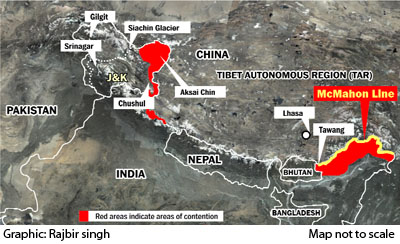
A century ago, on July 3, 1914, an accord was purportedly reached between China, Tibet and then British-ruled India, which continues to have a bearing on Sino-Indian relations to this day. The Simla Convention, which started on October 13, 1913, and concluded on July 3, 1914, was meant to define and demarcate the boundaries between India and Outer Tibet and between China and Inner Tibet. The British had then proposed the 'division' of Tibet into 'Inner' Tibet, which was to be under Chinese control, and 'Outer' Tibet, which was to have a sovereign like status. The accord, or agreement, as it is variously known, reached after tripartite talks between the three, led to the creation of what is popularly referred to as the McMahon Line in the north-east, which China has consistently rejected.

A series of political intrigues had both preceded and succeeded the holding of the tripartite talks, which is important to know in order to understand the context in which the convention was held. It goes back to the start of the 20th century when the ‘Great Game’ was at play. Colonial Britain, with its vast empire in the region, feared that Czarist Russia might be secretly planning to extend its influence over the strategically located Tibet. Whether or not Russia had any such plans in the region is a matter of much debate. But one of the factors that had reportedly sparked off London’s suspicions was the Mongolian-Russian monk Aquang Dorji’s (also referred to by the Russian name Dorzhiev) proximity to the 13th Dalai Lama. His political influence led to the signing of a treaty between Tibet and Mongolia in Ulan Bator (capital of Mongolia) in 1913, which incidentally he had signed on behalf of Tibet under the Tibetan name of Khen-chen Lobsang Ngawang.
The move, 100 years ago, behind the Simla Convention of 1913-1914 that led to an agreement being signed on July 3, 1914, to determine the boundary between India and Tibet was initiated by the British colonial government. The agreement has been consistently rejected by the Chinese and a series of questionable actions post-Independence by New Delhi has not helped India's case.

China’s gain

China initialled the agreement in April 1914 but walked away without signing the agreement at the tripartite summit between China, Tibet and British-ruled India, in Simla on July 3, 1914.

The big deal about the Army’s small arms

July 4, 2014
Rahul Bedi

Even deciding on a multi-purpose tool, akin to a Swiss knife, for example, has been delayed despite trials in 2011 featuring European and American vendors.

Shortly after taking over as the Chief of Army Staff in May 2012, General Bikram Singh had emphatically declared that upgrading the small arms profile of his force was his foremost priority.

Two years later, as Gen. Singh prepares to retire in end July, neither the 5.56mm close quarter battle (CQB) carbines nor the multi-calibre assault rifles he promised are anywhere in sight for the Army’s 359 infantry units and over 100 Special Forces and counter-insurgency battalions, including the Rashtriya Rifles and Assam Rifles.

The Army’s prevailing operational reality is that it does not own a carbine as the Ordnance Factory Board (OFB) ceased manufacture of all variants of the WWII 9mm carbines, including ammunition, around 2010.

And, two years later, the Ministry of Defence (MoD) finally endorsed the Army’s persistent complaints regarding the inefficiency of the Defence Research and Development Organisation (DRDO)-designed INdian Small Arms System (INSAS) 5.56x39mm assault rifles. It agreed that they needed replacing.

The former Defence Minister, A.K. Antony, was forced into admitting in Parliament in late 2012 that the INSAS rifles had been overtaken by “technological development” — a euphemism for a poorly designed weapon system which the Army grudgingly began employing in the late 1990s and, unceasingly, had complained about ever since.Among largest arms programmes

The Army’s immediate requirement is for around 1,60,080 CQB carbines and over 2,20,000 assault rifles that it aims on meeting through a combination of imports and licensed-manufacture by the OFB. Ultimately, the paramilitaries and special commando units of respective State police forces too will employ either or both weapon systems in what will possibly be one of the world’s largest small arms programmes worth $7-$8 billion.

Gen. Singh’s guarantees, however, remain delusional and, expectedly unaccountable. And, in time-honoured Indian Army tradition, they will now be transferred to his successor, the Army Chief-designate, Lieutenant Gen. Dalbir Singh Suhag, to vindicate.

Panchsheel 2014


C. Raja Mohan 
July 4, 2014
http://indianexpress.com/article/opinion/columns/panchsheel-2014/99/

As an increasingly powerful China seeks to reorder Asia, Delhi must firmly locate China’s Panchsheel campaign in a clinical assessment of Asia’s rapidly evolving geopolitics and its consequences for Indian security.

Last week’s celebrations in Beijing, marking the 60th anniversary of the Panchsheel proclamations, from Delhi’s perspective, might have looked like a ritual that had to be performed. For China, though, the occasion was about mobilising regional political support, including from India, for a new security framework that President Xi Jinping has been promoting with some vigour.


As it rises to become a great power, China is determined to reconstitute Asian geopolitics, which had been dominated by the United States since the end of World War II. Central to Xi’s argument is the proposition that the US security role in Asia is a manifestation of outmoded Cold War thinking. He is suggesting that American alliances must be replaced by a new regional security order.]

Xi has affirmed that “in the final analysis, it is for the people of Asia to run the affairs of Asia, solve the problems of Asia and uphold the security of Asia. The people of Asia have the capability and wisdom to achieve peace and stability in the region through enhanced cooperation.” Heady stuff indeed. This kind of rhetoric has not been heard in Asia for decades.

The Panchsheel is at the very heart of Xi’s conception of a new security order for Asia. The five principles were outlined by Zhou Enlai in separate joint statements with Jawaharlal Nehru and Burma’s U Nu in 1954. These principles — respect for territorial integrity and national sovereignty, non-aggression, non-interference in internal affairs, cooperation for mutual benefit and peaceful coexistence — were later expanded at the Afro-Asian Conference in Bandung, Indonesia, in 1955. The first summit of the non-aligned nations in Belgrade, Yugoslavia, in 1961 endorsed these principles.

Last week in Beijing, Xi argued that “it is no coincidence that the five principles of peaceful coexistence were born in Asia, because they embody the Asian tradition of loving peace”. Xi went on to add that, thanks to the contributions made by China, India and Myanmar, “these principles are accepted in other parts of Asia and the world”. For some, Xi’s attempt to recalibrate Panchsheel for its contemporary foreign policy needs might seem empty rhetoric at worst or political romanticism at best. A more careful look, however, would suggest China is dead serious.

The Planning Commission, in practice


By: Mihir Shah
http://indianexpress.com/article/opinion/columns/the-planning-commission-in-practice/99/

As speculation mounts by the day that the Modi government is thinking of winding up the Planning Commission, this is an opportune moment to reflect on the relevance of the institution in the context of a rapidly changing Indian economy and society.

One way of classifying institutions is in terms of the balance between their potential positive power (PPP) and potential negative power (PNP). Potential positive power may be broadly understood to mean the capacity and power to enforce or facilitate positive change that would hasten the achievement of national goals. Potential negative power, on the other hand, refers to the capacity or power to obstruct, delay or derail positive reform, in cases where such reform threatens entrenched vested interests, status quo or business as usual. The exercise of PNP is often a ruse to foster corrupt practices, but it can also be an exercise of wanton power for its own sake, reflecting a perverse sense of power-induced pleasure.

The two institutions with perhaps the highest quotient of both PPP and PNP in the government of India are the Planning Commission and the ministry of finance. In my five years in the Planning Commission, I saw many instances of PNP and how this became a source of great resentment against the Planning Commission, both among state governments and Central ministries. Of course, at times, the Planning Commission acted with sagacity in checking profligacy of funds and schemes. But there were many cases where in-principle approvals, investment clearances, grants-in-aid and other decisions appeared to smack of bureaucratic red tape more than an application of mind motivated by the broader national interest and effectiveness of functioning. There were also visible vestiges of the old Stalinist command and control, inspector raj mindset.

But it is also true that in these five years I saw innumerable instances of the exercise of positive power. I believe there are at least five broad areas in which the Planning Commission played an extremely positive role: one, pioneering an inclusive planning process; two, facilitating and mainstreaming reform, especially emphasising the principle of subsidiarity, recognising the deep diversity of India; three, co-ordinating across, if not breaking down silos; four, being the spokesperson of the states at the Centre; and five, arbitrating disputes by taking a more long-term and holistic view of issues.

*****Chinese Military Modernization and Force Development: Chinese and Outside Perspectives

JUL 2, 2014
The Burke Chair at CSIS has developed a new analysis of the trends in Chinese military strategy and forces entitledChinese Military Modernization and Force Development: Chinese and Outside Perspectives. This report provides a comprehensive update of previous Burke Chair studies and is available on the CSIS web site at

The goal behind this report is not to present the authors’ view of the balance, but rather to provide the basis for an unclassified dialogue on the military developments in China, including the size and structure of the country’s current and planned military forces. It draws on official US, Chinese, and other Asian official reporting, as well as the work of other scholars and the data bases developed by the IISS and Jane’s in an effort to compare different views of Chinese strategy and military developments, and is meant to provide US, Chinese, and other analysts with a better basis for understanding Western estimates of the changes in Chinese force strength and force quality.

The United States and the People’s Republic of China (PRC) face a critical need to improve their understanding of how each is developing its military power and how to avoid forms of military competition that could lead to rising tension or conflict between the two states. This report focuses on China’s military developments and modernization and how they are perceived in the UIS, the West, and Asia. It utilizes the unclassified data available in the West on the trends in Chinese military forces. It relies heavily on the data in the US Department of Defense (DoD) Report to Congress on Military and Security Developments Involving the People’s Republic of China, particularly the 2013 and 2014 editions.

It relies heavily on the annual military balances compiled by the International Institute for Strategic Studies (IISS), though a range of sources are included. It should be noted that this report focuses on Chinese forces, and therefore presents only one side of the US and Chinese balance and the security situation in Asia. It also draws upon a Burke Chair report entitled The Evolving Military Balance in the Korean Peninsula and Northeast Asia, looking at the bilateral US-Chinese balance in more detail.

Accordingly, it focuses on the actual changes taking place in Chinese forces, and it provides a detailed analysis detailed analysis of the trends in Chinese military forces since 1985, examining how the often-conflicting trends in outside sources interact with reporting on Chinese military spending and strategy. It also shows that important changes are taking place in US strategy and that these changes must be considered when evaluating Chinese actions.

The study makes it clear that US, other Asian, and other Western sources and analyses of Chinese military developments are not an adequate basis for US and Chinese dialogue without Chinese review, commentary, or more Chinese transparency in providing data on Chinese strategy, military forces, and military spending. There is a critical need for focused military dialogue and for joint US and Chinese efforts to develop common data and perceptions on US and Chinese military strategy and net assessments of the overall trends in military balance and strategic situation in the Pacific region.

Moreover, this report shows that focusing on strategy and concepts in broad terms is no substitute for a detailed examination of specific changes in force strength, the extent to which concepts and strategy are actually being implemented, and how the shifts in US and Chinese forces actually compare.

The report examines a range of data regarding Chinese capabilities and force modernization, focusing on the most reliable sources. Using these sources, it analyzes the full range of China’s military capabilities as well as trends in their growth and composition. The data indicate that the PRC has engaged in a continuing military modernization program that is expanding the capabilities available to the People’s Liberation Army (PLA).

Although the PLA has consistently reduced its Personnel since the 1980s, reductions in obsolete equipment and the procurement and deployment of modern systems in its land, air, naval, and missile forces have led to increases in the PLA’s overall military effectiveness, especially in the context of its “Local War under Conditions of Informatization” military doctrine.

Data alone, however, cannot provide a full narrative: this report places the observable data within the context of contemporary Chinese military thought and doctrine. Seen within the context of Chinese military doctrine, the modernization efforts in the PLA Army, Navy, Air Force, and Second Artillery Force have enabled changes in operations and tactics as well as in force structure and weapon systems: these changes, in turn, have expanded PLA military capabilities and placed China on the road to becoming a modern military power.

The report contains numerous maps, figures, and tables. Its contents are shown below:

Siachen Unmasked

http://www.indiandefencereview.com/news/siachen-unmasked/

ByLt Gen Prakash Katoch 
Date : 01 Jul , 2014


Much water has flown under the bridge since 2nd October 2012 when Atlantic Council of Ottawa put out the news bulletin titled “India-Pakistan experts agree on confidence-building measures at Lahore meeting”. The bulletin stated that since November 2011, militaries of both India and Pakistan held several rounds to boost confidence building measures, these meetings having been held in Dubai (20-21 November 2011), Bangkok (23-25 February 2012) and Lahore (23-25 September 2012) and that additionally, working group meetings took place in Chiang Mai (21 April 2012) and Palo Alto (30-31 July 2012).

With respect to Siachen, the bulletin said, “….as a part of the comprehensive resolution of the Siachen dispute, and notwithstanding the claims of each country, both sides should agree to withdraw from the conflict area while retaining the option of punitive action should the other side renege on the commitments”.

Notwithstanding the fact that above means withdrawing from Indian Territory and in effect acquiescing to the absurd Pakistani demand for the LC be to drawn from NJ9842 directly to KK Pass, inclusion of the following paragraphs too are ridiculous to say the least:


What is the logic (read wisdom) of this when Indian posts dominate the crest-line of the Saltoro Range and Pakistanis are sitting much below to the West?
“Withdrawal from Indian and Pakistani posts within line of sight of each other is to be coordinated so each side can observe the activities of the other”. What is the logic (read wisdom) of this when Indian posts dominate the crest-line of the Saltoro Range and Pakistanis are sitting much below to the West?
“Both sides should agree not to interfere with the other’s national technical means”. Are we naïve enough to believe that Pakistan would own up if she does indulge in such acts? Has she owned up to 26/11 Mumbai terror attacks beyond recent signals that it was the handiwork of LeT? What about Ajmal Qasab’s statement of having received training from Pakistani Navy? Does Pakistan acknowledge cyber attacks by the Pakistan Hackers Club (PHC) and the G Force under tutelage of the ISI? Has Pakistan owned responsibility for unleashing viruses like ‘Sea Brain’
“Small-scale intrusions are neither significant nor sustainable”. But what about opening the floodgates for infiltration into Ladakh and unlimited opportunities of establishing staging posts? Has our thinking gone so awry that we can now only think of intrusions of the scale that Pakistan made in Kargil during 1998-1999?

Is IAF Equipped

02 Jul , 2014

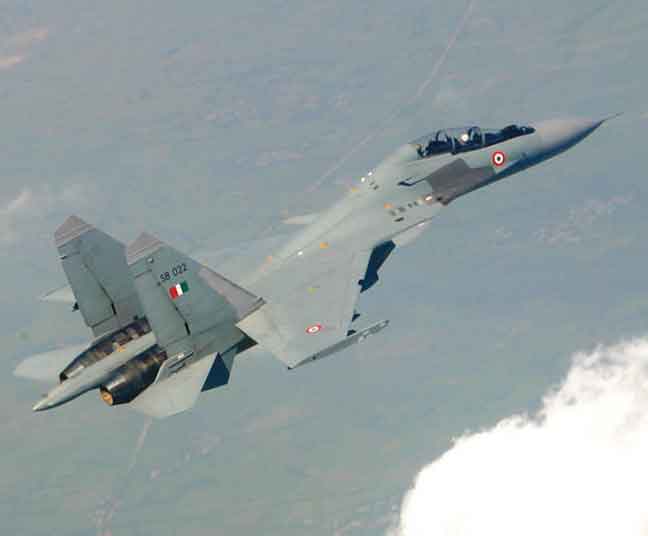
SU-30MKI

During the past decade, India’s defence preparedness has steadily and inexorably deteriorated despite constant clamour by the defence forces for modernisation and upgradation to meet assigned roles and tasks. Meanwhile, Pakistan’s anti-India stance and Chinese aggressive actions and iterations have neither helped to push away the trepidation of possible military conflagration with either one individually, nor done anything to liquidate the possibility of a two-front war. A combined and collusive threat from China and Pakistan would overstretch the Indian military machinery and, given the inordinately delayed modernisation in certain domains, could well be a recipe for an ignominious debacle reminiscent of the 1962 India-China War.

The PAF may be expected to be not far behind the leading edge of technology in the next five years…

In the past five years or so, the challenge of being militarily engaged by China and Pakistan simultaneously has exercised government and public attention visibly. On the other hand, since long, the three Services have always considered a ‘two-front war’ not just a possibility but highly probable. In February this year, the Indian Air Force (IAF) told a Parliamentary panel what the latter probably knew anyway – that it would be difficult for the IAF to manage a ‘two-front war’ although it had plans for doing so. As expected, the media played up this iteration by the IAF as ‘dropping a bomb’ and ‘an alarming admission’. No follower of military affairs is surprised though.

During the past decade, India’s defence preparedness has steadily and inexorably deteriorated despite the persistent clamour by the defence forces for modernisation and upgradation to meet assigned roles and tasks. Meanwhile, Pakistan’s anti-India stance and Chinese aggressive actions and iterations have neither helped to push away the trepidation of possible military conflagration with either one individually, nor done anything to liquidate the possibility of a two-front war. A combined and collusive threat from China and Pakistan would overstretch the Indian military machinery and, given the inordinately delayed modernisation in certain domains, could well be a recipe for an ignominious debacle reminiscent of the 1962 India-China War. The distended aerial battlefield encompassing the Western, Northern and Eastern perimeters of our extensive borders, and the air defence of our vast territorial expanse could burden the IAF to a spine shattering level. In addressing the issue of preparedness of the IAF for a two front war, it is important at the outset to study the contending air forces.

Pakistan Air Force (PAF)

&&* Rousing a Crippled Giant

Ajai Sahni
Editor, SAIR; Executive Director, Institute for Conflict Management & South Asia Terrorism Portal

Little can be expected of a one-month old Government, especially on issues as deeply entrenched as the multiple internal security challenges and crises of capacity that afflict India. These are the consequences of decades of neglect, misdirected policies, and an apparatus of governance that has been hollowed out by corruption. India's problems cannot be expected to simply disappear with the arrival of a purportedly charismatic leader, even one with a clear majority in Parliament that has eluded the succession of ailing regimes after Rajiv Gandhi's unprecedented windfall of 1984, in the wake of his mother, Prime Minister Indira Gandhi's assassination.

Nevertheless, Prime Minister Narendra Modi's Government is already being judged - and often misjudged - and it would appear that both his most passionate detractors and his most ardent supporters 'mis-estimate' what he can realistically be expected to achieve. It is unlikely, as some flights of imagination have suggested, that the 'fascist Modi' will crush all dissent and establish an intolerant, oppressive and authoritarian regime; or that he is going to engineer a dramatic developmental transformation, abruptly bringing India into the fraternity of 'great powers', as his admirers fantasize. He may, of course, initiate processes of transformation; but given the sheer magnitude of the developmental deficit, the decades of preceding institutional decay, and the state of national administration, these will take significant time to secure measurable impact, even if implemented with complete honesty.

In the Indian setup, moreover, we must understand what a Prime Minister does. Personality contributes a certain character to the idea of India and of the Indian state, but it does not dramatically alter the fundamentals of the nature and distribution of power, or of the capacities of the state, its constituents and its agencies.

Nevertheless, in terms of posture and public perception, Modi appears, as many have observed, to have "hit the ground running", articulating policy perspectives and announcing initiatives in days, where these had languished under past regimes for the months and years. While any detailed assessment of security postures and initiatives is not possible here, significant indicators of the new Government's approach to the country's principal internal security challenges - Pakistan-backed Islamist terrorism, the Maoist insurgency, and the multiple insurgencies of India's Northeast - are already available.

A Roadmap for Sino-Indian Cooperation in Afghanistan


As NATO and Western powers begin to take a backseat in Afghanistan’s future, one of the most pressing questions is what role the region can play in helping Afghanistan to become a prosperous and stable nation. Numerous efforts are already underway through multilateral and bilateral forums, yet the key to regional cooperation for Afghanistan’s future lies through closer interaction between Beijing and New Delhi. Drawing on a research project spanning a number of workshops in Beijing, New Delhi and Qatar and involving influential thinkers and experts from China, India, the UK and Afghanistan, this paper will try to map out specific ideas that policymakers in Beijing and New Delhi can explore as avenues of cooperation. Post-2014 Afghanistan will remain a major regional concern for at least the short to medium term. The earlier China and India can develop workable collaborative undertakings, the sooner they can forge a stable and prosperous neighbourhood.

Sino-Indian ties

Heralding 2014 as the ‘Year of China-India Friendly Exchanges,’ Chinese State Councillor Yang Jiechi declared, ‘Since the beginning of the 21st century, China and India have both embarked on a modernization drive and become the world’s most dynamic emerging markets.’ This declaration was followed by the visit to China of Indian Foreign Secretary Sujatha Singh who, in the middle of election season, visited Beijing as part of a blossoming strategic dialogue between the two countries. While longstanding tensions over a disputed border and differing relationships of both countries towards Pakistan continue to act as irritants to bilateral relationship, the past year has seen some notable diplomatic successes that both sides seem eager to carry over into the new Modi administration.

Both sides have made progress on the border dispute through the creation of a code of conduct – the Border Defence Cooperation Agreement – that promises regularised dialogue between special representatives from both sides. An agreement was also signed to renew and even enhance their hydrological information sharing, which, while going nowhere to address the deeper concern over China’s damming of the Yarlung Zangpo or Brahmaputra (as it is known in India), at least allowed authorities on both sides to claim they are talking about the problem. Progress has also been made through a regularised counter-terrorism dialogue, which now allows Special Forces from both sides to conduct regular joint-exercises. In April, a visit to India by a senior PLA delegation headed by Deputy Chief of General Staff Lt. Gen. Qi Jianguo also paved the way for closer military-to-military ties that have been in deep freeze during recent years. The trend in the Sino-Indian relationship, despite the occasional hiccups, is towards closer coordination on a wide spectrum of issues. And while the election season in India placed something of a hiatus on any major initiatives between Beijing and New Delhi, both sides agree that there exists a potential for a better relationship between the two Asian powers. Commenting to media persons prior to going into meetings with his visiting Indian counterpart, Chinese Vice Foreign Minister Liu Zhenmin stated ‘we are confident that promoting the China-India friendship is a shared consensus of all political parties in India.’1

Coming to the present, the Chinese government have extended their greetings and best wishes to the new Indian Prime Minister Mr Narendra Modi on his resounding victory in the just concluded elections. Vice Minister Liu pointed out that Modi was ‘not an unknown quantity’ to China.2 The new Chinese administration under Xi Jinping has placed a particular premium on its border relationships and there has been a clear signal in the past few years that China is increasingly focused on what Professor Wang Jisi has termed the ‘March Westward.’3 Both powers have increasingly looked to their common Central Asian backyard as an area in which they see possible trade links, as well as a region in which security concerns might emanate from.

There is a perceptible convergence of interests of both countries in Afghanistan where both Asian giants have invested a great deal and are increasingly seeking to find ways of cooperating together. So far, this cooperation has remained at a largely rhetorical level, but as NATO and western interest draws down, the two Asian powers will increasingly find themselves in a position to help steer Afghanistan into a more prosperous and stable future. This task may not be as daunting as it seems. On quite a few issues, there is a sufficient amount of unanimity on Afghanistan between China and India. Both countries agree that the rehabilitation of Afghanistan should be “Afghan-owned and Afghan-led”4; and there is a strong convergence on the importance of investment and economic development. Even cooperation on Afghanistan’s security, where the picture is obscured by the differing attitudes that both countries hold towards Pakistan and its militant proxies, Delhi and Beijing see eye-to-eye on a number of fundamental issues. Both confront a similar domestic threat from terrorism and extremism and worry about overspill from Afghanistan, yet neither country sees the answer to this problem in sending troops. Cooperation between China and India, therefore, is best structured using a three-pillar approach: security, economics and politics, with a fourth pillar of regional cooperation playing a supporting role that feeds all three main pillars. Taken together, these three aspects offer a stable platform upheld by China and India on which Afghanistan can construct its future.

Security

US to Sell India Submarine-Launched Missiles

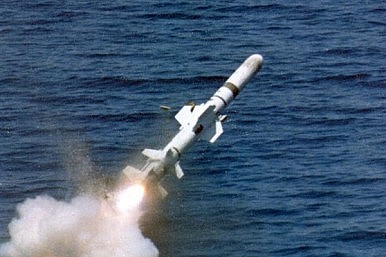
On Tuesday, the Pentagon announced Washington will be selling India submarine-launched Harpoon missiles.

On Tuesday, the U.S. announced its intention to sell India submarine-launched missiles.
The announcement was made in a press release by the Defense Security Cooperation Agency (DSCA). “The State Department has made a determination approving a possible Foreign Military Sale to India for UGM-84L Harpoon missiles and associated equipment, parts, training and logistical support for an estimated cost of $200 million,” the press release said. It noted that it sent a certification of delivery to Congress on July 1, 2014.

DSCA elaborated on the sale: “The Government of India has requested a possible sale of 12 UGM-84L Harpoon Block II Encapsulated Missiles, 10 UTM-84L Harpoon Encapsulated Training missiles, 2 Encapsulated Harpoon certification training vehicles, containers, spare and repair parts, support and test equipment, personnel training and training equipment, publications and technical data, U.S. Government and contractor engineering and logistics support services, and other related elements of logistics support.”

The press release went on to say that India’s Navy would use the new missiles on its Shishumar class submarine (Type-209). It also noted that India’s Navy already employs Harpoon missiles on its P-8I maritime patrol aircraft and its Air Force uses the same missiles on its Jaguar aircraft. DCSA said that selling India the submarine-launched Harpoon missiles would enhance India’s ability to defend critical sea lines of communication without altering the basic balance of power in the region.

The U.S. has made a concerted push to enhance its arms sales to India in recent years. In early 2013, Andrew Shapiro, the former assistant secretary of state for political-military affairs, said that U.S. military sales to India had jumped from near zero in 2008 to roughly $8 billion. Similarly, according to IHS Jane’s, India was the largest purchaser of U.S. military equipment in 2013 buying up $1.9 billion in arms from the U.S. including Boeing’s C-17A strategic transport aircraft and P-8I Maritime Patrol Aircraft. Similarly, America displaced Russia as India’s largest arms supplier last year.

JUDGING JIM GANT


Judging Jim Gant: Violence, Partiality, and Political Consolidation in Afghanistan

Several months ago — before the Bergdahl drama and Iraq’s abrupt meltdown — former Army Major Jim Gant received a brief flurry of attention due to the release of his biography American Spartan, authored by Ann Scott Tyson, which chronicles Gant’s turbulent career in Special Forces. It documents his dramatic rise to fame since 2009, when his strategy for Afghanistan, as described in a paper titled “One Tribe at a Time,” went viral among senior military leaders, subsequently becoming the basis for Village Stability Operations. It also details his precipitous fall from grace that followed from his alleged recklessness, substance abuse, and countless other infractions. Suffice it to say Gant is a polarizing figure who has both supporters and critics among those acquainted with his exploits.

But there are also more serious allegations; namely, that he perpetrated war crimes in Afghanistan, or at least supported their commission. In a 2010 blog post titled “Petraeus and McChrystal Drink Major Gant’s Snake Oil,” Central Asia specialist Christian Bleuer accused Gant of engaging in ethnic cleansing based on the following excerpt from “One Tribe at a Time:”

The highland people had taken and were using some land that belonged to the lowland people. The Malik told me the land had been given to his tribe by the ‘King Of Afghanistan’ many, many years ago and that he would show me the papers.[…] I made the decision to support him. ‘Malik, I am with you. My men and I will go with you and speak with the highlanders again. If they do not turn the land back over to you, we will fight with you against them.’[…] Without going into further detail…the dispute with the highlanders was resolved.

Additionally, on April 10 Adam Elkus, a War on the Rocks contributor,tweeted that “…it’s easy to judge. Particularly given that Gant facilitated ethnic cleansing.” Elkus is correct that it is easy to judge Jim Gant for his alleged crime. It is more productive, however, to attempt to understand the logic underpinning the act in question, and to assess its broader implications for counterinsurgency in Afghanistan.

Gant’s actions, though reprehensible, derive from a theory of victory more consistent with Afghanistan’s political reality than that offered by the prevailing counterinsurgency (COIN) wisdom of the time. GivenAfghanistan’s “kaleidoscopic” political landscape and its relative lack of preexisting political institutions, we should look not to mature Western political orders for models of political consolidation, but to the prerequisite process of state formation. This process is fundamentally illiberal and necessarily involves coercion and the domination of certain actors or coalitions over others. The upshot is that effecting a favorable outcome in Afghanistan, defined by a stable and self-regulating end state, may well demand a degree of complicity in immoral and/or illegal acts. This is not to say that the United States and its allies should engage in such acts. But we must adjust our expectations regarding the potential for self-restrained COIN and Foreign Internal Defense to deliver desired outcomes on acceptable terms, and perhaps should refrain from making categorical judgments about Gant.

The orthodox COIN wisdom of the past decade — that of FM 3-24 and David Kilcullen’s “28 Articles” — holds that securing a “durable peace” in COIN is ultimately a matter of establishing effective governance by a legitimate government. Legitimacy, which is billed as the key political variable, is defined by FM 3-24 as the acceptance of an authority by a society. While military force is necessary for eliminating and coercing insurgents, creating legitimacy requires the pursuit of non-military lines of effort, including the provision of essential services and economic and infrastructure development. Therefore, COIN is not warfare in the traditional sense, but is instead a competition for the hearts, minds, and acquiescence of the population.