5 January 2016

Australia–China cyber relations in the next internet era

https://www.aspi.org.au/publications/australiachina-cyber-relations-in-the-next-internet-era
Wednesday, 23 December 2015
By: Simon Hansen

ASPI has worked closely with the China Institute of International Studies (CIIS) to advance discussion on cyber policy, and several viable policy initiatives are proposed in this report.

Cybersecurity is a first-order national security issue, and ICT networks are critical for Australia’s digital future and economic prosperity. Common ground between Australia and China on cyber policy is thin, and there’s disagreement on many issues. But closer dialogue is needed to find opportunities to cooperate on shared threats and to limit the likelihood for misadventure. This special report is a building block for that discussion.

SR85_Australia_China_cyber_relations.pdf - PDF (6.4 MB)

THE STRANGE WORDS OF STRATEGY

http://warontherocks.com/2015/12/the-strange-words-of-strategy/
B.J. ARMSTRONG, DECEMBER 31, 2015

Today we face a world which some tell us is new and different. We have been assured by some that the ideas of the past have little relevance and must be changed to adapt to the future. Yet, if we discard the past, we are left with no foundation to build on. The most recent example of this is the growing use of a new concept labeled “gray wars” or the “gray zone.” Leaders from the special operations community are telling us that the world is new and different. But there are some very important concepts foundational to past military and national strategy that should not be ignored in the rush to the new buzzwords. As Colin Gray writes in his latest book, “problems in contemporary strategy are ever changing, but they all have common roots.”

Here at War on Rocks, Adam Elkus made an excellent critique of the squishy, nascent concept that has been labeled gray war (“50 Shades of Gray: Why the Gray Wars Concept Lacks Strategic Sense”). Elkus suggests that if we properly understood the work of previous strategists, we would better analyze the conflicts this buzzword is trying to describe. Whether or not you want “gray wars” to become an accepted part of the lexicon alongside asymmetric, hybrid, irregular, unconventional, fourth-generation, fifth-generation, and wicked conflict, Elkus’s piece is a must-read to help build the conceptual foundations for the discussion. In a follow up piece, “Abandon All Hope, Ye Who Enter Here: You Can Not Save The Gray Zone Concept,” he continued his blistering but systematic dismantling of the novelty of the idea.

The gray wars dialogue is just the most recent in a trend toward turning our back on historical precedent and previous strategic concepts. This past summer in the pages of Infinity Journal (free subscription), I attempted to make a similar case regarding to the idea of Air-Sea Battle, (or JAM-GC as it is now called). Debate over the operational concept which came to be known as Air-Sea Battle has been a large part of naval strategic discussion of the past several years. Despite the volume of words that have been spent on the subject, few have engaged with the actual theory and classical concepts of naval strategy. In my article, “D-All of The Above: Connecting 21st Century Naval Doctrine to Strategy,” I make the case that a better understanding of contemporary naval discourse’s place within the ideals of classical naval strategy will not only help us better understand proposals and counter-proposals, but it will also help strategists to better evaluate and develop future thinking.

FBI Tried a New Tactic In Order to Get Access to Encrypted Personal Communications

FBI Seeks to Reframe Encryption Debate
Devlin Barrett, Wall Street Journal, December 29, 2015
WASHINGTON—The Federal Bureau of Investigation is issuing a more direct challenge to technology companies in the wake of terror attacks in Paris and California, urging them in blunter terms to allow investigators to decrypt private communications during terror probes.
Hoping to escape a continuing debate over the technical feasibility of decryption, which they fear plays into Silicon Valley’s hands, FBI Director James Comey and others are pushing executives to move away from a policy they say values customers’ privacy over public safety.
“It is a business-model question,” Mr. Comey said at a recent congressional hearing, adding that executives “have designed their systems and their devices so that judges’ orders cannot be complied with…Should they change their business model? That is a very, very hard question.”
 
Challenging tech CEOs like Apple Inc. AAPL 1.80 % ’s Tim Cook directly suggests that Mr. Comey could be laying the groundwork for a push in Congress for legislation that would force the companies to change their products.
So far, however, there is no indication the tech industry is retreating from its argument that strong encryption is necessary to protect users’ information, and that providing a technological “key” or “backdoor” for law enforcement would simply make the information more vulnerable to hackers of all kinds.
A Samsung Electronics Co. Galaxy Note Edge smartphone running the Android mobile operating system displays the Google Inc. Hangouts app. Photo: Chris Goodney/Bloomberg News Apple, in response to questions for this article, said this isn’t a new issue, since the company has used encryption for well over a decade as a vital way to protect customers’ personal information.
“As hacking schemes and cybercrimes against individuals, companies and governments have become daily occurrences, we have worked hard to keep pace,” Apple said in a statement. “We know that criminals will seek out encryption techniques or develop their own, so weakening encryption in consumer devices will only hurt law-abiding citizens who rely on it to protect their data.”

Israel Unveils New VISINT and Counter-IED Balloon Reconnaissance System

December 30, 2015
New visual intelligence and counter-IED balloon unveiled
Yaakov Lappin, Jerusalem Post
A new visual intelligence and counter-IED aerostat was unveiled by its Yavne-based manufacturer, RT LTA Systems, on Monday.
The Skystar 330 will replace the Skystar 300 model, which was frequently visible over the Gaza border and is due to make its final flight in the coming days.

Skystar 330 will have new features, including GPS navigation and four fiberoptic cables, a spokeswoman for RT LTA said.
One of the new model aerostats is already operational in the IDF, while a European client has also purchased the model and is due to take delivery in the coming weeks.
The Skystar aerostats are used by militaries for intelligence, surveillance, reconnaissance, and communications, as well as counter- IED missions.

After gaining more than half a million operational hours in Israel and several other countries since 2007, RT LTA said the Skystar 300 model is due to end operations by December 31, though the company will continue to support and maintain the dozens of systems still operational worldwide.
“The new Skystar 330 has four optical fiber tethers, enabling extended communication bandwidth and range,” the company said in a statement. “In addition, the new system is equipped with an upgraded navigation system with high capabilities that include point on map ability, as well as advanced controllers, allowing better control and management of missions and targets.”

The Classical Principles of Counterinsurgency are Inadequate for Countering Global Insurgency

http://smallwarsjournal.com/jrnl/art/the-classical-principles-of-counterinsurgency-are-inadequate-for-countering-global-insurgen
by Jesse A. Heitz, Journal Article | December 30, 2015

This article will argue that the classical principles of counterinsurgency, while still exceptionally appropriate for countering regionally dominant insurgencies, are inadequate for countering modern global insurgency, making specific reference to the still present al Qaeda global insurgency. The classical principles which will be examined come from David Galula’s Counter-insurgency Warfare: Theory and Practice, as well as Robert Thompson’s Defeating Communist Insurgency: the lessons of Malaya and Vietnam.
We will start with Thompson’s first principle of counterinsurgency; this principle fixates on the premise that governments in the throes of dealing with insurgency are weak and ineffectual, and that the totality of the insurgency is powered by legitimate political grievances[1] and the resultant social unrest, rather than the inexplicable extremist motivations that dominate today’s global insurgency.

If one looks at the nations in which al Qaeda is most active, it can clearly be seen that the level of social unrest and political instability of a given Host Nation (HN) varies widely. For instance, it is true that hotbeds of al Qaeda-linked or exploited local insurgencies such as in: Sudan, Iraq, Pakistan, Afghanistan, Kenya, and Niger, are all incredibly unstable. However, other areas of al Qaeda dominance such as: Morocco, Uganda, Saudi Arabia, Indonesia, the Philippines, Yemen, and Tanzania, are all in the middle of the global pack in terms of stability. More recently, al Qaeda, its operatives, and those who are influenced and adhere to its ideology, have not only planted roots, but have become quite active in the world’s most stable of nations[2], such as: France, Spain, the U.K., Belgium, Germany, and the United States.[3] Worse yet, such an insurgency may have no readily identifiable political objectives[4] that could be attained through capitalizing on a HN’s weakness.

A folly that follows this train of thought comes from Thompson’s third principle, which stresses the necessity of “a balance between the military and civil effort, with complete coordination in all fields”[5]. This principle is beyond difficult to apply when countering a global insurgency. Not only would it take tremendous unity and avenues of communication for besieged governments and their international allies to satisfy this principle, but with each HN being a distinguishable variable in terms of stability and resources, it is unrealistic to expect such a level of coordination and organization at the global or multi-regional level.[6]

A Kinder Gentler, Machine Gun Hand or How I Gave Up My Right to Self Defense and Learned to Love COIN

by Matthew Swearingen, Journal Article | December 31, 2015 - 3:00am
Introduction
“Are we shooting?” Sgt. Barlow in Three Kings

In the beginning of the movie, Three Kings, it is March 1991, the Persian Gulf War had just ended, and Sgt. Barlow does not know if he can legally engage an Iraqi soldier. After the Iraqi soldier points his weapon in Sgt. Barlow’s direction, Sgt. Barlow shoots the Iraqi soldier, but is later unsure if he did the right thing since he then notices the dying Iraqi soldier had a white rag in his hand. While Sgt. Barlow now has time to second guess his decision, at that moment, he felt as though his life, and the life of the men that he serves with, were being threatened, and he had to make a choice.

Since the attacks of 9-11, U.S. service members[ii] have had to make similar life and death decisions in a split second during the wars in Afghanistan and Iraq. In the aftermath of the initial invasion, U.S. forces, after having achieved their objectives of ousting hostile Taliban or Ba’athist regimes, were left with rebuilding a country with hostile forces still embedded within the local populace and hiding amongst civilians. At all times, U.S. service members have been required to conduct themselves and conform their actions in accordance with international law and the Law of War, or the law of armed conflict. [iii] To accomplish this, U.S. service members are issued rules of engagement (ROE), which are guidelines issued by the President, the Secretary of Defense, and subordinate commanders that dictate the use of force that can be used by the military.[iv] While these rules may give service members wide latitude in the permissive use of force in self-defense, these rules may be further constrained in order to satisfy the principles of counterinsurgency (COIN).[v] Counterinsurgency focuses on protection of the local civilian population over the use of force against potential enemy targets in order to not cause collateral damage against civilians who may be nearby, inadvertently creating more insurgents and creating a perpetual conflict.[vi]

Many in the media and former members of the military have criticized the rules of engagement as being too vague, not clearly defined, or too restrictive.[vii] Furthermore, many argue that the rules of engagement in use since 9-11 have prioritized the “winning of hearts and minds” and counterinsurgency over winning wars and protecting the lives of those who serve in the military, and that the threat of legal punishment deters a service member’s basic right to self-defense.[viii]

The Best Leaders Are Constant Learners

https://hbr.org/2015/10/the-best-leaders-are-constant-learners?utm_campaign=HBR&utm_source=facebook&utm_medium=social

OCTOBER 16, 2015
As Juan Manuel Fangio exited the chicane before the blind Tabac corner in the 1950 Monaco Grand Prix, he stomped on the brake. It was a counterintuitive reaction for a racing driver exiting a corner — but one that likely saved his life. By slowing down he avoided plowing into a multi-car pile-up, which was just out of sight beyond the turn. In racing folklore, Fangio’s evasive action is considered a miracle. But why did he slow down?
The day before the race, Fangio had seen a photograph of a similar accident in 1936. As he approached Tabac, he noticed something about the crowd – an unusual color. Fangio realized that, instead of seeing their faces, he was seeing the backs of their heads. Something further down the road had to be attracting their attention. That made him recall the photograph.
This post is one in a series of perspectives by presenters and participants in the 7th Global Drucker Forum.

Like Fangio, leaders must scan the world for signals of change, and be able to react instantaneously. We live in a world that increasingly requires what psychologist Howard Gardner calls searchlight intelligence. That is, the ability to connect the dots between people and ideas, where others see no possible connection. An informed perspective is more important than ever in order to anticipate what comes next and succeed in emerging futures.

As the saying goes, “The best way to predict the future is to create it.” But how can business leaders make meaning of a playing field that is constantly changing shape?
The Best Leaders are the Best Learners

To find their way in societal shifts, leaders cannot rely on static maps, nor can they hope to manage complexity through fixating on the details. To do so would be to fall into the trap described by Jorge Luis Borges and Adolfo Bioy Casares in their 1946 short story “On Exactitude in Science,” in which empire cartographers draw up a map so detailed – the scale is a mile to a mile – that it ends up covering the whole territory and leads to the downfall of the empire. It’s a story of absurdity and unintended consequences, surely two things leaders today can appreciate.

4 January 2016

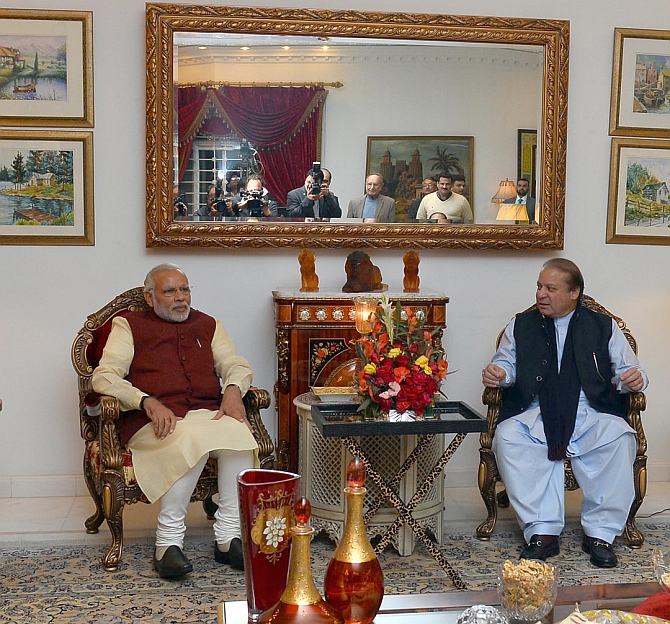
Pathankot attack: 'Someone' is unhappy with Modi-Nawaz talks

http://www.rediff.com/news/column/pathankot-attack-someone-is-unhappy-with-modi-nawaz-talks/20160103.htm
January 03, 2016
'Pakistan's military leaders have to accept that the policy of proxy wars has damaged Pakistan more than it has damaged the enemy,' says former R&AW chief Vikram Sood.
The latest attack in Pathankot on the night of January 1 and 2 is one more terror incident in a long series where every attempt by India to improve relations has evoked this kind of a response.

Everyone knows the list -- The Lahore Bus Yatra followed/accompanied by Kargil in 1999.
When the Agra Summit failed in 2001, we had the Parliament attack in December. When Indian forces were deployed in response, we had the attack on Kalu Chak in May 2002 and the two countries almost went to war.
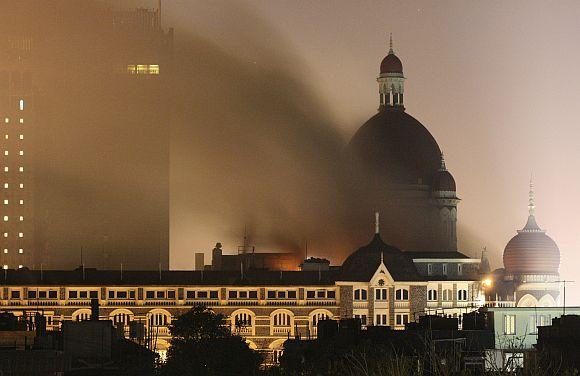
After the Musharraf-Manmohan talks ran into rough weather and Musharraf concluded he was not going to get what he wanted, we had the Mumbai serial train bombings and again Mumbai 2008.

The prime ministers met in Ufa last July and the response was a terrorist attack in Gurdaspur.
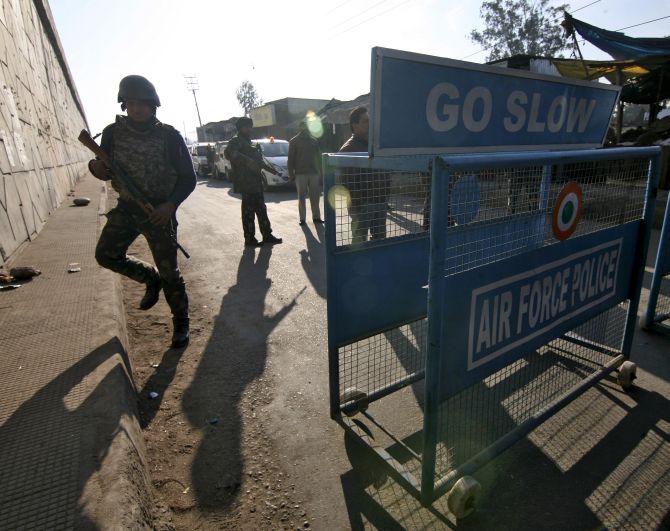
The Pathankot attack was less than a week after Prime Minister Narendra Modi met his counterpart in Lahore. Terrorists were able to penetrate the outer perimeter despite advance intelligence and massive security deployed in anticipation.
This prevented a massive attack on the main base although the ease with which they reached the target despite the warning is disturbing. They commandeered a vehicle and knew exactly where to go.

This means they had reconnoitered the airbase, worked out entry and exit points and they had local assistance. Some resident sleepers would have helped them to get to their target 30 kilometres away from the border in the middle of the night.
Punjab has been the target in recent months and the latest penetration at the Bhatinda air base, a classic intelligence operation, indicates heightened espionage efforts. There may be other similar operations and it remains to be seen if the Indian Air Force is being specially targeted.
Plus ca change, plus c'est la meme chose -- the more things change, the more they remain the same. This is what describes Pakistan's attitude towards India.
Yet there are many in India and some in Pakistan who are unable or unwilling to see the reality of India-Pakistan relations.

Pakistan will continue to support terrorists

http://www.rediff.com/news/interview/pakistan-will-continue-to-support-terrorists/20160102.htm
January 02, 2016
'The problem with India and Pakistan can be solved by Pakistan by ceasing its support for Islamist terrorists operating in India, letting go of its baseless demands upon Kashmir, ceasing its support for terrorists attacking India assets in Afghanistan.'
C Christine Fair is the author of Fighting to the End: The Pakistan Army's Way of War. An associate professor at the Centre for Peace and Security Studies, Georgetown University, Washington, DC, she is considered an authority on Pakistan and the Islamists within.
Professor Fair responded to Nikhil Lakshman/Rediff.com's inquiries on the Pakistan army and the current India-Pakistan rapprochement.
 
Do you believe the Pakistan army is on board with Prime Minister Nawaz Sharif's current rapprochement with India? Will the Pakistan military and the ISI behave or will it continue to needle India with its non-State actors?

Of course not, because there is no genuine rapprochement for several reasons.

The problem with India and Pakistan can be solved by Pakistan by ceasing its support for Islamist terrorists operating in India, letting go of its baseless demands upon Kashmir, ceasing its support for terrorists attacking India assets in Afghanistan.
There is only evidence for Pakistan's continued commitment to these goals.

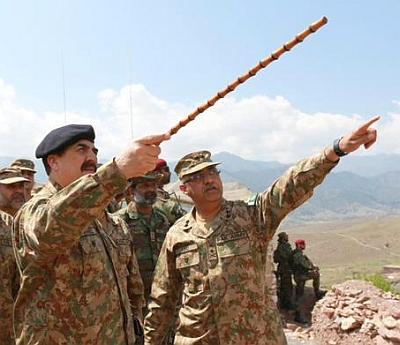
What do you think Washington told General Raheel Sharif, left, when he came a-visiting a few weeks ago? And what would they have needed to impress on him to get him to play ball?

Are lots of American goodies coming GHQ Rawalpindi's way?
The usual: Stop supporting the Haqqanis and take steps to eliminate them, stop supporting groups like LeT/JuD and take steps to eliminate them, stop engaging irresponsibly with respect to your nuclear programme, help bring the Taliban to the negotiating table.
As with previous similar 'lectures,' this army chief -- like all before him -- will ignore these messages and continuing doing what it does while continuing to get money from the United States because the United States is too afraid that Pakistan will fail etc.
We've seen this movie before. We know how it ends.

What would be the five things you would expect from Pakistan in 2016? 
 
1. More support for groups like JUD/LeT.
2. More support for the Haqqani network.
3. Inability and unwillingness to be constructive in Afghanistan.
4. More nuclear proliferation with respect to fissile material production and 'tactical nuclear weapons.'
5. More army dominance over the eviscerated democratic instittuions while engendering public support for the same.

'Very serious risk of a spectacular terrorist attack by ISI-backed groups'

http://www.rediff.com/news/interview/serious-risk-of-a-big-terrorist-attack-by-isi-backed-groups/20160103.htm: January 03, 2016
'The combination of the LeT and the ISI is the most dangerous terrorist challenge in the world because it carries a real and present danger of provoking nuclear war.'

Last year, former Central Intelligence Agency official Bruce Riedel made the startling revelation that Prime Minister Narendra Modi is in the cross-hairs of terrorist groups like the Lashkar-e-Tayiba and Al Qaeda.
Speaking at one of several conferences held on the eve of Modi's visit to the US in September 2014, Riedel, who was part of the CIA for over three decades, said, "Prime Minister Modi, his very persona, his past, the histories about him, perceptions for and against him, attract Islamic extremist thinking."

"Modi as an extremely successful Indian politician, known to be a strong nationalist, known to be a strong believer in the BJP ideology, is going to attract the attention of extremist movements like Laskhar-e-Tayiba, like Al Qaeda," Riedel, now a Senior Fellow and Director at the Washington, DC think-tank, the Brookings Institution's Intelligence Project, added.
"It is inevitable in who he is that enemies of that are going to try to take him down," Riedel warned.

"The attack underscores the determination of jihadist groups in Pakistan to sabotage any attempt at detente with India," Riedel replied when Nikhil Lakshman/Rediff.com sought an interview soon after the Indian Air Force station in Pathankot was attacked.
"These groups have very powerful friends in the Pakistani army who want to see the Lahore process collapse," he added.
After the bon homie of Christmas Day in Lahore, were you surprised that the Pathankot airbase attack occurred so quickly?
No, I was not surprised. An attack was very predictable by jihadists wanting to sabotage the Lahore process. A high profile target like an airbase was the jihadists' choice to buttress their claims to be warriors.

Preventing another Pathankot: A soldier's solution

http://www.rediff.com/news/column/preventing-another-pathankot-a-soldiers-solution/20160102.htm
January 02, 2016
'Attempts at long-term rapprochement have been rather feeble from both sides. The primary cause of the lack of progress is that these efforts do not appear to have the support of the Pakistan army,' says Brigadier Gurmeet Kanwal (retd).

Despite the political risk taken by Prime Minister Narendra Modi in stopping over at Lahore a week ago, terror strikes emanating from Pakistan soil continue unabated.
The attack on the air force base at Pathankot is only the latest example of Pakistan's continuing sponsorship of trans-border terrorism. Other recent incidents include strikes at Gurdaspur in Punjab and Udhampur in J&K.

The Pakistan army and the ISI do not appear to realise that a major terrorist strike could lead to military retaliation from India. Even though such retaliation would be carefully calibrated to avoid escalation, it would carry the risk of snowballing out of control to a full-blown conventional conflict with nuclear overtones.
Both nations need to move forward and ensure that conflict avoidance is accorded high priority. Existing Confidence Building Measures need to be implemented in letter and spirit and new ones need to be introduced to reduce the risk of conflict.

Though a few meetings have been held between the two prime ministers and between interlocutors of the two ministries of external affairs, since the Modi-led government came to power in May 2014, attempts at long-term rapprochement have been rather feeble from both sides.
The primary cause of the lack of progress is that these efforts do not appear to have the support of the Pakistan army. The trust deficit between the two countries has proved hard to overcome.

Tired of being targeted, America's Sikhs are standing up for their identity

http://www.csmonitor.com/USA/Society/2015/1231/Tired-of-being-targeted-America-s-Sikhs-are-standing-up-for-their-identity?cmpid=ema:nws:Weekly%2520Newsletter%2520%2801-02-2016%29&utm_source=Sailthru&utm_medium=email&utm_campaign=20160102_Newsletter:%20Weekender&utm_term=Weekend_Best_of_Web

The attack on an elderly Sikh man in Fresno Saturday, which police have called a hate crime, is the latest example of xenophobia toward the misunderstood religion, activists say, adding that the atmosphere is as tense as at any time after 9/11.
By Gloria Goodale, Staff writer December 31, 2015

Los Angeles — At the Gurdwara of Los Angeles, a small group of Sikh temple-goers move quietly between prayer and community rooms after work on Tuesday. They are here to eat and pray, but also to share their concerns about what many see as growing violence against their religion's members, easily identifiable by their traditional beards and turbans. Saturday’s attack on an elderly Sikh farmhand in Fresno, which police have called a hate crime, has heightened their concerns.

“We are very worried,” says Sukhwant Singh Sandhu, a 70-year-old grandfather who came to the United States from India 30 years ago. He is now a US citizen and retired six months ago. But, he says, during the many years he worked at convenience stores and gas stations, he regularly shaved his beard to avoid drawing attention to his appearance. “I am now growing this beard for six months,” he says sipping sweet tea with a smile.
Many Sikhs say after the attacks on 9/11, anyone who wore beards or religious headgear became a target for hostility, with attackers rarely making distinctions between various religions such as Islam or Sikhism.

Guest column: Wrong precedent by bureaucrats

http://www.hindustantimes.com/punjab/guest-column-wrong-precedent-by-bureaucrats/story-kp87zY8XevJfSSRe4XKp9K.html
Lt Gen Harwant Singh(retd), HindustanTimes, Chandigarh |
Updated: Jan 02, 2016

Two officers, special secretary (prisons) Subash Chandra and special secretary (prosecution) Yashpal Garg from DANICS (Delhi Andaman and Nicobar Island Civil Services) posted with the home department of the Delhi government, were recently placed under suspension for gross misconduct and insubordination, in that they refused to sign a cabinet note pertaining to a salary hike for public prosecutor and prison staff. They were only to sign the note and are not the sanctioning authority.
Rising to the support of these two suspended officers, IAS officers from the AGMUT (Arunachal Pradesh-Goa-Mizoram-Union Territories) decided to join those from DANICS to go on half-day casual leave. This in actual terms is a strike! Further, the DANICS officers association took the unusual step of writing to the union home ministry, asking that the suspension order be declared, null and void.

These IAS officers’ association adopted a resolution, declaring the suspension order illegal. Their contention being that the appointing authority in their case is the President of India, acting through the ministry of home affairs and not the home minister of the government of the national capital territory of Delhi and that the suspension order based on the central civil services conduct (CCS) rules is condemnable. These IAS officers associations have contended that the Delhi government can recommend the suspension of these officers to the ministry of home affairs and that suspension order can only be issued by the lieutenant governor after approval of the union home ministry. Such a contention strikes at the very roots of discipline and political control over the bureaucracy.

Pressure tactics set poor example
Bureaucrats frame such rules and the political executive, being none the wiser, blindly approve these. The more glaring example of this ignorance and incompetency of the political class is best showcased in the case of the defence secretary, where he alone stands responsible for the defence of India.

Searching For Voices Of Sanity In Kashmir – OpEd

http://www.eurasiareview.com/31122015-searching-for-voices-of-sanity-in-kashmir-oped/
By Dr. Adfar Shah December 31, 2015

Kashmiri youth continue to die needlessly one after the other – either as militants in encounters with the security forces or die as Zahid Bhat, a 19-year-old boy who was recently set ablaze by a mob in Udhampur and thus became the victim of a hate crime and beef politics. There are also thousands of other youth who have been killed in one way or another. Amid this never ending chaos, communal politics — and now especially cow politics — the people have lost hope in the system to do anything worthwhile and stem this needless loss of young and vibrant lives.

Deep frustration – especially frustration among the youth – has reached a new zenith and is in imminent danger of exploding! Today, in contemporary Kashmir, what youth from any section, class or educational background of Kashmiri society have in common is their horrible experiences and pathetic lived realities, as well as a distrust in and hopelessness with the system. Given such a dismal state of affairs prevailing in the Kashmir Valley and belonging to the same context, I too was greatly upset after the unruly mob attacked the truck in Udhampur and burned two youth mercilessly – one of whom succumbed to his severe burn injuries later. With never-ceasing civilian killings, regular encounters especially in south Kashmir, rising communal hatred in Jammu, the monster of hopelessness stalks every right thinking individual; with the uncalled for beef violence, every sane person feels disgusted. In utter despair I sent a text message to my teacher and the message read thus: “Sir, Kashmir is again, predictably enough, on the boil and it is really getting worse day by day. Zahid’s killing will further instigate violence and motivate the already inflamed youth, towards counter violence. What do you surmise is the way out to this terrible situation of uncertainty and cycle of violence?” After a moment I received a terse one liner which succinctly read as, “Voices of Sanity!”
In search of Sane Voices

Chinese Intelligence is infiltrating and intimidating Uighur exile communities Around the World

Holding the fate of families in its hands, China controls refugees abroad
Reuters, December 30, 2015
MONTREAL/MUNICH – Erkin Kurban, an ethnic Uighur from China’s frontier region of Xinjiang, left his homeland for Canada back in 1999. When he returned to Xinjiang for a visit in April 2013, he had not seen his family for more than 13 years. Kurban was especially excited about seeing his 85-year-old mother.
His joy was short-lived. On the third day after his arrival, an agent of China’s pervasive security police summoned him for a meeting at a police station. Over the next 10 hours, Kurban, a 55-year-old long-distance truck driver, was grilled on his activities in Canada and the United States. His interrogators urged him to send reports on fellow Uighur exiles when he went back, leaving him with a stark choice: Spy for China or never come back to see his family again.
 
The interrogators had a particular target in mind. For 90 minutes they demanded information on Washington-based Rebiya Kadeer, the most prominent leader of the Uighur community in exile and an outspoken critic of China’s treatment of the Turkic-speaking Muslim people in Xinjiang.
“They asked me who was active in the leadership and who was doing what,” said Kurban, as he steered his 53-foot tractor trailer on a long haul trip from California to Montreal. “They also wanted to know what Rebiya Kadeer was doing and what projects she had.”
Kurban’s interrogation is part of a global campaign of intelligence gathering and harassment by China against the Uighur community abroad. The effort is aimed at neutralizing the community’s leaders, whom Beijing accuses of plotting independence, and sowing distrust and discord among its members. With the power to treat family members back home as hostages, Chinese security services have strong leverage over Uighurs living overseas, thousands of whom have fled what they say is persecution by the authorities in Xinjiang. 

China creates Cyber Warfare Army Division

http://www.albanydailystar.com/world/china-creates-cyber-warfare-army-division-15046.html
by Ray Courtney | @ | January 2, 2016 0

China has created three new military bodies as part of reforms to modernise its military – the world’s largest standing force – and improve its fighting capacity. President Xi Jinping gaved military flags to the leaders of the three new units – a general command for the People’s Liberation Army, a missile force and a strategic support force. The new Strategic Support Force will likely focus on cyber warfare.
China’s Modernization of Army

By 2020, the northeast region in China should have achieved medium-high growth and met the target of building a moderately prosperous society, according to a statement released after the meeting, held by the Political Bureau of the Communist Party of China Central Committee yesterday.
Xi described the modernization reform as “a major policy decision to realize the Chinese dream of a strong army”. “Catch, catch, catch, catch”, chants the rapper, in a reference to Operation Fox Hunt, Mr Xi’s crackdown on alleged corrupt officials which has extended as far as Australia and Canada as targeted executives and bureaucrats flee arrest on the mainland.

Xi recalled the large-scale commemoration for the 70th anniversary of victory in the Chinese People’s War of Resistance Against Japanese Aggression and in the World Anti-Fascist War.
The reform will include cutting troops from 2.3 million to 2 million, phasing out outdated armaments, developing new weapons systems and reducing the size of the militia.
Xi said the three new units were created as part of a modernization reform and “to realize the Chinese dream of a strong military.” He has promulgated the idea of a “Chinese dream” involving “the great renewal of the Chinese nation” and sees a strong military as key to this.

China’s Space Warfare Capabilities Growing

Bill Gertz
Washington Times, December 30, 2015
Following recent tests of anti-satellite missiles and near-space hypersonic vehicles, China ’s military will soon create a new Space Force within the People’s Liberation Army, a sign Beijing is preparing for future space warfare.Military analysts say there has been no official announcement of the new space warfare unit; however, unofficial sources in China revealed the unit will be part of a new Strategic Support Forces service that will include nuclear missiles — currently under the Second Artillery Force — along with an electronic information forces, cyber warfare units and electronic and signals intelligence. The shift to space and information warfare is part of a major military reorganization that has been underway in China for the past several years. It’s designed to transform the once ground forces-heavy PLA into a high-technology force.
China conducted the sixth test of a hypersonic strike vehicle on Nov. 23, after having carried out an anti-satellite missile test on Oct. 30. Both weapons are part of China’s large-scale high-technology arms buildup.A Chinese Internet military blogger posted photos of a purported flight test on Dec. 13 in northwestern China of what was described as either a missile defense interceptor test or anti-satellite missile test.

As reported by Inside the Ring on Oct. 15, the annual report of the U.S.-China Economic and Security Review Commission warned that “China is pursuing a broad and robust array of counterspace capabilities, which includes direct-ascent anti-satellite missiles, co-orbital anti-satellite systems, computer network operations, ground-based satellite jammers and directed energy weapons.”“The Strategic Support Forces appear to have been inspired by the U.S. Strategic Command, which also controls missiles, space assets and cyberwarfare,” said Rick Fisher, a Chinese military affairs specialist. “It appears that the Space Force will control China’s military and commercial satellite program, its manned space program plus an increasing number of space combat programs.” The new unit also is expected to control China’s future strategic missile defense forces.Mr. Fisher, with the International Assessment and Strategy Center, said in addition to ground-launched anti-satellite missiles, future PLA space weapons may include aircraft-launched ASATs, laser-armed low earth orbit combat platforms, low earth orbit bombers and dual-use civilian military space shuttles.

China’s ‘good monk’ versus ‘bad monk’

http://www.dailypioneer.com/columnists/edit/chinas-good-monk-versus-bad-monk.html
Thursday, 31 December 2015 | Claude Arpi | i

Beijing is busy manipulating even the religious sentiments of its citizens. Earlier it practised atheism, but realising the people’s deep faith in Buddhism, it has begun promoting its official religious leaders
Modern China has several facets. Unfortunately, the most disturbing, the totalitarian one, has come to the fore during the past year. Take the example of Ursula Gauthier, the French correspondent based in Beijing for the weekly, L’Obs; the renewal of her Press visa was refused by the authorities. because she had offended the Chinese Government with an article questioning Beijing’s Xinjiang policy and refusing to compare some events there to terrorism.

Then, the National People’s Congress Standing Committee passed China’s first counter-terrorism law. In an editorial, The South China Morning Post commented: “Wherever Governments have passed unprecedented security laws to confront the threat of terrorism to civilised society and its way of life, their actions have prompted concerns about adverse effects on freedom of expression and intellectual property rights.” For sure, life will be tougher for the minorities and citizens in general who dare to express their genuine grievances.
Further, news agency Xinhua stated that the new counter-terrorism law makes it legal for China’s People’s Liberation Army to get involved in anti-terror operations abroad. Does it mean the PLA can be sent anywhere, when China’s interests are at stake, for counter-terrorist missions? These signs demonstrate a high degree of nervousness.

Last weekend, President Xi Jinping and the entire 11-member Central Military Commission visited the offices of The PLA Daily. Mr Xi called on the journalists/officers to play a leading role in “strengthening the military”. President Xi affirmed, “The PLA Daily must adhere to the leadership of the Communist Party of China and serve the PLA.” He added that the publication should uphold party principles and “unswervingly” embrace the CPC leadership.

Gauging The Jihadist Movement In 2016: The Al Qaeda Camp

from STRATFOR
-- this post authored by Scott Stewart
Since 2006, Stratfor has published an annual forecast for the overall jihadist movement. For the first several years, the forecast focused primarily on al Qaeda - a fact reflected in the titles we chose - but as the jihadist threat changed, stemming from a larger movement beyond that one organization, we dropped the "al Qaeda" from the title in 2009. In 2013 we changed the format of the jihadist forecast to a multi-part series because it had become too difficult to cover the topic in just one piece.

The 2013 series laid out the goals and objectives of the jihadist movement, as well as terrorist and insurgent theory. These elements were then used as standards to measure the status of various components of the jihadist movement and forecast what to anticipate in the year ahead. We have not repeated the sections on objectives and theory, but readers may find it useful to review these foundational pieces before reading further; they can be found here and here. Last year's analysis on defining the jihadist movement can be found here for reference.

This year, I will focus on three components of the jihadist movement: the al Qaeda pole, the Islamic State pole and grassroots jihadists. This particular piece will examine al Qaeda and its various branches.
Status of the Core
The al Qaeda core organization under the leadership of Ayman al-Zawahiri remains weak. Over the past year it has not conducted any significant attacks, and its ideological clout has continued to wane. Indeed, there is a general sense that statements from al Qaeda franchise group leaders such as al Qaeda in the Arabian Peninsula leader Qasim al-Raymi and Jabhat al-Nusra leader Abu Mohammed al-Golani carry more weight than al-Zawahiri's.

Is this the beginning of the end for Isil in Iraq?

http://www.telegraph.co.uk/news/worldnews/islamic-state/12073408/Is-this-the-beginning-of-the-end-for-Isil-in-Iraq.html
The recapture of Ramadi is hugely significant for the coalition – but tougher battles lie ahead in Syria
Members of the Iraqi security forces hold an Iraqi flag with an Islamic State flag which they had pulled down at a government complex in the city of Ramadi
By Con Coughlin, 30 Dec 2015

Abu Bakr al-Baghdadi, the self-styled leader of the Islamic State of Iraq and the Levant (Isil), must regret ever making his boastful Boxing Day message that, for all the coalition’s efforts, his organisation continues to grow and expand.
The dawn of 2016 finds Isil very much on the defensive in both Iraq and Syria"
No sooner had his message been broadcast through the Arab media than the Iraqi government announced one of the most significant military gains of 2015 – the recapture of the Sunni stronghold of Ramadi just 60 miles from the capital Baghdad. Isil’s capture of Ramadi last spring represented a severe setback to Haider al-Abadi, the Iraqi prime minister, who, with the help of several Iranian-backed militias, had just succeeded in recapturing another iconic Sunni position from Isil, former Iraqi dictator Saddam Hussein’s home town of Tikrit.

The liberation of Tikrit, moreover, was supposed to be the precursor for a far more challenging military offensive to liberate Mosul, Iraq’s second city, which was overrun during Isil’s initial invasion of Iraq in the summer of 2014. But the manner of Isil’s capture of Ramadi, where a few hundred jihadist fighters managed to rout a far stronger and better-equipped Iraqi force, put paid to any thoughts of liberating Mosul. On the contrary, the Iraqi military’s dire performance at Ramadi totally undermined the confidence of coalition commanders in its ability to take the fight to Isil. Thus the much-vaunted plan to liberate Mosul was quietly shelved in favour of rebuilding the war-fighting military capability of the Iraqi Security Forces (ISF).
In the complex campaign to destroy Isil in both Iraq and Syria, coalition leaders have concluded that it is vital that the ISF has the will as well as the strength to defeat its highly motivated and well-resourced foe. If the threat posed by jihadist fanatics can be eradicated in Iraq, then that will provide a firm platform from which to launch a decisive push to crush Isil in neighbouring Syria.

How ISIS Actually Lost Ramadi

 thedailybeast.com
by Nancy A. Youssef,Shane Harris ,  Dec. 30, 2015
It’s one of several ways in which the simplistic narrative of the battle for Ramadi is giving way to a more nuanced story-one that presents both promise and peril as the fight against ISIS continues. For those looking for good news, there was plenty: the emergence of Iraq’s elite fighters, and the apparent absence of the Shia militias which have threatened to turn the ISIS conflict into a sectarian war.

But there was troubling news as well. The Iraqi army’s inability to lead the five month battle for Ramadi leaves many in the Pentagon dubious of plans to liberate ISIS’s biggest Iraqi stronghold, in Mosul, despite pronouncements from Iraqi political leaders that the operation is on the horizon. The ISF can, at best, carry out the ancillary aspects of war fighting. And the elite counterterrorism unit is not large enough to do the job of liberating-and holding-multiple cities simultaneously.
The battle of Ramadi suggests that Iraq’s counterterrorism forces, an elite group akin to the U.S. Army’s Special Forces, are the Baghdad government’s most capable fighters. They can move block by block with the backing of coalition air forces that kill scores of ISIS militants, so that Iraq’s conventional forces don’t have to confront them.

“This was attrition warfare. This was not an aggressive ISF ground campaign. They were mostly coordinating and providing security for the counter terrorism unit and maintaining a perimeter, which can be quite taxing,” one defense adviser to the war on ISIS explained to the Daily Beast. “It was mostly about pinpointing ISIS positions to call in airstrikes, clearing booby traps so you could open up mobility corridors.”

Iraqi commandos and U.S. airstrikes drove the terror army from much of the city. But that war plan could backfire the next time around.
Pentagon officials hailed the U.S.-trained Iraqi army this week for retaking much of the western city of Ramadi from the self-proclaimed Islamic State.

A letter to a young Muslim on the future of Western Islam

http://qz.com/579526/a-letter-to-a-young-muslim-on-the-future-of-western-islam/
Written by Haroon Moghul Senior Correspondent, Religion Dispatches
December 27, 2015
We have failed you.
While jihadist movements continue to expand their reach, anti-Muslim bigotry is becoming more and more mainstream. Both narratives mean to deny the possibility of meaningful coexistence. Which is the identity and the reality of thirty million of us.
Thirty million Western Muslims, spread out across Europe (excluding Russia), the United States, Canada, Australia, and New Zealand. But though we had every reason to speak out, we have barely begun to come together.

When we are talked about, it’s either as a problem (terrorism) to be solved, or as the solution (counter-terrorism) to the problem we’re held responsible for. We have little to no relevance outside national security.
And because we do not seem to matter, we might begin to feel as if we do not exist.

I will not excuse myself by saying that we could not have known how bad it would have gotten, or that the forces arrayed against our narratives were too entrenched. I will not soften the blow, either, by hoping it is always darkest before dawn. Because it may get darker.
God does not change the condition of a people until they change themselves. I ask myself how we have gotten to this juncture. I reflect on what I could have done differently. If my life’s experiences can be of any benefit, even as a cautionary tale, then I offer them.

What follows is neither exhaustive nor conclusive, but an outline for what you can do, and what I think you must do, to reverse this state of affairs, to help build the kinds of communities our history and heritage promises we can.
Part I covers our relations to the wider world; Part II concerns our own communities and identities.
Part I: All allies, foreign and domestic
1. First and foremost
People will ask you, “Are you Muslim or are you American?” (Or some other such question.) You will answer, “Yes.”
People will also ask you, “Do you condemn terrorism?” And you must not say “Islam is a religion of peace.”
You will do more than condemn, too. You will show that you are actively involved in building narratives that compete with the dangerous ones. I know you won’t do this because powerful people are asking the questions, but because you, like me, want better for your communities.

The True Cost of Ending ISIS

http://nationalinterest.org/feature/the-true-cost-ending-isis-14759?page=show
Alexander Kirss, December 30, 2015

What would be the true cost of definitively defeating the Islamic State in Iraq and Syria (ISIS)? The answer should properly be measured in trillions of dollars, not $500 million per month for a no fly zone or the $330 million per month the United States is currently dispensing. It is increasingly clear that air power alone is insufficient either to defeat ISIS or to ensure the necessary post-conflict stability to prevent the rise of a similar terrorist threat in the region. Large numbers of ground troops—more than a token number of American Special Forces—would be required to achieve this goal.

Despite the recent announcement of an “Islamic military alliance against ISIS”headed by Saudi Arabia and the recent success of the Iraqi army in pushing ISIS out of the city of Ramadi, it is unlikely that the United States would be able to wholly outsource ground operations to local partners. Saudi Arabia is already engaged in an inconclusive military intervention in Yemen and the nascent alliance likely lacks both the political will for a long-term deployment and sufficient numbers of ground troops to pull it off. When the Iraqi army pivots north to the much larger city of Mosul, the potential for civilian casualties increases and the U.S.-led coalition will not be able to use airpower with as much impunity. Even if Kurdish forces were able to roll back ISIS on their own, the political costs for Turkey and the central Iraqi government would be far too high for either of them to support such a plan regardless of U.S. preferences.

The closest point of comparison for a comprehensive military campaign to destroy ISIS is the U.S. invasion and occupation of Iraq, which cost approximately $900 billion. There are two important considerations to keep in mind, however, when comparing the potential costs of defeating ISIS to past actions in Iraq. First, the cost of major operations in Iraq from 2003-2011 bought failure—in so far as it set the preconditions that allowed ISIS to form in the first place. Costs would likely be higher, therefore, if the U.S. sought to not only defeat ISIS once and for all but also to fully reconstruct Iraq and Syria and provide the necessary assistance to other regional states to prevent the rise of Islamist terrorism in those areas. (As Andrew Bowen has noted, ISIS’s “brand represents a broader long-term challenge than the actual ‘state.’”)

Ukraine Investigating Possible Russian Cyber Attack On Its Energy Grid

Ukraine to probe suspected Russian cyber attack on grid
Reuters, December 31, 2015
KIEV, Dec 31 (Reuters) - Ukraine will investigate a suspected cyber attack on its power grid, the energy ministry said on Thursday, an incident the country’s secret service has blamed on Russia.
A power company in western Ukraine, Prykarpattyaoblenergo, said on Dec. 23 that a swath of the area it serves had been left without energy, including the regional capital Ivano-Frankivsk, due to “interference” in the work of the system.

Ukraine’s SBU state security service blamed Russia, which has not so far commented on the allegation. The energy ministry in Kiev said on Thursday that it had set up a special commission to investigate what happened.
While cyber attacks are commonplace, few successful assaults on industrial targets have been documented. If the SBU’s accusations are validated by the probe, it would be the first time a specific power outage has been credibly linked to a cyber attack, said Robert Lee, a former U.S. Air Force cyber warfare operations officer.

Lee said it was too early to say whether the SBU’s account was credible. If the claims are validated, then the incident could prompt other nations to use similar tactics.
“Once there is a precedent, that would open up avenues for states to feel comfortable in going that route,” said Lee, chief executive of cyber security firm Dragos Security.

The World According to Russia

http://www.theatlantic.com/international/archive/2015/12/russia-putin-miroporyadok/422196/
A documentary on state television gives a glimpse of Vladimir Putin’s philosophy.
JEFFREY TAYLER, DEC 30, 2015
 
“Do you realize what you have done?” Vladimir Putin demanded at the United Nations in September. The question was a rebuke to the American-led bloc of countries that initially viewed with optimism the Arab Spring, which began five years ago this month, but has since given way to chaos and Islamist violence across once-stable parts of the Middle East and North Africa. Those events, and much else, look different when viewed from Russia than they do from the United States, and a documentary that aired recently on Russian state television helps explain the worldview behind Putin’s question.
The two-hour-plus film, Miroporyadok (World Order), explores, in the words of its narrator Vladimir Solovyov, “what is happening with us [Russians], what sort of world we have inherited from our parents, and what sort of world we will leave to our children.” Partly through interviews with the Russian president himself, it also offers a window on Putin’s own realpolitik perspective, one that I’ve found to be widely shared throughout Russia over many years of living in the country—a worldview according to which international relations consist of competing blocs of nations pursuing their interests, and the violation of sovereignty is a recipe for instability. This stands in contrast to Obama’s own position, which he stated at the UN two years ago, that “sovereignty cannot be a shield for tyrants to commit wanton murder, or an excuse for the international community to turn a blind eye to slaughter.”

Brave New War“I believe,” Putin tells Solovyov, “that no one should ever impose any sort of values he considers correct on anyone. We have our own values, our own conceptions of justice.” Putin doesn’t name names here, but the implication is clear throughout: World Order endeavors to incriminate American foreign policy and place the blame for the current chaos in the Middle East on the United States. The film’s anti-Americanism is subtle but relentless, and the spin comes mostly from omission of relevant facts. And though it originated within the Russian state propaganda machine, some of its criticisms of wrongheaded U.S. policies and blundering interventions in the Middle East since September 11, 2001, would give American liberals, centrists, and even a few conservatives little cause for dispute. Yet the documentary goes further, leaving the strong impression that greedy, bungling, incorrigibly myopic conspirators “from across the ocean” (a phrase Putin uses repeatedly in the film to describe the U.S. leadership) bent on world domination are to blame; Russia comes off as unjustly demonized and Russians themselves forced to suffer economically as a result.