27 April 2021

Why Does the Pandemic Seem to Be Hitting Some Countries Harder Than Others?

By Siddhartha Mukherjee
On December 2nd, Mukul Ganguly, an eighty-three-year-old retired civil engineer in Kolkata, India, went to the Salt Lake Market to buy fish. The pandemic was surging around much of the world, and he wasn’t oblivious of the risks of spending time at a wet market. His wife, a former forensic analyst, protested vehemently. But Mr. Ganguly wouldn’t be deterred. He picked up his fabric shopping bag, tucked a doubled-up handkerchief in his pocket, and stepped out.

Mr. Ganguly lives in a modest, two-story, book-filled house a few blocks from the market. He tied his folded handkerchief into a makeshift mask, and spent about two hours buying groceries, choosing vegetables and sweets, and bargaining with the venders. (Give a man a fish and you feed him for a day; teach a man to haggle with a fishmonger and you’ll feed him for a lifetime.) Two days later, he came down with a fever and a dry, incessant cough; he was barely able to walk to the bathroom. His daughter-in-law, in New Jersey—a cousin of mine—called me in a panic: he had tested positive for covid-19.

We worked up a plan. He was to be isolated in a room with a pulse oximeter. His vitals were monitored twice daily. We arranged for a supplemental oxygen tank to be brought home in case his O2 levels dipped too low. I called my doctor friends in Kolkata and asked them to stand by. For two days, Mr. Ganguly had a fever—100 degrees, 101 degrees—and then it subsided. By Christmas, he was pretty much back to normal. When I spoke to him in late December, he told me, in Bengali, that his experience had been typical. Various friends, all in their seventies and eighties, had contracted covid-19. All had bounced back.
India’s massive COVID surge puzzles scientists

Smriti Mallapaty

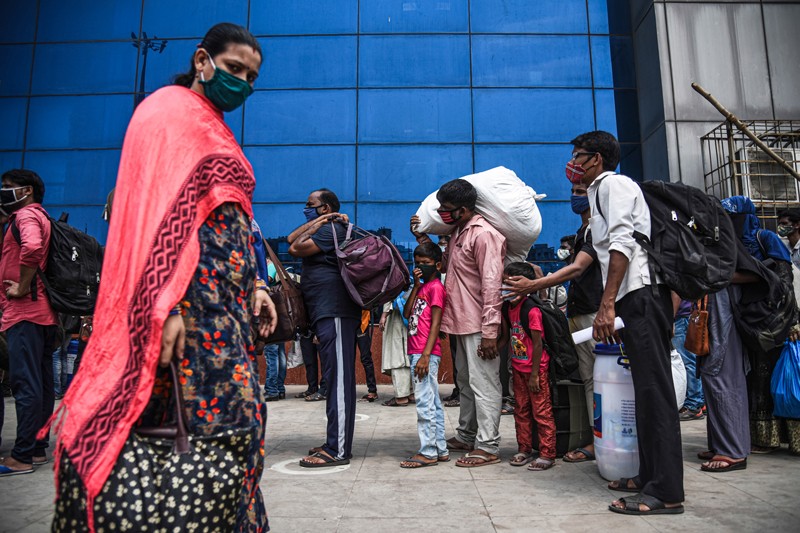
Ahead of a lockdown imposed on 14 April, migrant workers queue at a railway station to depart the city of Mumbai, India.Credit: Getty

The pandemic is sweeping through India at a pace that has staggered scientists. Daily case numbers have exploded since early March: the government reported 273,810 new infections nationally on 18 April. High numbers in India have also helped drive global cases to a daily high of 854,855 in the past week, almost breaking a record set in January.

Just months earlier, antibody data had suggested that many people in cities such as Delhi and Chennai had already been infected, leading some researchers to conclude that the worst of the pandemic was over in the country.

Researchers in India are now trying to pinpoint what is behind the unprecedented surge, which could be due to an unfortunate confluence of factors, including the emergence of particularly infectious variants, a rise in unrestricted social interactions, and low vaccine coverage. Untangling the causes could be helpful to governments trying to suppress or prevent similar surges around the world.

End the ‘Forever War’ Cliché


BY STEVEN A. COOK

Last week, President Joe Biden announced the withdrawal of U.S. forces from Afghanistan after two long and frustrating decades. Amid the praise and recriminations that followed, the phrase “ending endless wars”—and its variant, “ending forever wars”—was on repeat among pundits.

The planned withdrawal from Afghanistan by Sept. 11 poses a question for the foreign-policy community, however: Now what? “Ending endless wars” has become a neat and effective political slogan for analysts on the left and the right, but what does it actually mean for U.S. foreign policy after Afghanistan?

This is not to quibble with the president’s decision to withdraw. Once regarded as the “good war”—in contrast to the invasion of Iraq—the U.S. encounter in Afghanistan suffered from mission creep, interest creep, spectacular corruption, double-dealing partners, ineffectual partners, and an American public that remained mostly unaware of the conflict for the last two decades. The withdrawal from Afghanistan is hardly risk-free. Any objective observer must (or should) worry about the resurgence of the Taliban and what that means for the Afghan people and counterextremism efforts. Still, Americans have proved over and again that they cannot fix Afghanistan. Knowing this, Biden decided to end what truly seemed to be an endless war.

General Warns of Challenges to Tracking Terrorist Threats in Afghanistan After U.S. Exits

By Eric Schmitt

WASHINGTON — The top American commander in the Middle East said on Tuesday that it would be “extremely difficult” for the United States to watch and counter terrorist threats in Afghanistan like Al Qaeda after American troops leave the country by Sept. 11.

The head of the U.S. Central Command, Gen. Kenneth F. McKenzie Jr., offered the first extensive comments by a top commander about the effect of President Biden’s decision to withdraw more than 2,500 American troops from Afghanistan. Mr. Biden rejected the advice of top Pentagon and military advisers to keep a small force in place.

Among the major challenges once troops have left will be how to track and potentially attack militant groups in Afghanistan, a landlocked nation far from any major American base. General McKenzie said the administration was discussing with other countries where it could reposition forces to prevent Afghanistan from again becoming a terrorist base.

Possibilities in the region include Tajikistan, Kazakhstan and Uzbekistan, but those countries are under the sway of Russia to one degree or another, and the sanctions the administration imposed on Moscow last week complicates any such discussions, diplomats and military officials said.

Attack planes aboard aircraft carriers and long-range bombers flying from land bases along the Persian Gulf, Indian Ocean and even in the United States could strike insurgent fighters spotted by armed surveillance drones. But the long distances are costly and riskier.

“It’s going to be extremely difficult to do, but it is not impossible,” General McKenzie said under questioning from both Democrats and Republicans on the House Armed Services Committee.

Biden Made the Right Decision on Afghanistan

By P. Michael McKinley

The decision to withdraw the U.S. military from Afghanistan could have been made years ago or years hence: there was never going to be a perfect time, but the time has come, and President Joe Biden has made a difficult but right choice at a moment of historic shifts in global geopolitical realities.

Since 2001, successive U.S. administrations have carried out foreign policy through the prism and primacy of the wars in Afghanistan and Iraq and the global “war on terror” in the broader Middle East. While Washington’s attention was fixed on these concerns, China emerged as a global “strategic competitor” and Russia vied for influence in eastern Europe and the Middle East. The United States focused more energy on developing “out of areaNATO engagement in Afghanistan and the Middle East than on addressing the concerns that preoccupied its partners in Europe. And as the world underwent

Iran’s ‘New’ Partnership With China Is Just Business as Usual

Dina Esfandiary 

The recently finalized 25-year comprehensive cooperation agreement between Iran and China has been referred to in the media as a “game-changer,” a “breakthrough” and a “major geopolitical shift,” but in reality, it is much ado about nothing. Signed with great fanfare on March 27, during Chinese Foreign Minister Wang Yi’s visit to Tehran, the deal does provide Iran with a political and rhetorical win in the context of its ongoing negotiations over the revival of the 2015 nuclear deal. Beyond the optics of the agreement with China, though, the substance follows the same playbook that Beijing and Tehran have developed over decades of bilateral relations: agreeing to deepen ties but on vague terms that are scant on details and concrete commitments.

The deal itself has not been made public, and Iranian Foreign Minister Javad Zarif took pains to highlight that the agreement with China was not a treaty, removing the requirement for parliamentary approval. He also denied that it outlined any specific figures—despite reports of $400 billion in promised Chinese investments—or obligations for either side.

Leaders of the two countries first publicly discussed their growing partnership when Chinese President Xi Jinping went to Iran in 2016. During the visit, Xi and his Iranian counterpart, Hassan Rouhani, pledged to expand their bilateral ties and to boost two-way trade from $32 billion to $600 billion over the next 10 years—an ambitious goal. Xi agreed to increase Chinese investments in Iran’s energy, infrastructure and even nuclear sectors. The plan also covered greater defense and military cooperation, something Iran was starved for after a decade-long arms embargo. But notwithstanding these pledges, progress on building ties remained slow.

China's vaccine nationalism softens as country signals it may approve foreign-made shots

By Nectar Gan and James Griffiths

Hong Kong (CNN)As much as China may want to promote its domestically-produced Covid-19 vaccines, it has to face reality.

Last month, Beijing issued a new policy making it easier for foreigners to apply for a visa to China if they had received a Chinese vaccine -- raising concerns among experts, who warned it risked setting a dangerous precedent which could leave the world separated into vaccine silos.

There was also a practical problem: in many countries, including the United States, it is impossible to get a Chinese vaccine because they have not been approved for use by regulators.

With about half of adults in the US having received at least one Covid-19 shot, many travelers eligible to enter China -- either Chinese citizens or foreigners who managed to obtain a visa -- were left unsure whether the vaccine they received would be deemed sufficient to travel to China.

This confusion was fed by the fact Chinese officials and state media have been openly critical of foreign vaccines, particularly the mRNA-based shots primarily used in the US, exaggerating their alleged risks and boosting conspiracies in an apparent attempt to shore up support for China-made vaccines.

Looking Past China’s Rise for the Trends Shaping Asia


Under the leadership of President Xi Jinping, China has begun to more aggressively challenge America’s role as the key economic and political power in Asia. Increasingly repressive at home, Xi has not shied away from asserting China’s regional influence, positioning Beijing as the powerbroker on everything from trade routes to the ongoing efforts to denuclearize North Korea. And with its Belt and Road Initiative, China’s influence is spreading well beyond Asia, into much of Africa and even Europe. China’s ascendance is also evident in how much attention other global powers are paying to Beijing and its policies.

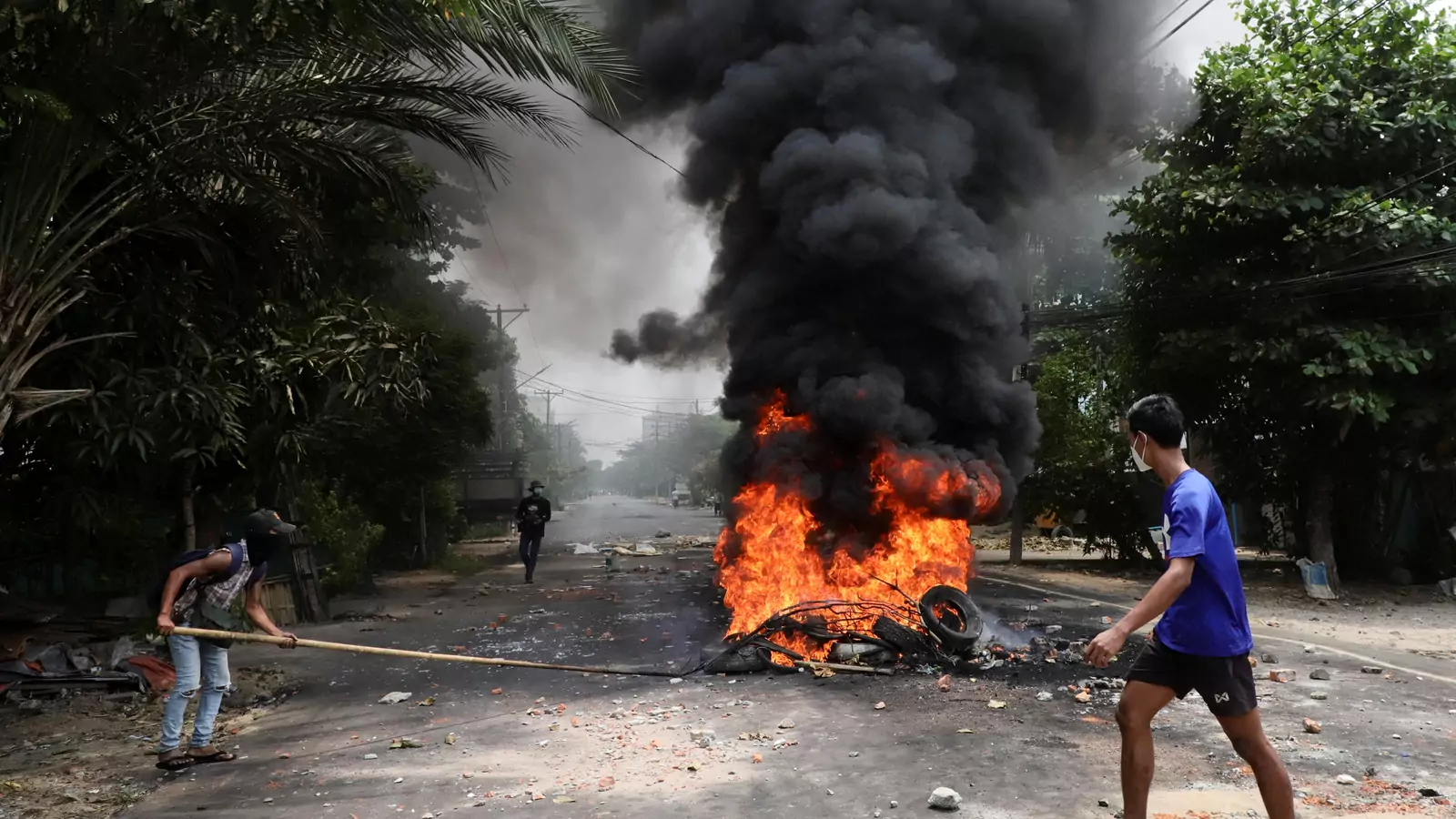
But while China’s rise often makes headlines, it is not the only trend shaping events in Asia. Illiberalism has become a force in democracies like India, where Prime Minister Narendra Modi rode the wave of Hindu nationalism to a massive victory in the country’s 2019 parliamentary elections. And in the Philippines, President Rodrigo Duterte’s electoral gains in midterm elections in 2019 left even fewer checks on his increasingly autocratic behavior. Meanwhile, Myanmar’s already faltering process of democratization came to an abrupt end in February, when the military seized power from the democratically elected government. The subsequent protests and the military’s violent crackdown in response have left the country teetering on the edge of civil war and failed state status.

Countering China’s Military Challenge, Today

By ERIC SAYERS and ABRAHAM DENMARK

In recent years, Defense Department planners have been intent to focus on the military challenge China will pose in the 2030s, when emerging technologies and military hardware promise to offer new operational capabilities to close the military gap with China. However, Washington would be falling into a temporal planning trap if it only organized to address the China military dilemma of 2035. As the past year has demonstrated, Beijing has escalated its use of coercion and aggression in areas of significant American interest in the western Pacific. Given this, the Pentagon, lawmakers, and the White House need a better strategy — and more targeted funding — that effectively deters the PLA of 2025. The grave costs, potential for miscalculation, and impact of an eroding military balance on America’s allies necessitates a near-term approach to ensure Beijing does not miscalculate.

Such a strategy need not seek to dominate the People’s Liberation Army (PLA) in all domains in all regions at all times — indeed, such a goal would be foolhardy. As with the Soviet Union in Europe during the 1970s and 1980s, the U.S. military faces a peer competitor that enjoys significant geographic advantages. Dominance or preeminence may have entered our military thinking in the 1990s when the United States faced no true competitor, but it is no longer a realistic approach and we know of no serious policymakers talking about dominance. As former Pentagon strategist Elbridge Colby testified to the Senate Armed Services Committee, our “armed forces will therefore need to shift from an expectation that they could dominate the opponent to one in which they must expect to be contested throughout the fight – and yet still achieve the political objectives set for them in ways that are politically tenable.”

The Chinese government embraces tech industry competition

Tom Wheeler

The Chinese government has been dismantling the bulwark behind which American Big Tech has been hiding to avoid domestic regulation. “While people are concerned with the size and power of tech companies,” Facebook Chief Operating Officer Sheryl Sandberg warned in 2019, “there is also a concern in the United States with the size and power of Chinese companies, and the realization that these companies are not going to be broken up.”

That argument just ran out of gas. In recent weeks, the Chinese government has moved forcefully to do what American tech companies have long fought in their home country: pro-market, anti-monopoly intervention and pro-innovation opening of big company chokeholds on digital information.

DE-TYCOONIFICATION

In what The Economist described as “de-tycoonification,” the Chinese government is moving to limit the power of its tech companies. In December, the State Administration for Market Regulation began investigating Alibaba’s online shopping platform practices. It took only until the first week of April for it to conclude the company’s practices had hindered competition. The result was a $2.8 billion fine against the tech giant and a message to all Chinese companies.

US-China competition not the same as a Cold War

By URBAN C. LEHNER

During the Cold War, trade between the combatants was minimal. In 1989, a relatively robust year, US-Soviet two-way trade totaled US$5 billion, less than 1% of total US trade. The US imported only $700 million in Soviet goods that year.

Thirty years later, the trade numbers with another rival nation are orders of magnitude bigger. US-China trade in 2019 totaled $558 billion, more than 10% of America’s trade with the world.

Tense exchanges between the US and China have become a nearly everyday affair, so it’s understandable that the term Cold War is back in vogue. Google “Cold War with China” or “New Cold War” and you’ll get hundreds of millions of results. I confess, I’ve used the term once or twice myself.

But ultimately it’s a misleading term. The two countries are engaged in a serious and often antagonistic competition, no question. But the Cold War is the wrong historical analogy.

Trade with the Soviet Union was a half-hearted, tactical affair. American companies built plants in Russia in the 1920s and 1930s but after World War II investment was rare, technology transfer rarer.

When you’re in a nuclear arms race with another country, you don’t do anything to strengthen its industrial base. (At times during the Cold War from 60% to 80% of US exports were agriculture products.)

No nuclear arms race

How Cyber Ops Increase the Risk of Accidental Nuclear War

By GEORGE PERKOVICH and ARIEL LEVITE

The risk of the United States and China going to war, leading to a nuclear exchange, is growing by the day. Cyber operations by either or both countries increase the risk significantly, as each side is tempted to use cyber tools to gain warning and an early edge in a crisis.

China’s arms buildup and assertiveness in the South and East China seas and its intimidation of Taiwan are animating calls in Washington to reinforce U.S. commitments and military power, including shifting from long-standing “strategic ambiguity” regarding the defense of Taiwan. The risk of “accidental” war is even higher, with collisions in the air or at sea leading to skirmishes that could escalate as leaders feel they must show their resolve and strength. China could use cyber operations to help neutralize the United States’ projection of conventional forces into China’s vicinity and in the process could become entangled with U.S. command and control systems that also are important for nuclear forces.

The U.S. has thousands more nuclear weapons than China does and an array of precise conventional strike weapons and missile defenses that threaten Beijing’s ability to strike back. Unlike with Russia, the United States has never agreed to base its strategic relationship with China on mutual vulnerability – the Reagan-Gorbachev idea that a nuclear war between them could not be won and so must never be fought.

Chinese analysts worry that the U.S. will thus use cyber operations to help pre-emptively destroy China’s nuclear deterrent before it could be used. Conversely, the United States worries that China might use cyber attacks to disable America’s advantage in nuclear forces. This is a classic security dilemma: each side feels it is acting defensively to blunt threats posed by the other and both feel less secure as a result.

Big Agriculture Is Best

BY TED NORDHAUS, DAN BLAUSTEIN-REJTO

In some ways, it is not surprising that many of the best fed, most food-secure people in the history of the human species are convinced that the food system is broken. Most have never set foot on a farm or, at least, not on the sort of farm that provides the vast majority of food that people in wealthy nations like the United States consume.

In the popular bourgeois imagination, the idealized farm looks something like the ones that sell produce at local farmers markets. But while small farms like these account for close to half of all U.S. farms, they produce less than 10 percent of total output. The largest farms, by contrast, account for about 50 percent of output, relying on simplified production systems and economies of scale to feed a nation of 330 million people, vanishingly few of whom live anywhere near a farm or want to work in agriculture. It is this central role of large, corporate, and industrial-style farms that critics point to as evidence that the food system needs to be transformed.

But U.S. dependence on large farms is not a conspiracy by big corporations. Without question, the U.S. food system has many problems. But persistent misperceptions about it, most especially among affluent consumers, are a function of its spectacular success, not its failure. Any effort to address social and environmental problems associated with food production in the United States will need to first accommodate itself to the reality that, in a modern and affluent economy, the food system could not be anything other than large-scale, intensive, technological, and industrialized.

The Five C’s of Biden’s Foreign Policy

Judah Grunstein 

If we’re honest with ourselves, it’s hard to deny that Donald Trump is a tough act to follow. As much as the return to calm since he left office—and more importantly, since his Twitter account was suspended—has been welcome, the drama and unpredictability he brought to the American presidency was as transfixing as it was unprecedented. This was perhaps truer in the realm of foreign policy than elsewhere due to the outsized autonomy U.S. presidents enjoy in the conduct of diplomacy, but also because of the impact Trump’s disregard for conventional wisdoms and established protocols had on America’s national interests and security.

It was no surprise, then, that for months before the U.S. presidential election, and in the months between the election and Joe Biden’s inauguration, more attention was given to how he would conduct U.S. foreign policy than any other issue, with the possible exception of his plans for handling the coronavirus pandemic. The challenges Biden faced were well-known: to repair the damage Trump had done to America’s alliances and partnerships; to reestablish America’s credentials as a “responsible stakeholder” in multilateral institutions and diplomacy; to reassert American leadership on issues that transcend borders, like climate change; and to do all of that while rehabilitating America’s reputation as a champion, but also an upholder, of human rights.

Why Putin Threatens Ukraine

By REUBEN JOHNSON

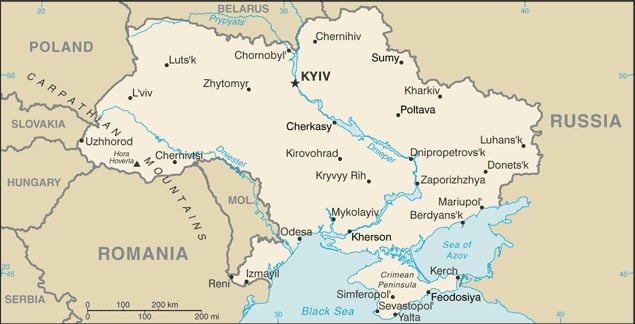
KYIV: Ukrainian citizens are studying maps to local bomb shelters as Russia builds up its forces at land and sea, while the US imposes sanctions and issues stern statements. But the question remains: what are Russian President Vladimir Putin’s objectives in this crisis. What, people are asking, does the former KGB lieutenant colonel hope to gain by threatening a full-scale invasion of his neighbor and former vassal state?

Whether or not war between Ukraine and Russia breaks out or not, the fact remains that Putin has a deep-seated desire “to make Russia great again” — if need be by invading its neighbors and destabilizing the entire region. Understanding that overriding imperative of Putin’s rule may be the singular element in formulating policy vis-à-vis Moscow.

Russia had been widely expected to invade Ukraine within a matter of days. This speculation followed weeks of escalating tensions between the two nations, an increase in the number of air space violations by Moscow’s military and an overall sense in the capital that armed conflict could break out at any time. The buildup of Moscow’s forces on the border is the largest since the 2014 Russian seizure of Crimea.

Speaking to Deutsche Welle, the Ukrainian Ambassador to the UK and former Foreign Minister Vadym Prystaiko described the degree to which the level of fear in Ukraine has increased in recent days.

US Agencies, Defense Companies Hacked Via VPNs

By BRAD D. WILLIAMS

WASHINGTON: US government agencies, critical infrastructure entities, and private sector organizations are back in the cyber crosshairs, the Cybersecurity and Infrastructure Security Agency said today — first in an alert and later in an emergency directive issued within hours of each other.

CISA’s emergency directive and alert were issued as US security companies FireEye and Ivanti disclosed separately — but in coordination with each other — that threat actors are targeting one newly discovered and three previously known vulnerabilities in Pulse Connect Secure appliances. Security patches are currently available for the three known vulnerabilities. A patch for the newly disclosed vulnerability is expected within weeks.

Ivanti, FireEye, Microsoft’s Threat Intelligence Center, and government and law enforcement agencies are said to be working together on this incident.

Pulse Connect Secure is an enterprise virtual private network (VPN) product. VPNs encrypt data as it’s transmitted across public networks, such as the internet. Pulse Connect Secure enables remote workers to securely access enterprise networks.

The emergency directive says, “CISA has determined that this exploitation of Pulse Connect Secure products poses an unacceptable risk to Federal Civilian Executive Branch agencies and requires emergency action. This determination is based on the current exploitation of these vulnerabilities by threat actors in external network environments, the likelihood of the vulnerabilities being exploited, the prevalence of the affected software in the federal enterprise, the high potential for a compromise of agency information systems, and the potential impact of a successful compromise.”

Germany’s Military an Unexpected Star in Pandemic Relief

BY ELISABETH BRAW

You may have heard that Germany has opened its first 24/7 COVID vaccination clinic. You may, however, not have heard that it was the Bundeswehr that set it up and operates it.

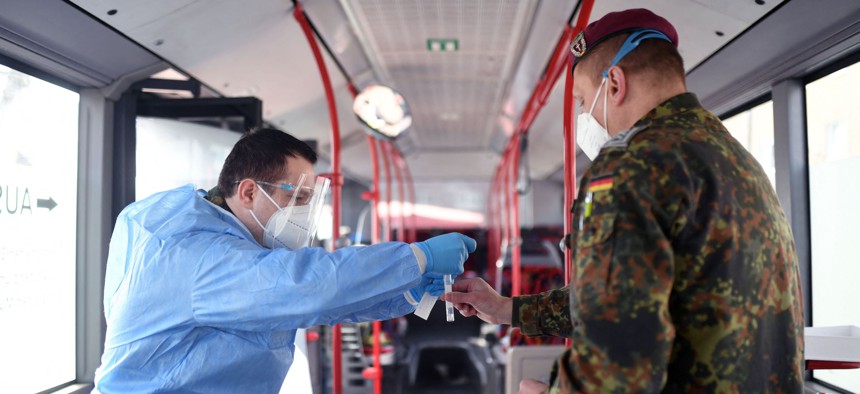
The German military is – sadly and certainly unfairly – one of the world’s most ridiculed organizations. But during the pandemic it has put in an equally formidable and surprising star turn, transporting critically ill patients from other countries to German hospitals, conducting COVID tests across Germany, and now pioneering round-the-clock vaccination. But Germans shouldn’t get used to this Red Cross-like role.

While the United States and the UK are speeding ahead with vaccinations, the European Union’s member states are struggling. Germany, in particular, seems a shadow of its usual well-organized self. It was therefore rare good news when, on Easter Day, the country’s first always-open vaccination center began operating in the state of Saarland. The Bundeswehr set up the clinic, and 108 of its soldiers are now dispensing vaccine jabs there around the clock.

What does Britain’s new Cyber Force mean for future of cyber security?


Cyber operations – or to use the pervasive but sometimes misleading phrase, “cyber attacks” – are becoming increasingly frequent across the world. The UK is not immune to this, with criminal activity, such as ransomware campaigns – as well as competition between states – posing various threats to the digital economy and international security. The new National Cyber Force (NCF) is part of the UK’s answer to these problems, consolidating its “offensive” forces in cyberspace.

What is the NCF? Does it mean that the UK is scrapping all its tanks and replacing them with popular culture’s hoody-wearing teenage hackers? No, but there are still significant changes ahead, including a transformation in force structure, dealing with legacy capabilities, and embracing new and emerging technologies. The government’s ambition is for a smaller but more capable Armed Forces, enabling Britain to play a leading, post-Brexit role in global strategic competition.

In our new report, co-authored with Amy Ertan and Dr Tim Stevens, we argue that the success of the NCF will be determined by the quality of the leadership, strategy, structures and processes that shape its growth and operational use. The expansion of the UK’s investment in offensive cyber operations creates new opportunities, but also raises key ethical and strategic dilemmas that are yet to be straightened out.

The emphasis on technology – and the NCF specifically – in the UK government’s recent Integrated Review of Security, Defence, Development and Foreign Policy, indicates the extent to which the government sees cyber capabilities as a major part of its defence and security ambitions.

Competition and Decision in the Gray Zone: A New National Security Strategy

Matt Petersen

The gray zone is the space below the threshold of major war, or, “the operational space between peace and war.”[1] China employs maritime militia against regional adversaries, and weaponizes international law by constructing artificial islands in the South China Sea. North Korea games sanctions and engages in cyber operations, while fostering a menacing nuclear strike capability. Russia maneuvers through cyber and information operations in Eastern Europe and worldwide. Action in this space exemplifies hybrid warfare: the “blurring of the modes of war…produc[ing] a wide range of variety and complexity” against an adversary nation or alliance.[2] These are now the principal venue and method of contest, in play in every operational theater.

…IN A HYPER-CONNECTED WORLD WHERE CONVENTIONAL WAR OFFERS LIMITED UTILITY, HYBRID WARFARE WILL BE THE DOMINANT FORM OF CONFLICT.

The ultimate target of hybrid warfare is not territory or military forces, but the political decision-making process itself. How will the United States deter aggression and dominate conflict in this environment, and how will decision-making processes adapt to remain relevant? This is the question that should most inform the new U.S. National Security Strategy, because in a hyper-connected world where conventional war offers limited utility, hybrid warfare will be the dominant form of conflict.

America’s peer competitors elucidated doctrines of hybrid warfare, exemplified by the writing of Gen.Valery Gerasimov in Russia[3] and Unrestricted Warfare by Cols. Qiao Liang and Wang Xiangsui in China.[4] Vocabularies vary, but each writer describes multi-domain, whole-of-government engagement to achieve political objectives while avoiding conventional military confrontation. The gray zone is this battlespace: neither declared war nor uncontested peace.

HYBRID WARFARE UN-CONCENTRATES COMBAT POWER.

26 April 2021

Taliban Says 'It's Too Early' to Know if Insurgents Might Attack Withdrawing U.S. Troops

BY JULIA MARNIN 

The Taliban said "it's too early" to determine whether insurgents would attack withdrawing U.S. forces, which are scheduled to fully depart Afghanistan before September 11 following a decision by President Joe Biden, according to the Associated Press.

The Taliban signed a deal with former President Donald Trump in 2020 that set a U.S. troops withdrawal date from Afghanistan of May 1, 2021, but the military pullout date was extended by Biden.

"It's too early for these issues, nothing can be said about the future," Taliban spokesman Mohammad Naeem told AP when asked about the possibility of violence from insurgents.

Pentagon Press Secretary John F. Kirby emphasized during a press conference last Friday that the withdrawal of troops will begin May 1 and be completed by September 11, saying, "We've seen their threats, and it would be imprudent for us not to take those threats seriously. It would also be imprudent for the Taliban to not take seriously what [President Joe Biden and Secretary of Defense Lloyd J. Austin III] both made clear: Any attack on our drawdown, on our forces or our allies and partners...will be met very forcefully."

Clausewitz and the Phantoms of War Without Victory

By James A. Russell

President Biden’s announced withdrawal of our troops from Afghanistan, in turn, followed by NATO allies, is certainly welcome and long overdue. It is an acknowledgment of what has long been obvious: we were unprepared to pay the astronomical costs of defeating the Taliban. Victory was always a phantom in Afghanistan, just as it has been in Iraq for the United States and the western democracies.

Ending the direct involvement in wars like Afghanistan a hemisphere away from what we now call the "homeland" is a good idea, but the unsettled state of the international system means that perhaps, even more, grave conflicts loom in the cold dawn to come.

The people of this country should reflect deliberately on these possible threats and give more thought (and afterthought) to what is glibly called the “forever war,” but which requires a sober, non-ideological, and critical analysis not found in tweets, Instagram pictures, and cable news tantrums put together for our entertainment.

The German Prussian theoretician of war Carl von Clausewitz reminds us from the 19th century that organized political violence exists across a spectrum of conflict. As such, the struggle of political will as organized violence, as well as the native anger and hatred somehow shoved into a political goal, can scarcely be said ever to have abated at all.

Afghanistan Will Know No Peace Without Pressure on Pakistan

BY M. ASHRAF HAIDARI

Forty-two years have passed since the start of nonstop imposed conflicts in Afghanistan. During this period, several attempts have been made to stabilize the country and to restore sustainable peace there. However, each peace effort has failed or stalled, including the Doha Agreement recently, which the United States under the Trump administration and the Taliban signed in February 2020.

This expedient measure that intended to serve the former president’s electoral goals excluded the Islamic Republic of Afghanistan as a principal stakeholder in the U.S.-Taliban talks that produced a fragile deal. But it coerced the Islamic Republic into making an unprecedented concession: the release of over 5,500 Taliban prisoners. In exchange, the Taliban was supposed to start meaningful “intra-Afghan” talks, notably reduce violence towards a mutual ceasefire, sever ties with al Qaeda and other terrorist groups, and ensure those prisoners would not return to the battlefield. None of these have so far materialized, thanks to the Taliban and their regional state-sponsor, Pakistan.

As former war criminals and drug-traffickers, most of the released Taliban prisoners have either returned to the battlefield or resumed drug-trafficking out of Taliban-controlled areas. And still others have manned the Taliban’s campaign of targeted killings, whose victims are largely the drivers of Afghanistan’s continued progress, including protection of human rights, empowerment of women and girls, and freedoms of expression and press.

‘The Taliban Have Tracked Me’


BY ALI M. LATIFI

POL-E ALAM, Afghanistan—Shaima Zargar, director of women’s affairs in Logar province, just south of Kabul, says that up until a year ago she dressed pretty much as she pleased. She certainly never wore a chadari, or burqa, the forbidding blue shroud that the Taliban forced all women to wear the last time they were in power.

Now, Zargar puts a burqa on wherever she goes.

“The Taliban have tracked me. I’ve been actively followed. I’ve received direct threats, and it’s all been over the last year,” Zargar said of the period since the Taliban signed an armistice with the Trump administration. That fear has only grown in the last few days since U.S. President Joe Biden announced he was pulling all U.S. troops out by the 20th anniversary of Sept. 11, and NATO followed suit.

Her greatest fear right now is violence and a sense it may be impossible for under-equipped local government forces to hold off the Taliban, said Zargar, whose office has worked hard to ensure the rights of Logari women. “We’ve fought back against cultural practices and prejudices, but none of that matters if families are afraid to send their daughters to school due to fear of bombs and mines,” she said.

That fear is borne out in the numbers. According to the United Nations, the first quarter of 2021 saw a 37 percent increase in civilian casualties among women.

“The number of Afghan civilians killed and maimed, especially women and children, is deeply disturbing,” said Deborah Lyons, the U.N. secretary-general’s special representative for Afghanistan.

In recent years, the United States has sought a “conditions-based” withdrawal from Afghanistan. From George W. Bush to Donald Trump, every president who has presided over the war has made reference to these nebulous conditions, which kept the resurgent Taliban on their toes.

ASEAN’s Myanmar Crisis

by Joshua Kurlantzick

With the situation in Myanmar disintegrating into chaos, and Myanmar possibly becoming a potential failed state, some regional powers, including the United States and Australia, have taken significant actions against the junta government. Australia has suspended military cooperation with the Myanmar military, and the Joe Biden administration has implemented a broad range of targeted sanctions against the junta and many of its businesses. Taiwan, which has significant investments in the country, has passed a parliamentary motion condemning the situation in Myanmar and calling on the junta to restore democracy. (Japan, historically reticent to take a tough approach toward Naypyidaw, has taken a more passive approach, calling on the Myanmar junta to restore democracy and having its defense head join a call rejecting the coup but so far not taking stronger moves.)

But Southeast Asian states, which have some of the greatest leverage over Naypyidaw—and certainly among the most to lose if Myanmar becomes totally unstable, with refugees flowing out of the country and conflicts possibly spanning borders—have done little about the crisis. Many regional states have remained silent on the coup and the atrocities, or have expressed mild concern. Indonesia has been an important exception, with President Joko Widodo condemning the violence and pushing for an emergency Association of Southeast Asian Nations (ASEAN) summit, which seems in the works, but with no fixed date yet even as Myanmar unravels.

Regional states claim they want to keep communication lines to Myanmar open, which is reasonable, but they have taken few other measures to address the crisis. As in many other crises, ASEAN remains torn, and with so many of its states now run by outright authoritarians or illiberal leaders who came to power in democratic elections, most of the region does not want to take a tough approach to the crisis.

Afghans Haven’t Forgotten Taliban Atrocities


BY STEFANIE GLINSKI 

QARABAGH, Afghanistan—The Taliban flooded into the Shomali Plain by the thousands, supported by tanks and air power. Reza Gul fled south toward Kabul barefoot amid the chaos, leaving behind her house, her belongings, and the bodies of her three teenage sons, slain by Taliban bullets.

Within days, the militants had deliberately killed countless people, scorched the rich farming land, destroyed tens of thousands of houses, and blown up irrigation systems. The Taliban’s 1999 invasion of the Shomali Plain, stretching north from Kabul toward Bagram, was one of their most brutal—and lingering. Today, the destruction is still visible. Behind the main highway, countless skeletons of old houses are testimony to the Taliban’s past atrocities; out of 70 villages in Gul’s district of Qarabagh, 99 percent of the houses were destroyed. Many of the ruins have never been rebuilt.

Gul, who is now 75, breaks into tears at the memory, which remains crystal clear, as deeply etched as the wrinkled crevasses in her face that she said show just how much she’s suffered.

US Nuclear Fears Are Shifting From a Clear Russian Threat to a Murkier Chinese One

BY PATRICK TUCKER

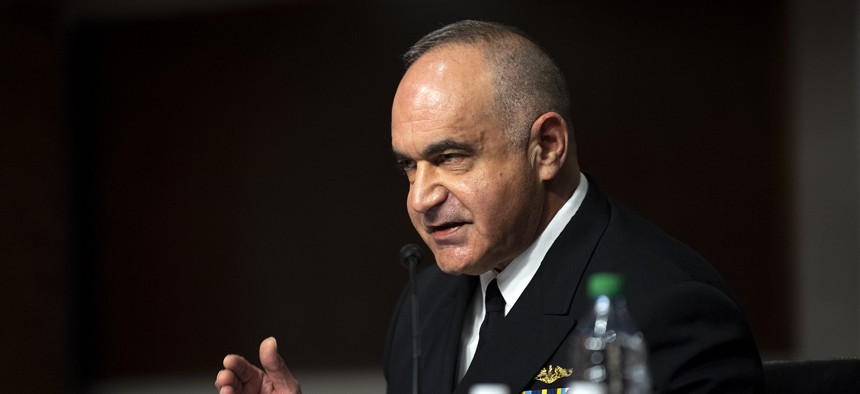
China is putting its nuclear forces on higher alert, yet the threat posed by Beijing’s arsenal is not well understood by the United States or its allies, the head of U.S. Strategic Command testified on Tuesday.

“I can’t get through a week without finding out something I didn’t know about China,” Adm. Charles Richard, the head of U.S. Strategic Command, told the Senate Armed Services Committee on Tuesday.

Richard said China’s “very opaque” nuclear policy makes it “difficult to determine their intentions.”

But evidence suggests that China is moving toward a higher state of alert, he said in his written testimony.

“While China keeps the majority of its forces in a peacetime status, increasing evidence suggests China has moved a portion of its nuclear force to a Launch on Warning (LOW) posture and are adopting a limited ‘high alert duty’ strategy,” he wrote.

Beijing is buying new satellites to detect enemy launches and new command-and-control systems for its own forces, he wrote.

“Their networked and integrated platform advancements will enable skip-echelon decision-making processes and greater rapid reaction,” he wrote.

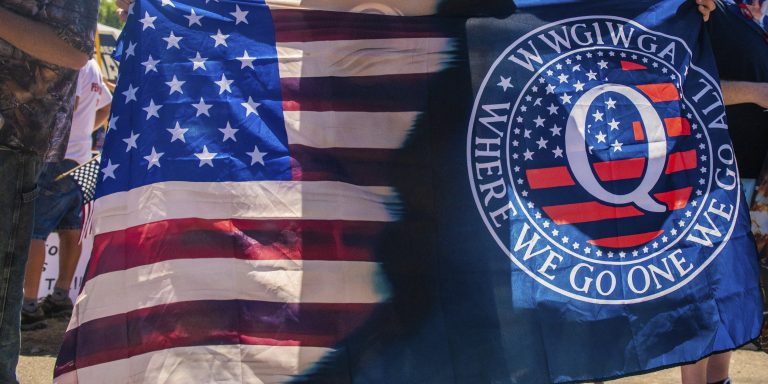
IntelBrief: QAnon – A U.S. National Security Threat Amplified by Foreign-Based Actors


FBI Director Wray remains concerned about the national security threat posed by QAnon conspiracy theories and adherents of this movement.

Key tenets of the QAnon conspiracy theory appeal to a significant number of Americans, according to a new Soufan Center report.

Russia-driven amplification of QAnon-related narratives was predominant in 2020, but began to wane beginning in 2021.

China-related perpetuation of QAnon conspiracies proliferated toward the end of 2020 and now outpaces Russia-related amplification.

In testimony last week to the United States Senate Intelligence Committee, FBI Director Christopher Wray highlighted the continuing national security threat posed by adherents of the QAnon conspiracy theory. Wray’s comments echo longstanding concerns within the Bureau, dating back to 2019, regarding the ability of online conspiracy theories to inspire real-world harm by individuals and small groups. QAnon believers committed various acts of murder, plotted political violence, and kidnapped children; in 2021, more than three dozen QAnon members were arrested (one was killed) for storming the U.S. Capitol building during the January 6 insurrection. In the aftermath, the main protagonist of the QAnon narrative, President Donald J. Trump, failed to be reinstated, as prophesized, and the shadowy individuals behind QAnon’s online postings have failed to deliver new content for months. This begs the question, why is the FBI still concerned about QAnon? The Soufan Center’s latest special report, “Quantifying the Q Conspiracy: A Data-Driven Approach to Understanding the Threat Posed by QAnon,” clarifies that the QAnon threat persists because its core message continues to resonate with large numbers of the American public. Moreover, the report lays out evidence that foreign-based actors, located in China and Russia, among other states, are amplifying QAnon-related content.

The Flawed WHO Coronavirus Origins Study

Anthony Ruggiero

The only thing the WHO report accomplishes is showing how the organization was focused on pleasing Beijing. This is an important test for Biden—Xi Jinping will triumph if the WHO report stands

Even the head of the World Health Organization does not trust his own investigators’ report on the origins of the coronavirus pandemic. He has every reason to be skeptical: Chinese authorities and the WHO’s credulous investigators arduously avoided a serious examination of the possibility that the virus escaped from a Wuhan laboratory. The report is less a researched conclusion than a collection of opinions of the WHO team filtered through the Chinese Communist Party (CCP). Neither the report nor the WHO’s current leadership can advance our paramount concern to prevent another pandemic.

Beijing essentially dictated the conclusions to the WHO when its officials visited China in January and February. At a press conference on Feb. 9 in Beijing at the conclusion of the trip, the WHO and China were on the same page labeling the lab-origin theory as “extremely unlikely” while amplifying the CCP’s claims that the pandemic started outside China. Two days later in Geneva, the WHO director-general said all hypotheses would be investigated. Nonetheless, the final report stuck with Beijing’s preferred line against the lab-origin theory.

A War in Europe? Why Putin’s Russia Is Escalating in Ukraine

by Andreas Umland

Vladimir Putin’s decisions in favor of Russia’s military territorial expansion were as rational, in terms of domestic and foreign power politics, in Georgia in 2008 as they were in Ukraine in 2014. A third such decision in the coming weeks or months would be equally so. In 2008, no sanctions by the West followed the de facto Russian occupation of South Ossetia and Abkhazia. The European Union’s only relevant sanctions package related to the Ukraine conflict was adopted less than two weeks after Russia had shot down a Malaysian passenger plane over eastern Ukraine on July 17, 2014. The sanctions that the EU adopted as a result, which remain in place to his date, and that have had a moderate impact on Russia’s economy, were not so much a reaction to the Russian invasion of Ukraine. Rather, they represented Brussels’s punishment of Moscow for the deaths of over 200 EU citizens who had been on the MH17 flight. Truly painful EU sanctions in response to Moscow’s adventures in the post-Soviet space—such is the lesson of Russia’s various wars in Eastern Europe and the Caucasus over the past thirty years—have never been and probably never will be adopted.

For Russia in 2008 and 2014, the economic costs of its violent escalations in Georgia and Ukraine were low, and, for the Putin regime, the short-term domestic political gains were high. Therefore, to refrain from military interventions in South Ossetia as well as Abkhazia in 2008, and in Crimea as well as the Donets Basin in 2014 would have been sins of omission. They boosted Putin’s popularity and his regime’s stability, at least in the short term.

The popularity of the Russian ruling elite has been declining for several months now. This is due, above all, to the far-reaching humanitarian, social, and economic consequences of the Coronavirus crisis, which are glossed over in Russia’s official statistics. Among Putin’s various current political problems, the best known is Alexei Navalny’s gradual transformation into a martyr. As a result of these and some other concurrent challenges, the stakes for Putin and his followers have risen significantly since 2020.

The U.S.-Japan Summit: Uneventful and Indecisive


Japanese Prime Minister Suga Yoshihide’s summit with U.S. President Joseph Biden was awaited with a mixture of anticipation and anxiety in at least four capitals: Washington, Tokyo, Beijing, and Taipei. Both the United States and Japan have concerns about increasingly assertive Chinese behavior in the East China and South China Seas and escalating pressure by China to annex Taiwan despite the often expressed wishes of Taiwan’s electorate to remain separate. In the weeks before the summit, China’s state-controlled media betrayed its leadership’s concern by repeatedly warning the Japanese government against collusion with the United States.

As is typical of high-level diplomatic discussions, the parties have different goals which must be reconciled lest the ritual communiqué be little more than vacuous statements about the commitment of both sides to peace, stability, and protection of the environment. Here, the stakes were high: this was to be the first state visit of Biden’s presidency and, as such, a symbol of the importance of the alliance with Japan as well as a test for both leaders. Japanese media opined that, since his previous career had focused on domestic issues, foreign affairs were not Suga’s strong suit and fretted about what that portended. Japan wanted yet another reiteration of American support for its claim to sovereignty over disputed islands in the East China Sea known to the Japanese as the Senkaku and to China as the Diaoyu, and a commitment to move forward with relocating the Futenma Marine Air Station to Henoko, long delayed because of political and geological problems. The United States wanted a stronger Japanese defense commitment to the alliance, while Taiwanese hoped for both sides to affirm their opposition to Beijing’s pressure for incorporation into the People’s Republic of China (PRC). And Beijing wanted to forestall exactly those aims.