By Uzair Younus
 On December 16, 1971, almost 100,000 Pakistani soldiers surrendered in Dhaka, leading to the creation of the sovereign nation-state of Bangladesh. Relations between both countries remain frosty 46 years after the Pakistani armed forces surrendered in Dhaka. While some attempts were made by the Pakistan People’s Party (PPP)-led government to normalize ties, the current government in Pakistan has made little to no effort in reaching out to Bangladesh. The PPP sent Foreign Minister Hina Rabbani Khar to Dhaka in 2012 and invited Bangladeshi Prime Minister Sheikh Hasina to the D-8 summit in Islamabad. However, the PPP was unwilling to meet Bangladesh’s decades-long demand of an unconditional apology for the atrocities committed in 1971, leading to the rejection of the invitation. Despite this, there was hope that both countries were making progress and would normalize relations in the near future.
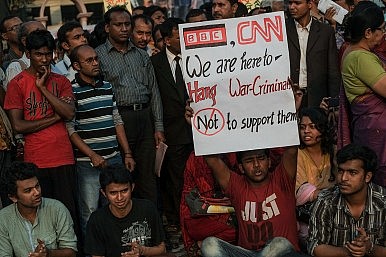
Relations began to sour when Bangladesh decided to hang Abdul Quader Mollah for war crimes in 2013. During the 1971 conflict, the Jamaat-e-Islami had allied itself with Pakistani security forces and had supported military efforts to quell the uprising in what was East Pakistan at the time. Mollah, a leader of the party during that period, was convicted for a whole host of crimes against humanity and sentenced to life in prison. Thousands took to the streets in Bangladesh to protest this verdict – they demanded that war criminals be given the death penalty. The war crimes law was subsequently amended and prosecutors filed an appeal in the Supreme Court against the leniency of the verdict. This was accepted by the court in September 2013 and Mollah was sentenced to death.
These events led Islamabad to react with anger: Pakistan’s National Assembly condemned the hanging and Chaudhry Nisar, the country’s interior minister at the time, said that “the whole nation is feeling sad over this tragic incident.” Meanwhile, Bangladesh continued to carry out the sentences given to those under trial: In May 2016 Motiur Rahman Nizami, leader of the Jamaat-e-Islami party, was hanged. Pakistan had another knee-jerk reaction and its Foreign Office commented that Pakistan was “deeply saddened.” This sentiment was echoed in Pakistan’s National Assembly, which issued another second condemnation of events unfolding in Dhaka.
Bangladesh was rightfully angered by what it viewed as an interference in its domestic affairs. It responded to Pakistan’s outrageous stance of supporting war criminals guilty of committing atrocities in 1971 by not attending the SAARC summit in September 2016. Relations between both nations had hit rock bottom.
Recent developments in the region, however, offer Pakistan an opportunity to reach out to Bangladesh. The ongoing crisis in Myanmar has led over 1 million Rohingya to seek shelter in refugee camps in Bangladesh, with the United Nations’ high commissioner for human rights saying that Myanmar has “committed acts of appalling barbarity.” This influx of refugees has placed an immense burden on Bangladesh but Dhaka has been unwavering in its resolve and commitment to the Rohingya. After visiting the Kutupalong Refugee Camp in September, Sheikh Hasina said that if her country can feed 160 million of its own citizens, then Bangladesh has “enough food security to feed the 700,000” Rohingya that are seeking shelter in her country.
Pakistanis have also rallied to the cause of the Rohingya and there is immense public sympathy for these refugees in the country. The process of normalizing relations can be initiated if the Pakistani government recognizes Bangladesh’s positive role in this crisis and offer unconditional support to Hasina’s government. This should be followed by high-level engagement with the Bangladeshis, where Pakistan should express a desire and commitment to normalizing relations.
Pakistan, however, cannot take a moral stance on the Rohingya without first coming to terms with its own past and laying the ghosts of 1971 to rest. To do so, it must offer Bangladesh an unconditional apology – this is something that Bangladesh and its people have rightfully demanded for decades.
The moral imperative is also accompanied by a strategic need to change course. Pakistan has become increasingly isolated in the region because of its inability to take concrete, proactive actions toward reconciling differences with its neighbors and traditional allies. Iran views Pakistan with suspicion, Afghanistan holds Pakistan in very low regard, India has largely won the public relations battle in painting Pakistan in a negative light, and the United Arab Emirates and Saudi Arabia, two historic allies, have cooled off on Pakistan and drawn closer to India. This leaves China as the only reliable partner in the region and the basket in which Pakistan has put all its eggs. While China is truly a strategic ally for Pakistan, it too has its own economic and geopolitical interests with other countries in the region, countries with which Pakistan has frosty relations at best.
A decision to apologize to Bangladesh would cause pandemonium among certain groups in Pakistan. Critics, particularly right-wing Islamist parties, will howl that war crimes were also committed by the Mukti Bahini, that India played a sinister role in the breakup of Pakistan, and that Hasina’s government is systematically killing “pro-Pakistani” politicians by hanging “innocent” men like Motiur Rahman Nizami. They would paint those in favor of offering the apology as “unpatriotic Pakistanis” and as “foreign agents.”
Given Pakistan’s standing in the region, it is folly for it to continue to maintain the status quo in its foreign policy simply to appease hardliners at home. Breaking ice with Bangladesh and offering an unconditional apology is a bold policy shift that would signal to the region that Pakistan, as a responsible country, is owning up to its past mistakes and trying to find common ground with other nations. Such a courageous shift is needed to bring Pakistan’s foreign policy into the 21st century. Without it, Pakistan will continue to feel increasingly isolated in the community of nations.
The most important fact, however, is that apologizing to Bangladesh is the right thing to do and something that is long overdue.
Uzair Younus is an Analyst at Albright Stonebridge Group. Views expressed are his own.
No comments:
Post a Comment