By Rajeswari Pillai Rajagopalan
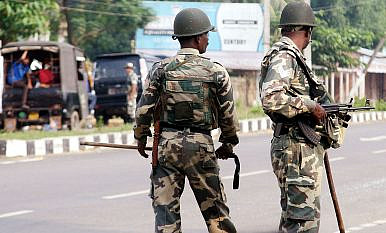 Despite the rising security threats it faces, India’s defense budget now stands at the lowest since the 1962 Sino-Indian border war, leading India’s Vice Chief of Army Staff, Lt. Gen. Sarath Chand, to lash out in the Parliamentary Standing Committee on Defense last week about the difficulty this causes the Indian Army. The Parliamentary Standing Committee report highlights the continuing deficiencies that the three services face in terms of military modernization, including the “Make in India’ initiative. The Army vice chief, in his unusually candid comments, made a case for capability upgrades by emphasizing the changing threat perception within the country as well as in the neighborhood. In his statement, Chand pointed to increasing “external strife and internal dissidence,” including Doklam. “China has become increasingly assertive,” he stated. On the western border, he pointed to the increased cross-border firing as well as terrorist attacks, asking that defense forces should therefore “get their due.”
The Army vice chief noted that capability development is almost impossible with the current capital expenditure outlay because the budget allocation does not cater to the scale of military modernization that is urgently required for the three services. In the army’s case, the budget allocated 268.16 billion Indian rupees ($4.14 billion) for modernization against the Army’s demand of 445.73 billion rupees, which is barely 60 percent of the requested funds.
The picture is similar with the other services as well. The navy wanted 356.95 billion rupees but was allocated only 200.04 billion rupees. But the air force had it the worst with projected figure of 776.95 billion rupees slashed down to 357.7 billion rupees. General Chand added that “the marginal increase in BE (Budget Estimate) barely accounts for the inflation and does not even cater for the taxes.”
While much of the public attention in India focused on the Army’s comments about the budget, the allocation for the Air Force and Navy (and the resultant modernization) deserves equal if not more attention. The Indian Air Force is down to 31 squadrons (despite wanting 42), while the Navy also faces significant shortfalls of ships and submarines as well as modernization of naval bases and facilities.
These deficiencies become all the more problematic because of the increasing tensions with China, from the Himalayas to the Indian Ocean. In addition, application of military power on the border areas will depend on the physical border infrastructure, which has remained pitiful on the Indian side of the border. China on the other hand, has a state of the art infrastructure relatively speaking – roads, railway networks, oil and logistic depots, in addition to a number of military and civilian airports. All of these indicate the far greater Chinese capacity to not only quickly mobilize forces on the border but also sustain them on the border areas for a relatively longer period of time.
The shortfalls in Indian defense budget allocations become even more serious when compared to China’s military spending. Earlier in the month, China announced its defense spending for 2018 at around 1.1 trillion yuan ($174.5 billion). Though that is almost certainly lower than the actual defense budget, India is spending less than one third of even this, at a time when India is claiming to be confronted with two and half war fronts.
It is going to be very difficult for India to match the Chinese defense budget, and it would be foolish even to try. But India could potentially attempt to generate greater military power by using its much more limited financial capacity more wisely. For example, India today has the world’s largest standing army, whose pension and salaries alone are sinking the Indian defense budget. India has to consider reducing the size of its army so that it can build a smaller but more capable force.
Of course, this runs into some problems considering that much of this large army is devoted to the ‘half war’: counterinsurgency operations in various parts of the country. The army and the government should consider alternate means of fighting such half wars, possibly by improving the large central paramilitary forces or even the state (provincial) police forces. What General Chand’s presentation demonstrated more than anything is that it is high time the political and military leaders took a hard look and make some hard decisions about how to manage India’s military security.
No comments:
Post a Comment