Amrita Jash
Introduction
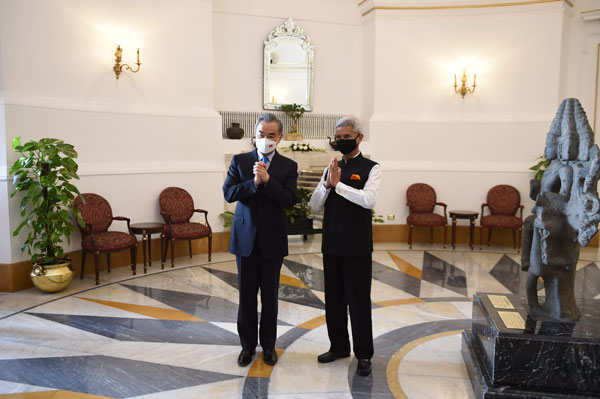 On March 25, State Councilor and Foreign Minister Wang Yi made a surprise visit to India after stopovers in Pakistan and Afghanistan (Ministry of Foreign Affairs of the People’s Republic of China [FMPRC], March 25). The visit was the first by a high-level Chinese official to India since December 2019 and the ongoing border standoff that broke out in May 2020 along the Line of Actual Control (LAC) in Eastern Ladakh. The sudden stopover, which was not announced in advance, generated speculation over Beijing’s intentions, particularly as it occurred in the immediate aftermath of Russia initiating its “special military operation” against Ukraine on February 24. This resulted in international condemnation and boycotts, and the imposition of economic sanctions by the U.S., the European Union, Japan and others on Russia. However, countries such as China and India, made an exception by choosing neutrality in condemning Russia. But did this shared position make any difference in improving China-India ties? Hitherto, relations have not substantively improved, notwithstanding the modest progress in the recent border talks. Following the 16th round of Corps Commander level talks on July 17, China and India stressed the “four-point consensus” they had reached on the resolution of the border issues (Xinhuanet, July 29). This “consensus” was further cited as the reason for the disengagement of troops from Patrolling Point-15 in Gogra-Hot Springs (Global Times, September 9). Notably, the disengagement followed a year-long impasse in the talks process and coincided with both countries’ participation in the Shanghai Cooperation Organization summit.
Misinterpreting Indian Neutrality on Ukraine
Both India and China abstained on the UN General Assembly (UNGA) resolution condemning Russia’s aggression and demanding a full withdrawal of its forces from Ukraine (UN, March 2). However, unlike New Delhi, Beijing castigated the U.S. as the main culprit in the Russia-Ukraine conflict, whose actions “pouring oil on the flame” are “irresponsible and immoral” (FMPRC, February 23). In China’s Five-Point Position on the Ukraine crisis, Wang Yi stated that the PRC views the conflict as an outcome of “complex historical context” and that Russia has “legitimate security concerns” (FMPRC, February 26). Moreover, Beijing also backed Moscow’s accusations that the U.S. has operated bioweapons facilities in Ukraine (China Brief, June 17; FMPRC, March 8). Most saliently, a few days prior to Russia’s invasion of Ukraine, Xi and Russian President Vladimir Putin affirmed that their friendship has “no limits” and stressed that “there are no ‘forbidden’ areas of cooperation” (President of Russia, February 4). Despite this overlap, Beijing failed to distinguish the differences between its own professed neutrality in the conflict and that of New Delhi. Whereas the PRC’s approach to the conflict is largely characterized by its reactive posture toward the U.S. and the West, New Delhi has maintained a position it considers principled by opting for diplomacy and dialogue over choosing a side.
Of course, Wang’s March visit to India must be understood in the context of the Ukraine crisis and specifically the opening ostensibly created by India’s adoption of a neutral stance on the Russia-Ukraine conflict in a break with fellow Quad members Australia, Japan and the U.S. As both China and India abstained from the UNGA resolution condemning Russian aggression, Beijing interpreted New Delhi’s shared stance as an opportunity to build diplomatic solidarity, which could help offset bilateral differences over the unresolved border. In the Chinese view, the Ukraine crisis reflects China-India common interests. As a Global Times editorial stated: “What happened in Ukraine recently has offered the international community, especially non-Western countries, a new inspiration, and unveiled the biggest consensus in China-India ties more clearly. This provides an opportunity for China-India ties to warm up” (Global Times, March 26). Besides, China has also endorsed India’s neutral stance as emblematic of New Delhi’s strategic autonomy, which, unlike Beijing, Washington fails to respect. Li Haidong, a professor at the China Foreign Affairs University, stated that India has refused to serve as a “hatchet man” for the U.S. in the international pressure campaign against Russia (Global Times, March 22).
Likewise, Zhao Gancheng, a South Asia expert at the Shanghai Institutes for International Studies, noted that “similar stances” on the war had “opened a window for the two neighbors to adjust their relations” (South China Morning Post, March 28). According to noted China scholar Taylor Fravel, Wang’s trip to New Delhi indicated China’s desire to return to the “diplomatic status quo” with India in the context of the Russia-Ukraine war and an altered international landscape (The Print, April 22). However, the visit failed to jumpstart substantive diplomatic progress, either in repairing fraught relations or in achieving a breakthrough in the ongoing border standoff. In contrast to Beijing’s efforts to achieve a broader improvement in ties on the basis of shared neutrality, India only saw common ground in promoting resolution of the Russia-Ukraine war. In his March 25 meeting with Wang, Minister of External Affairs S. Jaishankar stressed that both sides agreed “on the importance of an immediate ceasefire, as well as a return to diplomacy and dialogue” between Moscow and Kyiv (Ministry of External Affairs, India, March 25). In light of their interaction over the Russia-Ukraine war, it is worth briefly surveying the fundamental differences between the Chinese and Indian approaches to the border dispute as a major issue in their bilateral relationship. While China tries to work around the issue, India has increasingly maintained a tough stance.
For Beijing, Border Should Not Be a ‘Precondition’ for Renewed Ties
In China’s perception, India tends to believe that as long as the border dispute is not settled, there is little room for cooperation in other fields. However, Beijing maintains that even if the border dispute is not fully addressed, the two countries can still find common ground on areas of shared interest (Global Times, September 9). Consequently, in its outreach to New Delhi, Beijing has largely sought to sidestep the border dispute by emphasizing mutual agreement on the Russia-Ukraine war. In his meeting with India’s National Security Advisor Ajit Doval, Wang categorically stated that: “China and India should adhere to their two leaders’ strategic judgement that China and India should not be a threat to each other, but an opportunity for each other’s development, and put their differences over the border issues at a proper position in the bilateral relations” (Global Times, March 26). More specifically, Wang advanced a three-point proposal for China-India relations, which called on both sides to view the bilateral relations from a long-term perspective, to view one another’s development with a win-win mindset and finally to adopt a cooperative posture to actively participate in multilateral processes (Xinhuanet, March 26). The three-point proposal was foreshadowed by Wang’s National Party Congress press conference on March 7, wherein he stated that the relations have “encountered some setbacks,” which do not serve the “fundamental interests of the two countries” (FMPRC, March 7).
In this regard, Wang’s proposition is indicative of the idea advanced by Beijing that the border issue should not be treated as a precondition for improving bilateral ties. However, India sees thing differently. At the Munich Security Conference this February, Jaishankar categorically declared that “the state of the border will determine the state of the relationship, that’s natural. So, obviously relations with China right now are going through a very difficult phase” (Hindustan Times, February 20).
Notably, India’s official readout of the meeting between Wang and Jaishankar made no mention of the “three-point proposal”, which signals that New Delhi does not accept Beijing’s dictates. In his media briefing after the meeting, Jaishankar stated: “I was very honest in my discussions with the Chinese Foreign Minister, especially in conveying our national sentiments on this issue. The frictions and tensions that arise from China’s deployments since April 2020 cannot be reconciled with a normal relationship between two neighbors. Foreign Minister Wang Yi spoke about China’s desire for a return to normalcy…But restoration of normalcy will obviously require a restoration of peace and tranquility” (Ministry of External Affairs, India [MEA], March 25). Hence, the Indian side has very clearly stated that there is no quick fix for bilateral relations, which have been disrupted due to Chinese actions since April 2020. As a result, Wang’s less than 24-hour stopover in New Delhi was not just brief, but was also received with little warmth.
For India the Relationship is Defined by the State of the Border and the “Three Mutuals”
On August 29, Jaishankar reiterated that “the state of the border will determine the state of the relationship” and also clarified that a “positive trajectory” in relations is based on the “three mutuals” of mutual sensitivity, mutual respect and mutual interest (MEA, India, August 29). While India firmly maintains that the two sides should toe the line on the “three mutuals,” China often fails to do so. For example, prior to visiting India, FM Wang made remarks on the Kashmir issue at the Organisation of Islamic Cooperation (OIC) meeting in Islamabad. India condemned these remarks stating that: “other countries including China have no locus standi to comment. They should note that India refrains from public judgement of their internal issues” (The Economic Times, March 23).
In July, Indian Prime Minister Narendra Modi made a phone call to the Dalai Lama to wish the Tibetan spiritual leader a happy 87th birthday—a clear shot across the bow to Beijing on sovereignty issues (The Indian Express, July 7). In doing so, Modi solidifies a new precedent of Indian leaders officially sending well wishes to the Dalai Lama on his birthday, which in a significant departure from previous policy, he did for the first time last year. Beijing reacted by stating that the Indian side should “understand the anti-China and separatist nature of the 14th Dalai Lama” and “abide by its commitments to China on Tibet-related issues, act and speak with prudence and stop using Tibet-related issues to interfere in China’s internal affairs” (FMPRC, July 7). An MEA spokesperson retorted that it has been India’s “consistent policy” to treat “his holiness the Dalai Lama” as an “honored guest” who “enjoys a large following in India and is “accorded due courtesies and freedom to conduct his religious and spiritual activities” (The Times of India, July 8; Hindustan Times, July 7).
Furthermore, despite Beijing’s objections, New Delhi facilitated the Dalai Lama’s month-long visit to Ladakh beginning July 15, which coincided with border tensions in Eastern Ladakh. The Indian Air Force even deployed a Dhruv helicopter to fly the Dalai Lama from Leh to a remote village in Lingshet; and he was also honored with the “dPal rNgam Dustom” award—the highest civilian honor of Ladakh (The Hindu, August 6). This marked the Dalai Lama’s first visit to Ladakh after the revocation of Article 370 and creation of the Union Territory of Ladakh in 2019.
India’s high-level treatment of the Dalai Lama, as well as its hosting of the Tibetan Government in Exile that operates from Dharmashala in the Indian state of Himachal Pradesh, is seen by China as a critical challenge to its sovereignty over Tibet. Hence, New Delhi’s message to Beijing is firm and clear, both sides need to toe the line to prevent further deterioration of relations.
Conclusion
On the border issue, China professes support for peace and stability in the abstract, but its actions demonstrate its intention to change the status quo in its favor. While India calls for early resolution, Beijing is reluctant to take the substantive steps necessary to settle the boundary issue. As its inability to use shared neutrality on the Russia-Ukraine war demonstrates, China is unlikely to be able to find a quick fix to reset overall bilateral relations.
No comments:
Post a Comment