30 January 2014

Cyber Defense for Defense 2.0


At present, the defense policy landscape is replete with arguments, many of which are ultimately based in the lack of a common vision among both elites and within the broader citizens about the role of the political leaders in the future. Cyber operations are one element of these debates, though much of the discussion has centered on how best to defend against a growing cyber threat, the role of the Ministry of Defense in that debate, and tensions between privacy, human rights, freedom of speech, and security interests. Occasionally, greater attention is paid to questions about the use of cyber offensively, which brings with it questions of precedent, deterrence, international norms, and a host of other challenges. But it is also apparent that political leaders have already approved the use of offensive cyber capabilities, though under tight restrictions. While not ignoring this larger context, the specific question this project sought to examine in greater depth is whether the Ministry of Defense should make a more deliberate effort to explore the potential of offensive cyber tools at levels below that of a combatant command. 

With respect to operational and tactical cyber use, the Indian defense establishment finds itself at a logical but difficult decision point. As is historically the case with new technologies, from gunpowder to airpower to space, there is a natural evolution as the capability is introduced, begins to be used, becomes more integrated, and sparks creative thought about further applications. Cyber, and offensive cyber in particular, is moving along this path, which (as has been the case for other technology areas) is fraught with domestic and international legal and policy concerns. The Ministry of Defense enterprise has to focus its attention on addressing these issues at the level where the capabilities can have the most profound effects—the strategic level. But as progress is being made there, the military services are giving more serious consideration to the role that offensive cyber could play in also supporting the priorities of tactical and operational commanders. 

To date, the services’ efforts have progressed at different rates of speed, due in part to differing service cultures and to the priority placed on the development of these tools by senior leaders within each service. The question for the broader policy community at this point, and for the Office of the Defense Secretary in particular, is whether current efforts are sufficient, or whether a more systematic approach to exploring the potential is warranted. A broader consensus on the wisdom of delegating the authority to use offensive cyber tools may be far in the future, and resolving the many practical concerns explored here is both critical and nontrivial. At present, neither the procedures nor the tools are sufficiently robust to merit a delegation of offensive cyber authorities beyond the very limited ways in which they have been utilized thus far. But a reasonable determination of whether the potential operational benefits outweigh the real and legitimate potential costs outlined above necessitates further capability development, albeit in a very controlled context. 

SPLENDID ISOLATION

Britain’s defence cuts and remembering the Great War
Westminster Gleanings - Anabel Loyd

Our government’s unending cost cuts have affected the British armed forces adversely for several years and through several rounds of defence reviews; we are now reaching rock bottom and it seems that the government, faced with necessary economies, may not have thought things out as well as they should. A year ago, Philip Hammond, the defence secretary, was arguing against further cuts in his department in favour of more in social-service areas; now the boot is on the other foot. Defence cuts continue, but, as they have always been impelled by the requirement to reduce our overall fiscal deficit and not by joined-up thinking in their own department — the same applies, of course, for just about every other department of government — there is no proper blueprint of ways, means, order and good sense, let alone what we actually need going into the future.

When we were all busy banning the bomb not so very many years ago, wars, ho ho ho, or at least those that would touch home shores, were behind us and there were more important things to worry about — those social-service budgets, education and health, of course — the zeitgeist feeling was to cut defence costs. Now, some of us might still feel in our heart of hearts that we only need a very small standing military for our own purposes. Ireland, our major at-home defence problem, has been dealt with up to a point, and not much else threatens us beyond worldwide terrorism. If we have a decent police force — and, boy oh boy, that is a question on its own — why do we need a strong military force?

Well, I fear we do, for all sorts of reasons, and the ongoing cuts are going to make it hellishly hard to build up again what we are losing if those needs become imperative beyond the damage being done to our international standing more than it has been already. I was anti our involvement in Iraq and Afghanistan — much too 19th century, thank you very much — but, on the other hand, it appears that, in a smaller way, we are better at all that stuff than the Americans, better at hearts and minds, more likely to remember the past history of some of the places and find them on the map because they are part, like it or not, of our past history too.

If our military treads softer than some others, it is possible that it may be of value in peace-keeping operations that, however difficult and often botched, may make the lives of civilians in warring regions slightly easier and the numbers of those regions and countries are hardly shrinking.

Reducing our military, whatever role it plays, fits very well with our present attempts at splendid isolation, of course, but we want that every which way that suits us. Stay in Europe just as much as we want, regardless of everyone else, best buds with the United States of America without bringing much more than additional talking shop to the party — oh, and of course, expecting them to bail us out if we do hit a spot of bother with as little reciprocation as possible.

20YY: The Future of Warfare

January 29, 2014 · in Analysis

The U.S. military is at a critical juncture. With the end of two wars and a sharp drawdown in defense spending, investments over the next several years will set the military’s course for decades to come. The Pentagon can make smart investments now to prepare for the future, or it can continue to cling to “wasting assets,” legacy platforms and concepts that will be less and less survivable in a future of widely proliferated precision-guided weapons. Without a clear vision of what future force to build, however, bureaucratic inertia and existing programs of record will carry the day.

A new report from the Center for a New American Security (CNAS) articulates a vision of unmanned and autonomous systems as the centerpiece of an emerging warfighting regime dominated by robotics. The proliferation of anti-access and area-denial (A2/AD) technologies to both state and non-state actors is only a precursor to an even more lethal regime characterized by swarms of networked, intelligent machines. Because many of the underlying technologies behind robotics are driven by commercial sector innovation in information technology, the U.S. defense community does not have a monopoly on this technology. Unlike previous innovations like GPS, stealth technology, or advanced sensory capabilities, the robotics revolution will happen whether the U.S. moves first in this arena or not. While the United States enjoys a small lead in unmanned and robotic systems today, other actors are moving aggressively. Scores of states have unmanned vehicles, as do some non-state actors. Autonomous drones can be purchased off-the-shelf, allowing a single terrorist to field a swarm of kamikaze drones. Last month, a hacker demonstrated the ability to use a drone to hack and take control ofother drones, raising the specter of a “zombie drone” air force. The robotic warfighting regime is barreling down upon us at an alarming rate, and the U.S. military will need to be more adaptive and innovative or risk falling behind.

20YY: Preparing for War in the Robotic Age is the first report in a multi-year initiative that CNAS has launched examining the impact of emerging technology on the future of warfare. Rapid changes in robotics, autonomy, networking, and computer processing have the potential to dramatically change the character and speed of armed conflict.

Rapidly advancing information technology is leading to a world with greater transparency, connectivity, and more intelligent machines. Advanced sensors will make it increasingly difficult for U.S. platforms to hide from states possessing sophisticated reconnaissance-strike battle networks, while ubiquitous smart phones will make hiding large force elements in populated areas impossible. Smartphones and social media empower citizens with ad hoc command-and-control networks, allowing non-state groups to operate makeshift battle networks. The proliferation of precision-guided weaponry, from long-range ballistic missiles like China’s DF-21 to guided rockets, artillery, mortars, and missiles (GRAMM) in the hands of non-state actors, will increasingly allow adversaries to accurately hit what they find. These trends in the democratization of information and the democratization of violence will result in a future operating environment that is more contested, transparent, and lethal.

Navy, Electric Boat Test Tube-Launched Underwater Vehicle

by KRIS OSBORN on JANUARY 28, 2014

Groton, Conn. – The Navy and General Dynamics Electric Boat are testing a prototype of a system that would allow the launch and recovery of unmanned underwater vehicles and other payloads from the missile tube of a cruise missile submarine.

Called the Universal Launch and Recovery Module, the system houses, launches and recovers an underwater vehicle, a Lockheed-built 10,000-pound prototype vehicle called Marlin, from the submarine’s missile tube.

The system is showing promise in early testing and is slated to go sea aboard a guided missile, nuclear powered submarine (SSGN) next year, Electric Boat officials said.

“This is real prototyping to actually go and exercise the system before we put it on an SSGN and take it to sea,” Adm. David Johnson, Program Executive Officer, Submarines, said at the 2013 Naval Submarine League Annual Symposium, Va., in October.

The system is designed for a range of potential underwater missions to include counter-mine patrol, sonar or other intelligence, surveillance and reconnaissance (ISR) missions.

“Submarines have the ability to get really close to something. That is a big advantage,” said Franz Edson, director, mission systems & business development, General Dynamics Electric Boat.

The prototype vehicle is hooked up to temporary hydraulics and engineered to acquire a buoy at the top of the missile tube using a transponder, said Edson.

“It comes out of a tube, rotates, and then deploys. It goes off and does its thing — mine warfare, ISR, etc. –Then it comes back and it mates with that buoy before it is brought back down into the tube,” Edson said.

Once a tactical version of the technology is built, it will fill up the launch tube out to 60-inches in diameter and stretch as long as 23-feet, Edson said. The vehicle could weigh up to 30,000-pounds, he added.

The prototype vehicle is controlled by two laptop computers, removing the need to adjust the infrastructure of the submarine in order to accommodate the system, Edson explained.

“It is a gigantic elevator that will take up to 30,000 pounds and raise it from inside the ship to outside the ship. We’re not modifying the submarine’s infrastructure to control this,” Edson said.

In addition to being configured to swim from an SSGN, the system is also being configured by Electric Boat and the Navy to work from the Virginia Payload Modules of Virginia-Class attack submarines to begin construction by 2019, Edson said.

Virginia Payload Modules, or VPM, consist of an effort to increase the missile firing capability of Virginia-Class submarines from 12 to 40 vertically fired missiles.

Defense.org

Officials raise doubts about Obama administration’s rebalance to Asia

BRIAN H. ABEL/U.S. NAVY

The aircraft carrier USS George Washington transits toward the Military Sealift Command dry cargo and ammunition ship USNS Charles Drewprior to an ammunition off-load Dec. 2, 2013. George Washington with its embarked carrier air wing, Carrier Air Wing (CVW) 5, provide a combat-ready force that protects and defends the collective maritime interests of the U.S. its partners and allies in the Indo-Asia-Pacific region. 

Twenty-six ships from the U.S. Navy and the Japan Maritime Self-Defense Force steam together in the East China Sea on Nov. 16, 2012, after the conclusion of Keen Sword, a biennial naval exercise by the two countries to respond to a crisis in the Asia-Pacific region.
JENNIFER A. VILLALOVOS/U.S. NAVY

WASHINGTON — Members of Congress and senior defense officials see problems in the Obama administration’s ongoing rebalance of military forces toward the Asia-Pacific.

“I welcome the focus on the Asia-Pacific. However, time will tell whether words and promises are followed by action,” House Armed Services Committee chairman Rep. Buck McKeon said during a Congressional hearing Tuesday. “When the president framed rebalance, he discussed how we could now safely turn our attention to Asia because the war in Afghanistan was receding and al-Qaida was on the path to defeat. I’m concerned these conditions haven’t panned out.”

McKeon said national security challenges elsewhere combined with budget cuts threaten the rebalance.

“Violence and instability rage in the Middle East and Africa. Preserving forces’ readiness and capabilities in PACOM means less elsewhere. Can we afford to take risk in CENTCOM or AFRICOM?” he said. “Budget cuts only exacerbate the problem … As we look forward, defense funding is basically flat out into the future. We’re back to sequestration levels. And military leaders are left with no choice but to cut end strength, readiness and capabilities. And that has consequences for our security and military commitments in PACOM and across the globe unless we adequately resource defense.”

Senior Pentagon officials also believe that budget constraints are jeopardizing the rebalance.

“On the perspective of technological superiority, the Department of Defense is being challenged in ways that I have not seen for decades, particularly in the Asia-Pacific region,” Frank Kendall, the Under Secretary of Defense for Acquisition, Technology and Logistics, told lawmakers. “As we go through our budget cycles, we’re looking very carefully at Pacific Command’s requirements and what they need for the operations in that area, what potential future concerns [Adm. Samuel Locklear, commander of U.S. Pacific Command] might have, and we are prioritizing those investments. So we are responding, but … declining budgets alone make it more difficult for us to do that.”

Kendall said the budget situation could have a negative impact on the military balance between the U.S. and China, a major concern and a key impetus for the rebalance strategy.

“The trajectory for our relationship with China is uncertain today, where we’re going to go in the future. One of the reasons we’re focused on the Asia Pacific is we want to do our best to influence that trajectory to go in a positive way,” he said. “There is a range of things that deserve greater investment than we may be able to afford with the current levels.”

Official History Online: The U.S. Army in WWII

January 28, 2014


The U.S. Army Center for Military History has just publishedits entire official history of World War II (commonly known as the Green Books) on its website. It includes a whopping 79 volumes organized under the following 12 headings:
  • The War Department
  • The Army Ground Forces
  • The Army Service Forces
  • The Western Hemisphere
  • The War in the Pacific
  • The Mediterranean Theater of Operations
  • The European Theater of Operations
  • The Middle East Theater
  • The China-Burma-India Theater
  • The Technical Services
  • Special Studies
  • Pictorial Record
Happy Reading!

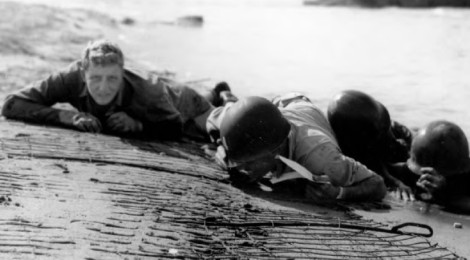
Image: U.S. Army, Soldiers hugging the beach during air strafing and bombing attack on Paestum Beach . Five enemy air raids, each by a formation of eight fighter-bombers, were made against U. S. troops along the beach. Several smaller formations were sent against ships offshore.

It’s Time to Abandon the Global Village Myth

January 28, 2014

The world is increasingly dangerous, we are told, because technology has made it smaller. In this “global village,” the costs of transport and communications have fallen to the point where predators have easy access to our vulnerable points. For instance, they can lay waste to our cities through nuclear terrorism or an “Electronic Pearl Harbor.” The sentiment is everywhere in Western security debate. It pervades formal strategic documents like the National Security Strategy of the United States and that of allies like Australia. Fear of the dangerous interconnectedness of things has rung loudly, from Tony Blair’s Chicago speech in April 1999 to the “Bush Doctrine” of first strikes and regime change to Barack Obama’s claim that America should bomb Syria to protect American children in the long run.

But the world is not small. Technology may accelerate movement and compress physical space. But it does not necessarily shrink strategic space, the ability to project power affordably across the earth.

The deadly cliché of the global village stretches back at least to World War Two. George Orwell questioned it in 1944, after the rapid, mobile war machines of the Axis powers had been blunted across the English Channel, the frozen wastes of the Soviet Union and the waters of the Pacific. Orwell mocked “the automatic way in which people go on repeating certain phrases,” like “the abolition of distance” and the “disappearance of frontiers.” He might have been writing of today.

The myth took root in American strategic minds on December 7, 1941, when Imperial Japan attacked at Pearl Harbor. Its Pacific Fleet in flames, America awoke to discover that predators could strike from afar out of the blue. In the age of naval aviation and the long-range bomber, President Franklin Roosevelt warned that Americans could no longer measure their safety as “miles on a map.”

Almost 60 years later, Arab Islamists headquartered in Afghanistan brought down skyscrapers in Manhattan and torpedoed the Pentagon. Again, the world seemed violently interconnected. Pondering the assault on America’s financial and military nerve centres, the 9/11 Commission believed, like Roosevelt, that there was no longer “home” and “away.” In the age of the mobile phone, cheap travel and digital finance, “the American homeland is the planet.”

How to lose great leaders? Ask the Army

By Tim Kane

The U.S. military is one of America’s premier leadership factories. But the product it manufactures is in decline.

Seven years ago, the number of young officers willing to recommit after their initial tours of duty dropped precipitously. Before the Iraq war, three-quarters of Army officers stayed for a career, a number that dropped to just two-thirds starting in 2006. The broken pipeline was initially blamed on the sputtering war effort in Iraq, but in fact the problem is a deep-rooted one. The Army has bled talent for decades, a consequence of a deeply dysfunctional organization that poorly matches jobs with talent and doesn’t trust its officers to make choices about their own careers.

The solution, however, isn’t beyond reach. The next step in the evolution of the Pentagon’s leadership system should be what I call a “total volunteer force”—one that treats officers as human capital with autonomy rather than as physical capital in inventory.

Let me explain. The retention crisis, even in an era of cutbacks and sequestration, is a decades-long dilemma that the military doesn’t often talk about. The Senate investigated the “critical and delicate” problem of a military brain drain as far back as 1954, after President Eisenhower called for Congressional action. Yet after public attention flared following a 2011 survey of junior officers, retired U.S. Army general Frederick Kroesen mocked the issue in the publication ARMY, declaring that “no other profession has developed better ways to identify, develop and reward its leaders.”

There is at least one top military leader who will talk about the problem. In a farewell address to the cadets of West Point in Feb. 2011, former secretary of defense Robert Gates, admired for his service under Presidents Bush and Obama, expressed his frustration. He wondered how the Army “can break up the institutional concrete, its bureaucratic rigidity in its assignments and promotion processes, in order to retain, challenge, and inspire its best, brightest, and most-battled tested young officers?”

Sec. Gates understood something that neither the Army nor its critics do. Critics like to think that the most talented young leaders simply leave, whereas many generals refuse to admit any problem exists. The real problem is that the talent is bleeding inside the organization. High quit rates are just a symptom of the deeper problem that too many military members are mis-matched with their jobs.

Disillusioned by the Great Illusion: The Outbreak of Great War

January 29, 2014

As we approach the centennial of World War I, Norman Angell is likely to receive more than the ritual criticisms that he endures in college and university courses on international relations each semester. Despite enjoying a sterling career—he served in the British Parliament, received a knighthood for public service at the end of his time in office, and won the Nobel Peace Prize in 1933—he is remembered primarily for a book that he wrote in 1910, The Great Illusion. In that text, runs the (or a) standard critique, he argued that economic interdependence between the countries of Western Europe had rendered war between them impossible. Rather than changing course in the face of widespread criticism, Angell doubled down on that judgment and published an expanded version of The Great Illusion in 1913. Europe descended into chaos less than a year later, affirming that formal education does not always produce practical enlightenment.

Angell argued that war was futile; history, however, remembers him for arguing that it could not occur. That this misinterpretation endures is unsurprising; distortions calcify quickly in the absence of correctives (and often persist despite them). What is surprising, however, is that it emerged in the first instance, considering how fundamentally it misreadsThe Great Illusion. “War is not impossible,” Angell explained therein, “and no responsible [p]acifist ever said it was; it is not the likelihood of war which is the illusion, but its benefits.” Indeed, in a March 8, 1913 letter to the Sunday Review—a copy of which appears in a 1921 sequel to The Great Illusion entitled The Fruits of Victory—Angell asserted that “not only do I regard war [between Britain and Germany] as possible, but extremely likely” (emphasis mine).

Even though he would take the time to issue countless such clarifications throughout his career, Angell had already grown exasperated soon after the first edition of the book appeared: “I find I am shouting myself hoarse in the [p]ress against this monstrous ‘impossibility of war’ foolishness.” On May 22, 1915, the New York Times asserted that Angell “has written books in the endeavor to prove that war has been made impossible by modern economic conditions….events have shown their fallacy. Ten nations, more or less closely bound a short time ago by economic ties, are now involved in war.” He replied two days later:

I have never written any book to prove that war has been made impossible…in every book I have written on the subject, [I have] urged, perhaps with wearisome emphasis, that no such conclusion could be drawn…Indeed, considering that violent wars were raging when the books were written; [and] have been raging very nearly continuously ever since, such books, had they been based on the argument that “wars had become impossible”, must quite obviously have been just silly rubbish.

BEWARE THE LITTLE GREEN MONSTER

29 January 2014

Wind farms and hydel power projects are supposed to be environment-friendly as they produce clean and renewable energy. However, they adversely impact communities and ecosystems, cause massive deforestation and pillage ecologically vulnerable regions

At a workshop to map a conservation plan for the critically endangered Great Indian Bustard, some of us raised the issue of the harmful impacts of ‘green’ energy projects and called for moratorium/strict regulation on these, in GIB and other important wildlife landscapes, given their devastating impacts on birds and natural habitats. This was met with much resistance from those concerned with planning and other sectors as it was perceived being too obstructionist.

To understand this issue, let’s examine the question: How ‘green’ is green energy? While not concentrating on their efficacy as a reliable and optimal source of energy, I would like to underline the fact that the viability of this sector is heavily subsidy-dependent and also relies on fossil fuels for infrastructure installation and maintenance. I will also focus on their impact on wildlife as well as wind and mini-hydel projects which are being aggressively promoted in India.

Globally, India ranks fifth in wind power generation with an installed capacity of 20,149MW, with an additional 6,000MW expected to be installed in 2014. Wind energy accounts for 1.6 per cent of our power generation. While there is no denying their minimal impact on climate change, we are failing to take into account their devastating impacts on ecology and natural habitats, besides high mortality of birds and bats, due to direct collusion.

The scales are enormous. A recent US-based study indicated that wind turbines kill between 1,40,000 and 3,28,000 birds annually. Published in the journal Biological Conservation last December, the study also finds a greater risk of collusion from giant turbines, which are more energy efficient.

In the Indian context, wind energy has similar disastrous implications. There are large concentration of wind energy farms in the deserts and grasslands of Kutch and Rajasthan — and a great push for their further expansion. These grasslands, usually dismissed as ‘wastelands’, are throbbing ecosystems, harbouring some of our rarest wildlife, including the critically endangered GIB, lesser floricans, wolves, blackbucks, wild asses and caracals. The Union Ministry of Environment & Forests’ guidelines for GIB recovery programme cites wind turbines as a “major threat to the these low flying birds”, and have strongly advocated that such bustard-unfriendly development be curtailed.

In a recent visit to Rajasthan’s Desert National Park, I saw the devastation first hand. Outside the park, the entire landscape is an endless wind farm (in fact, this region has one of the largest such farms in the world). The turbines are lethal for the birds, and along with transmission lines that criss-cross the landscape, allows no safe flyways to the GIBs, Houbara Bustards, vultures and other raptors that this region is known for. Forest staff and researchers working here assert that the GIBs have abandoned areas where wind mills have come up — a fact corroborated by conservationists in Kutch.

29 January 2014

A DIFFICULT VICTORY

China’s support for Hasina Wajed may have a message for India 
Subir Bhaumik


When Sheikh Hasina Wajed’s Awami League won a landslide in the January 5 polls, most were asking how long the government would last. It was not an unfair question, considering that a similar election in early 1996, held with Khaleda Zia in power, had led to huge protests that forced the Bangladesh Nationalist Party leader to accept a caretaker dispensation and hold fresh elections within a few months. That election led to an Awami League victory and a change of guard. After the January 5 polls, most were busy looking for parallels. The 1996 polls led to a 7 per cent turnout and was boycotted by the Awami League-led opposition. The January 5 polls had a much better turnout, but that was nowhere near the 80 per cent registered in the December 2008 polls. It was boycotted by the BNP-led opposition and marred by intense violence. Wajed was aware of the limitation in which she was taking over as prime minister for a third time as she promised a dialogue with the opposition and fresh polls as soon as a consensus was reached. The United States of America rubbished the elections as “less than credible” and its envoy in Dhaka, Dan Mozena, called for fresh dialogue and mid-term polls to “let the Bangladesh people express their will freely”. The European Union and the Commonwealth also dubbed the polls one-sided and called for fresh elections. Only India expectedly backed Wajed, saying that the polls were a “constitutional necessity”. 

But within a week, the situation has changed for her. Russia has come out in support of Wajed’s government, saying it looked forward to a “constructive partnership and cooperation” with the new government. More interestingly, the Russian statement blamed the opposition for the violence and the boycott while it explained the one-sided nature of the elections. This brought back memories of the 1971 liberation war for many Awami League veterans, of the troubled months when India and the erstwhile Soviet Union firmly upheld the cause of Bangladesh’s independence against a brutal Pakistani military regime backed by the US and China. After Vladimir Putin’s firm intervention in Syria, this move by Russia to back Wajed was also seen as yet another Kremlin assertion in a major Asian issue. But what came after that was all the more surprising. 

China, which backed Pakistan in 1971 but soon established good relations with Bangladesh, has maintained equidistance when it comes to the two rival, battling coalitions which have run the country since it returned to democracy from military rule in the early 1990s. Before the January 5 polls, the usually quiet Chinese envoy in Dhaka, Li Jun, had called for a dialogue between the Awami League and the BNP, so that “wisdom prevailed over violence”. But as Wajed assumed office and formed her cabinet, she received a message from the Chinese prime minister, Li Keqiang, saying that China was keen to “join hands” with her government to “advance the Sino-Bangla comprehensive and cooperative partnership to a new height”. Li Jun handed over the letter to the Bangladesh foreign secretary, Shahidul Haque, to deliver the message even more clearly that Beijing meant business when it came out in support. Li’s letter had no mention of the elections, let alone referring to its credibility or one-sided nature. The Chinese premier was clearly sending a message to the West, specially the US, that the business of democracy and governance be better left to the government in Dhaka. In December, the Chinese had told Indian and Bangladesh officials at a BCIM meeting in Kunming that Beijing was keen to work with both Delhi and Dhaka to develop an economic corridor connecting Calcutta and Kunming that would “open a new chapter in our relationship and economic development”. Now by breaking away from its strict equidistance policy and supporting the Hasina Wajed government, China is seeking to warm up to India as well and drive home the message that it would be only too happy to work with India in the region. That this comes at a time when India-US relations are at a low following l’affaire Devyani is significant. Chinese officials have previously dropped broad hints to Indian diplomats that the deep sea port they plan to build at Sonadia off the Cox’s Bazar coast would be useful to India in accessing its Northeast. Beijing is keen to draw India out of the US ambit and what better time than now? The expression of support for Wajed, who is seen as close to India is, for China, like killing two birds with an arrow. 

Japan enters where China is barred – northeast India

TNN | Jan 27, 2014

President Pranab Mukherjee taking salute as chief guest Shinzo Abe looks on during the 65th Republic Day parade in New Delhi on January 26, 2014. 

NEW DELHI: Japan is sailing in where China fears to tread. As India and Japan ramp up their bilateral relationship, India has invited Japan to invest in and build overland infrastructure in areas which are generally out of bounds for Chinese investments. 

India and Japan used the visit of Japanese Prime Minister Shinzo Abe to dramatically expand the scope of bilateral cooperation to include the politically sensitive northeastern states of India, areas where Chinese investment or projects are actively discouraged. Japanese companies will have the opportunity to help the development of the northeast specially to build roads, and aid agriculture, forestry and water supply and sewerage in these states. 

China claims Arunachal Pradesh as its territory, which has aggravated border tensions between India and China. Security agencies have also long tracked Chinese weapons assistance to militant outfits in northeastern states. It has taken India many difficult years to calm down these hills, but China remains a significant security threat. 

For India to invite Japan to build infrastructure here is a huge political statement. In 2007, China opposed an ADB loan for development works in Arunachal Pradesh describing it as "disputed territory". The last time the Japanese were in India's northeast was during the second world war, when they worked with Netaji Subhash Bose's INA to confront the British in Nagaland. 

Japanese companies have also been invited to help develop a new port in Chennai, which would be used to improve India's sea-route connectivity. India assiduously keeps China out of port development because they constitute India's critical infrastructure. Japanese assistance for Chennai port is also aimed at giving teeth to a new sea-based route that would start in Chennai, and end in Dawei port in Myanmar's Tanintharyi region. The port is being developed by Thailand.

In 2012, Thai PM Yingluck Shinawatra had promised PM Manmohan Singh that Thailand would pump in a massive $50 billion into Dawei, making it a bigger investment than China's in Gwadar or Hambantota. 

ZERO CONNECTIVITY AT THE ZERO LINE

29 January 2014

Villages along the LoC suffer from cross-border shelling but also poor infrastructure. Mobile phone towers do not exist in these remote areas, writes RAMEEZ RAJA

That entire night, ear-deafening sounds of firing and shelling across the border dominated the sky. All of Shayeen's family stayed together in one room, as they were not too sure if they will wake up alive the following morning. In that tense hour, they were equally worried about the livestock tied outside the house — with no shelter. Shayeen kept thinking about her father who was posted in Doda and unaware of the situation.

“I wish I could have called my father and listened to his voice, as we waited for our deaths”, said this 18-year old girl from Bharooti, a nondescript village tucked away in the border land of Poonch District in Jammu & Kashmir. Shayeen could not call her father, not because she didn’t have a mobile phone but because there were no mobile phone towers in the village. The ‘waiting for death’ moment is not new to those who hail from villages like Bharooti, located merely five to six kilometres from the Line of Control.

It started with the killing of two Indian soldiers at the LoC in January 2013, which was followed by the killing of five others in August last year. In the aftermath of such killings, a total of 150 incidents of ceasefire violations have transpired, the highest in the past eight years. For those residing away from the border, ceasefire violation is just news but for the ones living there, it is a nightmare.

To compound the problem, villagers have to face development challenges all alone. One of the major challenges faced by those inhabiting near zero line is connectivity. This is not talked about much but it is a challenge that affects their life quite severely.

Sixty-two year old Rasham Bi, a resident of village Ghani, shared her experience. She said: “Last month, I had to go to the sub-district hospital in Mendhar as I was feeling unwell. I was alone as my only son lives in Saudi Arabia working as a labourer there. Doctors, post checkup, suggested that I get admitted to hospital for a minimum of two days.” It left the old lady in distress as, although she had a mobile phone, she couldn't contact her daughter back home as there is no tower in her village. Later that night, her daughter had to come searching for her mother spending Rs 900 on a hired cab. Availability of a single mobile phone tower could have avoided the chaos.

View from the left

January 29, 2014

SUMMARY

The CPI(ML) weekly ML Update is critical of the army for announcing the closure of the Pathribal case and clearing itself. It demands the scrapping of the AFSPA.

LICENCE TO KILL

The CPI(ML) weekly ML Update is critical of the army for announcing the closure of the Pathribal case and clearing itself. It demands the scrapping of the AFSPA, claiming that army officers accused of murder and rape must enjoy no protection and asks the Centre to ensure that the Pathribal killers face trial in a civilian court. The editorial, the “Republic Has Blood on Its Hands”, quotes the president’s Republic Day-eve address, wherein he argued that “mavericks who question the integrity of our armed services should find no place in public life.”

“Perhaps for the first time in India’s history, the designated custodian of the Constitution virtually issued an open call to ‘supporters’ of [the] armed forces to evict critics of the army’s impunity from public life. And on the heels of Republic Day, the army gave itself a clean chit in the Pathribal case… The Republic has blood on its hands, but the public has been warned to remain silent.” The Pathribal episode, it says, also drives home the fact that the ordinary Kashmiri in India is entirely unprotected by any semblance of civil liberties or hope of justice, and is at the mercy of the army that enjoys the licence to murder.

ECONOMIC SAMENESS

The CPM’s People’s Democracy focuses on the BJP’s economic blueprint unveiled by Narendra Modi, arguing that it was high on rhetoric and low on content: “If at all there was any reconfirmation that was ever needed on the score that there is virtually no difference… on matters of economic policy between the Congress and the BJP, it has come in the RSS/ BJP’s prime ministerial prospect’s address at the recently held the BJP’s national council meeting…” It says that what Modi talked about, like building smart cities, bullet trains, creating more IITs, IIMs and AIIMSs as well as the development of infrastructure, reviving power plants, setting up of agro infrastructure, deploying optical fibre networks and establishing special courts to punish black marketing — sounds similar to the UPA’s Bharat Nirman.

The right way to look East

IssueCourtesy: Mail Today| Date : 28 Jan , 2014

Prime Minister Dr. Manmohan Singh meeting the Prime Minister of Japan, Mr. Shinzo Abe, in New Delhi.

Much has been achieved during Japanese Prime Minister Shinzo Abe’s current visit to India and much has not. In reiterating a clear intention to strengthen bilateral ties, the visit has been a success, though in breaking new strategic ground concretely, the results could have been better.

Significant 

Honouring Abe as chief guest at our Republic Day celebrations was politically significant. Such invitations are either intended to convey a desire to forge closer ties with a country or to indicate that relations had already reached a high level of entente. In other words, either an investment in the future or a celebration of success already achieved. Abe’s visit would fall in between these two categories.

If today there is a felt need to highlight this shared attachment to liberal values, it is to differentiate themselves from China’s authoritarianism.

The joint statement mentions the resolve of the two leaders to jointly contribute to peace and stability “taking into account changes in the strategic environment”- an indirect reference to the strategic issues raised by China’s rise and its increased assertiveness, as no other change in this environment has occurred that would disturb both India and Japan.

No doubt both countries are Asian democracies that share the values of freedom, democracy and rule of law, a feature of particular importance for Abe. But then, India and Japan have been liberal democracies since decades, without this providing a political glue all these years. If today there is a felt need to highlight this shared attachment to liberal values, it is to differentiate themselves from China’s authoritarianism. Uniting on the basis of universal values of democracy avoids the impression that the two are coming together on any explicit anti-China platform.

What Can Manmohan Singh Accomplish By Visiting Pakistan?

Indian Prime Minister Manmohan Singh will visit Pakistan in March to reignite the Composite Dialogue Process.
January 28, 2014

Indian Prime Minister Manmohan Singh is planning to visit Pakistan sometime in March 2014 to resume the long-stalled composite dialogue between India and Pakistan. The news comes a little over a week after Pakistani Trade Minister Khurram Dastgir Khan met his Indian counterpart Anand Sharma in New Delhi and the two agreed to move forward with warmer trade ties. Indian Commerce Minister Anand Sharma will pave the path for Singh’s trip to Pakistan when he heads to Lahore in mid-February for an Indian trade show.

The composite dialogue between India and Pakistan was suspended last January after an Indian soldier was beheaded by Pakistani troops–an incident that marked the beginning of a year that was marred by various skirmishes along the troubled India-Pakistan border. A series of ceasefire violations in 2013 ensured that no progress was made on ameliorating bilateral relations. Pakistani Prime Minister Nawaz Sharif pledged to improve relations with India prior to his election.

The so-called Composite Dialogue Process between India and Pakistan addresses the entire spectrum of issues inhibiting warmer ties between the two South Asian rivals, including the final status of Kashmir, Siachen, economic cooperation, counter-terrorism cooperation, and general confidence-building measures.

So far, 2014 has set a completely different tone for India-Pakistan relations compared to 2013. Where last year was littered with skirmishes along the Line of Control in Kashmir, this year the two have already broached major trade issues in an amicable bilateral setting. At the very end of 2013, the Director Generals of Military Operations (DGMOs) of both nations met at the Wagah border crossing to consult on military matters as well. Of course, what little progress was made during the brief bilateral consultation on trade issues was undone following an Indian drug bust in Kashmir, which prompted Pakistan to temporarily cease border crossings, but that hasn’t entirely undone the positive momentum underlying bilateral efforts this year. Prime Minister Singh’s resolve to travel to Pakistan in March underscores this trend and will likely be the PM’s last major foreign policy hurrah before his term ends in May after India’s general elections.

Thatcher offered military help to Indira

The role of the Special Air Services in Operation Bluestar unlikely
Kuldip Nayar

I HAVE no doubt that Great Britain assisted the Government of India to plan and execute Operation Bluestar, the Army’s nomenclature for the onslaught in and outside the Golden Temple at Amritsar to flush out Jarnail Singh Bhindranwale and his militant followers. The British have tried to prove the point that the Indians scurry to their colonial masters whenever they are pitted against a ticklish situation.

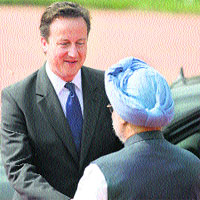
British Prime Minister David Cameron, seen here with Prime Minister Manmohan Singh, wants to go into the role of Mrs Thatcher's government in the 1984 operation and “establish the facts”. A Tribune file photo 

To rub salt into the wounds, the British archives have made public the documents and letters relating to that period to synchronise with the 30th anniversary of Operation Bluestar. The reason why Prime Minister Indira Gandhi sanctioned the operation was the fear she entertained from the militants who used the Golden Temple as their shelter. The then British Prime Minister, Mrs Margaret Thatcher, offered military help to Mrs Gandhi to enable her to go ahead with her plan.

I have reached this conclusion because of the daily telephone talks they held. Mrs Thatcher herself told me when I was India's High Commissioner in London that they would converse on the affairs relating to India and the UK. They could not be discussing the weather. Sikh militants would have figured in their talks. Once I asked Mrs Thatcher whether she was in touch with Prime Minister Rajiv Gandhi, she peevishly replied: “He was a different person.”

However, I rule out the assistance by the Special Air Services (SAS) in the operation. Had this been true, the media in the UK and India would have uncovered it in the last 30 years. The operation, as Lieut-Gen. K.S. Brar (retd) has claimed, was entirely carried out by the Indian forces. “We never saw anyone from the UK coming in here and telling us how to plan the operation.” In any case, the truth will be known when the inquiry ordered by British Prime Minister David Cameron is complete. He wants to go into the role of Mrs Thatcher's government in the 1984 operation and “establish the facts.”

The Sikhs in India and abroad are understandably upset because London has been giving the impression that as if it was not happy with the operation. Indeed, Mrs Gandhi before sending the Army into the Golden Temple was frantically seeking opinion from different people on whether to undertake the operation. R.K. Dhawan, her aide, came to my residence to know my reaction if the troops entered the temple. He indicated specifically that Mrs Gandhi had sent him. I told him that he would not have come without her permission knowing well how annoyed she was with me because of my writings.

Front Row Seat: Watching COIN Fail in Afghanistan

FRONT ROW SEAT: WATCHING COIN FAIL IN AFGHANISTAN
January 28, 2014 

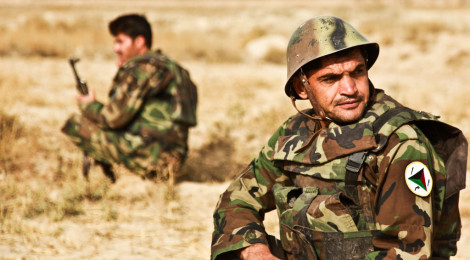
With President Karzai as unlikely as ever to sign a Bilateral Security Agreement with the United States, an early withdrawal of coalition forces from Afghanistan seems increasingly probable. Although the focus will soon turn to determining how to safely extract coalition forces, the United States also needs to think about how to preserve the strategic gains it has won at so great a cost over the past dozen years. Unfortunately, America’s own institutional inertia will probably lead Washington to continue pushing a failed nationalcounterinsurgency strategy on the Afghan military. The United States has taught its Afghan allies—albeit not always successfully—to fight and govern as Americans fight and govern, rather than teaching them to do so in a way consistent with their culture and in line with their own strategic beliefs. The current strategy, which requires a unified national policy directed by a strong, legitimate government, is unrealistic in its expectations and inappropriate against violence that is dispersed and motivated by local concerns. Unless the United States begins pushing the Afghan National Security Forces to adopt policies more suited to their current needs and their military culture, the blood and treasure we have poured into Afghanistan over the past twelve years will have been for nothing.

Current counterinsurgency doctrine presumes a national solution to local problems: that a national army, usually with the aid of local police or militias, can come into a fractious area and convince unfriendly locals to ally themselves with the state by bringing security and certain amenities like electricity or economic programs. This strategy requires a functioning and legitimate government and a skilled and disciplined military that can effectively target insurgents who hide amongst the civilian population without causing collateral damage. It assumes that all enemy strongholds must be retaken and that unless the insurgency is defeated in all its parts, the nation cannot survive.

Rather than allowing the Afghans to find their own solutions to the insurgency, the United States bequeathed its ally a reductionist approach. Thus, “the insurgents” were identified with the “Taliban” and the “Taliban” with those who most closely resemble the Taliban of Mullah Omar’s failed state. Although the insurgency is strengthened, fueled and spread partly through religious networks, it is fundamentally a localist and anti-government movement. Conservative rather than radical and tribal rather than religious, the insurgency is less a religious or political organization and more a classic peasant revolt of isolated, anti-modernist and largely landless individuals. These individuals’ only familiarity with the central government comes from being taxed and subjected to its military force. The dispersed and decentralized nature of the insurgency is not, as is sometimes argued, evidence of what is fashionably termed “chaoplexy” or otherwise indicative of an advanced cell-based structure. Rather, the insurgency is dispersed and decentralized because there are too many actors with too many different personal agendas dispersed over too large an area with too few communication tools for it to be a unified or coherentpolitical opponent—and it is precisely this that makes it so durable and so difficult to defeat using our current policies.

Our Quagmire in Afghanistan

By Richard Cohen - January 28, 2014

While watching the utterly gripping movie "Lone Survivor" recently, I comforted myself by noting that the four Navy SEALs engaged in a desperate firefight with the Afghan Taliban were all volunteers. They asked for this, I told myself. They were not draftees yanked out of civilian life and compelled to fight a war they could neither understand nor win. They had asked for this, I insisted, but I knew all the time that this was a lie. They had volunteered, but certainly not to die and certainly for no purpose.

OK, I know this is only a movie. But it is faithful to the book of the same name, which is faithful to the 2005 mission called Operation Red Wings that was intended to take out a Taliban commander. The title "LoneSurvivor" pretty much says what happened, but you owe it to the SEALs and to their families to see the movie. The ending is not in doubt, but the reason for their sacrifice undoubtedly is. Afghanistan is a war searching for a reason.

All through the movie I kept asking myself, "Why?" What are these men fighting for? Once, I knew the answer. After Sept 11, 2001, I wanted to wipe out al-Qaeda and kill its Afghan hosts, the Taliban. Even before the terrorist attack, reports of the Taliban's treatment of women -- stonings, public executions in the soccer stadium, etc. -- and the beheadings of men convinced me they simply had it coming: Send in the Marines.

But American fighting units have been there since 2001. The initial mission was completed long ago -- the destruction of al-Qaeda in Afghanistan. The Taliban and their allies remain, but unlike al-Qaeda they are indigenous and, seemingly, undeterred. They apparently have an unlimited supply of suicide bombers (who are these people?) and they continue to inflict mayhem on Afghans and foreigners alike. Earlier this month, the Taliban struck a Kabul restaurant with a western clientele and killed at least 21 people. The attack by gunmen was preceded by a suicide bombing.

Bob Gates, in his memoir "Duty," depicts Barack Obama as a commander in chief whose policy in Afghanistan was to do as little as possible -- simultaneously ordering a surge and announcing a pull-out date. Gates, then the secretary of defense, was appalled. "The president doesn't ... believe in his own strategy and doesn't consider the war to be his."

Well, the war is not Obama's. It is George W. Bush's -- one he interrupted to mindlessly chase after Saddam Hussein. But Obama embraced the Afghanistan mission and then, apparently, never knew what to do with it. I don't blame him. Afghanistan is an arid Vietnam, a quagmire presided over by the petulant and unpredictable Hamid Karzai. For Obama, Gates wrote, "it's all about getting out."