20 March 2015

Russia Deploys Bombers to Crimea

March 19, 2015

Russia is continuing to militarize its westernmost territories. 

The Russian military will deploy nuclear-capable Tupolev Tu-95 and Tu-22M3 strategic bombers on the Crimean peninsula. Additionally, the Kremlin is setting up an Iskander missile deployment in Kaliningrad, the Russian territorial exclave on the Baltic Sea coast, for a military exercise. Russia’s state-run TASS news agency quoted a source close to the Russian Defense Ministry who noted, “Strategic missile carriers TU-22MS will be transferred to Crimea in the course of a surprise combat readiness inspection.”

In Kaliningrad, the Russian military will continue to build its Baltic Sea presence by relocating jets and bombers to the region. ”Ground troops in the Baltic region will be boosted by the Iskander missile systems of the western military region. They will be delivered by big assault landing ships of the Baltic Fleet,” TASS quoted its source as saying.

The report added that Russia was additionally carrying out a “surprise readiness inspection” of its Northern Fleet, western military region, and airborne assets on Monday. The inspection will cover “38,000 troops, 3,360 weapons units and military equipment, more than 55 warships and submarines and 110 aircraft and helicopters.”

Following a spate of anti-government protests in Ukraine, Russia moved to annex Crimea in February 2014. The Crimean peninsula has been of strategic significance to Russian leaders dating back to at least the Imperial era — the peninsula offers Russia access to the Black Sea, and subsequently, the Mediterranean by way of the Bosphorus. Additionally, the Russian Navy’s sole warm-water port is located in Sevastopol.

Kaliningrad is Russia’s portal to the Baltic Sea and the North Atlantic. It additionally borders Poland and Lithuania, both NATO members with a deep skepticism of Russia’s strategic intentions in Eastern Europe. Russia’s Iskander missiles have a range of 500 km and are capable of carrying nuclear warheads.

Polish Prime Minister Ewa Kopacz stated that the timing of Russia’s military deployments westward was no coincidence: ”Russia is making this gesture before the European Council meeting. It is trying to influence European Council decisions concerning extending or adding new sanctions.”

More on Russian Intelligence Operations in Sweden

March 18, 2015 

Sweden security forces fear Russian military operations 

STOCKHOLM (Reuters) - Sweden’s security services said on Wednesday they feared possible Russian military operations against their country following an increase in espionage activity since the Ukraine crisis erupted a year ago. 

In their annual report, the security services identified Russian espionage as the biggest intelligence threat facing neutral Sweden, which along with the wider Baltic region has seen a sharp increase in Russian naval and airforce activity over the past year. 

"We see Russian intelligence operations in Sweden - we can’t interpret this in any other way - as preparation for military operations against Sweden," security police chief analyst Wilhelm Unge told a news conference. 

The report said Russian military espionage in Sweden included hacking, trying to get hold of secret equipment and trying to recruit agents. 

"Sweden is leading in several areas of military and also civil technology and this attracts Russia’s interest," he said. 

"And we have identified and stopped several cases of technology procurement during the year where we assessed that it was not a question, as the Russian partner claimed, of civilian usage but aimed at strengthening the Russian military." 

Unge said a third of Russian diplomats based in Sweden were believed to be intelligence officers. 

Relations between Russia and the West have become badly strained since Moscow annexed Ukraine’s Crimea peninsula last March and backed pro-Russian separatists battling Kiev’s forces in eastern Ukraine. 

Sweden is not in NATO but as a member of the European Union participates in economic sanctions imposed by the 28-nation bloc against Russia over its role in Ukraine. 

SUBMARINES AND BOMBERS 

Last November Sweden said it had proof that a foreign submarine had been operating illegally in the Stockholm archipelago after suspicions sparked the country’s biggest military mobilisation since the Cold War. 

Russia Sending Missiles to Kaliningrad Enclave and Nuclear Bombers to Crimea

March 17, 2015

Russia to Send New Missiles to Baltic Enclave on Maneuvers

MOSCOW — Russia plans to station state-of-the art missiles in its westernmost Baltic exclave and deploy nuclear-capable bombers to Crimea as part of massive war games to showcase its resurgent military power amid bitter tensions with the West over Ukraine.

The Russian military exercises this week range from the Arctic to the Pacific Ocean and involve tens of thousands of troops, the Defense Ministry said Tuesday.

The Iskander missiles will be sent to the Kaliningrad region that borders NATO members Poland and Lithuania as part of the maneuvers, said a Defense Ministry official, who spoke on condition of anonymity because he wasn’t authorized to comment publicly.

The official also said Russia will deploy long-range, nuclear-capable Tu-22M3 bombers to Crimea, the Black Sea peninsula that Russia annexed from Ukraine a year ago.

In a statement, the Defense Ministry said the Baltic Fleet, the Southern Military District and the Airborne Forces have been brought to the highest stage of combat readiness and have started moving to shooting ranges as part of the drills.

The wide-ranging exercise started Monday, when President Vladimir Putin ordered the Northern Fleet and other military forces on combat alert as part of the exercise in the Arctic. Other units in the Pacific region, southern Siberia and southwestern Russia also launched drills.

The Iskander missiles deployment to Kaliningrad reflects Moscow’s readiness to raise the ante in response to NATO moves to deploy forces closer to Russia’s borders. The missiles, which are capable of hitting enemy targets up to 500 kilometers (310 miles away) with high precision, can be equipped with a nuclear or a conventional warhead. From Kaliningrad, they could reach several NATO member states.

Can Putin Survive?

MARCH 17, 2015 

Editor's Note: This week, we revisit a Geopolitical Weekly first published in July 2014 that explored whether Russian President Vladimir Putin could hold on to power despite his miscalculations in Ukraine, a topic that returned to prominence with his recent temporary absence from public view. While Putin has since reappeared, the issues highlighted by his disappearing act persist.

There is a general view that Vladimir Putin governs the Russian Federation as a dictator, that he has defeated and intimidated his opponents and that he has marshaled a powerful threat to surrounding countries. This is a reasonable view, but perhaps it should be re-evaluated in the context of recent events.
Ukraine and the Bid to Reverse Russia's Decline

Ukraine is, of course, the place to start. The country is vital to Russia as a buffer against the West and as a route for delivering energy to Europe, which is the foundation of the Russian economy. On Jan. 1, Ukraine's president was Viktor Yanukovich, generally regarded as favorably inclined to Russia. Given the complexity of Ukrainian society and politics, it would be unreasonable to say Ukraine under him was merely a Russian puppet. But it is fair to say that under Yanukovich and his supporters, fundamental Russian interests in Ukraine were secure.

This was extremely important to Putin. Part of the reason Putin had replaced Boris Yeltsin in 2000 was Yeltsin's performance during the Kosovo war. Russia was allied with the Serbs and had not wanted NATO to launch a war against Serbia. Russian wishes were disregarded. The Russian views simply didn't matter to the West. Still, when the air war failed to force Belgrade's capitulation, the Russians negotiated a settlement that allowed U.S. and other NATO troops to enter and administer Kosovo. As part of that settlement, Russian troops were promised a significant part in peacekeeping in Kosovo. But the Russians were never allowed to take up that role, and Yeltsin proved unable to respond to the insult.

Putin also replaced Yeltsin because of the disastrous state of the Russian economy. Though Russia had always been poor, there was a pervasive sense that it been a force to be reckoned with in international affairs. Under Yeltsin, however, Russia had become even poorer and was now held in contempt in international affairs. Putin had to deal with both issues. He took a long time before moving to recreate Russian power, though he said early on that the fall of the Soviet Union had been the greatest geopolitical disaster of the 20th century. This did not mean he wanted to resurrect the Soviet Union in its failed form, but rather that he wanted Russian power to be taken seriously again, and he wanted to protect and enhance Russian national interests.

4 Years Later, What Japan Can Teach the World About Disaster Preparedness

March 18, 2015

While hosting a UN Conference on Disaster Risk Reduction, Japan shares hard lessons from the 2011 earthquake and tsunami. 

Japan hosted the Third World Conference on Disaster Risk Reduction from March 14 to 18. The Conference on Disaster Risk Reduction is held by the United Nations about once every decade; more than 40,000 people were expected to take part, representing governments and NGOs from more than 170 countries.

Fittingly, the conference was held in Sendai, described by Japan Times as “a city that is synonymous with resilience to disasters for its remarkable recovery from the Great East Japan Earthquake and tsunami.” That disaster struck four years ago on March 11, 2011, leaving more than 18,000 people dead or missing and triggering the ongoing Fukushima nuclear crisis.

Tokyo used the opportunity to highlight the ways in which it has contributed to sharing expertise and knowledge with the rest of the world, especially developing countries, to pursue development goals and promote recovery from natural disasters. Japan’s “knowledge sharing” initiative is based on emphasizing the three principles: cost-effective prior investment, the idea of “building back better” (to create nations and regions more resilient than they were before the disaster), and cooperation between the central government, local governments, companies and other entities.

New U.N. guidelines to be adopted at the conference will not set concrete numerical targets for disaster prevention efforts, but will call for greater investment in preparedness to promote sustainable development. The guidelines agreed to at Sendai will also set the tone for other key processes this year, including the agreement on development financing in July, the set of Sustainable Development Goals to be adopted in September, and a new agreement on climate change in December.

UN Secretary-General Ban Ki-Moon declared in a special interview to the Yomiuri Shimbun, “Our drive for sustainability will start in Sendai.” He added:

Strategies to manage disasters are critical. The world has already shown great progress in saving lives by improving weather forecasting, setting up early warning systems and organizing evacuations. But the Sendai conference is expected to also deliver strategies for disaster risk management, which lies at the hart of strengthening the international response.

Russia, Crimea and Central Asia

March 19, 2015
http://thediplomat.com/2015/03/russia-crimea-and-central-asia/

Central Asian governments have faced some difficult choices in responding to Russian revanchism. 

A little over a year ago, little green men began popping up at strategic locations throughout the Crimean peninsula. While they kept mum as to their funding and support, their ends were clear: instill a pro-Russian parliament, force a referendum, and attempt to provide a veneer of legality to a Russian occupation.

Twelve months on, the reverberations from the Kremlin’s heist are still being felt. Sanctions have continued and expanded, compounding an oil sag to dampen economic prospects throughout Eurasia. Russia’s self-sanctions, preventing access to European goods for its populace, have helped illustrate how flaccid and ad-hoc the Eurasian Economic Union truly is. And where Central Asian governments were primarily concerned with potential Islamist spillover from ISAF’s Afghan pullout, Russian revanchism provided a sudden, immediate security threat, with far broader and deeper penetration through the region than anything ISIS could hope to ever achieve.

Crimea, as we now know, shifted the basic presumptions undergirding the post-Cold War order, broaching a Westphalian system that had stitched together the international community for decades. As we push into the second year of occupation, it’s worth taking stock of how Central Asian governments responded to the invasion – and how they’ve attempted to spin their views since.

None of the five Central Asian governments acknowledged the annexation during the United Nations vote last year, with all either abstaining or failing to lodge a vote. (Those siding with Russia read as a rogue’s gallery of the international community: North Korea, Syria, Belarus, etc.) Reports soon circulated that, unsurprisingly, Russia had applied substantial pressure on Central Asian contingents to forego any opposition they may have felt.

Beyond the UN vote, Turkmenistan and Uzbekistan, the two countries furthest from Russia’s military and economic orbit, have remained largely mum on Crimea. Tajikistan, too, has opted to remain quiet – despitereports that Tajiks have been relocated to fight among Russian forces in eastern Ukraine. Kyrgyzstan, however, quickly acquiesced to the Russian position: Soon after Russian troops spread through the peninsula, Bishkekrecognized the “referendum” as valid.

Can Putin Survive?

March 18, 2015

Editor's Note: This week, Stratfor revisits a Geopolitical Weekly first published in July 2014 that explored whether Russian President Vladimir Putin could hold on to power despite his miscalculations in Ukraine, a topic that returned to prominence with his recent temporary absence from public view. While Putin has since reappeared, the issues highlighted by his disappearing act persist.

There is a general view that Vladimir Putin governs the Russian Federation as a dictator, that he has defeated and intimidated his opponents and that he has marshaled a powerful threat to surrounding countries. This is a reasonable view, but perhaps it should be re-evaluated in the context of recent events.

Ukraine is, of course, the place to start. The country is vital to Russia as a buffer against the West and as a route for delivering energy to Europe, which is the foundation of the Russian economy. On Jan. 1, Ukraine's president was Viktor Yanukovich, generally regarded as favorably inclined to Russia. Given the complexity of Ukrainian society and politics, it would be unreasonable to say Ukraine under him was merely a Russian puppet. But it is fair to say that under Yanukovich and his supporters, fundamental Russian interests in Ukraine were secure.

This was extremely important to Putin. Part of the reason Putin had replaced Boris Yeltsin in 2000 was Yeltsin's performance during the Kosovo war. Russia was allied with the Serbs and had not wanted NATO to launch a war against Serbia. Russian wishes were disregarded. The Russian views simply didn't matter to the West. Still, when the air war failed to force Belgrade's capitulation, the Russians negotiated a settlement that allowed U.S. and other NATO troops to enter and administer Kosovo. As part of that settlement, Russian troops were promised a significant part in peacekeeping in Kosovo. But the Russians were never allowed to take up that role, and Yeltsin proved unable to respond to the insult.

Putin also replaced Yeltsin because of the disastrous state of the Russian economy. Though Russia had always been poor, there was a pervasive sense that it had been a force to be reckoned with in international affairs. Under Yeltsin, however, Russia had become even poorer and was now held in contempt in international affairs. Putin had to deal with both issues. He took a long time before moving to recreate Russian power, though he said early on that the fall of the Soviet Union had been the greatest geopolitical disaster of the 20th century. This did not mean he wanted to resurrect the Soviet Union in its failed form, but rather that he wanted Russian power to be taken seriously again, and he wanted to protect and enhance Russian national interests.

France, Germany, Italy to join China-led $50bn infrastructure bank

March 18, 2015 
http://rt.com/business/241365-china-bank-eu-usa/

China's President Xi Jinping (3rd R) meets with the guests at the Asian Infrastructure Investment Bank launch ceremony at the Great Hall of the People in Beijing October 24, 2014. 

France, Germany and Italy have confirmed they’ll join China’s new Asian Infrastructure Investment Bank (AIIB). Participation in the rival to the US-led World Bank is seen as a setback for the Obama administration.

The three European countries on Tuesday confirmed in a statement they intend "to become founding members of the Asian Infrastructure Investment Bank," according to AFP.

"We want to bring our long experience... to help the bank build a solid reputation," said German Finance Minister Wolfgang Schaeuble, speaking also for Italy and France at a joint press conference with Chinese Deputy-Premier Ma Kai on Tuesday in Berlin. He added that the three countries want to make a contribution to the positive development of the Asian economy, in which German companies were actively taking part.

Chinese Foreign Ministry spokesman Hong Lei welcomed the decision, saying "the AIIB is an open and inclusive multilateral investment institution.”

"Participation by countries outside the region will intensify the extensive representatives of the AIIB," he added.

The decision of the three European countries comes after Britain last week became the first Western country to agree to become a founding member of the AIIB, FT reports. The UK government said the decision was in the country’s national interest, but it got a negative reaction from the United States.

The new China-led bank is expected to challenge the Washington-based World Bank, so the US is increasing pressure on its allies not to join the institution. The US’ concern is that the new investment bank might not have high standards of governance and environmental and social safeguards.

The new bank is expected to challenge the Western dominance of the US-led World Bank and IMF in global infrastructure projects, which experts believe will create healthy competition.

“Our messaging to the Chinese consistently has been to welcome investment in infrastructure but to seek unmistakable evidence that this bank… takes as its starting point the high watermark of what other multilateral development banks have done in terms of governance,” US Regional Assistant Secretary of State Daniel Russel said in Seoul, the Financial Times reports.

House Intelligence Committee to Hold Hearing Tomorrow on Cyber Threats

March 18, 2015

The following release appeared on the House Permanent Select Committee on Intelligence website:

House Intelligence Committee to Examine the Growing Cyber Threat and Its Impact on American Business

HPSCI to hold open hearing

Washington, D.C. – Chairman Devin Nunes and Ranking Member Adam Schiff of the House Permanent Select Committee on Intelligence (HPSCI) announced today that the Committee will hold an open hearing to publicly examine the growing cyber threat and its impact on American business.

The hearing will begin at 9:00 am on Thursday, March 19, 2015, in room HVC-210 of the Capitol Building.

Who: House Permanent Select Committee on Intelligence (HPSCI)

What: Hearing on the growing cyber threat and its impact on American business (Open)

When: Thursday, March 19, 2015

9:00 am – 12:00 pm ET

Where: Room HVC-210, Capitol Building

The hearing witnesses include: 
The Honorable Tim Pawlenty, Financial Services Roundtable 
John Latimer, TSYS 
Richard Bejtlich, FireEye 
Andrew Tannenbaum, IBM

Classified Document Reveals NSA Trying to Map the Communications of Major Corporations, Including Canadian Companies

COLIN FREEZE and CHRISTINE DOBBy 
March 17, 2015

NSA trying to map Rogers, RBC communications traffic, leak shows

The U.S. National Security Agency has been trying to map the communications traffic of corporations around the world, and a classified document reveals that at least two of Canada’s largest companies are included.

A 2012 presentation by a U.S. intelligence analyst, a copy of which was obtained by The Globe and Mail, includes a list of corporate networks that names Royal Bank of Canada and Rogers Communications Inc.

The presentation, titled “Private Networks: Analysis, Contextualization and Setting the Vision,” is among the NSA documents taken by former contractor Edward Snowden. It was obtained by The Globe from a confidential source.

Canada’s biggest bank and its largest wireless carrier are on a list of 15 entities that are visible in a drop-down menu on one of the presentation’s 40 pages. It shows part of an alphabetical list of entries beginning with the letter “R” that also includes two U.K.-headquartered companies – Rolls Royce Marine and Rio Tinto – and U.S.-based RigNet, among other global firms involved in telecom, finance, oil and manufacturing.

The document does not say what data the NSA has collected about these firms, or spell out the agency’s objective. A comparison of this document with previous Snowden leaks suggests it may be a preliminary step in broad efforts to identify, study and, if deemed necessary, “exploit” organizations’ internal communication networks.

Christopher Parsons, a researcher at the University of Toronto’s Citizen Lab, who reviewed the leaked document with The Globe, said the activity described could help determine useful access points in the future: “This is preparing the battlefield so it could later be used.

“This is … watching communications come in and out of a network and saying, ‘Okay, these are the places we need to go in.’”

DHS Report Indicates Highest Number of Cyber Attacks on U.S. Companies Focused on the Energy Sector

Jeremy Cowan
March 17, 2015

Washington, DC. March 12, 2015 — A report issued today by the US Department for Homeland Security says that in 2014 the Industrial Control Systems Cyber Emergency Response Team (ICS-CERT) responded to 245 incidents reported by asset owners and industry partners.

The energy sector, says Jeremy Cowan, led all others again in 2014 with 79 reported incidents, followed by manufacturing at 65 and worryingly healthcare at 15 reported incidents. ICS-CERT’s continuing partnership with the Energy sector reportedly provides many opportunities to share information and collaborate on incident response efforts.

Also noteworthy in 2014 were the incidents reported by the Critical Manufacturing sector, some of which were from control systems equipment manufacturers. The ICS vendor community may be a target for sophisticated threat actors for a variety of reasons, including economic espionage and reconnaissance. Of the total number of incidents reported to ICS-CERT, roughly 55% involved advanced persistent threats (APT) or sophisticated actors.

Other actor types included hacktivists, insider threats, and criminals. In many cases, the threat actors were unknown due to a lack of attributional data, says the US Department. The scope of incidents encompassed a vast range of threats and observed methods for attempting to gain access to both business and control systems infrastructure, including but not limited to the following: 
Unauthorised access and exploitation of Internet facing ICS/Supervisory Control and Data Acquisition (SCADA) devices 
Exploitation of zero-day vulnerabilities in control system devices and software 
Malware infections within air-gapped control system networks 
SQL injection via exploitation of web application vulnerabilities 
Network scanning and probing 
Lateral movement between network zones 
Targeted spear-phishing campaigns 
Strategic web site compromises (a.k.a., watering hole attacks.) 

British Intelligence to UK Companies: Stop Using Smart Phones If You Want to Prevent Hacking Of Computer Systems

Ben Riley-Smith
March 17, 2015

Britain’s spies have told businesses to consider stripping employees of company smart phones and memory sticks to protect themselves from cyber-attacks, The Telegraph can disclose.

Advice issued by GCHQ, the government’s listening post, and other departments warns firms that staff are the “weakest link in the security chain” and protective action must be taken.

Companies have been told staff should only use trusted Wi-Fi networks – effectively ruling out using laptops in coffee shops like Starbucks without special protections – and constantly update internet browsers.

They were also warned disgruntled employees may attempt to “steal or physically deface” computers or become vulnerable to blackmail if secrets about their personal lives become known.

The warnings were contained in ‘10 Steps to Cyber Security’ guidance issued by CESG – the Information Security arm of GCHQ – in conjunction with the Cabinet Office, Business Department and Centre for the Protection of National Infrastructure.

It comes after the Prime Minister called cyber-attacks “one of the biggest modern threats that we face” and prioritised improving Britain’s defences since taking office in 2010.

Part of the Coalition’s push to strengthen the country’s resistance to cyberterrorism is to build awareness and protection among the business community.

In a series of detailed guidance documents for businesses issued by GCHQ alongside other departments, firms are urged to take steps to make themselves less vulnerable to attacks.

“Monitor all user activity,” the advice says, telling companies they should be watching over the internet behaviour of employees at all times so they can always “identify” the staff member.

Make sure staff know “any abuse of the organisation’s security policies will result in disciplinary action”, the government says in another part of the advice.

Specific measures are also mentioned, including possibly stripping staff of company phones. “Assess business requirements for user access to input/output devices and removable media (this could include MP3 players and Smart phones),” the advice states.

US Military Losing Edge In Space: Kendall

March 17, 2015

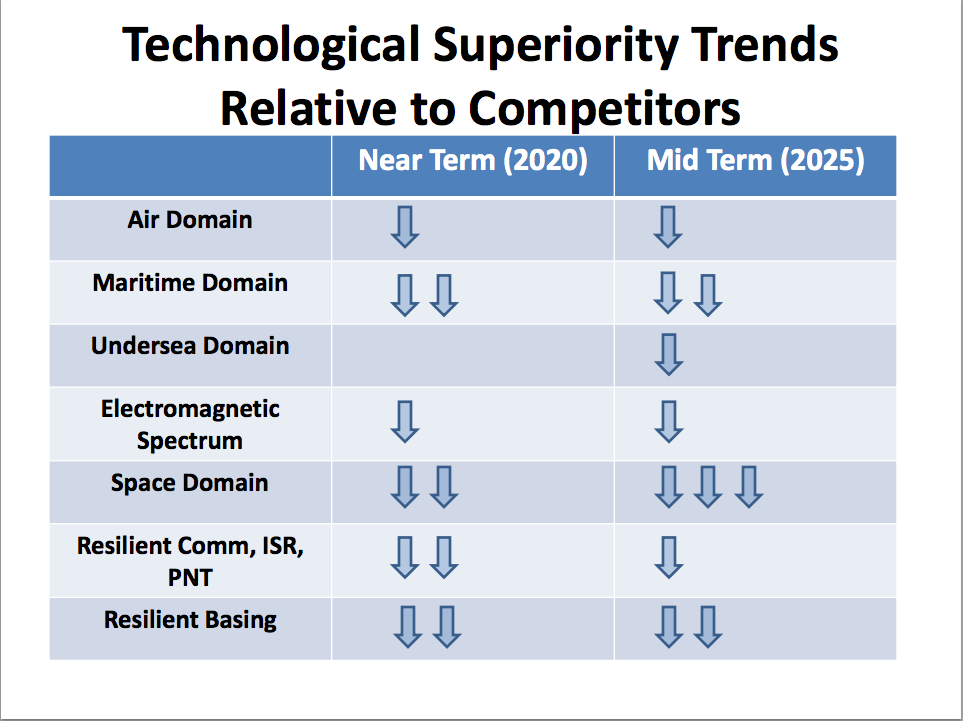
NEWSEUM: After more than a year of saying that the United States is losing its relative edge in military technology to China and Russia, the Pentagon’s top weapons buyer upped the ante today and said that the top American advantage — space — “is particularly bad” because both Russia and China are fielding a suite of anti-satellite capabilities.

The chart below sketches out the most detailed accounting Kendall has offered on this crucial topic. Of course, the details are classified as they involve threat assessments and assessments of foreign governments’ technological prowess. But in this simplified depiction, downward-pointing arrows are bad — and the “space domain” has more of them than any other category:

Areas where US technology advantage is eroding in the short term (2020) and long term (2025), according to Undersecretary Frank Kendall.

China has long targeted America’s space assets, having learned from the first Gulf War just how crucial those capabilities were and what an edge they gave American forces. First came their lazing of American spy satellites. Then they destroyed their own weather satellite in early 2007. Since then they have tested at least one more anti-satellite weapon — possibly two. And Russia has continued, Kendall made clear, to press ahead on its own systems.

MIT, Raytheon and others partner to combat cyber threats

Bill Kiczuk, Raytheon's vice president and chief technology officer.
Mar 16, 2015

MIT and companies including Waltham-based defense contractor Raytheon have teamed up to launch a cybersecurity initiative aimed at combating cyber threats on a broad scale.

The initiative involves five companies: Raytheon, Boeing, BP, BAE Systems, BBVA and various MIT divisions such as the Computer Science and Artificial Intelligence Laboratory and the Sloan School of Management, all of which are committed to "tackling the complex challenges involved in keeping our digital information safe," according to the university.

Bill Kiczuk, Raytheon's vice president and chief technology officer, said the initiative, which MIT officially unveiled last week, is timely and prudent.

"Technology is part of the fabric of our lives and (as) computing and software are more and more pervasive, so are the risks and potential impacts of cyber attacks," he said in an email. "This trend will not reverse anytime soon and protecting these systems we depend on for our security, health and way of life is incredibly important."

The partnership with MIT will provide companies like Raytheon (NYSE: RTN) access to the next generation of cyber engineers and experts, Kiczuk said.

The consortium of businesses and various MIT departments will be focused on preventing, working through and recovering from Web-based attacks, said Howard Shrobe, principal research scientist at MIT's Computer Science and Artificial Intelligence Laboratory.

Representatives from the companies will meet with researchers throughout the year to discuss issues and suggest new areas of research in the realm of cybersecurity, he said.

The cybersecurity initiative is funded with an undisclosed amount of money by the five member companies.

Shrobe said more companies will participate in the initiative in the coming years.

"We hope that these initiatives will help us work together with industry to create better systems to eliminate a lot of the current vulnerabilities that plague the digital landscape," he said in an email.

Pentagon Asking for $5.5 Billion for Cyber This Year; U.S. Cyber Command Budget Up 92%

Aliya Shernstein
March 17, 2015


U.S. Cyber Command spending will rocket 92 percent this year to get mission troops up and rolling in 2016, according to Defense Department budget figures. Last year, the force was funded at $190 million, while 2015 figures project a $364 million purse. 

Money for the command — tasked with orchestrating network defense maneuvers and offensive cyberattacks — eventually will stabilize over the next five years, totaling out at $1 billion.

About $500 million in 2016 would go toward compensating computer security whizzes departmentwide, according to budget materials provided to Nextgov. Earlier this month, Defense received the green light to fast-track the hiring of3,000 civilian cyber pros, in part, to staff the half-full Cyber Command.

The criticality of the command’s troops was underscored Friday, when Defense Secretary Ash Carter chose them as his first stateside military audience.

“That should tell you something about how vital the mission is that you all have taken on, how important it is for the security of our country and, for that matter, the security of our economy and our people in their individual lives, because cyber touches all aspects of their lives,” Carter said at command headquarters in Fort Meade, Maryland.

Defensewide, cyber funding would reach $5.5 billion under the White House’s 2016 budget, with more than half of that sum going toward operations and maintenance.

But a significant amount would also be devoted to innovation. The “research, development, test and evaluation” request totals $1 billion. That’s more than double the amount slotted for procuring new tools.

The Military’s Cybersecurity Budget in 4 Charts

MARCH 16, 2015

The White House is pitching $5.5 billion in cyber spending for FY 16. Here's what that money looks like. 

U.S. Cyber Command spending will rocket 92 percent this year to get mission troops up and rolling in 2016, according to Defense Department budget figures. Last year, the force was funded at $190 million, while 2015 figures project a $364 million purse. 

Aliya Sternstein reports on cybersecurity and homeland security systems. She’s covered technology for more than a decade at such publications as National Journal's Technology Daily, Federal Computer Week and Forbes. Before joining Government Executive, Sternstein covered agriculture and derivatives ... Full Bio

Money for the command — tasked with orchestrating network defense maneuvers and offensive cyberattacks — eventually will stabilize over the next five years, totaling out at $1 billion.

About $500 million in 2016 would go toward compensating computer security whizzes departmentwide, according to budget materials provided to Nextgov. Earlier this month, Defense received the green light to fast-track the hiring of 3,000 civilian cyber pros, in part, to staff the half-full Cyber Command.

Tragic Delusions: Neocons' Never-Ending Iraq Fairy-Tale

March 19, 2015

Will they ever give it a rest?

Old myths never die. So it is with the fable that neoconservatives and liberal interventionists alike keep telling: that President Bush left Iraq in pretty good shape in 2008 before President Obama’s withdrawal of U.S. troops in 2011 created a strategic opening for Iran today.

Take the Wall Street Journal’s recent editorial. The Obama administration, we are told, is primarily responsible for Iran’s military surge in Iraq. After all, the withdrawal of U.S. troops in 2011 helped destroy the sectarian peace that Washington had brokered following the surge in 2007. And the failure to deploy U.S. ground troops or rally a coalition of surrounding Sunni states to fight the Islamic State created security vacuums for Tehran to exploit.

Never mind that the U.S. troops left Iraq according to the very timetable President Bush himself had negotiated with Iraqi prime minister Nouri al-Maliki in 2008. Never mind the hatred and rivalries that are so much a part of Iraqi religious and tribal animosities were bound to erupt in the absence of a strong unitary state.

The point here is that the Journal, like most supporters of the decision to invade Iraq twelve years ago, still can’t acknowledge the taproot of today’s disaster: the toppling of Sunni rule that led to the Shia ascendancy in Baghdad.

Philippines: Questions Raised About US Anti-Terror Cooperation

March 19, 2015

A police report has confirmed a U.S. presence in the anti-terror operation in Mindanao. 

American soldiers did not join in any actual combat but they did provide intelligence, training, real-time information, equipment, and aircraft in a successful but controversial anti-terror operation in southern Philippines.

This was one of the findings of the Board of Inquiry of the Philippine National Police, which was created to probe the operation which killed 67 Filipinos, including 44 members of the police elite unit Special Action Force (SAF). The January 25, 2015 operation in Mamasapano, Maguindanao succeeded in killing Bali bomber Zhulkifli Bin Hir/Zulkifli Abhir (Marwan) but was also viewed as a tragedy because of the high number of casualties.

Marwan was a Malaysian citizen who escaped to the Philippines after the Bali bombing. He was a wanted international terrorist with a $5 million bounty placed by the U.S. Federal Bureau of Investigation.

The police operation to arrest Marwan raised several issues that have undermined the leadership of President Benigno Aquino III. The president was accused of violating the chain of command when he designated a suspended police general to coordinate the operation. The police general also failed to properly inform the army and even the top leadership of the police about the operation.

Another blunder is the failure to coordinate the planned attack with Muslim separatist rebels who control the area. The rebels are not linked to Marwan and they have a ceasefire agreement with the government. Aside from Marwan’s team, it was the rebels and other private armed groups which figured in a deadly clash with the police.

There is also the issue about the unclear involvement of the Americans in the operation. Residents recalled seeing foreigners and a flying object in their village during the week of the encounter. But an information officer of the U.S. embassy told local media that “no U.S. surveillance drone was used” in the operation.

Last week, the police finally released its report about the Mamasapano incident; and it tackled, among others, the role of the Americans in the operation.

Below are excerpts of the report:

“Six American nationals were at the Tactical Command Post in Shariff Aguak starting on the eve of the operations to provide real-time information (Intelligence, Surveillance and Reconnaisance) to the SAF troops.”

“The US counterparts provided real-time information on the actual movements of friendly and enemy forces in the area of operations…by providing technical equipment and aircraft, which they themselves operated.”

There’s A Systemic Lack Of Integrity Among Military Leaders

March 17, 2015


As long as military leaders compete to maintain perfection in metrics that have little to do with warfighting, a culture of dishonesty will always exist. 

Recently, a paper from the Strategic Studies Institute of the Army War College entered the military zeitgeist. Its title was provocative: “Lying to Ourselves: Dishonesty in the Army Profession.” Those who simply read the headlines and skimmed the condensed summaries in the civilian media likely just came away with the impression that the study was just another hit piece on military problems, bemoaning the poor character of service members.

To the contrary, the authors, Leonard Wong and Stephen J. Gerras, discussed dishonesty in the military with dozens of officers and describe situations that every military leader has seen in some form. From the motor pool reporting vehicles as ready because they aren’t technically broken until someone tries to drive them, to the individual soldier fudging the driving distance on his leave request, any veteran reading it will nod knowingly at many of the anecdotes in the report.

Let’s face it. Almost every leader in the military is a habitual liar. Don’t feel too bad. You wouldn’t have gotten as far as you have if you weren’t. It only hurts so much to think about it because the military is so hypocritical on the subject. Everyone expects a used car salesman to lie, but the services go on and on about honor and integrity even as they encourage their members to compromise that integrity on a daily basis. Unless you are the Jesus of training time, getting 297 days of annual training (the required time to execute all U.S. Army mandatory unit training, but typical throughout the services) completed in 256 available training days, you’re a liar. You may think you’re just “working the system” or “being efficient,” but the real word for those things is “lying.”

How to Finally Kill the Useless, Recurring Meeting Ryan Fuller


MARCH 17, 2015

How to Finally Kill the Useless, Recurring Meeting 

We’ve all been part of a bloated weekly meeting. You know the one, with 20-plus attendees that’s been happening every week for years; where everyone attends because they’re supposed to, but no one gets much value out of it; where everyone multitasks or wishes they were somewhere else (or both). The sheer amount of time invested in these low-value interactions is a high-cost impediment to getting things done. So how do you fix it?

Not with a sweeping gesture or an edict from a CEO. That’s because meetings tend to be reinforced by norms and network effects – if one person attempts to fix it by, say, declaring that they will no longer attend meetings on Wednesdays, the overall system tends to reject the change. In other words, their colleagues will just continue to schedule meetings on Wednesdays.

Popular tactics like removing conference room chairs, plastering the walls with meeting rules, or banishing PowerPoint presentations don’t work, either. They can be helpful, but aren’t sufficient to implement lasting cultural change.

The key is to engage all employees in a new way of thinking about time management and to encourage them to hold themselves and their colleagues accountable. To liberate victims from this seemingly inescapable vicious cycle, it’s necessary to kick-start a virtuous cycle in which everyone is empowered to say no, ask why, and identify strategies to allow everyone in an organization to be more effective on a day-to-day basis.

At VoloMetrix, we help companies quantify how much time goes into meetings and what effects they have on people. In the process, we have analyzed over 1 billion meetings across dozens of large businesses, so we have a rather unique perspective on both how widespread the problem is as well as how elusive the solutions are.

How to make them more productive. 

Leading with the Lights Out In The #FutureOfWar


Aaron Lapp is a U.S. Air Force officer. The opinions expressed here are his alone, and do not reflect those of the U.S. Air Force, the Department of Defense, or the U.S. Government. 

A mid-level Lieutenant Colonel is watching a full-motion video feed from a stealth drone overhead at the Combined Air Operations Center (CAOC). U.S. Soldiers are in a serious firefight, and the Lieutenant Colonel is about to use the information from the feed along with communications from a Joint Terminal Attack Controller on the ground to scramble F-35 fighters to the scene. Before he can give the order, the feed and all communication links go down. “There are troops in contact!” the Lieutenant Colonel yells to no one in particular. “Get that feed back on-line!” As the communications troops begin to work on the equipment, the lights go out. “How can this be happening, now?” the Lieutenant Colonel asks aloud, while silently wondering how to best support the battle and acknowledging that he hasn’t been trained for this. 

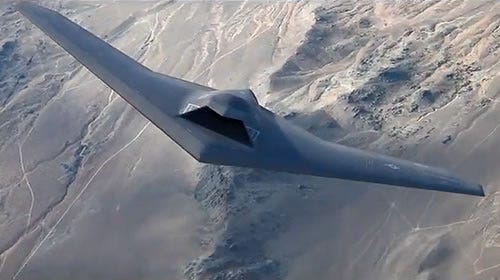
UCLASS Drone Concept Design (Lockheed Martin)

The future of war is unpredictable, but one thing is certain-there will be friction and fog. As Barry Watts highlights,“Clausewitzian friction is a basic structural feature of combat interactions between opposing polities.”[1] Human decision-making will cause most of this friction in future wars. Military theorists from Sun Tzu to John Boyd have extolled the virtues of making quick accurate decisions and using misdirection and surprise to interrupt an enemy’s ability to do the same. Making complex decisions is difficult under perfect conditions, because an unpredictable enemy always has a vote. “As Moltke remarked to his aides, the enemy always seemed to have three alternatives open to him and he usually chose the fourth.”[2]

Is the U.S. military currently training its future leaders to make decisions in a constrained information environment or is an over-reliance on technology disrupting this critical leadership ability?

Measure the Shade Part II: Challenge Accepted


James Auvil is a career officer who writes health policy for the U.S. Army and provides health care fraud expertise to federal entities. This article contains the views of the author and does not necessarily reflect the views of the Department of the Army, the Department of Defense or the United States Government. 

In Part I: A Prescription for Toxicosis, I defined the Boxer as a hybrid of the Boomer/Xer generation, cursed with unlimited drive and an absence of trust. Unlike the Boomers who saved the Army after Vietnam and prepared it to fight and win through Desert Shield/Desert Storm, Boxers nefariously used technology and policy to centralize power, punitively track effort and shift personal responsibility onto the organization. Boxers created timid permission-seeking leaders who became exceptionally good at telling them what they wanted to hear. This post presents a justification for change in case a total lack of trust across the enterprise isn't reason enough. It then describes the significant administrative challenge ahead and ends by explaining how my generation has the opportunity and skill set to restore trust.

“The people when rightly and fully trusted will return the trust.” — Abraham Lincoln

It’s always best to start with why. We need to restore trust so leaders feel comfortable reporting information honestly. Leaders need to know the bosscan handle the truth; if they report “bad news” the boss will primarily focus on fixing the problem and not blame. We are also strongly interested in winning on poorly defined, politically-charged and rapidly changing battlefields and that requires trust.

The Army Operating Concept (TRADOC Pam 525–3–1) states: “What all Army operations will have in common is a need for innovative and adaptive leaders and cohesive teams that thrive in conditions of complexity and uncertainty.” It says nothing about compliance-driven permission seekers wrapped in reflective belts. We won’t generate innovative and adaptive leaders by defining every aspect of their Army experience, boxing them into an increasingly delineated space. We need to make policy deliberately general and less specific so leaders have room to innovate and exercise judgement. The 10,000 foot screwdriver must become the tool of last resort. I’m talking to you, COL Mandatory Training.

NATO’s Article 5 and Russian Hybrid Warfare

BY EDGAR BUCKLEY AND IOAN PASCU
MARCH 17, 2015

NATO leaders at Cardiff Castle, Sept. 4, 2015 (photo: Tom Robinson/UK Foreign Ministry)

We warned last year (The Way to Avoid Wars: Article 5 and Strategic Reassurance Revisited) that any move by Russian forces into Eastern Ukraine would be highly destabilizing and have unpredictable results – probably including NATO countries providing logistical and intelligence support to Ukraine's military, possibly going beyond that.

That is what has happened and that is where we are today, with the risk of direct confrontation between NATO and Russian forces greater now than at any time since the end of the Cold War. The situation is exacerbated by the growing appreciation that Russia has engaged in hybrid warfare against Ukraine and that such tactics could also be used against NATO countries. How should NATO respond?

A fundamental shift in strategy is required, recognizing that Russia is no longer a country we can rely on not to attack NATO members. Russia has become a potential threat to our territorial integrity which must once again be deterred.

There is no obligation for NATO to intervene in the conflict in Ukraine because Ukraine is not a member of the Alliance. Nevertheless, there are important issues at stake for NATO.

The first is respect for international law, which underpins international security. Whatever we may think of President Putin's declaration that Russia will use all available means, including intervention under international humanitarian law, to defend the rights of Russian-speakers living abroad, we must reject and excoriate any interpretation of such policy to justify sending forces in disguise to support rebellions abroad and annex territory. If Russia believes it has the right to intervene in Ukraine under international humanitarian law, it should explain its case publicly - including the urgent humanitarian catastrophe it seeks to avert and why there is no alternative to its action - and be transparent about its actions. It should not act by stealth and revert to the "big lie", denying that its forces are engaged, denying that its missile units shot down Malaysian airliner MH17, pretending to be the peacemaker when the reality is the opposite.

19 March 2015

Sat Sri Akal Britain

http://www.asianage.com/columnists/sat-sri-akal-britain-326
Mar 18, 2015


The proposal of creating a Sikh Regiment in the British Army is partly due to the manpower shortage. Also, Britain wants to use the new regiment to tap into the political potential of British Sikh voters.

Reports in the British media indicate that a minister in the British government, “speaking on the sidelines”, touched upon a proposal under consideration in the British Army to raise a Sikh Regiment. The Indian Army is, of course, proud of having a Sikh Regiment (of 19 battalions), with a history going all the way back to the 19th century. The regiment has a proud record of valour, both pre- and post-Independence (including two winners of the Param Vir Chakra, India’s highest gallantry award). It can be reasonably assumed that proposed British Sikh Regiment would be basically of the same stock, raised from the manpower pool of the Sikh community domiciled in Britain, sometimes referred to as “British Sikhs”, all presumably British citizens and permanent residents of that country.

It can be further speculated that the new regiment might initially be a single active duty infantry battalion, after which the regiment would be progressed and expanded according to British government policy and availability of suitable manpower and finances. Not unnaturally, the news of a Sikh Regiment in the British Army has aroused interest and curiosity in India, because the Sikh faith is essentially of Indian origin, and India is historically the original habitat of the Sikhs.

A large number of Sikhs migrated mainly to Western countries like England, the United States, Canada, Australia, and other Commonwealth countries while many Sikhs living abroad have close family connections back home in India. This has created its own distinct social culture where the community abroad maintains home links with Punjab and its politics in India, and even replicates them in Britain in their own environment.

The distinctive trademark turbans and unshorn tresses and beards are no longer novelties abroad, but their presence in the armed forces of their adopted countries has not been in proportions to their numbers.