19 October 2016

*** MANHUNTING IN THE HINDU KUSH , THE DRONE PAPERS

October 15 2015

From 2011 to 2013, the most elite forces in the U.S. military, supported by the CIA and other elements of the intelligence community, set out to destroy the Taliban and al Qaeda forces that remained hidden among the soaring peaks and plunging valleys of the Hindu Kush, along Afghanistan’s northeastern border with Pakistan. Dubbed Operation Haymaker, the campaign has been described as a potential model for the future of American warfare: special operations units, partnered with embedded intelligence elements running a network of informants, pinpointing members of violent organizations, then drawing up plans to eliminate those targets from the battlefield, either by capturing or killing them.

INTELLIGENCE COMMUNITY DOCUMENTSobtained by The Intercept, detailing the purpose and achievements of the Haymaker campaign, indicate that the American forces involved in the operations had, at least on paper, all of the components they needed to succeed. After more than a decade of war in Afghanistan, a robust network of intelligence sources — including informants on the ground — had been established in parts of the historically rebellious, geographically imposing provinces of Kunar and Nuristan. The operators leading the campaign included some of the most highly trained military units at the Obama administration’s disposal, and they were supported by the world’s most powerful electronic surveillance agencies, equipped with technology that allowed for unmatched tracking of wanted individuals.

Despite all these advantages, the military’s own analysis demonstrates that the Haymaker campaign was in many respects a failure. The vast majority of those killed in airstrikes were not the direct targets. Nor did the campaign succeed in significantly degrading al Qaeda’s operations in the region. When contacted by The Intercept with a series of questions regarding the Haymaker missions, the United States Special Operations Command in Afghanistan declined to comment on the grounds that the campaign — though now finished — remains classified.

IMF warns Pakistan of looming China-Pak Economic Corridor bill

October 17, 2016 

The IMF has warned Pakistan that China's growing investments in the country, including the $46 billion economic corridor, have the potential to lift the cash-strapped economy's potential output, but the repayment obligations that come with it will be serious.

The report estimates that CPEC related imports could reach 11 per cent of total projected imports by 2020, equal to just over .7 billion, while inflows under the corridor will touch 2.2 per cent of projected GDP in that year. (Reuters)

The IMF has warned Pakistan that China’s growing investments in the country, including the $46 billion economic corridor, have the potential to lift the cash-strapped economy’s potential output, but the repayment obligations that come with it will be serious.

“During the investment phase, as the ‘early harvest’ projects proceed, Pakistan will experience a surge in FDI and other external funding inflows,” says the IMF in a short evaluation of the impact of China-Pakistan Economic Corridor (CPEC) related investments on Pakistan.

However, the import requirements of these projects “will likely offset a significant share of these inflows, such that the current account deficit would widen” within manageable levels during these years, the international lender was quoted as saying by the Dawn newspaper.

Why Pakistan Army Is Central To Governance Of Pakistan And Why It Will Continue To Be


October 14, 2016

In the first decade after independence in 1947 India had seven army chiefs. During the same period, Pakistan had seven prime ministers. While India ran down its defence forces, the Pakistani political leadership messed up their new country. The first prime minister of Pakistan, Liaquat Ali Khan, a Mohajir from India, was assassinated. The next six PMs included Huseyn Suhrawardy, a mass murderer, and Mohammad Ali Bogra, an American appointee. Pakistan remained a political wasteland as its elites could not even draw up a Constitution. The Economist noted that the country’s politics during that first decade ranged between "the grotesque and the macabre".

It was in the backdrop of communal riots, urban decay and food shortages that the Pakistan Army staged its first coup, in 1958. Just as Indians saw trains running on time and government employees punctually reporting for work during the Emergency of 1975-77, the Pakistani public too witnessed dramatic improvement in their everyday life under military rule.

For instance, shortly after the coup, General Ayub Khan casually remarked that the maximum penalty for concealing food stocks was death. Within hours, former Prime Minister Malik Firoz Khan Noon admitted he was holding 3000 tons of wheat in his private warehouse. Two other ex-ministers hurriedly declared they had wheat hoards of 6250 tons and 1500 tons each.

Major-General Iskander Mirza, in his presidential proclamation of martial law, pointed an outraged finger at the “ruthless struggle for power, corruption, the shameful exploitation of our simple, honest, patriotic and industrious masses, the lack of decorum and the prostitution of Islam for political ends”.

Ayub Khan summed up the military’s contempt for those he had deposed: “The biggest weapon of a politician is his tongue, which we've controlled. I think things are going to be quiet for a while.”

The public lapped it up. Most Pakistanis were fond of saying, “Pakistan mein toh mashallah ho gaya,” playing on ‘martial law’. It translated as: “In Pakistan things are great by the grace of Allah.”
Military messes up

Modi, Xi & the future

Oct 15, 2016

The world can’t depend on Western demand and consumption, financed by printing more money. China must team up with India, Brazil and Indonesia to restructure the IMF and World Bank. 

There is a misplaced notion prevalent in India that China’s slowdown means an opportunity for India. Even chief economic adviser Arvind Subramanian, though somewhat circumspect, says: “Cheap oil will help our macro-economic indicators. The Chinese slowdown and massive excess capacity in sectors like steel will put pressure. But the cost of building infrastructure has come down due to a fall in commodity prices. This will boost infrastructure development. India will remain an attractive destination.” To expect foreign capital to build India’s infrastructure is naรฏve. Foreign funds invariably come with a short-term perspective, and experience shows investment in India’s infrastructure is neither easy nor does it offer attractive returns.

The two economies are now in two entirely different stages of development. China’s GDP is three and a half times bigger than India’s. Its GDP is in excess of $7 trillion while India has just scaled $2 trillion. How China moves and acts in future will affect developed economies enormously as it has been the major provider of growth in the past two decades, and India’s growth had little bearing or derived little benefit from it. They exist in different orbits of the world economy. A slowed-down China now growing at seven per cent still adds $490 billion to global growth, while a speeded-up India now growing at seven per cent adds a mere $140 billion. For India to pick up the Chinese slack, it has to post a more frenetic 9-10 per cent growth in the next decade or more. There isn’t even a glimmer of that now.

While the Chinese economy doesn’t compete directly with India’s, the effect the former imposes on the global economy is likely to influence the Indian economy. In this regard, whether a slowing Chinese economy will really create more opportunities for India needs rethinking. If the global economy slows down further as part of the results of Chinese economic restructuring, it is difficult to see how a sluggish world economy will help India’s economy.

China Launches Longest Manned Space Mission In Effort to Build a Space Station

Simon Denyer
October 17, 2016

China launches longest manned space mission, aims to explore ‘more deeply and more broadly’
BEIJING — China’s march into space took another step forward Monday, as two astronauts embarked on the nation’s longest manned mission.

The pair aim to dock with an orbiting space lab and remain aboard for 30 days, a crucial step in China’s plans to operate its own space station by 2022, and part of a much broader space program that has ambitions to put astronauts back on the moon and land an unmanned rover on Mars.

State-run China Central Television (CCTV) showed the Shenzou-II spacecrafttaking off from a launch center on the edge of the Gobi Desert in northern China at 7:30 a.m., carried by a Long March-2F rocket.

The pair were seen on board saluting seconds before takeoff. They will dock with the Tiangong-2 lab in two days, and conduct a series of scientific experiments, testing computers as well as propulsion and life-support systems, CCTV reported.

After the launch was declared a success, Defense Minister Fan Changlong read a congratulatory message from President Xi Jinping calling for China’s astronauts to explore space “more deeply and more broadly.”

China’s Shenzhou-11 spaceship on board a Long March-2F carrier rocket takes off from the Jiuquan Satellite Launch Center in northwest China’s Gansu province on Oct. 17. (Chinatopix via Associated Press)

The president also encouraged them to “constantly break new ground for the manned space program, so that Chinese people will take bigger steps and march further in [their] space probe, to make new contributions to the building of China into a space power.”

Forecast for the Offensive to Retake Mosul

By Emily Anagnostos, Patrick Martin, and ISW Iraq Team
October 17, 2016

Iraq Launches the Campaign for Mosul

Iraqi and regional actors are preparing to assist with or spoil the Iraqi Security Forces’ (ISF) operation to retake Mosul and its environs from ISIS. Prime Minister Haidar al-Abadi announced the start of operations to retake the city on October 17. The ISF began shelling ISIS-held villages south of Mosul, Iraqi Army armored units and Federal Police advanced towards Mosul near Gwer, southeast of Mosul, and Peshmerga units began advancing towards Mosul from Khazar, east of Mosul. The ISF’s operation against ISIS will require security forces to isolate Mosul before it can begin a block-by-block clearing operation in the city itself. The ISF recaptured Shirqat, the last major ISIS-held city on the Mosul-Baghdad highway, on September 22, thereby setting the operational conditions to launch operations for Mosul. The ISF will need to continue its line of effort up the highway while also encircling the city from the north and northeast. ISIS will seek to conduct attrition warfare against the ISF before it arrives in Mosul, leveraging its remaining lines of communication in Anbar, Ninewa, and Syria to shift people and supplies. ISIS will also use the sparsely populated areas on both the eastern and western sides of the Tigris River to launch attacks against recaptured areas and the ISF. 

The ISF does not have the force size to take both the city and its environs on its own. Consequently, although the ISF will lead the operations into the city proper, they will need to cooperate with the Kurdish Peshmerga, who hold the majority of terrain surrounding the city. However, the Peshmerga participating in anti-ISIS operations will likely exploit the opportunity to take control of areas by displacing Sunni Arabs from their homes, as they did following operations in Sinjar in November 2015. 

The Iraqi Offensive to Recapture Mosul Has Begun

Loveday Morris and Mustafa Salim
May 16, 2016

Iraqi forces begin assault to retake Mosul from Islamic State

KHAZIR, IRAQ — Iraq announced the beginning of its offensive for the northern city of Mosul on Monday, embarking on the country’s biggest fight against Islamic State militants so far.

In an early-morning televised address, Prime Minister Haider al-Abadi pledged to raise the Iraqi flag over the city once more, calling on residents to cooperate with the advancing forces.

The operation aims to push the militant group out of its de facto capital in Iraq, the most populous city it controls. More than 1 million civilians are thought to be trapped in the city.

Tens of thousands of Iraqi troops from an array of the country’s forces have been drawn together to achieve that feat: Kurdish peshmerga soldiers, Sunni tribal fighters, army troops, police officers, Shiite militias and elite counterterrorism units. From the sky and on the ground comes close support from the U.S.-led coalition.

Despite sometimes competing agendas, they have united — at least for now — to take back the Islamic State’s most prized remaining territory in the country.


Mosul, about 250 miles north of Baghdad, is the Islamic State’s last major stronghold in Iraq, and the city has come to symbolize the group’s rise here. It was in Mosul’s Great Mosque that Islamic State leader Abu Bakr al-Baghdadi announced his self-proclaimed caliphate more than two years ago.

Enabling Unconventional Warfare to Address Grey Zone Conflicts

September 28, 2016 

The United States currently finds itself in several grey zone conflicts - political, economic, informational, or military conflicts where normal diplomacy has proven insufficient, but the conflict occurs short of a conventional war. In these situations, Unconventional Warfare (UW) has rarely been a first - or second or third - choice among options to influence a foreign power and achieve U.S. foreign policy and national security goals. However, UW provides the U.S. with the capability to deal with a foreign adversary without having to own the foreign terrain and the associated entanglements after the conflict is over.

UW is conducted by the Department of Defense primarily with Special Operations Forces (SOF) to enable a resistance movement or insurgency to coerce, disrupt, or overthrow a government or occupying power. UW looks a lot like covert action in the eyes of our legislators, but without the oversight processes that provide a balance between executive independence and congressional oversight. Without clear roles for the executive and legislative branches, there is inherent unease within both branches to use UW to achieve U.S. foreign policy goals. At best, the executive branch views UW as an ill-defined military mission encumbered by significant legislative concerns. At worst, legislators see UW as the next embarrassing military flap waiting to happen because of a lack of oversight. Even when the Defense Department is able to overcome these concerns, there is no clear and timely legislative path for gaining authorization and funding for UW missions.

Introduction

In this paper, we explore how the similarities between covert action and UW activities have led to a negative perception of UW and lengthy delays in its use. We then offer three actions to overcome these perceptions and enable the use of UW as a timely foreign policy option: creating a statutory definition of UW; proactively establishing congressional oversight and reporting mechanisms; and creating a specific legislative mechanism for acquiring authorization and appropriations.

The Root of Congressional Unease with UW

THE PERPLEXING PROBLEMS OF SOLVING SYRIA

OCTOBER 17, 2016

The calls for Washington to do more are getting louder, but no feasible plan is in sight.

What is there to say about Syria? That it is a tragedy? That only the horrors of the Holocaust, Pol Pot’s reign of terror, and Mao Zedong’s Cultural Revolution diminish its human toll? That the so-called international community strenuously condemns the murder of hundreds of thousands and the displacement of half of Syria’s population? These are, as so many have pointed out, merely words to salve the collective conscience of officials who have chosen to do the absolute minimum while a major Middle Eastern country burns. This tragedy was coming. 

It was obvious once Syrian President Bashar al-Assad militarized the uprising that began in the southern town of Deraa in March 2011. Policymakers in Washington and other capitals assured themselves — against all evidence — that it was only a matter of time before Assad fell. But anyone who knew anything about Syria understood that the Syrian leader would not succumb the way Tunisia’s Zine al-Abidine Ben Ali or Egypt’s Hosni Mubarak did. No, Assad’s ignominy is different, borne of the unfathomable amount of blood he has spilled. There was a time when this violence could have been minimized and American interests served through an intervention, but policymakers acquiesced to the arguments of those who said it was only a matter of time or, when Assad did not fall quickly, that it was too hard. Until it actually was. Now, the desperate images emerging from Aleppo have made it impossible to look away. It remains a matter of debate precisely what the Syrian air force and its Russian partners seek in Aleppo, thought it seems that they are seeking to wrest control of the eastern half of the city by flattening it from the air.

Top Oil Companies Looking At Smarter Ways To Tackle Crude Price Crisis

17 Oct, 2016

Top oil and gas companies are exploring the possibility of employing smarter technologies to cut costs and overcome the challenges that surfaced following deep slide in crude prices.

Total, Chevron, Shell and Statoil are experimenting with various technologies from data management, drones and drill design, to slash costs in a bid to safeguard the infrastructure that will allow them to compete and grow when the crude prices recover.

Total, French oil and gas major, is now using drones to conduct detailed inspections on some of its oil fields, while Norwegian company, Statoil, which has cut its development costs, savings have largely been made by focusing on the most efficient technology and designs.

Anglo-Dutch major Shell, on the other hand, has developed a new type of pipe to carry oil and gas from its deepwater Stones field in the Gulf of Mexico for processing. The company said innovations at Stones had played a significant part in cost savings.

Chevron is using a robotic device to clean and check the inside of pipelines on their Erskine field which has helped raise the field's daily production rate to the highest in two years. Canaccord Genuity oil and gas equity analyst Alex Brooks said technology innovation in the industry was about "100 tiny things", adding: "The bottom line is you end up with a much lower cost."

Europe Is under Threat Read more at: http://www.nationalreview.com/article/441123/europe-civilizational-confidence-crisis


(Dreamstime image: Borislav Bajkic) SHARE ARTICLE ON FACEBOOKSHARE TWEET ARTICLETWEET PLUS ONE ARTICLE ON GOOGLE PLUS+1 PRINT ARTICLE ADJUST FONT SIZEAA by GEORGE WEIGEL October 17, 2016 4:00 AM Unlock Free Digital Access Both externally and internally At a dinner party in Warsaw earlier this month, I listened to a dozen highly intelligent Poles with significant experience of public life discuss the current woes of the European Union. Like so many of their countrymen, these men and women had invested considerable hopes in the EU. 

Indeed, a decade ago, Poland’s accession to the European club, like its membership in NATO, seemed to fulfill the bright promise of the Revolution of 1989, for these new configurations of European politics signaled the end of Poland’s exile from its natural home in the West, which had begun with the German and Soviet invasions of 1939. Yet it was clear to my dinner companions that something was wrong with the EU; Brexit and what it might portend was on everyone’s mind; and so the Poles spent 90 minutes belaboring the question of what was wrong with the way the European project was working these days. Then our host turned to me and asked whether I had any thoughts. 

I said I hoped no one would take offense if I said that I felt as if I’d been kibitzing a conversation in Geneva in 1936, in which experienced and sophisticated people spent an evening discussing how to make the machinery of the League of Nations work better. I understood their concerns about the sometimes creaky, sometimes overbearing machinery of European governance. But, I suggested, Europe’s deeper problems really hadn’t been broached that evening. The following morning, at the inaugural conference of the new Foundation for Service to the Republic, held in the library of Warsaw University and attended by senior Polish political, cultural, and business figures, I had the opportunity to identify, in a brief presentation, what seemed to me the real threats to Europe in these first decades of the 21st century, beginning with the external environment and then moving “inwards.” THE EXTERNAL THREATS One. 

AMERICA IN THE AGE OF UNCERTAINTY

By: Dina Smeltz, Senior Fellow, Public Opinion and Foreign Policy; Ivo H. Daalder, President, Chicago Council on Global Affairs; Karl Friedhoff, Fellow, Public Opinion and Foreign Policy; Craig Kafura, Research Associate 
OCTOBER 6, 2016 

Executive Summary

Over the past year, Donald Trump has been able to channel the anxieties of a significant segment of the American public into a powerful political force, taking him to the doorstep of the White House. These public anxieties stem from growing concerns about the effects of globalization on the American economy and about the changing demographics of the United States.

Although Trump has been able to mobilize many of those who are most concerned about these developments, their motivating concerns are not new. They existed before Donald Trump entered the race, and they are likely to persist even if he loses the election in November 2016. Yet, uniquely among the candidates running for president this cycle, Trump has given voice to this group of Americans, notably through his tough stances on immigration and trade.

At the same time, while this segment of the American public has given Donald Trump traction in the presidential race, his views on important issues garner only minority support from the overall American public. While they are divided on expanding a wall on the US border with Mexico, Americans overall support continued immigration into the United States and favor reform to address the large population of unauthorized immigrants already in the country. Americans overall think globalization is mostly good for the United States, and they see many benefits to free trade. And the American public as a whole—including the core supporters of Donald Trump—still favors the country’s traditional alliances, a shared leadership role for the United States abroad, and the preservation of US military superiority.
Trump’s Core Support Is Based on Immigration and Trade

Trump’s rhetoric on immigrants and refugees has most clearly struck a chord with his base. On each and every question concerning immigration, Trump’s core supporters are the least favorable. An overwhelming majority of core Trump supporters agree that immigration is a critical threat to the United States— almost double the percentage among the general public (43%, see Figure A). Six in ten Trump supporters believe that illegal immigrants in the United States should be forced to leave their jobs and the United States (63%). And nine in ten Trump supporters support expanding the wall on the border with Mexico (92%). The public overall is divided on expanding the wall, and 58 percent support a pathway to citizenship for illegal immigrants.

Russia went to Syria to fight terrorists. We are succeeding


October 17, 2016

Russia’s UK ambassador offers his country’s justification for bombing Aleppo in the face of outrage from the west 

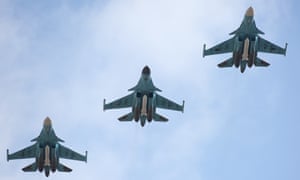
‘A year after Russia sent in its air force, reacting to a request from the legitimate government of Syria, Isis is in retreat.’ Russian planes return from a mission in Syria earlier this year. Photograph: TASS / Barcroft Media

The novel way of diplomacy proposed by foreign secretary Boris Johnsonhas so far materialised in a lone gentleman with a poster outside our embassy – not something I would describe as a big diplomatic victory. But the very fact of having to resort to (non-existent) campaigners to make a point is, in my opinion, a sign of the state of Britain’s Syria policy. Some would say thatRussia’s record on Syria has also been controversial – and here’s where I would strongly disagree.

We entered the conflict on 30 September 2015. The western coalition had already been active there for years, dropping bombs and missiles, and supporting the highly-praised “moderate opposition” against the radicals – as they say. And still, Syria was on the edge of collapse. Isis, a byproduct of ham-fisted western social engineering in Iraq, gained new ground, pushing back the Syrian army as well as rival anti-government forces.

They brought the conflict to a new degree of barbarity and cruelty unseen since the days of Nazi Germany. Massacres, public tortures and executions, and a slave trade on an industrial scale were a daily reality in the areas held by Isis – not to mention the destruction of many historic sites and artifacts. And they seemed to be moving in for the kill: preparing to take Damascus and rule the country by right of conquest. The establishment of a terrorist state in Syria would pose a grave threat to Russia and Europe.

Russia Building Sophisticated Air Defense System in Syria

By: Chris Harmer and Kathleen Weinberger
October 17, 2016

Over the last year, Russia has built up an expeditionary Integrated Air Defense System (IADS) in Syria. Russia intends to use this IADS to push the potential cost of continued US coalition involvement in Syria past the threshold of acceptable risk. On 03 OCT the Russian military deployed the S-300 (NATO reporting name: SA-23) air defense system to the Syrian naval base in Tartus. Russian forces already operate the S-400 (NATO reporting name SA-21 Growler) long-range air defense system, which has a claimed range of 400km, as well as the S-200 (SA-5 Gammon), in Syria. Russia also operates a number of short-range air defense systems, including the Pantsir-S1 and Buk missile systems, as well as the naval version of the S-300 a Slava-class guided missile cruiser in the Mediterranean. In addition to the IADS, Syrian forces operate the Bastion coastal defense system out of Tartus.

Now that the Russian IADS in Syria is deployed and presumably fully functional, it changes the regional security situation in two ways. First, it confirms that the ongoing Russian deployment of disparate missile systems to Syria over the past year always intended to culminate in a fully functional IADS, rather than individual missile systems in different locations. SAM systems in the S-300 family (including the S-400) are designed to be both forwards and backwards compatible, which means that their component parts - command and control modules, search and fire control radars, missile launchers and missiles - may be used in different combinations.

Euro is a 'house of cards' ready to collapse, key single currency architect warns


Professor Otmar Issing says the European Central Bank betrayed the principles of the currency project by bailing Greece out in 2008 

Professor Issing says Greece should have been allowed to crash out of the Euro and readopt the drachma AFP/Getty Images

The Euro currency project is unworkable in its current form and at the risk of “collapse”, its principal architect has warned.

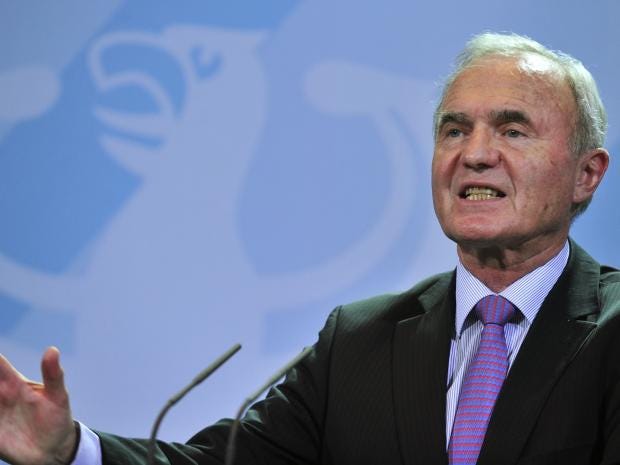
Professor Otmar Issing, the European Central Bank’s first chief economist who helped create the single currency at the turn of the century, has warned that the Euro cannot survive in its current form.

He said the ECB had become dangerously overextended as it tries to manage the 19 economies using the single currency.

Speaking to trade journal, Central Banking, he said: “One day, the house of cards will collapse”.

He said the experiment with a single currency went from the moment it was introduced in 2002 and said it had been betrayed by the politics of the region. 

“Realistically, it will be a case of muddling through, struggling from one crisis to the next. It is difficult to forecast how long this will continue for, but it cannot go on endlessly", he explained.

Japan's defense contractors get to grips with foreign military buyers

By Tim Kelly
OCT. 16, 2016

Until recently, public meetings between Japanese defense contractors and uniformed foreign military delegations would have stirred controversy in Japan, but last week’s aerospace show in Tokyo saw plenty.

With the nation stepping back from decades of state pacifism amid concern over China’s growing power and a deepening North Korean threat, Japanese defense companies are finally shedding their reluctance to sell arms abroad.

At the ShinMaywa Industries booth, Indonesian air force officials quizzed the company about its amphibious plane. In another corner of the Japan Aerospace 2016 show, Saudi Arabian military officers pored over military transport and patrol aircraft brochures handed out by Kawasaki Heavy Industries.

“The Indonesians are very interested in our plane,” said a ShinMaywa salesmen, as one of his colleague went through US-2’s specifications with the six-man Indonesian delegation. He asked not to be identified because he is not authorized to speak to the media.

The US-2 is one of the home-built military platforms that the Japanese government has identified as a candidate for foreign sales after Prime Minister Shinzo Abe in April 2014 lifted a ban on overseas arms sales.

The exhibition in Tokyo, which was last held four years ago in Nagoya, is the first major aerospace show since Abe came to power. The show drew some 800 companies as well as representatives from numerous of international militaries.

Russia Says It’s Joining China to Counter U.S. Missile Defense

October 11, 2016 

Russia said it’s working with China to counter U.S. plans to expand its missile-defense network, which the two nations see as targeting their military assets.

The upgrades aim to give Washington the ability to launch a nuclear strike “with impunity,” Lieutenant General Viktor Poznikhir of the Russian Armed Forces General Staff said Tuesday at a security forum in Xiangshan, China, according to a transcript of his speech posted on the Defense Ministry’s website. The Asian neighbors this year conducted a joint missile-defense exercise of their computer command staff, he said.

“We are working together on ways to minimize possible damage to the security of our countries," Poznikhir said. “The illusion of invulnerability and impunity under the guise of missile defense will encourage Washington to make unilateral steps in dealing with global and regional issues. This could lead to a decrease in the threshold for using nuclear weapons to preempt enemy actions.

Russia’s concern about U.S. nuclear capabilities highlights a deepening rift between the Cold War foes as they trade accusations over the war in Syria. While NATO members have stressed that the alliance’s global missile shield will be a defense solely against potential attacks from so-called “rogue states,” particularly Iran and North Korea, Russia and China have been voicing concerns over their own security.

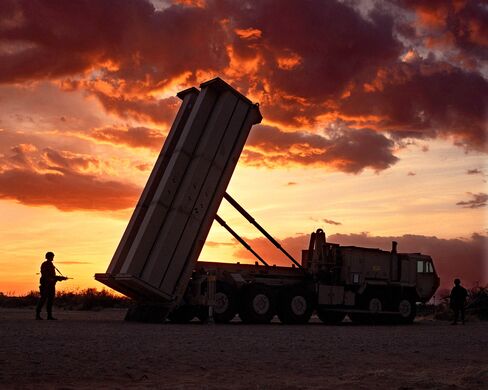
In May, Russian President Vladimir Putin said that placing parts of the system in Romania and Poland -- once Soviet satellites -- is threatening peace in Europe and warned that it may trigger a new arms race. China described the U.S. Terminal High Altitude Area Defense system as an "out-and-out strategic" move that threatens its national security, warning about taking “necessary measures to safeguard” its interests. The plan has already souredChinese ties with South Korea.

Syria Provokes an American Anxiety: Is U.S. Power Really So Special?

By Max Fisher and Amanda Taub
October 9, 2016 

What to do about Syria?

It is an urgent problem that has consumed foreign policy discussions for the last few years. But much more is involved than the fate of a single country in the Middle East. Underlying the Syria issue is a set of questions that have animated every major debate over foreign policy for a century: What is America’s role in the world, what are its obligations, and what happens if it falls short of meeting them?

One strain of thought holds that America has a mission to champion democracy and human rights, granting it a unique role in the world, along with special powers and obligations. But that idea has always been controversial, with skeptics arguing it is an alluring myth — and a potentially dangerous notion.

Joseph S. Nye Jr., a Harvard political scientist, said the Syrian war, like previous conflicts, had become a surrogate for this debate.

“That’s a recurring theme throughout our history,” Professor Nye said, “going back to the founding myths that the Americans are different.” …

Is U.S. Cyber Deterrence Strategy More Than (Russian) Roulette?

By Susan Hennessey 
October 12, 2016

Following the joint statement from DHS and ODNI accusing Russia of a recent spate of hacks aimed at influencing the US election, the obvious question is what exactly the US government plans to do about it. Over the weekend, the New York Times’ David Sanger and Nicole Perlroth offered a rundown of response options and Jack lamented that the Times report suggests that the US government still does not know how it should respond to Russian interference. He notes that, in the past, the US response to malicious cyber operations has been “dithering” at best.

Yesterday’s news that the White House plans to issue a “proportional” but possibly secret response does not actually indicate whether any decision has been reached regarding what sort of response we can expect and when. If anything, the statement indicates a continuation of the same policies. The Administration usednearly identical language when vowing to respond to North Korea’s attack on Sony (where the ultimate visible response was sanctions) and similar terms in pledging to retaliate against the Chinese for the OPM breach (where there was ultimately no visible US response, though China did arrest individuals it claimed were responsible).

It’s easy to be skeptical. Adversary nations continue to engage in significant malicious cyber activity against the United States. The only visible response from the US is a Name and Shame strategy of sanctions and indictments, which is applied sporadically and with mixed results. Name and Shame is purportedly augmented by “proportional” retaliatory cyber operations, but the secrecy and vagueness surrounding those prevent any meaningful assessment, raise questions as to whether adversaries even receive the intended message, and cannot deter outside groups who might be watching.

HOW HACKERS PLANT FALSE DIGITAL FLAGS TO HIDE/DISGUISE THEIR REAL IDENTITIES; AND, MAKE THEIR HACKS APPEAR TO HAVE COME FROM SOMEONE/SOMEWHERE ELSE

October 15, 2016 

How Hackers Plant False Digital Flags To Hide/Disguise Their Real identities; And, Make Their Hacks Appear To Have Come From Someone/Somewhere Else

With the U.S. Government reportedly leaning towards initiating some kind of cyber retaliatory action against Russia — for Moscow’s alleged hacking of the Democratic National Committee, and other U.S. political entities — an article on the publication Motherboard, is a reminder of the difficulty of cyber forensic attribution. Lorenz Franceschi-Biccherai has an article on the Motherboard website, dated October 12, 2016, about how digital cyber thieves, sleuths, privacy advocate and others, use false digital flags to disguise and/or, hide their true identities. He begins by noting that “during the first half of 2015, a mysterious hacking group allegedly started attacking military and government organizations in Peru, in what looked like a routine — even run-of-the-mill — espionage campaign.”

“The group used an old exploit and “clunky” malware, nothing particularly notable,” he wrote. “What was unusual,about this operation was that the malware was signed with a stolen digital certificate, that had already been used by the hackers responsible for disrupting an Iranian nuclear power plant with the Stuxnet cyber worm,” according to the Moscow-based Kaspersky Lab.

“All this made very little sense,” Lorenz Franceschi-Biccherai notes.

Predicting Terrorism From Big Data Challenges U.S. Intelligence

Chris Strohm 
October 13, 2016

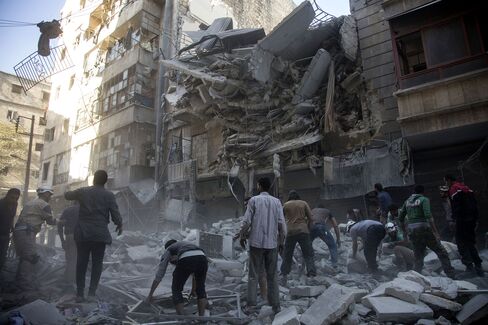
Rescuers gather at site of air strike in the rebel held neighborhood of Al-Shaar in Aleppo on Sept. 27, 2016. Photographer: Karam Al-Masri/AFP via Getty Images

Before Ahmad Khan Rahami planted bombs in New York and New Jersey, he bought bomb-making materials on eBay, linked to jihad-related videos from his public social-media account and was looked into by law enforcement agents, according to the Federal Bureau of Investigation.

If only the authorities had connected the dots.

That challenge -- mining billions of bits of information and crunching the data to find crucial clues -- is behind a push by U.S. intelligence and law enforcement agencies to harness “big data” to predict crimes, terrorist acts and social upheaval before they happen. The market for such “predictive analytics” technology is estimated to reach $9.2 billion by 2020, up from $3 billion in 2015, according to research firm MarketsandMarkets.

It’s the stuff of a science-fiction movie like “Minority Report,” in which Tom Cruise played a Washington cop who used technology to arrest people before they carried out crimes. It’s also a red flag for privacy advocates already fighting U.S. spy programs exposed by Edward Snowden and the FBI’s demands that Apple Inc. help it hack into encrypted mobile phones.

The idea is to make sense of the vast and disparate streams of data from sources including social media, GPS devices, video feeds from street cameras and license-plate readers, travel and credit-card records and the news media, as well as government and propriety systems.
‘Fundamental Fuel’

Marines adopt acquisition approach to work at cyber speed

October 13, 2016

Marines adopt acquisition approach to work at cyber speed

Marine Corps Systems Command (MCSC) has announced a new process for rapidly fielding cyber capabilities to its personnel.

A new cyber advisory team (CAT), which is made up of acquisition professionals and located at the command deck as a command asset for program office, seeks to facilitate and expedite acquisition and provide expertise on all things cyber, the team’s director, Mike Cirillo, told C4ISRNET.

In May at the annual Sea-Air-Space conference, the commander of Marine Forces Cyber Command, Brig. Gen. Loretta Reynolds, expressed concern that battling in cyberspace with outdated acquisition processes doesn't work. "The cyberthreat is an all day, everyday thing. We have got to have the ability to put tools on a network that get after the threats as they arrive.”

And now those tools have arrived. 

While there have been acquisional difficulties, Cirillo said CAT tailors the acquisition process to the fast-moving pace that is so common in the information technology field — something that was not done before. Senior acquisition officials gathered to analyze this pace, offering several recommendations to improve the Marines’ acquisition in cyberspace capabilities, he said.

The team developed two primary lines of effort under this program: an emergency acquisition process, which focuses on fielding capabilities in less than 30 days; and an urgency acquisition process, which is designed to field capabilities between 31 and 180 days. Anything that might take more than 180 days will be considered under the traditional acquisition process, Cirillo said, as it is clearly not an urgent need.

The team recently completed its first acquisition under this new process, MCSC said.

Has Wikileaks become a front for Putin’s cyber warfare?

15 October 2016 

This week has seen the US government officially accusing Russia of interfering in the presidential election, claiming that “only Russia’s senior-most officials” could have authorized an attack like the one against the Democratic National Convention, which came close to derailing the Clinton primary campaign, after revelations of illicit plotting by supposedly neutral Democratic officials against her competitor, Bernie Sanders. It seems that Russia keeps upping its cyber-warfare capabilities and ambitions, even as our institutions and societies are becoming more vulnerable. 

What is particularly interesting in this saga is that for once, Putin has wielded the truth rather than deploying his usual thick fog of misinformation and confusion. And he has done so through a channel that many Western liberals respect and root for: Wikileaks. 

This has prompted quite a strong response against Wikileaks and Julien Assange from the security-minded parts of the establishment who had hated the outlet for years, now branding Assange as a client of Moscow. But that is to rather overstate the case. Assange is an inflexible dogmatist and consummate self-publicist. He may have been keen to leak something like the DNC plot all over the media. Nor can we make the argument that it was the wrong thing to do - if we are going to pretend that we have genuine democracy, our institutions must be able to survive the fire of transparency. 

As it happened, Hilary Clinton’s Democratic campaign bounced back from the leaks, because, one the one hand, neither she nor her campaign had any involvement with the plot, and secondly because Bernie Sanders duly rallied behind her - she did get substantially more primary votes than him in the end, and Bernie Sanders does respect democracy - quite unlike other runners in the current presidential race. 
Political weapons

The Spy We Forgot

YUDHIJIT BHATTACHARJEE
October 13, 2016

Over the past six years, the United States intelligence community has taken two powerful punches from insiders — the first from Pfc. Bradley Manning of the Army (now Chelsea Manning) and the second from the National Security Agency contractor Edward J. Snowden, both of whom leaked thousands of classified documents. The news this month that another N.S.A. contract employee, Harold Martin III, removed a large volume of classified information from the agency shows that the government is still struggling to keep its secrets safe.

These security breaches may have caught the government by surprise, but intelligence officials have no excuse for being shocked. They were forewarned about the vulnerability of digital secrets a full 16 years ago by the actions of a little-known traitor named Brian Regan. A signals analyst at the National Reconnaissance Office — an agency responsible for managing the country’s spy satellites — Mr. Regan pulled off a heist of more than 20,000 documents containing top-secret satellite images and reports, which he tried to sell to Iraq and Libya.

Because Mr. Regan was caught before he could transfer secrets to an enemy, his case ended up as a mere footnote in the annals of American intelligence. To this day, his name remains unknown even to many in the intelligence community. But had the lessons of Mr. Regan’s case been heeded, the United States’s secret information would be far more secure.

Mr. Regan was a signals analyst in the Air Force who received praise for his work during the 1991 Persian Gulf war before being assigned to the satellite agency in 1995. In the late ’90s, faced with a mountain of credit card debt, he formed a plan to commit espionage. He had a top-secret security clearance and access to Intelink, a classified network of servers that functions as the intelligence community’s own internet.

Why Carthage Failed and Rome Succeeded.

OCT 16, 2016

'Hannibal Crossing the Alps,' engraving by Heinrich Leutemann (1866)

It is a symptom of the deplorable state of intellectual life today that readers of this magazine can guess the lineaments of the story told in Hannibal the instant they read early in its pages that classical Carthage, the city on whose behalf the great captain of the title fought against Rome, was "diverse" and "multicultural." 

To whatever degree bigoted contemporary observers regarded Carthage as brutal in its politics and religion, oppressive to its subjects, aggressive to its neighbors, and sly in its relations with foreign powers, a city boasting those two glittering qualities nearly divinized by our educators must have been, instead, kind and scrupulous in its dealings foreign and domestic, and victimized in its innocence by less politically correct nations. The countless newborn babies and small children the Carthaginians sacrificed to their gods—the remains of more than 20,000 have been found in Carthage alone— fade into no more than a single facet of the glorious cultural mosaic that was Carthage. And none of this needs to be proved, or even argued, by the author, who is also free to commit no few errors of fact: for a diverse and multicultural people are the good guys by definition, and a writer who sings their virtues is liberated from the dull grind of historical accuracy by the purity of her ideals. 

Ancient Carthage was, probably, roughly as diverse and multicultural as Saudi Arabia is today: A wealthy state with a small population, Carthage employed foreigners to do her nasty jobs and relied on foreign mercenaries rather than citizens to do her fighting. The mercenaries Carthage hired certainly felt no sense of belonging to the Carthaginian nation: When the Carthaginians, after their defeat by the Romans in the First Punic War (264-241 B.C.) proved unable to pay them, the mercenaries launched a war of unparalleled brutality—the so called Truceless War—against their former employers (240-238 B.C.). Ancient authors describe the Carthaginians as harsh overlords and, when offered Roman protection, nearly every polity in Spain and North Africa dominated by the Carthaginians cheerfully abandoned their former masters: Few seem to have participated willingly in the diverse and multicultural Carthaginian Elysium imagined by our author. 

The Way It Is

October 7, 2016

Killing is a natural extension of being a Grunt. It is both expected and necessary. Failure fails the unit, and that is bad. Everyone in the business knows that and honors the event. Organizational comfort is in knowing that everyone can and will kill.

Killing is easy at the instant moment. It is only later that it is hard. As Shakespeare said: “That’s the rub.”

Killing usually falls into three categories; at a distance, close, and without emotion. Of the three, the first is the most common; and the last most effective. In all cases, remorse may or not be an outcome. 

For those whom remorse never visits, we later identify as sociopaths. At the moment, they are heroes. For those that experience remorse, we call them Grunts and they live with it always. In truth, it takes a bit of both to survive on the battlefield. Surviving the afterlife is another issue. Unfortunately, the afterlife is experienced as an individual, not as a team where both the impetus and motivation ruled response and was the basic foundation for survival and success.

Killing at a distance is easy. It is detached from the human aspects other than fear. It is a participation event with the score not recorded until later if at all. Simply being part of the unit engaged is sufficient honor for each member and engagement. The truth and result of each participant’s actions are not recorded other than the end state which is devoid of personal association. It’s just another day. Later, it may be all day, all the time.