28 January 2015

JFQ 76 | Should Military Officers Study Policy Analysis?

By Nikolas K. Gvosdev

Recently, during a symposium with security studies faculty members from civilian institutions, the question arose as to how those of us who teach in the country’s professional military institutions approach the study and use of policy analysis in our classrooms. There was a certain degree of incredulity that places such as the Naval War College (and its sister institutions) would encourage their students—people bound by oath to faithfully execute the orders of the commander in chief—to probe and analyze decisions taken by the current and past Presidents as part of their academic experience. Indeed, many question whether military officers need to engage in the dissection and discussion of national security decisionmaking since, echoing Alfred Tennyson’s famous exhortation in his classic poem “The Charge of the Light Brigade,” “Theirs not to reason why/Theirs but to do and die.” Others take the view that, for military officers, ignorance may be bliss, following the advice popularly ascribed to the German chancellor Otto von Bismarck: “The less the people know about how sausages and laws are made, the better they sleep in the night.”

Such a view helps to explain why, initially, the study of “politics”—the behind-the-scenes and often messy process by which national security decisions are made—was not deemed appropriate for officers. Soon after the formation of the Naval War College, however, that approach was reversed. In his lectures, Alfred Thayer Mahan noted that although the direction of national policy is properly set by the “statesmen,” political questions “are also among the data which the strategist, naval as well as land, has to consider”; Mahan explicitly renounced the notion, which he said “once was so traditional in the navy that it might be called professional,” that “politics are of no professional concern to military [officers].”1 Yet the concern remains that the captain or colonel who in the classroom is learning to use analytic perspectives to examine decisionmaking could upset an already precarious civil-military relationship by giving him or her additional tools “to frustrate or evade civilian authority when the opposition seems likely to preclude outcomes the military dislikes.”2 Policy analysis, after all, moves away from the more general study of the prevailing global and regional security trends (covered in the discipline of international relations) to concentrate on government decisionmaking.3 It is the proverbial “peek under the hood” at what underlies international affairs and is centered on understanding how policy is shaped and executed at the national level.4 Policy analysis focuses on probing the “whys” of governmental behavior—to open up and probe the “black box” of the decisionmaking process so that “one could . . . recognize the actual complexity underlying decisions (which includes individual biases and bureaucratic processes).”5

JFQ 76 | Next Steps for Transforming Education at National Defense University

By Christopher J. Lamb and Brittany Porro 
Source Link

National Defense University (NDU) is implementing major reforms in the graduate-level programs it provides senior military officers and other national security professionals. If all goes as planned, the result will be a transformation in the way the university educates senior national security leaders.1 This article does not review the status of current change initiatives. Instead, it looks beyond the changes under way for the 2014–2015 academic year and identifies future steps senior leaders might consider in order to maintain momentum for the transformation of joint professional military education.
Chairman walks with Major General Frederick M. Padilla, USMC, after change of command ceremony in which Major General Padilla became 15th president of National Defense University, November 2014 (NDU/Katherine Lewis)

New US Concept Melds Air, Sea and Land


By Paul McLeary
January 24, 2015 

WASHINGTON — The Pentagon's five-year-old Air-Sea Battle concept is undergoing a major rethink as it opens its focus to incorporate input from the land services and combatant commanders, senior Joint Staff and Navy planners told Defense News on Jan. 22.

The effort to expand the predominantly Navy and Air Force-heavy concept kicked off last fall when the Joint Chiefs made a recommendation to Chairman Gen. Martin Dempsey to open it wider to the other services.

Dubbed the Joint Concept for Access and Maneuver in the Global Commons (JAM-GC), the emerging plan "is not trying to replace Air-Sea Battle with Joint Access and Maneuver, and it's not 'throw the Air-Sea Battle concept out and start all over again,' " said Navy Capt. Terry Morris, deputy director for Air-Sea Battle in the Pentagon. "It is an understanding of the environment, and the advances we have made since 2009 when we first started with this."

As part of the change, JAM-GC will be supported by the Joint Staff's Joint Force Development Office, or J7, and is expected to produce a concept paper by this fall.

The original concept for Air-Sea Battle "was focused on a smaller set of the operational access problem" than previous concept and strategic documents had, said Ric Schulz, division chief of joint concept development at the J7 office.

John Boyd’s Roll Call: Do You Want to Be Someone or Do Something?


January 22, 2014 

According to his biographer, Robert Coram, John Boyd made “more contributions to fighter tactics, aircraft design, and the theory of air combat than any man in Air Force history.”

As a fighter pilot, he was undefeated and earned the nickname “40-Second Boyd” for his ability to win any dogfight in under a minute.

Unmatched in the cockpit, his mind was also without rival. He was not simply a warrior of combat, but a warrior-engineer and warrior-philosopher.

When he was 33, he wrote “Aerial Attack Study,” which codified the best dogfighting tactics for the first time, became the “bible of air combat,” and revolutionized the methods of every air force in the world.

His Energy-Maneuverability (E-M) Theory helped give birth to the legendary F-15, F-16, and A-10 aircraft.

A briefing he developed, “Patterns of Conflict,” changed combat strategy for both airmen and ground troops, introduced the oft-cited, and typically misunderstood OODA loop, and “made him the most influential military thinker since Sun Tzu wrote The Art of War 2,400 years ago.”

All in all, John Boyd served in the United States Air Force for twenty-four years and through three wars.

But he was never promoted above colonel.

Kirby’s Rules

Kirby’s Rules
13 Rules to Live By

1. Good to your family

Nobody succeeds at this business alone. We all need help. Take time to appreciate everything your family does to support you. They’ll never ask for your thanks, but they darn sure deserve it.

2. Skeptical

Don’t be afraid to question policies or programs. You have to be the sanity check. If it doesn’t make sense to you, you are going to have a hard time communicating it. Worse, it may be a bad policy.

3. Courteous

Treat everyone you encounter as if they were at your grandmother’s dinner table.

4. Professional

Nothing about your job is personal, certainly not your relationships with media. You are always a spokesman … always. Be able to separate personal from professional issues.

5. Able to take two steps back

It’s all about context. Find ways to put things into perspective. That’s what we do.

6. Right

We can’t afford to pass bad information … ever.

7. Responsive

Reply to emails promptly. Get the phone before it rings three times. Make sure people know how to get hold of you at all times. Don’t be afraid to give out your home number.

Owning Your Professional Military Development — Junior Officers


Doctrine Man recently penned the well-known military adage that “no one can manage your career better than yourself”. Deployments, top jobs and plum geographic postings won’t be handed to you on a silver platter. This adage has a similar application when discussing professional development — the most important person managing your professional development is you.

Junior officers often comment that they want someone to ‘professionally develop’ them. They wait. Career courses are perceived as a tick-in-the-box attendance rather than professional development for future command roles. Post-graduate formal schooling, often squeezed into a posting as a part-time endeavour, is also often viewed as a tick-in-box requirement for promotion consideration rather than for personal intellectual growth. When attempts are made at formal development, complaints ensue that the topic didn’t interest them. And still they wait.

I cringe when I hear professional development being put into a box as if it is something that can be delivered in a two-hour session on a Friday afternoon. The concept of professional development is holistic not stop-start training periods. Professional development is always. It includes the formal and the informal.

Formal professional development has recently been vibrantly discussed over at The Bridge during their military as a profession debate. I’m on the side of military officers being professionals but only when we actively and consciously pursue this path. You don’t get to call yourself a professional by virtue of rank alone. If you’re getting your Masters for a tick-in-the-box then that’s your decision not ‘the system’.

27 January 2015

Anti-Americanism is dead

Dhruva Jaishankar
January 27, 2015 

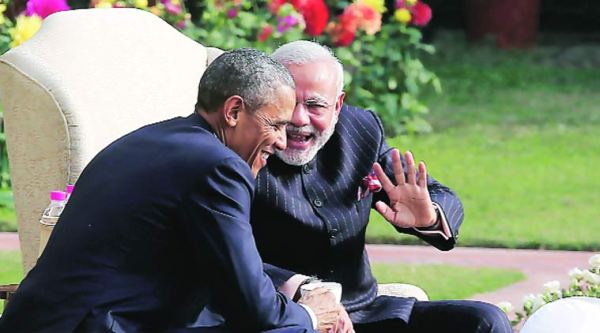
In the two days since US President Barack Obama has arrived in India, we have witnessed a multitude of memorable photo opportunities: Obama and Prime Minister Narendra Modi hugging, them having tea at Hyderabad House, and Obama’s appearance at the Republic Day parade. But what is this visit all about? What is it meant to achieve? There are three ways of evaluating Obama’s second — and most likely final — visit to India as president.

The most obvious is through a purely symbolic lens: the significance of having a US president as chief guest at India’s Republic Day. This alone ensures that it is no ordinary visit but an implicit acknowledgement and celebration by the US of India’s constitutional democracy, its diversity and role as a responsible military power. Additionally, between his two visits, Obama will have spent almost a week of his eight-year presidency in India, a not-insignificant amount of time, given his priorities at home and abroad with respect to West Asia, Afghanistan/ Pakistan, Russia and China.

Obama was also greeted warmly in the Indian capital this week, at a time when US relations with several other major countries — Russia and China, and even allies such as Germany, Japan, Turkey and Israel — are relatively poor or frosty. Despite the tyranny of routine crisis management, both sides have shown that they can take the time to invest further in a mutually beneficial partnership. By this measure, Obama’s very presence at Republic Day already makes this visit a success.

DEFENCE SECTOR TO EMBARK ON SUPERIOR GROWTH PATH, SAYS MAHINDRA & MAHINDRA

27 January 2015

Indian defence sector is set to embark on a significant growth path in the near future as the new initiatives announced by the government in promoting defence equipments manufacturing has begun to gain traction among global investors, a top M&M executive said. “I attended seminars organised on India specific issues at the WEF Annual Meeting.

“It is quite apparent that recent major initiatives by the government in promoting defence equipment manufacturing including by way of increasing FDI cap are beginning to gain traction and importance of the action is beginning to be understood by the global community,” Mahindra and Mahindra group’s defence business chief and overall group strategy head Shriprakash Shukla told the news agency in an interview. “The sector should be on a superior growth path in the near future,” he added.

Shukla said investors across the sectors made enquiries here about potential collaborations and there was an upbeat mood about India at the WEF Annual Meeting. “I’ve personally received several enquiries from potential collaborators in technology and business to invest with Mahindra in India. By investors across the spectrum for working with Mahindra group.

India hopes Modi has Midas touch

Mohan Guruswamy
Jan 27, 2015

Modi is playing the diplomatic game adroitly by building strong ties with the US, China and Japan. Just as the US can’t sacrifice its interests in Pak, India can’t sacrifice its interests just to placate any of its three main partners.

The Obama visit and the gains, real and imaginary, mark a sort of coming out for Narendra Modi. If comparisons have to be made I can’t think of anything better than Eliza Doolittle at the grand ball being led out to the dance floor by the visiting Prince of Transylvania. Unlike Eliza Doolittle, Narendra Modi had no Professor Henry Higgins to turn him from a humble chaiwala to a leader who calls the most powerful man in the world by his first name. He is a self-made and what he is, warts and all, is to his credit. Today he scored big for himself. As far as Indo-US relations go, Prime Minister Narendra Modi has done well for India. He has shown us a Modi touch that we now hope will turn into a Midas touch!

He has got the long-stalled Indian bid to generate 63,000 megawatt of power in 2032 from nuclear energy back on track. He has managed to create a climate favourable for foreign direct investment (FDI) which will create a bigger manufacturing base. Also, rather than mainly being an exporter of primary goods, it will make more exports of value added goods possible. Lest we get carried away by visions of huge flows of mother and apple pie American cash, most of the FDI which comes into countries like India and China are funds held by their own nationals. That more than 60 per cent of our FDI comes from Mauritius should make this obvious. India has to woo Indians as hard as it has to woo foreigners to invest in India.

Day after the summit

January 27, 2015 

The visit of an incumbent US president twice, and as chief guest on India’s Republic Day for the first time ever, is in and of itself significant. Anyone with even a nodding acquaintance of foreign and security policy will know that bilateral relations with the US constitute one of the more important, if not the most important, bilateral relationships for India. Only the uninitiated or those who habitually make assessments based on flawed assumptions and a profound misreading of where the world is headed would suggest otherwise. The visit was important not only for the elevation of Indo-US ties for their own sake but also for the efforts at seeking convergence in areas other than bilateral, those relating to stability and security in the Asia-Pacific and Indian Ocean regions, particularly as reflected in the US-India joint strategic vision document.

As the world’s two largest democracies, India and the US have worked over the last two decades to develop relations that have evolved steadily. There are nearly 40 dialogue mechanisms in place, demonstrating both the wide canvas and depth of the relationship. It is useful to set aside the hype that usually accompanies summit-level interactions of this kind and seek a clinical perspective. This necessarily requires ignoring commentators who are pathologically anti-US and those who salivate too easily at the prospect of doing business with the US.

The US is the world’s largest economy with a GDP of $18 trillion or more, twice the size of the Chinese economy and nearly 10 times the Indian economy, which has a GDP of less than $2 trillion. Less than a year ago, as a chief minister in election mode, Narendra Modi had to be persuaded to receive the then US ambassador under instructions from Washington to signal a change of attitude when it became clear that the chief minister, subject to a visa denial for over a decade, would be the next prime minister of India. Managing bilateral relations has not been easy. The relationship has been accident prone. Ever so often, it comes to be viewed as being transactional rather than the strategic partnership it is billed to be.

A visit and outcomes in superlatives

Rakesh Sood
January 27, 2015

The centrepiece of the Obama visit has been the ‘nuclear deal’, whose sticking points were a U.S requirement of keeping track of all U.S.-supplied nuclear equipment and materials at all times which India was reluctant to accept, and certain aspects of the liability law which suppliers found ambiguous. The U.S. now appears to have moderated its demand

Everybody was confident that U.S. President Barack Obama’s visit would be a good and successful one. There was enough in terms of symbolism to ensure that the following would have ensured a “good visit” — the first U.S. President to be the chief guest at the Republic Day; the first U.S. President to visit India twice during his tenure; the ceremony of the Republic Day parade notwithstanding the inclement weather; the excitement about the menu at the banquet the previous day; the buzz surrounding First Lady Michelle Obama’s outfits. The question was whether it would be a great visit, and a historic visit. Clearly, Prime Minister Narendra Modi wanted it that way and he has successfully put his imprint on India-U.S. relations.

The fact that he has done so in less than a year of his becoming Prime Minister provides us an insight into his thinking. His pragmatism was evident when he put the decade-long “visa ban” issue behind him and readily accepted Mr. Obama’s invitation to visit Washington in September last year. The U.S. too was signalling that the India-U.S. file had regained importance after the general election and that it was departing from the norm that bilateral visits did not normally take place when leaders were visiting New York for the U.N. General Assembly. It was evident that the two leaders connected. Mr. Modi was able to convince Mr. Obama about his vision for India and his belief that it needed a strong partnership with the U.S. which he could deliver on.

N-deal logjam cleared: Modi, Obama agree not to dilute liability law

Suhasini Haidar
January 26, 2015 

It will almost definitely mean a higher cost to any nuclear deal concluded with U.S. companies than was earlier anticipated

Negotiations between the nuclear contact group over the past two months paid off on Sunday, and Prime Minister Modi and President Obama announced a “breakthrough understanding” that would allow the commercialization of the Indo-US civilian nuclear deal launched in 2005.

The breakthrough also signaled a significant diplomatic victory for India’s stand that it would not dilute its liability law, although it will almost definitely mean a higher cost to any nuclear deal concluded with US companies than was earlier anticipated.

In effect, Indian officials were able to convince US officials to clear the logjam by transferring the “risk assessment” to the commercial operators and suppliers, i.e. GE-Hitachi and Westinghouse.

For the last few years, talks on the civilian nuclear deal’s “administrative arrangements” had been stalled after the US raised objections to India’s Compensation for Nuclear Liability and Damages law of 2010. The law included two sections, 17(b) and 46, which the US felt would indemnify companies supplying nuclear reactors and parts to India beyond what was required by international law or Convention on Supplementary Compensation (CSC).

OBAMA’S INDIA VISIT: TIME FOR EDUCATIONAL AND CULTURAL INITIATIVES – ANALYSIS

By Archana Arul
Source Link


The visit of US President Barack Obama to India as chief guest for the Republic Day celebrations should be seen much beyond the context of India showing off its military wares and cultural depth.

It gives the occasion to reflect on India-United States relations on a people-to-people basis and in the extent to which people from India have contributed to America and vice versa. It has never been a one way street.

The fact that as many as three million Indians call themselves Indian Americans or just “Americans” is reflective enough of the melting pot that is the United States. The Indian diaspora for that matter is said to be around 25 million spread far and wide in the world, especially in the Asia Pacific and Africa. The people of Indian origin have made it politically in the Indian Ocean states as also in the West Indies as the rich collection of this year’s Pravasi Bharatiya Divas would show.

But the Indian Americans in the United States are an example of the successful immigration, their assimilation and their contributions to social change of America. More than 100,000 students from India register in institutions of higher learning every year in the United States making the country the first in the list of foreign students in America.

STATEMENTS BY PRESIDENT OBAMA AND INDIA’S PRIME MINISTER MODI – TRANSCRIPT

Source Link

PRIME MINISTER MODI: Mr. President, and members of the media, it is a great pleasure and privilege to welcome back President Obama and the First Lady in India.

Mr. President, we are honored that you accepted our invitation to be the chief guest of our Republic Day. And I know how busy you are. It is special because on this day we celebrate the values shared by the world’s two largest democracies. You are also the first United States President to visit India twice in office. It reflects the transformation in our relationship. It shows your deep personal commitment to this partnership. It tells us that our two nations are prepared to step forward firmly to accept the responsibility of this global partnership for our two countries and toward shaping the character of this century.

The promise and potential of this relationship had never been in doubt. This is a natural global partnership. It has become even more relevant in the digital age. It is needed even more in our world for far-reaching changes and widespread turmoil. The success of this partnership is important for our progress and for advancing peace, stability and prosperity around the world.

From the turn of the century we had begun transforming our relationship, but we have to convert a good start into lasting progress. This requires translating our vision into sustained action and concrete achievements.

OBAMA COMES TO TOWN: MUCH CAN BE ACHIEVED – ANALYSIS

By Amit Dasgupta


Tweeting that President Barack Obama would be visiting during the Republic Day celebrations was a foreign policy coup by Prime Minister Narendra Modi.

Amid fears that the visit would be only remembered as a logistics and security nightmare, and a series of touristy photo-ops, some advocate the need to temper expectations. In short, keep the visit as a symbolic one. After all, they argue, getting Obama to visit India is in itself a major achievement.

While symbolism matters, substantive achievements could be a policy game changer for both countries. But for this to happen, good intentions and personal rapport needs to translate into visible timelines and reforms.
Nuclear Cooperation

The Indo-US civil nuclear deal was a monumental shift in the way the two countries had perceived each other for decades. But, after signing of the deal, cooperation ceased on account of India’s tough Civil Nuclear Liability Act holding suppliers directly liable in case of an accident. US companies argue that this is against global norms. Washington, similarly, insisted that, as per domestic legislation, nuclear material supplies needed to be tracked to ascertain its whereabouts. Delhi has protested that this is intrusive, as International Atomic Energy Agency (IAEA) safeguards are in place.

Narendra Modi dismisses calls for India to match China's climate goal

By SHASHANK BENGALI AND CHRISTI PARSONS


The United States and India sought to put a contentious history behind them Sunday by declaring a new partnership on climate change, security and economic issues, but Prime Minister Narendra Modi rejected calls for India to match China’s commitment to reducing greenhouse gas emissions.

As President Obama opened a three-day visit to New Delhi aimed at underscoring the two democracies’ shared ideals, Modi’s blunt dismissal of a sweeping climate agreement reflected the limits of Washington’s assiduous courtship of the popular new prime minister.

Even as Obama announced “a breakthrough understanding” that could clear the way for U.S. companies to build nuclear power plants in India — potentially reducing India’s heavy reliance on fossil fuels — Modi said he felt “no pressure” from any other country to curtail the South Asian nation’s carbon emissions.

Instead, the U.S. said it would cooperate with India in clean-energy initiatives such as expanding solar power, reducing the most toxic greenhouse gases and making air-conditioners more efficient — without demanding that it slow the rapid growth of its coal industry.

“India is a sovereign country,” Modi said during a joint news conference with Obama. “There is no pressure on us from any country or any person, but there is pressure when we think about the future generations and what kind of world we want to give them.”

Why India Is Still Hedging Its Bets on US

Melissa S. Hersh, Ajey Lele
January 26, 2015

Obama’s official state visit to India this week is unique due to the U.S. president’s place as “chief guest” during Delhi’s Republic Day celebrations, a role never previously bestowed on an American president. The visit comes on the coattails of several highly publicized, official state visits from China and Russia, both shortly before and after Prime Minister Modi’s visit to the U.S. in late 2014.

Many Indians are likely to view Mr. Obama’s presence at the Indian Republic Day celebration as a sign of India’s increased global importance and influence. Still, challenges—on both sides—threaten the sunny relationship. There is a pressing need to share both the benefits and risks bi-directionally across a number of areas, including foreign direct investments; technology co-creation; security and defense trade and cooperation; and energy and environment matters. If the U.S. can wrap its head around the fact that India will be India, inevitably trading with Russia and China and not always agreeing or siding with the U.S., then there is some hope for a positive set of outcomes this week. Likewise, India has challenges as well, with the need to manage liability, create more transparent procurement processes, and understand that Buy American can conditionally work with Make in India. Moreover, both countries need to come to terms with policies vis-à-vis Pakistan that can actually enable South Asia to be stable and peaceful. 

What will be on the agenda this week has been largely kept under wraps, fueling cross-border, Indian-Pakistani media antagonism. The tit-for-tat media volley has New Delhi claiming that inside sources in Washington told Islamabad to clamp down on cross-border terrorism during Obama’s visit. Islamabad has dismissed these allegations aspropaganda. If the allegations are true, they would be tacit confirmation that India faces an unwieldy “Pakistan problem” in which Washington would not likely interfere either before or after the U.S. visit. Moreover, Indian perceptions that the America’s lack of condemnation through actions—such as using aid as a bargaining tool—only adds insult to injury to those worried about the alleged condition for Obama’s visit. Secretary of State John Kerry’s most recent visit to Pakistan, where he offered $250 million in emergency aid, did not go unnoticed in New Delhi. 

Unity in Difference: Overcoming the U.S.-India Divide

Ashley J. Tellis 
JANUARY 21, 2015 

U.S. President Barack Obama’s return to India in January 2015 carries the hope that Washington and New Delhi may succeed in placing their cooperation on firmer foundations.

U.S. President Barack Obama’s return to India in January 2015 carries the hope that Washington and New Delhi may succeed in placing their cooperation on firmer foundations. Achieving this objective will require reconciling American expectations of exchange-based relations with the Indian desire for a no-obligations partnership. This challenge is best handled through a set of complementary policies in Washington and New Delhi that together are most aptly characterized as “unity in difference.”
Key Themes

India and the United States are still some distance away from realizing their objective of cementing a strong geopolitical affiliation that advances each other’s vital interests.

Bilateral ties were at their best during the Cold War when Washington pursued unstinting policies toward New Delhi despite the latter’s inability or unwillingness to reciprocate.

In the post–Cold War period, the willingness of a few American presidents to extend exceptional support to India and the appreciation in New Delhi of the durable strategic partnership with Washington opened the door to transformed bilateral relations.

Achieving a genuine strategic partnership between the United States and India is challenging, but it will be a worthwhile investment in the long-term security and relative power positions of both India and the United States. 
Recommendations for the United States and India

India-U.S. BIT: not a done deal yet

BY Rajrishi Singhal
23 JANUARY 2015

India is revising the model draft agreement of its existing bilateral investment treaties. Some of the new clauses are unlikely to be accepted by either U.S. negotiators or U.S. corporations without substantial dilution 

U.S. President Barack Obama’s second visit to India has resurrected hopes that the two countries will revive talks on the dormant but in-progress Bilateral Investment Treaty (BIT). A BIT is being eagerly sought by both sides—from the U.S., to provide comfort to American companies that they will not be treated unfairly, and from India in the belief that it will help increase foreign investment inflows into India.

But negotiating the many tripwires of the BIT will take time and effort. It may therefore be wise to rein in the optimism that is usually generated by high-profile state visits and the associated optics. More so because every significant India-U.S. bilateral visit in recent times—by Prime Minister Narendra Modi to Washington DC in September 2014, by U.S. Secretary of State John Kerry to India in June 2014 and January 2015, and by U.S. Trade representative Michael Froman in November 2014—has rekindled expectations about the abandoned BIT.

Talks on a BIT between the two countries have been on hold since February 2014. [1] Preparations to restart the conversation resumed in the backrooms soon after Modi’s swearing-in on 26 May 2014. Kerry discussed the pending BIT agreement with Modi on the sidelines of the Vibrant Gujarat Summit earlier in January. Diane Farrell, acting president of the U.S. Indian Business Council, confirmed this in a press statement. [2]

Transition in Afghanistan: Losing the Forgotten War?

JAN 26, 2015 

The Burke Chair circulated a report in early January on Transition in Afghanistan. We have since received extensive comments and the revised edition is being circulated in final draft form before becoming a CSIS E-book. This report is entitled Transition in Afghanistan: Losing the Forgotten War? It is available on the CSIS web site athttp://csis.org/files/publication/150126_Losing_Forgotten_War.pdf

The report focuses on the lessons that need to be learned from of the US experience in Afghanistan to date, and the problems Afghanistan faces now that most US and allied combat forces have left. It builds on more than a decade’s worth of reporting and analysis of the Afghan war. It examines the recent trends and problems in Afghan governance, the trends in the fighting, progress in the Afghan security forces, and what may be a growing crisis in the Afghan economy.

The report asks serious questions about the problems that are arising from the lack of political unity of the country and the problems in the effectiveness of its government. It provides a detailed analysis of the problems resulting from the recent election, a growing Afghan budget crisis, and critical problems with power brokers and corruption.

The report indicates that the military situation is far worse than the US Department of Defense and ISAF have reported, and provides detailed graphs and maps showing the real risks in the current security situation. It also provides a detailed analysis of the problems in the Afghan National Security Forces (ANSF) and the limits in their capability, as well as the weaknesses in past and planned US and allied force development and training efforts.

The report suggests that President Obama’s insistence on rapid cuts in the US advisory presence and its near elimination by the end of 2016 could cripple the Transition effort, and that a large and longer conditions-based effort may be critical to success.

FLAWED CAMPAIGNS: A General’s Apology for Iraq & Afghanistan

01.25.15 

Both a soldier and a scholar, Gen. Daniel Bolger seems ideally equipped to hash out what went wrong in Iraq and Afghanistan, but even his expertise and honesty are not enough. 

Taken together, the title and subtitle of Daniel Bolger’s Why We Lost: A General’s Inside Account of the Iraq and Afghanistan Wars suggest it’s either another contribution to an increasingly crowded genre—a memoir from an American soldier who has served his country on the forlorn battlefields of our current wars in the greater Middle East—or a strategic analysis of those wars. In fact, Why We Lost turns out to be much more of a conventional narrative history than a personal account or a strategic study. While drawing on his experiences in the field—the author served two tours in Iraq and one in Afghanistan—he relies heavily on primary and secondary sources in framing and fleshing out this story. General Bolger, it turns out, is not just a soldier, but a professional historian, with a Ph.D. in that subject from the illustrious University of Chicago. He has taught at West Point. 

This is a serious book about a vexed and divisive subject. The author dutifully surveys the origin and context of these two grueling, protracted struggles, at home and abroad, and goes on to explore in some detail the evolution of U.S. military culture, and civil-military relations, since the Persian Gulf War of 1990-1991. He provides balanced thumbnail biographies of the major players on both sides of the conflict, and well-observed sketches of ordinary soldiers, sailors, and Marines doing quite extraordinary things. 

US-INDIA JOINT STRATEGIC VISION FOR ASIA-PACIFIC AND INDIAN OCEAN REGION – STATEMENT


As the leaders of the world’s two largest democracies that bridge the Asia-Pacific and Indian Ocean region and reflecting our agreement that a closer partnership between the United States and India is indispensable to promoting peace, prosperity and stability in those regions, we have agreed on a Joint Strategic Vision for the region.

India and the United States are important drivers of regional and global growth. From Africa to East Asia, we will build on our partnership to support sustainable, inclusive development, and increased regional connectivity by collaborating with other interested partners to address poverty and support broad-based prosperity.

To support regional economic integration, we will promote accelerated infrastructure connectivity and economic development in a manner that links South, Southeast and Central Asia, including by enhancing energy transmission and encouraging free trade and greater people-to-people linkages.

Regional prosperity depends on security. We affirm the importance of safeguarding maritime security and ensuring freedom of navigation and over flight throughout the region, especially in the South China Sea.

We call on all parties to avoid the threat or use of force and pursue resolution of territorial and maritime disputes through all peaceful means, in accordance with universally recognized principles of international law, including the United Nations Convention on the Law of the Sea.

We will oppose terrorism, piracy, and the proliferation of weapons of mass destruction within or from the region.

GETTING TO IRAQI OWNERSHIP OF IRAQI SECURITY

January 26, 2015

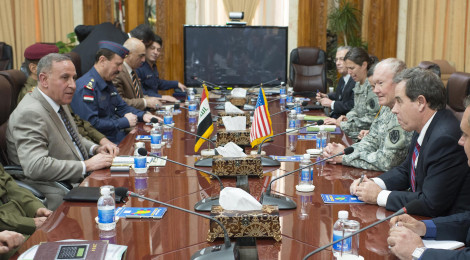
“This has to be about you. This has to be your campaign plan.” This is what the Chairman of the Joint Chiefs of Staff,General Martin Dempsey said to Iraqi leaders when he visited the country in the fall of 2014. General Dempsey delivered his most extensive public remarks on efforts to counter the Islamic State in Iraq and the Levant (ISIL) at November’s Defense One Summit. Rather than seizing control of an entire country and gradually transitioning it back to the host government as its capacity grows, as the United States did in Afghanistan in 2001 and Iraq in 2003, General Dempsey explained that, this time, the U.S. is leaving Iraqi forces in control and only augmenting them where absolutely necessary. The method starts and ends with Iraqi ownership of Iraqi security. This highlights a significant change in the U.S. approach to Iraq (and instability elsewhere), the import of which might easily be missed.

One of the vexing questions in Washington, D.C. for the last several months regarding the counter-ISIL campaign runs something like this: “We had over 100,000 troops in Iraq, and nearly a decade to train and equip the Iraqi Security Forces. If the result was a force that fled in the face of a much smaller non-state actor, how can we possibly train an Iraqi force now that will perform differently, especially without the leverage a large occupying force provides?”

Part of the answer lies with new Iraqi leaders who have a different mindset. General Dempsey compared the new prime minister, Haider al-Abadi, and his team to their predecessors and concluded, “The new leaders are more thoughtful and have an instinct toward inclusivity.” Mr. Abadi recently described his approach to governance: “Exclusion breeds extremism, so our new government includes Sunnis, Shiites and Kurds, as well as

A Game Changer for China and India in Sri Lanka?

By Kabir Taneja
January 25, 2015

On January 18, a Reuters reported claimed that Sri Lanka’s now former president, Mahinda Rajapaksa, had expelled the station chief of India’s intelligence agency in Colombo after accusing him of working against his government and supporting the opposition.

India denied the claim, but the report serves as an example of Rajapaksa’s thorny attitude towards New Delhi, irrespective of the face presented by public diplomacy.

The docking last September of a Chinese naval submarine in Colombo turned heads in New Delhi, just as the new government led by Prime Minister Narendra Modi was still getting up to speed. The event underlined the magnitude of Chinese influence in Sri Lanka under Rajapaksa, despite assurances from Beijing that the docking was a routine stopover to re-stock on supplies before heading to the Gulf of Aden to participate in anti-piracy operations.

A month later in October, the Indian government quietly launched an inter-ministerial review exercise to revisit India’s policies for the Indian Ocean. This followed on the heels of China’s proclaimed Maritime Silk Road, its growing influence around the Bay of Bengal, and the development of the Pakistani port of Gwadar, which is to be operated exclusively by Beijing. Glimpses of this exercise were seen the same month when Modi visited Myanmar, Australia and Fiji. China is the biggest foreign investor in Australia, and has liberally provided economic aid, loans and investments to Myanmar and Fiji. A few weeks later, China docked two of its submarines again in Sri Lanka.

China: Top Anti-Graft Body Faces Historic Challenge

By Bob Lee
January 25, 2015

It is very rare for an annual plenary session of the Central Commission for Discipline Inspection (CCDI), the nation’s top anti-graft body, to be held two months earlier than usual. Presiding over the meeting last week, Chinese President Xi Jinping vowed to keep up the intensity of his sweeping anti-corruption initiative. The Central Military Commission closely toed the party line the next day, pledging “absolute loyalty” to Xi in beefing up the corruption crackdown.

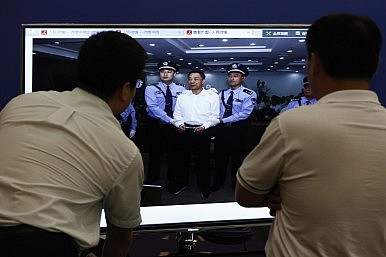
China Daily subsequently ran an article revealing that former security chief Zhou Yongkang and one-time high-flier Bo Xilai had formed a clique in preparation for “a big game” – hinting that the two had harbored nefarious intentions of trying to topple Xi at some point in his first term.

There are growing indications that Xi’s campaign is not going to die down, yet it is getting “arduous and complicated,” as Xi himself claimed, and of course it is also getting more interesting. It looks almost certain that Xi is now ready to point his cannon at some in the innermost circle of the Chinese Communist Party (CCP) who were once considered “too big to fall.” In 2015, we may well witness a showdown with one or more “super tigers” that could lead to a “defining victory”- a term increasingly used in the state media’s rhetoric.

In the process, cliques and factions affiliated with big bosses, like the Petroleum Gang, the Shanxi Gang, and the Shanghai Gang would crumble one by one. A statement released by the ruling Politburo after its final meeting of 2014 claimed that “organizing cliques within the party to run personal businesses is absolutely not tolerated.”

China’s “Server Sinification” Campaign for Import Substitution: Strategy and Snowden (Part 2)

January 23, 2015 

Since 2009, the Chinese government, in cooperation with state-run and private firms, has conducted an import substitution campaign in its computer server market, which is currently dominated by U.S. information technology (IT) companies IBM, Oracle and Hewlett-Packard (HP). China’s policy objective has been to reduce its reliance on the United States in server equipment, which it believes constitutes a threat to Chinese information security and imposes excessive costs on its domestic industry.

This article details the impact of external events on China’s import substitution program; most notably the effect of disclosures made by former National Security Agency (NSA) IT contractor, Edward Snowden, beginning in June 2013, which have proven useful to China in justifying import substitution on national security concerns. China also appears to be accelerating its activities in this area following diplomatic disputes with the United States, most notably in retaliation against the indictment of five alleged Chinese military officers on cyber espionage charges by the U.S. Department of Justice in May 2014.

Piling on Snowden

Beginning in June 2013, various world newspapers published leaked information from Snowden exposing extensive global monitoring systems operated by the United States in conjunction with several key allies, including the United Kingdom and Canada. Information from Snowden led to the public acknowledgement of the PRISM program, which allows the NSA and the Federal Bureau of Investigation (FBI) to monitor the private emails and conversation records of the U.S. public and foreign targets operating outside the United States. It is also claimed that the intelligence capabilities of the U.S. government have been enhanced with the support of a plethora of large U.S. IT companies, including Microsoft, Yahoo, Google, Facebook, PalTalk, AOL, Skype, YouTube and Apple. The Beijing Morning Postalso reported claims that Cisco Systems had participated in the PRISM project directed against the Chinese government, customs service, postal service, finance, railroads, civil aviation, medical services, military and police (Beijing Morning Post, June 19, 2013). A recurring criticism appearing in Chinese media is that prior to Snowden, relatively few restrictions had been imposed on U.S. IT and telecommunications companies in China; yet the United States had regularly impeded the activities of Chinese firms, such as the Chinese telecommunications giants Huawei and ZTE, in the U.S. market on national security grounds (Beijing Morning Post, June 19, 2013).

The Impact of SOE Reform On Chinese Overseas Investment

January 23, 2015 

Wu Yibing, director for China of Temasek, Singapore's state-owned investment company and a model for foreign investment in Chinese companies.

Chinese President Xi Jinping’s new round of state-owned enterprise (SOE) reform and his anti-corruption campaign will dramatically change the preferences and performance of SOEs’ overseas economic expansion. The economic and political initiatives undertaken by Xi meet in the state sector, as the Chinese government is tightening its control over assets and overall strategy at the macro-level, while loosening control over corporate governance at the micro-level. The increasing role of private stakeholders in SOEs will improve their management skills at the executive level and improve the transparency of the decision-making process. However, the introduction of private capital will not reduce the state’s control. In the short run, Chinese SOEs will be more prudential in acquiring foreign assets, with increasing awareness of risk control and profitability analysis. Vital to China’s national interests, the energy sector is still at the top of Beijing’s agenda for overseas investment and acquisition, together with an increasing appetite for the cultural, high-technology, healthcare and food industries. To create more investment opportunities for Chinese companies, the Chinese government will also accelerate its negotiations with major trading partners on bilateral or multilateral investment agreements.

When the Chinese government under then-President Jiang Zemin announced the “going-out” strategy to nurture national champions in the global market two decades ago, Chinese SOEs were the first and biggest movers to invest abroad. In 2013, SOEs represented 63.4 percent of China’s overall non-financial overseas direct investment (21st Century Business, January 17). Beyond government initiatives, Chinese companies have diversified their investments into foreign markets in response to diminishing returns at home and to acquire human capital abroad—upgrading their supply chain, improving management capability and acquiring high-tech intellectual property rights (IPR)—as well as to gain access to more mature markets.

“Ruling the Internet According to Law”: Chinese Internet Governance in 2014 and Beyond

January 23, 2015 

The Chinese government is known for its heavy-handed censorship of the country’s Internet, now with a user base of about 665 million. After the blockage or shut down of a series of social media accounts, commercial websites, text messaging applications, online libraries and cloud computing services, 2014 ended with the total blockage of Gmail, inaccessible without recourse to a Virtual Private Network (VPN). [1]

In February 2014 three months after creating and presiding over a powerful National Security Commission, which is responsible for cyber security issues, Chinese President Xi Jinping moved to head up a new government body, the Central Internet Security and Informatization Leading Group (CISILG). During the first meeting of the group, Xi called for “the proper management of public opinions on the Internet” (Xinhua, February 27, 2014). Making sure the Internet is under its control is now one of the most pressing strategic concerns for the Chinese Communist Party (CCP).

In October, the CCP held its Fourth Plenum of the 18th Party Congress. The decision document that emerged from the conference outlined an array of reforms under the theme of “ruling the country according to law” (yifa zhiguo), including “regulating Internet activities according to law” (see China Brief, November 20, 2014; Xinhua, October 28, 2014). The phrase “ruling the Internet according to law” (yifa zhiwang) has since been popularized. “The Party’s Fourth Plenum spirit of law should be vigorously applied to the Internet to ensure regulators and online users behave within the limits of law,” said Lu Wei. Lu, dubbed “China’s Internet Czar” by Western media, is the director of the State Internet Information Office (SIIO), China’s leading Internet regulatory body (Xinhua, October 27, 2014).

Energy Security, Geopolitics and the China-Russia Gas Deals

January 23, 2015

During the November 2014 Asia-Pacific Economic Cooperation (APEC) summit, Beijing was not only an impressive host, but also a generous financial supporter of a number of China-centered initiatives. The largest economic package during the APEC summit went to the second China-Russia mega deal of the year: Moscow and Beijing reached a non-binding memorandum that will see top Russian gas producer Gazprom ship 30 billion cubic meters (bcm) of gas annually to China over 30 years. This is just slightly less than the $400 billion accord the two countries signed in May 2014 for Russia to supply China with 38 bcm a year by 2018. The two gas deals, sealed only six months apart, have profound implications on China’s quest for energy security, the volatile global energy market, China-Russia relations and broader geopolitical movements worldwide.

China’s Quest for Energy Security

While the world media and expert opinions have focused mainly on the significance of these deals for Russian President Vladimir Putin and his confrontation with the West over the Ukrainian crisis in recent months, Beijing sees them primarily as a part of its long-term search for energy security and diversification of supply sources. The timing simply gave China the final breakthrough.

When China became a net importer of oil in the early 1990s, it already had begun to talk to Moscow about large-scale imports of Russian oil and gas, including gas pipelines from both eastern and western Siberia (Reuters, November 10, 2014). Over the past two decades, China’s dependence on imported oil has grown to 60 percent, with suppliers mostly from the Middle East and Africa.

Jinglue Haiyang: The Naval Implications of Xi Jinping’s New Strategic Concept


Admiral Wu Shengli, a member of the Central Military Commission and commander of the PLA Navy, has spoken about jinglue haiyang.

In studies of Chinese expansion in the near seas of East Asia, one topic that has been almost entirely ignored is the concept of jinglue haiyang, recently endorsed by the Party-state as a facet of China’s maritime power strategy. The word jinglue is not in common usage; indeed, most dictionaries do not define it. It is a verb combiningjing, the character for manage or administer, with lue, the character for strategy or stratagem. According to the 1979 edition of theCihai Dictionary, it means “handling an issue on the basis of prior planning.” A useable translation might be “strategically manage,” with the full phrase rendered as “strategic management of the sea.”

Chinese official and quasi-official sources, the naval press in particular, now regularly cite this new concept, often identifying it as a cornerstone of Chinese President and Commander-in-Chief Xi Jinping’s strategic thought. Given the exoticism of the term and its obvious importance for understanding Chinese maritime strategy, it is worth examining in greater detail. A close reading of Chinese texts suggests that the concept favors an expansive view on the use of sea power in peacetime, perhaps shedding light on the current leadership’s apparent preference for a more active and systematic pursuit of maritime dominance, especially in the waters of the South China Sea.

The Path to Endorsement

The notion of strategic management of the sea is in fact not novel. In a paper published in the Pacific Journal (Taipingyang Xuebao) in 1996, Luo Ruyu, a retired People’s Liberation Army (PLA) Navy Senior Captain and Director of the State Oceanic Administration (SOA), advocated for the concept to sit at the core of China’s maritime strategy. Luo’s understanding of the term, now nearly 20 years old, remains valid: