28 February 2024

China Is Running Out of Lines to Cross in the Taiwan Strait

Ben Lewis

In 2020 the balance of military power in the Taiwan Strait began a gradual but profound shift in China’s favor.

That August, Alex Azar, then the health and human services secretary, became the highest-ranking U.S. cabinet official to visit Taiwan in more than four decades. Though he was there to talk about the pandemic, China’s People’s Liberation Army (P.L.A.) responded by carrying out large-scale military exercises around the self-governing island, sending aircraft over the median line of the Taiwan Strait, the halfway point between China and Taiwan, for only the third time in more than 20 years. Since then, China has responded to such visits and other perceived provocations by flying more than 4,800 sorties, with growing numbers of aircraft flying in locations previously seen as off-limits and conducting dozens of increasingly complex air and naval military exercises around Taiwan.

The P.L.A.’s now-normalized presence around Taiwan raises the risk of an accidental confrontation. But over the longer term, it has also gradually created a dangerous sense of complacency in Taipei and Washington while giving China the crucial operational practice it might one day need to seize the island.

As a military analyst specializing in China and Taiwan who has spent the past two years managing an open-source database tracking Chinese military activity, I am deeply concerned about the dangers that this activity poses. Alarms should be ringing, but neither Taiwan nor the United States has taken meaningful action to deter China, and Taiwan’s response has been inconsistent and lacks transparency, which may further embolden Beijing. A more robust approach is needed to deter China from escalating the situation.

In 2020, shortly after China began raising the pressure, Taiwan’s Ministry of National Defense started releasing daily reports on Chinese military activity inside the island’s Air Defense Identification Zone, a perimeter extending beyond Taiwan’s territorial waters and airspace that is monitored to provide early warning of approaching Chinese planes or missiles. In previous years, China rarely entered the zone. But in 2020, P.L.A. aircraft breached it nearly 400 times. Last year, that number exceeded 1,700.

Ending the Houthi Threat to Red Sea Shipping

Nadwa Al-Dawsari, Casey Coombs, Ibrahim Jalal, Kenneth M. Pollack, Baraa Shiban, and Katherine Zimmerman

Once again, the United States confronts an unexpected threat in the Middle East—this time, from the Houthis of Yemen, who have chosen to take their war against the government of Yemen out into the Red Sea to try to strangle the 12 percent of global shipping that flows through the Bab el-Mandeb. 1 The Houthis are ostensibly doing this in support of Hamas, but in reality, it is in pursuit of their wider ambitions in Yemen and the region and on behalf of their Iranian allies.

Once again, Americans are asking what is the least we can do to address this threat. Unfortunately, as we should have learned over the past 45 years, trying to do the least in the Middle East often means we end up having to do the most. A smart, feasible middle course isavailable to the United States and its allies, but it will require us to recognize that the United States has a real stake in the outcome of the Yemeni civil war and that that interest lies with ensuring the Houthis do not prevail. While it will require important changes from how we have tackled the problem so far, the best news is it should not require American boots on the ground in Yemen and is likely to be welcomed by most Yemenis and all of our allies in the Middle East.

Washington warned, punished, and warned the Houthis again against drone and missile attacks on vessels transiting the Red Sea. Instead of stopping after joint US-UK strikes on Houthi targets in January, the Houthis escalated, including by launching one of theirmost complex attacks to date and increasingly focusing on US-owned vessels.2 They vowed to respond to a third round of joint US-UK strikes on February 3 that targeted “deeply buried” Houthi military capabilities.3 The Houthis remain undeterred and, in fact, are emboldened in the face of international pressure to back down.

How interoperability benefits military, civil and commercial domains

Dave Martin

As modern-day information systems become more complex, the importance of interoperability cannot be overlooked. Organizations across numerous industries rely on a myriad of software applications and devices to streamline operations, facilitate communication and drive innovation. However, without interoperability, the potential of these systems is hindered, which can lead to inefficiencies and barriers to collaboration.

Whether applied to military, commercial or consumer domains, interoperability can benefit every step of the supply chain by reducing overall costs and enabling rapid integration, as well as by improving the long-term sustainability and maintainability of fielded systems. Interoperability promotes cohesion and efficiency across these diverse systems, and the most obvious beneficiary of this is the system integrator.

Well-defined, standardized interfaces enable integrators to select “best in breed” capabilities from multiple potential suppliers without having to absorb the additional costs associated with proprietary or custom interfaces.

In addition, the use of interoperable interfaces across subsystems and components lets integrators keep up with constantly improving technology and capabilities. In growth areas like unmanned systems, interoperability is critical to sustainability since the current “state of the art” can be quickly replaced by a next-generation breakthrough. By focusing on interoperability, new capabilities can be quickly adopted and rolled out without significant system redesign.

Interoperability also can benefit industry vendors – particularly, small- and medium-sized ones. After all, modern systems have become too complex for a single vendor to excel in each of the system’s hardware, software, and mechanical requirements. Interoperable interfaces enable vendors to specialize their offerings and compete in niche areas, while targeting products toward a broad market.

How to Ruin the Marine Corp

GARY ANDERSON

Few would ever consider how to completely neutralize a truly iconic fighting force like the US Marine Corps.

However, for whatever reason, if one were motivated to do so, I would recommend the following strategy.

The Plan in Theory

First, I would not reveal my plans during my confirmation hearing as Commandant of the Marine Corps. That would alert the traditionalists among the retired Marines and friends of Marines who might oppose my appointment. Once confirmed and installed, I would present my real plan, proceeding confidently and decisively.

Let’s say my concept would involve a radical transformation of the Marine Corps from a worldwide force in readiness into a service primarily focused on deterring or fighting a war with China. I would issue my Commandant’s Planning Guidance to that effect and direct my combat development command to set up a series of war games that would support my plan.

I would use a small group of trusted agents to run the games and make sure that they supported the concept. I would ensure that anyone participating in the games signed non-disclosure agreements, and I would classify the process so that no dissenting opinions would be let loose. I would then declare that the results validated my concept.

Next, I would divest the Marine Corps of what I considered to be legacy capabilities no longer needed for the implementation of my plan. These divestitures would include all tanks, all its heavy engineer and assault breaching capabilities, much of the conventional artillery, its vaunted snipers, and about a third of the aviation assets.

Knowing that many retired Marines and friends of Marines would object to this radical departure from the Marine Corps’ traditional force-in-readiness posture, I would direct my public affairs people to dismiss them as hopeless reactionaries.

Ukraine: A struggle for the ages

JAMIE DETTMER

“Today I will not panic and cry. I will be calm and confident. My kids are watching.”

These were the words of Ukraine’s First Lady Olena Zelenska as dusk approached on the first day of Russia’s invasion two years ago. And she wasn’t alone in trying to fortify herself with such an admonition.

Ukrainian parents — hundreds and thousands of them — were all repeating similar sentiments. Their kids, in turn, were watching, scanning their parents’ faces for signs of fright, seeking reassurance and guidance on how to react as their world turned upside down. Conscious parenting doesn’t stop when bombs start falling. It just becomes much harder and much more urgent. And the children observed everything — they always do.

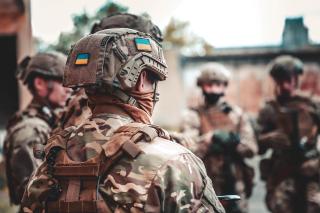
And what exactly did they see that day, when Russian President Vladimir Putin’s avowals that he wouldn’t invade his neighboring country were shown to be hollow? Like anyone who was there during those opening days of war, as I was, they saw a disciplined, resolute state gird itself, ready to defend its freedom and become what Putin says doesn’t exist — a nation.

As Russian tanks bore down on Kyiv and Western leaders wrung their hands — forecasting a quick collapse and offering the Ukrainian president a ride into exile — on the ground in Ukraine, it was clear the country would put up a fight.

And what a fight it has put up against its giant of a neighbor for two whole years now — a David and Goliath struggle for the ages.

What happened during those first few days of war will stay etched in my mind forever. There wasn’t panic. Instead, there was calmness and steadfastness. There were also tears — tears as families parted, with children and mothers heading west, out of harm’s way; tears as grandparents decided to stay rooted in cherished family homes as the bombs got closer; and tears as fathers said their final goodbyes to their families before heading east to confront the enemy.

Responsible science: What Sam Altman can learn (and not learn) from Nobel and Oppenheimer

Sarah Kreps

Last September, Emmett Shear, who was later temporarily CEO of OpenAI during an organizational shakeup, cautioned that artificial intelligence was moving too quickly: “[I]f we’re at a speed of 10 right now, a pause is reducing to 0. I think we should aim for 1-2 instead.” Shear, who is concerned about human-level artificial intelligence, did not last long as CEO. And OpenAI, like its competitors, has kept its foot on the development pedal. Pauses (like the one suggested for giant AI experiments) or Shear’s slowdown suggestion are unlikely to work given the investment-driven technological arms race that has raised the payoff for first mover advantages.

In science, technology, and business, “disruptive innovation” is a goal. But the same innovations that start in the business world often end up in the national security space. Disruptive innovations are both dual-use and double-edged. Not only can they go from civilian to military applications, but they can also present opportunities as well as dangers. There is no stopping innovation, nor should there be. But it’s important to ask if innovators can create transformative technologies while not imperiling their country’s national security. In other words, can they be more mindful scientific stewards without compromising advancement? And what can today’s disruptors learn from yesterday’s innovators?

Answering those questions requires reflecting on historical instances of disruptive technologies. It turns out. the scientists behind some of those technologies did not intend to be disruptive. Alfred Nobel is the quintessential example. Nobel was curious, a “barefoot empiricist,” the type of scientist who learned by hands-on experimentation through trial-and-error. In 1847, a French chemist had discovered nitroglycerin, used as an antidote for angina. Nobel began studying the chemical’s homeopathic virtues but also recognized its volatile properties and ultimately developed the explosive and detonator that countries used in ways that he regretted. The Swedish innovator nursed his remorse by creating five Nobel Prizes, one a peace prize that would be awarded in Norway, a country that had previously demanded that its union with Sweden dissolve.

The Spy War: How the C.I.A. Secretly Helps Ukraine Fight Puti

Adam Entous and Michael Schwirtz

Nestled in a dense forest, the Ukrainian military base appears abandoned and destroyed, its command center a burned-out husk, a casualty of a Russian missile barrage early in the war.

But that is above ground.

Not far away, a discreet passageway descends to a subterranean bunker where teams of Ukrainian soldiers track Russian spy satellites and eavesdrop on conversations between Russian commanders. On one screen, a red line followed the route of an explosive drone threading through Russian air defenses from a point in central Ukraine to a target in the Russian city of Rostov.

The underground bunker, built to replace the destroyed command center in the months after Russia’s invasion, is a secret nerve center of Ukraine’s military.

There is also one more secret: The base is almost fully financed, and partly equipped, by the C.I.A.

“One hundred and ten percent,” Gen. Serhii Dvoretskiy, a top intelligence commander, said in an interview at the base.

Now entering the third year of a war that has claimed hundreds of thousands of lives, the intelligence partnership between Washington and Kyiv is a linchpin of Ukraine’s ability to defend itself. The C.I.A. and other American intelligence agencies provide intelligence for targeted missile strikes, track Russian troop movements and help support spy networks.

But the partnership is no wartime creation, nor is Ukraine the only beneficiary.

It took root a decade ago, coming together in fits and starts under three very different U.S. presidents, pushed forward by key individuals who often took daring risks. It has transformed Ukraine, whose intelligence agencies were long seen as thoroughly compromised by Russia, into one of Washington’s most important intelligence partners against the Kremlin today.

A Neutral Ukraine Is Not the Answer

Dr. Philip Dandolov

Since the beginning of the Russian invasion of Ukraine there have been multiple negotiation rounds as well as proposed peace plans seeking to lay the groundwork for ending the war. While finding a lasting resolution is turning out to be elusive, if we are to take into consideration the events that have unfolded over the course of the last two years, what should almost certainly be ruled out with regard to the spectrum of desirable outcomes is the adoption of a neutral status by Ukraine.

Ukraine is not exactly a stranger when it comes to the notion of neutrality. In the aftermath of the fall of the Soviet Union, the country expressed an intention in its declaration of state sovereignty of 1 July 1990 to become a permanently neutral state that would shun participation in military blocs and show a commitment to denuclearization. This largely nonaligned status resulted in a vacillating foreign policy, which nonetheless appeared to be conducive to the pursuit of amicable relations with both the European Union (EU) and Russia, before being ultimately abandoned in December 2014 in the aftermath of Russia’s annexation of Crimea and the start of the Donbas war. In February 2019, with the overwhelming approval of the Verkhovna Rada (the Parliament of Ukraine), the Ukrainian constitution was amended, setting the country on a course toward full membership in the EU and NATO. Nonetheless, in late March 2022 Ukrainian president Volodymyr Zelenskyy was still prepared to discuss the possibility of Ukraine taking a neutral position as part of a potential peace deal with Russia to halt the invasion.

Yet there are quite a few practical and moral reasons as to why the train of neutrality should now be considered to have long left the station.

White House Wades Into Debate on ‘Open’ Versus ‘Closed’ Artificial Intelligence System


The Biden administration is wading into a contentious debate about whether the most powerful artificial intelligence systems should be “open-source” or closed.

The White House said Wednesday it is seeking public comment on the risks and benefits of having an AI system’s key components publicly available for anyone to use and modify. The inquiry is one piece of the broader executive order that President Joe Biden signed in October to manage the fast-evolving technology.

Tech companies are divided on how open they make their AI models, with some emphasizing the dangers of widely accessible AI model components and others stressing that open science is important for researchers and startups. Among the most vocal promoters of an open approach have been Facebook parent Meta Platforms and IBM.

Biden’s order described open models with the technical name of “dual-use foundation models with widely available weights” and said they needed further study. Weights are numerical values that influence how an AI model performs.

When those weights are publicly posted on the internet, “there can be substantial benefits to innovation, but also substantial security risks, such as the removal of safeguards within the model,” Biden’s order said. He gave Commerce Secretary Gina Raimondo until July to talk to experts and come back with recommendations on how to manage the potential benefits and risks.

Now the Commerce Department’s National Telecommunications and Information Administration says it is also opening a 30-day comment period to field ideas that will be included in a report to the president.

Why Zelensky Replaced Ukraine’s Top General and What It Means for the War

Eric Ciaramella

President Volodymyr Zelensky’s replacement of Ukraine’s top military leadership in early February—the most significant shake-up in Kyiv since the start of Russia’s full-scale invasion two years ago—was long in the making. Zelensky cast his decision to replace Armed Forces Commander-in-Chief Valeriy Zaluzhny and other senior officers as necessary to rejuvenate the war effort after last year’s failed counteroffensive. But, although Zelensky and Zaluzhny had clashed over certain aspects of Ukraine’s military strategy, the decision ultimately stemmed from politics and an interpersonal conflict between the two men that had escalated steadily since the earliest days of the war.

Zaluzhny was a relatively unknown figure when Zelensky appointed him to his position in summer 2021. Age 48 at the time, Zaluzhny was part of a younger generation of Ukrainian officers with no experience in the Soviet military and whose careers had been defined both by the war in the Donbas, which began in 2014, and by growing cooperation with the United States and NATO militaries.

In the run-up to Russia’s full-scale invasion, Zaluzhny is credited with critical decisions to disperse ammunition stockpiles and reposition forces that enabled a small number of outgunned Ukrainian troops to blunt Russia’s main ground attack against Kyiv. His quiet preparations came as Zelensky and other top civilian leaders were publicly dismissing warnings from the United States that Russia would attack. During the Battle of Kyiv, Zaluzhny’s quick and adaptive thinking allowed Ukrainian troops to exploit the Russian army’s many blunders, saving the capital from occupation. He soon became a folk hero, lionized as Ukraine’s “Iron General.”

But his popularity was also a vulnerability. Zelensky came to see Zaluzhny, whose public approval and trust ratings gradually eclipsed his own, as a rival. For the first 18 months of the war, Zaluzhny was careful not to overtly challenge Zelensky, although the general seemed to underestimate the political turbulence created when people around him tried to capitalize on his rising star. In recent months, some of Zelensky’s opposition critics, including former President Petro Poroshenko and Kyiv Mayor Vitaliy Klychko, began promoting the idea of Zaluzhny as an alternative leader for Ukraine. Zaluzhny may not have been behind these efforts, but the perception that he was working with the opposition fueled Zelensky’s mistrust.

Ukraine Can’t Win the War

ANATOL LIEVEN

The long-awaited counteroffensive last year failed. Russia has recaptured Avdiivka, its biggest war gain in nine months. President Volodymyr Zelensky has been forced to quietly acknowledge the new military reality. The Biden Administration’s strategy is now to sustain Ukrainian defense until after the U.S. presidential elections, in the hope of wearing down Russian forces in a long war of attrition.

This strategy seems sensible enough, but contains one crucially important implication and one potentially disastrous flaw, which are not yet being seriously addressed in public debates in the West or Ukraine. The implication of Ukraine standing indefinitely on the defensive—even if it does so successfully—is that the territories currently occupied by Russia are lost. Russia will never agree at the negotiating table to surrender land that it has managed to hold on the battlefield.

This does not mean that Ukraine should be asked to formally surrender these lands, for that would be impossible for any Ukrainian government. But it does mean that—as Zelensky proposed early in the war with regard to Crimea and the eastern Donbas—the territorial issue will have to be shelved for future talks.

As we know from Cyprus, which has been divided between the internationally recognized Greek Republic of Cyprus and the Turkish Republic of Northern Cyprus since 1974, such negotiations can continue for decades without a solution or renewed conflict. A situation in which Ukraine retains its independence, its freedom to develop as a Western democracy, and 82% of its legal territory (including all its core historic lands) would have been regarded by previous generations of Ukrainians as a real victory, though not a complete one.

As I found in Ukraine last year, many Ukrainians in private were prepared to accept the loss of some territories as the price of peace if Ukraine failed to win them back on the battlefield and if the alternative was years of bloody war with little prospect of success. The Biden Administration needs to get America on board too.

Yet supporters of complete Ukrainian victory have engaged in hopes that range from the overly optimistic to the magical. At the magical end of the spectrum is the notion, set out by retired U.S. Army General Ben Hodges among others, that Russia can be defeated, and even driven from Crimea, by long-range missile bombardment.

How Tech Giants Turned Ukraine Into an AI War Lab

Vera Bergengruen

Early on the morning of June 1, 2022, Alex Karp, the CEO of the data-analytics firm Palantir Technologies, crossed the border between Poland and Ukraine on foot, with five colleagues in tow. A pair of beaten-up Toyota Land Cruisers awaited on the other side. Chauffeured by armed guards, they sped down empty highways toward Kyiv, past bombed-out buildings, bridges damaged by artillery, the remnants of burned trucks.

They arrived in the capital before the wartime curfew. The next day, Karp was escorted into the fortified bunker of the presidential palace, becoming the first leader of a major Western company to meet with Ukrainian President Volodymyr Zelensky since Russia’s invasion three months earlier. Over a round of espressos, Karp told Zelensky that he was ready to open an office in Kyiv and deploy Palantir’s data and artificial-intelligence software to support Ukraine’s defense. Karp believed they could team up “in ways that allow David to beat a modern-day Goliath.”

In the stratosphere of top tech CEOs, Karp is an unusual figure. At 56, he is a lanky tai chi aficionado with a cloud of wiry gray curls that gives him the air of an eccentric scientist. He has a Ph.D. in philosophy from a German university, where he studied under the famous social theorist Jรผrgen Habermas, and a law degree from Stanford, where he became friends with the controversial venture capitalist and Palantir co-founder Peter Thiel. After Palantir became tech’s most secretive unicorn, Karp moved the company to Denver to escape Silicon Valley’s “monoculture,” though he typically works out of a barn in New Hampshire when he’s not traveling.

The Ukrainians weren’t sure what to think of the man making grandiose promises across the ornate wooden table. But they were familiar with the company’s reputation, recalls Mykhailo Fedorov, Ukraine’s Minister of Digital Transformation, who was in that first meeting. Named after the mystical seeing stones in The Lord of the Rings, Palantir sells the same aura of omniscience. Seeded in part by an investment from the CIA’s venture-capital arm, it built its business providing data-analytics software to U.S. Immigration and Customs Enforcement (ICE), the FBI, the Department of Defense, and a host of foreign-intelligence agencies. “They are the AI arms dealer of the 21st century,” says Jacob Helberg, a national-security expert who serves as an outside-policy adviser to Karp. In Ukraine, Karp tells me, he saw the opportunity to fulfill Palantir’s mission to “defend the West” and to “scare the f-ck out of our enemies.”

What are space nukes, the ‘indiscriminate’ satellite weapon raising tensions between Washington and Moscow?

Karen Gilchrist

A fresh spat between Washington and Moscow has raised alarm about the potential risk of a space-based nuclear satellite attack which could cause chaos to critical communications systems on Earth.

Russia denied U.S. claims that it was developing a space-based anti-satellite nuclear weapon, with President Vladimir Putin saying Tuesday that the Kremlin was “categorically against” the deployment of nuclear weapons in space, and accusing the White House of scaring lawmakers into passing a new aid package for Ukraine.

It comes after a Reuters report emerged earlier Tuesday, citing one source, that said the U.S. believes Moscow is developing a space nuke whose detonation could knock out the satellites underpinning critical U.S. infrastructure, including military communications and mobile phone services. CNBC could not independently verify the report.

Alarm bells around Russia’s nuclear advancements were first raised last week when U.S. House Intelligence Committee Chairman Mike Turner warned of a “serious national security threat” related to Russian capabilities in space.

President Joe Biden later said Moscow appears to be developing an anti-satellite weapon but noted that it posed no urgent “nuclear threat” to the U.S. people, and said that he hoped Russia would not deploy it. However, one source familiar with the matter told Bloomberg that such a capability could be launched into orbit as soon as this year.

Analysts told CNBC that the deployment of such a weapon could cause “indiscriminate” damage, reaping havoc on the systems on which people rely for everyday services such as payments, GPS navigation and even the weather.

Naval Special Warfare Will Have to Fight Differently

Seth Cropsey

Naval Special Warfare is a crucial strategic tool for the U.S. military. Yet there has been remarkably little public thinking on the role special operations forces might play in a large-scale strategic confrontation. The War of 2026 scenario helps clarify the requirements for Naval Special Warfare (NSW) in such a conflict.

Two points need articulation. First, the revisionist coalition the United States and its allies face, primarily in Eurasia, has weak points; second, special operations forces (SOF) are the best tool to stress these weak points while ensuring high-end conventional assets are available for traditional engagements. These two arguments indicate a third, more profound reality: SOF can demonstrate the necessary link between the operational and the geopolitical in great power war—assuming it is properly resourced. This is true not only for NSW, but also for the broader SOF community.

SOF and Strategic Objectives


Romanian, Ukrainian, and U.S. special operations personnel conduct close-quarters battle training in Romania in May 2021. The most pervasive peacetime SOF mission today is training with U.S. allies and partners globally. 

Special warfare is, by definition, odd. Anglo- American strategic historian Colin Gray once argued that special operations does not fit well into the United States’ political-military taxonomy. It is culturally, strategically, operationally, and tactically distinct from the traditional warfighting arms of any service. While NSW may fall under the Navy Department’s organizational chart, for example, SOF are naturally ground forces, and there will be friction between them and the traditional mechanized and armored forces that predominate.

Twenty years of counterinsurgency and counterterrorism transformed U.S. special operations from a niche discipline within a conventional military into a well-known, near-celebrity, almost standalone component of U.S. power. Joint Special Operations Command completely retooled itself during the 2000s and 2010s, becoming a force capable of prosecuting a strategic campaign against a mobile, adaptable, tenacious network of conventional and unconventional forces.

TROUBLING WATERS : Understanding Global Water Security

Zane Swanson & Sarah B. Grace 

Today, global water demand already outstrips availability, with at least half of the global population experiencing highly water-stressed conditions. That is, they live in a region of the world that is highly water stressed for at least one month of the year.

At the same time, climate change will have diverse and unpredictable consequences for water security.

The ramifications of the existing water crisis will continue to grow in scope and severity without swift and robust intervention.


I. The Basics of Global Water

Water covers about 71 percent of the earth's surface. However, only a relatively small quantity is available for human use and consumption.

Of the estimated 1.39 billion cubic kilometers of water on the earth, approximately 97 percent is found in the oceans. Just 3 percent of the earth's water is freshwater, but most of that is unavailable—either locked up in glaciers, polar ice caps, the atmosphere, and soil; too highly polluted; or located where is it not practically or economically feasible to access. That leaves about one half of 1 percent of the earth's water remaining as freshwater that is available for human use.

With what is available, the world uses about 4 trillion cubic meters of freshwater annually. This is a volume about six times greater than global freshwater withdrawal at the turn of the twentieth century.

By 2050 the world is projected to demand 20 to 25 percent more water. And it is estimated that the number of people suffering from severe water scarcity could increase by 40 percent by the end of this century.

Coming Year May Not End The War In Ukraine: But It Could Decide The Outcome – Analysis

Steve Gutterman

On February 21, 2022, Russian President Vladimir Putin made a grim, resentful speech that changed the minds of many who had until then believed Russia would not launch a major new invasion of Ukraine.

Less than 72 hours later, Russian missiles rained down across the country, and Russian forces crossed the border, as well as the existing front line in the Donbas. And Putin, Western intelligence indicates, believed that Ukraine would be under Moscow’s thumb within weeks, if not days.

That did not happen, and now the full-scale war is reaching the two-year mark. Will it end in its third year?

The answer: Probably not. But talk of a stalemate may be misleading, lulling Kyiv’s backers into complacency at a time when one massive factor that has come to the fore could determine the outcome of the war: Western weapons deliveries.

“It’s always dangerous to make predictions, but it’s difficult to imagine the war ending by the end of 2024,” Ruth Deyermond, senior lecturer in the Department of War Studies at King’s College London, told RFE/RL.

“As things stand, neither side seems to have the capability to inflict a decisive defeat on the other. For that to change there would probably need to be a significant shift in external factors, most importantly, the level of support provided by the West,” Deyermond said in an e-mail exchange.

“Significantly more Western material support will help Ukraine to make progress in liberating territory,” she added, while “a reduction in Western assistance could force Ukraine to agree to peace talks on Russia’s terms.”

Olga Oliker, program director for Europe and Central Asia at the Crisis Group, puts it in starker terms. “If Ukraine runs out of weapons and people, yes, the war will end in the next year,” Oliker said in a telephone interview.

The Western economy is about to be dealt a devastating blow

Karl Holmqvist

The modern Western world is dependent on undependable technology. From healthcare to banking, communications to infrastructure – electricity grids, water supplies, sewage systems and trains – we rely on complex systems that do what they do, when they’re meant to. For this to work, these systems must be secure against attack.

However, as shown by recent ransomware attacks on everything from hospitals to libraries, we often aren’t ready for sophisticated attacks on our technology. Our systems were built to be operationally reliable, but were not designed to be resilient to the efforts of determined adversaries who want our information or money. And this situation could get significantly worse. New technology has put a timer on our current security methods.

We are rapidly connecting the critical components of the most important systems that keep our economy running to the internet. The cornerstone of the current security practices that make this safe is cryptography; encoding information so that only the intended recipient can decipher it. Our current cryptographic techniques are highly secure against current technologies. They are totally unready for the quantum age and the new types of attacks our adversaries are aggressively developing.

Last year, the cybersecurity community was stirred by a sensational claim that RSA, the most widely deployed asymmetric encryption algorithm, had been cracked by a new method harnessing properties of quantum mechanics augmented by AI. This story passed without disaster. But at some point, quantum computers capable of breaking our current system will be here. Researchers and institutes around the world are pouring tens of billions of dollars into quantum computing, and the timelines for working devices are shrinking.

While there are many promising applications in science and medicine for a large quantum computer, one of the first specific and proven applications will be breaking cryptography. This means that RSA’s immunity, and the security of all the cryptographic systems powering our Internet connected society, may soon be in doubt. Last year’s announcement was a shot across the bows for the Western world. The next breakthrough could be real.

27 February 2024

Nancy Pelosi on Israel's Gaza War: 'I'm Not a Big Fan of Netanyahu'

David Brennan

House Speaker Emerita Nancy Pelosi is among the U.S. politicians most in the crosshairs of furious pro-Palestinian activists, as they look to force the American political establishment out of its "ironclad" support for Israel's devastating war on the Gaza Strip.

"I understand, for some people their frustration," Pelosi told Newsweek in an exclusive interview on the sidelines of the Munich Security Conference last weekend.

Pelosi's San Francisco home has been repeatedly targeted in recent months. Red paint and fake blood have been splashed around it, while severed pigs' heads have been left displayed outside. Last week, a truckload of manure was dumped on her driveway.

The California lawmaker has accused some protesters of being linked to Russia and China, most notably in a January confrontation outside her home in which she shouted at activists: "Go back to China."

"I don't know that this is all organic," Pelosi said. "Much of it is, much of it is organic and spontaneous and sincere. I respect that. I don't think all of it is."

A Reality Check on Afghanistan’s Isolation Under the Taliban

Shanthie Mariet D’Souza

The two-day meeting of regional and national special envoys for Afghanistan convened by the U.N. Secretary General Antรณnio Guterres in Doha ended on February 19 with consensus among the participants over “what needs to happen.” But there was almost no unanimity about how the international community should engage with the Taliban. The Taliban continue to demonstrate no signs of backtracking on their policies and show no interest in forming an inclusive government and restoring the rights to education, employment, and movement that girls, women, and minorities enjoyed for two decades.

Worse still, beneath the U.N. secretary general’s claims of consensus, a clear division is visible among countries regarding doing business with the present regime.

The meeting provided an opportunity for important stakeholders, regional as well as global, to converse on the future of Afghanistan and the steps required to arrest the country’s downhill slide under the Taliban. More importantly, the meeting aimed to bring the Taliban face-to-face with Afghan human rights and women activist groups on its sidelines, for a frank exchange of views. No such dialogue has been possible in Afghanistan.

The Taliban, however, refused to attend as their demand for recognition as the sole governing entity of Afghanistan in the meeting was not met. This would have amounted to the world body recognizing the so-called Islamic Emirate. In addition, the Taliban refused to meet any of the human rights and activist groups. The Taliban also rejected the idea of a new U.N. special envoy for Afghanistan given that the United Nations Assistance Mission in Afghanistan (UNAMA) is already functioning in the country.

The Taliban’s reaction was to be expected. The group is seeking to make the international community accept it without conditions. Time and again the Taliban regime has made it clear that it views such recognition as its right and it must not be linked to any improbable change in its policies or Afghanistan’s governing system. Under this view, another U.N. special envoy, one tasked with promoting dialogue between the Taliban and Afghan opposition groups, is unnecessary, as the Taliban have no intention of sharing power with anyone else.

A decent future for Myanmar is within reach — if the U.S. acts now

Keith B. Richburg

What seemed plausible two months ago is now undeniable: Myanmar’s awful ruling military junta is in retreat against the country’s anti-regime insurgents. The rebels include regional militias and self-styled “People’s Defense Forces” or PDFs, the ad hoc armed resistance groups that sprung up in response to the military’s February 2021 coup.

Ethnic armies have been a feature of Myanmar’s fractious political landscape since its independence in 1948. Along with the PDFs, the insurgents have seized hundreds of townships and military outposts since launching an Oct. 27 offensive. In January, the military suffered its most humiliating defeat yet, when soldiers surrendered Laukkaing, a key city and regional command center in Shan state to the rebels. There were conflicting reports as to the fate of six brigadier-generals responsible for the debacle. Local media outlets reported they had been sentenced to death, which the junta denied.

Myanmar’s military is finding its number of troops depleted by battlefield losses, surrenders and desertions. In a sign of its desperation, the junta has announced plans to begin conscripting young people into military service for at least two years. The announcement prompted thousands of people to attempt to flee over the border into Thailand, or to line up for visas outside Western diplomatic missions in Yangon.

But the surprisingly rapid retreat of the military’s forces from key areas doesn’t mean it is on the verge of collapse. By withdrawing to more defensible positions, including to the major cities and the capital, Naypyidaw, the military appears to be digging in for the long haul. While stymied on the ground, the armed forces continue to deploy devastating airstrikes against civilians — likely a war crime. The insurgents’ widespread use of drones, though effective, has not erased the regime’s battlefield advantage. Myanmar’s military is battle-hardened, well-armed and close-knit, living largely isolated from the population. Its soldiers have a reputation for brutality against civilians.

Where the Resistance Rules in Myanmar

Andrew Nachemson

Just over three years ago, Thar Thakhin woke up a wanted man. A prominent political writer, he had authored poems skewering the Myanmar military and a book lionizing Myanmar leader Aung San Suu Kyi. His work had won him admiration, particularly among supporters of Aung San Suu Kyi’s National League for Democracy (NLD) party. When the Myanmar military overthrew the NLD government in a coup on Feb. 1, 2021, arresting politicians, activists, and celebrities, it put a target on Thar Thakhin’s back.

The first space war is coming. Here are 3 things the US must do to win

Arthur Herman

Americans got a wake-up call when House Intelligence Committee Chairman Mike Turner and the White House let us know that the Russians were thinking about sending nuclear weapons into space, to destroy U.S. satellites if we ever wind up in a shooting war with Moscow.

Russian nukes in space is the nightmare we’ve all worried about since the Russians launched their first Sputnik satellite back in 1957. Six and a half decades later, we are learning that international agreements that are supposed to stop that threat mean nothing to a dictator like Russian President Vladimir Putin — and that America needs to get serious about defending its assets in space, including GPS.

We need the capability to deter the growing space threat from both Russia and China, before our perceived weakness triggers a full-scale war in space.

The truth is, whoever controls the space domain will dominate the future global economy. If America was the preeminent space power from Presidents John F. Kennedy to Ronald Reagan, we’ve let our edge slip away, while China and Russia aim to displace us altogether.


The US needs to work more closely with private companies as part of the space race. FILE: A SpaceX Falcon 9 rocket launches the third pair of O3b mPOWER satellites for Luxembourg-based company SES from pad 40 at Cape Canaveral Space Force Station in Cape Canaveral. 

In fact, a State of the Space Industrial Base conference report issued in 2022 predicted that China will overtake the U.S. as the dominant space power by 2032.

What do we know about China's global cyber operations?

RAFI SCHWARTZ

Throughout much of former President Donald Trump's administration, national attention was focused on various allegations, insinuations, and affirmations of massive Russian hacking efforts to penetrate and influence various American cyber targets. For many, it was their first real exposure to the shadowy, clandestine world of cyber warfare that has become a major pillar of geopolitical jockeying. But while Russia and its digital sorties may have grabbed headlines over the past decade or so, a tranche of newly leaked files from Shanghai-based data collection firm iSoon has opened a rare window into China's massive cyber warfare operations. The leak, posted this month to GitHub, not only raises questions about Beijing's sprawling digital capacity but also highlights the intricate network of for-hire hackers China allegedly uses to expand its reach throughout the world — and snoop on its own citizens.

While the exact source of the leak remains at the moment unknown, the nearly 600 documents that comprise this breach have been widely verified as legitimate by numerous cybersecurity experts. Although the tranche does not include much in the way of specific data harvested by the Chinese hackers, it does illuminate the otherwise murky contours of who Beijing is watching, and who it's paying to watch.

Based on these new documents, here's what we know about China's global cyber operations.

What did the commentators say?

The leak is an "unprecedented look" inside just one of the many companies the Chinese government contracts with for its "on-demand, mass data-collecting operations," The Washington Post said. It's rare to get "such unfettered access to the inner workings of any intelligence operation," cybersecurity expert John Hultquist said to the paper. While the documents are light on what iSoon uncovered throughout its investigations, it does feature "contracts, marketing presentations, product manuals, and client and employee lists," PBS News Hour said, adding that in total the leak shows how Chinese intelligence agencies "surveil dissidents overseas, hack other nations and promote pro-Beijing narratives on social media."

Corruption and Low Morale Still Plague China’s Military

Victoria Herczegh

It’s early days in the Year of the Dragon, but Beijing’s purge of the People’s Liberation Army shows no signs of stopping. The latest known victim is Wang Xiaojun, one of China’s foremost rocket scientists, who had been working closely with the PLA Rocket Force and Chinese defense companies. Wang was reportedly expelled from the Chinese People’s Political Consultative Conference, the country’s top advisory body, in late January. As with other recent sackings of Rocket Force officials, no reason was given for Wang’s dismissal.

Officially, the Chinese Communist Party is in the midst of a crackdown on corruption. In 2023, 45 senior officials were put under investigation, which Chinese media say is a record. But that is not the full story. Instead, misappropriated funds and a resultant drop in troop morale are fueling worries in the government about unrest within the PLA. Additionally, the Rocket Force officials who were expelled late last year reportedly made weapons acquisitions without the central government’s knowledge, raising questions about President Xi Jinping’s authority among the PLA’s top officials.

Aside from the high-level purges, in January the Communist Party secretaries of three Chinese provinces (Anhui, Fujian and Jiangxi) conducted separate tours of the PLA’s Eastern Theater Command, which oversees Taiwan. All three secretaries met with the theater commander, delivered rousing speeches before the troops, pledged benefits for veterans and soldiers’ families, and promised to contribute to the unification of Taiwan with mainland China. Provincial chiefs rarely do in-person inspections of military commands, so three in one month is highly unusual.

These are unusual times in the PLA. Xi’s government is committed to the force’s rapid modernization, to transform it into a “world-class” military by 2049. Its plans include the expansion and diversification of China’s nuclear capabilities. However, several recent reports have cast doubt on the PLA’s modernization drive. According to former officers, some military departments can hardly afford supplies or new equipment because of rampant corruption and poor budget management. Other reports cite the lack of cross-training among the five services and a critical shortage of professionally trained noncommissioned officers, who ensure that officers’ decisions are communicated to the troops and properly executed.

US officials combing leaked documents from Chinese tech firm for clues about Chinese hacking campaigns

Sean Lyngaas

US officials have been scouring a trove of newly leaked documents from a Chinese tech firm for clues on how the government in Beijing allegedly uses the company in extensive hacking campaigns, multiple US cybersecurity officials familiar with the matter told CNN.

The Biden administration’s study of the leak is ongoing, but private experts told CNN it offers some of the clearest public evidence yet of how they believe China’s powerful security agencies outsource hacking operations to tech firms to target victims around the world.

The documents, posted anonymously online last weekend for anyone to access, include screenshots of chat logs, as well as records of employees and Chinese government clients of the tech firm I-Soon. The company’s hacking victims range from Tibetan exile-run political groups, hospitals in Taiwan and India to Hong Kong’s universities following the city’s mass pro-democracy protests in 2019, according to the leaked data. More than a dozen, mostly Asian, foreign governments are listed as targets.

I-Soon’s clients include China’s police, intelligence service and military, according to a spreadsheet listing 183 contracts signed between 2016 and 2022 by I-Soon’s subsidiary in the southwestern province of Sichuan.

“This is some of the best visibility we’ve had into Chinese hacking operations outside of a government SCIF,” said Adam Kozy, who used to track Chinese hackers for the FBI, using an acronym for classified facilities.

“I’m not aware of the specifics you mentioned. In principle, I want to emphasize that China firmly opposes the unwarranted denigration and smearing against China,” Liu Pengyu, spokesperson for the Chinese Embassy in Washington, DC, said in an emailed statement when asked for comment.

Beijing Is Expanding Its Territorial Claims Without Firing A Single Shot

HELEN RALEIGH

After Taiwan’s voters defiantly voted for Lai Ching-te of the Democratic Progressive Party (DPP) as their next president in January, many people are waiting to see when communist China’s dictator Xi Jinping will attack Taiwan militarily. There are disturbing signs that Xi is already making progress toward taking control of Taiwan through “gray zone” operations, and the Biden administration is unprepared to address China’s aggressive geopolitical expansions.

A “gray zone” operation refers to “coercive actions that are shy of armed conflict but beyond normal diplomatic, economic, and other activities,” according to the Rand Corporation. China has deployed close to 80 different gray zone tactics in recent decades against its Asian neighbors, Rand reports. By gradually altering the regional and international status quo, Beijing has succeeded in expanding its territorial claims without firing a single shot or launching any military attack.

A good example of China’s gray zone operation is its handling of border disputes with Bhutan. China has built three new villages inside the Beyul region, which is internationally recognized as Bhutan’s territory. These villages house hundreds of Chinese residents, a few military bases, and Chinese Communist Party administrative centers. China’s actions violated its promise to Bhutan that “no unilateral action will be taken to change the status quo on the border.” But it was too late when Bhutan noticed what China had done. Beijing points to these Chinese villages inside Beyul as proof that the region has been China’s territory since immemorial.

Xi seems to plan to take control of Taiwan through similar gray zone operations; he is probably concerned that an outright military invasion may be too costly if the United States jumps to Taiwan’s defense. Step one of Xi’s gray zone operations over Taiwan was to gain control of the South China Sea, an essential international water and trade route that China’s Asian neighbors, including Taiwan, rely on.

The Current Red Sea Security Situation – Analysis

Can KasapoฤŸlu

1. A High-Ranking US Admiral Confirms the Presence of the Iranian Revolutionary Guard Corps in Yemen

The deputy commander of United States Central Command (CENTCOM), Vice Admiral Brad Cooper, confirmed that members of the Iranian Revolutionary Guard Corps (IRGC) now have boots on the ground in Yemen, where they are operating alongside the Houthi militia and providing them with targeting assistance. Admiral Cooper’s statement is the most high-profile acknowledgement from the US military of Iran’s direct role in the Houthis’ disruptive campaign against global maritime trade and the US Navy.

Recent reports confirm Admiral Cooper’s assertion and note that high-ranking IRGC General Abdolreza Shahlaei was sent to Yemen some time ago to personally oversee operations. General Shahlaei is a target of the US State Department’s Rewards for Justice program, which is offering $15 million for any information revealing his exact location.

The presence of the Iranian spy vessel Behshad in the Red Sea, where it has been providing intelligence, surveillance, target acquisition, and reconnaissance (ISTAR) capabilities to the Houthis, further illuminates the scope of Iran’s efforts in Yemen. Marine traffic tracking data suggests that the Behshad has recently moved closer to the Chinese military base in Djibouti to seek protection from US strikes.

According to several news outlets, last week US forces allegedly attempted to conduct a cyberattack to cripple the Behshad and limit its ability to share intelligence with the Houthis. That the Biden administration resorted to a cyberattack rather than any of the military options at its disposal speaks to the staying power of its Obama-era Iran policy, which aims to avoid confrontation but only cedes the reins of escalation dominance to Tehran.

2. Limited Preventive Strikes Are Proving Tactically—But Not Strategically—Important

The Houthis’ disruptive campaign against maritime trade in the Red Sea prompted the United States and United Kingdom to launch Operation Poseidon Archer, a series of preventive and punitive strikes against various tactical Houthi assets.