8 May 2014

Understanding—and Misunderstanding—NATO’s Role in the Ukraine Crisis

Published on The National Interest (http://nationalinterest.org)
Source URL (retrieved on May 6, 2014): Source Link

May 6, 2014

When the process of enlarging the North Atlantic Treaty Organization (NATO) began in the mid-1990s there was considerable discussion at the elite level in Washington, D.C. However, the American public was not broadly engaged and the [3]process [3] was framed before the U.S. Senate as a benign spreading of democracy and stability building. Hard discussions of security guarantees, costs, and potential risks were not generally aired or were downplayed by advocates. Yet recently, Secretary of State John Kerry[4]said [4] that, in the context of the Russia-Ukraine crisis: “NATO territory is inviolable. We will defend every piece of it.” Interestingly, that is a greater commitment than even the [5]NATO treaty [5]makes—as it obliges allies to consider an attack on one as if it were an attack on all, and to consult on appropriate responses with “such actions as it deems necessary, including the use of armed force, to restore and maintain the security of the North Atlantic area.” Consequently, Americans might reasonably be wondering just how all this came about.

Today, early [6]opponents [6] of NATO enlargement understandably claim vindication as they have long [7]predicted [7] an eventual backlash from Russia. Supporters [8] of NATO enlargement also feel vindicated, because they have long seen the process as an idealist vision of a new Europe—at least for those countries that joined the alliance. Some [9]advocates [9] even argue that Russia should understand its interests as having benefited from the policy.

NATO is faced with a serious crisis—would the [10]American public [10] or the European allies really risk war with a nuclear Russia to defend the Baltic countries? New NATO allies in particular are asking this question and thus seeking [11]reassurances [11] because NATO’s policy for defense is one of reinforcement in a crisis, not permanent forward deterrence as it was during the Cold War. It could be said that if the question of collective defense now has to be asked, then the general approach of NATO enlargement (which was always [12]premised [12] on not building new dividing lines in Europe) was not exactly a shining success. Still, these countries are NATO members today and America and its allies are sending appropriate messages of [13]reassurance [13]with small, but symbolic, rotational exercises on their territory.

The NATO members further from the eastern frontier also understand that there is a need to avoid handing unnecessary additional pretexts to the narrative of Vladimir Putin that his illegal actions are somehow justified by NATO enlargement. They are not. However, they rightly appear to conclude that how NATO is seen in Russia is also a real part of this crisis. Enlargement advocate’s failure to understand that does not bode well for a successful “de-escalation” which is the [14]stated [14] U.S. and NATO goal towards Russia and Ukraine. This will be a difficult turn for enlargement advocates to make as they have been [15]driving the NATO agenda [15] for two decades in Washington, D.C. and Brussels and will not be keen to close the “open door”.

The "Beware: Poison" Approach to Security

SWJ Blog Post | May 5, 2014


The "Beware: Poison" Approach to Security by Anna Simons, Foreign Policy Research Institute

The current debate about Ukraine is troubling for at least three reasons. First, Russia is being belittled and President Putin caricaturized in unnecessarily unhelpful ways. Second, the comparisons between President Obama and Neville Chamberlain or Putin and Hitler are deeply flawed. All analogies are problematic. But if an analogy is to be drawn, then why not make a comparison to the prelude to the Korean War, when it was thought that Washington had better counter aggression in East Asia if it hoped to retain allies in Western Europe. 

Did allied resolve over Korea really keep Western Europe out of communist clutches? Is that what kept the free world free? 

Questions such as these point to the third problem swirling around the Ukraine debate: some very important assumptions remain unquestioned. Like: what commitments does the United States have, and to whom? Presidents and their representatives have made all sorts of promises and pronouncements over the years. Yet, when is the last time the U.S. Senate openly debated the terms of a bilateral defense treaty? 

Constitutionally speaking, there are very constrained circumstances under which “we the people” owe other countries anything. So, what obligations are pundits, politicians, and policy makers actually referring to when they claim the U.S. needs to act?

Unfortunately, ‘we the people’ have paid insufficient attention to how diffuse U.S. foreign policy-making has become. Worse, those we rely on to advise us about national security – namely, defense intellectuals – have been equally derelict. Case in point, one question we should not have to ask is how, 12+ years after the dissolution of the Soviet Union, any part of Ukraine can be absorbable by Russia…

WILL THE U.S. REALLY PROTECT US (JAPAN) IN AN EMERGENCY?

May 4, 2014 

Our allies, friends, and adversaries have measured POTUS Obama and his White House and they see weakness, vacillation, and a country in retreat and disengaged — under this POTUS. RCP


Will The U.S. Really Protect Us In An Emergency?

From the standpoint of someone who’s covered international politics for many years, there appears to be an overlap between the relationship between Japan and the U.S. in recent years and the relationship between Western Europe and the U.S. during the Cold War. The question, “Will the U.S. really protect us in the case of an emergency?” being asked by Japan is the same sort of skepticism held by Western Europe at one time in the past.

During his visit to Japan, U.S. President Barack Obama stated that the U.S. was obligated to defend the Senkaku Islands under the Japan-U.S. security treaty, a promise that was also included in the joint statement issued by the two countries. It’s a significant development that an arrangement that had thus far been confirmed at the ministerial level was reaffirmed by the heads of government. But it remains to be seen how the security treaty will specifically be applied.

I’ve been struck by the many commonalities between the Obama administration and the administration of President Jimmy Carter between 1977 and 1981. There’s the weight given to morality in approaching international politics, the idealism, the indecision … Obama takes a passive approach toward military action, having learned the lessons of his predecessor’s military intervention in Iraq. Carter, too, responded negatively to the idea of using military force, having witnessed what happened with the Vietnam War.

It was during the Carter administration that doubts about the U.S. fulfilling its promise to provide protection arose in Western Europe. The Soviet Union had begun to deploy SS-20 medium-range ballistic missiles in the latter half of the 1970s, and while Western Europe was within range of the missiles, the continental U.S. was not, thus Carter expressed little interest. Moreover, the U.S. and the Soviet Union were holding the second round of Strategic Arms Limitation Talks (SALT) on arms control at the time.

Then chancellor of West Germany Helmut Schmidt revealed the distrust he felt toward President Carter in a memoir, saying that the U.S. refused to commit to SS-20 missile dismantlement out of fears that it would break down its bilateral talks with the Soviet Union, and didn’t even put the issue on the negotiating table.

Western European leaders visited Washington D.C. to reiterate the threat of SS-20 missiles, and the U.S. finally began to respond in January 1979. In December that year, the U.S. and Western European countries announced that unless the Soviet Union dismantled its SS-20s within a given period, the U.S. would deploy similar nuclear missiles in Western Europe. By getting the U.S. directly involved in its defense, Western Europe had managed to secure American responsibility for fulfilling it. Indeed, because the Soviet Union did not abide by the ultimatum, the U.S. deployed the missiles.

With China presenting a major market that could bring great benefits to the U.S., there’s a massive gap between Obama’s view of China’s threat and those held by countries in Asia. That gap may have narrowed somewhat during Obama’s Asian tour, but the question, “Will the U.S. really protect us?” is likely to come up from time to time not only in Japan, but in Southeast Asian nations as well. (By Megumi Nishikawa, Contributing Writer)

May 02, 2014(Mainichi Japan)

The Catholic Church and the Persecution of Christians in the Middle East

Published on The National Interest (http://nationalinterest.org)
May 6, 2014

With great fanfare, before a crowd of 800,000, with 1,000 bishops and 150 cardinals in attendance and a TV audience of several millions, the Vatican recently added two new saints to its pantheon. Pope John XXIII and Pope John Paul II were canonized for having effected medical miracles that saved the lives of three women who had begged their intercession for, respectively, Parkinson’s, internal hemorrhages, and a brain disease.

Those were, obviously, marvelous outcomes for these three individuals. But pull back the lens just a bit and the mood of jubilation appears ill placed. In light of what is happening to Catholics in the Middle East, the crowd should have been praying for miracles on an entirely different scale.

In Iraq, Syria and Egypt, Christians face a relentless campaign of murder, kidnapping, arson, bombings and persecution. In Turkey, Lebanon and Palestine, the anti-Christian violence is less overt, but there, too, intimidation and discrimination have fueled a huge exodus. Islamic extremists and fundamentalists are determined to drive Christianity out of its birthplace in the Middle East—and they are succeeding. A few decades ago, 20 percent of the Middle East was Christian; today that is down to 4 percent. Iraq alone has lost 80 percent of its Christians during just the last ten years. By any standard, this is ethnic cleansing.

But the numbers, however dramatic, can’t express the human cost. The sectarian war and the random violence in Iraq and Syria are bad enough, but Christians face special targeting. Their churches are regularly mortared and firebombed, congregants killed by suicide bombers or assassins just for attending mass. In Iraq, I met priests who had been kidnapped, tortured and beaten. Their teeth had been knocked out with revolver handles and their spines broken with hammer blows, until finally, a ransom was scraped together and they were dumped on the street half-dead.

And what is Rome doing about all of this? Not very much. One almost gets the impression that religious persecution is too messy for today’s modern, ecumenical church. Consider how it has sanitized sainthood. Formerly, the path to sainthood was martyrdom—you became a saint by enduring agonizing trials and torments before being killed in horrific ways, all the while holding firm to your faith. Today you can live out your life in comfort, die a natural death, then heal an ailing person from beyond the grave, and be declared a saint. That’s much more civilized, but it obscures the harsh fact that Christians are still being hunted, tormented and killed in horrific ways, yet are heroically holding steadfast to the faith. Instead of being an inspiration, one feels that they are seen as a sort of embarrassing blemish on the pretty contemporary face of interfaith dialogue.

Why Iraq Is Moving Closer to Full-Scale Sectarian War


Iraqi women show their inked fingers after casting their ballots at a polling station in Baghdad on April 30. (Ali Abbas/European Pressphoto Agency) 

EPA

Initial reports of high turnout and relative security during Iraq’s parliamentary elections have buoyed optimism that things might not be so bad there after all. Unfortunately, a smooth election and even the formation of a new government are not likely to reverse the negative security trends that are bringing Iraq ever closer to full-scale sectarian war.

The Islamic State of Iraq and Sham (ISIS) has established havens in Anbar, Diyala, and southern Baghdad in many of the locations from which al-Qaeda in Iraq, its ancestor, threatened the capital in 2006.

ISIS drove the Iraqi Security Forces from Fallujah in January. The Iraqi army has operated from the city’s outskirts but lacks the urban warfare capability to clear its interiors. It is shelling the city. Nearly 73,000 Iraqi families from Anbar have fled their homes, according to United Nations figures on internally displaced persons.

ISIS has been advancing on Baghdad since January. The gunmen who have controlled the Fallujah dam have twice flooded areas between Fallujah and Baghdad. ISIS destroyed an oil pipeline near the Tigris in ways that contaminated the capital’s water supply.

Shi’a militias have mobilized to counter the growing threat from ISIS and to serve the political parties with which they are affiliated. Militias have engaged in retaliatory executions and sectarian killings in several provinces. Some militias have forcibly displaced residents of Sunni villages; they have razed Sunni homes in Diyala province. Sunni families in remote areas have fled their villages en masse.

Did We Bomb Libya to Keep the Arab Spring Going?

Published on The National Interest (http://nationalinterest.org)
May 6, 2014

America is naturally a status quo power in international affairs. The current international order is of great benefit to us—no surprise there, as we’ve played the dominant role in shaping it. The international trade regime has been very profitable to us, and broadly rules-based international politics promote stability while hindering the emergence of rival empires. All this is not to say we ought to be reactionary in the current order’s defense, like Saudi Arabia or Czarist Russia, ready to stand on the throat of change wherever it may emerge. Part of our international appeal derives from the perception that we’re usually on the side of freedom. Yet reform, not revolution, should be our watchword; preserving our position should be our highest goal.

Our foreign-policy establishment doesn’t always share this view. That was on display at times in America’s response to the biggest recent shift in the international order—the Arab Spring. Though Washington was generally slow-moving and cautious throughout the Spring, at a few key moments, it took steps that put fuel on the fire.

Were those steps intentional? In testimony [3] last Thursday before the House Committee on Oversight, terrorism expert Daveed Gartenstein-Ross suggested that the Obama administration’s 2011 decision to intervene in Libya was influenced by a desire to keep the revolutions going. The administration, says Gartenstein-Ross, was initially wary of involvement. Yet as the international clamor to stop Qaddafi’s swift advance toward the revolution’s nexus in the eastern city of Benghazi grew, two lines of argument for American action became prominent. The first was a worry that Qaddafi would commit horrific crimes against humanity if he entered Benghazi. (That was, after all, exactly what Qaddafi had said he’d do.) The second argument was more strategic. Gartenstein-Ross quotes RAND Corporation political scientist Christopher S. Chivvis’ study of the intervention, Toppling Qaddafi [4]:

Why Iraq Is Moving Closer to Full-Scale Sectarian War

By KIMBERLY KAGAN
Iraqi women show their inked fingers after casting their ballots at a polling station in Baghdad on April 30. (Ali Abbas/European Pressphoto Agency) EPA

Initial reports of high turnout and relative security during Iraq’s parliamentary elections have buoyed optimism that things might not be so bad there after all. Unfortunately, a smooth election and even the formation of a new government are not likely to reverse the negative security trends that are bringing Iraq ever closer to full-scale sectarian war.

The Islamic State of Iraq and Sham (ISIS) has established havens in Anbar, Diyala, and southern Baghdad in many of the locations from which al-Qaeda in Iraq, its ancestor, threatened the capital in 2006.

ISIS drove the Iraqi Security Forces from Fallujah in January. The Iraqi army has operated from the city’s outskirts but lacks the urban warfare capability to clear its interiors. It is shelling the city. Nearly 73,000 Iraqi families from Anbar have fled their homes, according to United Nations figures on internally displaced persons.

ISIS has been advancing on Baghdad since January. The gunmen who have controlled the Fallujah dam have twice flooded areas between Fallujah and Baghdad. ISIS destroyed an oil pipeline near the Tigris in ways that contaminated the capital’s water supply.

Shi’a militias have mobilized to counter the growing threat from ISIS and to serve the political parties with which they are affiliated. Militias have engaged in retaliatory executions and sectarian killings in several provinces. Some militias have forcibly displaced residents of Sunni villages; they have razed Sunni homes in Diyala province. Sunni families in remote areas have fled their villages en masse.

Cooperative relationships exist between Shi’a militias and the Iraqi Security Forces. These conditions do not bode well for any Iraqi government. Should Prime Minister Nouri al-Maliki win a third term, he would do so having lost a province to terrorists and having entrusted terrain to militias. Meanwhile, competitors for power have organized militias with which to engage Mr. Maliki and one another.

The Iraqi people have shown their extraordinary resiliency in the face of danger. Iraqis voted in large numbers despite terrorist and militia violence in 2006 and 2010. But American troops were in Iraq then to ensure that the millions of Iraqis could overcome their terrorist foes. Without American support, it is far from clear that the terrorists won’t win this time.

Kimberly Kagan is president of the Institute for the Study of War.

KAZAKHSTAN MAY BE THE NEXT UKRAINE

May 5, 2014 

Kazakhstan May Be the Next Ukraine

By Richard Lourie

After a lapse of more than a century, the Great Game has begun again — in Kiev of all places.

In the 19th century, the Great Game was the rivalry between the British and Russian empires for Central Asia. England was wary that Russia’s relentless expansion would one day threaten the jewel in the imperial crown, India. Both sides vied to dominate Central Asia’s markets.

Seizing their “rightful” portion of Kazakhstan would bring Russia great riches and enormous geopolitical advantages.

Are the Donbass Separatists Paid Stooges?

When former Yukos CEO Mikhail Khodorkovsky visited Donetsk a week ago, the masked men holding the regional administration building refused to let him in, saying “you can easily learn everything about what is going on in Donbass from Russian media reports.”

Two hours later, Denis Pushilin, the self-­proclaimed leader of the Donetsk People’s Republic, came running to meet with Khodorkovsky. Pushilin — who formerly headed the Donetsk branch of the MMM company, Russia’s most notorious Ponzi scheme — was simply following orders issued by Rinat Akhmetov, the richest man in Ukraine.

When a high-profile mediator like Khodorkovsky arrives to speak with the insurgents but is told to “go watch the evening news,” it suggests that the insurgents are not insurgents at all but paid stooges.

Human nature has not changed in the last three months: A person fighting for something he believes in and who feels his back has been pushed up against the wall will always welcome an opportunity to state his case. And when given the chance, he’ll talk your ear off. But someone who is just carrying out orders will simply ask his superiors how he should respond to questions.

I also visited the occupied administration building in Donetsk. The pro-Russian protesters fell into two distinct categories.

The first group consisted of pensioners and a motley assortment of local residents. The pensioners kept screaming slogans in support of President Vladimir Putin, which were intermixed with slogans that U.S.-backed fascists had occupied Kiev.

The second group consisted of armed men in masks, the leaders of the “Donetsk Republic” and even their press secretary who, rather than state the insurgents’ position, told me to listen to his interview on Russian television. He then told his men to escort me out of the building.

Khodorkovsky received the same treatment.

Pushilin then showed up to have a talk with Khodorkovsky — not only because Akhmetov told him to do it but because he thought the photo-op with Putin’s exiled political rival would raise his status.

The whole episode was absurd. First, Akhmetov did not sit at the same table with Pushilin. He said hello and promptly left. Second, Akhmetov sent one of his men at the meeting who simply watched the proceedings in silence. He watched Pushilin to make sure he did not say too much to Khodorkovsky.

But when Khodorkovsky, who saw that the man was a strong Russian Orthodox believer, attempted to get Akhmetov’s representative to say a few words about the Ukrainian and Moscow patriarchs, he made a move to respond but apparently realized that he was not authorized to speak and shut his mouth again.


The problem is that pensioners and a handful of bored, unemployed local residents are not enough to seize and hold the regional administration building. That is why it is likely that they are being backed up by others.

Borderlands: The New Strategic Landscape

MAY 6, 2014
Stratfor

I will be leaving this week to visit a string of countries that are now on the front line between Russia and the European Peninsula: Poland, Slovakia, Hungary, Romania, Serbia and Azerbaijan. A tour like that allows you to look at the details of history. But it is impossible to understand those details out of context. The more I think about recent events, the more I realize that what has happened in Ukraine can only be understood by considering European geopolitics since 1914 -- a hundred years ago and the beginning of World War I.

In The Guns of August, Barbara Tuchman wrote a superb and accurate story about how World War I began. For her it was a confluence of perception, misperception, personality and decisions. It was about the leaders, and implicit in her story was the idea that World War I was the result of miscalculation and misunderstanding. I suppose that if you focus on the details, then the war might seem unfortunate and avoidable. I take a different view: It was inevitable from the moment Germany united in 1871. When it happened and exactly how it happened was perhaps up to decision-makers. That it would happen was a geopolitical necessity. And understanding that geopolitical necessity gives us a framework for understanding what is happening in Ukraine, and what is likely to happen next.

The German Problem

The unification of Germany created a nation-state that was extraordinarily dynamic. By the turn of the 20th century, Germany had matched the British economy. However, the British economy pivoted on an empire that was enclosed and built around British interests. Germany had no such empire. It had achieved parity through internal growth and exports on a competitive basis. This was just one of the problems Germany had. The international economic system was based on a system of imperial holdings coupled with European industrialism. Germany lacked those holdings and had no politico-military control over its markets. While its economy was equal to Britain's, its risks were much higher.

Economic risk was compounded by strategic risk. Germany was on the North European Plain, relatively flat, with only a few north-south rivers as barriers. The Germans had the Russians to the east and the French to the west. Moscow and Paris had become allies. If they were to simultaneously attack Germany at a time of their choosing, Germany would be hard-pressed to resist. The Germans did not know Russo-French intentions, but they did know their capabilities. If there was to be war, the Germans had to strike first in one direction, achieve victory there and then mass their forces on the other side.

When that war would be fought, which strategy the Germans chose and ultimately whether it would succeed were uncertainties. But unlike Tuchman's view of the war, a war that began with a German strike was inevitable. The war was not the result of a misunderstanding. Rather, it was the result of economic and strategic realities.

The Germans struck against the French first but failed to defeat them. They were therefore trapped in the two-front war that they had dreaded, but they were at least fully mobilized and could resist. A second opportunity to implement their strategy occurred in the winter of 1917, when an uprising took place against the Russian czar, who abdicated on March 15, 1917. (Germany actually set the revolution in motion in March by repatriating Lenin back to Russia via the infamous sealed train car.) There was serious concern that the Russians might pull out of the war, and in any case, their military had deteriorated massively. A German victory there seemed not only possible, but likely. If that happened, and if German forces in Russia were transferred to France, it was likely that they could mass an offensive that would defeat the British and French.

Don’t Contain Russia, Push It East


Instead of containment, the US should block Russia’s ambitions in Europe while encouraging them in Asia.
May 06, 2014

Last month, The New York Times reported that in the wake of the Ukraine Crisis, U.S. President Barack Obama had decided to abandon the reset with Russia in favor of a policy of containment 2.0. According to the report:

“Just as the United States resolved in the aftermath of World War II to counter the Soviet Union and its global ambitions, Mr. Obama is focused on isolating President Vladimir V. Putin’s Russia by cutting off its economic and political ties to the outside world, limiting its expansionist ambitions in its own neighborhood and effectively making it a pariah state.

“Mr. Obama has concluded that even if there is a resolution to the current standoff over Crimea and eastern Ukraine, he will never have a constructive relationship with Mr. Putin, aides said. As a result, Mr. Obama will spend his final two and a half years in office trying to minimize the disruption Mr. Putin can cause, preserve whatever marginal cooperation can be saved and otherwise ignore the master of the Kremlin in favor of other foreign policy areas where progress remains possible.”

Given Russia’s intransigence, it’s completely understandable that Obama would be tempted to pursue this approach. It’s also a mistake. Instead of containing Russia completely, the U.S. should block its ambitions in Europe while encouraging it to turn eastward towards Asia.

Despite the hopes of many in the post-Cold War era, the U.S. and Russia are not going to have compatible interests in Eastern Europe anytime soon. Russia will always see this as its natural domain, which is a status that the U.S. is unwilling to grant Moscow, especially since NATO’s expansion over the past two decades. On the other hand, as John Allen Gay recently noted, American and Russian interests are almost perfectly compatible throughout Asia. It is in this region that the strategic rationale of the reset was always on the firmest ground.

The challenge is forcing Russia to turn eastward. Europe’s dynamism throughout the modern era has forced the Russian state to adopt a westward orientation. This is reflected in the country’s geography — with most of the major cities being located in western Russia — and deeply ingrained in Moscow’s strategic culture.

Why Germans Love Russia

MAY 5, 2014

http://www.nytimes.com/2014/05/06/opinion/why-germans-love-russia.html?_r=0

BERLIN — Like most foreign-policy experts, I was shocked by Russia’s annexation of Crimea and its continuing “soft invasion” of eastern Ukraine. Can such a naked land grab really be happening now, in 21st-century Europe?

But Russia’s actions were not the only surprise. If you have followed the German debate about the Ukraine crisis, you have witnessed another strange phenomenon: a parade of former politicians and public figures going on TV to make the case for Russia.

According to these august figures — including former Chancellors Gerhard Schrรถder and Helmut Schmidt — NATO and the European Union were the real aggressors, because they dared to expand into territory that belonged to Moscow’s legitimate sphere of interest. And it seems part of the German public agrees.

You thought that Germans were the champions of international law and a rules-based world order? Think again.

There is a blatant hypocrisy here. At times the same people who had relied on international law to attack the American invasion of Iraq are now, as newborn realists, excusing Russia’s need to infringe on the sovereignty of other nations.

In point of fact, despite its trumped-up charges against Iraq, the Bush administration had at least 16 United Nations Security Council resolutions to support its case. Vladimir V. Putin, Russia’s president, had zero. The only common denominator of both positions seems to be an underlying anti-Americanism.

Some of this pro-Moscow sentiment is the work of Russia-sponsored propaganda: A recent investigative report by the newspaper Welt am Sonntag revealed how a shady network of Russia supporters has shaped public discourse in Germany. Even dialogue forums with Russia, co-sponsored by the German government, are full of friends of Mr. Putin, even on the German side.

But there is also a disturbing undercurrent among ordinary Germans that harks back to old and unfortunate German traditions. We have come to think of Germany as a Western European country, but that is largely a product of Cold War alliances. Before then it occupied a precarious middle between east and west.

Role reversal: how Japan became America’s ally and China fell from grace

4 May 2014
Author: Jean-Pierre Lehmann, IMD


Ask ‘who were the allies in WWII?’ and the answer will likely be: ‘the US, the USSR and Britain’. The fourth ally, China, has been airbrushed from history.

Yet China fought valiantly and suffered hugely. Had the Chinese not kept up the war with Japan in the Pacific, the US would not have been able to concentrate its military efforts on the Atlantic. Only after the war was won in Europe was the US able to hop across the Pacific, capture Iwo Jima in February 1945, Okinawa in April, drop the atomic bombs on Hiroshima and Nagasaki in August, and force Tokyo’s unconditional surrender.

In a bizarre twist — after China and the US had suffered at Japanese hands — the positions of the two East Asian countries vis-ร -vis the US were reversed: Japan became the ally, China the enemy. This has been the paradigm since; it informedBarack Obama’s visit to Tokyo and the need he felt to show support for Tokyo in its rift over the Senkaku/Diaoyu islands with Beijing.

This was not how the narrative was expected to develop. The sudden turn that occurred in the late 1940s/early 1950s accounts for the explosive powder keg that prevails in Northeast Asia to this day.

In the early to mid-19th century the rising Western imperialist powers, led by Britain, were seeking to open markets in East Asia. And it was the US, in the person of Commodore Matthew Perry, who forced the ‘opening’ of Japan in 1854 — setting in motion a series of striking developments that propelled Japan into a major industrial and imperial power.

The Chinese story is completely different. The Sino–American relationship developed in such a way that emotional bonds were created. In the late 19th century as the rapacious European imperialist powers and Japan were extending ‘spheres of influence’ in China, the US Secretary of State John Hay issued the ‘open door policy’. Though not as altruistic as it sounds, the intention could be seen as an attempt to prevent a European ‘scramble for China’ that occurred in Africa.

A powerful American China lobby emerged: China was America’s friend and America was China’s protector. The wife of Chiang Kai-shek, Soong May-ling, a Christian with native fluency in English, was tremendously effective in building up an influential American network.

THE ‘GOOGLIZATION’ OF INTELLIGENCE AND COUNTERTERRORISM ANALYSIS

May 5, 2014


The ‘Googlization’ of Intelligence and Counterterrorism Analysis

· By Dan Verton · May 02, 2014 

The ease of use and powerful search capabilities of Google have inspired a quiet revolution in the way some military intelligence organizations are using big data. But Google, the company, has nothing to do with it.

The company behind the big data search revolution in the military intelligence community is Melbourne, Fla.-based Modus Operandi Inc. Nearly a dozen military agencies, including the intelligence components of the services, have worked with Modus to conduct tests of the company’s Wave Exploitation Framework platform — a technology that leverages graph computing, natural language processing and big data analytics tools to help analysts map relationships between people, things, places and events.

Screen Shot 2014-05-01 at 2.59.39 PMThe Marine Corps and Army have recently conducted field tests using the Wave system, along with a new graphical user interface the company developed called BLADE, which is modeled after Wikipedia.

“It looks and acts like Wikipedia,” said Dr. Eric Little, vice president and chief scientist at Modus. “And you can search in a search bar just like Google.”

The familiar interface enables younger, less-experienced analysts to build profiles of individuals “just by clicking, dragging and dropping” information from multiple sources, he said. And it supports multimedia, including videos, photos and third-party apps.

Modus is marketing the technology to military, intelligence and counterterrorism organizations that are finding it difficult to manually discover relationships between terrorists and their supporters within the mountains of raw field data collected by soldiers and analysts. But the company believes the technology has much broader potential throughout the national intelligence community.

Graph computing

Screen Shot 2014-05-01 at 2.57.55 PMThe real power of Wave and BLADE comes from the ability to ingest massive amounts of data from existing stores and create an ontology that can be crunched and analyzed using graph computing.

First, the data is ingested and converted into a graph, a highly relational network model in which anything that can be classified as a thing becomes a node in the network. Those nodes are then assigned attributes for classification and search purposes.

For example, Wave enables analysts to understand the types of attributes that belong to persons, Little said. “People have parents, certain biometric characteristics, such as height, weight, hair color, eye color and skin tone,” he said. “They may have ancillary types of properties, like…glasses or a tattoo. You can describe certain features about where they live, where they work. You can also include things that people own, such as a cell phone.”

And that’s where things get interesting.

“Cell phones are the kinds of things that have phone numbers attached to them,” Little said. “Cell phones have call plans, cell phones have data plans, cell phones have carriers [and] cell phones have manufacturers. So you can see that from that person, you can go out to their cell phone; from the cell phone, you can go out to their data plan; from the data plan, you can hit their Facebook page; and from their Facebook page, now you’re connected to an organizational network of their friends.”

WE’RE SAVED! EXPERTS SHOW HOW TO FIX U.S. CYBER SECURITY

May 6, 2014 · by Fortuna's Corner 
We’re Saved! Experts Show How To Fix U.S. Cyber Security

Patrick Tucker, Technology Director for DefenseOne.com, and author of “The Naked Future: What Happens In A World That Anticipates You’re Every Move?,” had an online article May 4, 2014 in DefenseOne.com, with the title above. He writes that “350 members of the Truman National Security Project, ran a massive simulation last weekend — to see if the U.S. was capable of passing legislation to fix the nation’s cyber vulnerabilities — in the aftermath of a national crisis.”

After simulating a cyber attack against two electrical power generators in Coral Gables and St. Augustine Florida, the members of the Truman National Security Project war-gammed how Capital Hill and the POTUS might respond to such an event. Mr. Tucker notes that “the exercise represented something of a first in size and scope for legislative simulations, with players drawn from the Hill, cyber security field, and the military. In theory,” he writes, “the exercise showed that the POTUS and Congress are capable of passing a cyber security bill with mandatory standards for the industry.”

Matt Rhoades, Director of Cyber Space and Security Program at Truman; and, the designer of the exercise, “described it as an acid test to reveal the effectiveness (or not) of the White House’s recent Cyber Security Framework,” released this past February. Mr., Tucker adds that “the framework is a set of practices and guidelines for utility companies, software designers, and cyber security players to protect the nation’s critical infrastructure from [catastrophic] attack.”

“I have felt for a long time…that it’s unlikely that we will get much policy movement in the cyber area, without a crisis,” Rhoades told DefenseOne. “So, that leads me to two questions. One is, what is our threshold in terms of what sort of crisis actually spurs that on? The second one is, if we are actually making decisions at the time of a crisis, are we making good decisions, or bad decisions — are we making decisions that we are better off making at a more sober time — than at the time of the crisis?”

“How did the game play out?”, asks Mr. Tucker. “A simulated House and Senate were barely able to pass a bill with mandatory provisions for industry to follow to improve cyber security. But, this outcome was no liberal pipe dream,” he adds. “The White House had to carve out a role for industry via a public-private working group consisting of the Department of Homeland Security, a council of industry players and others.” “Republicans were willing to accept the mandatory standards because they felt the industry had more of a role…it was important to have industry at the table as part of the legislative process that was ongoing,” said Rhoades.

The Pentagon Just Got a New Ship That Can Track Satellites … And Help Destroy Them

Cobra King vessel has some of the most powerful radars ever put to sea
David Axe in War is Boring

The U.S. military has declared operational a high-tech new radar ship.Howard O. Lorenzen, named for a pioneering spy satellite inventor, is better known by her interchangeable code names “Cobra Judy Replacement” and “Cobra King.”

Officially a “missile range instrumentation ship,” in fact Cobra Judy Replacement, a.k.a. Cobra King, is a combination spy vessel, test asset and diplomatic tool—and a key part of a high-tech military team that, just six years ago, proved it could destroy a satellite in orbit with a ship-launched missile.

Just don’t ever expect the Pentagon to publicly state that.

CJR/CK was supposed to enter service earlier, but the ship—not her radars—had mechanical problems that needed fixing. The Navy’s quasi-military Sealift Command, previously in charge, is handing responsibility for the vessel to the Air Force.

“CJR will provide the nation with a fully capable, flexible and adaptable system that will handle future radar data collection on ballistic missiles,” the Navy stated.

Scores of nations possess long-range ballistic missiles. And all the world’s nuclear powers—the U.S., Russia, the U.K., France, China, India, Pakistan, Israel and North Korea—maintain ballistic rockets with atomic warheads.

It’s one of Cobra King’s main jobs to monitor any tests of these rockets using her S-band and X-band radars. The S-band sensor sweeps vast expanses of sky for possible missiles in flight. The X-band zeroes in to closely track a target.

Both radars boast ranges of thousands of miles, meaning the 534-foot-long Cobra King can park in international waters and watch rockets launches, say, deep inside China or Russia. Diplomats can use the data for what the military calls “treaty verification”—in other words, making sure countries are sticking to their arms-control agreements with each other.

Cobra King. U.S. Navy photo

There’s a flip side to treaty verification. Any data Cobra King collects could help the Pentagon develop missile countermeasures. The Defense Department has spent $10 billion annually for many years designing and manufacturing air-, sea- and land-based sensors and missiles for detecting and shooting down enemy rockets.

And with minimal tweaking, these Ballistic Missile Defense systems can also target satellites in orbit. The older ship Cobra King is replacing—code name Cobra Judy—helped the Pentagon do just that in 2008.

Journal of Defence Studies, Vol. 8, No. 2, April-June 2014

Journal of Defence Studies, Vol. 8, No. 2, April-June 2014

The issue discusses vulnerabilities in the capital acquisition process, maritime security cooperation, privatisation of anti-piracy operations, cloud computing's relevance for defence, Pakistan's biologicval weapons programme and how marine eco-concerns impact India's maritime strategy.


Perspective
-- Amit Cowshish
Focus
-- Lee Cordner

-- Riddhi Shah

-- Ajey Lele and Munish Sharma

-- Dany Shoham

-- Arnab Das

Review Essay
-- Gautam Sen

Book Reviews
-- Prakash Singh

-- Sanjiv Tomar

-- P.K. Chakravorty

7 May 2014

Military Assault on Pakistan Media

By Karamatullah K Ghori

Published: 07th May 2014 

http://www.newindianexpress.com/opinion/Military-Assault-on-Pakistan-Media/2014/05/07/article2209541.ece

The more things seemingly change in Pakistan the more they remain the same. Anyone doubting the veracity of this dictum need only look at the unfolding saga of the attempted murder of ace television anchor Hamid Mir on April 19, and the train of events since been triggered in its wake.

Pakistan’s chequered history has long been held hostage by its “deep state”, comprising a deep-seated oligarchy of feudal lords, generals and power-hungry bureaucrats. Under the frequent military rule—which spans, to date, half of its sovereign life—the “deep state” acted up front with impunity and without any accountability. It laid down ground rules that had to be obeyed in totality without question or demur.

Even when they weren’t stalking the land, up front, as rulers and overlords, the power brokers of the deep state made sure that the lines drawn by them—the so-called “red lines”—weren’t crossed, either by the civilian rulers or by those hanging on to their coat-tails. Anyone with the temerity to cross them did so at their own peril and perished in the process.

Who could have known this cardinal rule of political life in Pakistan better than incumbent prime minister Nawaz Sharif? He made the error of challenging the deep state and its pampered, puffed-up, denizens in his two previous stints in power and lost on both occasions. His nemeses in the deep state may have thought he’d learned his lesson and wouldn’t dare disturb the unwritten equation of power-peddling in his third crack at the rampart. But Nawaz apparently didn’t take any heed from his two previous Waterloos, a capital crime in the eyes of those ruling the roost in Pakistan.

It isn’t Nawaz alone who miscalculated; many others did, too, including pundits following the graph of Pakistani politics and the realm’s power distribution. They thought ground realities had changed, drastically perhaps, in the years since Nawaz was booted out of power by the last Bonaparte, General Pervez Musharraf, at the cusp of the century. Pundits and politicians, alike, overestimated the power of the news media which has come into its elements in the past one decade and thought it had become a power to contend with and also challenge the high and the mighty at their game.

Battles for Zoji-La and Namka Chhu

Issue Net Edition | Date : 05 May , 2014

A non-combatant who witnessed and filmed the first flight to Leh & Battles For Zoji-La and Namka Chhu.

“…the fall of Leh will be a strategic blow to India. It has to be saved at all cost….. I will be on that flight in your cock-pit. So let’s go.” Major General K S Thimayya, DSO, 23 May, 1948.

“An eye witness to two stunning Himalayan Battles fought at either end of the range… had savored the joy of victory at Zoji La ……. And the sadness of withdrawal at Se La, from poor preparedness …” W M (Bill) Aitken, 2009.

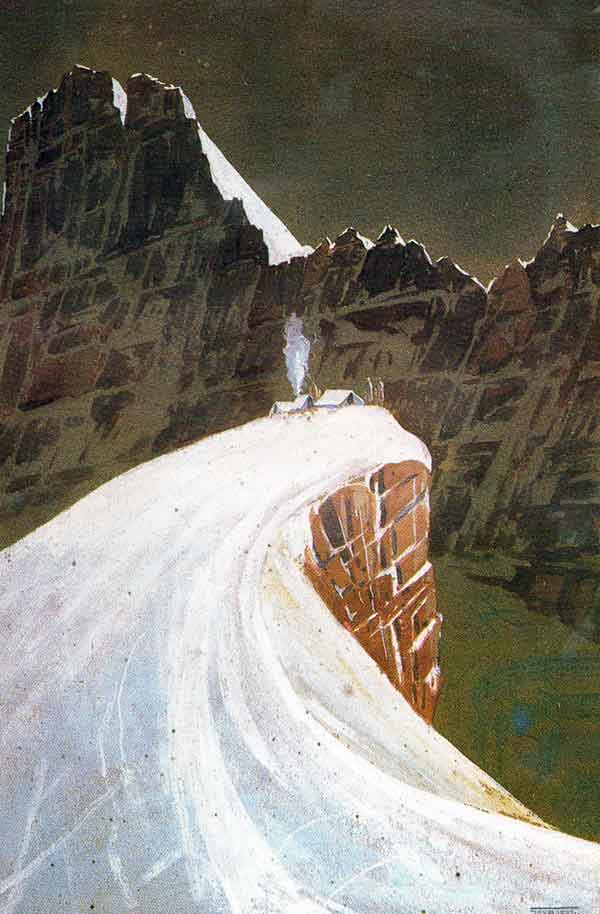
“ … very special thanks are due to Serbjeet Singh for his kind permission to reproduce the spectacular panorama of the Namka Chhu Valley and Thagla ridge which he was still painting, perched on a hill over-looking the Battle-field, when the Chinese launched their attack on 20 October, 1962.” Major General D K Palit, Vr C, 1991. 

It was in 1978, when waiting to catch the attention of the Director General Military Operations in his office, that I noticed a card-board object lying on a table by the window. On a closer look subsequently, that cratered card-board was in fact a paper-mache, three dimensional model of the Namka Chhu Valley. It was a stunning replica of the terrain over which 7 Infantry Brigade had sited its defenses and engaged the PLA troops in October 1962. The master crafts man was, Serbjeet Singh!

I had known the name but not the Man, leave alone his stupendous deeds and fame. A graduate in History (First Division) from Forman College, Lahore but his life’s calling lay elsewhere; the Himalayas were his load-stone, not just their physical attraction but rather the philosophical introspection they inspire among human beings at different levels and how they shape the lives and cultures of those who dwell in and around them. Above all, Serbjeet Singh (SS) perhaps even understood the geo-strategic significance of the Himalayas as India’s Northern frontier. For, how else can one explain the presence of a twenty four year old film-maker-cum-artist (Charcoal, water colour and Oils), participating of his free volition in the First Flight to Leh (24 May, 1948), and witness the Battles at Zoji La (01 November, 1948), watch the history-making exploits of the Stuart Tanks of 7 Cavalry beyond Zoji La and all other engagements culminating with the capture of Kargil, on 23 November, 1948!! And all of it filmed, sketched, painted and recorded in text too, in his personal diaries.

From times immemorial but especially beginning with Napoleon’s era, professional artists have been commissioned to paint battles and in particular scenes related to acts of valour (Victoria Cross) which are honored and prized to this day. All such art was a re-creation removed in time and space, even by Continents, but based on recorded history and supplemented at times by interviews with eye witnesses. But here was SS who was impelled solely by the inner urgings and the Faith of an artist (Dharma), not the money motive and certainly not ego. Perhaps SS may have assumed that his actions symbolized the “shoulder-to-shoulder” presence of the entire Nation with the front-line soldier? And in the same vane I salute SS, as the expression of gratitude to him on behalf of India’s Armed Forces as a whole, for recording on Film and through paintings the History of war in J&K in 1948-49.

The history of my narrative (in essence a compilation of nuggets of Military History), had its beginnings on the lawns of the Civil Lines Club, Jullander, on a balmy winters evening in February, 1948. SS was screening his 16 mm film on “Life In The Himalayas”, especially for Dr Gopi Chand Bhargava, the Chief Minister of the then Punjab State. Within minutes of commencement, “in strode a tall man who was received by the Chief Minister. That gentleman was Major General K S Thimayya, DSO, GOC Jullander Area.”* Evidently the General was so impressed by the film that he decided to encourage SS to document the combat actions of India’s fledgling Army in J&K, with the offer to SS and his younger brother thus, “If you boys are prepared to make a film on the war in Kashmir, I will send a signal to the GOC-in-C Western Command to help you. Come to my office tomorrow, in the Cantonment.” @