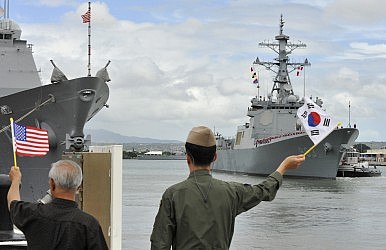
As Japanese Prime Minister Shinzo Abe arrives in Washington for a summit meeting with President Obama and to give an address to a joint session of Congress, the U.S.-Japanese alliance is at a critical turning point. Because U.S. officials are increasingly concerned about China’s growing economic and military power in East Asia, they look to Japan to play a more vigorous security role. That is a major change in attitude. A little more than two decades ago, General Henry Stackpole, commander of U.S. Marines in Okinawa, opined that the United States was the “cork in the bottle” preventing a resurgence of Japanese militarism and the fears that such a development would engender throughout East Asia. Stackpole may have been undiplomatic, but his views accurately reflected the wariness of U.S. policymakers about Japan playing the role of a normal great power in the security arena.

27 April 2015
The Japan Dilemma: Asia's Next Geopolitical Nightmare?
APR 24, 2015
The U.S. Department of Defense (DOD) released a new strategy on April 23, 2015, to rewire the Pentagon for cyber operations. The 33-page document includes five key strategic goals, ranging from workforce and human capital development to full integration of cyber capabilities into military operations and deterrence.
Q1: What makes the 2015 DOD Cyber Strategy different from the 2011 cyber strategy?
A1: The 2015 DOD Cyber Strategy is a more comprehensive and detailed articulation of the 2011 strategy, of DOD’s role in defending the United States against cyber attacks, and of how DOD will integrate cyber capabilities into military operations.
The new strategy serves as guidance for the development and deployment of DOD’s Cyber Mission Force structure, which will include 6,200 cyber operators divided into three missions: (1) defense of the department’s own computer networks; (2) protection of the U.S. homeland and U.S. vital interests against significant cyber attacks; and (3) provision of full-spectrum cyber capabilities for military operations.
China's 3 Most Powerful Dynasties
Contrary to the common perception of China being historically isolated and weak, many Chinese dynasties were very powerful and have had a profound impact on global history. Yes, it is true that during the Ming Dynasty, China ships conducted multiple voyages of exploration (1405-1433) before abruptly stopping. But this hardly dented the enormous economic and political influence China wielded for most of its history in East, Southeast, and Central Asia. Although the people of these regions pursued their own interests as best as they could, China was always the major power to be dealt with.
Nonetheless, not all Chinese dynasties were created, and these three stood above the rest.
China's South China Sea Disaster
China, Philippines Spar Over South China Sea Run-Ins
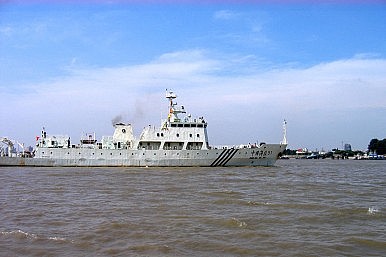
On Tuesday, the Philippines said that the Chinese Coast Guard used water cannons on a group of Filipino fishermen at Scarborough Shoal, damaging some of the fishermen’s boats. Hong Lei, a spokesman for China’s Foreign Ministry said the Chinese vessels were performing “guard duty in waters off the Huangyan Island [the Chinese name for Scarborough Shoal] to maintain the normal order of these waters in accordance with the law.” Hong added that Manila should “show earnest respect for China’s territorial sovereignty, step up its regulation and education of the fishermen and stop all actions infringing upon China’s territorial sovereignty, and rights and interests.”
South China Sea: China's Unprecedented Spratlys Building Program
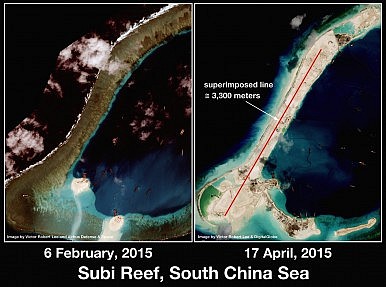
Military analysts have observed that a runway 3,300 meters long could support virtually all types of combat and supply aircraft in China’s navy and air force.
As recently as February 6, 2015, only two small sites of dredging and land fill activity were detectable at Subi Reef, part of a maritime region that is claimed by the Philippines, Vietnam, Malaysia and Taiwan, as well as China. As of April 17, 2015, the land fill of Subi measured 2.27 square kilometers in area, on a par with the rapidly manufactured island at Fiery Cross Reef, recently assessed as 2.65 square kilometers in area.
Why Buy the Hardware When China Is Getting the IP for Free?
BY DAVID WOLF
APRIL 24, 2015
In Beijing in late March, IBM CEO Virginia Rometty announced that the company’s new strategy in China will be to share its technology to help build the country’s IT industry.
“If you’re a country, as China is, of 1.3 billion people, you would want an IT industry as well,” she told the crowd at the China Development Forum, a government-sponsored event. “I think some firms find that perhaps frightening. We, though, at IBM … find that to be a great opportunity.”
Rometty needs a great opportunity. As the CEO of IBM since 2012, she has spent her more than 30-year career at the company watching it slowly shed the hardware, heft, and influence that earned it the “Big Blue” moniker. Still, IBM is no pipsqueak: With a roughly $160 billion market capitalization andjust under 380,000 employees, the firm remains a massive force in information technology.
Military Spending and Arms Sales in the Gulf
APR 28, 2015
This report is entitled Military Spending and Arms Sales in the Gulf: How the Arab Gulf States Now Dominate the Changes in the Military Balance, and is available on the CSIS web site here. It provides a wide range of tables and charts describing the patterns in military spending and arms transfers both in comparative dollar terms and by major weapons system and transfer of military technology.
The Arab-Israeli Conflict
By Ghaith al-Omari
APR 24, 2015
For the last seven decades, the Israeli-Palestinian conflict has been a central defining feature of the
Middle Eastern geostrategic landscape. In recent years, resolving this conflict through a negotiated two-state solution has become a matter of global and regional consensus and the subject of numerous initiatives. Changing realities between and within Palestine and Israel and the transformations facing the region at large have raised questions as to the feasibility of reaching such a permanent solution.
THE IRAN NUCLEAR DEAL: CONTAINMENT OR APPEASEMENT? – ANALYSIS
A framework agreement on Iran’s nuclear programme that would restrict the number of centrifuges it can possess, as well as limit its development of uranium enrichment was concluded in Lausanne on 3 April 2015. Iranian compliance with the agreement would result in the removal of crippling sanctions that have severely affected its economy. This deal can be said to represent a marked change in the international community’s approach to dealing with Iran’s nuclear ambitions.
US-South Korea: A Pragmatic Alliance?
The report, “Measuring a Giant: South Korean Perceptions of the United States,” looks at multiple indicators of how South Koreans view the U.S.: the favorability of ROK-U.S. relations, the U.S. national image, the U.S. in historical perspective, and the United States’ current political and economic influence vis-ร -vis China, among many others.
The data indicates that South Koreans maintain a favorable view of the United States, despite deepening economic ties with a “rising” China. For those interested in South Korean nationalism “in a era of strength and prosperity,” the data also indicates a rising pragmatism in South Korea.
Your Guidebook to a Greek Financial Default
It is worthwhile to review how we got here: The 2008 financial crisis exposed the Greek debt problem, yields spiked, and in an effort to maintain stability in the European Union (EU), the troika—the International Monetary Fund (IMF), the European Commission, and the European Central Bank (ECB) — bailed the Greek government out. This kept Greece in the EU, and the EU itself stable for a time. But the troika required adjustments to the Greek economy in return for its money, and this “austerity” thrust the Greek economy into a depression-like economic cycle.
U.S. Boots Hit the Ground in Lviv
April 24, 2015
While Russian officials and commentators have condemned the deployment as provocative, the direct impact will likely remain limited, even deflecting pressure for more direct U.S. involvement, such as providing lethal military assistance to Kyiv. In the longer term though, it is likely the United States will find itself playing a larger role in Ukraine, whether it wants to or not, a development that holds out the most hope for a diplomatic solution to the conflict.
OIL PRICE WAR MAY BENEFIT BOTH US SHALE AND SAUDI ARABIA – ANALYSIS
Even as financial commentators on CNBC are starting to come around to the idea of a bottom in oil prices, the key question for US oil producers remains one of timing. How long will the oil price slump last? Is this a relatively short term event like 2008, or a longer term slump like the one in the mid 1980’s? After the oil price crash in 1985, it took almost twenty years for prices to revert to previous levels. If oil does not return to $100 a barrel until 2035, there will be a lot less shale companies around. Some market commentators have cited hedging as a potential source of safety for oil producers, but the truth is that given most firm’s individual levels of hedging and the price of oil today, the hedges are more of a Band-Aid over a gunshot wound than anything else.
Secretary Of Defense Lays Out New Cyberwar Strategy, Wants Silicon Valley To Help
By Taylor Tyler
Apr 24, 2015
The 42-page strategy, for the first time publicly, lays out circumstances which would justify the deployment of cyberweapons against an attacker.
The strategy states: "As a matter of principle, the United States will seek to exhaust all network defense and law enforcement options to mitigate any potential cyberrisk to the U.S. homeland or U.S. interests before conducting a cyberspace operation.
Iranian cyberwar is a US right wing myth
By NICK FARRELL
24 APRIL 2015
Claims that Iran has been conducting a cyberwar against the United States have been greatly exaggerated by US conservatives.
Last week the New York Times took time out of its busy schedule advertising Apple products to run a yarn about a report of how Iran had conducted hundreds of thousands of cyberattacks against American industrial targets.
The article was based on a report penned by Norse, a prominent cybersecurity firm but they were working with the American Enterprise Institute, which is politely called a conservative think tank, or less politely a bunch of right wing nut jobs who think that the US can rule the world by bombing the Islam out of it.
According to the Daily Dot the Iran report was inaccurate, politically motivated, and a transparent marketing ploy to take advantage of headline-making international relations between the US and Iran.
Russian hackers accessed President Obama's unclassified emails: Report
April 25, 2015
Russian hackers had access to President Obama’s emails after infiltrating the White House and the State Department’s unclassified computer systems last year, according to reports.
The attack was far worse than officials initially admitted and hackers were able to view emails the president had sent and received, senior officials briefed on the investigation told The New York Times.
Michael Daniel, special assistant to the president and cybersecurity coordinator at the White House, speaks at Bloomberg Government's "Cybersecurity: Costs and Solutions" conference in Washington, D.C., U.S., on Wednesday, Oct. 30, 2013.
The hackers obtained access to the email archives of people inside the White House and reached emails that the president had sent and received, the Times reported Saturday.
Secretary Carter Wires in to Silicon Valley
APR 24, 2015
Q1: What are the fundamental changes in the high-tech world that have led Defense Secretary Ash Carter to work to “rewire” the Pentagon’s approach to innovation?
A1: Cutting-edge technological advances are being increasingly driven by commercial companies and by private investment. This is a world-wide phenomenon that means that high tech is both more commercial and more global than in the past. The share of global research and development (R&D) that is directed explicitly to the needs of the Department of Defense (DOD) is now 4 percent, a low point in the post–World War II era. Although sequestration has significantly hurt defense R&D, the trend predates sequestration, and it is largely caused by the private sector increasing its R&D spending in response to the demand for new technology in the global marketplace. This means that the preponderance of technology development, much of it with direct national security applications, is happening among firms that are not traditional suppliers to DOD and many of which are located overseas. Secretary Carter is seeking to tackle the challenge DOD faces in gaining awareness of and access to the technologies being developed by these firms.
Geography and World Power at 100
Fairgrieve was an intellectual disciple of the great British geopolitical thinker Sir Halford Mackinder, and borrowed some of Mackinder’s concepts in formulating his own geopolitical worldview. Fairgrieve factored into his geopolitical analyses topography, location, climate, relative population density, the distribution of energy, the ease or difficulty of movement, and political and social organization.
GULF OF SECRETS: THE EVOLUTION OF GULF STATE INTELLIGENCE SERVICES – ANALYSIS
In Yemen, it is Saudi Arabia along with the United Arab Emirates (UAE), Qatar, and other allies that have taken the lead in supporting the beleaguered government. On the other side is Iran, which is supporting the Shiite minority Houthis who are in turn allied with elements of the former president of Yemen.
Turkmenistan's War on Satellite Dishes
April 25, 2015
At the end of March, 2015, local housing authorities in the capital, Ashgabat, and its suburbs started ordering residents of multistory apartment buildings to take down their satellite dishes, citing simply an “order from above” that allegedly stated the dishes ruined the view of the city. Authorities told residents they could instead get cable television packages through the government or state satellite antennae.
Turkmenistan maintains a neutrality policy and opts out of participation in most regional endeavors, HRW calls it “one of the most closed and repressive countries in the world.”
The Disintegration of the World
CHRYSTIA FREELAND
Leon Trotsky is not often invoked as a management guru, but a line frequently attributed to him would surely resonate with many business leaders today. “You may not be interested in war,” the Bolshevik revolutionary is said to have warned, “but war is interested in you.” War, or at least geopolitics, is figuring more and more prominently in the thinking and fortunes of large businesses. Of course, multinational companies such as Shell and GE have long cultivated an expertise in geopolitics. But the intensity of concern over global instability is much higher now than in any recent period. In 2013, the private-equity colossus KKR named the retired general and CIA director David Petraeus as the chairman of its global institute, which informs the firm’s investment decisions. Earlier this year, Sir John Sawers, the former head of MI6, Britain’s CIA, became the chairman of Macro Advisory Partners, a firm that advises businesses and governments on geopolitics. Both appointments are high-profile examples of a much wider trend: an increasing number of corporations are hiring political scientists, starting their board meetings with geopolitical briefings, and seeking the advice of former diplomats, spymasters, and military leaders.“The last three years have definitely been a wake-up call for business on geopolitics,” Dominic Barton, the managing director of McKinsey, told me. “I’ve not seen anything like it. Since the Second World War, I don’t think you’ve seen such volatility.” Most businesses haven’t pulled back meaningfully from globalized operation, Barton said. “But they are thinking, Gosh, what’s next?”
40 maps that explain the Middle East
By Max Fisher
March 26, 2015
Middle East History
If this area wasn't the birthplace of human civilization, it was at least a birthplace of human civilization. Called "the fertile crescent" because of its lush soil, the "crescent" of land mostly includes modern-day Iraq, Syria, Jordan, and Israel-Palestine. (Some definitions also include the Nile River valley in Egypt.) People started farming here in 9000 BC, and by around 2500 BC the Sumerians formed the first complex society that resembles what we'd now call a "country," complete with written laws and a political system. Put differently, there are more years between Sumerians and ancient Romans than there are between ancient Romans and us.
The Fighting Gurkha
24 Apr , 2015
Both have a very distinctive appearance; with the Punjabi Mussalman they make up the bulk of the Indian Army; and their proud tradition has been won in every fight on our frontiers. Now other classes, whose qualities were hidden, live in the public eye. The war has proved that all men are brave, that the humblest follower is capable of sacrifice and devotion; that the Afridi, who is outwardly the nearest thing to an impersonation of Mars, yields nothing in courage to the Madrasi Christian of the Sappers and Miners.
These revelations have meant a general levelling in the Indian Army and the uplift of classes hitherto undeservedly obscure. At the same time the reputation of the great fighting stocks has been splendidly maintained.
A Baptism By Fire - Gallipoli at 100 Years
By James Holmes
April 24, 2015
Piercing Turkish sea and land defenses promised big things. Western forces would bypass the deadlock on the Western Front, restoring maneuver to the war. Forcing the straits would reestablish shipping lanes connecting the Western combatants with beleaguered Russia—an empire hard-pressed not just by German armies but by a Turkish assault on the Caucasus. It would turn the Central Powers’ southern flank, menacing German ally Austria-Hungary through the Balkans. And everyone loves a winner. Allied leaders hoped to woo new allies while discouraging others from bandwagoning with Germany.
Which Central Asian Leaders Are Attending Russia's Military Parade?
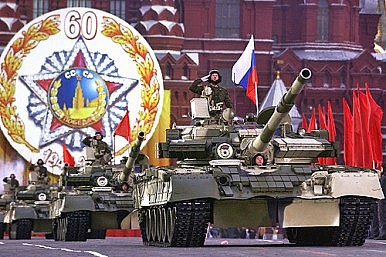
May 9 is Victory Day throughout the former Soviet Union, commemorating the surrender of Nazi Germany. The Soviet Union viewed the German surrender at Reims, France on May 7, 1945 as preliminary, as it had no representative present who had the authority to accept the surrender. A subsequent surrender, signed in Berlin late on May 8 (which was already May 9 in Moscow) ended the war for the Soviet Union. This year’s schedule of military parades across Europe and the former Soviet Union mark 70 years since the end of the war.
The Moscow parade promises to be a lavish affair, featuring 16,000 soldiers and over 200 pieces of Russian military hardware. Similar parades will be held across Russia. According to Russian media the Moscow parade will include T-90 battle tanks, GAZ-2975 Tigr infantry mobility vehicles, BTR-80 armored personnel carriers, and 2S19 Msta-S self-propelled howitzers, as well as an accompanying flying parade of MiG-29 and -31s, various Sukhoi Sus, and Yakovlev Yak-130s for the first time. The parade is also scheduled to feature for the first time three RS-24 Yars mobile ICBM launchers.
Barking up the Wrong Tree: How Not to Save the British Armed Forces from Legal Defeat
April 21, 2015
Judicial imperialism is defeating the British armed forces. At least this is what the authors of a report recently published by the Policy Exchange—an influential British think tank—claim. Provocatively entitled Clearing the Fog of Law: Saving our Armed Forces from Defeat by Judicial Diktat, the report argues that the judicial extension of peacetime legal standards to the battlefield is harmful to operational effectiveness and calls upon the UK Government to reverse this trend. The report builds upon an earlier paper on the same topic published by the Policy Exchange in November 2013 (read here and see comments here, here and here). Benjamin Wittes linked to it here.
There is little doubt that the British armed forces are facing significant legal challenges. These must be addressed as a matter of priority. However, neither the fiery tone of the report nor its actual policy recommendations are best suited to preserve the operational freedom of the military. In this post, we seek to explain why this is so (for a more detailed analysis along similar lines, see here).
PATTON’S HAWAIIAN ORDEAL: EVEN A LEGEND CAN LEARN FROM HIS MISTAKES
By Col. Cole C. Kingseed, U.S. Army retired
Then-Maj. Patton arrived in Hawaii in March 1925. Detailed to Schofield Barracks, he was appointed acting G-1 (personnel officer) and G-2 (intelligence officer) of the Hawaiian Division. Patton’s transfer to Hawaii was fortunate for an officer interested in training regiments, brigades and a division for war. In the continental U.S., the Army was dispersed in small detachments. As in the Philippines and Panama, however, Schofield Barracks could accommodate a sizable number of troops.
26 April 2015
India Bans Al Jazeera for Broadcasting 'Wrong' Maps of Kashmir
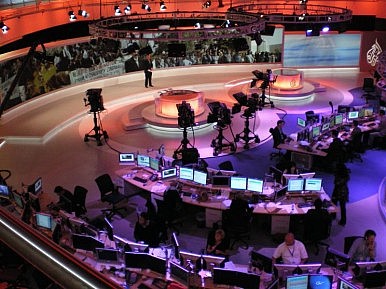
Yesterday, the Indian government banned Qatar-based Al Jazeera English from broadcasting within the country for five days after the channel showed a map of Kashmir that showed parts of the territory as belonging to Pakistan and China.
According to Agence France-Presse, any Indian viewers attempting to tune in to Al Jazeera English were instead left with a screen noting that “As instructed by the Ministry of Information and Broadcasting, this channel will not be available.”
The episode highlights the Indian government’s continued reliance on censorship in dealing with politically touchy subjects in the media and sensitivity to the representation of Kashmir in the media.
US-India Collaboration on Aircraft Carriers: A Good Idea?
Subscribe to:
Posts (Atom)