by Kris Osborn
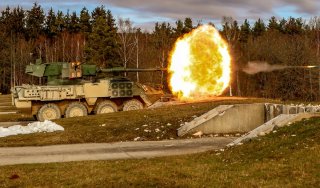 Strykers (see picture above) will incinerate enemy drones, helicopters, aircraft, and maybe even incoming enemy missiles, rockets, and artillery with 50kw laser weapons during an upcoming “combat shoot-off” at Fort Sill, Okla.
During the shoot-off, and Army Futures Command statement says, the laser-armed Strykers will face a series of “scenarios designed to test the system and establish threshold requirements for this class of laser.”
For quite some time, the Army and other laser weapons developers have been working on engineering power-scaled lasers able to fire with greater strength, power, precision, and range. This requires exportable sources of power, the proper form factors or hardware configurations and specially engineered laser-firing technologies built to optimize firepower.
The Army has been integrating and testing laser weapons on Strykers for quite some time and has in recent years already armed tactical vehicles with some measure of power. The reasons for this are both clear and numerous.
Lasers are quiet, meaning they can fire without a large acoustic signature which could give away an attack position, should a large missile or cannon be fired. They can offer a kind of silent attack. They are also scalable, meaning they can fire off to fully destroy and incinerate or merely stun or disable an enemy target, depending upon the power setting of the weapon. Higher and higher power lasers are fast emerging to the point where should technology and form factor miniaturization mature at the current pace, fighter jets, tanks, and other large-scale combat platforms will likely be armed with very high-power laser weapons.

/cloudfront-us-east-1.images.arcpublishing.com/mco/TXYBVZAICFGEHEBMHXAXWNXLTQ.jpg)










/cloudfront-us-east-1.images.arcpublishing.com/mco/RJMS3BUGEJFFVKF653XK6T6LBQ.jpg)


