Does this portend the new, more aggressive era of Indian counter-terrorism—and perhaps even covert operations—that many anticipated from Prime Minister Narendra Modi? While it's true that the speed of the Indian response is novel, some questionable lessons are being drawn in the breathless press coverage. This isn't helped by the fact that Indian accounts are presently mired in inconsistencies and contradictions.
14 June 2015
Did India's Special Forces Just Send 'A Message' to China and Pakistan?
How China and Pakistan Are Beating India in the New Great Game
In South Asia and beyond, Islamabad and Beijing are giving New Delhi a run for its money.
Modi’s Bangladesh outreach is part of a broader strategy of “SAARC-minus-one,” aimed at integrating members of the South Asian Association for Regional Cooperation (SAARC), except for Pakistan. Similarly, as part of its “Look East” policy, New Delhi plans a more assertive Asia-Pacific strategy, aimed at countering China by strengthening relationships with countries such as Australia, Japan, and South Korea, which fear Chinese hegemony.
But as India looks east, it is losing influence to its west to China and Pakistan. India’s inability to consolidate space in South Asia should induce greater caution in assessments of its rise as a global power given its inability to establish dominance in its periphery.
India has experienced a flurry of setbacks to its west as of late.
One, New Delhi has lost influence in Afghanistan, where President Ashraf Ghani has tilted his government toward Pakistan and China, as part of a bid to secure peace in his country. After coming into office last fall, Ghani’s first foreign visits were to Saudi Arabia, China, and Pakistan. His first presidential trip to India took place this April, after he suspended an arms deal with New Delhi.
Why China and India Want Russia's New Armata Battle Tank
June 11, 2015
China and India are among the countries that could purchase Russia’s new T-14 Armata battle tank, according to the Russian government.
“There really is interest, despite the fact that the equipment is expensive,” Kozhin said, according to Russian media outlets. “To a large extent, it is our traditional partners; India, China and South-East Asia.”
The need for China makes sense. Although China has largely settled its land border disputes with neighbors, China’s military still lacks a viable battle tank, despite its valiant modernization efforts,. “China’s main battle tank, the Type 99, is still a derivative of the old Soviet T-72 main battle tank, with a design that stretches back to the mid-1980s,” Kyle Mizokami noted on The National Interest back in May.
How China Could Become a Two-Ocean Power (Thanks to Pakistan)
Claude Rakisits
June 12, 2015
IMF: Ghani has Shown Afghanistan is ‘Open for Business’
BY ASHISH KUMAR SEN
Fund official says administration in Kabul still has to overcome some 'bottlenecks'
Afghan President Ashraf Ghani has shown the world that his administration is “open for business,” but Afghanistan still faces “a lot of bottlenecks” that need to be addressed, the International Monetary Fund’s top official in Kabul said June 11.
In recent discussions with Afghan officials, he said “there was a very strong impetus and desire of the [Ghani] administration to agree [to] something with the IMF as a way of signaling to the world that Afghanistan is open for business and the new administration is determined to proceed with reforms.”
Will This Chinese Weapon Be Able to Sink an Aircraft Carrier?
According to Gertz, the WU-14 high-speed warhead is “a high-technology strategic weapon capable of delivering nuclear or conventional warheads while traveling on the edge of space.” Additionally he noted that the HGV is “assessed as traveling up to 10 times the speed of sound, or around 7,680 miles per hour.”
What makes this week’s test launch, which occurred at a test facility in western China, different from previous ones that took place last year – on January 9, August 7, and December 2 – is that the WU-14 allegedly performed “extreme maneuvers”, according to intelligence officials that Gertz spoke to.
China Warns Japan to Stay out of South China Sea
Zachary Keck
June 12, 2015
In a regular scheduled press conference on Friday, Chinese foreign ministry spokesperson, Hong Lei, warned Japan to stay out of the South China Sea dispute.
“The Chinese side is gravely concerned and indignant about the negative moves of the Japanese side. We have lodged multiple solemn representations with Japan,”
He went on to say:
Japan is not a party concerned to the South China Sea issue. Recently it has behaved in an abnormal way, deliberately thrust a hand in the South China Sea issue, driven a wedge among regional countries and maliciously created tensions in the South China Sea. Japan’s moves do no good to solve the South China Sea disputes, or safeguard peace and stability of the South China Sea. It also severely damages the political and security mutual trust between China and Japan, and runs counter to the momentum of improving bilateral relations. We once again urge the Japanese side to abide by its commitment of not taking sides on the South China Sea disputes, put an immediate end to the hyping up of the South China Sea issue and groundless accusations against China, stop provoking conflicts among different parties for self-serving interests, genuinely maintain the momentum of improving Sino-Japanese relations and respect the efforts by China and ASEAN countries to safeguard peace and stability of the South China Sea.
Made in Beijing: An Anti-China Alliance Emerges
Richard Javad Heydarian
June 13, 2015
Recognizing the gravity of the deepening crisis in the South China Sea, the world’s leading western powers have begun to speak out. During their latest summit in Germany, the Group of Seven (G7) leaders underlined the “importance of peaceful dispute settlement as well as free and unimpeded lawful use of the world's oceans,” and expressed how they “strongly oppose the use of intimidation, coercion or force, as well as any unilateral actions that seek to change the status quo, such as large-scale land reclamation [author’s own emphasis].” Obviously, it was too diplomatically provocative to explicitly name China, but it was pretty clear which country the Western leaders had in mind.
China to Japan: Stay Out of South China Sea
By Shannon Tiezzi
June 13, 2015
China dismisses the notion that Japan has any real interests at stake in how the South China Sea disputes are handled. Beijing refuses to acknowledge Japanese (and U.S.) claims that freedom of navigation through this vital shipping lane is at risk. Writing for the Chinese-language edition of Financial Times, Chinese scholar Xue Li argued that Japan’s loudly voiced concern for South China Sea shipping lanes is a “facade” and that Japan’s real motive was a wish to maintain political influence in Southeast Asia and bolster its own position on the East China Sea territorial disputes.
China: Active Defense in the Cyber Domain
By Elsa Kania
China Sends Most Lethal Bombers Near Taiwan, Philippines
June 11, 2015
Chinese bombers participated in a joint air-sea military exercise near Taiwan and the Philippines this week.
A Chinese Navy official downplayed the importance of the drills, claiming they were routine and in line with international law.
"During the drills there was no impact upon freedom of navigation or fly-through in the relevant seas or air," the official said, Reuters reported. He added: "Going forward, similar drills and exercises will keep taking place.”
Sorry, Obama: America Can't Contain China
June 12, 2015
"Our clumsy statecraft these last few months in the Asia-Pacific betrays a deeply antiquated and dangerous misunderstanding of the Middle Kingdom and how to deal with its growing influence."
America’s responses to current territorial conflicts in the South China Sea and the expansion of the Asian Infrastructure Investment Bank (AIIB) in April harken back to Cold War containment. Despite its protestations otherwise, the United States has been clearly trying to establish boundaries on China’s power in the Asia-Pacific. For “the world today,” that approach encourages aggression with few benefits.
Philippines and China in "video war" over South China Sea
Jun 11, 2015
A Chinese Coast Guard vessel (R) passes near the Chinese oil rig, Haiyang Shi You 981 (L) in the South China Sea, about 210 km (130 miles) from the coast of Vietnam June 13, 2014.
The documentary titled "Karapatan sa Dagat", or maritime rights, will be aired on state-run television as the country observes Independence Day.
"Our objective is to inform our people," Charles Jose, the foreign ministry spokesman, said adding they hoped to "rally support of our people behind our Philippine government's policy and action".
The Philippines has filed an arbitration case against China, which claims almost the entire South China Sea, believed to be rich in energy resources and where $5 trillion ship-borne trade passes every year. Brunei, Malaysia, Vietnam and Taiwan also have claims on the sea.
Preventing Iran's Nuclear Checkmate
Avner Golov
June 13, 2015
Chess is considered to be one of the best games for strategy training. The game's main purpose is to eliminate the opponent's options and reduce the number of his available alternatives until nothing is available—Checkmate!
Chess originated in an area which today is part of Iran. It is therefore fitting that Iran’s negotiation strategy with world powers over its nuclear program can be explained according to the rationale of the game. If this analysis reflects the Supreme Leader Khamenei's stance, then Iran’s stated opposition to comprehensive inspections on military sites should not be seen as Iran's red lines. Rather, this public stance reflects a sophisticated strategy aimed to undermine the most important basis for the American policy in the post-nuclear agreement world. Tehran is preparing its final move—Checkmate!
U.S. Adapts ‘Lily Pad’ Strategy to Defeat ISIS in Iraq
June 11, 2015
The top U.S. military officer likened the expanding American footprint in Iraq Thursday to “lily pads” that will sprout across the pond known as Anbar Province, where the Islamic State of Iraq and Greater Syria seized the capital last month.
“Our campaign is built on establishing these ‘lily pads’ that allow us to encourage the Iraqi security forces forward,” Army General Martin Dempsey, chairman of the Joint Chiefs of Staff, told reporters during a visit in Italy. “As they go forward, they may exceed the reach of the particular lily pad”—leading to the creation of new ones.
While the strategy may be a new one since the U.S. pulled its forces out of Iraq in 2011, it has been done before. In both Afghanistan and Iraq, similar campaigns were carried out, often called “oil spot” or “ink blot” strategies.
Assessing the Fragmentation of the Middle East
June 11, 2015
Today, the term Middle East, to the extent that it means anything, refers to the Muslim-dominated countries west of Afghanistan and along the North African shore. With the exception of Turkey and Iran, the region is predominantly Arab and predominantly Muslim. Within this region, the British created political entities that were modeled on European nation-states. The British shaped the Arabian Peninsula, which had been inhabited by tribes forming complex coalitions, into Saudi Arabia, a state based on one of these tribes, the Sauds. The British also created Iraq and crafted Egypt into a united monarchy. Quite independent of the British, Turkey and Iran shaped themselves into secular nation-states.
Dempsey: New Hub in Iraq Could be Model
June 11, 2015
NAPLES, Italy (AP) -- The new U.S. military hub setting up in Iraq's western desert could be a model for more such train-and-advise operations - and with it likely more U.S. troops - designed to help Iraq defeat the Islamic State, the top-ranking American general said Thursday.
"It's another one of the options" short of committing U.S. ground combat forces, he said. President Barack Obama has ruled out U.S. ground combat.
Dempsey spoke the day after the Obama administration announced that as many as 450 U.S. troops will go over the next two months to al-Taqqadum, situated between the Islamic State-occupied cities of Ramadi and Fallujah in Anbar province, to advise Iraqi forces and help integrate a larger number of Sunni tribal fighters into the Iraqi campaign to retake Ramadi.
House kills push to defund anti-ISIS training for Syrian rebels
June 10, 2015
The House rebuffed an attempt late Wednesday night to eliminate funding for the Obama administration's program to train and equip Syrian rebels to fight against the Islamic State of Iraq and Syria (ISIS).
Clawson compared the Obama administration's dependence on what he described as "untested" Syrian rebels to serve as "vicarious fighters" against ISIS to the U.S. providing assistance in the 1970s to mujahadeen fighters to combat the Soviet Union. Those militants ultimately became the Taliban.
ISIS publishes manual on ‘How to Survive in the West’
You can download the entire manual at this link. https://db.tt/mMNQg9Hv Sorry to be late in sending this out as a friend just sent me this. I missed then when it was discussed in March, April, and May.
I have pasted the table of contents below the article. I guess ISIL is really taking on the image of a state as it is being nice enough to publish its "doctrine" just as we do. Note the discussions on propaganda and guerrilla warfare. Note also the discussion of very recent terrorist events such as in Paris and Denmark.
This really is an ISIL unconventional warfare manual (with ISIL Characteristics).
As we work to counter-Unconventional Warfare we should study this manual and we should observe for the activities described.
Europe's New Central Asia Strategy
RFE/RL reports that soon the EU’s Central Asia strategy will be updated again, presumably at a June 22 meeting of foreign minister in Luxembourg.
According to RFE/RL, the new strategy will put more focus on “serious challenges to human rights” in the region.
The 2007 strategy identified “security and stability” as the EU’s strategic interests in the region. The document did not ignore human rights–placing emphasis on dialogues–but skipped over topics such as torture. Focus was placed on rule of law, combating corruption, and stemming the drug trade flowing out of Afghanistan.
Pentagon Asks China to Stop Island Building in South China Sea (Again)
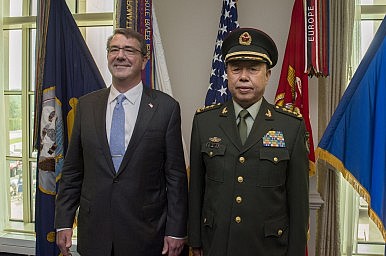
General Fan is the most senior Chinese military leader to visit Washington since Chinese President Xi Jinping took over the leadership of the Chinese Communist Party. Fan directly reports to Xi, the only person outranking the general in the Central Military Commission.
According to DoD News, land reclamation by China and other rival claimants in the South China Sea was one of the principal topics of discussion, with both sides sticking to their positions. Carter once more stated that the United States wants China and all other countries to stop building islands and end the militarization of disputed territories.
The Bear and the Elephant
Maria Butina
June 12, 2015
It may take the election of a Republican to the White House in 2016 to improve relations between the Russian Federation and the United States. As improbable as it may sound, the Russian bear shares more interests with the Republican elephant than the Democratic donkey. No doubt leading Republicans will denounce Russian aggression during the campaign season, as former Florida Governor Jeb Bush did recently during his visit to Berlin where he called Russian president Vladimir Putin a “bully.” He added, "I'm not talking about being bellicose, but saying, 'Here are the consequences of your actions.' And that would deter the kind of bad outcome that we don't want to see." But talking tough on the campaign trail is one thing. Governing is another. Perhaps a Republican president would look for ways to move past the increasing confrontation that has characterized the U.S.-Russia relationship in the past few years.
Another Reason to Support the Trans-Pacific Partnership
June 11, 2015
Not only is the TPP an integral part of the Asia pivot, but it will also strengthen America's position in the Western Hemisphere.
Center for the National Interest Honors Secretary of Defense Ashton B. Carter
June 12, 2015
The event featured appearances by National Security Adviser Susan E. Rice and Senator Pat Roberts. James Rosen, chief Washington correspondent for Fox News, was the emcee.
Rice, a longtime colleague of Carter’s, delivered an impressive tribute. Shepraised his analytic disposition, his effectiveness in “cutting through red tape” to get things done, and the respect that he and his wife Stephanie have “earned from the men and women who wear our country’s uniform.” Rice argued that it is “a tribute to [the Center] and our honoree” that the gathering drew “such a broad cross section of Washington—academics and ambassadors, leaders from Congress and the Administration, Republicans and Democrats.” She added that “for more than twenty years, the Center has reminded us of something we should never forget—that our national security should stand above politics.” Carter, who Rice called “a public servant’s public servant,” enjoys a similar reputation.
Putin's Russia Is Not 'Back in the U.S.S.R.' (Op-Ed)
By Ivan Sukhov
Jun. 10 2015
That allusion to perestroika immediately raises some uncomfortable questions. Is the current rise of authoritarianism and the breakdown of basic institutions the logical consequence of Gorbachev's reforms, or is it some strange evolutionary offshoot, a careless wrong turn down a historical blind alley?
Also, how likely is it that the current regime will recognize the need for reforms? Will a new "Gorbachev" emerge from President Vladimir Putin's "politburo," and if so, will he manage to overcome the inertia of his political milieu?
Tactical Nuclear Weapons and Deterrence
By Christine M. Leah
June 12, 2015
How Wi-Fi Will Power Tomorrow’s Battle Gear
Last week, researchers from the University of Washington unveiled a paper, “Powering the Next Billion Devices With Wi-Fi,” that describes how to power a small camera with a Wi-Fi signal. In essence, the camera’s 2.4-GHz antenna becomes an energy harvester that transforms radio frequency signals into DC power. Unlike some other ambient power schemes, this one doesn’t interfere with the functioning of the router. (WIRED took note, declaring “Wi-Fi to power your gadgets is closer than you think,” and then walked back expectations with “Wi-FI charging is real, but probably won’t charge your iPhone.”)
Cyber Threat from China: What it Means for India
Dr Saroj Kumar Rath
12 Jun, 2015
If there is a second India-China War, India’s adversary does not need to send troops to the trenches of the Himalayas but only has to ask its cyber warriors to cripple India’s security infrastructure from their air-conditioned rooms.
As per an estimation of the National Security Council, China, with its 1.25 lakh cyber security experts, is a potential challenge to India’s cyber security. In humiliating contrast, India has a mere 556 cyber security experts. At stake is India’s US$ 2.1 trillion GDP, power grids, telecommunication lines, air traffic control, the banking system and all computer-dependent enterprises.
India and China’s cyber security preparedness is a striking study in contrast. India is a reputed information technology-enabled nation while China struggles with its language handicap. India, with a massive 243 million internet users, has digitized its governance, economy and daily life on an industrial scale without paying adequate attention to securitize the digitization plan. In the digital era, national security is inextricably linked with cyber security, but despite being the single biggest supplier of cyber workforce across the world India failed to secure its bandwidth and falters to detect the simplest of cyber crimes, which often leads to devastating consequences.
Chinese Cyber Agenda
The Future of Net Assessment at the Pentagon
June 12, 2015
Yoda has left the building: What does the U.S. Secretary of Defense want the Pentagon’s internal think tank to focus on?
In a June 4 memo titled “Guidance,” Defense Secretary Ashton Carter outlined that he expects the institution, which has a $10 million annual budget and is headed by ret. Air Force Col. James H. Baker, to focus its expertise more on current defense policy issues rather than hypothetical future threats.
Showdown: Is Greece Headed towards a Financial Meltdown?
June 12, 2015
Will Europe's financial crisis ever end?
The point of urgency (this time) was a June 5 payment due from Athens to the International Monetary Fund (IMF), the first of four. Greece’s government said it had the monies on hand to meet that €300 million obligation. Doubts abounded. Whatever the truth of Greece’s ability to cover this particular payment, it remains plain that Athens cannot make good on the full €1.6 billion due over the course of the month. To discharge that obligation, the Greek government must reach some agreement with the European Union (EU), the European Central Bank (ECB), and the IMF, the so-called troika, to gain access to the €7.2 billion remaining in the bailout fund established in 2012. The IMF, by allowing Greece to bundle all its June obligations into one payment due on June 30, has bought a grand total of some three additional weeks for negotiations.
Subscribe to:
Posts (Atom)