 With growing number of coronavirus cases in India (and worldwide), policymakers have sprung into action – more information is being disseminated about preventive measures such as hand washing and not touching the face. Social distancing has been suggested as a tool to “flatten the curve”, or in other words, prevent the health system from being overburdened. Although the number of COVID-19 cases are still low in India, experts have warned against community spread of the disease which will lead to rapid and huge increase in demand for health facilities. Private healthcare is expensive and unavailable for many poor households in India which leaves public healthcare facilities as the only available option for them. For patients who are found to be COVID-19 positive, isolation wards are needed; additionally, for critical cases, intensive care is needed. Currently, almost all suspected cases of coronavirus are referred to government hospitals and it’s important to assess where we stand in terms of medical capacity to provide necessary healthcare to the affected individuals.
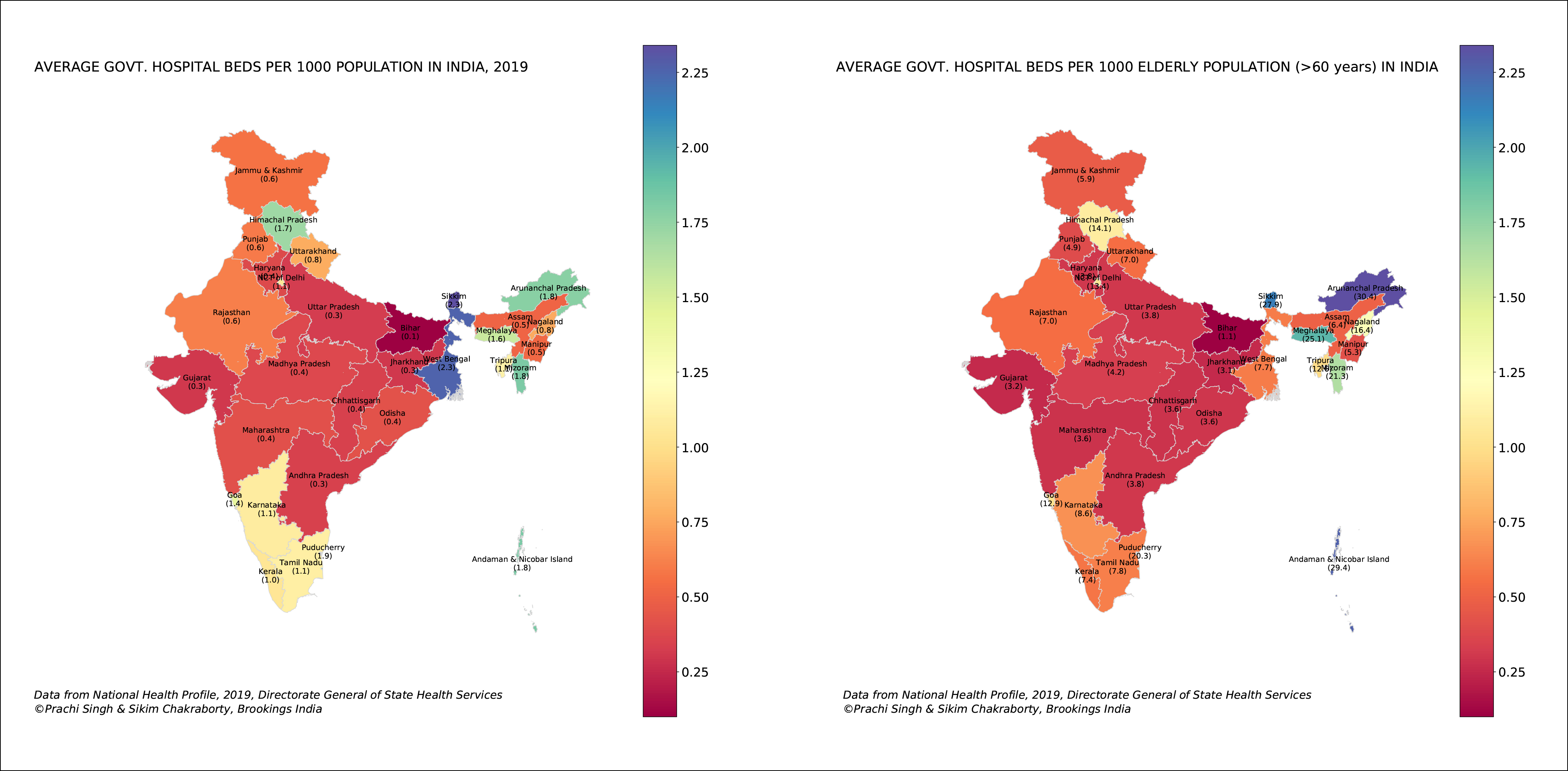
In this piece we focus on availability of government hospital beds[1] for major states in India. Using data from National Health Profile–2019, we observed that there are 7,13,986 total government hospital beds available in India. This amounts to 0.55 beds per 1000 population[2,3]. The elderly population (aged 60 and above) is especially vulnerable, given more complications which are reported for patients in this age group. The availability of beds for elderly population in India is 5.18 beds per 1000 population. In the heatmaps below, we show the state-level variation in availability of government beds in India.
We observe that many states lie below the national level figure (0.55 beds per 1000 population)[4], these include Bihar, Jharkhand, Gujarat, Uttar Pradesh, Andhra Pradesh, Chhattisgarh, Madhya Pradesh, Haryana, Maharashtra, Odisha, Assam and Manipur. These 12 states together account for close to 70% of the total population in India. Bihar has an acute shortage of government hospital beds with just 0.11 beds available per 1000 population. Some states do better on this metric such as West Bengal (2.25 government beds per 1000) and Sikkim (2.34 government beds per 1000). The capital city of Delhi has 1.05 beds per 1000 population and the southern states of Kerala (1.05 beds per 1000) and Tamil Nadu (1.1 beds per 1000) also have better availability of beds. The scenario is pretty similar when the analysis is done for just the elderly population: Northeastern states do far better than others; southern states also have higher number of beds available for elderly population — for example, Kerala (7.4), Tamil Nadu (7.8), Karnataka (8.6) — while northern and central states have relatively low availability of government beds for elderly population.
The availability of government beds is abysmally low in India, and an epidemic like coronavirus can very quickly complicate the problem even further. An estimated 5-10% of total patients will require critical care in form of ventilator support. In a worst-case scenario, according to one estimate at least, we may end up with 2.2 million cases in India[5] by May 15, which implies that we will need 110,000 to 220,000 ventilators. We have no official figures on the number of ventilators available in the public sector, however ,we arrive at an estimated figure using the number of hospital beds available — 7,13,986 total government beds, out of which 5-8% are ICU beds (35,699 to 57,119 ICU beds)[6]. Assuming that 50% of these ICU beds have ventilators, we arrive at an estimate of 17,850 to 25,556 ventilators in the country. Even in the best-case scenario where all ICU beds are equipped with ventilators, we have a maximum of ~57k ventilators to cater to a growing number of COVID-19 patients. Clearly, the growing demand for ventilators is going to outstrip the limited supply really soon.
While demand is being kept down by behavioural interventions such as social distancing etc, supply of beds and critical care equipment like ventilators needs to be quickly ramped up. In this regard, the government has already banned the export of critical care medical equipment. Additionally, excess capacity in private healthcare can be strategically used by the government and emergency plans of setting up hospital beds in army camps should be executed as soon as possible.
No comments:
Post a Comment