3 July 2014

Is Afghanistan the Next to Crumble?


Afghan security forces leave the site of burning NATO supply trucks after an attack by militants near the Pakistani-Afghan border, June 19, 2014


Amid the stunning rout of Iraqi forces in northern Iraq, many have asked whether a similar reversal of American foreign policy goals is possible in Afghanistan. The answer is a qualified yes.

Of course, Iraq and Afghanistan have a number of differences, urbanization, wealth, history, and geography among them. They have in common a lengthy U.S.-led intervention combining efforts to build a military force with the creation of a government. Iraq, like Afghanistan, held elections in the waning days of American involvement, to form a multi-ethnic government. As with Iraq, the U.S. military is announcing plans to leave Afghanistan on a note of cautious optimism.

In Afghanistan, as in Iraq, there is widespread disaffection with the government. In fact, it is not uncommon to hear Afghans refer to their government as a mafia. Corruption and patronage dominate both governments, ranking among the world's worst according to Transparency International. The defense and security sectors of both countries are assessed at a high risk (PDF) of corruption, ranking in the bottom third worldwide. Moreover, the absence of a coherent political strategy in Afghanistan to address issues of factionalism, patronage and corruption has contributed to the development of a government that few seem willing to fight for.

In both countries, a persistent bias toward combat operations over institutional capacity-building and governance prioritized the here-and-now over the long haul. As a result, efforts to develop intelligence, logistics and sustainment capabilities lagged far behind efforts to reach manpower and equipment goals.

Of course, it is too early to say that these failures will lead to a collapse of the military, but few attempts have even been made to ask the question. There is at least a basis for concern: A 2010 audit (PDF) by the Special Inspector General for Afghan Reconstruction found that both corruption and infrastructure failures had a corrosive effect on morale within the Afghan National Security Forces.

The preparation of the force is only half of the equation. Equally important is the nature of the threat faced by the military. In Iraq, the insurgents are the Islamic State in Iraq and the Levant, known as ISIL or ISIS, brutal actors with an agenda of disruption and dreams of a caliphate. They resemble the Taliban of the nineties, who wanted power without the shackles of actually governing a state.

The Taliban today are very different. They have honed their skills at local government, as evidenced by the sophistication of their judicial system (PDF) and the existence of shadow governments in districts across the country. The Taliban probably have less interest in random violence, and more desire to coopt institutions of government compared to ISIL.

A Taliban takeover in the hinterlands might not involve much more than targeted assassinations to allow supporters step into the shoes of local governors. A political takeover of this type would be equally damaging to Kabul, but not obvious to outsiders until it is poised to fall.

Welcome to Stanistan

ARGUMENT
Behold the power of Central Asia's new superstate.
BY FRANK JACOBS
JULY 1, 2014

At a signing ceremony in the Kazakh capital, Astana, on May 29, the presidents of Russia, Belarus, and Kazakhstan ratified the Eurasian Economic Union (EEU) into existence. An EEU modeled on the European Union was first mooted back in 1994 by Kazakh President Nursultan Nazarbayev, but took off only after his Russian counterpart, Vladimir Putin, seized upon its potential as a Moscow-centered, Asia-oriented alternative to the EU. The groundwork was laid in 2010 by a customs union among the three signatories.

Armenia intends to join the EEU in July, and Kyrgyzstan and Tajikistan are also on the fast track toward membership. Already, though, the three-nation EEU has created a single trade zone of 170 million people with a GDP of $2.7 trillion. Although the integration initially is purely economic, if Putin has its way the EEU could become a more overtly political project over time -- like the EU itself.

But whether the fledgling EEU and its first inductees are planting the seeds of a new world empire remains to be seen. Putin's dream to restore Russia to its former glory may falter at the EEU's inherent contradictionsand shortcomings: Its members themselves seem more interested in trading with Europe and China than with each other, and, even combined, their economies measure less than one-fifth of either the EU or the U.S. economy.

If Putin's new Eurasia is to be more than re-demarcating the shrunken limits of the Kremlin's regional influence, it will eventually need to attract a few crucial states on its eastern and western flank as EEU members: China and Ukraine, for example. Or even Turkey, which is officially still waiting for the green light from Brussels to join the European Union. None of those three countries seems likely to accede to the EEU (though Turkey at least has been officially invited by Kazakhstan). So for now, the EEU consists of Russia and the most Moscow-friendly of the former Soviet republics -- its nearest abroad, so to speak.

Belarus was always going to be the most willing partner in Russia's attempts at self-aggrandizement. Having languished under President Aleksandr Lukashenko since 1994, Europe's last dictatorship is isolated from the West and totally dependent on Russian oil and natural gas, and thus has no other geopolitical options. And like Belarus, Kazakhstan is landlocked and somewhat lacking in democratic credentials -- Nazarbayev has been running the show since 1989, even before the collapse of the Soviet Union in 1991.

But unlike Belarus, whose main exports include tractors and meat, Kazakhstan is resource-rich. With 30 billion barrels still in the ground, it has the world's 11th-largest crude oil reserves. Gas, coal, and uranium are also plentiful. The country's stated aim is to use its mineral wealth to join the club of 30 most developed nations and become a "Singapore of the steppes."

Kazakhstan is neither poor nor insecure -- which seem the two main reasons for other former Russian satellites to want in on the EEU. In fact, despite signing the accord, the Kazakhs seem wary of Moscow's intentions and could strike out for an empire of their own -- if only they looked south for inspiration instead of west for reassurance. But that runs counter to the instinct of its present leadership.

In February 2013, Nazarbayev proposed changing his country's name to Kazakh Eli, to differentiate it from the "stans" on its southern border. The change (which hasn't gone through yet and might never be adopted) illustrates a mindset popular among the nouveaux riches, be they individuals or countries: Dissociate yourself from your poor, backward, violent cousins.

Sri Lankan perceptions of the Modi government

IDSA COMMENT
http://idsa.in/idsacomments/SriLankanperceptionsoftheModigovernment_gsultana_010714.html

July 01, 2014

There is a common perception in Sri Lanka that India’s policy towards the island nation is greatly influenced by Tamil Nadu. This perception gained ground during the days of coalition politics in India over the last two decades, when political parties from Tamil Nadu formed part of the ruling coalitions at the centre. Therefore, when the Bharatiya Janata Party (BJP) succeeded in securing an absolute majority and its leader Narendra Modi became Prime Minister, a section of the commentators in the Sri Lankan media, particularly from the Sinhala community, heaved a sigh of relief that Tamil Nadu would no longer be able to dictate India’s Sri Lanka policy.

The turn of events after the elections seemed to strengthen this perception. Prime Minister-elect Modi ignored protests by Vaiko and Jayalalitha against extending invitation to the Sri Lankan President Mahinda Rajapaksa to attend the swearing-in ceremony of the new government in New Delhi. In fact, Vaiko, who is an alliance partner of the BJP-led National Democratic Alliance (NDA), was arrested along with other activists while protesting against Mahinda Rajapaksa’s visit in Delhi on May 26.

However, the Sri Lankans were in for a shock when Modi reiterated the previous government’s position on the ethnic issue and requested President Rajapaksa to ‘expedite the process of national reconciliation by fully implementing the 13th Amendment and going beyond’, during their bilateral discussions in Delhi on May 27, 2014. Following this, hundreds of activists, led by the National Freedom Front (NFF), a coalition partner in the United People’s Freedom Alliance (UPFA) government, protested in Sri Lanka against Modi over his advice to Rajapaksa to step up post-war reconciliation with the Tamils. The Lankan government spokesman and Minister Nimal Siripala de Silva said that the government would cooperate with India but no one should interfere with the internal affairs of the country.
Sinhala Nationslist Perceptions

The Sinhala community, particularly the Sinhala nationalists had their reasons to be hopeful about a shift in India’s Sri Lanka policy under the new government. Modi was seen as a nationalist leader and therefore, it was believed that there could be better understanding and cooperation between Modi and Mahinda Rajapaksa. It was also argued by some in the media that Modi, who was allegedly responsible for human rights violations during Godhra riots in India, would not raise the issue of human rights in Sri Lanka. It was also argued that since, Modi was denied visa to the US as a private citizen, he would not cooperate with the US on any issue detrimental to Sri Lanka’s interests.1 Further, it was perceived that Modi would not have to listen to Tamil Nadu on his decisions on Sri Lanka, as his party had a majority (282 seats) in the parliament. Although Jayalalitha’s All India Anna Dravida Munnetra Kazhagam (AIADMK) got 37 seats out of 39 in Tamil Nadu, it would not play any decisive role in the Lok Sabha far from influencing Modi government’s policies towards Sri Lanka. Extending the same logic the optimists in Sri Lanka also hoped that the other two Tamil parties, most vocal on Sri Lankan issues— Pattali Makkal Katchi (PMK) and Marumalarchi Dravida Munnetra Kazhagam (MDMK)— despite being alliance partners of the BJP, would also not be able to carry much influence in this regard. Therefore, Sri Lankans saw in Modi a reliable ally and partner. However, after the bilateral discussions, Modi was seen, like previous Prime Ministers of India, as interfering in the domestic affairs of Sri Lanka.

Renewed Violence in West Asia: Rising Instability

02/07/2014
http://www.claws.in/renewed-violence-in-west-asia-rising-instability-gurmeet-kanwal.html

After having overrun Mosul and Tikrit, armed militants of the al Qaeda-linked militant organisation the Islamic State in Iraq and Syria (ISIS; also called the Islamic State in Iraq and al-Sham and ISIL – Islamic State in Iraq and the Levant), are close to knocking on the gates of Baghdad. They have seized key border crossings with Syria and Jordan. Meanwhile, forces of the Kurdistan government have captured Kirkuk, regarded as the Kurd capital.

The civil war in Iraq and Syria is only the latest manifestation of conflict in West Asia that is driven by unstable states and deep-rooted divisions in society on sectarian lines. Stretching from the edge of the Indian Sub-continent in the east to the Horn of Africa in the west, West Asia has often been called the ‘Arc of Crisis’. The popular image of West Asian instability is that of a chaotic world, crumbling everywhere and always falling apart, an area governed by abrupt, sweeping changes and unpredictable developments. The West Asian states are locked in internecine quarrels due to religious, ethnic or historical rivalries and inherited colonial legacies such as boundary disputes. West Asia is a house divided, an Islamic world divided against itself despite the strongest possible motive for unity – a shared hostility towards Zionism.

The long-standing Arab and Palestinian opposition to the existence of Israel as a nation-state and senseless terrorism directed against the Jews, have led Israel to pursue a belligerent foreign and national security policy that is not conducive to peace in the region. Israel’s annexation of the whole of the West Bank and Gaza, as well as East Jerusalem and the Golan Heights in Syria in the 1980s remains unacceptable to the Arabs and the Muslim world. Israel’s excursion deep into Lebanon in 1982, all the way up to Beirut, created more problems than it solved. The Palestine Liberation Organisation (PLO), whose evacuation from Lebanon was secured by Israel at great cost, was soon back in strength. Palestinian and Hizbollah terrorism has abated somewhat after Israel’s pull-out from the occupied territories in Gaza and South Lebanon, but sporadic violence continues; and, Israel’s on-off rocket, missile and air attacks against Hamas militiamen remain in the headlines.

The continuing deadlock over Palestine remains a vexatious issue. Though the world accepts the Palestinians’ right to an autonomous state, the issue is still to be finally resolved. Prime Minister Yitzhak Rabin’s historic handshake with Chairman Yasser Arafat in September 1993 had changed the course of history but has so far led only to a temporary reprieve. The installation of a Hamas-supported Palestinian government has further exacerbated the situation.

Beyond RIMPAC: 3 Ways to Engage China on Security


China’s participation in RIMPAC is a good start. Now, the goal must be to sustain and expand security cooperation.

By Natalie Sambhi & Nicole Yeo
July 02, 2014

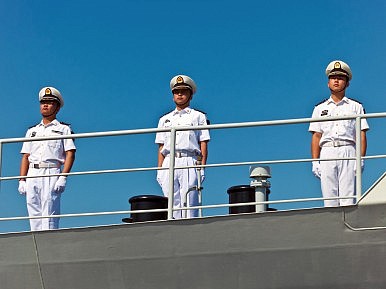
With the 2014 Rim of the Pacific (RIMPAC) exercise now underway, commentators have once again begun toquestion the usefulness of the U.S. and its allies and partners engaging China’s People’s Liberation Army (PLA) at all, given the America’s legal limitations on the level of interaction that is allowed between its armed services and the PLA and the generally limited scope of such exercises.

Such skepticism needs to be framed in the context of what the goals of security cooperation with China are. In its latest annual report to Congress on military and security developments involving the People’s Republic of China, the U.S. Department of Defense placed strong emphasis on “building a military-to-military relationship with China that is sustained and substantive.” The report highlighted the importance of using military-to-military ties with China as a way to “encourage China to contribute constructively to efforts with the United States, [America's] allies and partners, and the greater international community to maintain peace and stability.”

Contrary to the view that international military exercises, particularly with China, are meaningful in name only, there are long-term benefits to such engagements that can only be gained through a sustained commitment to slowly building up personal relationships and communication channels with the PLA. Furthermore, security cooperation can encompass paramilitary or constabulary-level cooperation and does not always have to come in the form of large-scale RIMPAC-style interactions. It is important for commentators to calibrate their expectations of individual exercises and for policymakers to sustain their efforts at fostering broader and deeper security cooperation. While deepening security ties could involve consistent repetition of existing exercises to reinforce their place in institutional culture, broadening the scope of such interaction (while still working with the United States’ NDAA FY 2000 constraints) requires some creative thinking. Here are three alternative approaches for engaging the PLA that the United States and its regional allies and partners should consider:

1. Using “Non-Aligned” Countries As Conduits

Given recent tensions in the South China Sea, it is imperative that ASEAN members explore creative options to engage China as well, including through military exercises. Over time, as an Asian Pacific power, the U.S. might seek invitation to these activities, first as an observer. These kinds of low-level interactions are another interface between regional military members — one that can also circumvent the kinds of political sensitivities and legislative challenges on both sides in rushing to broaden the existing repertoire of U.S.-China bilateral exercises.

China Won’t Be a Different Kind of Global Power

July 02, 2014

http://thediplomat.com/2014/07/china-wont-be-a-different-kind-of-global-power/
Like the U.S. before it, the China of today will be the hegemon of tomorrow.

The Diplomat is blessed to have a wealth of excellent regular contributors. Even among this distinguished group, however, Chen Dingding is particularly notable. Week in and week out he writes insightful, thought-provoking articles that challenge the conventional wisdom on some of today’s most important issues.

Last week was no exception as Dingding took to Flashpoints to challenge David Shambaugh’s new article in The National Interest challenging the notion that China is a global power. Much as he did in his latest book, Shambaugh claims instead that Beijing is at most a partial power and there is good reason to think it will never ascend to the ranks of great powers.

Dingding made a number of damning criticisms of Shambaugh’s arguments including that there is usually a lag between a country’s economic rise and it becoming a military, diplomatic and political power. Overall, however, the main thrust of Dingding’s criticism is that Shambaugh’s definition of global is based almost exclusively on how the U.S. behaves on the international stage. This is problematic, according to Dingding, because “the U.S. is not just a global power, it is a global hegemon in many ways.” Other great powers act differently, and “It is impossible for China to become another U.S. for a variety of historical, cultural, and social reasons.”

Similarly, as Shannon noted over at China Power yesterday, Chinese President and long-time Diplomat reader Xi Jinping used the occasion of the 60th anniversary of the “Five Principles of Peaceful Coexistence” to reiterate Dingding’s points. Specifically, Xi claimed that China will not be like previous great powers in the international system because “No matter how strong China gets it will never become a hegemon.” That’s because, Xi insisted, the “Chinese people do not have the gene for hegemony or militarism.”

China’s Hurdle to Fast Action on Climate Change

JULY 1, 2014

A coal heating plant in Beijing. China is the world’s top greenhouse gas polluter. Credit Image by How Hwee Young/European Pressphoto Agency.

When the Environmental Protection Agency published in June its new rules to combat carbon emissions from power plants, the American political class lit up in debates over what this meant for the country’s carbon emissions, its coal industry and its economic growth.

But a more relevant discussion was taking place some 7,000 miles away. In Beijing, He Jiankun, an academic and deputy director of China’s Advisory Committee on Climate Change, told a conference that China, the world’s largest greenhouse gas polluter, would for the first time put “an absolute cap” on its emissions.

His comments, and the brief flurry set off over whether they represented government policy, highlight a little-appreciated feature of the long-running, often acrimonious debate over how to slow climate change. The most pressing issue is not whether the United States will manage to wean itself from coal, or even about how quickly the American economy can reduce its reliance on fossil fuels.

The most pressing issue is to what extent and under which conditions China will participate in the global effort to combat climate change. Any hopes that American commitments to cut carbon emissions will have a decisive impact on climate change rely on the assumption that China will reciprocate and deliver aggressive emission cuts of its own.

Full Article click here

Protecting China’s Overseas Interests: The Slow Shift away from Non-interference

Mathieu Duchâtel, Oliver Bräuner and Zhou Hang
SIPRI Policy Paper No. 41
ISBN 978-91-85114-85-6


Non-interference is one of the Five Principles of Peaceful Coexistence that is core to China’s foreign policy and to its self-image. But in a pragmatic and incremental adaptation to its globalizing economic and security interests, Chinese foreign policy is slowly shifting away from a strict interpretation of this principle. However, the debate on China’s overseas interests and noninterference is far from over. There is still a degree of uncertainty regarding whether China will continue on the path of pragmatic adaptation within the non-interference framework, and the degree of change in concrete policy outcomes that such an evolution would entail.

The authors show that the possibility of a dramatic policy change cannot be ruled out, as dramatic and unforeseen events could precipitate change. China’s foreign policy could also strictly remain within the boundaries of non-interference. Its ultimate strategic choice will certainly have far-reaching effects on global governance and international security.

Contents

1. Introduction
2. Chinese debates on non-interference 
3. Protecting China’s energy interests overseas 
4. Protecting Chinese nationals overseas 
5. Conclusions

About the authors

Dr Mathieu Duchâtel (France) is head of SIPRI’s China and Global Security Project and is SIPRI’s representative in Beijing. His research interests include China’s foreign and security policies in North East Asia and Europe–China relations.

Oliver Bräuner (Germany) is a Researcher with SIPRI’s China and Global Security Project. His research interests include China–EU security relations and the protection of Chinese citizens in the Middle East.

Zhou Hang (China) is a Researcher with SIPRI’s China and Global Security Project. His research interests include Africa–China relations and maritime security.

INSIDE THE COLLAPSE OF THE IRAQI ARMY’S 2ND DIVISION

July 1, 2014 · in Analysis
Recent advances by the Islamic State in Iraq and the Levant (ISIL) (which recently renamed itself the Islamic State) in Mosul and Tikrit captured the attention of many analysts, many of whom were surprised at the stunningly weak performance of the Iraqi Security Forces. But those forces did not collapse overnight: they had been failing for over a year before they finally crumbled on June 10th. There is no doubt that ISIL has grown militarily in the past four years, but that was not the sole cause of their recent gains. In areas such as Fallujah, it took extended guerrilla operations and urban warfare to keep out government forces, but in Mosul, Tikrit and other recent ISIL offensives, retreat was voluntary and disorganized rather than forced by heavy fighting. Based on interviews with a variety of active and former Iraqi soldiers, along with civilians living in their area of operations, and supplemented with open-source research, we identified a number of institutional and political challenges that left the 2nd Division of the Iraqi army vulnerable to the sudden collapse it experienced in early June. Corruption, neglect, and a shortfall of combat-effective resources and personnel crippled the Iraqi military’s capability and widened ISIL’s range of strategic options in Nineveh province. Many problems the 2nd Division faced are widespread within ISF and likely to complicate its counterinsurgency effort.

The 2nd Division of the Iraqi army bears primary responsibility for military operations against ISIL in Nineveh province. It shares security duties under Nineveh Province Operations Command with the paramilitary 3rd Division of the National Police, which falls under the Interior Ministry. In late 2013 and early 2014, as ISIL launched major offensives in Anbar and declared an Islamic government in Fallujah, Mosul suffered a significant increase in violence. Gunmen, ambushes, and suicide attacks aimed at security personnel in Mosul were a frequent problem, although soldiers did not describe intense or territorially-oriented contestation from ISIL as had occurred in Anbar. On June 6 and 7, car bombings and firefights precipitated an increase in deaths in southern and eastern areas of Mosul. Following that, forces under Nineveh Province Operations Command retreated in disarray, with many soldiers reporting their positions collapsed without a shot fired. They left behind weapons, vehicles, uniforms, and no government opposition to ISIL within Mosul itself.

Map of Iraq’s provinces. The 2nd Divisions area of responsibility is in the country’s north. (Click to enlarge.)

Although the collapse of forces in Mosul shocked many in the region, many causes of their collapse can be attributed to systemic internal factors throughout the Iraqi Security Forces (ISF) generally, and forces under Nineveh Operations Command in particular. Despite facing a lower tempo of enemy operations through June 2014 compared to the earlier Anbar offensive, Iraqi forces under Nineveh Operations Command struggled to implement an effective counterinsurgency strategy. Low capacity and poor relations with the population created a feedback loop compromising ISF’s ability to push ISIL out of Nineveh. ISF choked Mosul with checkpoints, seeking to prevent militants from maneuvering about the city, while Iraqi National Policemen frequently detained local citizens. These approaches alienated the local population while catering to relatively low capabilities within the 2nd Division. Checkpoints put minimal strain on poorly-trained and disillusioned soldiers but resulted in the mistreatment of the local population, without serving as an active measure for seeking out and dismantling insurgent groups. Corrupt military and police practices, such as soliciting bribes for the release of detainees or extorting business owners, only compounded this problem.

Bioterrorism is Already Here

It just doesn't look like we expected.

This is a story of unconnected dots.

On October 17 2013, a strain of polio endemic to Pakistan first appeared in Deir al-Zor province, Syria. This virus presumably hitched a ride on a ne’er-do-well from Balochistan who thought supporting the Nusra Front would be a good use of his time and likely had no idea he was infected.

On February 12, the U.S. Department of State launched a new Global Heath Security Agenda. The highlight Secretary Kerry’s op-ed on the launch? The 2003 outbreak of SARS, hyped scourge of Asia, with 8,000 known infections and 775 known deaths. The famed Anthrax attacks of 2001, with 17 infections and five deaths, also made an appearance.

On March 11, an infant in Lebanon presented with paralysis. Unlike Jordan, Lebanon has refrained from establishing formal camps for its refugees in an effort to deter permanent residence — a lesson, perhaps, learned from the influx of Palestinians half a century ago.
Priorities

The fact that our “global health security agenda” focuses on future pandemics and deliberate bioterror threats is laughable in the face of reemerging infectious diseases and slaughtered immunization workers. True health insecurity is present globally, and it should not require a mystery test tube and ill intent to be perceived as valid and pressing threat.
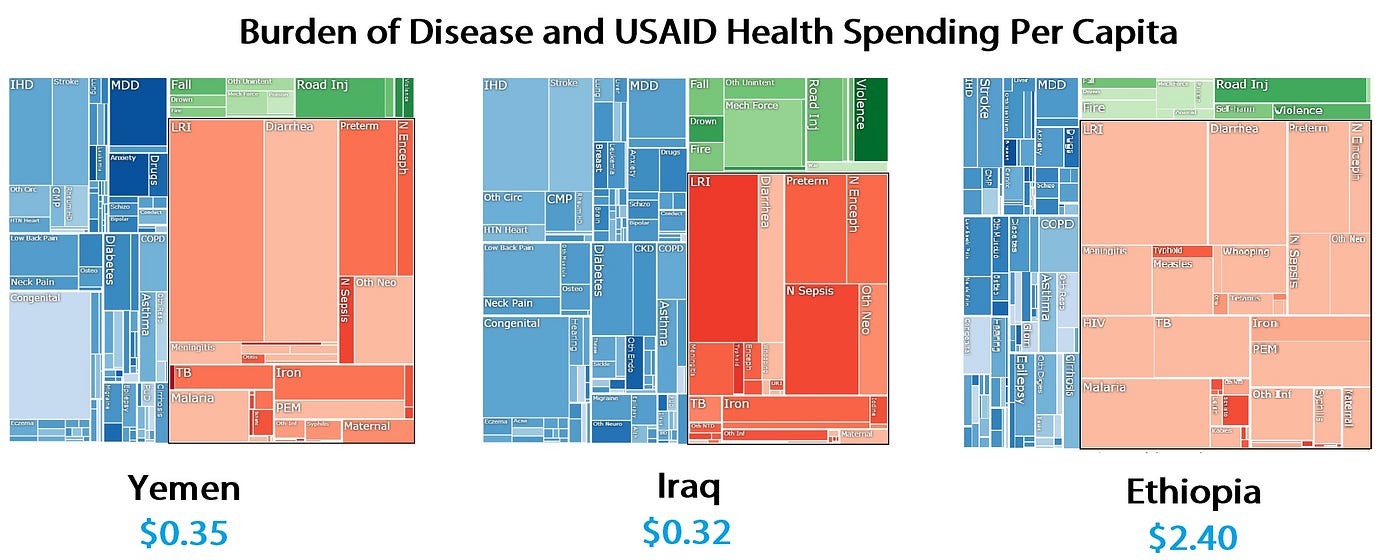
Disease distributions in three countries, with red representing infectious disease. Images from the University of Washington’s Institute for Health Metrics and Evaluation. Data obtained from 2012 State Department budget and CIA Factbook population statistics.

The least health-secure areas are often conflict zones, where the U.S. is heavily invested militarily but where health assistance often lags far behind. There is no better example than the Middle East, where poor health access tends to be masked; statelessness, migrancy, and the sheer law of averages merge oil conglomerates and marginalized masses into a bland middle-income yellow.
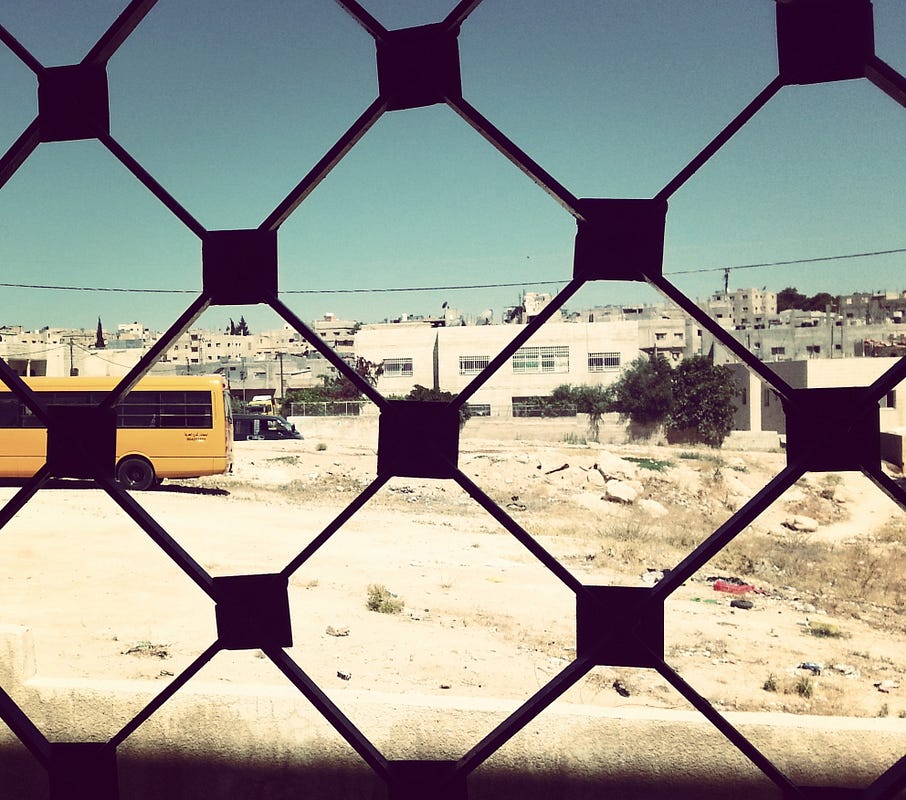
View from the Taybeh Health Center in Amman, Jordan, which serves a catchment area of 18,000 Palestinian refugees. Though a model clinic in the region, Taybeh is managed by UNRWA, which is struggling to absorb Palestinian-Syrian double refugees.

27 polio cases have surfaced in Syria since October. That may seem negligible compared to the SARS numbers cited by Kerry, but it represents the tip of an iceberg. When polio “appears,” this often means the case expresses symptoms in the iconic FDR sense — otherwise, it’s rather difficult to tell you have it. The cases easiest to detect, where the virus enters the central nervous system and causes paralysis — obviously signaling a need for prompt medical attention even for people with so much else on their plates — represent roughly 5% of all infections.

27 identified infections imply over 500 total infections. That’s 27 identifiedinfections in a war-torn nation with a decimated capacity for disease surveillance, a barely-existent ability to prevent further spread, and fighters pouring in from an estimated 83 countries. And to top it all off, that same state is hemorrhaging hundreds of refugees by the day.

OTTOMAN NOSTALGIA: A PROACTIVE TURKEY IN THE MIDDLE EAST?

July 1, 2014

Istanbul, Turkey – Nostalgia for the Ottoman Empire has been on the rise as of late. The Ottoman Sultan’s seal can be found on T-shirts, advertisements, and jewelry everywhere in its old imperial capital of Istanbul. More alarmingly, the jihadists of the Islamic State of Iraq and Syria (ISIS) are now proclaiming a new Islamic caliphate in former Ottoman provinces.

The shadows of history over the Middle East bring back images of 1916, when the current lines of the Middle East were drawn by the British and French empires in the secret Sykes-Picot Agreement. Four years later, the Treaty of Sevres was intended as the fait accompli, dismantling as it did what remained of the Ottoman Empire. The effects of these nearly hundred-year old events are being felt and bitterly remembered in Turkey today. Yet it’s not just the ancient past, but more recent history that should trouble Ankara. With the fall of Mosul and the kidnapping of the Turkish Consul General and over 80 Turkish citizens, the painful shadows of Al-Qaeda’s attacks in Istanbul a decade ago hover over Ankara once again. In the 1920s, Mosul was claimed by the new Turkish Republic and was the subject of one of the League of Nation’s first major arbitrations, thereby assuring itself a special significance in Turkish historical memory.

Turkish policymakers who once hoped that their shared Sunni faith and pragmatic (and often laissez-faire) dealings with the ISIS would protect them have painfully re-learned Lord Palmerston’s maxim: there are no permanent friends, only permanent interests. And the interests of ISIS have little overlap with Ankara’s, despite Turkey’s largely romantic longings for the days of yore. Ankara has few good options in response to the worst hostage crisis since the 1979 seizure of America’s embassy in Tehran (and despite its relatively low level of coverage in the Western press, that’s what it is) and is dependent on how the United States and other regional powers decide to weigh in on the future of Iraq for the safe return of its citizens. Yet, Ankara has made one critical bet, throwing support behind the ambitions of the Kurdish Regional Government over those of Baghdad.

FROM SARAJEVO TO BAGHDAD: THE LESSONS OF WAR

JULY 1, 2014
POSTED BY JOHN CASSIDY

Apologies to all you World Cup fans, but today I am concentrating, briefly, on less uplifting matters. In Iraq on Sunday, the Islamic State of Iraq and al-Sham proclaimed the establishment of a caliphate extending from western Iraq through parts of Syria, areas it already largely controls. “This is not the first border we will break, we will break other borders,” a jihadist boasted in an English-language video called “End of Sykes-Picot,” which was posted on (and subsequently removed from) YouTube. Meanwhile, here in the United States, intelligence experts warned that terrorists trained in Syria and Iraq may be preparing to launch attacks on Western airliners with new hard-to-detect bombs.

These events came a day after the citizens of Sarajevo marked the hundredth anniversary of the shot that led to the outbreak of the First World War: the assassination of Archduke Franz Ferdinand, of Austria, by Gavrilo Princip, a young Serbian nationalist. After the Archduke’s murder, it took about six weeks for Germany and Austria (the members of the Dual Alliance) and Britain, France, and Russia (the members of the Triple Entente) to declare war on each other, and another two years of unimaginable bloodshed for the British and the French to finalize the secret Sykes-Picot Agreement, which laid out a division of the Arab provinces of the teetering Ottoman Empire into French and British zones. These eventually became the countries we now know as Syria and Lebanon (the French bits), and Iraq and Kuwait (the British bits). The road linking Sarajevo to Baghdad was a long but direct one.

So, it was historically fitting for the propagandists of ISIS to mark the hundredth anniversary of Archduke Ferdinand’s death by tearing down—or, at least, saying that they’d torn down—one of the last vestiges of what became known as the Great War. The Sykes-Picot Agreement was exposed by the Bolsheviks in 1917, and has been, ever since, a symbol of Western imperialism and perfidy for many in the Middle East. Prior to the war, the British government, in the personage of Colonel T. E. Lawrence and others, had promised Arabs a homeland of their own in return for taking Britain’s side against the Ottomans. But, when push came to shove, the colonialists acted true to form.

The Real Red Line in the Middle East


If ISIS attacks Jordan, neither the United States nor Israel will be able to stay out of the fray.

BY DAVID ROTHKOPF JUNE 30, 2014 SHARE +JORDANWARMIDDLE EASTThere is a Sarajevo somewhere in Jordan. It lies well outside Amman, somewhere in the hostile terrain to the east or the north. Were the armed ISIS extremists -- who now call themselves representatives of the Islamic State and soldiers of the new caliphate -- to cross this line, the current conflict that engulfs Syria and Iraq would likely explode and grow more complex and costly by quantum degrees. This is not the sort of red line that is the product of an ill-considered, halfhearted burst of presidential bravado. This is the type of red line that triggers historic change and is worth considering as we mark the epoch-making events in Sarajevo that spawned World War I 100 years ago.For now, the wars in Syria and Iraq seem almost to be inviting the United States to remain more or less on the sidelines. Once an amorphous mess, it has seemed to take on something of a shape and symmetry. In both countries today, alliances featuring the ruling governments working in collaboration with Iran and Russia are taking on the extremists. 

With the announcement this weekend of Russian planes and munitions being shipped to the government in Baghdad, the orchestrated bombings last week of ISIS targets by Syrian jets in Iraq, and the active role of Iran and the Islamic Revolutionary Guard Corps in both places, it almost seems like a traditional conflict with two sides vying against one another.Further, with Moscow and Tehran willing to take up the fight against ISIS, it might be tempting for Washington to effectively sit this one out. After all, if the United States wants promises of political reform and the Iranians and Russians clearly don't require it to intervene, the Iraqis will be even harder for America to deal with. Intransigent Prime Minister Nouri al-Maliki may simply opt for the support of Tehran and Moscow, as well as a tacit alliance with Syria's Bashar al-Assad, avoiding the hard work of creating a truly representative Iraqi government -- which also happens to be the most self-serving possible choice. Unfortunately, for the world, the route of "letting others fight our battles for us" might be "easier" -- but it's exceptionally dangerous.The two wars that have spilled into one another do not represent a simple two-sided conflict. In Syria, not only is the opposition still fragmented, containing extremist groups like Jabhat al-Nusra that are themselves bitter enemies (usually) of ISIS, but it also involves more moderate groups, like the Free Syrian Army. You remember them? That's the collection of rebels the United States has effectively resisted supporting thus far because it was uncertain of their allegiances or trustworthiness. 

Three years later, of course, now that ISIS has gone from terrorizing northern Syria to marauding across Iraq, the United States has somehow discovered that it is possible to "vet" suitable partners among them and start offering training and aid. The $500 million that Barack Obama has pledged to this effort is a good thing, though it's diminished by its lateness. Meanwhile, in Iraq, it is not just Sunni extremists versus an out-of-touch Shiite regime in Baghdad. There are more moderate Sunnis who don't relish the prospect of living in ISIS's 13th-century self-declared caliphate. And there are the Kurds who seek and deserve independence -- a fact not appreciably advanced by the declaration of support they received over the weekend from Israeli Prime Minister Benjamin Netanyahu, who is not exactly the ally of first resort you want in that neck of the woods.Perhaps even more disturbing is the fact that in its current configuration -- and absent a constructive move toward effective political resolutions in Iraq or Syria -- the conflict offers a panoply of unappetizing potential conclusions. 
By MICHAEL PECK


Like many nations whose armies disintegrated, the Iraqi government is looking to the sky for salvation.

As Sunni militants continue their mostly unopposed blitz across northern Iraq, Moscow has sold Baghdad a dozen Su-25 Frogfoot close air support aircraft—in essence, Russia’s equivalent to America’s A-10 Warthog—as well as trainers to teach Iraqis how to fly the straight-wing jets.

Prime Minister Nouri Maliki has blamed his army’s rout on Washington’s refusal to speed delivery of new F-16s, currently slated for handover this fall. The Islamic State of Iraq and Syria militants “could have been repelled if Iraq had proper air defense,” Maliki said, according to Russian media.

“I’ll be frank and say that we were deluded when we signed the contract [with the U.S.],” Maliki complained to Russia’s RT News. “We should have sought to buy other jet fighters—like British, French and Russian—to secure the air cover for our forces.”

“If we had air cover we would have averted what had happened,” Maliki griped.

Say what? The Iraqi army disintegrated before a numerically inferior force of lightly armed fundamentalists because Iraq lacked “proper air defense?”

In fact, Iraq’s air arms—including helicopter gunships and missile-armed Cessnas—have fought hard against the ISIS onslaught … and suffered heavy casualties.

A lack of air power is not the problem.

Coalition forces destroyed this Iraqi Su-25 during the 1991 Gulf War. Photo via Wikipedia

A handful of Su-25s is not going to make much of a difference to the Shia-dominated Iraqi government. For one, Iraqi rather than Russian pilots apparently will fly the Su-25s, thus raising the question of how long it will take to bring the Iraqis up to speed for the demanding task of providing close air support with what is, to them, a new warplane type.

Iraq deployed Frogfoots during the 1980s war with Iran, but that almost 30 years ago.

Let’s be optimistic and assume that Iraq can keep two-thirds of its Su-25s flightworthy. That’s eight Frogfoots providing air support at a time when entire divisions of Iraqi army troops are dropping their weapons and fleeing.

But the biggest reason why air power will have a limited impact is that it hasn’t had much affect in the neighboring conflict that most resembles the situation in Iraq. The Syrian government had ample strike aircraft and helicopters at the start of the country’s civil war.

No doubt their firepower was an asset. Yet the Syrian army nearly collapsed anyway. What saved it weren’t bombs from above, but rather boots on the ground as Hezbollah fighters intervened to stiffen sagging government morale.

ISIS is a force of fanatical ground troops. Only an equally determined Iraqi army can stop them. Air power can help, but it’s not salvation from the sky.

The End of Iraq as we know it?

Andreas Krieg, Lecturer Defence Studies Department, King’s College London, Qatar Armed Forces

Looking at the atrocities committed, the sable rattling on both sides, and the increasingly sectarian nature of the conflict, many have asked me in the past week whether recent events in Iraq might be the prelude to the end of Iraq as we know it. There is surely no easy answer to this question. When approaching the question one has to bear in mind the historical legacy of Iraq, its domestic sectarian dynamics and the arbitrariness with which France and Britain marked out their spheres of influence in the Middle East – ultimately defining the territorial integrity of Iraq today. The result of the Franco-British Sykes-Picot Agreement of 1916 was the shuffling together of sectarian groups not based on their cultural heritage but based on the strategic interests of the Great Powers. Thus, some might say that there is nothing natural about Sunnis, Shi’as and Kurds living under one rule in one country – particularly not when this country’s central government is dominated by either one of the groups. So the question of whether ISIS’ operational victories will translate into the effective end of Iraq as we know it can mean different things. For one, will Iraq’s territorial integrity seize to exist with all three groups seceding from the unified state of Iraq? And two, will the current American-built Shi’a dominated governance system under the leadership of Maliki disintegrate giving way to a more effective and inclusive governance system?

The short answer is, yes Iraq as we know has inevitably seized to exist. As territorial gains stand today, Iraq in the short-term is effectively divided into Kurdistan in the North, a Sunni heartland dominated by the propaganda machine of ISIS and a Shi’a South. Turning towards the north of Iraq, the Kurds are probably the great winners of the current state of anarchy. Ever since 2003, the Kurds have enjoyed a degree of autonomy from Baghdad that almost equals quasi-independence. With Kurdish territorial gains in the Kirkuk area, Kurds might now exploit the current situation to take another step towards independence uniting Kurdish majority areas under its green-white-red flag. Kurdistan will then control the significant hydrocarbon riches of Northern Iraq. At this point it seems unlikely that ISIS can rally the necessary support in the Sunni community to snatch these areas away from the Kurds. Equally, in the South, Shi’as will probably be able to withstand the advance of ISIS into its Southern heartlands where most of Iraq’s current hydrocarbon revenues are being generated. Iran, Hezbollah and even the US would not allow ISIS to advance on the Shi’a shrine cities of the South: Najaf and Karbala. Shi’as will put up a fierce fight to protect their oil-rich heartland. Considering the number of Western oil companies operating there and the number of private security companies securing these facilities, it would be a fight that ISIS cannot win. 

After Retreat, Iraqi Soldiers Fault Officers

By C. J. CHIVERSJULY 1, 2014

The remnants of the Ninth Brigade of Iraq’s border guards at Al-Ukhaidir fortress, far from the positions they once held. Credit Image by Tyler Hicks/The New York Times
Until late June, this eighth-century redoubt in the Shiite south of Iraq had been a tourist and heritage site. Now the remnants of the Ninth Brigade find shelter within its walls.

These men have no pressing duties, even at a time of Iraq’s grave need. Instead, more than 300 miles from posts they had been ordered to defend, they huddled around visitors to describe an embarrassing retreat.

“We were sold, it was a sellout,” said one of the enlisted men, as a crowd of his fellow guards nodded in agreement. “Everyone here was willing to fight.”

Members of the Iraqi Parliament pointed fingers after an argument broke out on Tuesday in Baghdad.As Iraqi Violence Rages, Lawmakers Fail to Reach Deal on New GovernmentJULY 1, 2014
Saudi Arabia Donates $500 Million to Help Displaced IraqisJULY 1, 2014
Middle East Memo: ISIS Threatens Al Qaeda as Flagship Movement of ExtremistsJUNE 30, 2014
Iraqi refugees waited to be granted permission to enter the Kurdish Autonomous Region of Iraq.A Reignited War Drives Iraqis Out in Huge NumbersJUNE 28, 2014
The account of the Ninth Brigade of Iraq’s border guards, confirmed by an official who witnessed many of the events, is a portrait of generals unfit to lead in war and of mismanagement, incompetence and ultimately treachery under the patronage of Prime Minister Nuri Kamal al-Maliki.

Ninth Brigade members, now at Al-Ukhaidir fortress, said they had been eager to fight but were undermined by commanders who failed to provide water and food. Credit Image by Tyler Hicks/The New York Times

In early June, as militants from the Islamic State in Iraq and Syria, or ISIS, stormed through the north, Iraq’s security forces crumbled. Some soldiers and police officers shed their uniforms and bolted. Others were captured or changed sides.

But what was sometimes labeled cowardice or treason in the rank and file was often nothing of the sort, members of the border forces said in interviews in recent days. In the case of the Ninth Brigade, at least, its members insisted that they were eager to fight but were undermined by high commanders who failed to provide border forces with water and food, causing the brigade to abandon positions in the searing desert heat.

Two critical border crossings, Qaim and Waleed, slipped from government control last month, and large stretches of open desert along the Syrian border have not been patrolled since the Ninth Brigade withdrew over a week ago, border guards said. The collapse gave ISIS unchallenged cross-border movement.

A New U.S. Grand Strategy

July 01, 2014

The recent ISIS crisis is Iraq once again has American politicians arguing in favor of military intervention. Among the most vocal are those who led the United States into Iraq a decade ago, a decision that helped set in motion the events now playing out on the outskirts of Baghdad. There will always be such crises and such calls for the United States to deploy its military far beyond its borders.

The problem is that the United States has grown incapable of moderating its ambitions in international politics. Since the collapse of Soviet power, it has pursued a grand strategy that can be called “Liberal Hegemony,” which is unnecessary, counterproductive, costly, and wasteful. In my book, Restraint, I explain why this grand strategy works poorly.

Three major events affected my thinking—the enlargement of NATO to include the former vassal states of the Soviet Union, the war in Kosovo, and the war in Iraq. The first expanded U.S. obligations in ways that did little for U.S. security and needlessly antagonized Russia. Kosovo was an elective war, rationalized on the basis of information that was at best poor, and at worst deliberately mischaracterized by motivated policy entrepreneurs, and nearly bungled militarily due to the war’s founding illusions. The 2003 Iraq war echoed the mistakes of the Kosovo war, but on a larger scale and with much greater costs. Military spending has been excessive throughout this period, because the political ambitions that it serves have been greater than national security required. This is a track record. The United States needs a change of grand strategy.

The United States, like all other countries, must live in the world as it is—a world without a single authority to provide protection. Any state can resort to arms to enforce its claims, so the United States wisely remains prepared to enforce its claims, if it must. The most important claim is to sovereignty, territorial integrity, and safety. That said, the development of military force is expensive, and the use of military force is terrible. Great American generals from William Tecumseh Sherman to Dwight Eisenhower remind us that war is hell and that war is waste. The United States needs military power and needs to be prepared to use it. But this is no casual matter. Military power must be subjected to the discipline of political analysis. That is the purpose of grand strategy.

The United States has the luxury to be very discriminate in the commitments it makes and the wars it fights. 

An alternative grand strategy is “Restraint.” Restraint advises us to look first at the elemental strengths of the United States, which make it an easy country to defend. The United States thus has the luxury to be very discriminate in the commitments it makes and the wars it fights. Although the United States has been much at war since the end of the Cold War, only one fight was forced on us—the Afghan War. And even there, the United States was not forced to fight that war in the naïve and profligate fashion that it chose.

The United States is a wealthy and capable state. It can afford more security than most states. But the United States has extended the boundaries of its political and military defense perimeter very far. Taken separately, each individual project has seemed reasonable and affordable, at least to its advocates. Taken together, however, they add up to an embedded system of ambitious and costly excess. For these reasons, I have signed up with the advocates of Restraint. The United States should focus on a small number of threats, and approach those threats with subtlety and moderation. It should do that because the world is resistant to heavy-handed solutions. It can do that because the United States is economically and militarily strong, well-endowed and well-defended by nature, and possessed of an enormous ability to regenerate itself. It is not smart to spend energies transforming a recalcitrant world that we could spend renewing a United States that still needs some work.

Though it may seem inevitable that the United States took the path it did, there was much discussion in the 1990s about how to proceed. One can identify four different strands of opinion. Sadly, these have been reduced to two—the establishment consensus on Liberal Hegemony and Restraint. Four factors helped make Liberal Hegemony the victor. First, with the collapse of Soviet power the United States became the most capable global power in history. Nothing stood in the way. Second, the Western liberal model was triumphant. History vindicated the rightness of our system and made it in our eyes the appropriate model for others. Third, the Cold War ended with U.S. forces “manning the ramparts” around the world. Insecurity and disorder beyond the ramparts quickly created demands from within and without to move them outward. Fourth, the United States had built giant organizations to wage the Cold War and squadrons of national security experts to manage them. Most organization theorists will tell you that organizations never want to go out of business; if they succeed at their first task, they will try to find another. For these reasons, a more rather than a less ambitious strategy emerged after the Cold War, even before the September 11, 2001, terrorist attack on the United States, which supercharged the whole effort.

At bottom, these policies run up against three problems, which will get worse. First, other countries want security as much as we do. When we define our security expansively, we encourage some of them to compete more intensely. Others welcome our help, and because they can count on the United States, are stingy with their own defense spending. They “cheap ride.” Second, global trends will make U.S. expansiveness ever more costly because other states are growing in power, as are peoples and groups, as the U.S. government’s National Intelligence Council has been reporting for several years. More capable states are more able to push back and hence more inclined to do so, as are individuals and nonstate actors. Third, perhaps since the middle of the nineteenth century, ethno-nationalist, religious, and class identities have become heavily politicized. Globalization and modernity have the paradoxical effect of intensifying these identities rather than weakening them. These identities ease the way for the political mobilization of power—for street action, for voting, for civil and international war, for terror. They provide both purpose and motive force. Strong politicized ethno-national and religious identities dislike rule by other groups, or foreigners, above all else. Liberal Hegemony puts the United States in that role, or close to it, too often. Finally, although modern high-technology weaponry has created the impression that military power is a scalpel that can be used to excise diseased politics, in my view it remains a club, which in the end mainly allows us to beat problems into grudging submission at best, remission at worse. Liberal Hegemony is not only unnecessary, it will prove increasingly costly.

There are three important security challenges for the United States—the maintenance of a balance of power in Eurasia, the management of nuclear proliferation, and the suppression of international terrorist organizations that choose the United States as a target.

Restraint dictates that, in Eurasia, the United States would do best to conserve resources by correctly assessing the situation. The European allies are well able to look after themselves, and Russia is no longer a candidate for hegemony. China, on the other hand, may ultimately bid for regional hegemony. But other states in Asia have considerable capacity to balance China, and rather than rushing the net toward a new "Cold War," the United States should begin to energize these states to make reasonable contributions to their own security.

Zero nuclear proliferation will be difficult to achieve—among other things, it could require costly and ineffective preventive wars. The United States should do what it can to slow proliferation, and confine possession of nuclear weapons to states that can be deterred because they have something to lose, and keep them out of the hands of independent groups, who may not be deterred because they have little to lose. This requires much more active cooperation with those states that possess nuclear weapons to ensure the highest standards of control and safety. 

Finally, peculiar terrorist groups with vast ambitions, such as al-Qaeda, will arise from time to time. Global cooperation to improve defenses and collect intelligence is the best answer. Wars to secure ungoverned or poorly governed spaces and attempts to build strong democracies have foundered on nationalist resistance to outside forces, and inter-group enmities. Because invasion antagonizes local populations and generates new recruits for terror, kinetic solutions should be used sparingly.

I want to emphasize that the military strategy and structure of Restraint is essentially maritime—“command of the commons.” The United States should invest its scarce military power in the maintenance of an ability to access the rest of the world. It should reduce, however, its regular military presence in the rest of the world. The United States should avoid certain missions altogether, especially coercive state and nation building. Thus the United States can radically cut the ground forces that seem most apt for garrison duties and counterinsurgency. Major force structure cuts should allow the United States to save significant amounts of money, cutting the defense budget to perhaps 2.5 percent of GDP.

Unless the United States begins to recognize the limitations of its power and its resources—as well as the uncertain effects that such decisions can have—it will forever overreach, overspend, and overcommit.
Editors' Note: This article is an updated version of the preface to Barry R. Posen's book,Restraint: A New Foundation for U.S. Grand Strategy. His piece, "The Case for Doing Nothing in Iraq" appeared earlier this month in Politico.

America Broke Iraq: Three Lessons for Washington


"America should get out of the business of invasion and occupation."

July 1, 2014 

Colin Powell put it clearly and succinctly: “If you break it, you own it.” America broke Iraq. America owns Iraq. This is how the rest of the world sees it. This is also why the world is mystified by the current Obama-Cheney debate. Both these camps are saying, “You did it.” Actually both the camps should say, “Wedid it.”

The tragedy about this divisive debate is that America is missing a great opportunity to reflect on a big and fundamental question: why is America so bad at the simple task of invading and occupying countries? Surely, the American invasion and occupation of Iraq will go down in history as one of the most botched operations of its kind. America spent $4 trillion, lost thousands of American lives and millions of Iraqi lives, and at the end of the day, achieved nothing. Since the failure was so catastrophic, why not at least try to learn some valuable lessons from it? There are at least three lessons that scream for attention.

The first lesson is the folly of good intentions. Let’s be clear about one thing: Americans are not evil people.They do not conquer countries to rape, pillage and loot. Instead, they conquer countries to help the people. President George W. Bush’s goal was to set up a stable, functioning Iraqi democracy, not to set up an American colony in perpetuity. The British colonial rulers of Iraq in the early twentieth century would have been totally mystified by these good intentions. And they would have been even more flummoxed by the methods used to achieve these good intentions. For example, the British would preserve local institutions, not destroy them.

The last successful American occupation was the occupation of Japan. MacArthur wisely preserved Japanese institutions—including Emperor Hirohito, despite his role in the war. By contrast, America destroyed both Saddam’s army and his Ba’ath party at the beginning, thereby condemning the occupation to failure. Some Americans believed they could manage Iraq because American governance was inherently superior. Paul Bremer assumed he could rule Iraq effortlessly with his big boots, without ever being aware that his big boots were culturally offensive.