30 August 2014

Hamas Claims ‘Victory’ Amid the Rubble of Gaza

08.28.14

Having achieved virtually none of the objectives it said it fought for, at a cost of 2,000 dead and 500,000 displaced, Hamas tries to make the case it won the war.

AL SHAJAYA, Gaza — Exhausted, battered and traumatized from 50 days of fighting and incessant Israeli bombardment, Gazans are now pouring through the streets lined with the rubble of former buildings and breathing a collective sigh of relief. Whether flocking to reopened cafés or pulling cinder blocks out of their blown-out living rooms, as the ceasefire takes effect people are feeling they have withstood the worst and survived. It's a sentiment Hamas is seizing on to try and claim “victory” in a war that has yet to end the seven-year siege of Gaza – which was supposed to have been its purpose when Hamas was launching rockets at Israel.

Rather than focusing on an agreement that doesn’t seems to get Palestinians anything more than they got at the end of the 2012 war, Hamas changed from its wartime claims that it was fighting a battle to end the blockade to new rhetoric about victory in survival and repelling the Israeli ground invasion.

As darkness fell over Al Shajaya’s ruined buildings and debris-filled craters Wednesday night, hundreds of residents and people from around Gaza climbed on wreckage and filed into living rooms with no front wall in anticipation of the first live public speeches by Hamas's fighting force, the Al Qassam Brigades. The smell of death still lingers in parts of the destroyed neighborhood where tens of thousands have been displaced by Israeli shelling and ground forces. 

Masked fighters from all Palestinian factions -- including Palestinian Authority president Mahmoud Abbas’s Fatah movement – clamored over each other to get a place on the podium next to Al Qassam Brigades spokesman Abu Obeida. Fighters displayed shoulder rocket launchers, mortars and assault rifles as the red keffiya-clad Al Qassam representative called for Palestinian unity through armed resistance to Israel and pointed to Al Shajaya as the example of success. It was the scene of a ferocious hit and run campaign against the Israeli forces that cost 16 of them their lives.

“We are not weak,” he boomed through the mike as the stage lights illuminated the grey dust from the demolition that still hangs in the air. “We won the war with our hands,” he claimed about a conflict that has killed over 2000 Palestinians who are mostly civilians -- including 500 children-- wounded more than 10 000, and displaced over 500,000 Gazans, while killing 64 Israeli soldiers and six civilians on the Israeli side of the border.

A Grim Stalemate at War's End in Gaza

August 27, 2014

TEL AVIV, Israel (AP) -- The third Gaza War in six years appears to have ended in another sort of tie, with both Israel and Hamas claiming the upper hand. Their questionable achievements have come at a big price, especially to long-suffering Palestinians in Gaza.

In a sense, Israel got what it wanted: Hamas stopped firing rockets in exchange for mostly vague promises and future talks. But the cost to Israel was huge: Beyond the 70 people killed - all but six of them soldiers - the economy has been set back, the tourism season destroyed, its people rattled for 50 days and its global standing pummeled by images of devastation in Gaza.

Prime Minister Benjamin Netanyahu faces bristling from people who sense that Hamas controlled events and could not have its grip loosened on the Gaza Strip, which it seized by force from the Palestinian Authority in 2007. Around the corner lie international investigations into war crimes allegations.

Hamas is celebrating its success after surviving Israel's far superior firepower. The Islamic militant group's rocket fire emptied a string of Israeli border communities and disrupted Tel Aviv's international airport. Weak a few months ago, it may emerge as more of a player in Palestinian politics, and the plight of Gazans is again atop the world's concerns.

It also paid dearly: 2,143 Palestinians were killed, including nearly 500 children and hundreds of militants. The U.N. estimates the war destroyed or severely damaged 17,200 homes and left 100,000 Palestinians homeless, with considerable swaths of Gaza in rubble. Hamas' rocket arsenal is much depleted and many - if not all - of its attack tunnels against Israel have been destroyed.

For the moment, Israel has promised to open border crossings with Gaza to a degree, something it does intermittently anyway, and to increase access for Gaza fishermen. Hamas' other demands are to be later discussed: an airport and seaport, prisoner releases, salaries for its thousands of civil servants and the opening of the Rafah crossing to Egypt. Israel will ask for demilitarizing Gaza. Little is likely to be resolved anytime soon.

The region is unpredictable. But as it seems this cease-fire may stick, here are some preliminary lessons:

FORCE MAY HAVE WORKED

Update on Security Situation in Pakistan

August 28, 2014
Pakistan Security Brief

PAT leader Tahirul Qadri and PTI leader Imran Khan suspend dialogue with government; Qadri declares August 28 day of revolution if demands not met; Imran Khan; Government accepts most PTI demands, but refuses to accede to demand for Prime Minister’s resignation; Islamabad police chief bars use of force against protestors; Election Commission refutes rigging allegations; Report claims army and government close to deal on power sharing in exchange for defusing political crisis; Punjab police register murder case against Prime Minister Nawaz Sharif, Punjab Minister Shahbaz Sharif and 19 others; TTP commander killed in encounter in Dera Ismail Khan; IED blast injures two security personnel in Mohmand; Militants attack three oil tankers in Mastung, Balochistan; Three injured in militant attack in Harnai, Balochistan; U.S. sanctions LeT financier; U.S. repatriates nine prisoners from Afghanistan to Pakistan; Fresh firing across Indo-Pak border following de-escalation talks; UN calls for peaceful resolution of Indo-Pak dispute; North Waziristan IDPs demand repatriation by August 30.

Politics 

On August 27, Pakistan Awami Tehreek (PAT) chief Dr.Tahirul Qadri and Pakistan Tehreek-e-Insaf (PTI) chief Imran Khan suspended all dialogue with the government. Dr. Qadri declared August 28 as the “day of revolution” if his demands were not met. Imran Khan said that he would declare his future course of action on August 28. Federal Minister Saad Rafique said on August 28 that the government had agreed to five out of six demands of PTI but would not consider the resignation of Prime Minister Nawaz Sharif. On August 28, the government also agreed to Qadri’s demand to register a criminal case against Prime Minister Nawaz Sharif, Punjab Chief Minister Shahbaz Sharif and 19 others regarding a clash between PAT protestors and police in June that resulted in the death of 14 protestors.[1]

On August 27, Senior Superintendent of Police (SSP) for Islamabad issued a notification restricting police personnel from using violence against the protesters unless given orders by a magistrate.[2]

On August 27, the Election Commission of Pakistan refuted allegations made by its former additional secretary and those by Pakistan Tehreek-i-Insaf (PTI) chief Imran Khan that the 2013 elections were rigged, calling them “baseless.”[3]

On August 27, a report by the Wall Street Journal declared that the Pakistani military is close to reaching an agreement with the government through which the Prime Minister would cede control of foreign affairs and security policy to the military in exchange for the army chief’s intervention in resolving the current political impasse.[4]

Militancy 

Russia Lies About Invading Ukraine as It Invades Ukraine


08.28.14

Russia Lies About Invading Ukraine as It Invades Ukraine
As Russia troops and tanks make an apparent bid to open the land route to annexed Crimea, discontent is growing in the motherland about the obvious but oft-denied war in Ukraine.

MOSCOW, Russia – Where U.S. President Barack Obama and German Chancellor Angela Merkel have failed to make Russian President Vladimir Putin acknowledge his ever-more-overt invasion of Ukraine and think about pulling back, Valentina Melnikova, the head of Russia’s famous Soldiers’ Mothers Committee, might just have a chance.

Early Thursday morning, Melnikova started getting phone calls from Russian army bosses. All of them, from the deputy defense minister to the paratrooper division commanders, wanted to meet with the great matriarch of the Russian military. She had accused the entire high command, along with Commander-in-Chief Vladimir Putin of invading Ukraine and of committing a crime against Russian citizens by sending Russian soldiers to "the bloody battlefields" without declaring the war, without signing legal papers with the servicemen, without letting Russian mothers know where exactly their drafted sons ended up dying.

The day before, Russian servicemen were fighting shoulder to shoulder with pro-Russian separatists in Novoazovsk, a strategic port city on the Russian border. By taking over Novoazovsk, the separatists cleared the way for more servicemen to pour into Ukraine. “According to our expert analyses,” said Melnikova – and few organizations have better information than hers – “ there are over 10,000 Russian soldiers fighting in Ukraine today."

It’s important to understand just how important Melnikova and her organization are in the minds of the Russian people and, often grudgingly, to the Russian military. She is an active member of defense ministry's public council, and commanders knew perfectly well that no secrets can be hidden from Soldiers Mothers, since the organization has first-hand information about the army’s affairs. Melnikova's opinion has been respected by the Russian people since the days when the first zinc coffins flowed back to the Soviet Union along what came to be called “the river of the dead” from Afghanistan in the 1980s. 

Today, in an exclusive interview, Melnikova sounded absolutely furious. She said she was "personally humiliated as a citizen of the Russian Federation by our commander-in-chief's pure, direct crime.” Putin is “violating not only international laws, not only the Geneva Convention, [he] also is breaking Russian Federation law about defense,” she told The Daily Beast, “and as for Vladimir Shamanov [commander-in-chief of the Russian airborne troops], we should be too disgusted to even mention his name - he forces his servicemen to fight in a foreign state, Ukraine, illegally, while mothers receive coffins with their sons, anonymously.”

Loose Cannons and Ukrainian Casualties

27 August 2014

So now the number of dead Ukrainian soldiers is 722. The number of wounded is 2,625. The Ukrainian army keeps on making slow but steady advances; the pro-Russian terrorists appear to have suffered heavy losses; Russian regular forces are openly engaged in the fighting; Russia’s “humanitarian convoy” apparently looted some Ukrainian armaments factories on its way back home; and, on August 25th, Russian tanks crossed into Ukraine just north of the Sea of Azov.

All is definitely not quiet on the eastern front.

German Chancellor Angela Merkel visited Kyiv on August 23rd, where she expressed support of Ukraine. Some Ukrainians were unhappy that her support wasn’t stronger, but they should remember that her very presence in Ukraine on the eve of its Independence Day celebrations was a powerful message to Russia’s unconstitutionally elected president, Vladimir Putin.

Whether or not Putin chooses to heed that message is another matter. If he’s smart, he will. No country can take on the whole world. The United States, when it was still a “hyper-power,” tried, and you know how that ended. A “Belgium with the bomb” and lots of gas to sell is acting stupidly if it thinks it can get away with playing the world’s bully.

Putin, unfortunately, looks more and more like a loose cannon, an irrational leader who responds to his own internal demons and not to anything resembling logic or national interest. Significantly, when a German interviewer asked Merkel to explain just “what Putin wants,” she couldn’t answer, providing instead an elaborate argument for the need for a political solution.

Take that “humanitarian convoy.” Just what did it prove? That Russia can intervene in Ukraine? But it’s been doing that for two months, and everyone knows it. That Russia is humanitarian? But if it is, why all the subterfuge? That Russia is tough? But if it is, then why all the humanitarian rigmarole? The one thing the convoy didn’t prove is that Russia is reliable. Instead, the whole convoy business made Russia and Putin look like conniving SOBs.

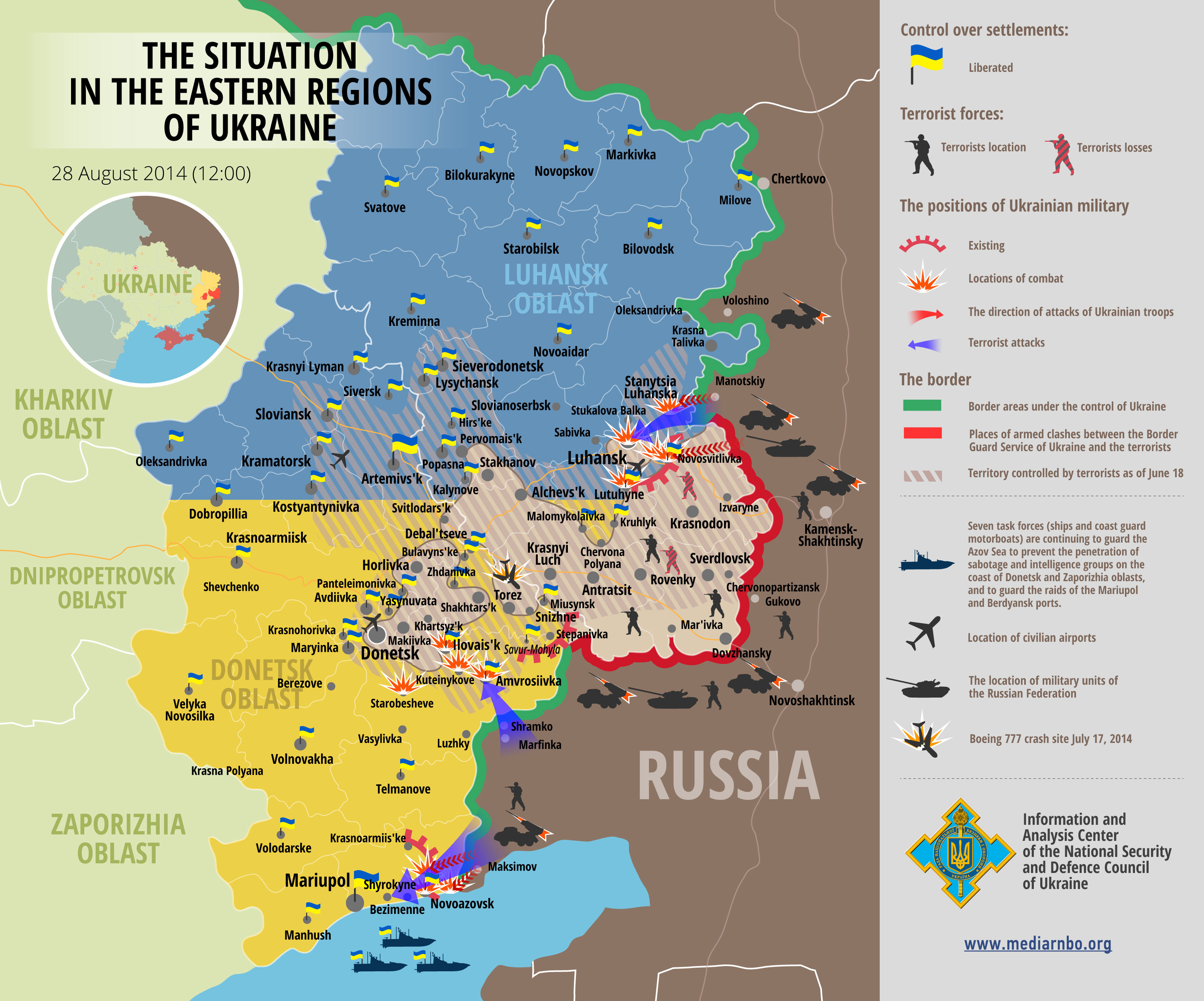
Situation Map of the Battlefield in the Eastern Ukraine

August 28, 2014

The Ukrainian National Security and Defense Council has put online a new large-scale situation map detailing as of 1200 hours Kiev time the rapidly changing battle lines in the eastern Ukraine.

The situation map is significant because it shows the three areas where Ukrainian rebel forces, reportedly backed by large numbers of Russian troops, tanks and artillery, have mounted attacks over the past 72 hours.

* In the north, a Russian-backed armored column has crossed the Russian-Ukrainian frontier near the Russia town of Manotskiy and reached forward positions a few miles west of the besieged rebel-held city of Luhansk.

* To the south, another armored column has entered the Ukraine near the Russian village of Shramko and attacked northwards toward the Ukrainian town ofAmvrosiivka, which is roughly 30 miles southeast of the rebel capital of Donetsk.

* And perhaps of greatest potential importance, a large armored-back force, reportedly led by a sizable force Russian tanks and mechanized infantry, crossed the Ukrainian border near the town of Maksimov on the shores of the Sea of Azov, and this morning captured the Ukrainian town of Novoazovsk, located about 7 miles from the Russian border

Over the past 24 hours, the Ukrainian military has rapidly reinforced the defenses of the port city of Mariupol, about 20 miles to the west of Novoazovsk, with at least one, and possibly two brigades of mechanized infantry. Whether these forces will be sufficient to prevent Mariupol from being captured is open to conjecture at this point in time.

Ukrainian troops who have retreated from Novoazovsk to Mariupol report that they were forced to abandon their defensive positions, in large part because of a lack of artillery and air support.


Can Germany Save Ukraine?

August 28, 2014

Putin and Poroshenko's recent meeting in Minsk opened the door for dialogue. Can Merkel keep it open?

The Minsk meeting between presidents Vladimir Putin and Petro Poroshenkohas produced more than a handshake. It was the two leaders’ first serious conversation. No one should have expected an immediate result from the two hours of private discussions, but they must have been useful. Separate negotiations on the terms of trade—now that Ukraine has signed an Association Agreement with the EU—and on the price for the Russian gas will follow in September, even though they will probably take several rounds to reach agreement.

War in eastern Ukraine was not formally on the agenda in Minsk, but it was of course at the top of the leaders’ minds. The armed conflict did not take a break during the Minsk meeting; it only intensified. President Poroshenko said that all parties in Minsk wanted a peaceful solution in Donbass, but of course each wanted it on its own terms. President Putin called the fighting an issue for Ukrainians, and cast Russia in the role of a facilitating party in the search for peace.

His claims of Russia’s noninterference were not helped by the recent capture of ten Russian paratroopers inside Ukraine, whose pictures were on TV screens around the world at the time of the Minsk summit. An awkward moment for Moscow, but at the end of the day, little more than a nuisance. Since last February, Vladimir Putin has felt and behaved like a wartime president, using all means available to him, short of a large-scale invasion, to prevent Ukraine from joining NATO or hosting U.S. military bases.

While everyone’s eyes in Minsk were on Putin and Poroshenko—will they shake hands? will they meet?—the meeting was unique in bringing together, for the first time, some top officials from the European Union alongside the leaders of the Eurasian Union countries (Belarus, Kazakhstan and Russia) and Ukraine. Had such a conversation taken place last year, and produced a compromise, many lives might have been saved and much damage could have been avoided.

Significantly, the trilateral dialogue in the Belarusian capital was immediately preceded by the first-ever visit to Kiev by the German chancellor. Angela Merkel was strongly advocating a cease-fire and held out a promise of a 500-million-euro-worth aid package to help Ukraine rebuild the war-ravaged Donbass. Mrs. Merkel also publicly stated that Russia’s interests should not be ignored.

BBC News International Using Intercepted Russian and Ukrainian Rebel Communications to Detail Battlefield Developments in the Eastern Ukraine

Christopher Woolf
August 28, 2014

A Ukrainian serviceman fires at pro-Russian separatists in the eastern Ukrainian town of Ilovaysk, Tuesday.

The news from Ukraine can be bewildering. There are reports of heavy fighting. But knowing who is doing what requires sorting through often competing claims. 

Ukraine blames Russia for most of the violence. As evidence, it has posted a video supposedly showing some Russian soldiers caught fighting in Ukraine. But Russia denies sending troops in — and blames Ukraine. 

Journalists are left trying to use every tool they can think of to piece together the true story. 

Our Ukrainian colleagues at the BBC World Service, for instance, are using intercepted radio and phone messages. BBC news editor Olexei Solohubenko oversees a lot of that effort. 

In one example, you can hear a rebel female artillery spotter complaining to her battery commander that he missed the target. Instead, she says he had hit three houses where civilians were sheltering. There were casualties, including small children. 

The artillery commander on the other end, according to Solohubenko, sounds somewhat inebriated. He advises the spotter to do what he’s doing and down a shot of vodka; he says this is war, and these things happen. Besides, he says, they will blame it on the Ukrainian government forces anyway. 

Solohubenko says the BBC goes to great length to verify the details of what they’re hearing. They check accents, locations, dates, times and anything else that can be cross-referenced with other sources of information. Sometimes they try to connect with the speakers on the recordings. 

Ukrainian Rebel Leader Says That There are 3,000 Russian ‘Volunteers’ Fighting With His Forces

August 28, 2014
Ukraine Rebel Leader Says Targeting Strategic Port

DONETSK Ukraine (Reuters) - Pro-Moscow rebel forces in Ukraine on Thursday gained a foothold on the Azov Sea and their objective is to fight their way down the coast to the Ukrainian port city of Mariupol, the leader of the main separatist entity told Reuters.

Alexander Zakharchenko, prime minister of the self-proclaimed Donetsk People’s Republic, said in an interview that there were about 3,000 Russian volunteers serving in the rebel ranks.

He said that the rebels could defeat the Ukrainian military without the need for the Russian state to provide them with military support.

That sinking feeling (again)


If Germany, France and Italy cannot find a way to refloat Europe’s economy, the euro may yet be doomed
Aug 30th 2014 
JUST a few months ago the euro zone’s leaders believed that, having weathered the storm, they were set fair at last. Buoyed by the promise of Mario Draghi, the president of the European Central Bank, to do “whatever it takes” to support the currency, confidence had seeped back into the continent. Growth seemed to be returning, albeit at a slow pace. Troubled peripheral countries were recovering, after bail-outs and painful measures to cut budget deficits and improve competitiveness. Unemployment, especially among the young, was still desperately high, but at least in most countries it was falling. And bond spreads had narrowed sharply, as financial markets stopped betting that the euro would fall apart.

It was an illusion. In recent weeks the countries of the euro zone have begun to take in water once again. Their collective GDP stagnated in the second quarter: Italy fell back into outright recession, French GDP was flat and even mighty Germany saw an unexpectedly large fall in output (see article). The third quarter looks pretty unhealthy, partly because the euro zone will suffer an extra drag from Western sanctions on Russia. Meanwhile, inflation has fallen perilously low, to around 0.4%, far below the near-2% target of the European Central Bank, raising fears that the zone as a whole could fall prey to entrenched deflation. German bond yields are hovering below 1%, another harbinger of falling prices. The euro zone stands (or wobbles) in stark contrast with America and Britain, whose economies are enjoying sustained growth.

What started more than four years ago as a banking and sovereign-debt crisis has decayed into a growth crisis that is now enveloping the three biggest economies. Germany is teetering on the edge of recession. France is mired in stagnation. Italy’s GDP is barely above its level when the single currency came in 15 years ago. Since these three countries account for two-thirds of euro-zone GDP, growth in places like Spain and the Netherlands cannot make up for their torpor.

The underlying causes of Europe’s new ills are three very familiar and interrelated problems. First, there is a shortage of political leaders with the courage and conviction to push through structural reforms to improve competitiveness and, eventually, reignite growth: the big countries have wasted the two years bought by Mr Draghi’s “whatever it takes” commitment. Second, public opinion is not convinced of the urgent need for deep and radical changes. And third, despite Mr Draghi’s efforts, the monetary and fiscal framework is too tight, throttling growth—which makes structural reforms harder.

Clouseaunomics

China Tells U.S. to Reduce or Halt Reconnaissance Flights Off Chinese Coastline

August 28, 2014
China Tells U.S. to Reduce or Halt ‘Close Surveillance’ Patrols

BEIJING — China on Thursday urged the United States to cut back on, or even stop, its close surveillance of the Asian giant using patrol aircraft, if it seriously seeks to repair damaged bilateral ties.

Ties between the world’s two largest economies have been strained by competing territorial claims between China and its neighbors, some of them U.S. allies, in the South China and East China seas.

The two countries have exchanged barbs over a jet intercept of a U.S. navy patrol plane by a Chinese aircraft last week, with the United States saying the Chinese jet came within 10 m. (33 ft) of its plane over the sea.

"If the United States really hopes to avoid impacting bilateral relations, the best course of action is to reduce or halt close surveillance of China," Defense Ministry spokesman Yang Yujun said in a statement on the ministry’s website.

The U.S. patrols had “seriously harmed China’s security interests”, he added.

The Pentagon has said the Chinese fighter pilot flew acrobatic maneuvers around the U.S. Navy’s P-8 Poseidon anti-submarine reconnaissance plane in international airspace in the South China Sea.

China has said the criticism by the United States, which filed a diplomatic complaint with Beijing on Friday, is groundless and that its pilot kept a safe distance.

Military officials from both countries held talks on rules of behavior this week at the Pentagon, a U.S. official said.

The incident took place 220 km (137 miles) from China’s southern island province of Hainan, Yang said. Hainan is home to several military bases, including one that houses a sensitive submarine fleet.

China’s pilots acted properly and took safety into account, Yang added.

"Compared to those countries that let their pilots fly about at other people’s doorsteps, we certainly value the security of our pilots and equipment more," he said.

The United States and China have differing views about the legality of U.S. military overflights in much of the region as a result of China’s broad territorial claims and differing interpretations of rights under the Law of the Sea treaty.

Yang blamed the U.S. patrols as being the root cause of unforeseen air incidents.

"The U.S. is constantly nagging about the distance between both countries’ aircraft and technological issues and neglecting the political problem of its high-frequency, close surveillance of China."

China’s sovereignty claims over the strategic stretch of mineral-rich water off its southern coast and to the east of mainland Southeast Asia set it directly against U.S. allies Vietnam and the Philippines, while Brunei, Taiwan and Malaysia also lay claim to parts of the disputed areas.

China vows to respond to US surveillance flights

 Aug 28, 2014

BEIJING: China said on Thursday that it will continue responding to US military surveillance flights off its coast, rejecting American accusations that one of Beijing's fighter jets acted recklessly in intercepting a US Navy plane last week. 

Defense ministry spokesman Yang Yujun said China's military would closely monitor US flights and reiterated calls for the US to scale back or end such missions altogether. 

"According to different situations we will adopt different measures to make sure we safeguard our air and sea security of the country," Yang said at a monthly news briefing. 

China has long complained about US surveillance flights that just skim the edge of China's territorial airspace. However, Yang said such flights this year have become more frequent, are covering a wider area and are coming even closer to the Chinese coast. 

US sea and air surveillance missions occur most frequently during Chinese military exercises or weapons tests, raising the risk of accidents and misunderstandings, Yang said. 

That was a likely reference to an incident last December in which China accused a US Navy cruiser, the USS Cowpens, of having veered too close to China's sole aircraft carrier in the South China Sea during sea drills. That nearly led to a collision with a Chinese navy ship in the most serious sea confrontation between the two nations in years. 

The latest incident also revived memories of the 2001 collision between a Chinese jet and a US Navy surveillance aircraft off China's Hainan Island, killing the Chinese pilot and forcing the Navy plane to make an emergency landing on the island. 

Yang, however, wouldn't say what distance China considers acceptable, saying only that the US should scale back or end such flights entirely if it wants to avoid potential accidents and build mutual trust. 

The Pentagon said that in the August 19 encounter, a Chinese jet made several close passes by the Navy P-8 Poseidon plane, coming within 30 feet (9 meters) of it at one point. 

It said that included the Chinese jet doing a "barrel roll" maneuver over the top of the Poseidon — a modified Boeing 737 — and passing across the nose of the Navy plane apparently to show that it was armed. 

The incident took place about 135 miles (220 kilometers) from Hainan, which is home to naval airfields and a highly sensitive submarine base. 

Yang rejected US accusations that the Chinese pilot acted in a dangerous and unprofessional manner, saying it was the US that seemed to have little regard for the safety of its personnel. 

"China is a developing country. Our aircraft are very precious. The lives of our pilots are even more precious," Yang said. "Compared to countries that ask their pilots to fly down on other countries' door steps, we cherish more the safety of our personnel and equipment.

Syrian Air Strike Kills a Number of Senior ISIS Commanders in Deir al-Zor Province

August 28, 2014
Syria Air Strike Kills Islamic State Commanders: Monitor

BEIRUT — A Syrian government air strike killed commanders of the Islamic State group in the eastern province of Deir al-Zor on Thursday, including Syrians, Arabs and foreigners, the Syrian Observatory for Human Rights, which monitors the war, said.

Syrian state TV reported that the army “eliminated more than 10 terrorists” in an attack east of Deir al-Zor airport, including two men it named as Islamic State leaders in the province, and destroyed 14 armored vehicles.

The Observatory, which says it gathers information from all sides in the Syrian conflict, reported that Syrian war planes had struck a building used as a headquarters by Islamic State while a meeting of its commanders was underway.

The Many Ways to Map the Islamic 'State'

AUG 27 2014
Does ISIS control huge swaths of land or a network of roads? It depends on your definition of 'control.'

ISIS territory in Iraq and Syria tends to be described as "swaths." The estimated size of these swaths, which ISIS leader Abu Bakr al-Baghdadi declared a caliphate in June, varies widely in reports, from 12,000 square miles—"an area the size of Belgium," per The Wall Street Journal—to 35,000 square miles, or “an area the size of Jordan,” as George Packer wrote this week in The New Yorker. Whatever else the caliphate is, by these estimates of territorial size at least, it's starting to look more and more like a state. Packer continued:

The self-proclaimed caliphate stretches from the newly conquered towns along the Syrian-Turkish border, through its de-facto capital of Raqqa, in northern Syria, across the obliterated Iraqi border into Mosul, Tikrit, and Falluja, down to the farming towns south of Baghdad—roughly a third of the territory of both [Iraq and Syria].

The EconomistThe Economist's map shows where ISIS is present in, controlling, or contesting territory—a broad depiction of what the 'caliphate' might be. Under that definition, this image would not have changed much since June despite recent gains by ISIS; where it has acquired more territory (as in Syria's Raqqa province, where this week it seized the last of the government-controlled military bases), ISIS was in many cases already shown as "present" in the map above. The difference now is that ISIS has won more battles, and as a result has more infrastructure and resources to fund and defend what it now calls the Islamic State.

Obama Shouldn’t Bomb ISIS in Syria


We have no strategy for intervening there, and no reason to think it will work. 

President Barack Obama addresses the nation from the State Dining Room of the White House on Aug. 7, 2014.

Let’s hope that President Obama does not bomb ISIS inside Syria—unless, maybe, the airstrikes are coordinated with some other country’s troops on the ground. That’s what happened in northern Iraq last week, when U.S. airstrikes paved the way for a mix of Iraqi special forces, Shiite militias, and Kurdish peshmerga fighters to push ISIS away from the Mosul Dam. But that’s not likely to happen in Syria.


It’s not likely to happen for two reasons, both lamentable. First, there are no ground forces inside Syria that can both repel ISIS and serve as palatable American allies. Second, the Obama administration and the neighboring Middle Eastern countries appear to have no strategy of what an intervention in Syria might look like or of what Syrian politics should look like in its aftermath.

That is a particular shame, since the United States and just about every country in the region could form a very potent alliance against ISIS. They all hate and fear the al-Qaida offshoot that calls itself the Islamic State. They all share an interest in seeing the group pummeled. But in many of these countries, domestic politics or conflicting interests on other matters impede such an alliance from forming.

A strange alliance—which could include the United States, Iran, Egypt, Jordan, Turkey, Israel, and Saudi Arabia—is at least conceptually feasible in Iraq, assuming its new prime minister, Haider al-Abadi, forms a government that seems inclusive and responsive to Shiite and Sunni leaders. If Abadi manages this feat (and the bloody sectarian violence in recent days dampens its prospects), this hypothetical alliance—which includes Sunni and Shiite nations, among others—would be fighting not just against ISIS but also for a stable and potentially amenable Iraq.

This is a cold thing to say, but too many countries have an interest in keeping Syria a cauldron of chaos. 

In Syria, ISIS and Assad Must Both Lose

By Robert Tracinski
AUGUST 28, 2014 
Has anyone thought about what we’re going to have to do about the Islamic State—I mean, really thought about it?

It has become obvious that the group that calls itself ISIS or just the Islamic State is the most serious terrorist threat to the United States since 9/11, and allowing its formation is the biggest mistake of President Obama’s administration.

Secretary of Defense Chuck Hagel recently called ISIS “a force and a dimension that the world has never seen before.” It is not just a terrorist group distinguished by its brutality and fanaticism. It is not just a group that has demonstrated its interest in killing Americans. Worst of all, this is a group filled with an unprecedented number of jihadists from Europe, and even a few from America—Western passport-holders who will almost certainly make their way back home. According to the group’s own threats, ISIS members or sympathizers are already here. Oh, and ISIS is inspiring copycat groups in places like Pakistan.

A lot of us warned that Obama’s inaction in Syria was allowing al-Qaeda to reconstitute itself in Syria; what we couldn’t have predicted is that the group that arose would be even more radical and brutal than al-Qaeda. So it cannot be allowed to exist, not without courting the risk of another 9/11.

But no one in the administration seems to have figured out what will be required to make that happen.

I don’t just mean the size of the effort, though that’s part of it. While it would be nice to rely on local proxies like the Kurds, it’s becoming clear that there is no one on the ground in Iraq and Syria who can defeat them. Eradicating ISIS—not just suppressing them or stopping their advance, which is all we’ve done so far—will require a much larger effort. I’m pretty certain it will require American boots on the ground.

I’m sorry if that makes you nervous or breaks a campaign pledge or means you have to turn your back on your dad’s anti-war rhetoric. Don’t want another 9/11? Then you’ve got to get serious about ISIS. Suck it up.

As Chairman of the Joint Chiefs of Staff Martin Dempsey has been telling everyone, taking down ISIS will also require intervening in Syria. And that’s the real problem, the one issue that no one seems to have thought through. If all we do is go after ISIS, we are acting as shock troops for Bashar al-Assad. And that’s by design. That’s why Assad helped create ISIS in the first place.

An excellent, in-depth analysis by Nicholas Blanford makes this clear.

US air strikes on Syria would face formidable obstacles

Aug 28, 2014

American forces face formidable challenges as President Barack Obama considers an air assault on Islamist fighters in Syria.

WASHINGTON: American forces face formidable challenges as President Barack Obama considers an air assault on Islamist fighters in Syria, including intelligence gaps on potential targets, concerns about Syria's air defenses and fears that the militants may have anti-aircraft weapons, current and former US officials say.
 
The Pentagon began preparing options for an assault on Islamic State fighters after the militants last week posted a gruesome video showing the beheading of American photojournalist James Foley. Deliberations by Obama's national security team on expanding the campaign against Islamic State from Iraq into neighboring Syria gathered pace in recent days, officials say. 

While it is unclear how soon strikes might be launched, Obama's go-ahead for aerial reconnaissance over Syria has raised expectations he will approve the attacks rather than back off as he did last year after threatening to strike Syrian President Bashar al-Assad's forces. 

Any air offensive would likely focus on Islamic State's leadership and positions around the city of Raqqa in their stronghold of eastern Syria, and border areas that have served as staging grounds for Islamist forces that have swept into Iraq and taken over a third of the country. 

But every option carries significant risk. 

"There are all kinds of downsides and risks that suggest air strikes in Syria are probably not a great idea," said Aaron David Miller, a former Middle East adviser under both Republican and Democratic administrations. "But that doesn't mean they won't happen anyway." 

Efforts to hit the right targets in Syria will be more difficult than in Iraq, hindered by a shortage of reliable on-the-ground intelligence, in contrast to northern Iraq where Iraqi and Kurdish forces provided intelligence. 

US-backed moderate rebels who could provide intelligence in Syria have yet to coalesce into a potent fighting force. It is unclear, for instance, if they can provide forward spotters needed to help guide any air strikes in territory held by Islamic State. 

Russian-built air defenses 

Syria's Russian-built air defense system is another concern. It remains largely intact more than three years into the country's civil war. 

Assad may opt not to use it, mindful that he could benefit from a US assault on Islamic State. He has struggled to fend off advances by the radical offshoot of al Qaeda, which has taken three Syrian military bases in northeast Syria in recent weeks, boosted by arms seized in Iraq. 

He could also face US retaliation for any Syrian government interference in a US air campaign. 

Of greater concern to Western military planners is anti-aircraft weaponry Islamic State fighters might have acquired. 

"Flying aircraft over Syria is very different than in Iraq," said Eric Thompson, senior strategic studies analyst at the Center for Naval Analyses, which advises the US military as part of the CNA Corp think tank in Virginia. "There are more sophisticated air defenses, some in the hands of ISIS," he added, using an alternative name for Islamic State. 

In a recent report, Small Arms Survey, an independent research group based in Geneva, detailed a range of shoulder-launched missile systems in the hands of the militants. Known as MANPAD, or man-portable air defense systems, some were apparently stolen from government stockpiles while others were supplied from outside sources in other countries. 

Intelligence gaps 

The Pentagon has publicly conceded it has less-than-perfect information about the movements and capabilities of Islamic State fighters, a limitation reflected in a failed attempt by US special forces to rescue Foley in July. 

Intelligence gaps raise the risk of civilian casualties from any US air strikes in Syria, especially given that the militants are highly mobile and intermingle with the civilian population in urban areas like Raqqa. 

From unmanned armed drones to powerful Stealth bombers, a wide range of US airpower is at Obama's disposal, including possible missiles fired from warships at sea or from aircraft flying outside Syria's borders. 

Drones, Obama's weapon of choice in the fight against al Qaeda in Pakistan and Yemen, could also be used, but possibly more for surveillance than missile strikes. Given the risk of missed targets and civilian casualties, US forces typically prefer to operate drones in tandem with intelligence operatives on the ground. 

Islamic State leaders' use of encryption in communications is highly sophisticated and hinders efforts to track them, according to US officials familiar with the group's tactics. As a result, Islamic State leaders such as Abu Bakr al-Baghdadi are expected to be hard to find.

US openly accuses Russia of sending combat troops to Ukraine

Aug 29, 2014

President Barack Obama again ruled out US military action, saying there must be a diplomatic solution. But he said he would reaffirm US commitment to Nato allies in the region at a summit next week.

WASHINGTON: The United States openly accused Russia on Thursday of sending combat forces into Ukraine and threatened to tighten economic sanctions, but Washington stopped short of calling Moscow's intensified support for separatist forces an invasion. 

President Barack Obama again ruled out US military action, saying there must be a diplomatic solution. But he said he would reaffirm US commitment to Nato allies in the region at a summit next week. 

"We are not taking military action to solve the Ukrainian problem. What we're doing is to mobilize the international community to apply pressure on Russia," he told reporters at the White House. 

After days in which pictures appeared of Russian soldiers in uniform and Russian weapons in action in a renewed offensive against Ukrainian troops, Washington brushed aside Moscow's disavowals of direct involvement in the fighting. 

"Russia has ... stepped up its presence in eastern Ukraine and intervened directly with combat forces, armored vehicles, artillery, and surface-to-air systems, and is actively fighting Ukrainian forces as well as playing a direct supporting role to the separatists' proxies and mercenaries," State Department spokeswoman Jen Psaki told a media briefing. 

"We have a range of tools at our disposal" to respond, she said, and added that increased sanctions on Russia were "the most effective tool, the best tool." 

At an emergency meeting of the UN security council, US ambassador Samantha Power poured scorn on Moscow's declarations that its forces were not involved in Ukraine. "It has manipulated. It has obfuscated. It has outright lied," she said. 

"The mask is coming off. In these acts, these recent acts, we see Russia's actions for what they are: a deliberate effort to support, and now fight alongside, illegal separatists in another sovereign country." 

British U.N. Ambassador Mark Lyall Grant told the meeting: 

"Formed units of the armed forces of the Russian federation are now directly engaged in fighting inside Ukraine against the armed forces of Ukraine. These units consist of well over 1,000 regular Russian troops equipped with armored vehicles, artillery and air defense systems." 

Russian response 

Russia's UN ambassador, Vitaly Churkin, responded: "There are Russian volunteers in eastern parts of Ukraine. No one is hiding that." Moscow has said some Russians have, in their own time, gone to Ukraine to support the cause of the separatists. 

Churkin said he had a message for the United States: "Stop interfering in the internal affairs of sovereign states." 

Obama, who will visit Russia's tiny neighbor Estonia before attending a Nato summit in Wales next Thursday and Friday, said Russian President Vladimir Putin had ignored opportunities to find a diplomatic solution. 

In Estonia, he said he would "reaffirm our unwavering commitment to the defense of our Nato allies." 

The White House said Ukrainian President Petro Poroshenko would meet with Obama at the White House on Sept. 18 in a visit that "will highlight the United States' firm commitment to stand with Ukraine as it pursues democracy, independence, and stability." 

Obama spoke by phone on Thursday with German Chancellor Angela Merkel, who has played a big role trying to resolve the crisis. The White House said the two agreed the United States and Europe should consider more sanctions. 

Pentagon and Intel Community Frustrated by White House “Dithering” on Going After ISIS

Nancy A. Youssef, Jonathan S. Landay and Lesley Clark
August 27, 2014
Obama weighs risks of attacking jihadists in Syria

WASHINGTON — Amid growing pressure to act, President Barack Obama on Tuesday cautioned that defeating the Islamic State would take time, even as some Pentagon officials expressed frustration with what they decried as White House foot-dragging on striking the militant group’s Syria sanctuaries.

With U.S. aircraft pressing attacks on Islamic State fighters in Iraq, the administration confronted mounting questions about how it would deal with the al Qaida’s spinoff’s presence on Syria’s side of the border. That is a far more complex goal because any setback dealt the group in Syria could benefit Syrian President Bashar Assad, whose ouster is official U.S. policy.

Senior Pentagon officials have been conferring with the White House on hitting Islamic State targets just inside eastern Syria, from where the group launched an atrocity-filled offensive in mid-June that overran roughly half of Iraq and brought it to the outskirts of Baghdad, said two U.S. Defense officials.

The White House, however, has yet to request a formal proposal, said the Defense officials, who expressed frustration over what both separately called the administration’s “dithering.” They spoke on condition of anonymity because they weren’t authorized to discuss the issue publicly.

“The targets would be similar to the ones we struck in Iraq,” said one of the officials, referring to the Islamic State combat vehicles, artillery positions and checkpoints that the U.S. has hit in nearly 100 airstrikes in northern Iraq since Aug. 8.

The officials compared the current situation to Obama’s hesitancy nearly one year ago to make good on a threat to attack Assad’s chemical weapons arsenal after what the United States and its allies charged were regime nerve gas attacks that killed hundreds of civilians.

The administration contends that by withholding those strikes, the United States and Russia were able to broker a deal under which Assad surrendered nearly all of his chemical weapons stocks. But critics portrayed Obama’s decision as a retreat that made the United States look weak, boosted Assad’s international standing, hurt the moderate Syrian rebel movement and spurred new recruits and funding for the Islamic State and other Islamist groups fighting the Syrian leader.

Obama has come under mounting pressure to act against the Islamic State inside Syria since the group posted a video a week ago showing the beheading of American freelance journalist James Foley. The subsequent bellicose reactions by senior administration officials and assertions that the Islamic State can’t be defeated unless it’s hit in Syria boosted expectations that U.S. airstrikes were imminent.

ISIS Has Reportedly Captured Advanced Shoulder-Fired Surface-to-Air Missiles From Syrian Army

Thomas Gibbons-Neff
August 26, 2014
Islamic State might have taken advanced MANPADS from Syrian airfield

A Man Portable Air Defense System is seen in this undated file photo. (AP Photo/Small Arms Survey) 

Islamic State militants stormed a Syrian airbase over the weekend, routing the remaining elements of the country’s army from northern Raqqah province and reportedly seizing a cache of shoulder-fired surface-to-air missiles. 

The seizure of Tabqa air base, while not the first installation of its type to fall to militants, highlights the Islamic State’s gains in the region and the group’s continued pilfering of advanced military equipment, particularly the surface-to-air missile systems known as MANPADS, short for Man Portable Air Defense Systems. 

Matt Schroeder, a senior researcher at the Switzerland-based research group Small Arms Survey and author of a recent report on MANPADS in Syria, believes that the takeover of Tabqa airbase could mark a “significant proliferation” of the weapons across the region. 

“What we do know from previous airfield seizures is that these places are a source of MANPADS and similar weapons,” Schroeder said. 

It is difficult to independently confirm that Islamic State seized MANPADS from Tabqa. Charles Lister, an analyst at Brookings Doha Center who has tracked the flow of weapons in the region, tweeted a photo that purportedly showed an Islamic State fighter wielding what appeared to be MANPADS. 

Schroeder did not know the model of the system but noted it has the characteristics of an SA-18 and other Soviet MANPADS.