26 August 2015

On Display: China's Master Plan to Sink the U.S. Navy

August 24, 2015

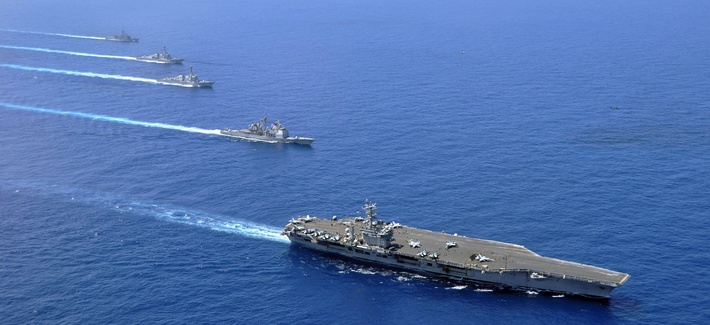
Look out, China military watchers. Beijing seems to have displayed some of its most impressive missile technology—technology that would be used to keep the U.S. Navy at bay in the event of a military conflict. And if all works out, we might just get an up-close look in the days to come.
According to a report in China’s Global Times, Beijing displayed some of its most deadly military hardware during a warm-up for its September 3rd World War II commemorations and parade.

Get your cameras and cell phones ready. Logic would suggest such weapons will be displayed in the actual celebrations.

According to various accounts, several types of missiles were paraded, among them some of the most lethal in China’s arsenal.

“The latest weaponry-the DF-26 intermediate-range ballistic missile that could reach a major U.S. base in Guam in the western Pacific, and the most potent missile, the DF-5 intercontinental ballistic missile, were seen in the rehearsal,” explained Shao Yongling, a senior colonel from the People's Liberation Army (PLA) Second Artillery Command College.

Time for a U.S. Military Strategy to Stop China in the South China Sea

August 24, 2015

As any close observer knows, the South China Sea is a rapidly evolving—and increasingly perilous—strategic arena. China’s assertion that almost the entire sea is “indisputably” Chinese territory has been backed by a rapid buildup of maritime military power and an audacious series of land grabs. The most dramatic of these has been the construction of multiple artificial islands. The military utility of these formations has hardly been disguised. On Fiery Cross Reef, for example, a long military runway with attendant radars is being constructed.

Reactions among Southeast Asian claimants to maritime tensions in the South China Sea have varied along a spectrum of alarm, fear, anger, defiance, and resignation. There is no indication that Beijing regards any of these countries—Vietnam, Malaysia, Indonesia, Brunei, and the Philippines—as a serious impediment to Chinese ambitions over the near to medium term. 

The only nation seen as capable of seriously constraining China is the U.S. But from Beijing’s standpoint, America has no business “interfering” in a region far from its shores and where its interests are secondary compared to China’s. For Beijing, Washington’s insistence on maintaining a military presence in the South China Sea is provocative, destabilizing and illegitimate. A distinguished Chinese professor speaking at a recent conference in Washington described America as acting like a “gangster boss” in the South China Sea.

Is China’s Soft-Power Bubble about to Burst?

August 25, 2015

In Soft Power: The Means to Success in World Politics, Joseph Nye emphasizes the importance of utilizing noncoercive means for achieving desirable strategic outcomes. For great powers, reliance on persuasion, attraction and co-optation are ultimately more sustainable means of maintaining hegemony than outright demonstration and exercise of force. After all, as the Harvard academic correctly points out, great powers will have “to set the agenda and attract others in world politics, and not only force them to change by threatening military force or economic sanctions.” This is the essence of authoritative leadership.

Historically, as Edward Luttwak shows in The Grand Strategy of the Byzantine Empire, soft power was an essential element of the Byzantine Empire’s remarkable (millennium-old) staying power, despite the fact that it was, in military and economic terms, only a shadow of the Roman Empire under the rule of Trajan, Hadrian, Pius and Aurelius (AD 98-180). Throughout its repeated cycles of rise and decline, soft power was also at the heart of Imperial China’s enduring tributary system in East Asia, which reached its zenith under the Tang dynasty (AD 618-907). In Day of Empire, Amy Chua shows how it was primarily China’s civilizational prestige and gigantic economic resources that undergirded its status as the preeminent power in the region until the advent of European colonialism.

Are China’s GDP Numbers Believable?

By Eric Tegler
August 24, 2015

Almost immediately after the Chinese National Bureau of Statistics released its second quarter GDP growth estimate of 7 percent in mid-July, a group of China watchers were crying foul. China officially targeted full-year growth of around 7 percent in 2015, a number matched exactly by its reported GDP figures for the first half of the year.

Last week, Forbes ran a piece by hedge fund manager Jay Somaney, who argued that China’s growth is significantly lower. Somaney cited as evidence data points from the precipitous drop in the Chinese stock market and an 8.3 percent drop in exports to a glut in the country’s real estate market and the devaluation of the renminbi (RMB) by Chinese monetary authorities. Ivan Glasenberg, CEO of the commodity trading and mining firm, Glencore, speculated that China’s crackdown on corruption has stalled infrastructure projects, slowing growth well below 7 percent. As this piece was written, the median estimate of 11 economists surveyed by Bloomberg put China’s GDP at 6.3 percent.

Why China Is Its Own Worst Nightmare

August 24, 2015

For all the complexity of China’s interaction with the outside world as it has grown to be a larger geopolitical and economic player over the last three decades, the fundamental principles on which it operates are straightforward and dependable enough. From the time of Deng Xiaoping, China has sought one quality above all in its main partners, be they the United States, the EU, Russia, or China’s neighboring countries – and that is stability and predictability. The mindset of Chinese leaders is that of a victim; they see China as vulnerable, making up for time lost during the “century of humiliation,” and taking its moment to rectify the injustice of this modern history of imbalance. The two decade-long period of strategic opportunity that Jiang Zemin referred to in 2000, which is now three-quarters of the way over, refers precisely to this process of rectification.

Europe’s Impossible Task of Trying to Monitor Thousands of Terrorism Suspects

Adam Nossiter
August 24, 2015

Europe Facing New Uncertainty in Terrorism Fight

PARIS — Two days after a young Moroccan man was thwarted from an apparent plan to cause carnage on a Paris-bound express train, European officials confronted the deepening quandary of what additional steps they could take in the face of such attacks on soft targets, short of paralyzing public spaces or even more intrusive surveillance.

Enhanced security and surveillance measures had already filtered out the young man, Ayoub El Khazzani, 26. But he was one of thousands of Europeans who had come on the radar of authorities as potential threats after traveling to Syria.

The sheer number of militant suspects combined with a widening field of potential targets have presented European officials with what they concede is a nearly insurmountable surveillance task. The scale of the challenge, security experts fear, may leave the Continent entering a new climate of uncertainty, with added risk attached to seemingly mundane endeavors, like taking a train

In fact, the authorities in at least two countries already knew quite a lot about Mr. Khazzani before he surged into notoriety on Friday afternoon: He was on a French list as a security threat, and Spanish officials told news media there that he had traveled to Syria — not in itself an offense, unless he went there for jihad. Had he been living in France, a tough new surveillance law, approved at the end of July by France’s constitutional council, would have likely turned up even more on him.

French Train Gunman Doesn’t Understand Why He Is Being Called a Terrorist

August 24, 2015

France train gunman ‘dumbfounded’ by terrorism allegations

A heavily-armed gunman previously flagged by intelligence services who was overpowered by passengers in a crowded train said he was “dumbfounded” by accusations of terrorism levelled against him, his lawyer said Sunday.

The alleged attacker, named as 25-year-old Moroccan national Ayoub El Khazzani, on Friday evening boarded a high-speed train in Brussels bound for Paris armed with a Kalashnikov assault rifle, Luger automatic pistol, nine cartridge clips and a box-cutter.

Witnesses say he opened fire, injuring a man before being wrestled to the floor by three American passengers and tied up, until the train stopped in the northern French city of Arras where he was taken into police custody.

Khazzani has denied any intention of waging a jihadist attack, saying he had merely stumbled upon a weapons stash and decided to use it to rob passengers, according to Sophie David, a lawyer assigned to his case at the beginning of his detention in Arras.

Iraq: Conflict Alert

24 Aug 2015

A wave of protests has brought Iraq to the edge of yet more serious conflict. Prime Minister Haider al-Abadi has introduced sweeping reforms to halt the deterioration but in a manner that may make things worse. An important course correction is needed if he is to survive politically and Iraq is to avoid what could become in effect a military takeover.

The country has seen protests over the systemic inadequacy of service delivery before, but this crisis lays bare two overriding problems: massive, deeply entrenched corruption and growing militarism heightened by the war against the Islamic State (IS). The power grid’s failure during extreme summer heat was the trigger that turned general discontent into anger about governance and the political class. An ineffectual effort to overcome the crisis and start addressing fundamental problems could turn that anger into fury, precipitating a breakdown of the post-2003 order.

The protests tie into an intra-elite power struggle that opposes the prime minister, a year in office, to Iran-backed Shiite militia commanders whose credibility has been burnished by the war against IS and who seek to capitalise on popular disenchantment to assert control.

We Asked Paula J. Dobriansky: What Should Be the Purpose of American Power?

August 25, 2015

The purpose of American power, which includes military, economic, diplomatic, ideological, legal and cultural components, is to protect the entire range of our national-security interests. While we face many pressing domestic challenges, America cannot afford to focus on them alone. Americans cannot be secure and prosperous without a stable, rule-driven international order. Terrorism, refugee flows, pandemic diseases, pollution, cyberattacks, economic decay, nuclear proliferation and military aggression can directly threaten our security and prosperity even when they arise overseas.

We cannot handle these threats successfully in an ad hoc fashion. American power must be continuously applied to maintain political, military and economic international institutions and alliances that, with effective U.S. leadership, can safeguard global stability, economic growth and the rule of law. This does not mean that every foreign dispute or fight concerns us. But we must counter fundamental assaults on the existing global liberal order.

We Asked Yoichi Funabashi: What Should Be the Purpose of American Power?

August 25, 2015

The future of American power must be a long-term game of strategic rebalancing—both in the Asia-Pacific region and at home. A momentous shift in economic, military and political power is rapidly taking place in Asia, with global repercussions. The great drama of the twenty-first century will be the trajectory of China’s rise. The challenge posed by China is twofold. An ascendant China is a rival to U.S. power and a potential threat to the post–World War II liberal international order, of which China has been a beneficiary. If Beijing seeks to undermine the existing order and establish an alternative system based on its own Sinocentric strategic vision, then the organizing principles that have laid the foundation for unprecedented peace, stability and prosperity in the Asia-Pacific are at risk of being overturned.

We Asked Robert W. Merry: What Should Be the Purpose of American Power?

August 25, 2015

Editor’s Note: The following is part of TNI’s special 30th anniversary symposium. We asked twenty-five of the world’s leading experts: What is the purpose of American power? You can find all of their answers here. You can also find our exclusive interview with Henry Kissinger here.
America is the most powerful nation in the world, perhaps the most powerful nation in world history. Thus, it has a major global role to play. But foreign policy must focus above all on the interests of the nation itself, and its people. That means, first, protecting vital American interests at home and in our region. It means, second, maintaining the country’s position in the world so that it can successfully execute the first requirement. It means, third, avoiding messy military involvements that undermine America’s global position and sap its resources. If the first job of U.S. foreign policy is to ensure the well-being of the American people, then any action that undermines that well-being, without justifiable longer-term returns, is foolhardy. The hurts and wants of unfortunate peoples caught in the vortex of history don’t come into this equation, as sad as that is.

Spy Satellite and Drone Surveillance in the U.S.

Jeffrey T. Richelson (ed.)
August 24, 2015

Washington, D.C., August 24, 2015. - “FBI spy plane zeroes in on Dearborn
area” was the headline in The Detroit News on August 5, 2015. The story,
which broke the news that the FBI had conducted at least seven surveillance
flights recently over downtown Detroit, also raised a broader issue. It
illustrated the fact that along with the controversy concerning electronic
surveillance activities focused on telephone and e-mail records of United
States citizens there exists a corresponding source of controversy - the use
of satellites and assorted aircraft (manned and unmanned) to collect imagery
and conduct aerial surveillance of civilian targets within the United
States.

Today, the National Security Archive posts over forty documents, many
appearing online for the first time, related to the domestic use of
overhead imagery and the controversy it has generated. Among those documents
are:

- Annual activity reports of the Civil Applications Committee, created in
1975 to provide a forum for interaction between the Intelligence Community
and civil agencies wanting information from “national systems” (Document 2,
Document 4, Document 6, Document 13, Document 16).

Military Situation in the Ukraine and Other Russian Military News

August 24, 2015

Dangerous, Absurd And Very Real

Ukrainian military intelligence has been warning of another offensive in eastern Ukraine (Donbas) and it was supposed to start today, which is the Ukrainian Independence Day. While there were recent major movements of Russian armored vehicles and artillery into Donbas and an increase in ceasefire violations by pro-Russian forces there, the offensive has not happened. At the same time Ukraine is trying to get its constitution changed to offer Donbas a special status that might satisfy Russia and stop the war there. If the Ukrainian president can get the constitutional amendment enacted an offer can be made to Russia to call off their undeclared invasion in return for an autonomous Donbas and a lifting of sanctions. This is a long shot but Ukrainian leaders see the alternative as years (or decades) of this state of war, which has been very expensive for Russia and Ukraine. But the Russian leadership appears split on the idea of any sort of compromise. The Russians have justified this war by convincing the Russian people that NATO attacked Russia first by scheming to take control of Ukraine and make it part of NATO, as was already done in Poland and the Baltic States. Westerners are appalled at the absurdity of this idea but Russia’s East European neighbors have heard it many times in the past as it is the traditional Russia excuse for invading its neighbors. All in the name of self-defense of course. Most Western leaders and news editors don’t know enough about Russian history to appreciate what is going on here. The new NATO members in East Europe are trying very hard to educate their Western friends but it is slow going because this Russian attitude seems so unbelievable. Many aspects of Russian history and culture seem absurd to Westerners, but these things are very real and very dangerous. 

Ukraine believes over 6,800 have died since the Russian aggression in Donbas began in April 2014. In addition to the violence Ukrainian intelligence officials have found evidence of Russia funding Ukrainian opposition parties (which tend to be leftist one, including current or former communists) in order to gain more influence on the government. 

Russia Engages in Military Drills on Europe’s Doorstep

August 25, 2015

Russia and its military partners across Asia have been busy practicing. While the Russian Navy is engaging in exercises with China in the Sea of Japan (which The Diplomat’s Franz-Stefan Gady covered here), its air force has been exercising with units from the Commonwealth of Independent States (CIS), and the Collective Security Treaty Organization (CSTO)’s Rapid Reaction force (CRRF) is also engaging in exercises. While the CSTO exercises are an annual event, this year’s location has drawn increased attention.

Cooperation 2014 unfolded in Kazakhstan, attended by over 3,000 soldiers from Armenia, Belarus, Kazakhstan, Kyrgyzstan, Russia and Tajikistan, focused on “psychological and cyber warfare for the first time.”

Obama’s Disingenuousness on Iran

By David J. Karl
August 24, 2015

Depending on one’s perspective, President Obama’s address at American University earlier this month was either a rousing defense of the Iran nuclear agreementor an egregious instance of political demagoguery. But one thing the speech underscores with certainty is that Mr. Obama’s earlier vows that he was prepared to use military force to prevent Tehran’s atomic ambitions were disingenuous.

These were pledges Obama issued with regularity as the multilateral negotiations with Iran got underway. In his 2012 State of the Union address, he stated that “America is determined to prevent Iran from getting a nuclear weapon, and I will take no options off the table to achieve that goal.” In a media interview shortly afterwards, he emphasized that he was not bluffing about the military option and that “when the United States says it is unacceptable for Iran to have a nuclear weapon, we mean what we say.” “I don’t bluff,” he emphatically insisted. The president then followed this up by delivering a hard-hitting address to the American Israel Political Action Committee, an influential lobbying group in Washington, stressing that “when it comes to preventing Iran from obtaining a nuclear weapon, I will take no options off the table, and I mean what I say.”

US Military Base in Japan Rocked by Explosion

August 24, 2015

A blast that shattered the U.S. Army’s Sagami General Depot in the city of Sagamihara, approximately 25 miles (40 kilometers) southwest of Tokyo, causing a fire that burned through the night but injuring no oneAFP reports.

First reports that a bomb had gone off in the warehouse proved inaccurate. “I thought the American military facility came under a terrorist attack,” a security guard told local media. ”Orange sparks were rising quite high. I couldn’t see smoke but smelled something like gunpowder,” an eye witness noted.


The blast occurred at 12:45am on Monday local time and was extinguished at 7:09am by the local fire department, which dispatched 13 trucks to the site of the explosion, according to the Wall Street Journal

There was some confusion what exactly was stored at the depot. “We coordinated with U.S. fire units, and did not spray water as we waited for information related to what was inside,” a Sagamihara fire department official told AFP.

In the US, computer science is (unfortunately) a privilege


Students from lower income backgrounds are less likely to have computers at home or any type of computer science instruction. Which explain why Silicon Valley is so homogenous.

There’s a reason why Silicon Valley has a reputation for being the land of young, white, privileged brogrammers.

If you look at the makeup of students today, white children who grow up in higher-income households with educated parents are more likely to have a computer at home and access to computer science classes, according to a new survey from Gallup that was commissioned by Google. (The report surveyed 1,673 students in seventh to 12th grades, 1,685 parents, 1,013 teachers, 9,693 principals, and 1,865 school district superintendents.)

Hans Morgenthau and Hannah Arendt: An Intellectual Passion

August 25, 2015

IN THE late 1940s, Leo Strauss left the New School for Social Research in New York to take a position at the University of Chicago. Hans Morgenthau, who was a professor in the Political Science Department and on his way to establishing himself as the father of realism, was instrumental in securing the post for Strauss, and the two men, whose life experiences were so very similar, immediately formed a close bond. Morgenthau told an associate that he learned more from Strauss “in a few minutes’ conversation than from hours with other political scientists.” Strauss was equally admiring of Morgenthau. Yet that initial compatibility masked deeper incompatibilities—both in outlook and personality—that weren’t long in coming to the surface and scotched whatever element of sympathy existed between the two men.

Some years later, Hannah Arendt came to Chicago. She and Strauss never got along (though they had known each other since their student days in Germany when, it is said, Strauss courted her). But her relationship to Morgenthau was very different, and also very different from Strauss’s relationship to Morgenthau. In contrast to the Strauss-Morgenthau connection, there always remained a quality of sympathy between Arendt and Morgenthau—colored, it should be said, by an element of the erotic.

New Report on Intelligence Contractor Oversight

Steven Aftergood
August 24, 2015

Intelligence Contractor Oversight, and More from CRS

Effective oversight of intelligence community contractors is a particularly difficult exercise since the reliability of official data on contractor activities is uncertain and most of it is classified and inaccessible to outsiders, a new report from the Congressional Research Service explains.

“Contractors have been and are an integral part of the intelligence community’s (IC’s) total workforce (which also includes federal employees and military personnel). Yet questions have been raised regarding how they are used, and the size and cost of the contractor component.”

The new CRS report “describes several initiatives designed, or used, to track contractors or contractor employees. [It also] addresses the questions of whether IC contractor personnel are performing inherently governmental functions and whether the IC’s acquisition workforce is equipped to monitor contractors performing critical functions….”

Seriousness of the OPM Data Breach Disputed

August 23, 2015

Intelligence experts agree that redlines need to be drawn but disagree on where to draw them
Catherine Lotrionte (l), director, Institute for Law, Science, and Global Security, Georgetown University and Robert Knake, fellow, Council on Foreign Relations. They discussed the cyberattack on OPM at the Atlantic Council, Aug. 19. (Gary Feuerberg/ Epoch Times)

WASHINGTON—On April 15, 2015, officials of the Office of Personnel Management realized they had been hacked and the records of 4.2 million of current and former employees had been stolen. Later investigations by OPM determined in early June that the number affected is 21.5 million, for whom sensitive information, including Social Security Numbers (SSNs), was stolen from the background investigation databases.

This was the biggest breach of United States government data in history. Reports point to China as the source of the breach, but the Administration has not formally accused China.

Remember the Pentagon’s Pacific Pivot? It’s Still On

AUGUST 21, 2015

A new strategy document outlines Chinese activities in the South China Sea and the planned US responses to them. 

The U.S. will continue sending new weapons and equipment to the Asia-Pacific region to counter China, U.S. Defense Department officials say. And in a new strategy document, the Pentagon said it would continue ignoring Beijing’s claims that reclaimed land in the South China Sea constituted sovereign territory.

Marcus Weisgerber is the global business reporter for Defense One, where he writes about the intersection of business and national security. He has been covering defense and national security issues for nearly a decade, previously as Pentagon correspondent for Defense News and chief editor of ...Full Bio

Earlier this month, Chinese Foreign Minister Wang Yi said Beijing had halted land reclamation in the South China Sea. A senior defense official said it was unclear whether that was so.

Philippines, Malaysia Hold Joint Naval Exercises Amid Security Concerns

August 25, 2015

The Philippines and Malaysia are holding naval drills this week as both countries seek to deepen their cooperation in maritime security and transnational crime.

The four-day naval drills, codenamed MTA MALPHI LAUT 18/5, are the 18th iteration of an annual bilateral training exercise between the two Southeast Asian states since a memorandum of understanding on defense cooperation was concluded in 1994.

According to Rear Admiral Primitivo Gopo, commander of the Naval Forces Western Mindanao (NFWM) which is hosting the five-day Maritime Training Activity (MTA), the exercises will be held ashore and afloat in Zamboanga City and in the Moro Gulf and focus on maritime security and transnational crime. They will run up to August 28.

The exercises, Gopo added, would consist of three phases and involve 157 sailors from the Philippine Navy (PN) and 136 sailors from the Royal Malaysian Navy (RMN). The first phase, the harbor phase, will take place from August 24 to 25 and would involve various activities including courtesy calls, subject matter expert exchange lectures, special operations activities and naval aviation training. The second phase, at sea trials, will occur from August 26 to 27 and involve combined ship maneuvers to address various contingencies at sea. The third and last phase from August 27 to 28 will involve a sports cup activity and other recreational activities before the departure of RMN ships.

Back from the Brink: How the Koreas Made Up

August 25, 2015

The ‘August Crisis’ between South Korea and North Korea appears to have come to a close. As my colleague Franz-Stefan Gady reported, Pyongyang has agreed to apologize for its provocative behavior and, in return, Seoul will cease propaganda broadcasts across the demilitarized zone (DMZ) separating the two countries. Seoul resumed broadcasts for the first time in more than a decade after two South Korean soldiers suffered injuries from a North Korean land mine, the first North Korean provocation to result in South Korean casualties since Kim Jong-un took over the Hermit Kingdom.

For long-time observers of the Koreas, it always seemed slim that this period of escalating rhetoric and action would be the one to thrust the Korean peninsula back into all-out war. What may have been less obvious, before the inter-Korean talks kicked off at Panmunjom, were the actions both sides could take to return to the status quo, before the land mine incident. For both states, a resolution that did not allow their leadership to save face would have been intolerable. Fortunately, neither Seoul’s actions nor Pyongyang’s seemingly brazen series of provocations caused a scenario where both Koreas had their backs to the wall. Room for a face-saving compromise was possible as long as Seoul responded to Pyongyang’s provocations carefully.

Confirmed: North and South Korea Reach Agreement to Deescalate Tensions

August 25, 2015

South Korea will get an apology from Pyongyang for its recent military provocations and Seoul will stop broadcasting propaganda via loudspeakers into the North, according to an interim-agreement reached by both sides Yonhap News Agency reports.

The negotiations that were taking place in the “truce village” of Panmunjom, inside the demilitarized zone, purportedly ended at 00:55 local time on Tuesday after 40 hours of talk, according to the BBC. Kim Kwan-jin, South Korean President Park Geun-hye’s national security adviser, lead the South Korean delegation, whereas Hwang Pyong-so, a top military aide to Kim Jong-un represented the North during the negotiations.

In the interim-agreement, to be officially announced soon, Pyongyang will allegedly offer “regrets” over the August 4 incident, in which two South Korean soldiers were severely injured by a landmine explosion and for which the North has been held responsible by the South.

No one has cared to inform us about the '65 war celebrations: Wounded war veteran


Col HN Handa, the senior-most wounded officer of the 1965 Indo-Pak war, recounts how his leg was blown off and the unrest in the military hospital before Indira Gandhi's visit.


Five months short of turning 80, Col. (Retd) HN Handa is the senior-most wounded officer of the Indo-Pak war of 1965. He now heads the Disabled War Veterans (India) association. In this interview with Scroll.in, he reminisces about the war, how his leg was blown off, and discloses details of incidents not really known – the unrest sparked by the wounded in a Pune hospital which warranted the deployment of a battalion to check it, and their memorable meeting ith Prime Minister Indira Gandhi. Excerpts:

DoD plans to send more officers to civilian grad schools


By Andrew Tilghman
August 24, 2015 

The Pentagon wants to send more officers to earn graduate degrees at top-notch civilian universities, a key piece of soon-to-be released personnel reforms that could fundamentally alter the career tracks of senior military leaders.

Defense officials familiar with the plan said the aim is to both improve and diversify the officer corps' education and also provide future military leaders with more experience studying or working in the civilian sector and developing nontraditional skills.

The shift toward civilian schools is driven in part by concerns that the military's own educational institutions like those under the National Defense University in Washington and the service-run war colleges no longer are capable of delivering the comprehensive training that tomorrow's force will need to succeed.

"We're moving to a time when a battalion or brigade commander assigned to Joint Task Force-Horn of Africa might have a master's degree in public policy," said one defense official familiar with the plan.

Hybrid War as a War on Governance

August 19, 2015 

Dr. Mark Galeotti is Professor of Global Affairs and the academic director of the Transnational Security concentration of the MS in Global Affairs program at New York University's School of Professional Studies. He is a specialist in transnational organized crime, security affairs and modern Russia.

In the 21st century we have seen a tendency toward blurring the lines between the states of war and peace. (…) The role of nonmilitary means of achieving political and strategic goals has grown, and, in many cases, they have exceeded the power of force of weapons in their effectiveness.

Russian Chief of the General Staff Valery Gerasimov

As Clausewitz emphasized, we first need to understand exactly the nature of the war/threat that we are confronted with. What are the core features of this Russian approach on hybrid warfare?

CONSTANT CONTACT: HOW MUCH IS TOO MUCH DURING DEPLOYMENTS?


By Rebecca Alwine
August 17th, 2015 

Over the past decade or so, technology—and with it, communication from faraway lands—has changed our lives. Probably no other demographic of people has experienced this change as much as the military. In World War II, telegrams and letters were the lifeline between families back home and soldiers overseas. The postal service sped up slightly as troops were sent to Korea. Now, some soldiers have constant access to the Internet; they can see firsthand what is trending on Twitter and Instagram. With these changes, however, comes this question: How much communication is too much?

From the beginning of their careers, soldiers are cut off from their families. Basic training breaks the constant contact that society is so accustomed to today. Soldiers focus on the most important thing at that point: their job. It is essential that family members understand and respect this. It is equally important for family members to learn that there are times when communication is simply impossible or inappropriate.

25 August 2015

The Daily Fix: Why the period just after failed India-Pakistan talks is the most dangerous for Modi


Above the Fold: Top stories of the day

1. Five people died and dozens were injured after a lorry collided with a train in Andhra Pradesh's Anantapur district early on Monday morning.

2. A new book from the Indian Army seeking to make stories about past wars more reader-friendly also attempts to insist that India won the 1965 war with Pakistan, which is generally remembered as ending with a stalemate.

3. A Supreme Court panel has said a massive Rs 2,300 crore project to put a railway line through the Western Ghats in Karnataka would cause "huge and irreparable damage" to the environment.

The Big Story: Picking up the peace pieces

Now to figure out what happens next. With India and Pakistan having cancelled the proposed National Security Advisor-level talks, and each side blaming the other for it, those hoping for actual discussions in New Delhi and Islamabad will have to carefully plan out their next moves to avoid the mess of the last few days. There are a few bright spots ahead: a proposed meeting of the chiefs of the Border Security Force and the Pakistani Rangers, a potential meet between the prime ministers of the two countries on the sidelines of the United Nations General Assembly.

New Tri-Service Commands

By Lt Gen Prakash Katoch
22 Aug , 2015

Newspapers on August 20 blared headlines ‘Govt gets cracking on three new Tri-Service Commands’. The “cracking” part was amusing for in 2004-2005 the same hype was created about the Aerospace Command, creating an impression it will be a reality next year. This was 10 years ago and much before the Naresh Chandra Committee was formed. Same hype was created about the Mountain Straike Corps that even the Chinese took notice and we know what its state is today, though not aware what state it eventually will come up in. Ditto for the National Defence University.

…what shape these new Tri-Service Commands will come up and how effective they will be?

All this is because the higher defence set up including the MoD is without military expertise, the very reason we don’t have a National Security Strategy, have not undertaken a comprehensive defence review and have not been able to establish credible deterrence against asymmetric wars that both Pakistan and China are waging against us. Unfortunately, the Modi government despite being in office for 15 months has made no move to undertake administrative reforms, particularly of the MoD.