AUDREY DECKER
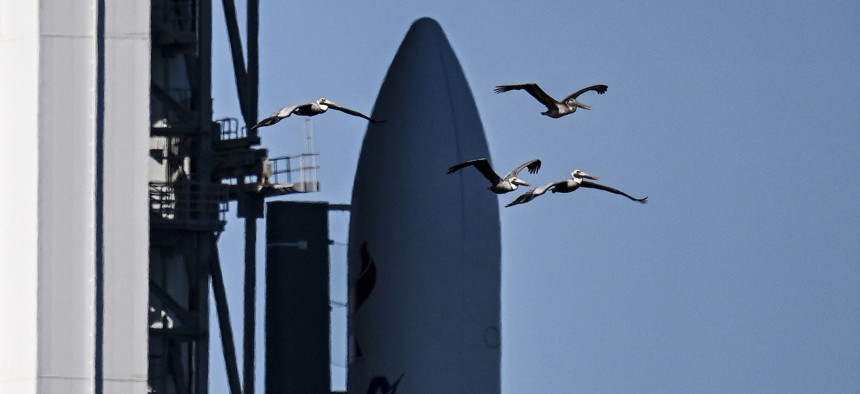
United Launch Alliance successfully launched its much-anticipated heavy-lift rocket, a key step in its plans to compete against launch titan SpaceX.
The first flight test and certification mission for ULA’s Vulcan Centaur rocket lifted off from Cape Canaveral Space Force Station in Florida at 2:18 a.m. on Jan. 8, company officials said.
Vulcan will be “very competitive” in the space market because it has the capabilities of the Atlas V and Delta IV rockets combined into one system, officials said.
“Vulcan is really designed to support a full range of missions across all the markets that we serve, commercial, civil and national security, and because we do have that adjustability in its configuration can be really tailored to the specific mission,” Mark Peller, ULA vice president of Vulcan development, told reporters Friday ahead of the launch.
But even with Vulcan entering the launch market, SpaceX will still have an advantage over ULA once SpaceX’s Starship mega-rocket becomes operational. Starship will “have an order of magnitude larger payload capacity than Vulcan and a cost per pound that much less than even the Falcon 9,” said Todd Harrison, a senior fellow at the American Enterprise Institute.
“I don't see any scenario in which Vulcan becomes cost-competitive with Falcon 9 or Starship, and a big reason is that it is not designed for reusability. What will keep Vulcan alive is U.S. military policy that says they want to have at least two launch providers, and commercial customers that want to avoid becoming dependent on Elon Musk—like Amazon. Once Blue Origin's New Glenn enters service and gets qualified to launch military satellites, all bets are off,” Harrison said.
However, ULA is looking at reusing the engines “downstream,” Peller said, maintaining that the current version of Vulcan is competitive regardless.