1 February 2014

War divides, trade unites

Wagah border trade can boost India-Pakistan relations
Davinder Kumar Madaan

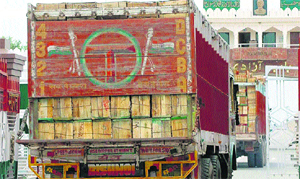
Trucks carrying tomatoes cross over to Pakistan at Wagha. A Tribune file photo
THE recent meeting of the Commerce Minister of Pakistan with his Indian counterpart on the margin of the 5th SAARC (South Asian Association for Regional Cooperation) Business Leaders Conclave in New Delhi decided that Non-Discriminatory Market Access (NDMA) and normal trade relations between India and Pakistan would be implemented by the end of February 2014. Both countries agreed to open the Wagah-Attari Land Customs Station operational on all seven days of each week, and liberalisation of the business visa regime. Further, on January 22, 2014, Pakistan approved the signing of a Memorandum of Understanding (MoU) for a deal to buy electricity from India for which an inter-connection will be built between Amritsar and Lahore. Earlier, India offered to export electricity to the tune of 500 MW to Pakistan. In fact, the important milestone for their mutual trade took place on March 20, 2012, when Pakistan switched over from this Positive List of 1,963 items to the Negative List of 1,209 items that cannot be imported from India. Thus, more than 7,500 items became importable from India. All steps by the two countries are expected to accelerate the process of their mutual trade relations as there are tremendous gains due to their geographical proximity and contiguity of territories, which can help in saving the transportation and transhipment costs.

Though enormous trade potential between India and Pakistan exists, still they realised less than 8 per cent of the potential. Nearly 70 per cent of what Pakistan consumes is from imports, but its imports from India are very less. During 2012, the official trade between India and Pakistan could have increased from US$ 2.1 billion to US$ 29.8 billion (14.2 times), provided both had removed certain irritants in the way of trade. Pakistan's tariff on import from India was as high as 100 per cent on black tea, 70 per cent on cardamoms, 31.9 per cent on woven fabrics, and 30 per cent on tomatoes, chickpeas and cumin seeds. India's tariff was as high as 42.8 per cent on cotton fabrics, 30 per cent on sesamum seeds, and 24 per cent on dates.

The Wagah border is very important for exploiting the trade potential between India and Pakistan. During 2012-13, 34 per cent of the total bilateral trade was via this land route. Both countries resumed the truck movement at the Attari/Wagah border on October 1, 2007. With the inauguration of the Integrated Check Post (ICP) on April 13, 2012, the number of trucks crossing the Attari/Wagah border increased from 51 in 2009-10 to 207 per day in 2012-13. The items imported included cement, chemicals, gypsum, dry dates, dry fruits, float glass, marble stone and sand. The items that were exported to Pakistan were potatoes, tomatoes, onions, cotton, meat, ginger, garlic, green chillies, soyabeans, newsprint, polypropylene, carbon dioxide in liquid form, etc.

Pakistan’s myths and manipulations

February 01, 2014

The Pakistani mind is encouraged by the state to nurse certain myths about why the country is in trouble.

SUMMARY
The uneasy alliance with America is crumbling, and al-Qaeda and affiliates are more popular than ever.

The Pakistani mind is encouraged by the state to nurse certain myths about why the country is in trouble. The foreign office, ever articulating the current military thinking, encourages this mythmaking by not coming clean on matters that exercise the collective mind.

The first myth is that India must not be present in Afghanistan. Why? Because India threatens Pakistan’s security through its consulates; it is already busy abetting insurgency in Balochistan, for which Pakistan need not present any evidence to India. The Taliban are killing people because “external powers” are manipulating them. America has its own designs on the region, including Central Asia; it is helping India become the big power in South Asia as part of the American “pivot” against China. But on the ground, non-state actors incubated by the state (that is, the army) to carry out cross-border proxy wars are killing innocent people, most of their acts criminal rather than revolutionary because there is money in it. The ultimate myth is that the state is under threat from without and not from within, despite a former army chief’s assertion that it is under threat from within.

These are signs of where Pakistan is headed, its mind collectively warped. A number of American analysts have written books saying Pakistan just didn’t deliver on its commitments as an ally and was in fact colluding with terror; that the Pakistani state was in crisis and couldn’t help itself let alone help the US; that the Pakistan army was internally divided and its intelligence agencies were following strategies that crisscrossed with the grand design of the Taliban-al-Qaeda combine; and that, because of the ongoing collapse of the state, al-Qaeda was bound to make a comeback in Pakistan after being ousted from the Islamic world by drone attacks.

Former US secretary of defence Robert Gates, in Duty: Memoirs of a Secretary at War, says, “Although I would defend them (Pakistan) in front of the (American) Congress and to the press to keep the relationship from getting worse and endangering our supply line, I knew that they were really no ally at all… The US never thought of consulting Pakistan before raiding Osama bin Laden’s Abbottabad compound because it feared that the Inter-Services Intelligence was protecting him. Empowering the Pakistani military at the cost of democratic institutions was an American mistake and Washington’s personalisation of relations with different autocrats has significantly weakened the state of Pakistan.”

SHARIF WANTS EARLY START TO TALIBAN TALKS

31 January 2014

Pakistan Prime Minister Nawaz Sharif Friday met members of the committee formed to hold talks with the Taliban and instructed them to initiate peace talks immediately, a media report said.

The four-member committee, which includes journalist Rahimullah Yousafzai, former ambassador and expert on Afghanistan affairs Rustam Shah Mohmand, former ISI official Amir Shah and Irfan Siddiqui, columnist and special assistant to the prime minister on national affairs, was formed Wednesday. The panel met Sharif to discuss the dialogue strategy, Geo News quoted sources as saying. Interior Minister Chaudhry Nisar was also present at the meeting.

The prime minister said he wanted to make efforts to restore peace and directed the interior minister to keep him informed about the progress of the team. Sharif also asked the panel to open communication channels with the factions that are ready to take part in the dialogue process. The report, quoting informed sources, said it was decided in the meeting that the committee should be able to exercise autonomy during talks with the Taliban.

Ten Fictions that Pakistani Defense Officials Love to Peddle

January 31, 2014 

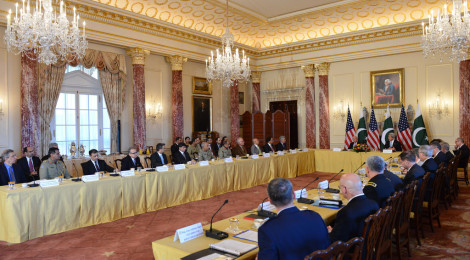
The U.S.-Pakistan “strategic dialogue” has restarted yet again. I would be remiss if I did not point that it has never been strategic and it has certainly not been a dialogue. No doubt the Pakistanis are worried that wary American taxpayers and their congressional representatives may close the checkbook for good when the last U.S. soldier departs from Afghanistan. In the spirit of perpetual rent-seeking, Pakistani defense officials have recently alighted upon Washington to offer the same tired and hackneyed narratives that aretailored to guilt the Americans into keeping the gravy train chugging along.

Here are the top ten ossified fictions that Pakistani defense officials are pedaling and what you need to know to call the “Bakvas Flag” on each of them.

1. “Our relationship should be strategic rather than transactional.”

Nonsense and here’s why. For the U.S.-Pakistan relationship to be “strategic,” there should be a modicum of convergence of interests in the region if not beyond. Yet, there is no evidence that this is the case. In fact, Pakistan seems most vested in undermining U.S. interests in the region. In the name of the conflict formerly known as the Global War on Terror (GWOT), the United States has given Pakistan some $27 billion in military and financial aid as well as lucrative reimbursements. However, during these same years, Pakistan has continued to aid and abet the Afghan Taliban and allied militant groups such as the Haqqani Network. These organizations are the very organizations that have killed American military and civilian personnel in Afghanistan along with those of our allies in theInternational Security Assistance Force (ISAF) and countless moreAfghans, in and out of uniform. This is in addition to the flotilla of Islamist militant groups that Pakistan uses as tools of foreign policy in India. Foremost among them is the Lashkar-e-Taiba, which is proscribed by the United States and which is responsible for the most lethal terror operations in India and, since 2006, has openly operated against Americans in Afghanistan.

2. “The United States has been an unreliable ally.”

Rubbish. Pakistani officials enjoy invoking the two treaties, the Central Treaty Organization (CENTO) and the Southeast Treaty Organization (SEATO) through which the United States and Pakistan ostensibly were allies. They lament that despite these partnerships and commitments, the United States did not help Pakistan in its wars with India (1965 and 1971) and even aided non-aligned India in its 1962 war with Communist China. It should be noted that Americans were never party to CENTO; rather, they maintained an observer status, and Americans were leery of letting the Pakistanis join SEATO, fearing that it was a ruse to suck the alliance into the intractable Indo-Pakistan dispute. In point of fact, Pakistani officials beginning with Muhammad Ali Jinnah, Liaquat Ali Khan, and General Ayub Khanrepeatedly sought to join American military alliances in exchange for money and war materiel.

China’s Deceptively Weak (and Dangerous) Military


In many ways, the PLA is weaker than it looks – and more dangerous.
By Ian Easton
January 31, 2014

In April 2003, the Chinese Navy decided to put a large group of its best submarine talent on the same boat as part of an experiment to synergize its naval elite. The result? Within hours of leaving port, the Type 035 Ming III class submarine sank with all hands lost. Never having fully recovered from this maritime disaster, the People’s Republic of China (PRC) is still the only permanent member of the United Nations Security Council never to have conducted an operational patrol with a nuclear missile submarine.

China is also the only member of the UN’s “Big Five” never to have built and operated an aircraft carrier. While it launched a refurbished Ukrainian built carrier amidst much fanfare in September 2012 – then-President Hu Jintao and all the top brass showed up – soon afterward the big ship had to return to the docks for extensive overhauls because of suspected engine failure; not the most auspicious of starts for China’s fledgling “blue water” navy, and not the least example of a modernizing military that has yet to master last century’s technology.

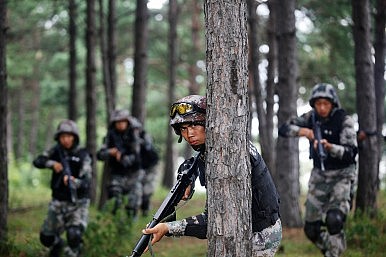
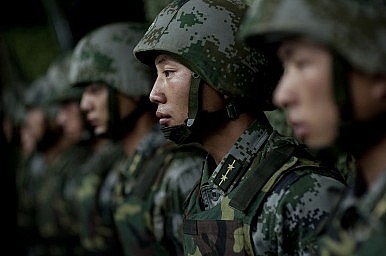
Indeed, today the People’s Liberation Army (PLA) still conducts long-distance maneuver training at speeds measured by how fast the next available cargo train can transport its tanks and guns forward. And if mobilizing and moving armies around on railway tracks sounds a bit antiquated in an era of global airlift, it should – that was how it was done in the First World War.

Not to be outdone by the conventional army, China’s powerful strategic rocket troops, the Second Artillery Force, still uses cavalry units to patrol its sprawling missile bases deep within China’s vast interior. Why? Because it doesn’t have any helicopters. Equally scarce in China are modern fixed-wing military aircraft. So the Air Force continues to use a 1950sSoviet designed airframe, the Tupolev Tu-16, as a bomber (its original intended mission), a battlefield reconnaissance aircraft, an electronic warfare aircraft, a target spotting aircraft, and an aerial refueling tanker. Likewise, the PLA uses theSoviet designed Antonov An-12 military cargo aircraft for ELINT (electronic intelligence) missions, ASW (anti-submarine warfare) missions, geological survey missions, and airborne early warning missions. It also has an An-12 variant specially modified for transporting livestock, allowing sheep and goats access to remote seasonal pastures.

The Chinese Military's Toughest Opponent: Corruption

Is Xi Jinping willing to bring his anti-corruption drive to bear on the People’s Liberation Army?
February 01, 2014

South China Morning Post reported details this week on an official government raid of the home of Lt. Gen. Gu Junshan, one of the highest-ranking PLA officers to ever be investigated for graft. Gu, who used to be the deputy chief of the PLA’s General Logistics Department, reportedly had quite a collection of treasures at his home in Henan Province, including “a pure gold statue of Mao Zedong, a gold wash basin, a model boat made of gold and crates of Maotai liquor.”

For all the recent fervor in the United States over China’s military modernization programs, corruption within the ranks could be weakening these efforts behind the scenes. According to Xinhua, China’s official defense budget for 2013 was $114.3 billion, a 10.7 percent increase over 2012. Western analysts such as Andrew S. Erickson and Adam P. Liff have noted that it is incredibly difficult to tell exactly what this money is being used for. “China still does not release even basic information that would provide insight into intra-PLA spending priorities, including a budget breakdown by service, the total amount spent on weapons imports, or the procurement costs of specific weapons and platforms,” they told the National Bureau of Asian Research in 2013.

It’s worth wondering, though, if the Chinese government itself keeps a careful eye on where all this money goes. Given the amounts of money Chinese civilian officials have been convicted of embezzling—over $28 million in the case of former Railways Minister Liu Zhijun—if there are similar levels of corruption in the PLA, a significant chunk of China’s defense budget (both reported and unreported) might be used not to develop new weapons systems, but to pad officers’ pockets. There haven’t been nearly as many public reports on corruption in the PLA, but the occasional investigation does suggest the scale of the problem. In 2005, the last military official to be toppled by corruption charges, Adm. Wang Shouye, was rumored to have stolen almost $20 million.

In April 2012, PLA General Liu Yuan, the political commissar of the PLA’s General Logistics Department (and rumored to be a close friend of Xi Jinping’s) gave a series of candid speeches on the issue of corruption in the PLA. According toForeign Policy, Liu told PLA officers that “no country can defeat China … only our own corruption can destroy us and cause our armed forces to be defeated without fighting.” In addition to misusing funds, Liu also pointed to the problem of effectively buying promotions, another issue that the civilian and military spheres seem to share. This could have serious repercussions on the efficacy of Chinese military leadership.

On Iran, compromise is needed


After Iran and the major powers signed onto an interim deal on Tehran’s nuclear program, expectations were high. Over the past week, they have fallen sharply as Iranian officials have made tough public comments and Israel’s prime minister has reaffirmed his opposition to almost any conceivable deal, a skepticism shared by several influential U.S. senators. This does not mean a final deal with Tehran is impossible, but it does mean that both sides, Tehran and the West, need to start thinking creatively about how to bridge what is clearly a wide divide and how to get around the main obstacle they will face — which is not abroad but at home.

The Iranian statements that have attracted so much attention came from both the foreign minister and president. The former, Mohammad Javad Zarif, explained to CNN’s Jim Sciutto that, contrary to what Washington had repeatedly claimed , Iran “did not agree to dismantle anything.” Later, in an interview with me also on CNN, President Hassan Rouhani explained that Iran would not destroy any of its existing centrifuges. He also indicated to me that Iran would not shut down its heavy-water reactor at Arak, a point of contention with the West, which worries that the facility can produce plutonium capable of making a bomb.

Iran and America have fundamentally different views about an acceptable final deal. On the basis on my interview with Rouhani and talks with other Iranian officials, my sense is that the Iranian vision is as follows: Iran will provide the world with assurances and evidence that its nuclear program is civilian, not military. This means that the country would allow unprecedented levels of intrusive inspections at all facilities. This process has already begun. The interim agreement calls for international inspections at Iran’s centrifuge production factories, mines and mills. This week, for the first time in nearly a decade,inspectors have entered Iranian mines.

But Iran’s officials are determined not to accept any constraints on their program. They speak often about the importance of being treated like any other country that has signed the Nuclear Non-Proliferation Treaty, which to them means having the unfettered right to enrich uranium to produce electricity. In fact, the treaty says nothing about enrichment activities specifically. Many countries with nuclear power plants do not enrich but others do, which allows Iran to claim, reasonably, that enrichment has so far been a permitted activity. The only criterion the treaty lays out is that all nuclear production must be “for peaceful purposes.”

Enable the Warrior-Diplomat

January 30, 2014 

The mission in Afghanistan is either going to change into something much smaller—about 10,000 troops—or it will end. After two long foreign occupations in Iraq and Afghanistan, the appetite of the American public for lengthy stabilization operations is gone. Cries for “returning to our roots” and “getting back to the basics” will echo through the corridors of the Pentagon. Top line fiscal cuts will cause the bottom lines of “nonessential” training and education programs to dwindle. We’ll lean out our personnel numbers, stick to the basics of offensive and defensive land, amphibious, maritime and airborne operations, and forget the “softer side” of basic combat operations. Never mind training for what happens after initial combat ends—nongovernmental organizations, intergovernmental organizations, and other governmental organizations will take care of that, right?

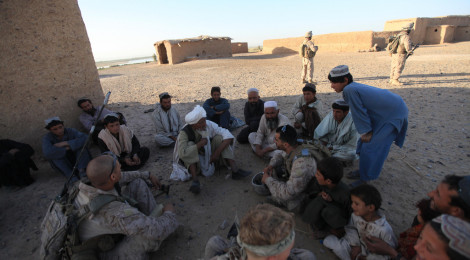
Such outspoken advocates of “returning to the basics” should keep in mind the timeless observation of former Speaker of the House Tip O’Neill, who was more right than he knew when he said “All politics is local.” This is true in Afghanistan, and will continue to be so wherever Washington tells the military to deploy, even in wars that we may initially view as “conventional,” like Iraq in 2003. And even as Washington spurns any operation with a whiff of counterinsurgency, U.S. forces remain involved in missions that require partnering with and assisting allied militaries and community leaders. Evan Munsing’s recent article does well to highlight the harsh reality that locally brokered solutions in Afghanistan will be the product of a weak central government. However, given the failed imposition of a centralized counterinsurgency approach to a decentralized problem in Afghanistan, this author would argue that the need for well-trained “warrior-diplomats” is key for future deployments in resource-constrained environments. COIN doctrine itself was not the problem. The strategy was the problem. The lack of a clearly defined political endstate gave rise to interagency parochialism and regional interpretations of “progress” and “stability.” Some units improvised local solutions, in anticipation of those inevitable locally brokered post-withdrawal deals of which Munsing speaks. This was certainly the case with the U.S. Marines in Sangin District of Helmand Province in Afghanistan in 2010 and 2011 when they were given the nebulous mission to “conduct full-spectrum counterinsurgency operations in order to extend the governance and economic development of the Government of the Islamic Republic of Afghanistan.” And as the mission in Afghanistan draws down, it is worth looking back on some lessons learned. For even when dealt a strategy that lacks clearly defined political objectives, units at the operational level can adapt and counter instability using a locally ascertained solution.

The centralized government solution that the International Security Assistance Force (ISAF) was tasked to realize was ignorant of cold hard facts on Afghan society, economy, and history; namely, the feudal traits of Afghan society, a piddling economy, and a history of being the proverbial doormat of invading forces heading into and out of Southwest Asia. Consequently, the operational objectives that the Marines in Sangin and all other allied forces in Afghanistan were ordered to pursue conflicted egregiously with the political realities of individual districts to the point of being tactically ineffective. So, like good Marines, they adapted to the local version of stability in the final months of 2010. Was the result the “picture of success” envisioned in ISAF headquarters and Washington? Only time and commitment would tell.

To retake cities, Iraq turns to Sunni tribes


By Loveday Morris

BAGHDAD — In his battle against an al-Qaeda-led insurgency in western Iraq, Prime Minister Nouri al-Maliki is providing arms and funds to unnatural bedfellows — Sunni tribesmen who complain of being neglected by his Shiite-dominated government.

The government has trucked weapons and approved millions of dollars in payments to tribesmen in Anbar province in a bid to win their help ousting al-Qaeda-linked fighters who took over the cities of Fallujah and Ramadi earlier this month. The United States is also speeding up its supply of small arms to Iraq, urging authorities to pass them on to tribesmen.

The support is a desperate attempt by Maliki to reassert control of Anbar by reviving a wilted initiative — the organization of Sunni tribes and former insurgents into the so-called Awakening movement, also known as the Sahwa — that the United States used to dramatically weaken the insurgent group al-Qaeda in Iraq during the final years of the war there.

But the effort faces major challenges. The ranks of the paramilitary movement have dwindled since the U.S. military withdrawal in 2011, and Maliki is facinginsurrection from parts of the country’s wider Sunni minority, who complain of mistreatment and subjugation at the hands of his government.

With the government wary of arming tribesmen who may turn against it, trust is lacking on both sides. Still, some observers say a revival might be the best chance Maliki, who has ruled out sending the Shiite-dominant Iraqi army into Sunni-majority Fallujah, has to pacify Anbar.

“No one can face the terrorists without the help of the Sunnis. The Americans couldn’t eliminate them without the Sunnis, and nor can the government,” said Dhafer al-Ani, a spokesman for the Sunni Mutahidun political party.

To bring them on board, Maliki has recently said there is no limit on arming and equipping tribal fighters. Government spokesman Ali al-Moussawi said the Iraqi cabinet has approved $3.4 million for payments to tribesmen and more than $17 million for infrastructure projects in Anbar.

Ukraine: Heading towards civil war?

Nidhi Sinha
30 January 2014

The situation in Ukraine has deteriorated sharply with violence marring the anti-government protests. Opposition activists claimed that five people were killed in clashes, while government has acknowledged the death of two and a police officer. 

The sudden deterioration has led to Leonid Kravchuk, Ukraine's first president after the dissolution of the Soviet Union, to warn that the country was on the "brink of civil war" while asking the parliament (Verkhovna Rada)to "act with great responsibility". Political forces in Ukraine are engaged in talks aimed at diffusing the situation. As part of the compromise measures outlined by President Viktor Yanukovych, the Parliament (Rada) is debating an amnesty for protestors arrested during the agitation. 

In the last week, 10 of the 27 regional governments have been overturned and government buildings taken over by the protesters in a direct challenge to the President's authority. President Yanukovych's supporters have termed these as violations of law and claim external support is being provided to the protesters.

The sticking points for a final compromise are, however, Yanukovych's insistence that the protestors immediately leave their current camps in Kiev and elsewhere, while the opposition maintains that the barricades will be pulled down only when the President steps down, announcing early parliamentary and presidential elections.

These waves of demonstrations started in November last year after Yanukovych decided not to sign the association agreement with European Union. This, followed by acceptance of the Russian $15 billion economic bailout package coupled with lowering of prices for natural gas supplies, created the public perception that Ukraine was moving away from the EU towards the Moscow-promoted Eurasian Union.

The Ukrainian government justified the decision on economic grounds, arguing that the Russian offer was more beneficial to Ukraine than whatever the EU had offered, because the Russians did not impose any conditions similar to the IMF conditions embedded in the EU financial offer. Additionally, there were fears that the EU insistence on elimination of tariffs and monopolies would lead to the decimation of Ukrainian manufacturing, which would buckle in the competition with more efficient European producers. 

Iran and North Korea: The Nuclear 'Axis of Resistance'

WRITTEN BY
01.31.14

A new U.S. intelligence report warns North Korea could resume exporting nuclear technology and material. That could spell trouble for U.S. efforts to keep Iran from getting the bomb.

The comprehensive nuclear deal Iran is negotiating with the West could be undermined by increased Iranian cooperation with North Korea, a country that the U.S. intelligence community reports is ramping up its nuclear enrichment and illicit export programs.

Iran has halted its enrichment of uranium to the 20 percent level as part of the interim agreement it signed with the world’s major powers last November. Thattemporary deal doesn’t address Iran’s illicit trade with countries like North Korea, which has been building a massive complex of uranium-enriching centrifuges. Given North Korea’s penchant for selling Iran illicit technology, the risk of Pyongyang exporting nuclear technology is real, according to the U.S. intelligence community.

“North Korea’s export of ballistic missiles and associated materials to several countries, including Iran and Syria, and its assistance to Syria’s construction of a nuclear reactor… illustrate the reach of its proliferation activities,” the U.S. intelligence community wrote in its annual Worldwide Threat Analysis, released Wednesday. And despite its repeated pledges “not to transfer nuclear materials, technology, or know-how, North Korea might again export nuclear technology.”

North Korea has already expanded its uranium-enrichment facilities at its Yongbyon nuclear facility, and restarted a plutonium reactor at Yongbyon that was shut down in 2007, the IC report stated. North Korea conducted its third nuclear test last February.

Get Real(ist) About the Geneva Talks

January 30, 2014

Let me start by saying that I hate the Syria debate. I think it shows the worst of our national tendencies toward oversimplification, wishy-washiness, blind ideological fervor, and hopeless optimism. And yet, I feel compelled to participate. Clearly, I need an intervention.

What sparked this epiphany was the recent article in by Michael Doran and Michael O’Hanlon entitled “Why Syrian Peace Talks Will Fail.” Then another article by Anne-Marie Slaughter entitled “Stopping the Syria Contagion” was brought to my attention. Last, but certainly not least, the latest contribution to the Syria debate is Zachary Keck’s “America is Winning the Syrian Civil War.”

Starting with the last, because the last shall be first, Keck’s article is very interesting, and I am not sure I disagree with many of his conclusions. He leads with a haymaker: “The U.S. is right to seek a quick settlement to the civil war in Syria…[but] the legitimate desire to end the conflict does not diminish the reality that the U.S. is winning in Syria.” He further states, “Just as the U.S. has been the primary benefactor of the Syrian civil war, no third party has been a bigger loser in Syria than Iran.”

That second bit—that no party has been a bigger loser than Iran—is important, but underappreciated. The material and moral costs for Iran (and Hezbollah) have been significant. Scarce resources have been utilized to support Assad’s regime, which could be used elsewhere. Equally importantly, as Keck points out, Iran’s stature in the Arab world has collapsed, and its relations with both states and key non-state actors such as Hamas have deteriorated. These are important things to notice, since a consistent trope in the “take a hard line on Syria” side of the debate has been that we have to halt the rise of Iranian power and influence in the region. Keck concludes with the warning that humanitarian concerns, the growth of potentially explosive sectarianism, and the possibility of spillover into neighboring countries make a negotiated solution in America’s best interest.

IS THIS AL QAEDA’S JV TEAM?

January 31, 2014

Is Al Qaeda fielding its JV team? The answer depends on what game we’re playing.

The President’s recent characterization of Al Qaeda in an interview with David Remnick of the New Yorker, and the subsequent discussion it has sparked, illustrates a basic misunderstanding on the part of many self-proclaimed foreign policy thinkers about the on-going conflict between the U.S. and its allies, and the global network of Al Qaeda-affiliated jihadist organizations. As the President put it, “…if a jayvee team puts on Lakers uniforms that doesn’t make them Kobe Bryant… I think there is a distinction between the capacity and reach of a bin Laden and a network that is actively planning major terrorist plots against the homeland versus jihadists who are engaged in various local power struggles and disputes, often sectarian.” The President’s implication here is that Al Qaeda’s highest aspiration, which would require their “varsity” level of effort, is to strike against the U.S. homeland, while less capable versions of Al Qaeda must satisfy themselves with fighting local conflicts having peaked at their maximum operational reach. However, what the President’s assessment of modern jihadism fails to take into account is the distinction and the interrelation between decisive and shaping operations. Without a greater understanding of the difference, this conversation will remain an echo chamber of cross-purposed argument.

Decisive and shaping are two doctrinal terms which originally defined and clarified the efforts of various forces fighting traditional, linear, force on force wars. Decisive operations are those that serve to accomplish the specified task at hand—seizing key terrain, destroying a specified enemy formation, etc. Shaping operations, on the other hand, serve to shape the battlefield in a manner more advantageous to the main effort. These could include artillery fire to attrite enemy forces or infantry seizing nearby high ground from which to provide supporting fires. Understanding the distinction between these two often has little to do with the form which these attacks or efforts take. Rather, one must understand that the shaping attack sets the conditions for success by the decisive effort, not the other way around. A commander will allocate his assets and array his forces in a way that will most likely achieve success in his decisive effort. To return to the President’s basketball analogy, sinking baskets is any team’s decisive effort. Passing and defense would be shaping efforts. While all of these are important, a varsity team would be one which best accomplishes its decisive goal of scoring more points than an adversary.

DNI Clapper: Transparency is the Way Forward

January 30, 2014

The primary lesson that emerges from the unauthorized disclosures of classified intelligence information by Edward Snowden is that U.S. intelligence agencies must be more transparent in their operations, said Director of National Intelligence James R. Clapper yesterday.

“The major takeaway for us, certainly for me, from the past several months is that we must lean in the direction of transparency, wherever and whenever we can,”DNI Clapper told the Senate Intelligence Committee.

“With greater transparency about these intelligence programs the American people may be more likely to accept them,” he said, promising “further declassification.”

Another possibility, he acknowledged, is that even with greater transparency the American people will choose not to accept certain kinds of intelligence programs.

“If dealing with reduced capacities is what we need to ensure the faith and confidence of the American people and their elected representatives, then we in the intelligence community will work as hard as we can to meet the expectations before us,” DNI Clapper said.

Already, the Snowden disclosures have caused “profound damage” to U.S. intelligence, the DNI said.

“What Snowden has stolen and exposed has gone way, way beyond his professed concerns with so-called domestic surveillance programs. As a result, we’ve lost critical foreign intelligence collection sources, including some shared with us by valued partners.”

“Snowden claims that he’s won and that his mission is accomplished. If that is so, I call on him and his accomplices to facilitate the return of the remaining stolen documents that have not yet been exposed to prevent even more damage to U.S. security,” the DNI said.

The use of the word “accomplices” appeared to suggest that the DNI views the journalists who possess and report on the Snowden documents as Snowden’s partners in crime, and even as criminals themselves.

“Is it now the official view of the Obama administration that these journalists and media outlets are ‘accomplices’ in what they regard as Snowden’s crimes? If so, that is a rather stunning and extremist statement,” wrote Glenn Greenwald, who first reported on the Snowden releases last June.

But though it has never yet figured in an actual prosecution, the issue of criminal liability for journalists in this area is embedded in the law.

It’s true that there is no general legal prohibition on publication of classified information. (Congress passed such a statute in 2000, but President Clinton vetoedit.)

But there is a clear and specific prohibition on the willful disclosure of classified communications intelligence information. And that prohibition, in 18 U.S.C. 798, extends also to anyone who “publishes” such information.

NASA to make water on Moon and oxygen on Mars

Jan 30, 2014

NASA is planning to launch robotic missions to make water on the Moon in 2018 and oxygen on Mars in 2020.

The Moon mission will be the US space agency’s first attempt to demonstrate in-situ resource utilisation (ISRU) beyond Earth.

The purpose of ISRU, or “living off the land” is to harness and utilise space resources to create products and services which enable and significantly reduce the mass, cost, and risk of near-term and long-term space exploration.

“Every pound that you don't have to launch from the Earth of dumb mass - things like water and air and propellant - means that you can add a pound of intelligent mass - an experiment, a computer, something designed to accomplish some job or give us some capability,” said lunar geologist Paul Spudis, with the Lunar and Planetary Institute in Houston.

“Doing ISRU gives you incredible leverage because you’re changing the fraction of intelligent-to-dumb mass on your spacecraft in favour of the intelligent part,” he said.

The first in-space ISRU test is targeted for 2018, ‘Discovery News’ reported.

NASA plans to launch a mission called Resource Prospector that includes a rover with instruments to scout for telltale hydrogen, drill out samples, heat them and scan for water vapour and other volatiles on the moon.

Vapour also could be re-condensed to form a drop of water.

“A lot of the technologies have broader use than just lunar...It’s just a convenient location to be testing the ISRU technology,” said Jason Crusan, director of Advanced Exploration Systems at NASA headquarters in Washington DC.

A second ISRU experiment is due to be aboard NASA’s next Mars rover, which is slated for launch in 2020.

The device, which is yet to be selected, would pull carbon dioxide from the planet’s atmosphere, filter out dust and other particles and prepare the gas for chemical processing into oxygen.

The demonstration also could include actual oxygen production, the report said.

Defense expert calls for thousands of US troops in Africa

JOHN VANDIVER/STARS AND STRIPES
Published: January 30, 2014

In 2011, the U.S. military trained a battalion of roughly 700 Congolese troops as part of an effort to professionalize a force that has a reputation for lawlessness. U.S. efforts in Congo have been limited mainly to training. 

STUTTGART, Germany — The U.S. should send a 5,000-strong security assistance brigade to the Democratic Republic of the Congo to help stabilize a country ravaged by more than a decade of war, a prominent U.S. military analyst recommends.

In a “memorandum” to President Barack Obama, Michael O’Hanlon of the Brookings Institution also urges the White House to send several hundred military advisers to Libya to help train that country’s fledgling armed forces.

“The United States should, with a focused effort and in partnership with other states, make a significant push to improve security in Africa,” O’Hanlon wrote in his Jan. 23 memo, which was posted on the Brookings website. “No massive deployments of U.S. troops would be needed, and in fact no role for American main combat units is required. But we should step up our game from the current very modest training efforts coordinated through Africa Command (AFRICOM).”

The recommendation comes at a time of increased concern about instability in certain parts of Africa. The list of hotspots is long: Mali, Somalia and across ungoverned spaces in the Sahel region of western and north-central Africa, where extremists have taken root, armed in large part with weapons looted from Libyan armories during NATO’s air assault on Moammer Gadhafi’s regime in 2011.

In addition, ethnic divisions have exploded into bloody violence in South Sudan, the Central African Republic and the DRC.

AFRICOM has engaged in many of those hotspots, though U.S. military action generally takes the form of modestly sized training missions, intelligence gathering operations and logistical support to French forces on the ground in places like Mali.

It seems unlikely that the Obama administration would follow O’Hanlon’s recommendation.

In his State of the Union speech Tuesday, Obama emphasized that as the war in Afghanistan winds down, he would send U.S. forces into conflict zones only as a last resort.

“I will not send our troops into harm’s way unless it’s truly necessary. Nor will I allow our sons and daughters to be mired in open-ended conflicts,” Obama said.

No COIN for You? The Most Stagnant Debate in Strategic Studies

January 30, 2014 ·

Counterinsurgency remains the most controversial topic ofdebate in the U.S. military and strategic studies community. While AirSea Battle and the so-called “rebalance” to Asia raises the temperature in the room, counterinsurgency still blows the roof off the building. But, the debate on that topic has stagnated well beyond the point of diminishing returns. It revolves between two poles that are little more than simplistic views on what is more important, the population or the enemy. Counterinsurgency is called the graduate level of war, but the counterinsurgency debate has yet to graduate from middle school.

In 2012, Colin S. Gray bemoaned the lack of strategic theory applied to the population-centric versus enemy-centric counterinsurgency debate. He noticed that the debate was taking place in a world apart from reality, as if counterinsurgency was some special form of warfare immune to the precepts of strategic theory. In my recent article for Military Review, I attempted to square the circle by applying Clausewitzian ideas, especially the trinity, to the problem.

Both sides of the debate were right and wrong. By focusing on one aspect of war and applying it to counterinsurgency, theorists discovered applicable ideas, but then stopped short of viewing war as a whole—itsgestalt. Since both sides see only a part of conflict rather than viewing it as a gestalt as Clausewitz would have done, the debate continued without resolution or progress. This caused the United States in Iraq and Afghanistan to pivot between two poles, first attempting to defeat insurgents directly and then indirectly, without ever pursuing a comprehensive strategy that takes advantage of both methods. While the tilt towards pop-centric counterinsurgency in 2006 after the release of FM 3-24 was probably a necessary corrective, it went too far. U.S. military forces were called upon to build schools, repair infrastructure, and take on basic governance for which they were ill-suited, diluting the combat power available in theater. While these tasks may be necessary, other elements of national power could be deemed more appropriate for their accomplishment. Certainly, the practice of counterinsurgency in Iraq and Afghanistan exhibited both methods, but that just goes to show how little the debate serves the practice. Practice is already far beyond the theory.

Submarines in Southeast Asia: Proliferation, Not a Race

http://thediplomat.com/2014/01/submarines-in-southeast-asia-proliferation-not-a-race/
ASEAN countries are looking to bolster their submarine fleets, but this is not an arms race.
By Koh Swee Lean Collin
January 30, 2014

In early January this year, Vietnam formally joined the Southeast Asian “submarine club” with its first Russian-built Kilo-class submarine christened the Hanoi. Not too long ago, Jakarta expressed interest in acquiring the same model of submarines from Russia or more boats from South Korea, ostensibly to augment the incoming new fleet of three SS-209 boats purchased from South Korea back in August 2012. Just recently in November 2013, Singapore contracted German shipbuilder ThyssenKrupp to develop the Type-218SG, the first of two boats slated to enter service in 2020.

Other Southeast Asian countries have evinced interest in acquiring an undersea warfighting capability, but were prevented from doing so largely because of budgetary constraints. In the case of Thailand, even though no submarines were bought after the German offer of second-hand Type-206A boats lapsed in March 2012, the Royal Thai Navy has reportedly constructed submarine basing support and training facilities in anticipation of future acquisitions. The Philippine Navy has been eyeing submarines but for now, decided to prioritize the use of limited funds to beef up surface and naval aviation forces, with anti-submarine warfare capabilities tipped as the next major focus to substitute for a submarine capability.

A “Submarine Race” in Southeast Asia?

This recent spate of submarine acquisitions being implemented or planned has characterized Southeast Asian naval modernization efforts to date, which could lead to observers highlighting the revival of a “submarine race” in the region after the bout of submarine purchases made in the 1990s to early-2000s. A superficial survey of open remarks by the region’s defense and naval planners seemed to allude to this. For example, Indonesian Defense Minister Purnomo Yusgiantoro reportedly remarked that the submarine purchase, among other defense equipment, is designed to signal Jakarta’s commitment towards Indonesian defense modernization so that “we can keep up with ASEAN members.” Bangkok referred to the submarine programs of neighboring Southeast Asian navies when it emphasized the need for submarines as part of the country’s naval capabilities.

31 January 2014

Afghanistan’s uncertain future

Playing with fire
Hamid Karzai’s vilification of America is risking his country’s security
Feb 1st 2014 | KABUL | Source Link

THANKS to its bewildering president, Afghanistan has seen relations with the United States plunge to new lows just two months before a presidential election. If Hamid Karzai cannot reach an agreement with America for some troops to stay, then NATO is scheduled to pull out completely by the end of the year. Thus, though Mr Karzai will step down at the end of a possibly drawn-out process of choosing his successor, his unpredictability, and his desire to settle scores before going, threaten his country’s interests far into the future.

Confirmation of serious trouble came first in November, on the occasion of a loya jirga, a grand assembly of 2,500 community leaders and tribal elders. The meeting was convened to approve a bilateral security agreement (BSA) with America that will allow a small number of foreign troops to continue training and assisting Afghan security forces. Without their presence, many Afghans fear that flows of foreign aid will dry up and that, unable to resist the Taliban, the state might collapse.

The BSA had taken nearly a year to negotiate, and the loya jirga overwhelmingly endorsed it. Yet Mr Karzai used the occasion to attack his American allies for myriad perceived failings and to announce new conditions for his signing the pact. He also suggested that the responsibility for doing so should probably fall to his successor. (Mr Karzai is constitutionally barred from contesting another term.)

Since then, Mr Karzai has continued to give free rein to his resentments. On January 25th he held a press conference in which he excoriated the Americans further. He accused them of engaging in a “psychological war” in their efforts to seal the BSA and acting as a “rival” rather than as a friend. For good measure, Mr Karzai insisted that America must start serious peace talks with the Taliban—an impossibility, given the Taliban’s hostility to the BSA. If the Americans would not accept his conditions, he added, “they can leave anytime and we will continue our lives”.

Debating Rouhani in Post-Imperial America

January 30, 2014

The nuclear talks with Iran have two meanings. For those highly skeptical of the process the talks are, or should be, about nuclear weapons -- and about preventing Iran from obtaining them. For the Obama administration, which is committed to the process, the nuclear issue is partly a pretext, something that must be finessed, in order to reach a strategic understanding with Iran.

There is a big difference between these two positions. The neoconservatives and hardline Democrats who form the bloc of skeptics have very little interest in a strategic accommodation with Iran. That, in their eyes, smells of appeasement and the desertion of America's traditional allies in the region, specifically Israel. They see this Iranian regime as altogether evil, and view Iranian President Hassan Rouhani as -- pardon the cliche -- a wolf in sheep's clothing. And because the regime is altogether evil, it cannot be trusted with any sort of nuclear capability that might one day lead to a weapons breakout.

The Obama administration sees Rouhani very differently. It views him as a potential Iranian Deng Xiaoping, someone from within the ideological solidarity system who can, measure-by-stealthy-measure, lead his country away from ideology and toward internal reform -- something that could, in turn, result in an understanding with the West.

The skeptics would throw Rouhani under a bus if that's what it would take to kill a deal they fear will lessen the economic sanctions on Iran without forcing it to kill its nuclear enrichment program. To the Obama White House, however, Rouhani may represent the last best opportunity for negotiation before Iran embarks further down a road that might lead to a U.S. or Israeli military strike.

Rouhani: Is he or isn't he a true change agent?

How one comes down on that question depends on how one views American power and interests in the Middle East. For the fact is, few people are objective about Rouhani himself. How can they be, given that so much about Iranian politics remains opaque, with the result that people read into him what they want?

Those skeptical of both Rouhani and the Iranian nuclear talks believe the United States must maintain geopolitical primacy in the Middle East and ensure a modicum of order there, as well as work forcefully to install more democratic-trending regimes. In addition, such people feel American military and political preponderance in the region is a grand strategy of sorts for which the public at home clearly has an appetite -- or should have. They blame the ongoing disintegration of Syria, the partial disintegration of Libya, and the endemic violent turmoil in Iraq as reflections of weak U.S. resolve to set these places to rights. They believe all this because, in their eyes, a stable Middle East is vital to U.S. interests.

The Obama administration and its supporters, both active and passive, don't really believe much of this -- though they will not say so publicly. They believe that a broad transition is occurring in world affairs, and particularly in the Middle East, ushering in a less unipolar world. For them, public anger over the Iraq War and public weariness over the war in Afghanistan demonstrate that there is just not sufficient public support for American attempts to set complex and populous Muslim societies to rights, and that fixing them is not a primary American interest in any case. A messy and irregular Sunni-Shiite war across the Levant may be awful in humanitarian terms, but it does not necessarily endanger sea lines of communication or even the existence of Israel, which can survive regional anarchy well, thank you. Furthermore, according to this way of thinking, it is perfectly all right if the Sunnis of al Qaeda are preoccupied with killing Shiites rather than with killing Americans. After all, wasn't the Iran-Iraq War in the 1980s enormously beneficial to the West? War within the Muslim world clearly has its uses. Now, were violent unrest to spread to Jordan, Saudi Arabia and the Gulf States, that would be another question -- but it hasn't yet. And so wouldn't it be nice if the United States could reach an understanding with Iran over basic issues in the region? Wouldn't that lessen the load on the United States and reduce the possibility of America having to intervene again militarily in the Middle East, especially as the United States requires a diminished amount of oil from the region?