29 March 2014

What Are the Global Implications of the Ukraine Crisis?

Q&A MARCH 27, 2014

SUMMARY

Russia’s annexation of Crimea and possible future incursions into eastern Ukraine could reshape the geopolitical map of Europe and derail cooperation between Moscow and the West for years to come.

Russia’s annexation of Crimea and possible future incursions into eastern Ukraine could reshape the geopolitical map of Europe and derail cooperation between Moscow and the West for years to come.

Carnegie experts from around the world assess Ukraine’s instability and how the conflict’s fallout will impact global security challenges. Here’s how the crisis will influence Putin’s next moves, European security, U.S. strategy, efforts to calm the Syrian war, negotiations to contain Iran’s nuclear ambitions, and China’s foreign policy.

HOW STABLE IS UKRAINE?

Eugene Rumer: Ukraine is a long way away from stability after suffering a violent change of government, an annexation of a portion of its territory by a vastly bigger and more powerful neighbor, and—undoubtedly—economic contraction.

As if all that wasn’t enough, southeastern Ukraine is still facing the threat of Russian military intervention. Amid reports of skirmishes and violent protests involving provocateurs and vigilantes in various parts of the country, members of the general public remain fearful for their future. There are also reports of citizens buying guns and weapons being distributed from military armories to the public and paramilitary groups. And a new national guard and local self-defense units are being organized. 

The central government in Kyiv looks decidedly unlike Ukraine, lacking some key party and regional representation. The most committed revolutionaries, distrustful of the provisional government and its handling of the Crimea crisis, continue their occupation of the Maidan and threaten another uprising if they feel betrayed by the government.

The presidential election is scheduled to take place in two months, and given the short time left to prepare, it runs the risk of being poorly organized and plagued by irregularities that could threaten its legitimacy. Little has been heard lately from Ukraine’s powerful business elite, but with its record of dominating the country’s politics and economy, it is surely maneuvering behind the scenes to protect its corporate interests.

Moreover, Russia’s annexation of Crimea has raised the specter of separatism in other parts of Ukraine. In the West, where parts of the country were carved out of Hungary, Romania, Slovakia, and Poland, local residents may look to their more prosperous co-ethnics across the border where life is more stable and well-off. What is to keep them from following in Crimea’s footsteps?

China Turns to Southeast Asia

ARTICLE MARCH 28, 2014

SUMMARY

A primary focus of China’s next era of foreign policy will be emerging powers in Southeast Asia. Indonesia in particular will take center stage in China’s new approach to the region.
RELATED TOPICS

When Chinese President Xi Jinping coined the phrase “a new type of relationship between major countries” during a summit with U.S. President Barack Obama in June 2013, everyone assumed he was talking about relations with the United States. But the Chinese leadership may have had other countries in mind, and these nations may prove even more vital for China.

Xi’s foreign visits since the summit—as well as those of Chinese Premier Li Keqiang—have demonstrated that a primary focus of China’s next era of foreign policy will be emerging and neighboring powers, especially in Southeast Asia. Indonesia in particular will take center stage in China’s new approach to the region.

DEPUTY DIRECTOR
CARNEGIE-TSINGHUA CENTER FOR GLOBAL POLICYMore from this author...

Statements by Chinese leaders confirm Beijing’s interest in turning to its Southeast Asian neighbors. At the World Peace Forum, a high-level international security meeting that took place shortly after the U.S.-China summit, Chinese Foreign Minister Wang Yi affirmed that Chinese diplomacy will “take its surrounding region as a priority” with the goal of fostering “a more peaceful, stable and prosperous neighboring environment.”

This statement kick-started a new foreign policy in which Beijing is using economic investments to strengthen bilateral relations with countries in Southeast Asia. The Chinese leadership has emphasized on many occasions that China will promote a new initiative of building a “community of common destiny” with members of the Association of Southeast Asian Nations (ASEAN). This initiative may come to define the regional arrangement, like the European Union or the North American Free Trade Agreement.

This focus on improving bilateral ties and forging strategic partnerships with key neighbors may be one of the most substantial changes in Chinese diplomacy during Xi’s term. Ever since its admission into the World Trade Organization in 2001, Beijing has been increasing China’s presence at the multilateral level. And because multilateralism provides a platform for cooperation with other powers, China will likely continue to strengthen its voice in the multilateral organizations it is member of, such as ASEAN and the Asia-Pacific Economic Cooperation (APEC). However, multilateralism tends to privilege the status quo. All members of a multilateral institution are required to abide by the organization’s rules and norms. As a rising and emerging power, China needs a more flexible arrangement to accommodate its expanded interests, so Xi is putting greater emphasis on bilateral concerns.

Education: The Cheap, Easy Way to Eliminate Dirty Bombs


If the public understood the threat posed by dirty bombs, that threat would no longer exist. 
March 28, 2014

Dirty bombs were all the rage at the Nuclear Security Summit this week.

First, many world leaders attending the summit participated in a stimulated dirty bomb attack on a major Western city in an exercise they called “nukes on the loose.” As the London Telegraph reported: “World leaders played an interactive nuclear war game designed to test their responses to a terrorist atomic ‘dirty bomb’ attack that threatened the lives of hundreds of thousands of people.” In addition, 23 nations at the summit announced they would follow international guidelines for securing the radioactive materials used in dirty bombs, and even go further in some areas than the guidelines recommend.

A dirty bomb is a conventional explosive that is laced with radioactive material. The purpose of the weapon is to have the explosion disperse the radioactive material throughout the area in which it detonates, wreaking havoc above and beyond what the conventional explosive itself causes. Particularly since 9/11, there has been extensive concern among security analysts and political leaders that terrorists might use dirty bombs in their attacks on civilian targets, given the relative ease with which they could secure the requisite materials. Thus, much of the response to the perceived threat of dirty bombs, including the initiative cited above, has focused on supply-side tactics—that is, trying to deny terrorists access to radioactive materials.

This is all very sensible and something I generally support. However, there is a rather easier and cheaper way to fight the supposed dirty bomb threat that gets no attention. Namely, by educating the public.

Why would educating the public counter the potential threat posed by dirty bombs? Dirty bombs, which are also called radiological dispersal devices (RDD), don’t actually pose much of a threat in and of themselves. In fact, to the extent that they pose an actual threat to the public, this threat has largely been created by a massive (yet unintentional) misinformation campaign waged by public figures and security analysts since 9/11.

Inherently, however, a dirty bomb’s largest threat comes from the actual conventional explosive contained in the bomb. As the United States Nuclear Regulatory Commission (NRC) explains, “Most RDDs would not release enough radiation to kill people or cause severe illness — the conventional explosive itself would be more harmful to individuals than the radioactive material.” It continues: “If there are casualties [from a dirty bomb attack], they will be caused by the initial blast of the conventional explosive. The radioactive particles that are scattered as a result of the explosion cause the ‘dirty’ part. The explosives in such a bomb would still be more dangerous than the radioactive material.”

That’s because: “It is very difficult to design an RDD that would deliver radiation doses high enough to cause immediate health effects or fatalities in a large number of people.” Indeed, even the long-term threat of the radiation exposure is limited. According to the NRC, “just because a person is near a radioactive source for a short time or gets a small amount of radioactive dust on himself or herself does not mean he or she will get cancer. Any additional risk will likely be extremely small. Doctors specializing in radiation health effects will be able to assess the risks and suggest what medical treatment, if any, is needed, once the radioactive source and exposure levels have been determined.”

Putin's Landgrab Alarms Baltics

Published on World Affairs Journal (http://www.worldaffairsjournal.org)
Roland Flamini

Putin’s landgrab of the Crimean Peninsula is understandably viewed with considerable alarm in the Baltics. Latvia, Lithuania, and Estonia all have Russian minorities; for example, in Estonia, a quarter of the population is of Russian descent. In Latvia, about 30 percent of the population is of Russian descent, and there is a strong ethnic Russian presence in the Latvian Parliament.

Still, the region’s media are sounding alarm bells of Kremlin efforts to destabilize their respective countries. The English-language Baltic Timesreported that the Lithuanian intelligence service, the VSD, has warned that its Russian counterpart and other Russian security services “were acting most aggressively against Lithuania.”

In Latvia, the daily paper Neatkariga quotes the country’s security police chief as saying Russia has intensified its “soft power” efforts “through information campaigns, as well as through cultural, educational, and other similar instruments,” the paper said.

Estonia’s defense minister, Urmas Reinsalu, has called on more Estonian citizens to join the Estonian Defense League (Estonia’s version of the US National Guard). He told Estonian Public Broadcasting, “The Ukrainian crisis shows that the idea that defending the state is the problem of professional military only is outdated.”

Estonia’s national defense plan calls for membership of the Defense League to be expanded to 30,000 by 2022, more than double the current 14,000. An informal online poll conducted by the daily Postimees last weekend yielded more than 8,000 responses, with 32 percent saying they would seriously consider joining, 14 percent saying they might do so in the future, and 36 percent saying they would not. Twelve percent said they were already members. 

There is no shortage of advice on what the West should do next. In an editorial, the Baltic Times urged the Atlantic Alliance to “step up and offer Ukraine accelerated NATO membership,” which—it said—the Ukrainian prime minister had already requested in private meetings with NATO officials. “Ukraine is a worthy and willing candidate for NATO,” the paper said. “The NATO community needs to stand and rectify the wrongs of Yalta and Bucharest.”

Is Carnage in Syria Obama's Fault?

March 27, 2014

It has been alleged by some commentators that U.S. President Barack Obama -- by doing nothing to halt the carnage -- is responsible for more deaths in Syria than President George W. Bush was in Iraq. There are, to say the least, problems with this analysis.

First of all, the number of Iraqi deaths remains inconclusive and a subject of controversy. It is possible that, say, 200,000 or more people were killed in Iraq, while 146,000 have died in Syria so far. But that is a detail. For the real problem with blaming Obama for Syria's war is the faulty assumption that America has been somehow responsible for a civil war in a complex and populous Muslim society half a world away. Such an analysis assumes Washington is in control of domestic realities around the globe when it demonstrably isn't. It assumes omnipotence on Washington's part that is self-reverential in the extreme.

The argument in favor of early intervention in Syria takes something for granted that is far from clear: that such an early intervention would have gone smoothly, or relatively smoothly. It may well not have. It is easy to design an intervention scenario on a newspaper opinion page, where none of the details have to be explained beyond the 1,000-word article limit. It is another thing to actually have to plan and carry out such an intervention, even if it does not involve the insertion of troops. Advice was legion on the op-ed pages about intervention in Libya. Libya is now a failed state. And Libya was simple compared to Syria. To say that intervention in Syria in 2011 would have been easier than in 2014 is to miss the point: Even intervention in 2011 would have been fraught with great risks.

Three years ago, there was a significant likelihood of an American-led intervention leading to a circumstance where Obama would have midwifed to power a jihadi state -- if not immediately, then eventually. For while jihadi fighters were not as numerous in Syria as they are now, the "moderate" opponents to Bashar al Assad were distinctly unimpressive in their organization, even as Sunni extremist attitudes to al Assad's Shia-trending Alawite rule had been building for decades behind the scenes.

The Israelis, who actually have to live next door to Syria, rather than merely deal with it as an issue from thousands of miles removed, have always been deeply uneasy about toppling al Assad for the very reasons I have outlined.

While it is true that interventionists were never calling for boots on the ground, it is also true that no peace in a country like Syria was ever conceivable without substantial numbers of boots on the ground. And if the United States facilitated the toppling of the al Assad regime, Washington would have come under considerable international pressure to arrange the stabilization force, if not to man it, at least in part.

One-Ship Ukraine Navy Defies Russia to the End

Minesweeper Dodges Larger Force for Weeks in Crimea
By 
PHILIP SHISHKIN
Updated March 26, 2014

The last Ukrainian ship stationed in Crimea fell siege to the Russian Navy, Tuesday, after an extended game of cat-and-mouse. The reported 50 members of the crew onboard were detained. Photo: ะ›ะธะปั ะะฑะธะฑัƒะปะฐะตะฒะฐ

NOVO-OZERNE, Ukraine—Its escape to the open seas blocked by sunken ships, the Ukrainian minesweeper Cherkassy weaved and lurched in a narrow gulf on Tuesday afternoon with a symbolic, if inevitably brief, distinction: the last Ukrainian military vessel in Crimea not yet seized by the Russian navy.

From the banks of the gulf cutting into the western flank of the peninsula from the Black Sea, the Russians watched the trapped, constantly moving ship, then dispatched patrol boats to chase and bump the stubborn vessel in several unsuccessful capture attempts.

All other Ukrainian vessels blockaded in the same gulf, known as the Donuzlav Lake, had been seized in recent weeks.

On Tuesday night, the Russians tried again to seize the minesweeper. There was gunfire, explosions and smoke grenades, while helicopters hovered above the craft.

Officials at the Russian military base on the gulf declined to comment during the standoff on Tuesday.

The maritime drama has made enemies of sailors from two navies that have long trained, lived and studied together.

Born of a single Soviet mother, the Russian Black Sea Fleet and its Ukrainian counterpart went their separate ways after the breakup of the Soviet Union, splitting up old Soviet ships between the two of them.

Although Crimea remained part of independent Ukraine, Moscow continued to use the peninsula as headquarters of its Black Sea Fleet, under a treaty signed with Kiev.

Once Moscow moved to annex Crimea from Ukraine this month, the Black Sea Fleet was turned into a logistical base to assist in the takeover, in part by funneling troops into the streets of Crimea. One Ukrainian military analyst described the Russian fleet as a "Trojan horse."

The Kremlin has long worried about having part of its navy based in a country pursuing closer ties with the North Atlantic Treaty Organization, which Moscow views as a strategic foe.

THE RUSSIA CRISIS PROVES THE CASE FOR THE ASIA PIVOT

March 27, 2014

It is the worst crisis in Europe since the end of the Cold War. It is the end of the post-Cold War order. Alarm bells are ringing over Russia and Ukraine. America must now rethink its entire role in NATO, look to deploy troops in Eastern Europe, rush Georgia into NATO, and re-do the ballistic missile defense architecture to emphasize Poland and the Czech Republic. And, above all, America must now rethink its “pivot” to Asia. These actions would all be imprudent and risk making a bad situation with Russia even worse. Moreover, the fundamental strategic assumptions are wrong. The Russia-Ukraine crisis all the more shows the need for the Asia pivot.

The narrative that drives the aforementioned assumptions sees Russia as a neo-imperial threat. Is it? A nationalistic Vladimir Putin has lost Ukraine, one of his most important buffers with the west. He has gained Crimea – a piece of land that Russia already had de facto control over. Yes, it is possible he could move forward putting further pressure on the government in Kiev by encroaching into eastern Ukraine or Trans-Dniester. But even still, Russia is weak and isolated and will be more so in the days to come if they choose badly. Putin has done grave damage to his nation’s desire to be treated with respect in the world. As President Obama said in Europe this week, “Russia is a regional power that is threatening some of its immediate neighbors, not out of strength but out of weakness.”

With that, suddenly, Crimea is more important than the Asia pivot? Really? For example, New York Times columnist Roger Cohengave voice to those who have long opposed the pivot to Asia, using the Ukraine crisis to say: “…certainly, pivot to Asia does not look like such a great idea right now.” Yet, structural realities, not just opinions, matter in the world. The United States trades twice as much with Asia as it does with Europe and thus the global correlation of power has dramatically shifted, especially as the Eurozone crisis lingers. Meanwhile, the potential for China to translate economic gains into military power is generated by its size, location, and population, which could prompt Beijing to adopt a more outward-looking national security policy – especially towards the South China Sea and with risky moves like its announced air control zone late last year. Still, the pivot seeks to balance between sustaining a hedge against future Chinese threats, while engaging China constructively to cultivate mutual interests as a basis for cooperation as is natural between major world powers.

That is not to say what happens in the Russia crisis is not relevant to Asia. It is important to demonstrate a strong and cohesive series of costs for Russia’s illegal actions to signal reassurance to allies in Asia. On the other hand, it is equally probable that China benefits from seeing the United States pulled into peripheral conflicts outside of the Asia-Pacific region and making the pivot more difficult to achieve. Therefore, the central question moving forward for America and Europe is how to best align the transatlantic relationship so that America’s allies there will be better prepared to address their primary security concerns while the pivot continues on to Asia?

How to Win Cold War 2.0 To beat Vladimir Putin, we're going to have to be a little more like him.

Unfortunately, it didn’t, and now former Soviet republics with a Russian minority—which is most of them—must now wonder what parts of their country the Kremlino Win Cold War 2.0

To beat Vladimir Putin, we're going to have to be a little more like him. 

By JOHN R. SCHINDLER 

March 25, 2014 
Read more: Source Link

By JOHN R. SCHINDLER March 25, 2014 

The last two weeks have witnessed the upending of the European order and the close of the post-Cold War era. With his invasion of Crimea and the instant absorption of the strategic peninsula, Vladimir Putin has shown that he will not play by the West’s rules. The “end of history” is at an end—we’re now seeing the onset of Cold War 2.0

What’s on the Kremlin’s mind was made clear by Putin’s fire-breathing speech to the Duma announcing the annexation of Crimea, which blended retrograde Russian nationalism with a generous helping of messianism on behalf of his fellow Slavs, alongside the KGB-speak that Putin is so fond of. If you enjoy mystical references to Orthodox saints of two millennia past accompanied by warnings about a Western fifth column and “national traitors,” this was the speech for you.

Putin confirmed the worst fears of Ukrainians who think they should have their own country. But his ambitions go well beyond Ukraine: By explicitly linking Russian ethnicity with membership in the Russian Federation, Putin has challenged the post-Soviet order writ large.

For years, I studied Russia as a counterintelligence officer for the National Security Agency, and at times I feel like I’m seeing history in reverse. The Kremlin is a fiercely revisionist power, seeking to change the status quo by various forms of force. This will soon involve NATO members in the Baltics directly, as well as Poland and Romania indirectly. Longstanding Russian acumen in what I term Special War, an amalgam of espionage, subversion and terrorism by spies and special operatives, is already known to Russia’s neighbors and can be expected to increase.

In truth, Putin set Russia on a course for Cold War 2.0 as far back as 2007, and perhaps earlier; Western counterintelligence noted major upswings in aggressive Russian espionage and subversion against NATO members as far back as 2006.The brief Georgia war of August 2008, which made clear that the Kremlin was perfectly comfortable with using force in the post-Soviet space, ought to have served as a bigger wake-up call for the West.

Unfortunately, it didn’t, and now former Soviet republics with a Russian minority—which is most of them—must now wonder what parts of their country the Kremlin may wish to unilaterally seize in the future. Statements from Crimea’s new rulersthat the Tatar population will need to be relocated—considering that Stalin deported them in toto in 1944, killing nearly half in the process—speak volumes about the Kremlin’s mentality.

There is ample Soviet nostalgia on display, combined with a crude nationalism that ought to worry all Europeans. After all, issues of ethnicity and borders led directly to both World Wars. Central and Eastern Europe believed such questions had been settled—by Josef Stalin, let us remember—in 1945 and ought not be reopened.

Where revisiting this leads was made painfully clear in the Balkans in the 1990s. Yet Putin has now done the same in the far bigger post-Soviet space, with implications that are deeply troubling. That Russia, a patchwork of nearly 200 nationalities, not all of them deeply pro-Kremlin, ultimately has far more to lose than Ukraine from redrawing borders based on ethnicity seems not to have occurred to anyone in the Kremlin.

Since the annexation of Crimea, Russian intelligence has reportedly been employing its playbook in eastern and southern Ukraine, using spies and operatives to stir up trouble among ethnic Russians and lay the groundwork for a future invasion by “self-defense militias” backed by Russian troops. It’s not yet clear that these techniques will get Putin what he wants, but there is always the option of overt invasion by the Russian military, which must be judged a serious possibility.

The Geopolitical Potential of the U.S. Energy Boom

Author: Michael A. Levi, David M. Rubenstein Senior Fellow for Energy and the Environment and Director of the Program on Energy Security and Climate Change

March 26, 2014

In his testimony before the House Committee on Foreign Affairs, Michael A. Levi argues that as the crisis in Ukraine continues and the United States seeks new leverage against Russia, the United States should allow energy exports but be modest about what they can accomplish.

Hot Air About American Gas Will Not Scare Putin

Author: Michael A. Levi, David M. Rubenstein Senior Fellow for Energy and the Environment and Director of the Program on Energy Security and Climate Change
March 25, 2014 
Financial Times

Calls are mounting for the US to export shale gas to Europe to help free the continent from Russian influence. Observers are right to focus on Moscow's energy leverage but they are prescribing the wrong response. The most useful thing that Europe could import is not American gas itself but the open economic model that has enabled the US natural gas industry to thrive.

Europe buys nearly 30 per cent of its natural gas from Russia. This has led to concern thatPresident Vladimir Putin might turn off a few taps to gain leverage in the confrontation with Ukraine. For now, these fears are overblown – among other things, Europe has a lot of natural gas in storage – but the fundamental worry is well founded.

Yet US natural gas exports would do little to reduce Russian leverage. They cannot replace Russian gas in the current crisis since it will be more than a year until any US export terminals are built. Even once these facilities are up and running, the economics of sending shale gas to Europe are unlikely to make much sense. Once the cost of shipping is included, Russian gas is far cheaper; Moscow's share of the European market is not likely to change much. Instead, American gas will flow mainly to Asia.

This is not to say that US exports would not hurt Mr Putin. They would push down the price of gas in Europe, which is one of the many reasons why they should be allowed. But it is fanciful to suppose that they could provide a decisive edge against Moscow in a future crisis.

Europe's politicians should instead put their energy into copying the successful US policies that laid the groundwork for a spectacular boom in natural gas production. This might allow Europeans to produce more gas at home instead of buying it from Russia. The US Energy Information Administration estimates that Europe has 598tn cubic feet of technically recoverable shale gas, roughly half as much as the US. Yet almost none of this is being exploited. In part, that is because the continent is playing catch-up with a boom that started elsewhere. But there are deeper reasons, too. Many European countries have banned shale gas production. Those that allow development have slapped on taxes and government royalties that do much to deter it.

The US has lessons to offer on both fronts. Most gas-rich US states have rejected calls to prohibit shale gas production; instead, they have allowed development subject to robust environmental safeguards. The specifics vary from state to state. In Texas, a longtime energy producer, the industry has won public acceptance with less oversight than elsewhere. In Ohio or Illinois, which are new to the natural gas game, regulation is more stringent. Europeans would be wise to draw lessons from US states that have struck a balance between development and the environment.

The American shale gas industry has flourished on private land, where property owners are susceptible to commercial incentives. In Europe, mineral rights are generally publicly owned and unlikely to be privatised. Still, the more basic lessons – that government policy should be careful not to undermine the economics of gas development, and that care should be taken to ensure that local communities benefit from development – should be listened to carefully.

Emerging Arctic Explored in New CFR InfoGuide

March 25, 2014 

The Council on Foreign Relations (CFR) has released a new interactive guide examining the economic opportunities and environmental risks emerging in the Arctic. Climate change, technological advances, and a growing demand for natural resources are driving a new era of development in the Arctic region. Many experts assert that Arctic summers could be free of sea ice in a matter of decades, opening the region up to hundreds of billions of dollars in investment, most notably in energy production and shipping.

But the region's warming will also bring new security and environmental complications, particularly for the five Arctic Ocean coastal states—the United States, Russia, Denmark (Greenland), Canada, and Norway.

"I don't think about the Arctic in isolation. I think about it in terms of its location in the center of some major geopolitical developments," says Michael Byers, Canada research chair in global politics and international law at the University of British Columbia, in the overview video. He adds that U.S.-Russia relations, global climate change, and the development of China as an economic power dependent on shipping are all issues that converge in the Arctic.

The "Emerging Arctic" InfoGuide includes:
  • an overview video with insights from Scott Borgerson, CEO, CargoMetrics and Cofounder, Arctic Circle; Michael Byers; Heather Conley, senior fellow and director of the Europe program at the Center for Strategic and International Studies; and Marlene Laruelle, research professor of international affairs at George Washington University;
  • a timeline highlighting commercial, political, and environmental milestones in the Arctic;
  • infographics detailing the region's demographics, oil and gas potential, and ships and shipping routes;
  • an interactive diagram showing the intersecting affiliations of Arctic Council member states; and
  • policy options for a stable and sustainable future in the Arctic.
  • an interactive map showcasing the receding sea ice, regional oil and gas resources, areas of diplomatic dispute, seasonal shipping routes, and the five Arctic Ocean coastal states;
The "Emerging Arctic" InfoGuide is the third in a series that also includes "China's Maritime Disputes" and "Child Marriage." InfoGuides, produced by the CFR.org editorial team, utilize a responsive design for tablets and mobile devices. Various multimedia sections are embeddable, including the timeline, map, and infographics. CFR's interactive offerings also feature the Emmy Award–winning Crisis Guides and the Global Governance Monitor.

InfoGuides are produced in partnership with Phase 2 Technology, and made possible by funding from the Carnegie Corporation of New York.

View "The Emerging Arctic" at www.cfr.org/arctic.

Markets for Cybercrime Tools and Stolen Data

Hackers' Bazaar

DOWNLOAD EBOOK FOR FREE
Full Document
1.8 MB 

0.1 MB 


Research Questions 
  • What are the fundamental characteristics of black and gray markets for hackers? 
  • How did they grow into their current state? What direction do they appear to be heading? 
  • How can the existence of these markets harm the information security environment? 

Abstract

Criminal activities in cyberspace are increasingly facilitated by burgeoning black markets for both tools (e.g., exploit kits) and take (e.g., credit card information). This report, part of a multiphase study on the future security environment, describes the fundamental characteristics of these markets and how they have grown into their current state to explain how their existence can harm the information security environment. Understanding the current and predicted landscape for these markets lays the groundwork for follow-on exploration of options to minimize the potentially harmful influence these markets impart. Experts agree that the coming years will bring more activity in darknets, more use of crypto-currencies, greater anonymity capabilities in malware, and more attention to encrypting and protecting communications and transactions; that the ability to stage cyberattacks will likely outpace the ability to defend against them; that crime will increasingly have a networked or cyber component, creating a wider range of opportunities for black markets; and that there will be more hacking for hire, as-a-service offerings, and brokers. Experts disagree, however, on who will be most affected by the growth of the black market (e.g., small or large businesses, individuals), what products will be on the rise (e.g., fungible goods, such as data records and credit card information; non-fungible goods, such as intellectual property), or which types of attacks will be most prevalent (e.g., persistent, targeted attacks; opportunistic, mass "smash-and-grab" attacks).

Key Findings

  • The Hacking Community and Cyber Black Markets Are Growing and Maturing 
  • The cyber black market has evolved from a varied landscape of discrete, ad hoc individuals into a network of highly organized groups, often connected with traditional crime groups (e.g., drug cartels, mafias, terrorist cells) and nation-states. 
  • The cyber black market does not differ much from a traditional market or other typical criminal enterprises; participants communicate through various channels, place their orders, and get products. 
  • Its evolution mirrors the normal evolution of markets with both innovation and growth. 
  • For many, the cyber black market can be more profitable than the illegal drug trade. 
  • These Cyber Black Markets Respond to Outside Forces 
  • As suspicion and "paranoia" spike because of an increase in recent takedowns, more transactions move to darknets; stronger vetting takes place; and greater encryption, obfuscation, and anonymization techniques are employed, restricting access to the most sophisticated parts of the black market. 
  • The proliferation of as-a-service and point-and-click interfaces lowers the cost to enter the market. 
  • Law enforcement efforts are improving as more individuals are technologically savvy; suspects are going after bigger targets, and thus are attracting more attention; and more crimes involve a digital component, giving law enforcement more opportunities to encounter crime in cyberspace. 
  • Still, the cyber black market remains resilient and is growing at an accelerated pace, continually getting more creative and innovative as defenses get stronger, law enforcement gets more sophisticated, and new exploitable technologies and connections appear in the world. 
  • Products can be highly customized, and players tend to be extremely specialized. 
Recommendations

  • Explore how computer security and defense companies could shift their approaches to thwarting attackers and attacks. 
  • Explore how bug bounty programs or better pay and incentives from legitimate companies might shift transactions and talent off the illicit markets into legitimate business operations. 
  • Explore the costs and benefits of establishing fake credit card shops, fake forums, and sites to increase the number and quality of arrests, and otherwise tarnish the reputation of black markets. 
  • Explore the ramifications of hacking back, or including an offensive component within law enforcement that denies, degrades, or disrupts black-market business operations. 
  • Explore the options for banks or merchants to buy back their customers' stolen data. 
  • Explore the effects of implementing mandates for encryption on point-of-sale terminals, safer and stronger storage of passwords and user credentials, worldwide implementation of chips and PINs, and regular checks of websites to prevent common vulnerabilities put a dent in the black market, or enforce significant changes to how the market operates. 
  • Explore how to apply lessons learned from the black market for drugs or arms merchants to the black market for cybercrime. 
  • Determine whether it is more effective for law enforcement to go after the small number of top-tier operators or the lower- or open-tier participants. 
  • Examine whether governments and law enforcement worldwide could work together to persecute and extradite when appropriate, and coordinate for physical arrests and indictments. 
1.8 MB 

The Net Closes Around Us

Invasion of the data snatchers: Big Data and the Internet of Things means the surveillance of everything


Estimates vary, but by 2020 there could be over 30 billion devices connected to the Internet. Once dumb, they will have smartened up thanks to sensors and other technologies embedded in them and, thanks to your machines, your life will quite literally have gone online.

The implications are revolutionary. Your smart refrigerator will keep an inventory of food items, noting when they go bad. Your smart thermostat will learn your habits and adjust the temperature to your liking. Smart lights will illuminate dangerous parking garages, even as they keep an “eye” out for suspicious activity.

Techno-evangelists have a nice catchphrase for this future utopia of machines and the never-ending stream of information, known as Big Data, it produces: the Internet of Things. So abstract. So inoffensive. Ultimately, so meaningless.

A future Internet of Things does have the potential to offer real benefits, but the dark side of that seemingly shiny coin is this: companies will increasingly know all there is to know about you. Most people are already aware that virtually everything a typical person does on the Internet is tracked. In the not-too-distant future, however, real space will be increasingly like cyberspace, thanks to our headlong rush toward that Internet of Things. With the rise of the networked device, what people do in their homes, in their cars, in stores, and within their communities will be monitored and analyzed in ever more intrusive ways by corporations and, by extension, the government.

And one more thing: in cyberspace it is at least theoretically possible to log off. In your own well-wired home, there will be no “opt out.”

You can almost hear the ominous narrator’s voice from an old “Twilight Zone” episode saying, “Soon the net will close around all of us. There will be no escape.”

Except it’s no longer science fiction. It’s our barely distant present.

Home Invasion

"[W]e estimate that only one percent of things that could have an IP address do have an IP address today, so we like to say that ninety-nine percent of the world is still asleep," Padmasree Warrior, Cisco's Chief Technology and Strategy Officer, told the Silicon Valley Summit in December. "It’s up to our imaginations to figure out what will happen when the ninety-nine percent wakes up."

Yes, imagine it. Welcome to a world where everything you do is collected, stored, analyzed, and, more often than not, packaged and sold to strangers— including government agencies.

In January, Google announced its $3.2 billion purchase of Nest, a company that manufactures intelligent smoke detectors and thermostats. The signal couldn’t be clearer. Google believes Nest’s vision of the “conscious home” will prove profitable indeed. And there’s no denying how cool the technology is. Nest’s smoke detector, for instance, can differentiate between burnt toast and true danger. In the wee hours, it will conveniently shine its nightlight as you groggily shuffle to the toilet. It speaks rather than beeps. If there’s a problem, it can contact the fire department.

Why Are African Countries Buying All These High-Tech Jet Fighters?

Governments from Uganda to Angola are investing billions in state-of-the-art combat aircraft—and it’s not clear why

Peter Dรถrrie in War is Boring

Africa’s air forces are on a buying spree. Flush with oil cash, many African states are investing heavily in modern multirole jet fighters, deadly helicopter gunship and even sophisticated air-defense systems with radars and surface-to-air missiles.

The deals are worth hundreds of millions of dollars in countries still lacking many basic social services. So it’s worth asking exactly what Uganda, Angola, Sudan and the like are planning to do with their new air forces.

Some of the most interesting acquisitions involve modern, or modernized, Russian hardware. The Sukhoi Su-30—NATO codename “Flanker-C”—is a particular favorite of African governments. In just the last six years, African states together have acquired no fewer than 50 Su-30MKs.

Algeria and Uganda have the most, with 18 more planes slated to go to Angola. With a unit price hovering around $37 million, these twin-engine, tw0-seat fighters don’t come cheap for countries that still rank low on development indices.


The Su-30 is a highly advanced multirole fighter with capabilitiescomparable to those of the American F-15E Strike Eagle. It boasts a powerful radar, a heavy payload and a range of 3,000 kilometers. In Africa, only South Africa with its 26 Swedish-made JAS-39C Gripens can match the Su-30s.

The new fighters are the crown jewels of Africa’s air arms, but a variety of other modern weapons systems made it to the continent, as well. They include at least 64 Mil Mi-24 gunship helicopters for the Democratic Republic of Congo, Nigeria and Sudan.

The Su-25 ground-attack plane is popular in Africa, as are the BrazilianEMB-314 Super Tucano attack turboprop and China’s K-8 and F-7 light fighters, the latter an improved version of the venerable MiG-21.

In addition to all this flying hardware, several countries have also invested in surface-to-air defenses.

The Stockholm International Peace Institute estimates that African aerial weapons deals doubled in volume in the six-year period 2008 to 2013, compared to 2002 to 2007. So what is Africa equipping for?

An Algerian Su-30. Photo via Wikipedia
‘Total overkill’

We can assume African states aren’t investing in air power in order to suppress domestic uprisings, according to Siemon Wezeman, a senior fellow with SIPRI’s arms-transfer program.

Advanced combat aircraft such as the Su-30 in conflicts like that in Sudan’s Darfur region is “total overkill,” Wezeman tells War is Boring. And almost none of the countries which are currently acquiring new fighters—among them Uganda, Ethiopia, Angola and South Africa—are actually under threat of internal conflict at the moment.

Likewise, ground-based air-defense systems are also useless in civil war, Wezeman explains. After all, rebel groups almost never have combat aircraft for the defenses to shoot down.

Rather, in purchasing Gripens or Su-30s, countries like South Africa and Uganda are trying to build up forces for regional power projection. Geopolitical posturing is also a factor.

“The new South Africa feels that is to some extend a regional power and with these ambitions come military force ambitions,” Wezeman says. “Angola feels that is has a very serious stake in the Democratic Republic of the Congo and the Angolan air force has been used there in the past.”

“Uganda” he adds, “is preparing itself to defend its new-found oil fields, if necessary. Right now Uganda supports the government of South Sudan [in its civil war]. There have been air strikes far up in the north of South Sudan which I think only the Su-30s are capable of, considering the range.”

The River Nile, which counts six East and North African countries in its basin, looms in the minds of African military strategists, according to Wezeman. Colonial-era treaties reserve the lion’s share of the Nile’s waters exclusively for Sudan and Egypt. Both countries are almost entirely dependent on the river.

But recently Ethiopia has questioned the status quo—and is in the process of building a massive dam close to its border with Sudan. Egypt has already threatened to take military action against the dam, if it results in less water reaching its domestic agricultural sector.

“Considering also that Sudan is busy re-establishing its airfields in the south of the country, which are not facing Darfur but are facing South Sudan and Ethiopia, I have the feeling that Sudan is getting ready to make sure that the Nile waters are not disappearing,” Wezeman says.

Apparently in response, Ethiopia is beefing up its air defenses.

All these countries have well-equipped conventional forces, including modern tanks and field artillery. It makes sense, in theory, to have equally modern air arms.

But in practice, modern—and correspondingly expensive and complex—fighters have yet to prove themselves in Africa.
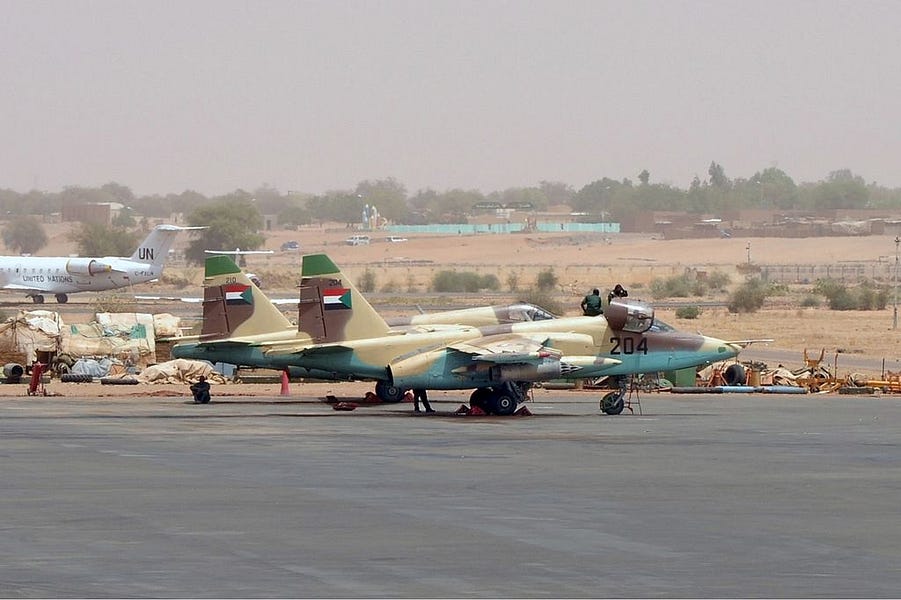
Sudanese air force Su-25s. Photo via Wikipedia
Cost to own

The first issue is maintenance. Traditionally, African air forces have struggled to keep their hardware in a serviceable state, owing to a lack of money to buy spares and the absence of the highly-skilled maintenance professionals.

While many countries’ finances have improved in recent decades, the old logistical problems persist.

South Africa has grounded most of its Gripens because flying them on a regular basis is prohibitively expensive. In many countries, Eastern European fly the helicopters and fighters because there aren’t enough qualified African aircrews. Again, it’s prohibitively expensive to train them up.

Even if Uganda and Angola can keep their Su-30s and other modern assets flying, they might still end up not getting their money’s worth. “You need the whole maintenance system, you need good training, an air-defense system for your airfields, radar coverage for your own air space and neighboring countries,” Wezeman explains.

So it’s possible we’re currently witnessing the slow-motion waste of hundreds of millions of dollars by African governments. That said, it’s better that all this new aerial weaponry go to waste, if the alternative is some huge war that actually puts it to use.

Sign up for a daily War is Boring email update here. Subscribe to WIB’s RSS feedhere and follow the main page here.

Karl Kraus, the Press, and War

Published on The National Interest (http://nationalinterest.org)
March 27, 2014

Reviewing Jonathan Franzen’s book The Kraus Project, the German poet Michael Hoffmann argues [3] that people call the Austrian satirist, Karl Kraus, brilliant, “though it’s sometimes said with a there-now-go-away-please undertone”. By that Hoffman implies that people all too freely bestow the title of genius on the fin-de-siรจcleViennese journalist, because they do not fully comprehend what he is trying to say with his intricate, quotation-drenched, and aphorism-dominated prose. After all, partial comprehension is often a prerequisite for mantled brilliance. If we could comprehend Kraus in his entirety, the title of genius might become superfluous. To many, therefore, to this day, Karl Kraus remains a distant mystery.

To read Karl Kraus is to wander a vast labyrinth. He himself stated, “A writer is someone who can make a riddle out of an answer.” With his magnum opus, The Last Days of Mankind, he appears to be fulfilling this declaration. Described as a “faulted masterpiece” by the historian Edward Timms, this documentary play—written between 1915 and 1922, and dealing with the First World War from Austria-Hungary’s perspective—is filled with bizarre apothegms, outdated vernacular, vitriol, and obscure references to contemporaries often only familiar to diehard historians of the Habsburg Empire. It starts off as a realistic satire observing the reaction of average Viennese to the outbreak of the war and ends expressionistically with talking gas masks, flames, dead horses and a murmuring ‘dead forest’.

Nevertheless, with the centennial of the outbreak of the First World War just around the corner [4], Kraus’s critique of the mass media and its partial responsibility for prolonging a conflict that ended up claiming more than twenty million lives is probably the most revolutionary insight of the play, albeit not a new one. In 1909, German chancellor Bernhard von Buelow asserted: “Most of the conflicts the world has seen in the past ten decades have not been called forth by princely ambition or ministerial conspiracy but through the passionate agitation of public opinion, which through the press and parliament has swept along the executive.” The surreptitious role that his government played in inciting the press is of course left unmentioned by Buelow.

Consequently, during the war, Kraus saw his principal literary and political task in unveiling the Masken des tragischen Karnevals (the masks of the tragic carnival) of war as he states in the introduction of the The Last Days of Mankind. Kraus attempted to unmask the manipulative doublethink nature of the liberal press that had unreflectively embraced jingoism and military romanticism—despite its proclaimed humanistic and liberal values—and which he considered more dangerous in swaying public opinion towards war because of the media’s alleged use ofverhuellte Worte (veiled words). In comparison, Kraus viewed overtly right or leftwing radical publications, those that plainly stated their true agenda, as less malignant.

March 2014 Issue of the CTC Sentinel Now Posted

SWJ Blog Post | March 27, 2014

West Point's Combating Terrorism Center has released the March 2014 Issue of the CTC Sentinel.

The issue contains the following articles:

- The War of Jihadists Against Jihadists in Syria
By Nelly Lahoud & Muhammad al-`Ubaydi
- The Finnish Foreign Fighter Contingent in Syria
By Juha Saarinen
- The Narco of Narcos: A Profile of Fugitive Mexican Druglord Rafael Caro-Quintero
By Malcolm Beith
- The Caucasus Emirate: From Anti-Colonialist Roots to Salafi-Jihad
By Derek Henry Flood
- The Evolution of the Ethnic Baluch Insurgency in Iran
By Chris Zambelis
- A Profile of the Informal Anarchist Federation in Italy
By Francesco Marone
- Recent Highlights in Political Violence