8 February 2015

What Do We Mean When We Say ‘This Is Our 9/11’?

BY ELIAS GROLL
FEBRUARY 5, 2015

Since the day the Twin Towers fell and a plane smacked into the side of the Pentagon, the attacks of Sept. 11, 2001 have become a symbol of terror, devastation, and sorrow. Synonymous with horror and subsequent fury, the attacks have bifurcated recent history into an era of before and after.

By virtue of its magnitude, 9/11 has also gained a symbolic meaning for violence that is shocking, unpredictable, and perpetrated by fanatics. Over time, 9/11 as a metaphor has been gradually stretched, and in the years since, similar attacks have been described in terms that begin and end with that day — as “our 9/11,” no matter the extent of the loss.

This week, the Islamic State gave its global audience a macabre spectacle: The horrific execution of Jordanian fighter pilot Moaz al-Kasasbeh, who was videotaped as he burned to death in a makeshift cage. Days before the release of that video, the group had released another showing the decapitation of Kenji Goto, a Japanese journalist.

Kasasbeh’s execution, for its awful method, has dominated headlines. By contrast, Goto’s execution — and that of another Japanese ISIS prisoner, Haruna Yukawa — has evoked a defiant grief among Japanese who are comparing the tragedy to the 9/11 attacks.

“This is 9/11 for Japan,” Kunihiko Miyake, a former diplomat who has advised Japanese Prime Minister Shinzo Abe on foreign affairs, told the New York Times. “It is time for Japan to stop daydreaming that its good will and noble intentions would be enough to shield it from the dangerous world out there. Americans have faced this harsh reality, the French have faced it, and now we are, too.” In response to Goto’s beheading, Abe pledged that Japan, a country formally committed in its constitution to a pacifist policy, would avenge his killing.

These comparisons are reflective of 9/11’s symbolic role in this age of terrorism, as a marker of extreme violence, as a way to make that violence comprehensible, and to situate such violence within a framework that makes sense, the so-called “war on terror.”

Every act of terror, it seems, is now “our 9/11.”

US Navy's 6th Generation Fighter Jets Will Be Slow and Unstealthy

Zachary Keck
February 5, 2015 

The U.S. Navy’s next generation air superiority fighter will not be “super-duper fast” or employ much in the way of stealth, a senior navy official announced on Wednesday.

Chief of Naval Operations Adm. Jonathan Greenert, the Navy’s top officer, divulged some details about the Navy’s so-called Next Generation Air Dominance F/A-XX fighter jet during a speech at an industry conference.

“I don’t see that it’s going to be super-duper fast, because you can’t outrun missiles.” Greenert said, the Washington Examiner reported. “And you can’t become so stealthy that you become invisible — you are going to generate a signature of some sort,” he also noted, adding “You know that stealth may be overrated…. If something moves fast through the air and disrupts molecules in the air and puts out heat – I don’t care how cool the engine can be – it’s going to be detectable.”

In lieu of stealth and speed, Greenert said that the F/A-XX would gain access by deploying “a spectrum of weapons” that could suppress enemy air defenses.

Greenert made the remarks while speaking at the Naval Future Force Science and Technology Expo in Washington, DC.

His concerns about speed and stealth appear to be valid. As USNI News notes, the proliferation of high-speed anti-air weapons to America’s potential adversaries greatly reduces the value of speed. Stealth also is a wasting asset, as Dave Majumdar recently explained on The National Interest:

6 charts that show renewable energy is getting cheaper


3 Feb 2015 

Things are changing very quickly in the world of renewable energy. The conventional wisdom — that renewables are expensive, that they depend on subsidies, that it’s too costly to integrate them into the grid — is rapidly being rendered anachronistic, though no one seems to have told U.S. policymakers and pundits. 

So let’s check in on the real cost of renewables. The International Renewable Energy Agency (IRENA), an intergovernmental research organization, recently released its latest report, “Renewable Power Generation Costs in 2014,” and it’s chock full of current info. 

The news is mostly good. Let’s look at some charts! 

But first, a quick note. To understand these charts you need to understand the “levelized cost of energy.” LCOE is often used as a kind of summary measure of the overall competitiveness of a particular technology or power plant. It includes capital and fuel costs, operating and maintenance costs, and financing costs, as well as the assumed rate of utilization. It does not include externalized costs, either positive (subsidies) or negative (health or environmental damages). It’s pure apples to apples. 

IRENA maintains a comprehensive database of LCOE costs for power projects around the world and uses those as its basis of comparison. 

Now, charts! 

Here’s the LCOE for different kinds of utility-scale renewable energy projects, in 2010 and 2014:

The tan horizontal band across the chart is the range of LCOEs for fossil-fueled power. As you can see, biomass for power, geothermal, hydro, and onshore wind are now squarely in that range, or even lower. And solar PV, though it ranges widely in costs, is, on average, declining quickly — increasingly it’s also in the fossil-fuel range. 

The cost of wind and solar power keeps dropping all over the world

Brad Plumer
February 5, 2015

Many people have probably heard that it's getting cheaper to install rooftop solar panels in the US. But that's just part of an even bigger trend. Since 2010, the cost of renewable energy has been plummeting all over the world.

David Roberts highlights a new study from the International Renewable Energy Agency laying it out in detail. Large wind farms got cheaper between 2010 and 2014. Large-scale solar got alot cheaper. And at least some renewable plants are even becoming competitive with new fossil-fuel plants:


"CSP" is concentrated solar power. (IRENA)

The chart shows the "levelized cost of electricity" for different utility-scale renewable projects built in 2010 and 2014. This is an oft-used metric for comparing different energy technologies. It's a ratio of how much money a power plant costs over its lifetime to how much electricity it will generate. So it factors in construction costs, fuel costs, financing, and how often a plant is used. Notably, it doesn't factor in any subsidies that governments may provide.

Report: Wind and solar energy have tripled since 2008

Chris Mooney 
February 4 

We worry a lot about the problem of climate change. And we try to fix it — again, again and again — by changing how the country uses energy. 

What we don’t stop and ponder enough, though, is that the country ischanging how it uses energy. It’s certainly not enough to silence all environmental concerns. But nonetheless, the progress, when you sample it, is really impressive. 

Such is the takeaway from a new report out by Bloomberg New Energy Finance, which has just released its 2015 Sustainable Energy in America Factbook, prepared for the Business Council for Sustainable Energy. Looking back over recent years, the report shows that on any number of metrics, progress in clean energy has really been immense. 

“There’s a trend already underway where these technologies are making progress and gaining share at the expense of technologies that have been there previously,” explains Bloomberg New Energy Finance’s Michel Di Capua

The proof? Just consider a few pretty impressive findings from the report: 

1. The United States overall has seen nearly $ 400 billion in clean energy investment since 2007. 
The United States still fell short of China in total clean energy investment last year, but overall investment in this country has been massive. As you can see in the figure above, compared with 2004, investment last year was higher by a factor of five. 

The dawn of marketing’s new golden age

Jonathan Gordon and Jesko Perrey 
February 2015

Marketers are boosting their precision, broadening their scope, moving more quickly, and telling better stories.

Science has permeated marketing for decades. Fans of the television drama Mad Men saw a fictionalized encounter when an IBM System/360 mainframe computer physically displaced the creative department of a late-1960s advertising agency. In reality, though, the 1960s through the early 1990s witnessed a happy marriage of advertising and technology as marketers mastered both the medium of television and the science of Nielsen ratings. These years gave birth to iconic advertising messages in categories ranging from sparkling beverages (“I’d like to buy the world a Coke”) to credit cards (“American Express. Don’t leave home without it”) to air travel (“British Airways: the world’s favourite airline”).

Until recently, marketers could be forgiven for looking back wistfully at this golden age as new forces reshaped their world into something completely different. These new trends include a massive proliferation of television and online channels, the transformation of the home PC into a retail channel, the unrelenting rise of mobile social media and gaming, and—with all these trends—a constant battle for the consumer’s attention.

The resulting expansion of platforms has propelled consistent growth in marketing expenditures, which now total as much as $1 trillion globally. The efficacy of this spending is under deep scrutiny. For example, in a survey of CEOs, close to three out of four agreed with the following statement: marketers “are always asking for more money, but can rarely explain how much incremental business this money will generate.”1 Chief marketing officers (CMOs), it appears, don’t disagree: in another recent survey, just over one-third said they had quantitatively proved the impact of their marketing outlays.2 Paradoxically, though, CEOs are looking to their CMOs more than ever, because they need top-line growth and view marketing as a critical lever to help them achieve it. Can marketers deliver amid ongoing performance pressures? 

In this article, we’ll explain why we think the answer is yes—and why we are, in fact, on the cusp of a new golden age for marketing. At the core of the new era are five elements that are simultaneously familiar and fast changing. The first two are the science and substance of marketing. Leading marketers are using research and analytics to shed light on who buys what, and why; who influences buyers; and when, in the consumer decision journey, marketing efforts are likely to yield the greatest return. That understanding, in turn, is making it possible for marketers to identify more effectively the functional benefits that customers need, the experiences they want, and the innovations they will value.

Debt and (not much) deleveraging

Richard Dobbs, Susan Lund, Jonathan Woetzel, and Mina Mutafchieva 
February 2015

Download Executive Summary PDF–763KB Full Report PDF–3MB 

Seven years after the bursting of a global credit bubble resulted in the worst financial crisis since the Great Depression, debt continues to grow. In fact, rather than reducing indebtedness, or deleveraging, all major economies today have higher levels of borrowing relative to GDP than they did in 2007. Global debt in these years has grown by $57 trillion, raising the ratio of debt to GDP by 17 percentage points (Exhibit 1). That poses new risks to financial stability and may undermine global economic growth.

Exhibit 1
Since the Great Recession, global debt has increased by $57 trillion, outpacing world GDP growth. 

A recipe for economic growth

February 2015 

Former US treasury secretary Lawrence H. Summers believes institutional reforms and significant investment are required to push the world economy forward.

At a time of historically low interest rates and nervousness about the outlook for global economic growth, why aren’t governments investing more? In this interview with McKinsey’s Rik Kirkland, former US treasury secretary Larry Summers urges policy makers to invest aggressively in everything from infrastructure to education. Summers also believes that in a world of rising inequality and rapid technological advances, there is going to be a need for more progressive taxation. An edited transcript of his comments follows.
Interview transcript

Reforming our institutions

Confidence is the cheapest form of stimulus. Governments need to recognize that fairness and inequality and sharing the benefits of growth more widely are crucial issues going forward, but they need to do it without invoking a politics of envy. That can be very debilitating to business investment.

I think growth probably is going to be slower in terms of aggregate GDP over the next 50 years than it has been over the last 50 years. We’ve already seen some trend toward decline and, if I had to guess, that trend will persist. But that’s a reason why we’ve got to do all we can.

For example, if we’re not going to have as much quantitative improvement to the labor force, we’re going to need qualitative improvement. That goes back to issues of education—to issues of the transition from school to work. We’re also going to need a much greater effort at innovation. Science has more promise today than ever before, yet the fraction of our resources being devoted to science has gone down in the United States. That’s not how it should be.

There’s plenty of work in our society that needs to be done: think about healthcare, think about education, think about taking care of the aged. But whether we’ve got the social institutions that will permit that work to get done is going to be a very large question. We’re going to have to think in very fundamental ways about how our society changes in response to technology, just as we have seen our society change in very fundamental ways because of what came about in the Industrial Revolution.

How Resource Wealth Fuels War

Daniel Curwin
February 6, 2015 

Though mired in the depths of the Cold War, the latter half of the twentieth century was a period in which the standard of living across the globe rose substantially. Many of the technological and industrial advancements during this period have been reliant on our ability to increasingly obtain, harness and capitalize upon myriad natural resources, and while these seemingly abundant natural resources have spurred growth in much of the world, they are often found in some of the world’s most fragile social, political and ecological regions. Indeed, natural resource–rich states often find themselves at the bottom of the Failed States Index. To complicate matters, from 1950-2000 over 90 percent of the major armed conflicts occurred within countries containing biodiversity hot spots—biogeographic regions with a significant reservoir of biodiversity under threat from humans—located in western and eastern Africa, along the Mediterranean, the Caucasus, Southeast Asia and in large portions of Latin America. Wars are now less often fought in Europe among competing powers, but in their natural resource–rich former colonies, where the combatants often have local needs, grievances and goals. Twentieth-century international institutions have helped guide the world through a period of unprecedented growth. However, they have unsuccessfully addressed twenty-first-century threats such as rising inequality, intrastate conflict and global warming. Natural resources can serve as an impetus for conflict or cooperation, prolong a bloody conflict and play an essential role in the postconflict process. The emergent field of environmental peacebuilding—which integrates natural-resource management in conflict prevention, mitigation, resolution and recovery to build resilience in communities affected by conflict—offers contemporary strategies that can address the problems associated with natural-resource development in conflict-prone regions.

The Role of Natural Resources in Conflict

Is this the future of cyberwarfare?

Aaron Ernst
February 5, 2015

Five years ago, the most sophisticated cyber weapon the world had ever seen ravaged Iran's nuclear program. Allegedly developed by the U.S. and Israel, the complex virus infected the computer system that ran the centrifuges. Slight tweaks to the software caused hundreds of the centrifuges to self-destruct, setting the program back years. The malware was dubbed Stuxnet.

Traditionally, foreign governments have used malware to spy and steal. But this was something entirely different.

“Stuxnet, it is a weapon, it’s not 'like' a weapon,” says German computer security expert Ralph Langner, who was the first to identify how the virus worked. “It is a weapon because it was designed to cause physical damage.”

Now, Langner worries that Stuxnet could come back to haunt the U.S. Those same vulnerabilities in Iran's nuclear control systems that the malware exploited can be found in similar systems throughout America. 

“These components are used in chemical plants, nuclear power plants, everywhere," Langner said. “We open Pandora's box without any idea, any clue, how we would deal with that when somebody turns that around. And that turnaround is only a question of time.”

But there are signs the threat that Langner has feared may have already arrived.

Espionage, then sabotage?

In early January, the world’s foremost experts in hacking and industrial control systems packed into a conference room in Miami for the buzziest event of the S4x15 security conference. The speaker was Kyle Wilhoit, a virus hunter who's been tracking the evolution of a sophisticated new threat known as BlackEnergy.

Why Israel Hacks


2/5/2015

Israel's tenuous position in the world drives its leaders to stay ahead of its cyber adversaries, chief among them the Islamic Republic of Iran.

Fifth in a series on the motivations that compel nation-states to hack.

Israel's intelligence corps, Unit 8200, has rapidly grown into one of the world's most formidable cyber counter-terrorism organizations. The elite group employs Israel's best and brightest to combat existential threats to its national security in the cyber domain. The number of nations and terror groups that threaten Israel is considerable, and the significance of the threat varies from political posturing, to a credible threat of harm to Israel as a nation and their people.

To understand how Israel has found itself in an adversarial relationship with most of its neighbors, it is useful to review the evolution of Israel as a nation. Admittedly, the history of modern Israel and its relationship with the Arab world is exceptionally complex. With that, the following is a brief summary intended to provide some historical context; it is not in any way intended to be comprehensive. I don’t usually include disclaimers in my blogs, but given the complexity of the issue, I want to set the right expectations.

A brief history

Beginning with the Zionist movement toward the end of the 19th Century, European Jews began migrating to Palestine in response to a growing tide of anti-Semitism. A number of events occurred in the first half of the 20th Century that would keep the growing Jewish community in Palestine on course toward achieving an independent Jewish State. The carefully crafted language of the Balfour Declaration of 1917 endorsed the creation of a Jewish "Homeland" in Palestine. The British Mandate for Palestine, authorized by the League of Nations in 1922, provided guidance for the establishment of a Jewish "Homeland" in Palestine.

Is a cyber arms race between the US and Russia possible?

Alexandra Kulikova
Jan 28, 2015

If the U.S. is already planning for a major war in cyberspace, as Edward Snowden suggests, the world should be bracing for the dangerous weaponization of cyberspace and even greater distrust between the U.S. and Russia in the cyber domain.


U.S. President Barack Obama arrives to speak at the National Cybersecurity and Communications Integration Center in Arlington, Va. on Jan. 13. Obama renewed his call for Congress to pass cybersecurity legislation, including a proposal that encourages companies to share threat information with the government and protects them from potential lawsuits if they do. 

Last week prominent German media outlet Der Spiegel published the second part of former NSA agent Edward Snowden’s revelations. According to these documents, the U.S.-led global surveillance program was only the first round of a broader cyber strategy by the United Sates that aims at preparing for global cyber war with other countries.

As indicated from this second round of revelations, the U.S. National Security Agency (NSA) suggests in no uncertain terms that the next major conflict will take place in cyberspace. In addition, the documents outline the development and implantation of malware programs to disable the enemy’s key infrastructure objects - including banking systems, power plants and airports. 

The government's cyberterrorism 'concerns' are a pretext for their own hacking operations


4 February 2015

Invoking the threat of terrorism is the most common mechanism used to deny citizens both due process and free speech in the 21st century 

The US has always been the world leader of cyberwar, hacking damn near everyone without any repercussions. And, for years, US intelligence officials and private contractors have been milking hacks to secure billions in cyber security programs: all you need is an enemy, and they will sell you the cure.

Their blatant hypocrisy, threat inflation and militaristic rhetoric must be challenged if we are to have a free and equal internet.

That familiar formula is playing out again with the recent Sony hack. We are supposed to be shocked that these “cyber-terrorists” – purportedly from North Korea – would attack our critical infrastructure and, clearly swift retaliation is in order. But, despite the apocalyptic hype, the Sony hack was not fundamentally different from any other high-profile breach in recent years: personal information was stolen, embarrassing private emails were published and silly political rhetoric and threats were posted on Pastebin. In many ways, it’s similar to an Anonymous operation except that, this time, the FBI accused North Korea. That accusation was based on supposed forensic analysis which they have not publicly produced after refusing to participate in joint inquiries.

This official narrative is disputed by many renowned infosec figures. Any skilled hacker or well-financed nation-state practices anti-forensics measures like modifying logs and using proxies to make the attacks appear to originate elsewhere. And North Korea has already been falsely accused of several cyber-attacks – including attacks against US and South Korean targets in July 2009 andagain in 2013. The inherent difficulty of identifying the true attackers should give us pause

Satellite Set To Stream Daily Images Of Earth From Space

JOE PALCA
FEBRUARY 06, 2015

There's something majestic, even awe-inspiring about the sight of planet Earth as a blue disc, hanging in the vastness of space.

The three astronauts aboard Apollo 8 were the first to get that view; if all goes well, later this year everyone will be able to get it on a daily basis over the Internet.

The images will come courtesy of a spacecraft called Deep Space Climate Observatory (DSCOVR). It's a mission with an unusual history.

Al Gore first proposed the idea for DSCOVR back in 1998, when he was vice president. Gore was so smitten with the view of Earth from space that he put an enormous print of a picture taken by Apollo 17 on the wall of his West Wing office. "Wouldn't it be nice," Gore asked in 1998, "to have that image continuous, live, 24 hours a day?"

So he proposed sending a probe to a spot a million miles from Earth — a place known as the L1 Lagrange point, where the gravity of the Earth and the sun cancel each other out. The space probe, originally dubbed Triana, would point a telescope with a color camera back at our planet from L1, and send images down to Earth.

At the L1 Lagrange point (approximately a million miles from Earth), the gravitational forces between the sun and Earth are balanced. Any satellite "parked" there has a relatively stable orbit that requires few corrections.

NASA

NASA was game to build and launch Triana, but Roger Launius says the space agency officials weren't crazy about the idea of a satellite that only had one instrument on board. Launius, now associate director of theSmithsonian National Air and Space Museum, was NASA's chief historian when Gore proposed Triana. "They certainly wanted to make it a more scientifically viable project than, maybe, was envisioned initially by Mr. Gore," Launius says.

So NASA added instruments to measure the solar wind and radiant energy coming from Earth.

THE SCHOOLHOUSE: REMAKING EDUCATION IN INTERNATIONAL AFFAIRS

Ryan Evans
February 4, 2015

America’s higher education system, and in particular, its advanced graduate training, have long been the envy of the world. Richly endowed and highly respected, universities in the United States are counted upon to generate knowledge and innovation, solve pressing problems, train future leaders, and shape national discourse. In the field of international affairs, however, there is a growing sense that something may be amiss, and that our graduate training – in particular our Ph.D. programs – may be coming up short.

At War on the Rocks, we are putting together a series called “The Schoolhouse” to explore and debate the state of advanced graduate education in international affairs. We aim to move beyond the often-repetitive and tiresome debates about the usefulness of scholarship to policy. We believe there are deeper issues at stake. What should be the mission of graduate education in international affairs, and are we successfully meeting it? If you could redesign graduate programs from the ground up, what would they look like? How would you balance the often-competing interests between students, disciplines, universities, and the wider world? Is it possible to prepare students to engage both the world of ideas and the world of action in international affairs?

Tomorrow we launch “The Schoolhouse” with an essay by Frank Gavin of MIT. Frank is the mastermind of this series and we thank him for the energy and effort he has put into the project. His essay will be followed by others, including one by Stephen Van Evera, another by David Betz, as well as future contributions from graduate students, policymakers, think tankers, and more. We hope others will contribute. Disagreement and debate is encouraged. Submissions are welcome at editor@warontherocks.com.

The Coaching Tree : The Impact of Leadership through the Generations

Major General Fox Conner

In his recent post on mentorship at Beyond the Objective, Army Major Nate Finney raised four key points needing further examination:

The effect of both “toxic” and phenomenal leaders on their subordinates

The difficulty in balancing time, work, family, AND mentoring

The challenges in working up through an ossified bureaucracy

The personal reasons for continuing (or leaving) military service

At a time when people seem to be increasingly pushed aside as we race toward an uncertain future, each of these issues represents an essential component of contemporary mentoring. But it’s the first point that brought us here today.

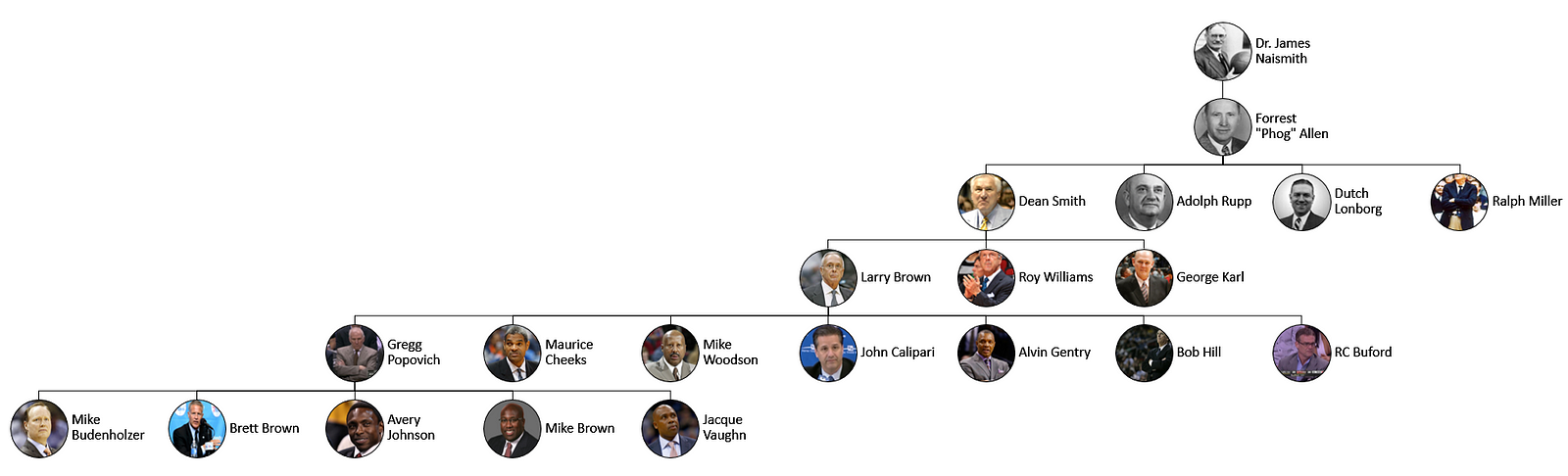
The coaching tree of Dr. James Naismith, the inventor of basketball

Any student of mentoring will recognize the name Fox Conner. His influence on the leaders of “The Greatest Generation” has been the subject of monographs, books, and countless articles. If you were to scribble Connor’s “mentoring tree” on the back of a napkin, it would probably look very similar to the “coaching tree” of Dr. James Naismith, whose influence on the sport of basketball is still visible today. Connor’s tree would likely feature the names of his early proteges, leaders such as George C. Marshall, Dwight D. Eisenhower, Omar Bradley, and George S. Patton. It would branch into subsequent generations and capture the incredible influence of a humble man whose subtle leadership defined how we view mentoring today.

The Indian Air Force 2020 And Beyond

Air Chief Marshal Fali Homi Major (Retd)

Military power, as history bears out, shall always remain a very critical component of national power – without it, the progress and growth of a nation is possible only upto the point where it clashes with the ‘interests’ of another stronger nation. ‘Aerospace power’ today is perhaps the most important component of this military power. There are many reasons for this – flexibility and speed of response, mobility / transportability of national power, long reach, precision targeting, minimum fuss and reduced visibility. Aerospace power fits the bill just so perfectly! How has aerospace power attained such outstanding enabling characteristics? As they say − ‘it is in the very nature of the beast’! This nature is founded and premised on technology – the very reliability and effectiveness of aerospace power hinges upon it! The 21st century undoubtedly belongs to aerospace power, because ‘air’ and ‘space’ with their essential similarities, have come together in a synergy that has dramatically enhanced the capabilities of air power astonishingly – it has become more reliable, effective, clean, responsive, enables ‘effects-based’ / ‘parallel’ operations and creates ‘strategic’ effects, both in peace and in war! The Indian Air Force, in our national security calculus, has the onerous task to conceptualise, plan, execute and project Aerospace power – in all its hues!

The Weapon And Equipment Profile

Not all Air Forces have the capability to project aerospace power in its many hues, but the Indian Air Force – one of the finest in the world can, provided its ongoing modernization and capability building plan is executed with speed, determination, grit and transparency. And based on this modernisation plan, the force structure of the IAF in 2025 would be – about 45 combat fighter squadrons; a formidable combat-ready fleet of helicopters and transport aircraft; adequate numbers of AWACS / AEW and air-to-air refueling aircraft; a mix of modern trainer aircraft / simulators; a well-packaged fleet of UAVs / UCAVs; new generation air defence and surface-to-air missile systems to plug existing gaps in the AD grid; about 40 operational air bases with day / night / all-weather facilities to cater for all types / categories of aircraft; a robust and secure network centric warfare capability; a state-of-the-art and dynamic maintenance / logistics infrastructure; smart weapons and other force multipliers / enhancers. The hardware involved in this modernisation package is in various stages of induction and procurement – some operational, some in the pipeline, some under evaluation, some in design / development stage and some still being identified. 

19 percent pass rate for women in Ranger prep


By Michelle Tan
February 4, 2015 

Five female soldiers successfully completed the Ranger Training Assessment Course at Fort Benning, Georgia, moving them one step closer to attending the Army's storied Ranger School this spring.

A total of 58 soldiers — 53 men, five women — completed the two-week course Jan. 30, officials at Fort Benning announced Wednesday.

In all, 122 soldiers started the course, for a completion rate of almost 48 percent.

Among the men, 55 percent of them successfully completed the course (96 started the course; 53 successfully completed it). Among the women, 19 percent were successful (26 started the course; five successfully completed it).

The five women are all officers.

The Army announced in January that it plans to conduct a one-time, integrated assessment at Ranger School in April.

The assessment is part of a wider effort to determine whether and how to open combat arms jobs to women. This assessment will be a first for the two-month Ranger School, which until now has been open only to men.

Women who successfully complete Ranger School will receive a certificate and be awarded the coveted Ranger tab. They will not, however, be assigned to the 75th Ranger Regiment, which is separate from Ranger School.

Gen. Stanley McChrystal Has A Plan For All Young Americans To Serve Their Country

DRAKE BAER

It all started with a question.

In the summer of 2012, Gen. Stanley McChrystal was wrapping up an onstage conversation at the Aspen Ideas Festival conference.

He was asked if the US should reinstate the draft.

Yes, he replied, but not to grow the size of the armed forces.

He argued that since only 1% of Americans serve their country, America lacks in shared experience — there’s almost no common background between the upper class and the middle class, the educated and the uneducated, the rural and the urban.

The solution, then, wouldn’t be mandatory military service, but national service — programs likeTeach for America and City Year, but made accessible to a full quarter of a yearly cohort rather than an elite few.

Since that conversation, McChrystal has campaigned for making a “service year” a part of young Americans’ trajectories. The goal is to “create 1 million civilian national service opportunities every year for Americans between the ages of 18 and 28 to get outside their comfort zones while serving side by side with people from different backgrounds.”

In an interview with Business Insider, McChrystal, who has held positions as head of US Joint Special Operations Command and as the top commander of US and international forces in Afghanistan, explained his plan for making that happen, and the effects national service could have on American society.

4 Things Television’s Top Writer Can Teach Us About Military Leadership


Nathan K. Finney
February 3, 2015

A true look at mentorship as a flawed and personal relationship with little effect on the bureaucracy is something that is way overdue in the military.

Editor’s Note: This article has been modified from its original version, which was published on “Beyond the Objective,” a blog by Doctrine Man.

Note on suspension of disbelief: This quick piece is not intended to address the political preferences inherent in the television content discussed below. I left my political biases at the door, and I hope you can do the same.

I was recently drawn into the television show “The Newsroom,” a fictional series created by Aaron Sorkin based around the tensions and choices made when covering the news (at least from the perspective of a cable news channel). What struck me about this show was not the sexual drama (everyone is sleeping with or dating everyone else at some point), the shifting existential crises of the main characters in every show, or even the political commentary inherent in the message of each show .  The overall theme of the show is the challenge of treading the fine line between journalistic responsibility and making money for parent corporations to remain on the air. Instead, I was struck that every show contained a healthy dose of mentorship, and not the feel-good, “I’m a commander and I just gave great career advice to a subordinate in a scheduled counseling” kind of way.

The beauty of any Sorkin television drama —  something I didn’t realize until I had this epiphany about “The Newsroom” and went back to look at his other shows like “The West Wing” and “Sports Night ” —  is his coverage of the varied dynamics of mentorship: ambition, loyalty, frustration, intellectual engagement, self-identification, discipline, flexibility, fear for the success of a cause, desire to leave your job/profession better than you found it, personal investment in others, self-sacrifice, and even pride.

Mentorship Done Right


An Aaron Sorkin Version of the Military

Eisenhower relaxing with another man at a camp during the Louisiana Maneuvers, 1941.

Note on suspension of disbelief: This quick piece is not intended to address the political preferences inherent in the television content discussed below. I left my political biases at the door…and I hope you can do the same.

I was recently drawn into the television show Newsroom, a fictional series based around the tensions and choices made when covering the news (at least from the perspective of a cable news channel). What struck me about this show was not the sexual drama (everyone is sleeping with or dating everyone else at some point), the shifting existential crises of the main characters in every show, or even the political commentary inherent in the message of each show — the overall theme of the show is the challenge of treading the fine line between journalistic responsibility and making money for parent corporations to remain on the air. Instead, I was struck that every show contained a healthy dose of mentorship…and not the feel good, “I’m a commander and I just gave great career advice to a subordinate in a scheduled counseling” kind of mentorship.

The beauty of any Aaron Sorkin TV drama — something I didn’t realize until I had this epiphany about Newsroom and went back to look at his other shows like the West Wing and Sports Night — is his coverage of the varied dynamics of mentorship: ambition, loyalty, frustration, intellectual engagement, self-identification, discipline, flexibility, fear for the success of a cause, desire to leave your job/profession better that you found it, personal investment in others, self-sacrifice, and even pride.

No matter what sanitized version of mentorship the military vomits into its doctrine (page 7–11), or even worse, the personnel technocrats warp into an “official” program, mentorship is a relationship. It is an in-depth, long-term personal connection between two people that have an asymmetry in either knowledge or skills — rank matters not. Mentorship only occurs if there’s a personal spark between two people — both the mentor and the protege have to believe the other is worth spending time on and with.

Average Soldiers Don’t Trust Their Generals and They Have a Point


Rep. Duncan Hunter
02.03.15 

A survey last year showed only 27% of the military felt senior leaders looked out for their best interests. To fix the morale crisis generals need to stop acting like politicians. 

Through a decade-plus of war, America’s military men and women, and the families that support them, have experienced their share of hardships. Separations through multiple deployments and the inherent dangers of combat are enough to press the emotional and physical limits of even the strongest individuals. 

For some of these faithful defenders of America’s interests, there have been difficulties far beyond the battlefield—difficulties not imposed by any enemy or the distance and time that separates them from their loved ones. Most ironically, the assault against them—intended or not—can sometimes come from within the military institution for which they fought, bled and sacrificed so much. 

It’s no wonder why there’s concern for morale in today’s force. Just recently, outgoing Secretary of Defense Chuck Hagel said he too is worried about the decline in enthusiasm, and he believes it will take some time to reversing the mindset and perspective of the force. 

There’s no single reason for the decline in morale, although some reasons are more pronounced than others. Take for instance the question about whether “senior military has my best interests at heart.” In 2009, 53 percent of respondents answered yes. By 2014, only 27 percent answered affirmatively. 

One recurring complaint involves what many service personnel perceive as the excessive politicization of the military during wartime, giving rise to high profile prosecutions, excessive punitive actions and decision making that is at odds with the best interests of service personnel. So much so, instincts necessary in combat have been replaced with second-guessing and hesitation, matched by a growing sense of distrust among the ranks. 

129 Army battalion, brigade commanders fired since 2003


By Michelle Tan
February 2, 2015 

The Army has relieved 129 battalion and brigade commanders since 2003 and implemented several initiatives in its ongoing effort to hold leaders and commanders accountable for their actions, senior leaders told Army Times.

"I think the narrative comes out of many soldiers who rightfully or wrongfully believe that the Army doesn't hold senior leaders, senior military officers accountable in the same fashion they hold junior officers or enlisted," Army Secretary John McHugh said. "I view it as a multilevel challenge, and we're trying to respond in a number of different ways."

Since 2003, the Army has relieved 98 battalion commanders and four lieutenant colonel staff officers, according to information provided by the Army. Twenty-four of those reliefs were conducted in combat.

In that same time period, 31 brigade commanders and four colonel staff officers were relieved; one of those was conducted in combat.

In addition, according to Army data:

• The Army has administered non-judicial punishment (Article 15s) to 1,472 officers since 2008.

• It has court-martialed 41 lieutenant colonels or higher, including two general officers, in the last six years.

• Seven general officers have been relieved from their positions since 2008.

• Since 2010, 29 general officers were referred to Army Grade Determination Review Boards.

7 February 2015

No Proof Required: Believe it or not statistics

Surjit S Bhalla
February 7, 2015 

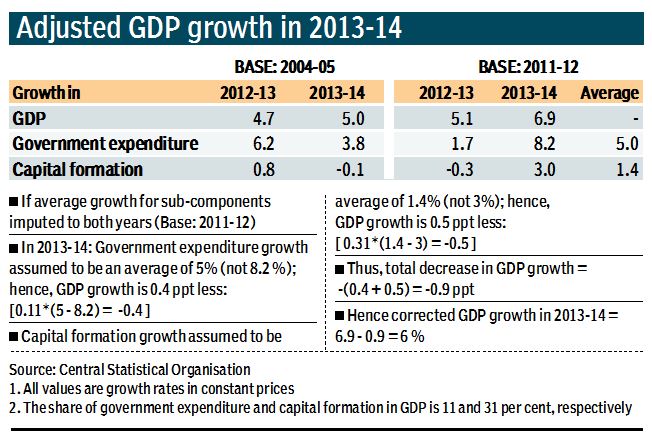
The Indian statistical authorities (Central Statistical Organisation or CSO) recently released a revised set of GDP numbers that have set the statistical house on fire. The new salvoes being fired from the CSO’s shoulders suggest a radically different interpretation of the Indian growth story over the last few years, and indirectly, of what happened in the national elections in May 2014. Just to recall: in May 2014, the ruling Congress party was decimated and registered its lowest seat tally ever, 44 seats in a 543-seat Parliament. For those keeping records, this was the second largest decline in parliamentary history in the world, possibly ever. The record holder for the worst thrashing was the Progressive Conservatives Party of Canada. Under Brian Mulroney, the Progressive Conservatives won re-election in 1988, with 169 out of 295 seats. At the subsequent election, in 1993, the party collapsed to win just two seats, falling from first to fifth place.

Many of us thought that a major reason for the magnificent loss of the Congress was the economy. We were told that GDP growth for two successive years was less than or equal to the 5 per cent mark, 4.7 per cent in 2012-13 and 5 per cent in 2013-14, a toxic decline from the heady years of near-double-digit growth. If GDP growth declines by half, voters are likely to be upset, and we all concluded that the voting reflected the pocketbook. Much ink was spilled, and many trees were cut, to document the close relationship between economic performance and voting behaviour.

India, China and an opportunity

February 7, 2015 

Keeping up the momentum in India-China relations, External Affairs Minister Sushma Swaraj came back from her three-day visit to China with several deliverables — including a new Chinese openness in seeing India take up permanent membership of the Shanghai Cooperation Organisation (SCO) and Asia-Pacific Economic Cooperation (APEC). Previously, the Chinese had linked SCO membership with a greater role for Beijing in the South Asian Association for Regional Cooperation (SAARC). Ms. Swaraj, during her first visit to China as External Affairs Minister, built on the three meetings Prime Minister Narendra Modi has had with Chinese President Xi Jinping. She also called on the Chinese President, a rare opportunity for any visiting Foreign Minister. Clearance for the early operationalisation of a new route to Kailash Mansarovar and a decision to hold a session of talks between the Special Representatives tasked by the two sides to resolve the boundary dispute, are other takeaways. Her trip was also part of preparations for Mr. Modi’s visit later in the year. As reported in the Chinese media, President Xi himself has set the agenda for taking bilateral ties to a new level by suggesting that the two countries seize the “opportunity of the century” by combining their development strategies. With a slowing economy and sluggish European recovery, China may be focussing on the Indian market. It also appears willing to invest, following Prime Minister Modi’s “Make in India” call.

It is in such a scenario of contact and consultation that “strong leaders” such as Mr. Modi and Mr. Xi can think about making some hard decisions when it comes to the decades-old boundary dispute that keeps surfacing during major bilateral visits. So far, the coalition nature of Indian governments has been seen as a major obstacle to the give-and-take, compromise approach on the border question. Today, Mr. Modi is in the happy situation where he can take a political call on issues, rising above intra-coalition pressures. In 2005, the Agreement on the Political Parameters and Guiding Principles for the Settlement of the Boundary Question signed by the two countries had raised hopes for an eventual settlement, but those have been belied. It would also seem that President Barack Obama’s successful visit to India around Republic Day has not dampened Beijing’s willingness to take relations with Delhi to the next level. Interestingly, India while talking to the U.S. and its other allies in the Asia-Pacific about safety in the sea-lanes, has agreed to set up a “consultation mechanism” on Asia-Pacific affairs with China and Russia. India’s diplomatic success lies in keeping several balls in the air at the same time.