4 May 2015

Mullahs against the mouse Iran, unhindered, proceeds with its scheme to dominate the Middle East


The cat and mouse game playing out in the waters of the Middle East has profound consequences, not only for the United States, but for the rest of the world. It’s part of the clash of civilizations, whether the West likes it or not — the mullahs in Tehran against the Katzenjammer Kids in the White House. It’s not yet clear who’s the cat, and who’s the mouse, but the mullahs think they know.

The mullahs are pushing hard to consolidate a growing control over the region by seizing the initiative, nautical mile by nautical mile, from the U.S. Navy, which succeeded the British Royal Navy as the monarch of the seas after World War II. A few days ago two Iranian merchant ships, carrying arms to their Houthi tribal friends in Yemen, were observed sailing in these troubled waters. The Pentagon immediately dispatched an aircraft carrier, presumably assigned to intercept them. Someone, almost certainly someone at the White House, tipped the news that despite United Nations sanctions against the Yemeni rebels, the Americans would not board the ships to halt the arms cargoes.

Apparently as confused as the rest of us about what American policy might be, the little Iranian flotilla turned tail and headed home. The sight of an American carrier is impressive.

Iran and Saudi Arabia Are on a Collision Course

May 1, 2015

To prevent recent airline and shipping incidents from escalating into a wider military confrontation with Iran, all sides will need to exercise great caution in the Persian Gulf and the skies over Yemen.

On April 28, Saudi-led coalition aircraft bombed runways at Yemen's al-Rahaba Airport to prevent an Iranian Airbus A310 plane from landing there. The Sana airport is currently controlled by Houthi/Zaidi forces with close ties to Shiite Iran, and the plane belonged to Mahan Air, a company affiliated with Iran's Islamic Revolutionary Guard Corps. At the controls was a famously reckless ex-IRGC cargo pilot who had stubbornly ignored orders from Saudi F-15 crews to change course, spurring the runway strikes that rendered the airport inoperable and eventually forced him to turn back.

Iranian officials, especially within the IRGC, are frustrated by the coalition's actions against Houthi/Zaidi militias and by their own inability to provide military assistance to them. Only days before the airport incident, IRGC commander Maj. Gen. Mohammad Ali Jafari had called for a more aggressive stance against coalition operations in Yemen, while Hassan Firouzabadi, the chairman of the General Armed Forces Staff, called for "heavy-handed punishment" of the Saudis. Just last week, a convoy of cargo ships from Iran had attempted to run the Saudi blockade and deliver supplies and possibly arms to Yemeni ports under Zaidi control. The convoy was reportedly escorted by two of the IRGC Navy's Tondar-class missile boats (armed with Ghader anti-ship missiles, whose range is up to 200 miles), but it was called back after the U.S. Navy sent the aircraft carrier USS Theodore Roosevelt and the guided missile cruiser USS Normandy from the Persian Gulf. The standoff was brief and politically courteous, but it also carried a clear message for Iran.

The Faltering Russian Economy Makes a Renewed Ukraine Offensive More Likely

Publication: Eurasia Daily Monitor Volume: 12 Issue: 73

“Boring” is perhaps the prevalent impression of President Vladimir Putin’s televised four-hour-long Q & A session that aired last Thursday (April 16), which was meant to demonstrate his good health and relaxed attitude to the great many problems worrying his loyal subjects. The three key points he stressed were that everything is under control, the economy is set to improve from the low point of the crisis, and there will be no war (Slon.ru, April 17). His command of facts and figures was far from convincing to support the first point, and the everyday reality of falling incomes disproves the second one; thus, the commitment to peace inevitably looks dubious. Triumphalism over the “spectacular” annexation of Crimea was gone, overtaken by a return to “mundane” issues such as degenerating health care and the credit crunch to small businesses, which have fueled domestic discontent. And under the Putinist system, such discontent can only be neutralized by a new patriotic mobilization (Moscow Echo, April 17).

The Russian president has not found any inspirational idea for such a mobilization and even implicitly distanced himself from the rabid conservatism targeting “corrupt” Western values, which is fanned by the official propaganda (Novaya Gazeta, April 16). Reportedly, more than 3,000,000 questions and pleas were recorded for last week’s carefully staged performance. Putin attempted to highlight a few “human stories” but clearly preferred to push the pesky details to subordinates (Gazeta.ru, April 16). Russia’s governors and ministers, however, excel in explaining such problems away. Thus, Nikolai Rogozhkin, the presidential envoy to Siberia, suggested that the devastating forest fires raging in Khakassiya were caused by arson executed by specially trained oppositionists (Newsru.com, April 17). Sabotage is indeed a perfect cover-up for man-made disasters caused by rampant embezzlement. And it is typical in this respect that one issue that has disappeared completely from Putin’s discourse is the fight against corruption (Navalny.com, April 17).

NSA Is Not Resisting Proposed New Restrictions on Its Eavesdropping Activities

Peter Baker and David E. Sanger
May 2, 2015

WASHINGTON — For years after the attacks of Sept. 11, 2001, even as theNational Security Agency fiercely defended its secret efforts to sweep up domestic telephone data, there were doubters inside the agency who considered the program wildly expensive with few successes to show for it.

So as Congress moves to take the government out of the business of indiscriminate bulk collection of domestic calling data, the agency is hardly resisting. Former intelligence officials, in fact, said Friday that the idea to store the data with telecommunications companies rather than the government was suggested to President Obama in 2013 by Gen. Keith B. Alexander, then the N.S.A. director, who saw the change as a way for the president to respond to criticism without losing programs the N.S.A. deemed more vital.

The limits on bulk collection are the centerpiece of legislation now advancing in the House that would be the first significant response to the spying revelations by Edward J. Snowden, a former N.S.A. contractor. In addition to new restrictions on domestic data sweeps, the plan would require more transparency and introduce ostensibly independent voices into secret intelligence court proceedings.

But as one recently departed senior intelligence official put it on Friday, “This is hardly major change.”

The legislation would still leave an expansive surveillance apparatus capable of tracking vast quantities of data. Some of the most sweeping programs disclosed by Mr. Snowden, particularly those focused on international communications, would remain unaffected. The N.S.A. could continue efforts to break private encryption systems, and information about Americans could still be swept up if originating overseas.

Moscow Likely to Choose Control of Territories Over Their Economic Development

Publication: Eurasia Daily Monitor Volume: 12 Issue: 80
April 29, 2015

The Russian government is considering building a new water link connecting the Caspian Sea to the ocean via the Azov and Black seas. The new route is supposed to be the shortest and the cheapest way to carry Chinese goods via Central Asia to Europe. Existing oil and gas pipelines from the Caspian Sea to outside markets also have hit the limits of their capacities, and finding new ways for exporting oil and gas is another important aspect of the project. Central Asian countries are regarded as the primary beneficiaries of the new transportation link, with Kazakhstan reportedly being its most ardent supporter. It is believed the new link will also boost the stagnant economies of the North Caucasus, creating new jobs and providing better access to world markets and investment. The Eurasian Development Bank has allotted $2.7 million for early project assessment, and the results of the research was discussed in the Russian Ministry of Transportation, but that discussion was closed to the public (Kavkazskaya Politika, April 17).

The proposed water link, commonly referred to as the “Eurasia canal,” would significantly affect the economic and political situation in the North Caucasus and southern Russia more generally (see EDM, June 25, 2007). Southern Russia has significant agricultural potential and would certainly be of interest to Chinese investors. Access by Chinese investors to the North Caucasus would also substantially improve local economies and decrease their dependence on subsidies from Moscow. As a rule, the Russian government prefers control to development. Unless the government is reassured that there is no threat to its control over the North Caucasus, it is unlikely to proceed with even the most lucrative developmental projects.

Will Turkey Choose the European or Eurasian Energy Union?

Publication: Eurasia Daily Monitor Volume: 12 Issue: 72

The sixth meeting of the World Forum on Energy Regulation is scheduled to be held on May 25–28, in Istanbul, and is being organized by the office of the prime minister of the Turkish Republic. The competitive and dynamically expanding nature of the energy sector in Eurasia has been boosting Turkey’s regional importance as it prepares to take on the role of a strategically important transit and energy hub country (Hurriyet Daily News, January 28).

December 2014 saw the reemergence of competition between rival pipeline projects in Eurasia—similar to the earlier competition between the Nabucco natural gas pipeline, proposed by a consortium of European companies, and Russia’s South Stream. Currently, Russia’s new proposed pipeline project—Turkish Stream—is challenging the Azerbaijani-initiated Southern Gas Corridor, which will carry Caspian-basin gas to Europe via the South Caucasus, Turkey and then across Southeastern Europe. Turkey is already signed on to the Southern Gas Corridor—the Corridor’s longest pipeline segment, the Trans-Anatolian Pipeline (TANAP), will cross Turkey from east to west—but it is also being strongly courted by Moscow to host Turkish Stream (see EDM, December 17, 2014; February 20, 2015). This growing significance of Turkey in competing large-scale energy transit projects across Europe and Eurasia has also opened up a discussion domestically regarding which prospective energy union the country should become part of—European or Eurasian.

Russia’s Hybrid War Against Poland

By: Matthew Czekaj

In early April 2015, the Polish Internal Security Agency’s Governmental Computer Security Incident Response Team (also known as CERT—Computer Emergency Response Team), released its annual report on cyber security in Poland (Cert.gov.pl, April 3). According to the report’s findings, Poland came under a record number of hacker and cyber attacks in 2014—7,498 specific cyber attack “incidents” last year, compared to 5,670 confirmed incidents in 2013, 457 in 2012, and 249 attacks verified by CERT in 2011 (Cert.gov.pl, accessed April 28). In addition to a marked escalation in cases, the threat and level of sophistication of the registered cyber attacks also increased compared to previous years, in many cases pointing to state backing. The report highlights a series of high-profile hacking and distributed denial-of-service (DDoS) attacks against key Polish state and financial websites in mid-August 2014, including the homepage of Poland’s president and the Warsaw stock exchange. Those incidents were promptly claimed by an online group calling itself “Cyber Berkut,” which stated it was acting in retaliation against the Polish government’s support of the post-EuroMaidan Ukrainian authorities.

However, what is novel about the 2014 issue of the CERT report, compared to all previous years, is the fact that, for the first time, it discusses an emerging “new trend” of “information war” directed against Poland via the Internet. As CERT notes, examples of such efforts include the dissemination of foreign “propaganda-disinformation” by bloggers and contributors to online discussion forums or website comments sections. Many such individuals, the report states, are on the payroll of a foreign state; while others may simply be naรฏve, misinformed or ideologically driven “useful idiots [sic]” whose viewpoints or standing can be exploited. Though the report does not specifically single out the Russian government as being behind this effort, CERT does highlight the veritable “deluge” of pro-Russia “trolling” commentary on the Polish Internet and blogosphere immediately following the Russian Federation’s annexation of Crimea (Cert.gov.pl, April 3). The Polish news outlet Niezalezna quickly pointed to these findings as examples of Russian hybrid warfare being waged against Poland (Niezalezna.pl, April 14).

Why, and how, Britain might leave the European Union

Apr 29th 2015

GREECE has long seemed a decent bet to crash out of the euro zone, and perhaps also the European Union. But during the current election campaign in Britain, Britain's exit (or a "Brexit") from the EU has also started to seem a real possibility. David Cameron, the prime minister, has promised an in/out referendum vote on Britain’s EU membership by the end of 2017 if the Conservatives remain in power on May 7th. Several other smaller parties, notably the UK Independence Party (UKIP), are campaigning specifically to leave the EU. Moreover, polls show that any referendum would be an extremely tight one. Why might Britain be leaving the EU, and how would it happen?

Even at the best of times Britain has always been a semi-detached member of the EU. The first post-war Labour governments turned down the opportunity to participate in the negotiations that led to the birth of the forerunner of the EU in the early 1950s. Since then Britain has often been more sceptical of the European project than committed to it; the country has been called “the awkward partner”. Britain eventually joined what was then called the European Communities under a Tory government in 1973, as Europe seemed to be doing so well economically. But the next Labour government quickly held a referendum on membership in 1975. The majority, on that occasion, voted to stay in, but over the past few decades British governments have kept their distance as others within Europe pursued "ever closer union". Britain did not join the single currency, and it is not a member of the Schengen passport-free travel zone. Traditional hostility to the EU has increased in recent years with the arrival of hundreds of thousands of east Europeans (quite legally, under EU rules) to find work, which has caused parties such as UKIP to assert that they are hogging an unfair proportion of the housing, school-places and health services that should go to Britons. 

On Trade: Obama Right, Critics Wrong


APRIL 29, 2015 

BERLIN — I strongly support President Obama’s efforts to conclude big, new trade-opening agreements with our Pacific allies, including Japan and Singapore, and with the whole European Union. But I don’t support them just for economic reasons.

While I’m certain they would benefit America as a whole economically, I’ll leave it to the president to explain why (and how any workers who are harmed can be cushioned). I want to focus on what is not being discussed enough: how these trade agreements with two of the biggest centers of democratic capitalism in the world can enhance our national security as much as our economic security.

Because these deals are not just about who sets the rules. They’re about whether we’ll have a rule-based world at all. We’re at a very plastic moment in global affairs — much like after World War II. China is trying to unilaterally rewrite the rules. Russia is trying to unilaterally break the rules and parts of both the Arab world and Africa have lost all their rules and are disintegrating into states of nature. The globe is increasingly dividing between the World of Order and the World of Disorder.

When you look at it from Europe — I’ve been in Germany and Britain the past week — you see a situation developing to the south of here that is terrifying. It is not only a refugee crisis. It’s a civilizational meltdown: Libya, Yemen, Syria and Iraq — the core of the Arab world — have all collapsed into tribal and sectarian civil wars, amplified by water crises and other environmental stresses.

Army awards $4B Rifleman Radio contract


Harris Corp. and Thales Defense and Security are the winners of a $4 billion contract to purchase the Army's handheld, manpack and small-form fit (HMS) Rifleman Radio.

Under the agreement, each vendor will produce 50 radios, which then will undergo laboratory tests to determine if threshold requirements have been met, according to an Army release. If the vendor meets qualifications, its radios will move a subsequent operational evaluation phase. If the vendor fails to meet qualifications, the vendor will be off-ramped. Vendors that are found to be qualified through testing will then compete to fill delivery orders on an as-needed basis.

"By working closely with our requirements and contracting teams, these contract awards are a critical step in moving closer toward full rate production of the Rifleman Radio. Using the nondevelopmental item strategy, we are hoping to procure superior radios at lower costs, relying on a competitive, innovative radio marketplace," COL Jim Ross, Army project manager tactical radios, said in a released statement. "These radios are key in closing the information gap on the battlefield."

The indefinite delivery, indefinite quantity contract, awarded under a "radio marketplace" strategy, has five base years and five option years. With each new generation, the Army plans to procure radios with better capabilities, including faster processors, increased power and battery life and decreased weight.

Cyber War and Peace

Javier Solana

MADRID – Information and communication technologies have become a central part of everyday life for most of the world’s population. They affect even the most underdeveloped and remote areas of the planet and have become a key factor driving development, innovation, and economic growth.

But this is just the beginning of a fundamental transformation. In the coming years, new technologies, such as the “Internet of things,” 3-D printing, and autonomous vehicles will revolutionize businesses operations, regulatory regimes, and even social conventions.

These technologies generate enormous benefits, but they are also risky, owing to the ease of accessing data and using it for criminal purposes. Cyber attacks are already vastly increasing in number, sophistication, magnitude, and impact. As the world becomes more interdependent and hyper-connected, there is growing concern about the vulnerability of the Internet, an infrastructure on which nearly all economic activities – including trade, energy provision, and the entire financial system – have come to depend.

Cyber attacks take place in a medium, cyberspace, where offensive actions have an advantage over defensive ones. Indeed, most of cyberspace’s infrastructure was designed to ensure its interoperability and openness, often at the expense of security, which tends to limit usability.

Former Intelligence Chief: U.S. and Israel Must Increase Collaboration in Cyber Warfare

by Eliyahu Berkowitz

Cyber warfare is a very real reality. Any military force that uses weapons more advanced than swords and spears relies on computers for most of its most basic functions. Israel is vastly outnumbered so much of its security is based on maintaining a technological edge over its enemies. Tel Aviv University (TAU) Institute of National Security Studies (INSS) director and former Israel Defense Forces (IDF) Chief of Military Intelligence Maj. Gen. (Res.) Amos Yadlin spoke at a conference in Washington, DC, and explained that it is no longer sufficient to build up cyber-defenses. Just as in conventional warfare on a physical battlefield, it is essential to be on the offensive in cyber warfare.

“Building a cyber-wall-of-defense around strategic national assets is not enough,” said Yadlin. “A country’s cyber-defense toolbox must include advanced attack capabilities. This combination is essential for effective cyber-defense.”

Though America and Israel have a long history of cooperation in the military and in intelligence, there has yet to be such an initiative in the area of cyber warfare. The conference was a step towards remedying that.

INSS director of Military and Strategic Affairs and Cyber Security Gabi Siboni also participated in the conference. Siboni said, “Not enough has been done to advance cyber-cooperation between Israel and the US, given the severity of the threats facing both countries. There is a need for a joint mechanism to integrate the technological and intelligence capabilities of Israel and the US.”

Report: To Aid Combat, Russia Wages Cyberwar Against Ukraine

AARTI SHAHANI
APRIL 28, 2015 

The rules of War 2.0 (or 3.0) are murky. Experts and pundits say that cyberwarfare is happening. And it makes sense. But it has been very hard to prove.

A new report adds to the body of evidence, charging that the Russian military is waging a sustained cyber campaign against Ukrainian military and law enforcement agencies, and the purpose is to extract a steady stream of classified documents that can aid violence and on-the-ground combat.

A Sustained Campaign Targeting Military

Lookingglass, a security firm based in Arlington, Va., and Baltimore, publishes a report Tuesday documenting a real-life instance of a cyberwar campaign.

CEO Chris Coleman says the attacks are persistent, but not sophisticated. "We're not claiming we found some big exploit in the Windows operating system," he says. "We tracked malware that was in emails, and it shows full-scale coordination."

Lookingglass says a dedicated group of hackers is getting Ukrainian military, counterintelligence, border patrol and local police to open emails with malicious attachments.

Only, they look legit. It's masterful — so far as manipulation goes — because of the "lure documents" that attackers use as bait.

Learning from South Korea’s mobile-retailing boom

byHeeyoung Hwang, Paul McInerney, and Jun Shin

How much do South Koreans love their smartphones? Well, the country has the highest smartphone penetration in the world: more than two-thirds of South Koreans own one, compared with 47 percent of Americans, 57 percent of Australians, and 52 percent of Britons.1 South Koreans are also big users of their smartphones, with sales of goods purchased using mobile devices jumping more than fourfold since 2012 to about 10 trillion won, or $9.8 billion.

This enthusiastic adoption has put the country at the vanguard of so-called omnichannel commerce, where physical stores and online shopping are complemented by mobile (m-commerce). The majority of South Korea’s consumers already have experience with m-commerce, and on-the-go shoppers spend about as much on each mobile transaction as they do in stores. In addition, consumers who turn primarily to their phones to shop—“mobile first” consumers—tend to spend more than shoppers in other channels. South Korea’s rapid m-commerce growth means not only that local companies are taking their know-how elsewhere—witness SK Planet’s recent purchase of Silicon Valley start-up Shopkick2 —but that the country’s experience holds lessons for players around the world.
Four m-commerce insights

Every year since 2010, South Korea’s mobile-commerce market has more than doubled in value. Today it represents nearly one-third of all web-based sales. Using smartphones to buy products and services has become so commonplace (tablets play an extremely limited role in South Korea) that nearly two of every three people have done so at least once, up from fewer than half in 2012 (exhibit). By comparison, just one in four US and Australian consumers have had a mobile-shopping experience.3

Are the Dangers of Cyberwar Being Hyped for Personal Profit and Political Gain?

Josh Gerstein
April 30, 2015

Two former high-ranking U.S. officials presented different perspectives Wednesday on the current risk of a serious or catastrophic cyberattack against the U.S.

Former National Security Agency Director Keith Alexander said the danger of such attacks is growing. He laid out scenarios where a bad actor might take down the power grid and mount a cyberattack on the financial sector at the same time, causing a high degree of panic, confusion and economic damage.

“The use of cyber, both for criminal activity and for nation-state, has had a significant rise in the last seven, eight years. … We see this only picking up,” Alexander said at a discussion in Washington organized by the Aspen Security Forum. He said he was optimistic that Congress may be on the verge of passing long-debated cybersecurity legislation intended to facilitate information-sharing between industry and government.

“We’ve told them it’s a crisis,” Alexander said of the message he’s delivered to lawmakers. Director of National Intelligence James Clapper has also put cyber atop his annual list of threats to U.S. security.

However, speaking to the same group, former National Counterterrorism Center Director Matt Olsen said that while the greatest risk of a devastating cyberattack remains in the future, more conventional forms of terrorism are a greater danger right now.

Drone strikes are bad; no drone strikes would be worse

By Editorial Board 

AT A time when Islamic jihadism has become a major threat in at least half a dozen countries, it’s important to acknowledge that the group that has posed the greatest threat to Americans and the U.S. homeland — the original al-Qaeda affiliate in Pakistan — has been devastated. By all accounts, U.S. counterterrorism actions — above all drone strikes — have eliminated several generations of the organization’s leadership and pushed its survivors into far corners of Pakistan and Afghanistan, where they have scant chance to concoct operations like that of Sept. 11, 2001.

This success, veiled by the secrecy of the U.S. operations but nonetheless very real, must be part of any evaluation of the tragic deaths of two hostages, including American Warren Weinstein, in a Jan. 15 drone strike.President Obama rightly apologized for the failure to detect the hostages inside a structure targeted by a drone and promised a review.

One consideration in such a review could be whether drone strikes not targeted at specific individuals — known as “signature strikes” — are still justified in Pakistan. Since Mr. Obama tightened procedures for drone attacks in 2013, their numbers have decreased dramatically; outside monitors have counted only about two dozen in Pakistan in the past year, with civilian casualties in the single digits. Nevertheless, it was a signature strike that killed the two Western hostages, as well as four al-Qaeda militants. Such attacks do not require a finding that the targets pose an imminent threat to the United States, though they must still involve a judgment of “near certainty” that no civilians will be killed.

Why Terrorism Works

By Bruce Hoffman
March 2, 2015

Does terrorism work? Its targets and victims steadfastly maintain that it does not, while its practitioners and apologists claim that it does. Scholars and analysts are divided. Given the untold death and destruction wrought by terrorists throughout history, the question has an undeniable relevance that has only intensified since the September 11 attacks. Yet a definitive answer unaccountably remains as elusive as a universally accepted definition of terrorism itself.

"Terrorists can never win outright," Prime Minister Ian Smith of Rhodesia declared in 1977. Following the 1983 suicide truck bombing that killed 241 U.S. military service personnel in Lebanon, President Ronald Reagan defiantly proclaimed that "the main thing" is to show that terrorism "doesn’t work," and "to prove that terrorist acts are not going to drive us away." Margaret Thatcher described the attempt by the Provisional Irish Republican Army to kill her at the 1984 Conservative Party Conference as illustrative not only of a failed attack but of a fundamentally futile strategy. And in July 2006, Prime Minister Ehud Olmert of Israel promised that his government "will not give in to blackmail and will not negotiate with terrorists when it comes to the lives of Israel Defense Force soldiers."

Scholars have made similarly sweeping claims. Thomas Schelling, a Nobel laureate in economics, observed in 1991 that despite considerable exertion, terrorists have little to show for their efforts except for fleeting attention and evanescent publicity. In the wake of the September 11 attacks, the historical novelist cum military historian Caleb Carr consolingly averred, "The strategy of terror is a spectacularly failed one." And in a 2006 article unambiguously titled "Why Terrorism Does Not Work," the political scientist Max Abrahms argued that terrorism is a failed tactic. "The notion that terrorism is an effective coercive instrument," he concluded, "is sustained by either single case studies or a few well-known terrorist victories."

Tactical or strategic: all nuclear weapons are political by nature

by Pranay Kotasthane and Rohan Joshi
April 28, 2015

Why Pakistan’s claims to “full spectrum” deterrence are meaningless in the subcontinental context.

Two disparate triggers in March 2015 turned the world’s attention to Pakistan’s nuclear weapons programme, yet again. The first was a Stimson Center essay Pakistan’s Tactical Nuclear Weapons: Operational Myths and Realities by Jeffrey D McCausland which concluded that the induction of short-range, nuclear-capable delivery vehicles in Pakistan’s arsenal is both dangerous and problematic.

The second trigger was a speech by Gen Khalid Kidwai at the Carnegie conference on Nuclear Policy where he gave a glimpse of Pakistan’s nuclear philosophy — Pakistan moving to what he described as “full-spectrum deterrence,” the desire for a sea-based deterrent and how “having tactical nuclear weapons would make a war less likely”. These occurrences have been interpreted as Pakistan’s attempt at lowering the nuclear threshold by using short-range, battlefield “tactical” nuclear weapons. The fear that these tactical nuclear weapons might be inducted into Pakistan’s armed forces triggered concern among the nuclear non-proliferation observers, multilateral organisations and states.

The Bren is One Awesome Machine Gun

May 1, 2015

In April 1945, an entire brigade of British special forces joined the massive effort to attack the German army until its back was against the Po River.

If successful, the Wehrmacht would have no choice but escape across the river and evacuate Italy — or stay and fight, facing the prospect of heavy losses.

Cpl. Thomas Peck Hunter, a 21-year-old member of 43 Royal Marine Commando, was Bren gunner in charge of his section during Operation Roast. Deployed for combat on April 2 near Lake Comacchio, Hunter and his fellow Royal Marines faced German soldiers behind three fearsome MG-42 machine guns lodged in nearby houses.

The Germans were well-protected and had a clear field of fire for hundreds of yards. Hunter realized that the German machine gun fire would mow down the British troops, who had no cover.

Hunter grabbed his Bren gun and ran 200 yards, dodging both machine-gun fire and mortar rounds. He fired from the hip and reloaded on the run, purposely drawing fire toward him and away from his fellow Royal Marines.

Hunter was shot and killed. But his actions — and his Bren gun — likely saved the lives of his fellow Commandos.

Why physical standards still dog the fight about women in combat units

May 1 

FORT BENNING, Ga. — Retired Army Col. Ralph Puckett watched thoughtfully as a few dozen soldiers prepared for an outdoor breakfast of eggs, home fries and waffles after a six-mile road march. A legendary Army Ranger, he earned two Distinguished Service Crosses, two Silver Stars and five Purple Hearts while serving in Korea and Vietnam, but was reflecting on the military’s future before dawn on a damp morning in April.

Puckett, 88, is revered enough in the Rangers to have a street named after him on this massive base in western Georgia. He’s the sort of old-school soldier that is celebrated for his heroism, and welcome virtually anywhere on base.

He also appears relatively open-minded when it comes to the polarizing idea of women serving in the infantry and other combat units.

“It’s okay with me if they maintain standards,” Puckett said April 19. “I think there are some who can meet the standards, and I want to see it.”

Puckett’s views are common among combat veterans as the military examines how to integrate women into more combat units. A decades-long ban on women serving in direct ground combat assignments was lifted in January 2013, but top Pentagon officials gave the services until later this year to research whether it should submit requests to keep some jobs closed.

The Differences in Military's 'Command Culture'

May 1, 2015

Jรถrg Muth’s Command Culture (University of North Texas Press, 2013) is an insightful study that compares the shortfalls and strengths of the U.S. Army officer corps to that of the German Armed Forces. In developing his comparison of the leadership cadre in both services, Muth focuses his attention on the first half of the 20th century (1901 through 1940, specifically), investigating the respective services’ selection and education systems and evaluating their efficacy through the battlefield consequences of World War II. To summarize his project’s intent, Muth writes, “Command culture is in this study is to be understood as how an officer considers himself in command, i.e., does he command as a visible person close to the action or rather through orders by his staff from his command post?”

In very direct language, Muth ties together historical documents, memoirs from past field grade and general officers and personal interviews to paint a picture of of American military education through two schools: the U.S. Military Academy at West Point (USMA), as well as the more intermediate Command and General Staff School (CGSS) at Fort Leavenworth, Kansas. From the outset of WWI in 1914 through 1940, West Point graduates – though approximately 1.5 percent of total personnel in the U.S. officer corps – held up to 74 percent of the 480 general officer billets. A professionally educated and trained corps by any estimation.

Nitin Pai: How much does India really spend on defence?


Zen practitioners routinely confront puzzling parables, or koans, as part of their practice to attain enlightenment. One koan goes: "There was a woman walking down the street. Was she the elder or the younger sister?" Thinking with our logical minds, the question seems absurd. How can we tell whether the woman is the elder or the younger sister merely based on the information in the koan? But the method of Zen is to abandon logical thought, for it gets in the way of true enlightenment.

But why is a Business Standard column getting into Zen on a Monday morning? Well, because our defence Budget is much like the aforementioned koan. Every year, the government announces a defence Budget (this year, it amounted to Rs 2.47 lakh crore or $40 billion) and people begin to debate whether it is low, high, adequate or inadequate.

Unfortunately, national defence in a liberal democracy cannot be managed through Zen methods: it needs thought, logic, reasoning and analysis in order to persuade the citizens that so much of their collective wealth and income ought to be allocated for their collective security.

Earlier this month, Prime Minister Narendra Modi was in France where he concluded a deal to purchase 36 readymade fighter aircraft, leading to more Zen: was it right to purchase them even when most people agree that we ought to make in India? This is not about procurement procedures, which are merely instruments. This is about the fundamental question: how should we allocate resources between "Buy" and "Make"?

3 May 2015

An All-Weather Partnership for China and Pakistan

April 30, 2015

Although Chinese President Xi Jinping’s first official visit to Pakistan was ‘postponed’ last year, Xi successfully completed a two-day tour April 21-22, 2015 that focused on further strengthening bilateral relations between the visiting nation and Pakistan on a number of essential political, security and infrastructure issues. One topic of prime focus was the Chinese western province Xinjiang, an incredibly strategic, culturally rich area, and home to millions of Muslims.

Significance of Xinjiang

What is the significance of Xinjiang to China? The simple answer is the tremendous strategic importance the western territory plays in Beijing’s political, geographic, economic and cultural landscape. By holding this area that accounts for about one-sixth of China’s land, China can influence internal political unrest and maintain rule. Xinjiang is also a vital part of Beijing’s energy strategy. Much talk has been made of the secessionist movement in China about Tibet and Taiwan, but far less discussion is given to the secessionist movement of Xinjiang made by the predominately Muslim, ethnic Uyghur population. During the past 1,300 years, the Muslim population in China has rebelled against ruling authority and Beijing has seen spikes in violence during the late 1990s, 2000s and present. Fully aware of the implications that such conflict could inspire others from within its borders if it was to grant Xinjiang independence, China has opted for another path.

With Resurgent Taliban Gaining Ground, US Military Units Return to the Afghan Battlefield

AZAM AHMED and JOSEPH GOLDSTEIN
April 30, 2015

KABUL, Afghanistan — Months after President Obama formally declared that the United States’ long war against the Taliban was over in Afghanistan, the American military is regularly conducting airstrikes against low-level insurgent forces and sending Special Operations troops directly into harm’s way under the guise of “training and advising.”

In justifying the continued presence of the American forces in Afghanistan, administration officials have insisted that the troops’ role is relegated to counterterrorism, defined as tracking down the remnants of Al Qaeda and other global terrorist groups, and training and advising the Afghan security forces who have assumed the bulk of the fight.

In public, officials have emphasized that the Taliban are not being targeted unless it is for “force protection” — where the insurgents were immediately threatening American forces.

But interviews with American and Western officials in Kabul and Washington offer a picture of a more aggressive range of military operations against the Taliban in recent months, as the insurgents have continued to make gains against struggling government forces.

Rather than ending the American war in Afghanistan, the military is using its wide latitude to instead transform it into a continuing campaign of airstrikes — mostly drone missions — and Special Operations raids that have in practice stretched or broken the parameters publicly described by the White House.

Reflections on the American War, Karzai, and Orientalism in Afghanistan

SHAH MAHMOUD HANIFI

The historical legacy of Hamid Karzai and the American presence in Afghanistan is one of a new dimension of violence perpetrated by official (overt and covert) US military actors and privatized mercenaries against Afghan civilians. Much of the official and sub-contracted US military activities in Afghanistan since 7 October 2001 have straddled the boundaries of legality. Here I refer to para-legal detentions and interrogations, ‘renditions’ to black sites, blimp and satellite surveillance, drone warfare, the use of weaponized uranium in munitions, etc. The spurious ethical and marginally legal basis of these new forms of US surveillance, bombing, and assassination in Afghanistan were legitimized by the hasty installation and fabricated inauguration (through the improvisation of the Bonn Conference and the crudely staged Loya Jirga) of Hamid Karzai in 2001, and the subsequent international recognition he received. Despite his own rhetoric to the contrary, Karzai was, and will likely forever be viewed by the majority of Afghans, as a product of US policy that represents the moral scars of corruption, subservience, and, most importantly in what is recognized to be an honor-bound society that values autonomy and independent action, shame.

Vietnam: 40 Years Later

By Sebastian Strangio
May 01, 2015

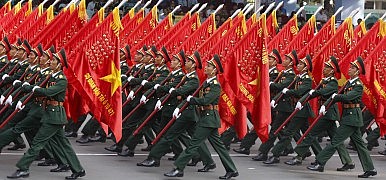
HO CHI MINH CITY—ON April 30, 1975, the armies of communist North Vietnam army took Saigon, toppled the government of South Vietnam, and brought two decades of American military involvement in Vietnam to an end. Today the fall of Saigon is defined, at least in the west, by two indelible images. The first, taken by the late Dutch photographer Hugh Van Es, shows a line of desperate Vietnamese trying to board an American helicopter from a rooftop in downtown Saigon. The other image was captured on film by the Australian journalist Neil Davis: It showed a North Vietnamese tank, bristling with diminutive bo doi infantry, smashing through the cast-iron gates of the Presidential Palace, climbing to its roof, and running up the standard of liberation.

In their own way, both images were a fittingly shambolic testament to a war that was hastily conceived, poorly planned, and conducted with brutal indifference to the people of the country that it ostensibly sought to save. The U.S. intervention in Vietnam cost the lives of around 3 million Vietnamese and 58,000 Americans, devastating the country’s physical infrastructure and setting its development back by decades.

Forty years on, those who are old enough still remember the mixture of fear, relief and uncertainty that marked South Vietnam’s final days and the end of the war. “On April 30 there were tanks in the street here. Saigon was very chaotic,” said Nguyen Quoc Kien, 48, the owner of a coffee shop in Cholon, the Chinese district of Saigon. “I remember a girl – she was shot at a roundabout because she was a Viet Cong.” Pham Van Minh, 67, a former engineer in the South Vietnamese navy, remembered an eerie calm. “We were very happy to have peace, to have the war finished,” he said, crossing his fingers and jabbing them to emphasize the closing of one era and the beginning of another.

Exploring Nepal's Historic Treasures


This edition of our ongoing series of archaeological and historical sites of Asia will focus on Nepal. 

Nepal suffered a devastating earthquake last week. In addition to the loss of life and property, many of Nepal’s historical treasures were damaged. Nepal and the greater Himalayan region are unique in South Asia for their preservation of monuments and manuscripts that have survived in these regions for much longer than in the hot, damp plains of northern India and Pakistan. Below, I discuss some of Nepal’s most interesting archaeological sites.

Many of Nepal’s most important historical sites are found in the Nepal or Kathmandu valley, which lay on the major trade route between the Ganges valley in India and Tibet. In the city of Kathmandu, there are multiple temples and palaces built in an architecturally distinct style from Hindu temples in neighboring north India, with the distinct pagoda-like features more prominent in eastern Asia.

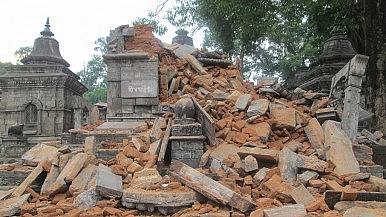
Many of these structures were severely damaged by the earthquake including the temple of Kasthamandap, a squat temple from which the city takes its name. Kathmandu’s Durbar (palace) square was filled with rubbleand ruins after the earthquake though some pagodas survived. The most important and oldest Hindu temple in Nepal, dedicated to Shiva, Pashupatinath Temple near Kathmandu (from around the fifth century C.E.) hassurvived and is now the site for the cremations of many victims of the quake.

After Unimaginable Destruction and Misery, a Marshall Plan for Nepal?

May 02, 2015

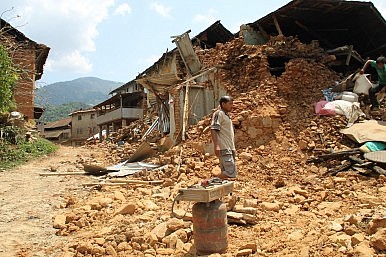
In a small village in Nepal, an old woman is picking up whatever belongings she can scrounge from the rubble, all that remains of her one story home. Sifting through the pile of debris, she lays her hand on a small shoe and suddenly freezes. She starts wailing. The shoe belonged to the woman’s 8 year-old granddaughter, Padma, who was crushed under a pillar when the family house collapsed in the magnitude 7.8 earthquake that hit Nepal last Saturday. By the time her father came to rescue her, the young girl had succumbed to her injuries.

Fifty meters away from the old woman’s house, Laxmi and Manilal Thapa are trying to pull a few sacks of grains from what’s left of their house. They have dug a few potatoes from the debris and hope to find some rice, allowing them to cook their first meal in two days. Ever since the tremor hit, they have been in a daze. They mourn Manilal’s wife, who lost her life saving their two children, protecting them from a collapsing wall to save their lives. But the family cannot mourn for long. Manilal and his sister, who also lives in the neighborhood, continue to frantically search through the debris, hoping to find their two goats that still remain buried.

Further down in the street, a group of men sit in a makeshift tent, wearing white robes. All around them are ruins and rubble. The compound of five houses that they once lived in are now completely shattered. The men have lost their family’s patriarch in the earthquake. The 72 year-old was napping when the tremor struck and was crushed under the weight of the terrace wall.

In the village of Jeevanpur and Chhetria Deurali, 50 kilometres away from the capital of Kathmandu, almost every household is in mourning. The destruction is widespread and all encompassing.

3 'Grueling Realities' for Post-Earthquake Nepal

By James A. Schear
May 01, 2015

The original version of this article appeared on the Wilson Center’s New Security Beat.

Nepal’s devastating earthquake last Saturday was both tragic and expected. On September 18, 2011, as colleagues and I were driving through Kathmandu, our car started to shake, buildings began to sway, store fronts cracked, hundreds of people jumped out of windows and streamed into already crowded streets. It was the so-called Sikkim earthquake. There were only a few fatalities and injuries — it was a very minor event compared to last weekend’s disaster. But it validated the rationale for our visit: to help launch a disaster relief dialogue involving U.S. government experts, Nepalese security forces, and their country’s emergency responders.

We also imagined, sadly, it was a harbinger of things to come.

Sitting atop colliding tectonic plates, the Nepalese people inhabit one of our planet’s most earthquake-prone regions. The urban sprawl of their historic capital city, Kathmandu, swells across a high mountain valley around which seismic shocks (and aftershocks) can bounce and reverberate. When these plates shifted on Saturday, the Indian subcontinent driving underneath Eurasia, more than 8 million people were eventually affected. Estimated fatalities currently exceed 5,000 and are still rising, with thousands more injured and remote areas closer to the quake’s epicenter still largely cutoff.

Is there any good news here? Well, tragically, a sense of inevitability does hone a degree of personal resilience and public preparedness. Disaster risk reduction has been a highly visible theme in Nepal’s international partnerships over the past decade, despite the country’s political fragility and severe economic hardships, and we may be seeing glimpses of that right now.

How Asia’s Richest Man Is Connected to China’s Leaders

May 02, 2015

The lead-off story this week: the long-awaited investigation into the finances of billionaire Wang Jianlin and his Wanda Group firms, which have grown from real estate to encompass the film and entertainment industry. The investigation, by Michael Forsythe, was the subject of a major controversy back in 2013, when the story was allegedly killed by Bloomberg’s editor-in-chief out of fears that it would incite China’s rage. Forsythe left Bloomberg soon after the controversy broke and is now with the New York Times, where he published the Wang story this week.

As with previous exposรฉs of financial ties between Party elites and big business, the piece does not allege that any actual wrongdoing took place. But the story does illuminate financial ties between Wanda companies and family members of some of China’s top leaders, including former Premier Wen Jiabao, former President Hu Jintao, and even current President Xi Jinping.

In other news, Xinhua released its take on the Baltimore protests and riots in a commentary on Wednesday.Xinhua highlighted both racial and economic disparities in its piece and called on the United States to address its own human rights problems. “American democracy is under serious attack and we call upon the government to act and act swiftly,” Ngande Mwanajiti, the former head of the Inter African Network for Human Rights and Development, told Xinhua.