17 April 2016

Neighbourhood First: Navigating Ties under Modi

Edited by Aryaman Bhatnagar and Ritika Passi, this publication brings to focus India’s policy towards its immediate and extended neighbourhood—South Asian Association for Regional Cooperation (SAARC) members, Iran, China and Myanmar—under Modi thus far. Each country-specific chapter describes bilateral ties, debates elements of continuity or change since the new government has come to power, and explores future prospects for ties under Modi given existing challenges and opportunities. Thematic chapters also intersperse this publication, which contextualise India’s neighbourhood policy and its bilateral ties in the region.

To download free MOBI (Kindle) and Epub versions of e-book for any e-reader please click here. Or for PDF versions of all GP-ORF series publications please click here.

CONTENTS

1. India, India’s Neighbourhood and Modi: Setting the Stage
Ritika Passi and Aryaman Bhatnagar

2. India’s Neighbourhood Policy through the Decades
Ashok Malik

3. Dealing with Pakistan: India’s Policy Options
Radha Kumar

4. India’s Afghanistan Policy: Going beyond the ‘Goodwill’ Factor?
Shanthie Mariet D’Souza

5. India’s Iran Policy in a Changed Dynamic
Kanchi Gupta

6 Why Engage in a Neighbourhood Policy? The Theory behind the Act
Varun Sahni

7 India’s China Policy under Narendra Modi: Continuity and Change
Alka Acharya

8 Modi’s ‘Act East’ Begins in Myanmar
K. Yhome

9 China’s Role in South Asia: An Indian Perspective
T.C.A. Rangachari

10 India-Nepal Relations: On the Threshold
Jayant Prasad

11. Paradigms in India-Bhutan Relations and Pathways for Cooperation
Medha Bisht

12. India-Bangladesh Relations in Modi’s Era
Joyeeta Bhattacharjee

13 The Domestic Elements: States as Stakeholders
Shashi Tharoor

14 India-Sri Lanka Relations under Modi
Rajeswari Pillai Rajagopalan

15 India-Maldives Relations: Solid Base, Shaky Structure
N. Manoharan

16 SAARC at Thirty: Integration by Parts
Sheel Kant Sharma
Carter’s India Visit: The China Factor

Rahul Bhonsle

Apr 14, 2016 

US Defence Secretary Dr. Ashton Carter’s indefatigable energy brought him to India a second time in as many years and onboard an aircraft carrier on the Western Fleet. He is the only foreign leader to have visited both the fleets – Eastern and Western of the Indian Navy. Thus, there were many expectations from the visit to India from 10 to 13 April (2016) the least of which was signing the Logistics Support Agreement (LSA).
This would have been the topping on the icing for a Defence Secretary, who has given a lot of his personal time for the betterment of India-US defence relations. But that was not to be. Amongst other factors, the timing of the signing of an LSA in whatever form was just not right with India’s Defence Minister’s visit to China a week ahead and Carter’s trip to the Philippines to announce the presence of US troops at the Clarks Base in the country.
Clubbing India and Philippines and leaving out a prescheduled visit to China created challenges.

Under the circumstances expecting India to sign even a mild LSA was highly unrealistic, perhaps the intent was not to ink one but only to prepare grounds for the same, we will never know.
Ironically one of the factors for proximate India-US defence connections is supposed to be China; the Dragon has now become an Elephant (sic) in the Room.
But coming to the Carter visit first and the LSA. The joint statement issued by the Ministry of Defence in New Delhi stated that both sides decided, “to conclude a Logistics Exchange Memorandum of Agreement (LEMOA), and to continue working toward other facilitating agreements to enhance military cooperation and technology transfer”.

The so-called LEMOA is expected to allow the United States and India to entrรฉe each other’s logistics facilities without establishing the right to automatic access. So this will be something like a case to case basis plus. Mainly the financials could be covered through the LEMOA with an escrow account taking care of visits by US Navy ships to India.
As to how many Indian ships will be visiting the US bases remains to be seen? Indian Navy mainly operates one or two battleships on port visits outside the primary zone of the Indian Ocean littoral and may not require assistance from the US at least in the near to midterm.
There were, however, many positives during the Carter visit.
Defence Minister Parrikar and Secretary Carter outlined some of the priorities in Indo-US defence relations to include, “expanding collaboration under the Defence Technology and Trade Initiative (DTTI); Make in India efforts of Government of India; new opportunities to deepen cooperation in maritime security and Maritime Domain Awareness; military-to-military relations; the knowledge partnership in the field of defence; and regional and international security matters of mutual interest”.

The other take away were in terms of maritime security – a “white shipping” technical arrangement to improve data sharing on commercial shipping traffic, Navy-to-Navy discussions on submarine safety and anti-submarine warfare and a bilateral Maritime Security Dialogue, co-chaired by officials at the Joint Secretary/Assistant Secretary-level of the Indian Ministries of Defence and External Affairs and the U.S. Departments of Defense and State have been agreed upon.
The joint statement also underlined “ensuring freedom of navigation and over flight throughout the region, including in the South China Sea.” This comes as China and the US are in a spat over the declaration of air defence identification zone over the South China Sea by Beijing. Will India also force through this ADIZ following the US? An unlikely scenario to say the least.

SC’s Constitutional Coup: Ambedkar’s Finely Crafted Balance Of Power Is Gone

http://swarajyamag.com/politics/scs-constitutional-coup-ambedkars-finely-crafted-balance-of-power-is-gone
R Jagannathan
April 13, 2016,

SC has over-read the constitution to give itself almost dictatorial powers, something the constitution never envisaged.
Over the last few years, and quietly since the 1990s, the Supreme Court has indirectly made out a case for a benevolent and populist dictatorship: itself.
As it intervenes in more and more areas of policy, law-making, policing and regulation (yesterday it wanted to have a go at banks’ bad loans problem), the court has taken on powers never envisaged by our constitution-makers. It has upset the delicate balance of power between executive, legislature and judiciary.
The police and the bureaucracy are accountable to the executive, the executive is accountable to the legislature, and the legislature is accountable to the people, but who is the judiciary accountable to? This is what makes it a “benevolent dictator” of sorts when it takes on roles that go beyond interpreting the law.
A “benevolent” dictator is one who appoints himself to power (it could be through a coup or any other means not prescribed in the law). He rules basically by making out a case that elected politicians are untrustworthy and corrupt, that the whole system is dysfunctional, that an impartial (but unelected) ombudsman can do the right things instead of being guided by vested interests, as he can appoint competent people to jobs without fear or favour, etc, etc.
All populist dictatorships derive their legitimacy from being seen as doing the right things. Pakistan’s army has repeatedly staged military coups using the unpopularity of elected politicians as an excuse. It has often been welcomed by the public for it.

Now consider the case of the Indian Supreme Court.
It is unelected and largely unaccountable to anyone. It appoints its own judges and they can’t be removed easily.
Thanks to Indira Gandhi’s internal emergency, when the government made the judiciary subservient to itself, the Supreme Court - through two judgments in 1993 and 1998, called the second and third judges cases – arrogated to itself the job of appointing upper judiciary judges. Governments could protest, but could do nothing if they didn’t like the judiciary’s choices. The executive’s role has been reduced to that of the typist who composes the appointment letter.
These judgments were in clear violation of the spirit of article 124 of the constitution which says that the President (i.e, the government) shall appoint judges to the higher courts in consultation with the Chief Justice and/or other judges. When the NDA government, with near unanimity in parliament, tried to claw back some of its old powers by enacting the National Judicial Appointments Commission (NJAC) Act 2014, the Supreme Court shot it down. It killed a law where it was itself an interested party when it could have read down the provisions which could have dented its independence.

Nepal’s Divisive New Constitution: An Existential Crisis

http://www.crisisgroup.org/en/regions/asia/south-asia/nepal/276-nepal-s-divisive-new-constitution-an-existential-crisis.aspx
Read full report (pdf)

EXECUTIVE SUMMARY AND RECOMMENDATIONS
On 20 September 2015, Nepal’s new constitution passed amid deadly protests by Madhesi and Tharu groups across the southern Tarai plains that continued for months, leaving 57 dead. Protesting groups said the statute backtracked on addressing structural discrimination. The protests had deep support in ethnic Madhesi Tarai communities, reflecting a profound, increasing sense of alienation from the state. A 135-day blockade of vital supplies by Madhesi civic and political groups, partially supported by India, has ended, but as no political solution is on the table, the protests are almost certain to resume. To stop violent polarisation and a breakdown of social relations, national parties and protesting groups must urgently agree on how to manage contentious issues, with timelines, guarantees, and a role for civic participation. A sustainable, equitable social contract is necessary for lasting peace and reconciliation.

After the devastating earthquakes in spring 2015, the largest parties in the Constituent Assembly decided, amid controversy, to fast-track a new constitution so as to fulfil a longstanding peace process commitment and enable them to focus on reconstruction. Some administrative and structural reforms mandated by the 2006 Comprehensive Peace Agreement (CPA), 2007 Interim Constitution and other political agreements are enshrined in the new constitution. But Madhesi, Tharu, janajati, Dalit, religious minorities and women’s groups – all considered historically marginalised – believe the new statute and the process by which it was rushed through diluted commitments to meaningful federalism, redress for historical, structural discrimination based on ethnic and religious identity and gender, and democratic consultation.

There is disagreement over boundaries of new states, electoral representation and affirmative action, constituency delineation and citizenship-related clauses. Supporters of the new constitution feel much has already been achieved and say an excessive focus on identity-based grievances threatens Nepal’s unity, integrity, even sovereignty. The objections of those who demonstrated against it have their roots in long-running social disagreements on what it means to be Nepali and whether a homogenous conception of Nepaliness has led to structural discrimination against groups that do not conform to the behaviour and values of hill-origin, Nepali-speaking, upper caste Hindu communities.

Political Conflict, Extremism and Criminal Justice in Bangladesh

Read full report (pdf)
EXECUTIVE SUMMARY AND RECOMMENDATIONS
As the Awami League (AL) government’s political rivalry with the Bangladesh National Party (BNP) reaches new heights, so has its repression. At the same time, a deeply politicised, dysfunctional criminal justice system is undermining rather than buttressing the rule of law. Heavy-handed measures are denting the government’s legitimacy and, by provoking violent counter-responses, benefitting violent party wings and extremist groups alike. The government needs to recognise that it is in its interest to change course, lest it fail to either contain violent extremism or counter political threats. A key part of a more prudent course would be to depoliticise and strengthen all aspects of the criminal justice system, including the judiciary, so it can address the country’s myriad law and order challenges and help stall a democratic collapse.

The political conflict between the AL and BNP has resulted in high levels of violence and a brutal state response. The government’s excesses against political opponents and critics include enforced disappearances, torture and extra-judicial killings. Police tasked with targeting the government’s rivals and an overstretched justice system compelled to prosecute opposition leaders and activists now also face a renewed threat from violent extremists. The permissive legal environment, however, is creating opportunities for extremist outfits to regroup, manifested in the killings of secular bloggers and foreigners and attacks on sectarian and religious minorities in 2015. The government’s reaction to rising extremism, including arrest and prosecution of several suspects without due process and transparency, is fuelling alienation that these groups can further exploit.

Reconciling with the opposition and hence stabilising the state requires both political compromises and an end to the repressive use of law enforcement agencies and abuse of the courts. Politicising the police and using elite forces, particularly the Rapid Action Battalion (RAB), to silence political dissent, are laying the seeds of future violence. By concentrating on targeting the opposition, the police are failing to curb criminality; the prisons are overburdened by the mass arrests of opposition leaders and activists; and the judiciary, perceived as partisan for trials and sentences based on political grounds, is losing credibility. The result is a justice system that swings between two extremes: woefully slow and dysfunctional for ordinary cases and speedy, undermining due process, in politically charged ones.

** Stratfor: Europe’s Chronic Jihadist Problem

Summary: The pace of attacks suggests Europe’s jihadist problem is growing worse. Here Stratfor explains how and why. Until they learn to grapple with this, the consequences will be severe.
Scott StewartStratfor, 8 April 2016
Forecast
European authorities have arrested a number of suspects linked to the Paris and Brussels terrorist attacks, but the arrests address only the immediate threat, not the root of the problem.
Europe’s jihadist threat will continue to be deeper and more complex than North America’s because of differences in their Muslim communities.
Despite recent counterterrorism successes, the threat of attacks in Europe will remain high for years to come.
As long as the ideology of jihadism survives, and as long as Europe’s Muslims remain marginalized and disenfranchised, European security services will not be able to arrest their way out of this problem.
Analysis

Like the assaults in Paris last year, the March 22 terrorist attacks in Belgium prompted a wave of arrests and energized attempts by European authorities to disrupt the Islamic State and other jihadist operations. But arrests will not solve the intractable problem of radicalized Muslims bent on attacking Europe. Until the underlying issues that help drive radicalization on the Continent are addressed, authorities will be neutralizing only the immediate threat, not countering its root cause. In the meantime, jihadists will continue to pose a threat in Europe and elsewhere.
Police and security forces across Europe arrested dozens of purported Islamic State operatives in the wake of the Brussels bombings. The arrests have not been limited to Belgium and France; they have also taken place in Germany, Italy and the United Kingdom. Though these operations may help to identify and dismantle an Islamic State network (or a network of networks), Europe’s problems run much deeper than this one layer of jihadists.
The Roots of Radicalization

Geopolitics has tightly woven together the European and Muslim worlds since the earliest days of Islam. The entanglements started with the Umayyad invasion of Spain and France in the early 700s and continued through the Crusades, the Ottoman sieges of Vienna in the 1500s and 1600s, and the European colonization of North Africa and South Asia in the 1700s and 1800s. The fall of the Ottoman Empire in the wake of World War I and the European colonization of the Middle East drew the two cultures even closer together.
The proximity of North Africa and Turkey to Southern Europe and European colonization efforts, combined with the desire in the Muslim world to seek education and employment in Europe, has resulted in large populations of Muslims living on the Continent. But this close relationship has not been without friction. Though a large portion of Muslims in Europe come from families who have lived there for four or five generations, many have not integrated into European society, living instead in isolated, Muslim-dominated areas. In a telling example of this isolation, Matthew Levitt, the director of the Stein Program on Counterterrorism and Intelligence at the Washington Institute for Near East Policy, noted in a recent Politico article that only eight of the 114 imams in Brussels speak any of Belgium’s traditional languages.
Moreover, the weak European economy has disproportionately affected the Continent’s Muslim population and has created an alarmingly high unemployment rate among young Muslims. In addition to frequent discrimination in the job market, this has left many Muslims feeling alienated, disenfranchised and resentful. Combined with the European welfare state, in which work is not necessary to survival, these sentiments have created a climate where Muslims who are exposed to radical discourse can more easily be recruited into radical political or even militant activities.
Europe’s immigration and asylum laws, which granted refuge to many jihadist ideologues who were persecuted in their home countries, have exacerbated the situation. High-profile radicals such as Omar Bakri Mohammed, Abu Qatada, Abu Hamza-al Masri and Mullah Krekar, among many others, were allowed to set up shop on the Continent, and Europe’s Muslim areas have provided rich environments for the jihadist preachers seeking to recruit disaffected Muslims to their cause.

Although European countries have taken steps to expel or extradite many of these old-guard jihadist imams in recent years, they have been replaced by a second generation of preachers, including Khalid Zerkani, a Belgian citizen of Moroccan origin who was convicted in July 2015 (along with Paris attack mastermind Abdelhamid Abaaoud) for running Belgium’s largest jihadist recruitment network. Abaaoud, who was tried in absentia, was killed in a police raid in Saint Denis, France, five days after the Paris attacks.
The sheer number of European jihadists who have traveled to Iraq, Syria, and more recently, Libya, demonstrates that the issue of disaffected Muslim populations has only grown in recent years. The refugee crisis, along with incidents such as the French burqa ban and the anti-Islamic rhetoric of politicians such as Geert Wilders, reinforces the narrative put forward by jihadist recruiters that Islam is under attack from Europeans, aiding their recruitment efforts.
A Unique Kind of Threat

Just as the Muslim communities in Europe and the United States differ, so does the nature of the jihadist threat in each. In the United States, where Muslims are more integrated into the whole of society, plotters tend to be more self-radicalized and aspirational. Once they become radicalized — frequently via the internet — it is common for them to be arrested as they seek assistance with their plots from individuals who turn out to be FBI agents or police informants working on sting operations.
But Europe’s concentrated and disenfranchised Muslim population makes it easier for radicalized Muslims there to find confederates who are not police informants. In many cases, European cell members have known one another since childhood, have been in street gangs together, or have been incarcerated at the same time.

King Coal Is Losing His Throne

http://foreignpolicy.com/2016/04/13/king-coal-is-losing-his-throne-peabody-bankruptcy/?utm_source=Sailthru&utm_medium=email&utm_campaign=New%20Campaign&utm_term=%2AEditors%20Picks
Peabody Energy joins a growing list of coal miners who are going broke thanks to a perfect storm of cheap natural gas, the slowdown in China, and tougher environmental rules.
BY KEITH JOHNSON APRIL 13, 2016
Peabody Energy, the world’s biggest privately owned coal mining company, filed for bankruptcy protection in the United States on Wednesday. The company becomes the latest casualty of a coal-market bloodbath that has already pushed other big U.S. miners into insolvency in recent months.
Peabody said in its bankruptcy filing that the challenges facing the coal sector are “unprecedented” and include a slowdown in China, cheap natural gas, and new environmental regulations. The company hopes to use bankruptcy protection to shed debt and improve cash flow, and will keep all mines operating in the meantime. Peabody President and CEO Glenn Kellow called bankruptcy “the right path forward” in order to “lay the foundation for long-term stability and success in the future.”
In the United States, coal companies’ fortunes have gone south dramatically, and in a hurry. The big four producers — Peabody, Arch Coal, Alpha Natural Resources, and Cloud Peak Energy — were worth a combined $34 billion in 2011, according to the Rhodium Group, a consultancy. Today, they are worth about $185 million.

Coal’s challenges seem more fundamental than the cyclical headwinds that periodically hammer U.S. commodities producers. Cheap and abundant natural gas has pushed coal out of its dominant perch in the U.S. power sector. At the same time, the Obama administration has sought to slap coal with tough new environmental regulations. Neither headwind for coal looks set to disappear anytime soon.
“Without a doubt, this is a structural shift,” said Kelly Mitchell, energy campaign director for Greenpeace USA, the environmental group. Rather than tallying up all the challenges the coal sector faces, she said, “it’s easier to try to determine what’s gone right for them. And the answer is, essentially nothing.”
Globally, the outlook for coal is a little different. Natural gas isn’t yet quite as cheap or abundant in many other markets as it is in the United States, leaving more room for coal, especially in Asia.
“The U.S. has a fundamental difference in market conditions, but internationally, I do not think there is a fundamental barrier to a recovery in coal prices,” said Jim Thompson, head of Americas coal research at consultancy IHS Cera.

Can we defeat ISIS by “killing them all”? We’ve learned nothing since 9/11.

Summary: What have we learned from our ways since 9/11? How have we changed since 9/11? The enthusiasm of our presidential candidates, except Trump and Sanders, for more of the Long War suggests we’ve learned nothing. The broad support for torture (63% in a recent poll) suggests that we have become more like the monsters we fight. This interview with noted military experts Ralph Peters shows both these trends, an ominous sign for our future.

“Kill them all; let God sort them out.”
— Loose translation of phrase attributed to Papal legate Arnaud Amalric before the Massacre at Bรฉziers, in France at the start of the Albigensian Crusade.
Another demonstration of America’s failure to learn from our post-9/11 wars


In the 15 years of our post-9/11 wars US forces have fought across the Middle East. We have employed the full trinity of US military methods — popular front militia, massive firepower on civilians (e.g., winning hearts & minds with artillery), plus sweep and destroy missions. Local forces have defeated us in Iraq and Afghanistan by the only metric that counts — they’re still there after we leave. Yet we have learned nothing from this expenditure of America’s blood and money, as we see here.
Ralph Peters (Lt. Colonel, US Army, retired) on Fox News, 22 March 2016

O’REILLY: Do you think the American people have the will to fight ISIS? I mean, the polls show that most favor ground troops, but an entire political party, the Democratic Party is against any kind of meaningful confrontation. What about the folks in general? What do you think?
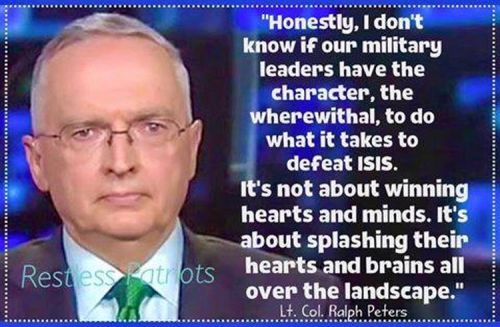
PETERS: Well, I think the American people certainly could summon the will to defeat ISIS, to destroy ISIS, if properly led. But we are not properly led, and I’m afraid looking at the political landscape we may not be properly led. Because I’m not — generalities won’t defeat ISIS. I’m not hearing the kind of expertise, depth, and strength of character it will take. Worse, Bill, worse, we now have two generations of military officers educated, trained, convinced that it’s more important to prevent casualties and collateral damage than to win. Honestly, I don’t know if our military leaders have the character, the wherewithal to do what it takes to defeat ISIS. It’s not about winning hearts and minds, it’s about splashing their hearts and brains all over the landscape.
Even for Fox News, this is an amazingly ignorant statement to hear in the 15th year of our post-9/11 wars (he said much the same thing in 2014). We’ve learned nothing from our experiences, going back to our attempts to win by “killing them all” in the Vietnam War…
At an early intergovernmental meeting {1962} on the importance of psychological warfare, one of {General} Harkins’ key staffmen, Brigadier General Gerald Kelleher, quickly dismissed that theory. His job, he said, was to kill Vietcong. But the French, responded a political officer named Donald Pike, had killed a lot of Vietcong and they had not won.

We tried to “kill enough”. The US dropped 1,613,000 tons of bombs in Europe during WWII — and almost five times that on Southeast Asia ( 7,662,000). That’s almost 500 pounds of explosive per person, not including the massive use of artillery and napalm {for more information see this study) — and the more retail-level killing (as at Mai Lai, a sadly common event). Nick Turse’s book documents the result: Kill Anything That Moves: The Real American War in Vietnam.
It should be obvious — but obviously isn’t — why mass murder of insurgents by infidel foreigners is unlikely to work. First, there is the difficulty of distinguishing them from the other locals. The following steps are no easier. This has been proven many times by many nations since WWII, as explained in Chapter 6.2 of Martin van Creveld’s The Changing Face of War (2006)…

* Stratfor: Al Qaeda’s North African Franchise Expands to the South

Summary: As I’ve said for years, a key strength of al Qaeda’s comes from its use of western business methods (see links at the end of this post). Here Stratfor looks at their expansion plans, which rely on the powerful tool that built McDonald’s and other great corporations: franchising. It works for terrorists, too.
31 March 2016
Summary
A string of unusual attacks by al Qaeda’s North African branch could shed some light on the jihadist group’s latest predicament. Pressure is mounting on al Qaeda in the Islamic Maghreb (AQIM) to counter the Islamic State’s growing encroachment on its territory, resources and pool of recruits. The rise of an effective rival for the helm of global jihadism has forced al Qaeda to step up its game, especially in areas where it has been weakened. Northern Africa — and particularly Mali, where France’s military intervention has significantly degraded AQIM’s capabilities over the past few years — is one such place.
The reversal of AQIM’s fortunes by both the Islamic State and France may be the motive behind the group’s latest spate of attacks against soft targets in African cities. Since the beginning of 2016, AQIM has launched several assaults on hotels located well outside its traditional area of operations, including the Hotel Splendid in Burkina Faso and the Grand Bassam resort in Ivory Coast. As the group strives to remain relevant in the face of numerous threats to its position in the region, it will likely continue to ramp up its attacks against Western targets in countries that lack the security resources to defend them.
Analysis

The Islamic State’s ideology is gaining traction across North Africa, and the group’s growing popularity has put al Qaeda on the defensive. Needing to present a united front, the leaders of the al Qaeda core have pressed the group’s various branches and affiliates to put aside their differences and join forces against their common enemy.
In December 2015, al-Mourabitoun — a breakaway faction of AQIM led by Mokhtar Belmokhtar — did just that by rejoining the North African branch. The reunion has had a noticeable impact on both the tempo and selected targets of terrorist activity in West Africa ever since. In January, AQIM laid siege to the Hotel Splendid in Burkina Faso’s capital, Ouagadougou, leaving 30 people dead. Two months later, the group claimed responsibility for an attack on the Grand Bassam beach resort near Ivory Coast’s economic hub, Abidjan, that killed 16. The assaults were the first of their kind in both countries.


The groups’ cooperation reflects a key strength of al Qaeda’s broader franchise structure: flexibility. The ability of various al Qaeda nodes to work with one another or on their own gives the group two major advantages over its enemies. First, it enables better funded and more dynamic groups such as Belmokhtar’s al-Mourabitoun to conduct fundraising operations or attacks throughout the region without interfering with the territory of other AQIM cells. Second, it gives AQIM the ability to leverage small, local militant groups with narrow agendas for its own purposes. For example, the Macina Liberation Front, a group with distinctly provincial interests, participated in AQIM’s November 2015 assault against the Radisson Blu hotel in Bamako, Mali. Funneling weapons, training and money to small groups has given AQIM greater knowledge of and control over certain areas of Northern Africa.
Regaining Prestige With Limited Resources

AQIM will need these advantages if it is to rebuild its presence in the region. France’s Operation Serval, launched in 2013 to halt an al Qaeda-led advance southward toward Bamako, was hailed largely as a success. Though it did not completely eradicate Islamist militancy from the Sahel, it did move AQIM even further from its goal of overthrowing North Africa’s “apostate” governments and establishing an Islamic emirate in their place.

‘All-weather’ friends: China, Sri Lanka agree to resume controversial Colombo Port City project

PUBLISHED : Monday, 11 April, 2016,

China and Sri Lanka have vowed to develop an “all-weather” friendship, in a move analysts say is aimed at putting disagreements over infrastructure projects behind them.
But some observers believe that despite the pledge, Colombo’s new government plans to diversify the country’s diplomatic partners and dilute its reliance on Chinese investment.

Wrapping up a three-day trip to Beijing yesterday, Sri Lankan Prime Minister Ranil Wickremesinghe said Colombo planned legal reforms to encourage foreign investment. He asked China to accept equity in infrastructure projects in return for cancelling some of the US$8 billion Sri Lanka owes Beijing and offered to sell it stakes in Sri Lankan companies.
The countries also announced the resumption of a controversial US$1.4 billion project, the Colombo Port City, suspended for more than a year over irregularities in the contract arranged by Sri Lanka’s previous administration.

“The pledge to develop an all-weather friendship is a gesture to say change of government and politics will not affect the relationship,” said Du Youkang, professor of South Asia studies at Fudan University.
Sri Lanka upset Beijing last year when it ordered a review of the project, approved under the administration of former president Mahinda Rajapaksa, who had faced criticism domestically for too heavy a reliance on Chinese investment.
Faced with falling foreign reserves, Sri Lanka’s new administration under President Maithripala Sirisena, is hoping to boost investment from abroad.
Wang Dehua, a professor of South Asian studies at the Shanghai Institute for International Strategic Studies, said China would consider the equity swap.

http://www.scmp.com/news/china/diplomacy-defence/article/1935065/all-weather-friends-china-sri-lanka-agree-resume

China adds Nigeria to its African Empire

14 April 2016

Nigeria’s Minister of Foreign Affairs, Mr. Geoffrey Onyema, announced on Tuesday that China has offered Nigeria a $6 billion loan to fund infrastructure projects. Onyema and President Muhammadu Buhari secured the deal with President Xi Jinping in Beijing, where Buhari is currently on his first official state visit to China at the invitation of the Chinese president.
The confirmation by Onyema coincided with an agreement reached between Nigeria and China yesterday on a currency swap deal, as he looks for ways to shore up the naira, Nigeria’s currency, and fund a record budget deficit.
Onyema announced that the credit would be:
“on the table as soon as we identify the projects. It won’t need an agreement to be signed; it is just to identify the projects and we access it.”
The loan comes at a good time as Nigeria faces its worst economic crisis in decades. The country’s projected 2016 deficit is currently at N2.2 trillion ($11.1 billion). Sinking oil prices have eaten into its foreign reserves and the naira has weakened against other currencies. As a resource-rich country, Nigeria’s economic performance has unfortunately been driven by the oil and gas sector. Unfortunate because the progress recorded towards genuine economic development prior to the discovery of oil in commercial quantity has since been virtually eroded. Relying onoil and gas for around 40% of GDP (50% at peak production in 2004) has left the economy vulnerable to the global oil price crash. The sector also represents 90% of their total exports.

But the oil crash cannot be blamed entirely – Nigeria’s quest for development has spanned decades not months. It is still yet to deliver on the ultimate goal of poverty reduction, despite various plans, programmes, and projects. There is also the added pressure from Buhari who plans to triple capital spending in the 2016 fiscal year.
Much like the despair felt worldwide for economic basket-case Zimbabwe, one can’t help but feel frustrated at the mismanagement of Nigeria’s abundant natural resources. In addition to oil and gas, Nigeria also boasts sizeable reserves of: tin, iron ore, coal, limestone, niobium, lead, zinc and arable land. Its rainforest region is also amongst the richest and most important in the continent for research and conservation. Yet as the World Bank said in 2007, weak and unreliable infrastructure, macroeconomic instability, microeconomic risks from corruption and weakness of institutions and regulations to guide investment behaviour are the main constraints to high performance of the economy.

Ukraine’s Political Instability Continues

April 11, 2016
By Lili Bayer
The prime minister’s resignation highlights the discord among political factions in Kiev.
Summary Revolutions make for strange bedfellows, and when they are over, power struggles among the victors begin. Ukrainian Prime Minister Arseniy Yatsenyuk announced his resignation on April 10, following a months-long political crisis in Kiev. The political instability and factional fighting that follow revolutions define the course of new regimes. Ukraine’s future depends in large part on the commitment of Western governments to supporting Kiev politically and financially. A weak and unstable government in Kiev presents challenges for the West and opportunities for Moscow. Although the West will remain influential in Ukraine, the U.S. and Russia will likely come to a compromise on the country’s neutrality.
Franz Kafka wrote that “every revolution evaporates and leaves behind only the slime of a new bureaucracy.” Many Ukrainians likely agree. Since coming to power in 2014, Ukraine’s leadership disappointed many citizens and Western governments by failing to effectively address corruption and revive the country’s economy. Yatsenyuk’s resignation is one element in an ongoing crisis plaguing the country’s fragile ruling coalition.

Ukraine’s political troubles are an example of a classic problem of revolution. Revolutions take place when an uprising of citizens leads to a change not only of a particular government, but of an entire regime. Revolutions usually require diverse social and political forces coming together. Once they defeat the regime, however, dynamics shifts. As Dr. George Friedman wrote in a 1991 essay, “Revolution is about the sublime and the sacred. Governing is about the prosaic and the profane.” Once the moment of revolution is over and the challenges of policy and everyday governing emerges, the revolutionary alliances generally fall apart. The different factions are then left fighting over the legacy of the revolution and how to move forward.
It was a little over two years ago when a group of Ukrainian public figures stood at Maidan Square encouraging the crowds to oppose then-President Viktor Yanukovych. Yatsenyuk, a seasoned economist and politician, was there representing his mentor and party leader, Yulia Tymoshenko, who was in prison. Also present were Petro Poroshenko, an oligarch with candy and media empires; Vitali Klitschko, a popular boxer with political aspirations; and Oleh Tyahnybok, a nationalist and openly anti-Semitic politician.

Peers Discuss ‘Hacking Inward,’ Cyber War Games at RSA Conference 2016

By Itzhak Kotler, Co-Founder and CTO, SafeBreach
During the recent RSA conference in San Francisco, I moderated a Peer2Peer session called “Hacking Inward—Implementing Effective Cyber War Games.”

Peer2Peer group discussions center around specific security topics, where participants get the chance to really dig deeply into a topic. One of the reasons this particular topic is important is because validating your security in a continuous way is good security practice. It helps you identify your weaknesses, ensure your security strategies are sound, and exposes issues in time to be remedied. Companies don’t need to understand adversaries as much as they need to understand how adversaries view them.

By hacking inward and implementing effective war games, you can:
Unearth people, process and technology issues.
Answer the question of “Are we secure?” and “Can a breach happen to us?”
Practice and refine proper process/procedure for when a breach does happen.
We divided our discussion into three parts—people, process and technology.

People
End-users are typically the weakest part of an organization’s security strategy. This first set of discussion was on the potential for human error, mistakes and occasional stupidity by end users. The key focus for many organizations in the session was on education.
Reducing business risk and improving security starts with making sure employees realize that security is everyone’s problem. Similar to how you may report to authorities when you see an unattended bag at airports, the same type of vigilant employee base with a high level of imprinted situational awareness in action is required when it comes to cybersecurity.
Participants shared a variety of educational tactics. They ranged from “security” fairs to phishing campaigns that test the effectiveness of user education. Another participant shared how USB flash drives were dropped in the parking lot and common areas to see how many users would pick them up. One unusual tactic I found interesting was sharing information on attacks launched on the organization with employees. Instead of just explaining to employees the appropriate security best practices, this internal information sharing approach helps provide real examples of how attackers are specifically targeting their organization.

Processes
Most of the discussion on processes was around validation of third party processes especially payment processes, which seems appropriate in light of the recent Bangladesh bank heist, where a $20 million bank transfer was stopped because of a typo. The participants shared their specific process validation. In one example, the payment process for vendors triggers an alert if the invoice is above a certain threshold. Others shared that human intervention was necessary, and that specific employees were required to review certain transactions before they were approved.

Technology
We agreed that technologies that validate and prove that the security systems are functioning correctly are an essential part of a robust cybersecurity strategy. The typical organization in this session uses a combination of technologies and “specialized” humans to try to address this challenge.

Participants discussed using a myriad of tools from patch management/vulnerability assessment tools to application security platforms. In addition, many also hire external pen testing teams for third-party validation. Most security leaders in the room were interested in building an internal security red team because of the benefits of an internal team that understands the business and can execute relevant breach scenarios.
An internal red team can play true war games that give more complete answers across people, process and technology. But red teams tend to be limited to larger organizations with a fairly sizable security team and robust security framework. Participants who had internal red teams wanted to increase the frequency of security validation performed.

In general, participants felt that the existing security validating approaches are flawed. Dependency on specialized humans isn’t scalable, and the frequency of validation (annual/bi-annual) by external consultants do not accurately reflect true security risks. The majority of audience felt that a new way of automating and continuously validating our security controls was needed—an “automated red team” on a platform. An automated platform not only helps addresses risks in dynamic environments, but also extends security validation to both internal and external attacks. This approach called “continuous security validation” or “attack simulation” is emerging technology that is available today, but we ran out of time for more in-depth discussions.

I want to thank everyone who participated in the Peer2Peer session. As a former red team leader, I believe in cyberwar games as an effective way to identify key issues that need to be remediated. Effective cyberwar games starts with understanding your business and security objectives, and testing the framework that you’ve put in place. By hacking inward on a continuous basis, you can test people, process and technology, and stay ahead of the attacker.

Itzik Kotler is CTO and Co-Founder of SafeBreach. Kotler has more than a decade of experience researching and working in the computer security space. He is a recognized industry speaker, having spoken at DEFCON, Black Hat USA, Hack In The Box, RSA Europe, CCC and H2HC. Prior to founding SafeBreach, Itzik served as CTO at Security-Art, an information security consulting firm, and before that he was SOC Team Leader at Radware (NASDQ: RDWR). Follow him on Twitter at @itzikkotler.


- See more at: http://www.rsaconference.com/blogs/peers-discuss-hacking-inward-cyber-war-games-at-rsa-conference-2016#sthash.kKWZsckW.dpuf

The Race to Attribution Needs to Stop

http://deaddrop.threatpool.com/race-attribution-needs-stop/
March 30, 2016  AuthorEmilio Iasiello

It has become almost systemic for people to immediately question, “Who did it?” when a major breach occurs in the public and/or private sectors. Understandably, the victimized have a keen interest in identifying their faceless attackers especially when they have been publicly exposed. There is also a competitive aspect, as the first person to make attribution can add credibility to his or her name. However, while providing information for public consumption is important, it’s equally as important to provide accurate information.
In the cyber security industry, a commonly heard mantra is that attribution in cyberspace is difficult. Cyber security experts and organizations, and even some government officials, have emphasized this point. If most agree that attribution is difficult and time consuming, why is there invariably a need to immediately attribute hostile activity that may end up being incorrect and misleading?

This is perplexing especially when one considers that some state actors are considered to be sophisticated and stealthy, yet once their operations are exposed, attribution appears relatively easy to assign. This contradicts the general premise of the attribution challenges that cyberspace presents and discounts the anonymization and obfuscation techniques employed by savvy actors to avoid those very identification efforts. Furthermore, reliance on technical evidence as indicators of attribution may become less important as actors may alter timestamps, use different keyboard languages, and change compile times to point blame in a different direction.
Three highly public cyber incidents have involved a rush to judgment over the identity of the perpetrators that may ultimately prove incorrect. In one incident, a state actor is strongly suspected as being the perpetrator; in another, later evidence suggested that the original suspects may not have conducted the activity; and the last, the high confidence accusation of a state government’s involvement in destructive activity is met with considerable criticism and doubt by the larger computer security industry.
Office of Personnel Management (OPM): In June 2015, OPM announced that it had been breached and potentially exposed four million federal employee records to suspected nation state-affiliated hackers. State actors, or actors working on behalf of the state, were believed to have carried out this attack because, in addition to technical indicators and “unique” malware, the perceived stolen material was not found to be monetized on underground hacking forums. However, according to one source, 23,000 government e-mails from different agencies were found on an underground hacking forum two days later. While it can’t be concluded that these e-mails were harvested from the OPM breach, it certainly warranted further investigation that didn’t occur. Rather, it was quickly concluded that the motivation for this attack was the compilation of information to be used for future espionage campaigns, or the creation of a database for all U.S. federal employees by the state actor in question. Little consideration was given to any other possible scenario. A June 2015 report further intimated that state actors were behind the attack; although it cited two possible groups – both suspected state hackers – as the perpetrators, a fact that only additional time and investigation would have helped to determine. In the end, Beijing arrested the actors in question claiming that the activity was a criminal manner. Given the confluence of cyber crime and the fact that cyber espionage activities occurring more regularly, who’s to say that more espionage groups aren’t going to engage in similar moonlighting efforts?
France’s TV5 Monde: In April 2015, France’s TV5 Monde was breached, shutting down transmissions and inserting pro-jihadist messages on its social media accounts. At the time, officials from the Islamic State of Iraq and Syria (ISIS) claimed responsibility for the attack. However, after further investigation, French security investigators suspected a Russian hacking group to have been responsible (the website was hacked and replaced with a pro-“Cyber Caliphate” message). The investigation is still ongoing, indicating that even the most seemingly mundane attacks can have more complex machinations behind them. The “easy” answer may not prove easy at all.

Sony Incident: In 2014, Sony Pictures Entertainment was hacked by suspected North Korean hackers in protest of the release of a film. In addition to stealing confidential documents and intellectual property, the attackers may have also destroyed corporate data. The North Korean government was quickly implicated in the hack, a position that the U.S. government did not waiver from despite numerous criticism from cyber security experts and companies. While North Korea may have been behind that attack, the fact that there was little consideration over other alternatives is deeply disconcerting, particularly in a domain that traditionally favors attackers’ abilities to obfuscate their locations and implement deception techniques.

It should be noted that cyber attribution, while difficult, is not impossible. Based on the amount of time and effort it takes to gain fidelity into what transpired in a breach, particularly those conducted by sophisticated actors, attributing blame shouldn’t be a “quick” process. This is especially true where suspected government involvement is concerned. It would be unwise to base a course of action before concretely knowing who is behind an attack, as implications can extend far beyond the cyber realm into economic and diplomatic consequences.

The United States government quickly levied economic sanctions against North Korea for its perceived implication in the Sony hack, but has treaded much more judiciously in assigning the same culpability to China, even though it indicted five members of the People’s Liberation Army for hacking. Potential consequences against states should be evaluated on a case-by-case basis, regardless of convincing attribution evidence.

There is little advantage to be gained by hurrying to call out particular governments or their agents as the orchestrators of hostile cyber activity, particularly since such a claim is subject to change as more information comes to light and is analyzed. One cyber security company received much criticism for a report in which it intimated that a nation state was behind a slew of attacks, a claim that it later had to back away from later.

While attribution is important in assigning responsibility for an attack, it may detract from the most important next step for a breached organization – mitigating the damage caused, patching up security “holes,” and ensuring that business operations continue promptly and securely. There will be time later to determine who was behind the attack, or at least, as good as can be expected given the tools and information on hand.
http://www.defenseone.com/technology/2016/04/carter-may-elevate-cybercom-full-combatant-command/127243/?oref=d_brief_nl
APRIL 5, 2016 BY PATRICK TUCKER

As network warriors pound away on ISIS in the battle for Mosul, Carter says it’s time to consider full-COCOM status for cyberwarfare.
Defense Secretary Ash Carter is considering turning U.S.Cyber Command into a full combatant command, an acknowledgment that cyber warriors are today not just defending military networks but joining in combined-arms attacks on the enemy.
Pentagon leaders long have said that cyber has joined land, sea, air, and space as a new warfare domain. Especially in cyberspace, Carter said at the Center for Strategic and International Studies in Washington, “our reliance on technology has given us great strengths and great opportunities, but also led to vulnerabilities that adversaries are eager to exploit,”

It is time, Carter said, to “consider changes to cyber’s role in DOD’sUnified Command Plan.”
The military is currently organized into nine COCOMs: six geographic commands (Pacific, Europe, Africa, Middle East, etc.) and three that field specialized capabilities: special operations, nuclear (strategic) forces, and transportation. U.S. Cyber Command, orCYBERCOM, is currently a sub-unified command under U.S.Strategic Command.
“I have given Cyber Command in the ISIL fight its first wartime assignment,” Carter said Tuesday, referring to the historic role that network experts are playing in the Mosul offensive, described primarily as disrupting the group’s communications, command, and control capabilities.
“Increasingly, I’ve brought Strategic Command and Cyber Command into these operations as well to leverage their unique capabilities in space and cyber to contribute to the defeat of ISIL. Beyond terrorism,” Carter said. “A couple of years ago, that would never have occurred to a secretary of defense.”

The calculation has changed largely as a result of ISIS’s own behavior and what the Defense Department perceives as the need to fight ISIS on the group’s own turf, inside online communications networks. He described the thinking as: “Hey, these guys are using this tool. We need to take it away.”
Adm. Michael Rogers, commander of Cyber Command, told the Senate Tuesday morning his unit was ready for the upgrade. Appearing before the Senate Armed Services Committee, he discussed the future of the fledgling Cyber Mission Force and defending networks and as part of the so-called Third Offset, the Defense Department’s bid to develop technologies to secure technological advantage. “USCYBERCOM stands ready to help develop and deploy the new cyber capabilities entailed in the Third Offset, particularly hardened command and control networks and autonomous countermeasures to cyber attack,” he said.
Becoming a Combatant Command “would allow us to be faster, which would generate better mission outcomes,” he said.

The destructive threat of cyberwarfare

http://www.delawareonline.com/story/opinion/columnists/2016/04/12/destructive-threat-cyberwarfare/82943134/
George F. Will  April 12, 2016
There is a consensus that aggression by one nation against another is a serious matter, but there is no comparable consensus about what constitutes aggression. Waging aggressive war was one charge against Nazi leaders at the 1946 Nuremberg war crimes trials, but 70 years later it is unclear that aggression, properly understood, must involve war, as commonly understood. Or that war, in today’s context of novel destructive capabilities, must involve “the use of armed force,” which the Rome Statute of the International Criminal Court says is constitutive of an “act of aggression.”
Cyberskills can serve espionage -- the surreptitious acquisition of information -- which is older than nations and not an act of war. Relatively elementary cyberattacks against an enemy’s command-and-control capabilities during war was a facet of U.S. efforts in Operation Desert Storm in 1991, in the Balkans in 1999 and against insurgents -- hacking their emails -- during the “surge” in Iraq. In 2007, Israel’s cyberwarfare unit disrupted Syrian radar as Israeli jets destroyed an unfinished nuclear reactor in Syria. But how should we categorize cyberskills employed not to acquire information, and not to supplement military force, but to damage another nation’s physical infrastructure?

In World War II, the United States and its allies sent fleets of bombers over Germany to destroy important elements of its physical infrastructure -- steel mills, ball bearing plants, etc. Bombers were, however, unnecessary when the United States and Israel wanted to destroy some centrifuges crucial to Iran’s nuclear weapons program. They used the Stuxnet computer “worm” to accelerate or slow processes at Iran’s Natanz uranium-enrichment facility, damaging or even fragmenting centrifuges necessary for producing weapons-grade material. According to Slate magazine columnist Fred Kaplan, by early 2010, approximately 2,000 of 8,700 “were damaged beyond repair,” and even after the Iranians later learned what was happening, another 1,000 of the then-remaining 5,000 “were taken out of commission.”
For fascinating details on the episodes mentioned above, and to understand how deeply we have drifted into legally and politically uncharted waters, read Kaplan’s new book, “Dark Territory: The Secret History of Cyber War.” Three of its lessons are that cyberwar resembles war, much of it is very secret and everything essential to the functioning of modern society is vulnerable.

The things controlled by or through computers include not just military assets (command-and-control systems, the guidance mechanisms of smart munitions, etc.) but also hospitals, electric power grids, water works, the valves of dams and the financial transactions of banks. And, Kaplan notes, unlike nuclear weapons or the ballistic missiles to deliver them, cyberweapons do not require large-scale industrial projects or concentrations of scientists with scarce skills. All that is needed to paralyze a complex society and panic its population is “a roomful of computers and a small corps of people trained to use them.”
Clearly the United States needs a cyberdeterrent capacity -- the ability to do unto adversaries anything they might try to do unto us. One problem, however, is that it can be difficult to prove the source of a cyberattack, such as that which Vladimir Putin did not acknowledge launching, but almost certainly did launch, in 2007 to punish Estonia for annoying Russia.

Army Soldiers Will Fight: Buy Them The Tools To Win

http://breakingdefense.com/2016/04/army-soldiers-will-fight-buy-them-the-tools-to-win/?utm_campaign=Breaking+Defense+Daily+Digest&utm_source=hs_email&utm_medium=email&utm_content=28434929&_hsenc=p2ANqtz-8-BdKvxE7KMsDXKXGrR07-V1-16LiSZAHxwZGjPTd5mK0Q2hastkyzDiuzAxXkm9DDGSrZfc98QBOO6tQFbZOOz7LngA&_hsmi=28434929
By GORDON SULLIVAN on April 14, 2016 
Budget battles between the Army and what would become the Air Force date back to the court-martial of Billy Mitchell in 1925. In the late 1990s the two services hurled imprecations, arguments and doctrine at each other as they fought over a shrinking pool of money, a situation not unlike what we face today. Those stresses are resurfacing, albeit with much less rancor and far greater understanding of how important fighting alongside the other services is. But that money pot is still shrinking and budget battles truly are zero-sum games.


Court-martial of Army Air Service Brig. Gen. Billy Mitchell.

That’s an important part of the context for both this essay, by Association of the US Army president Gordon Sullivan — a retired Army Chief of Staff — and an earlier op-edby retired Air Force Lt. Gen. David Deptula and Doug Birkey of the Mitchell Institute for Aerospace Studies, an offshoot of the Air Force Association. Both articles respond to the bold statement by the Army’s chief futurist, Lt. Gen. H.R. McMaster, that “we are outranged and outgunned by many potential adversaries,” McMaster said, “[and] our army in the future risks being too small to secure the nation.” The Army Chief of Staff, Gen. Mark Milley, largely concurred with McMaster’s dire assessment. But Deptula and Birkeywarned against “parochial budget posturing” and pledged the Air Force and other services would always help the Army out (provided they were properly funded, of course). Now Gen. Sullivan steps in to say that the Army’s soldiers are willing to fight and able to win — but it may take more time and casualties in the future if we shortchange Army budgets now. read on. The Editor.

Lead By Example The Three Most Important Words for Leaders

https://medium.com/the-smoking-gun/lead-by-example-ca506b94d434#.k48d7ssyu
Joshua Chamberlain’s original Medal of Honor, found inside a book at a church fundraising sale in 2013

He stood alone, visibly shaken, chain smoking from a pack of borrowed cigarettes. We’d just taken our first hostile fire of the war, some inaccurate mortar rounds that peppered the rocky soil just outside the hastily-strewn concertina wire that formed our defensive perimeter. But that fire, combined with early reports of division casualties, was enough to push him to the edge. I approached him and stood by his side, facing the opposite direction as I watched the soldiers maneuver carefully to keep their distance from their commander.
“You doin’ alright?” I asked quietly.
“I’m fine,” he answered, his hands shaking noticeably as he took a hard pull on the cigarette.

“I’ve never seen you smoke,” I replied.
“I’m out of Copenhagen.”
“You know,” I said, easing into the meat of the conversation, “this isn’t a good look for you.” I nodded toward the nearby troops, “They’re watching you. They see you’re upset, and it’s upsetting them.”
“What do you want me to do about it?” He spat. “I’m not like you. I can’t just turn it off.”

“Sir,” I began, “they need you now more than ever. This is ‘go time.’ They need to know that you’re in control. They need to see that command presence.”

He took another long pull from the cigarette in his hand, threw it to the ground, and crushed it under the toe of his boot. He stuck his forefinger into the pack and fished out a fresh cigarette and lit it. He looked down at his feet for a moment, then took a breath and turned his head in my direction. “Are you through?” He asked.

I was. I left him there, standing alone, cigarette in trembling hand.