31 January 2014

The triumph of Vladimir Putin

Successes abroad and the Winter Olympics make Russia look strong; but where it matters, it is weakFeb 1st 2014

IN 2008, soon after winning the competition to stage the 2014 Winter Olympics, Vladimir Putin, the country’s president, announced that “at last Russia has returned to the world arena as a strong state—a country that others heed and that can stand up for itself.” Next weekend sees the opening of Russia’s first Olympiad since the summer games in Moscow in 1980. At the president’s behest, the games are being held at Sochi, an unsuitable subtropical resort, and the government has spent $50 billion—four times the cost of the jamboree in London in 2012—on staging the event. Big posters proclaim “Russia—Great, New, Open!” State-owned Sberbank offers the faintly menacing motto, “Today Sochi, tomorrow the world.”

The Olympic celebrations come after a good year for Mr Putin. At home, he has seen off the huge protests that greeted his return to the Russian presidency in 2012. Lacking any serious challenger, he has felt confident enough to free both Mikhail Khodorkovsky, a business oligarch whom he jailed in 2003, and the Pussy Riot protesters.

Abroad, Mr Putin has used his UN Security Council veto to see off Western ideas of military intervention in Syria, instead brokering a deal on chemical weapons and sponsoring a Syrian peace conference. His brutal ally, Bashar Assad, remains in power. Mr Putin has taken some comfort that NATO’s campaign in Afghanistan has been as difficult and frustrating as the one the Soviet Union endured 30 years ago—and a lot longer (see article). He has raised Russian defence spending. And he has left European diplomats looking flat-footed by deploying a mix of money and threats to persuade Ukraine’s president, Viktor Yanukovych, to walk away from a trade deal he was preparing to sign with the European Union.

Yet the revival of Mr Putin’s fortunes is not quite as impressive as it seems. It is not just that Russia’s political model has little appeal to others. Its resurgence is limited by a corrupt, state-directed economy that seems to be condemned to stagnation (see article).

A skater with feet of clay

After Mr Putin became president in December 1999, economic growth was strong enough for Russia to be classed in the BRIC group of fast-growing countries. Russians’ incomes rose in tandem, and pensions and welfare benefits improved—and were paid on time. This was a large part of the explanation for Mr Putin’s popularity with ordinary Russians. They supported him not just because he promised to make Russia strong, but also because he was seen to have brought stability and rising living standards after the chaos and ruin of the 1990s.

However, this achievement was founded almost entirely on oil and gas prices, which have climbed fivefold since 1999. Dependence on energy exports is greater even than under the Soviet Union: they now account for 75% of the total, against 67% in 1980. In 2012 Russia’s total bilateral trade with America was worth only $28 billion, and its trade with China, despite a long, shared border and copious amounts of commodities to sell, amounted to just $87 billion. By contrast America’s trade with China was worth $555 billion.

At home, high labour costs and low productivity make much of Russian industry uncompetitive, so most goods in the country’s shops are imported. Investment is too low; capital continues to leave the country, along with talented young Russians. A bloated and inefficient state, plus the firms it controls, account for half of GDP. And, as the Sochi costs indicate, corruption is endemic. Graft and inefficiency cost Gazprom $40 billion in 2011, according to the Peterson Institute, an American think-tank. An even larger sum is siphoned off by well-connected oligarchs—and squirrelled away in countries like Switzerland and Britain that are prepared to tolerate the crooks whom America wisely rejects.

Russia and the 'Resource Curse'

January 30, 2014

Russian President Vladimir Putin has extracted immense profits from his country's abundant oil and mineral deposits. He nationalized part of the oil industry and forced private energy firms to pay a pretty penny to do business in, beneath and just offshore of his once-great country.

Because of Russia's great oil wealth, and possibly owing something to his own autocratic personality, Putin had great interest in Hugo Chavez's resource-rich Venezuela. One time, an agent was dispatched to Caracas to talk with the Chavez government about oil exploration or some similar subject. The Russian's flight got in late, so he took a room for the night on the top floor of a Venezuelan hotel.

The Russian soon put in a call to the front desk. He asked if there was some national celebration going on outside. The front desk said no. He asked if they were sure about that. The front desk didn't budge. He insisted there must be some celebration because of all of those fireworks he could see and hear from his window. Oh that, the front desk said, "Those are actually gunshots."

Peter Kaznacheev delivered that droll punch line at a small lunch a few weeks ago at the Cato Institute in Washington, DC. Kaznacheev is a former adviser to the Kremlin. These days, he runs a natural resources consultancy out of London. He was in DC to present an ambitious working paper.

Are countries blessed with abundant oil and mineral deposits actually afflicted with a "resource curse"? That's what many development economists -- including his eminence Jeffrey Sachs -- have argued for years, until it became something of a consensus view.

Count Kaznacheev an unbeliever. For him, curses belong to folklore, not economics. "Not all countries are cursed," he told the small room full of policy wonks chowing down on catered pasta, sandwiches and cookies.

Sure, according to the Index of Economic Freedom, nine out of the 10 least economically free countries are also resource-rich countries, Kaznacheev said, but that doesn't tell the whole story. Look up, says Kaznacheev: half of the 10 most economically free countries at the top of the list are resource-rich as well.

The more economically-free, resource-rich nations tend to be wealthier, have lower crime and higher literacy and life expectancy rates. How can oil be a blessing for them but a curse to others?

"I don't think it's a resource curse, but maybe a resource issue," Kaznacheev framed the problem, before guiding us into the heart of his analysis.

The Vocabulary of Sectarianism


JANUARY 29, 2014

As the conflict in Syria continues to spread throughout the Levant and adopt a broader sectarian tone -- Sunni Salafis on one side and Iranian-backed, ideologically influenced Shiite Islamists on the other -- it is important to know how the main actors have cast one another. Unlike the rhetoric during the Iraq War (2003), sectarian language on both sides is regularly finding its way into common discourse. Fighting between Sunnis and Shiites has picked back up in Iraq, is slowly escalating in Lebanon, and there have been incidents in Australia, Azerbaijan, Britain, and Egypt.

The utilization of these words in militant and clerical lingo reflects a broader and far more portentous shift: A developing sectarian war and strategy of dehumanization. This is not simply a representation of petty tribal hatreds or a simple reflection on Syria's war, but a grander regional and religious issue. If language serves as a guide to how a conflict will develop and how participants view it, a number of key terms must be understood.

Sunni Islamists, particularly Salafis, have used six main terms to describe those that support, are on the side of, or are fighting with the Assad regime: Nusayri, rafidha, majus, Safawi, Hizb al-Lat, and Hizb al-Shaytan. Their Shiite Islamist foes have also adopted their own titles for their Sunni opponents, some of the main terms include: Nasabi, Takfiri, Ummayad, and Wahhabi. For both sides, these terms serve to paint their enemies as nothing more than infidels bent on destroying Islam. Consequently, there can only be one punishment: Death.

When Sunni Islamists use "Nusrayri," it is in reference to Abu Shuayb Muhammad Ibn Nusayr, the founder of the Alawite religion during the eighth century. It is used to frame the Alawite religion as following a man and not God and therefore not divinely inspired. While the term Nusayri has been used by global jihadis going back years as a derogatory term toward the Assad regime and the Alawites more generally, the majority of Syrians, let alone Sunnis in another country, did not partake in such terminology. However, it has become normalized within the mainstream rebellion as well as outside among religious scholars and others.

It is easy to find supporters of the Free Syrian Army (FSA) using Nusayri when talking about the people they are fighting. Further, in June 2013, Hassan Aboud, leader of the Islamic Front's strongest faction, Ahrar al-Sham, in an interview on Al Jazeera Arabic stated:

What is happening in Syria is that the country has been ruled by a Nusayri idea, a Shi'a group that came to power and started discriminating against the Sunni people. They prevented them from practicing their religion and painted a picture of Islam that is far from what Islam is, with traditions and practices that are not Islamic at all. It wanted to wipe true Islam from the country. 

Tensions in Ukraine

Published: January 31, 2014 

The unrest in Ukraine, which recently flared into violence, is dividing the country and intensifying long-standing tensions between Russia and the West. Public protests started in December 2013 over President Viktor Yanukovych’s decision to abandon a deal with the European Union in favour of aid and natural gas agreements with Russia. The protesters, who for weeks were peaceful and even returned equipment to the police after water cannon was used to disperse crowds in the capital, Kiev, have seized government offices across the country, including the Justice Ministry. Their demands include an end to corruption and self-enrichment by the ruling political elite, and at least four people have died as security forces opened fire. Mr. Yanukovych has softened his position by putting an amnesty for protesters through Parliament and by offering the prime ministership and deputy prime ministership to the respective opposition leaders, Arseny Yatsenyuk and Vitali Klitschko. But the opposition parties are furious that the amnesty requires the protesters to vacate the occupied buildings, and the offer of political posts has been rejected.

Mr. Yanukovych has now taken a time-out by going on “sick leave,” but his cosmetic measures are bound to fail because Ukraine is a prize in a geostrategic tussle between Russia and the West. To start with, the President’s policies since his election in 2010 have troubled a substantial section of Ukraine’s 46 million people, especially those in the western regions, who support accession to the EU. Eastern Ukrainians, however, prefer closer links with Russia. Secondly, the EU deal was tied to an IMF bailout that would require public-spending cuts and higher gas prices. Thirdly, NATO and Ukraine have held joint exercises, which they have progressively enlarged, though Parliament cancelled the 2009 manoeuvres. The EU association agreement proposes deeper Ukraine-NATO links, though only 30 per cent of Ukrainians favour NATO membership; such proposals fuel support for aggressively ethno-nationalist far-right coalitions such as Prawy Sektor (Right Sector). Russian President Vladimir Putin, for his part, has blocked the Kiev-EU agreement with €15 billion in aid, cheaper gas supplies, and trade deals. While Moscow sees NATO as trying to encircle Russia, the Atlantic alliance has repeatedly tried to invent new roles for itself since the Soviet Union and the Warsaw Treaty Organisation collapsed in 1991, and both NATO and the IMF have in effect tried to hijack the EU’s relations with Ukraine; neither Ukrainians nor the EU must allow themselves to be traduced thus, and Ukraine’s future direction must be decided solely by Ukrainians.


© The Hindu

Israel seeks to export cybertech

January 31, 2014
http://www.thehindu.com/opinion/op-ed/israel-seeks-to-export-cybertech/article5635525.ece

Israeli Prime Minister Benjamin Netanyahu announced a bold initiative this week calling on tech giants and western powers to band together to protect the world from cyberattacks, vowing to relax export restrictions normally placed on security-related technologies so that Israeli cyberdefence companies can sell their expertise around the globe. Making this vision a reality, however, will be complicated.

Industry experts say that tech companies and intelligence agencies would likely be loath to trade secrets and reveal their own vulnerabilities. Israel also risks compromising its own national security by allowing cybercompanies, mostly formed by graduates of stealth Israeli security units, to export advanced technologies that enemies could use against Israel.

“We are taking a gamble,” Mr. Netanyahu acknowledged at a cybertechnology conference on Monday. “Entailing some risks, but willing to do so to get much bigger gain.”

Israel established a national cyberbureau two years ago to coordinate defence against attacks on the country’s infrastructures and networks, such as a virus that recently shut down a major Israeli roadway two days in a row.

The bureau also seeks to boost Israel’s economy by building up its cyber-defence industry. In the last few years, the number of Israeli cyberdefence companies has ballooned from a few dozen to more than 200, accounting for five to 10 per cent of the global cyber-security industry, said Eviatar Matania, head of Israel’s national cyber bureau.

Dr. Matania estimated the global industry to be worth $60 to $80 billion a year. Check Point Software Technologies, one of the world’s leading cybersecurity firms, was founded in Israel.

“By developing more and more human capital in the area ... we will be able to be a global cyberincubator,” Dr. Matania said.

This week, international giants IBM and Lockheed Martin announced new cyberresearch projects in Israel, and Deutsche Telekom and EMC have also established research centres in the country. Hundreds of cybersecurity companies and experts, including directors of cybersecurity in the U.S. Department of Homeland Security, attended this week’s expo of Israeli security companies and start-ups in Tel Aviv.

Seeking to learn from that Israeli prowess, Symantec, a leading computer security company, hosted a “hackathon” at the expo, inviting Israeli hackers including some teenagers who ditched high school for the day to try to pierce through its systems. Ewa Lis of Symantec said the company has hosted similar hacking challenges throughout Europe.

Israel has established itself as a world leader in cybertechnology innovation, fuelled by graduates of prestigious and secretive military and security intelligence units. These units are widely thought to be behind some of the world’s most advanced cyberattacks, including the Stuxnet virus, which attacked Iran’s nuclear energy equipment.

Each year, these units churn out a talent pool of young Israelis who translate their experience executing or protecting against advanced cyberattacks to the corporate world. But regulation of the industry to bar Israeli secrets and know-how from leaving the country like limits that Israel puts on weapons exports has been almost non-existent. The same is true in other countries. Only last month did western signatories to the Wassenaar Arrangement, an international treaty that regulates arms sales, move to place restrictions on the cybertechnology trade. Israel is not a signatory to the Wassenaar Arrangement, but the country says its weapons trade policies follow the spirit of the agreement.

Chameleonic Opposition to an Iran Deal

Published on The National Interest (http://nationalinterest.org)
January 29, 2014

In the long story of the evolving Iran nuclear issue, we naturally tend to focus on whatever is the chapter immediately before us. Right now that mainly involves the negotiation-subverting Kirk-Menendez sanctions bill, which President Obama in his State of the Union address explicitly threatened to veto if Congress passed it. But we also ought to keep a longer-term view of how opponents of an agreement with Iran have kept changing their tune and changing their arguments as their earlier arguments have become inoperative.

Back when the Iranian president everyone loved to loathe, Mahmoud Ahmadinejad, was still in office, the go-to tactic for opponents was to cite whatever was the most recent outrageous rhetoric that had come out of Ahmadinejad's mouth, whether or not it had anything to do with the substance of the nuclear issue. That tactic did not work so well after Hassan Rouhani replaced Ahmadinejad, although there still seems to be little hesitation in repeatedly going to the well of mistranslated vintage Ahmadinejad “wipe Israel off the map” comments. The emphasis has now become less on what Iranian leaders say than on what nefarious intentions supposedly lurk behind what they say—hence Benjamin Netanyahu's “wolf in sheep's clothing” formulation.

There also once was much doubt expressed about whether the Iranian leadership would ever want to negotiate seriously. Then when serious negotiations got under way last fall, there was doubt expressed about whether Iran would make significant concessions about its nuclear program. Then when Iran made major concessions in the Joint Plan of Action concluded in November, opposition tactics had to be adjusted again.

The tactics in the wake of the JPA have taken several forms. One is outright misrepresentation about this preliminary agreement, including talk about its unbalanced and disproportionate nature—which is true, except that it was Iran that made disproportionately large concessions. Another is sabotage disguised as support for negotiations, which is what the Kirk-Menendez bill is all about. Another tactic is the moving of goalposts, and in particular the deal-killing demand to end totally any Iranian enrichment of uranium. Yet another is in effect to change the subject and to pretend that the question is not the pros and cons of a prospective nuclear agreement but instead a popularity contest about the Iranian regime—and anything else it may be doing that we don't like.

Netanyahu provided in a speech this week [4] a particularly vivid example of complete abandonment of a previous argument that has been negated by accomplishment at the negotiating table. His centerpiece imagery used to be the famous cartoon bomb he displayed before the United Nations General Assembly. That cartoon would be an excellent prop for describing what has been achieved with the Joint Plan of Action, with its end to 20 percent enrichment of uranium and elimination of existing stocks enriched to that level. Except that the lines on the cartoon are moving down, not up. As Joseph Cirincione has put it, the Joint Plan of Action “drained” Netanyahu's bomb.

Jakarta’s Troubled Infrastructure


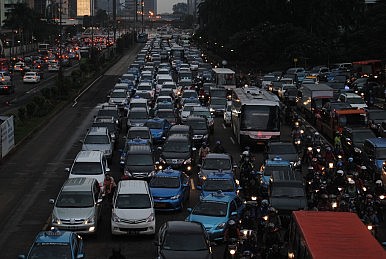
Outdated infrastructure and constant gridlock are worsening with rapid growth in car ownership.
By Alex Hamer
January 30, 2014

Total gridlock looms as more and more cars clog Jakarta’s roads, while the government fights reformasi-era rules to get new infrastructure projects underway. Indonesia’s capital city has been facing severe traffic problems for more than twenty years, but huge growth in car ownership, fuelled by a rapidly expanding middle class and government incentives coupled with poor infrastructure, has made getting around town a nightmare.

Experts have suggested traffic is going to get worse, with the Indonesia Effort for Environment executive director Ahmad Safrudin warning of “total gridlock” this year. Public transport is already overcrowded and only services the main arteries, and during peak hours five-kilometer journeys by car can take an hour or more. Businesses have dealt with these problems for years, and many high-level companies operate “mobile offices”; cars with internet connections and room enough to hold meetings.

Shannon Smith, an Australian marketing consultant who has worked and studied in Jakarta on and off for 20 years, says businesses are hugely limited by this lack of mobility.

“I can usually only do two meetings a day. Three is possible, but that’s a long day on the road.”

To make the best use of his time, he dedicates two days a week to meetings, and stays in the office the other three.

A 2013 IMF working paper put Indonesia’s “ease of doing business” rating as the second lowest in the region, and the quality of infrastructure as the worst.

Infrastructure spending in Indonesia currently sits at under five percent of GDP, down from the 1995 peak of 9.2 percent. Susilo Bambang Yudhoyono’s government aims to reach five percent, but it looks like this goal will pass on to the next president, given elections in July.

World Bank urban development expert Josie McVitty says infrastructure has fallen behind in Jakarta due to its rapidly growing population and poor planning processes.

The Rand Paul Moment

Published on The National Interest (http://nationalinterest.org)
January 31, 2014

At Foreign Affairs, Colin Dueck discusses [4] Rand Paul and his role in the foreign-policy debate within the Republican Party and the country at large. Responding to Peter Beinart [5] and others who have argued that Paul is now the frontrunner for the 2016 GOP presidential primary, Dueck contends that Paul’s views on international affairs in fact place him out of step with his party’s base and make him unlikely to be the Republican nominee. Marshaling a range of polling data, Dueck says the GOP base is instinctively more militarist that Paul on issues such as defense spending, drone strikes and how to deal with Iran, and thus likely to be turned off by Paul’s positions on those issues.

Does this argument hold up? Let’s get a few obvious caveats out of the way: Barring some international event like a major crisis or war, most Americans don’t usually vote on the basis of foreign policy. And with the 2016 election still nearly three years away, predictions about how it will play out are still largely a mug’s game. (Dueck admits as much on both points.)

But the larger point that Dueck doesn’t address is that there is one big reason why Paul has gained as much positive attention as he has: the fact that when it comes to foreign policy, he is basically competing in an open field. The George W. Bush first-term approach to the world—the aggressive use of military force to promote American values overseas—is still deeply unpopular with the public. But among leading national Republicans, Paul is the only one to be presenting a real alternative to it that is even close to fully fleshed out. The Senate GOP’s other loudest voices on foreign policy, Lindsey Graham and John McCain, continue to see threats to American interests everywhere and support constant American action—usually military action—to respond to those threats. As Graham put it [6] on Tuesday night, he believes that “the world is literally about to blow up” and that only America can stop it from doing so.

Meanwhile, Marco Rubio has also recently attempted to outline his own foreign-policy agenda in a series [7] of speeches [8]. Rubio rejects labels like “hawks” and “doves,” and tries to frame his approach as a sensible, middle-ground one. But as Isaac Chotiner observed [9] at the New Republic, his speeches have largely consisted of platitudes. He forswore the hawk label, but he also presented a vision of the world in which America is constantly besieged by threats and compelled to combat them through the use of American power. It was, as Chotiner wrote, “a full-throated defense of hawkishness” that nevertheless said “not a single thing that would commit him to anything substantive were he to win the Republican nomination or become president.”

The result is that among those in the GOP who don’t support the Bush approach, Rand Paul has become the only game in town. There are precious few, if any, other Republicans of national stature and even semi-realistic presidential aspirations who have anything interesting to say about foreign policy at all. And while there are issues on which Paul and the GOP base might differ on foreign policy, there are also ones on which he channels its views quite well—most notably in his vocal opposition to conducting military strikes against Syria last year. Another example comes in the war in Afghanistan, which has grown increasingly unpopular with the public and in which Paul has long favored a faster withdrawal of U.S. troops.

Obama's Big Ideas Problem

Published on The National Interest (http://nationalinterest.org)
January 30, 2014

At one point when passing a health care bill looked like forcing a square peg through a round hole, President Obama’s advisers suggested he scale back his ambitions. No less a Clinton administration veteran than Rahm Emanuel admits he begged Obama to ease up.

"This is about whether we're going to get big things done," Obama replied in a not-too-subtle dig at the Clintons. "I wasn't sent here to do school uniforms."

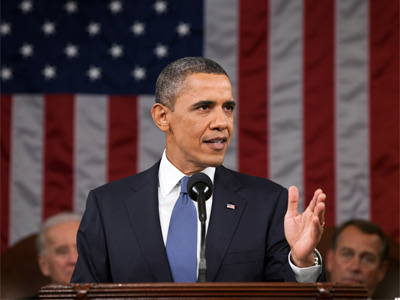
Five years into his presidency, Obama is still looking for the next big thing. This week, he delivered his school uniforms and V-chips State of the Union address. All that was missing was the midnight basketball.

An executive order raising the minimum wage for federal contract workers sounds impressive. But once you wade into the details, the number of people [3]actually affected [3] is vanishingly small. Despite the poll numbers being on the president’s side, legislation boosting the federal minimum wage for the rest of the country is unlikely to clear the Republican-controlled House.

Republicans might hand Obama a victory on immigration—the House leadership seems intent on caving on amnesty in all but name—but if conservatives stiffen their resolve, the Gang of Eight is as dead as McCain-Kennedy. That’s why Obama said relatively little about immigration in his address to Congress. He knows his fate there rests in GOP hands.

Otherwise, the speech was filled with trite appeals to the American can-do spirit and bite-sized Emanuel-like policy initiatives like “myRAs”. The president was back to promising to close Guantanamo Bay, which he hasn’t done since taking office in 2009.

We might end the war in Afghanistan this year. Then again, we might not. While the president is clearly no McCain-style dead-ender on the wars George W. Bush started, Obama’s plans for Afghanistan sound much like his blueprint for Iraq: we’ll stay in some capacity if the local government lets us; if not, we’ll leave and he’ll take credit for ending the war while trying to avoid blame for the post-withdrawal chaos.

The Yasukuni Shrine and the Confederate Flag

The messy legacy of the U.S. Civil War has lessons for the current tensions in Northeast Asia.
January 31, 2014

On Wednesday, the United Nations Security Councilheld an open debate on the theme of “war, its lesson, and the search for a permanent peace.” Under-Secretary General for Political Affairs Jeffrey Feltman, addressing the Security Council, laid out the core of the problem: “As we have seen repeatedly, fighting that ends without reconciliation – especially fighting inside States – is fighting that can, and often does, resume.” In the concept paper for the debate, Prince Zeid Ra’ad Zeid Al-Hussein of Jordan wrote that the UN could play a role in “forging a deeper reconciliation among ex-combatants … based on an agreed or shared narrative, a shared memory, of a troubled past.” A common interpretation of history, Zeid believes, helps smooth tensions between former enemies.

To those following the tensions between Japan and China (as well as South Korea), the implications are obvious. As my colleague Ankit wrote, the UN debate became a stage for China, South Korea, and North Korea to criticize Japan’s handling of history. While the fighting between these nations ended almost 70 years ago, the process of reconciliation remains incomplete. The “deeper reconciliation” Zeid described, one based on “a shared memory of a troubled past,” has not yet emerged.

China and South Korea do have a “shared memory,” as shown by their comments during the UN debate. The problem, in their eyes, is that Japan “remembers” thing differently. When calling on Japan to “face up to history” or “admit mistakes,” as Foreign Ministry Spokesperson Hua Chunying did this week, what they really mean is that Japan should accept without reservation China and South Korea’s version of history.

Here’s the problem with that approach: it’s inevitable that each country will view its past from a more sympathetic (though not necessarily approving) perspective. Generally, each country acknowledges (more or less) that mistakes were made, but no one else understands better how those mistakes happened — the mitigating factors that humanize the decision-makers. For example, Chinese citizens, in general, have a much rosier idea of Mao Zedong’s rule than non-Chinese; they know he made mistakes but will often claim that Mao did the best he could with the historical circumstances he faced.

The current tensions in Northeast Asia have another analogue: the conflicted legacy of the U.S. Civil War. As in the Northeast Asia dispute, the major issue is how to appropriately remember the war — especially the Confederates, who fought on behalf of slave-owning states.

For example, is it appropriate for Richmond, Virginia, the former capital of the Confederacy, to have a statue of famed Confederate general Robert E. Lee in the heart of the city; for high schools in the South to be named after Lee and other Confederate generals, or even after the Jefferson Davis, the President of the Confederacy, who was arrested (but never tried) for treason? And the ultimate symbolic issue, the subject of a televised debate onNewshour a few years ago — is it acceptable for Southerners (who may or may not have had ancestors fighting in the war) to fly the Confederate flag?

Cyber adversaries may go after private sector systems: Experts

30 January 2014

While governments are getting better at managing cyber and internet threats, adversaries may go after private sector systems, in the absence of active public-private cooperation, experts have warned. 

Participating in a roundtable discussion on "Debating Cyber Security and Internet Governance" at Observer Research Foundation on January 17, they pointed out that private sector systems have a critical bearing on the health of the (victim) nation, raising the question of how social systems as a whole, not just governmental infrastructure can be protected. 

The central theme of the discussion was enhancing network protection and addressing governmental disagreements on internet governance. The current trends do not paint a bright picture, with the issue of government-led capacity lagging behind the unregulated cyber world being flagged. 

The lack of a global consensus on the approach to cyber governance was attributed to the basic divergence between the two principal schools of interpretation. The liberal democratic paradigm emphasises the ’protection of information networks’ against sabotage and unwarranted intrusion, whereas the authoritarian paradigm additionally focuses on ’content management’, thus scrutinising content with an intention to regulate dissent or counter opinions. The issue, it was said, gets magnified when these diverging interpretations are sought to be pushed onto the global governance agenda. A concern was expressed that cyber parochialism and ’cyber balkanization’ goes against the very essence of a borderless information world, and would potentially disrupt the critical role played by the internet in socio-economic globalisation, thus creating massive distortions in markets and inter-state relations.

It was agreed that the functional capabilities of hardware and software are increasing exponentially. Cyber security capabilities have either not evolved bottom up or have tended to lag behind these technologies, or have failed to predict or register surges in the cyber space. An example is the Arab Spring. A cyber security expert, in 2005, could never have predicted the influence and usage of social media for such political upheaval, given that Facebook was still restricted to college campuses at the time and Twitter had not been invented.


Military Plans Reflect Afghanistan Uncertainty

JAN. 29, 2014

WASHINGTON — American and NATO military planners, facing continued political uncertainty about whether foreign troops will remain in Afghanistan after December, have drawn up plans to deploy a force this summer that is tailored to assume a training mission in 2015 but is also small enough to withdraw if no deal for an enduring presence is reached, alliance officials said.

With President Hamid Karzai of Afghanistan refusing to sign security agreements approving a presence for American and NATO troops after 2014, allied military planners have been forced to prepare for both sudden success and abject failure of proposals for a continuing mission to train, advise and assist Afghan forces after combat operations officially end this year.
RELATED COVERAGE


The decision on whether to extend the foreign military presence is a political one, and it will be decided first by Mr. Karzai and then by President Obama and the elected leaders from NATO nations. The process has brought vitriol in Kabul, the Afghan capital, and deep concern in Washington and allied capitals.


Launch media viewerSoldiers in Kandahar, Afghanistan, last week. Allied officials have drawn up plans for a force small enough for a quick exit. I. Sameem/European Pressphoto Agency

The delays have complicated military planning, since the governments of nations that contribute troops must approve any sustained deployments — and the required financing — months in advance, with a number of notional deadlines for finishing an agreement already long passed.

In preparing the mechanics of this summer’s regular troop rotation, American and NATO military commanders have set in motion a plan intended to give the alliance’s political leadership maximum flexibility, according to senior NATO officials.

Bombing Iran: Tough Tasks for Israeli Intelligence

Published on The National Interest (http://nationalinterest.org)
January 30, 2014

Historically, Israel's intelligence services have played a vital role—both direct and indirect—in making decisions of war and peace. In 1954, Israeli intelligence persuaded then Defense Minister Pinhas Lavon to approve of an attempt to sabotage the Anglo-Egyptian agreement concerning British withdrawal from the Suez Canal. And there would have been no air strikes on the Iraqi nuclear reactor in 1981 and the Syrian reactor in 2007 if not for the information collected by Israel's intelligence services. Not only are the three current intelligence chiefs (Aviv Kochavi of military intelligence [Aman], Tamir Pardo of Mossad, and Yoram Cohen of Shin Bet) among the key individuals tasked with collecting and presenting information related to an Israeli military operation against Iran's nuclear program, they are also part of the inner circle of advisors to Prime Minister Benjamin Netanyahu. Moreover, they would be responsible for assessing the civil and political consequences of attacking Iran's nuclear facilities.

Although there are several forms of military operations that could be undertaken, with Israel's capabilities and preparations in mind most analysts focus primarily on air strikes directed against Iran's key nuclear sites. There are five main operational tasks related to destroying an underground facility: detecting the facility; characterizing the site's features; planning the attack; neutralizing the site; and assessing the success of the operation.

A critical question for Israeli decision-makers and the intelligence apparatus is whether they have sufficient qualitative and accurate intelligence on the Iranian nuclear sites. There is no simple solution to locating and characterizing an underground facility. Possible options include imagery intelligence (photographs from satellites), signature intelligence (detecting heat, sound, or vibration), signals intelligence (radio and radar signals), and the use of human intelligence (agents or informants). Usually, one source is not enough to characterize a facility and determine whether it is for leadership protection, weapons production, weapons storage, or something else. In order to integrate all the methods in an efficient and cost-effective endeavor, one must first obtain the approximate location of a site. This is usually done with either human intelligence or satellites imagery. Israel has some tools to detect underground and excavated facilities. The Ofeq series of reconnaissance satellites provides some photographic coverage of Iran. Furthermore, the Eros-B satellite provides it with a camera that improves the assessment capabilities regarding sites of interest. The satellites' images can help answer questions regarding whether construction is taking place under the surface, what kind of materials are used in the construction process, and how deep the Iranians are digging. However, given the large size of Iran, and Israel's somewhat limited satellite assets, searching for clandestine facilities is a challenging task. Moreover, the hide-and-seek game played between Iran and Israeli intelligence allows for the use of deception, which further complicates the search. In order to reduce the risk of deception, intelligence needs to draw its information from multiple sources. Human intelligence would provide added value in this regard and may be the most effective mean to detect clandestine facilities.

Japan's Maritime Self-Defense Force Acknowledges Losing Unmanned Submersible In Tsugaru Strait

Plus Pakistan’s National Security thinks the U.S. loves India more than Pakistan, and more. Mid-week links.
January 30, 2014

A few defense and security links, curated for Flashpoints readers:

Japan’s Maritime Self-Defense Force admitted Wednesday to losing a $5 million unmanned underwater vehicle (UUV) last year. The UUV was lost during a seabed study and a nine-day search mission yielded nothing. According to The Japan Times, the MSDF chose to reveal the loss of the UUV now because it judged that there would be on impact on the environment. The MSDF notes that the UUV was lost around 2 p.m. on November 30 in the Tsugaru Strait between Aomori and Hokkaido. “The vehicle was being used to survey the underwater terrain as well as water currents and temperatures,” according to one official.

Pakistan’s National Security Advisor Sartaj Aziz, at a strategic dialogue with the United States, told his interlocutors that “You don’t love us as much as you love India.” Aziz’s remarks additionally confirmed that Pakistan’s foreign policy outlook was being driven by its fixation on perceived security threats emerging from India instead of terrorism within its borders. Aziz noted that Pakistan felt that the United States was not adequately conveying Pakistani concerns to India and instead courting India entirely independently of its alliance with Pakistan. Aziz’s remarks reinforce the ice that the U.S.-Pakistan alliance is increasingly fraying along incompatible national interests on both sides. Aziz’s remarks come soon after former Defense Secretary Robert Gates’ memoir revealed that he did not consider Pakistan an ally at all.

The U.S. Under Secretary of Defense for Acquisition, Technology and Logistics told Congress that the Department of Defense expects China to export its Chengdu J-20 fifth-generation twin-engine stealth fighter.

A new publication by the Center for Strategic and International Studies titled “South Asia Regional Dynamics and Strategic Concerns” examines the likely U.S. position in South Asia following its drawdown in Afghanistan. The authors propose a framework for U.S. policy in the region that takes the diverse interests of India, Pakistan, and China into account.

How Much is a Drone Base Worth?

Published on The National Interest (http://nationalinterest.org)
January 27, 2014

In searching and scratching for a reason for continuing the presence of U.S. troops in Afghanistan beyond 2014, after thirteen years of warfare, the most commonly stated rationales come up short. The original purpose of the military intervention involved, of course, responding to an attack by a terrorist group that at the time had a presence in Afghanistan. But what is left of that group has not been based in Afghanistan for a long time. There also are still the questions of how much Afghanistan is to be considered unique as a potential base for terrorist attacks, and how much any physical base in a faraway place affects the level of terrorist threat to the United States. Other rationales involving human rights or democracy in Afghanistan run up against questions both about how much any U.S. military effort in Afghanistan can accomplish on those fronts and about the priority such objectives have or ought to have among U.S. interests.

Those inside and outside the administration who have thought hardest about what is and is not being accomplished by a U.S. military presence in Afghanistan keep coming back to a different reason: that we need that presence to provide enough security to operate unmanned aerial vehicles from Afghanistan (and perhaps to do enough for other aspects of Afghan security so that the government of Afghanistan will permit the continued operation of the drones from Afghan soil), and we need the drones to keep whacking at terrorists next door in Pakistan. David Sanger and Eric Schmitt's article [4] on this subject in the New York Times is on the mark regarding the thinking on this subject. There are two undeniable facts involved in this particular rationale for staying in Afghanistan. One is that a base in Afghanistan affords a geographic advantage given where many of the targets are located. The second is that missiles fired from drones have eliminated a significant number of malevolent individuals in northwest Pakistan.

Think even harder and more broadly, however, and this rationale for a continued military presence in Afghanistan exhibits several patterns of thought that in most other circumstances would be considered fallacious.

One is to confuse availability of use with desirability of use. The drone strikes often have been considered “the only game in town” in terms of getting at undesirables in the wilds of Waziristan. But this in effect means that because the tool we happen to have is a hammer (and a very nifty hammer at that), not only do things start looking like nails, but we also feel an uncontrollable urge to keep pounding, whether or not pounding is apt to do us more good than harm.

30 January 2014

Whither Special Forces?

IssueNet Edition| Date : 28 Jan , 2014

Compact deadly sub unit

While discussing a monogram on Special Forces at a prominent Think Tank in New Delhi last month (December 2013), one of the discussants (a former Brigadier) opined that the “entire Parachute Regiment should form part of the proposed Special Forces Command.” It is not the stupidity and absurdity of the proposal alone but the dogged pusillanimous pursuit with which this idea of converting all Parachute Battalions to Special Forces has been followed over the years – stymieing the Special Forces; pulling them down any which way so that the Parachute Battalions can wear the Special Forces badge and more importantly, get the Special Forces allowance in the process. That this Brigadier was a former paratrooper requires no guesses. But it so happened, that he was a last minute substitute to the two-star officer in Military Operations Directorate of the Army. The latter’s name had already been mentioned in the program for the said event circulated to all concerned by the Think Tank. Why the two-star ducked was obviously to avoid uncomfortable questions since he has not served for a single day in a Special Forces unit and was probably advised to stay away by the Director General of Military Operations who happens to be Colonel of the Parachute Regiment and has never served with Special Forces either. So the Brigadier was commandeered all the way from Kolkata to do their bidding.

At such an international seminar hosted by the United Services Institution (USI) of India, New Delhi during 2005, the Deputy Defence Attachรฉ of the US Embassy in India expressed surprise about suggestions by some veteran paratroopers that Special Forces operations should be limited to about five kilometers across the borders.

In the past, the military has been regularly participating in Special Forces seminars in both national and international levels. At such an international seminar hosted by the United Services Institution (USI) of India, New Delhi during 2005, the Deputy Defence Attachรฉ of the US Embassy in India expressed surprise about suggestions by some veteran paratroopers that Special Forces operations should be limited to about five kilometers across the borders. In fact, he drew the attention of the audience that the Defence Minister speaking at the inaugural session stating that India’s areas of strategic interest included the Straits of Malacca, the Cape of Good Hope, the Middle-East and beyond. Later, in 2013, the USI planned a Special Forces seminar for exclusive participation by the military Special Forces, as prelude to a larger seminar at international level. However, this had to be called off because the Army refused to participate. The reason was very much obvious; the two-star officers heading the Additional Directorate General (Special Forces) under Military Operations (MO) Directorate, right from its establishment in 2006, and even the one-star deputy have continued to be those who have not served one single day in Special Forces. Naturally, answering questions in seminars implies exposure. The faรงade of secrecy just does not hold because nothing classified is ever discussed in Special Forces seminars at national or international levels.

No place to lay the wreath

Published on The Asian Age (http://www.asianage.com)
29 Jan 2014
The need for a National War Memorial for soldiers, sailors and airmen has been under examination for over half a century, but nothing has materialised so far thanks to bureaucratic hassles and political indecisiveness

The need for a National War Memorial for soldiers, sailors and airmen has been under examination for over half a century, but nothing has materialised so far thanks to bureaucratic hassles and political indecisiveness

This Republic Day, I watched the Indian high commissioner ceremonially lay a wreath at the impressive Indian Peace-Keeping Force war memorial in Colombo. Sri Lankan Navy buglers suitably participated in the solemn function.

The names of 1,000 Indian soldiers killed in Sri Lanka are inscribed in golden letters on black granite at the IPKF memorial. I knew some of the officers whose names are inscribed there. They made the supreme sacrifice at the altar of the folly of our political leadership. This war was not in defence of our nation nor for promoting our national interests.

Irrespective of any faulty decision of the political leadership, the soldier acting on it in his line of duty and making the supreme sacrifice is a national hero and his memory must be honoured. The IPKF contingent returning from Sri Lanka faced hostile demonstration and black flags in their home country when they landed in Tamil Nadu.

J.R. Jayawardene, the late President of Sri Lanka, had asked for Indian help in dealing with the LTTE and that set a chain of events in which the Indian Army was fighting the Tamil Tigers. President Ranasinghe Premadasa wanted the IPKF to quit Sri Lanka and the IPKF was withdrawn. In 1993, he invited India to put up an IPKF war memorial in Colombo for which he earmarked a site. Little later he was assassinated by the Tamil Tigers. The IPKF memorial was completed in 2010. The memorial for Sri Lankan soldiers killed in the war against Liberation Tigers of Tamil Eelam is not far from this site.

For their soldiers who made the supreme sacrifice for their country, the US has Arlington in Washington, the UK has the Cenotaph in London, France has the Arc de Triumph in Paris and in our neighbourhood, Bangladesh has one in Dhaka and Sri Lanka has a memorial in Colombo.

The British not only included the Indian soldiers in their war memorial in London, but also memorials near battlefields in countries like France, Italy and Egypt. When the capital of India was shifted to New Delhi, they built India Gate in the heart of Lutyens’ New Delhi to honour the memory of Indian soldiers killed in the Third Afghan War and the First World War. They quit India soon after. But they built war memorials for the soldiers who laid down their lives near the battlefields at Kohima and Imphal. The former is perhaps the prettiest war memorial in the world. It is on a terraced well-maintained lawn with names of soldiers along with their religious symbols inscribed on small brass tablets in rows in lush green grass. The entrance has an arch with the following touching words inscribed on it: “When you go back home tell them of us, for their tomorrow we gave our today.” Over 80,000 Indian soldiers have died in various wars we have fought since Independence. There is no National War Memorial for them in New Delhi. The need for a National War Memorial for soldiers, sailors and airmen has been under examination for over half a century, but nothing has materialised so far thanks to bureaucratic hassles and political indecisiveness. As deputy adjutant-general in early Seventies and, five years later, as adjutant-general in late Seventies, I was closely associated with the National War Memorial project at a prime place in the heart of the capital, where both our and foreign dignitaries could place wreaths.

My mother and the Mahatma

January 30, 2014 
Shankar Kistayya, standing extreme left, was an accused in the assassination of Gandhi (Wikimedia commons)

SUMMARY


92-year-old Kamalamma is one of the few living witnesses to Gandhi’s murder trial.

Shankar Kistayya, standing extreme left, was an accused in the assassination of Gandhi (Wikimedia commons)

The young lady was just leaving the magistrate’s office to go home when a breathless attendant caught up with her to inform her that the sahib wanted her to return to his office. She was surprised, and a bit concerned — she had come here to meet Oscar Brown, chief presidency magistrate, Bombay, to get a domicile certificate that would enable her to apply for a job at a higher grade in government. The meeting had gone unexpectedly well. The Scotsman was delighted to hear she was born in Bellary, a town where he had spent several years, and was curious about how the place had changed over time. He had assured her that she would get the certificate. So, was there some unforeseen hitch?

Back in the magistrate’s office, she found that he had a proposal for her. Just after she left his office, he had been asked to find a native Telugu speaker, since Shankar Kistayya, one of the accused in the murder of Mahatma Gandhi, required a court interpreter during the course of the trial. Brown had immediately thought of her as a possibility (educated, fluent in Telugu and English, a government employee), and so asked her if she could go forthwith to Delhi. Kamalamma said she needed to inform her cousin and pack her clothes. The magistrate said he would send a constable ahead to her house, inform her cousins and bring them and her bags to the railway station while she did the necessary paperwork for being seconded to the trial.

The 26-year-old Kamalamma was nothing if not adventurous. Married off after she lost her father at age 13, she stayed on at home tending to her cancer-stricken mother, who encouraged her to complete school. After her mother’s death, she refused to consent to the marriage, and with the help of friends, went to Mysore’s Maharani’s College and studied psychology. In 1942, she had participated in the Quit India Movement, and had been arrested for picketing. Feisty, attractive and with a quick wit, she made an impression on her teachers and college contemporaries.

The trial was being held in one of the army buildings within the premises of the Red Fort. The proceedings were being presided over by Special Judge Atma Charan of the ICS. Kamalamma and many other staff members involved in the trial were accommodated in the same premises. The investigative officer, Deputy Commissioner of Police J.D. Nagarwala, had made proper arrangements for their accommodation and took good care of his assisting staff. The accused were also being held in one of those buildings, which had been designated a prison. This gave Kamalamma an opportunity to meet and talk with the accused outside the courtroom as well.

The prosecution was led by C.K. Daphtary, advocate-general of Bombay, assisted by lawyers Petigara and others, including a young J.C. Shah, whom Kamalamma was later to encounter when she worked for the solicitors firm Kanga & Co. A battery of lawyers from all parts of the country had been pressed into service in the defence of Savarkar, of whom she particularly recalls Bhopatkar, Mehta and a plump lawyer called Banerji. (When I asked her why the prosecution, the investigative team and others like her had been sent for from Bombay, she felt that this was because Sardar Patel did not have enough confidence in the police in Delhi — after all, they had not followed up on the earlier abortive attempt by the conspirators and had failed to prevent the assassination of his beloved leader — and also that the conspiracy had been hatched in the Bombay Presidency.)